VISUAL CUE-BASED FOOTWORK AND TACTICAL RESPONSE TRAINING SYSTEM FOR FENCING
US20260069953A1
2026-03-12
19/245,387
2025-06-22
Smart Summary: A new training system for fencing uses lights to help fencers practice their moves. It has a clear panel with LED lights that can change colors and patterns, showing different commands and scenarios. Fencers can set how long they want to wait before responding to the cues and adjust how often they practice. This system helps improve their timing, footwork, and decision-making skills during matches. It can also be used for other sports that need quick decisions in small areas and can be customized using data from past performances. 🚀 TL;DR
Abstract:
A fencing training system delivers programmable visual cues to simulate referee commands and tactical bout scenarios. It includes a transparent panel (11) with addressable LED lights (10), mounted on a tripod (12) and controlled by a microcontroller (14). Timed color and pattern sequences prompt fencers to initiate offensive, defensive, or interpretive actions. Users can customize delay intervals, cue types, and repetition frequency. The system improves timing accuracy, footwork consistency, and decision-making within the four-meter engagement zone. Configurable preparation windows and distance markers (20, 22, 24) aid spatial judgment. The system is adaptable for saber and foil fencing and may include auditory cues, motion detection, or mobile app control. Designed for portability and real-time responsiveness, it supports solo and group training. The invention may also be adapted for other sports requiring timed decision-making in confined spaces and incorporate AI-based customization using bout performance data to personalize footwork timing and cue sequences.
Applicant:
Interested in similar patents?
Get notified when new applications in this technology area are published.
Classification:
A63B69/02 » CPC main
Training appliances or apparatus for special sports for fencing, e.g. means for indicating hits
Description
U.S. PATENTS
| Patent Number | Kind Code | Issue Date | Patentee | |
| 7,951,045 | B1 | 2011 May 31 | Brader | |
| 11,433,291 | B1 | 2022 Sep. 6 | McClain | |
U.S. Patent Application Publications
| Publication Nr. | Kind Code | Publ. Date | Applicant | |
| 20070191141 | A1 | 2007 Aug. 16 | Weber | |
| 20210291030 | A1 | 2021 Sep. 23 | Anousis | |
Foreign Patent Documents
None known at this time.
Non-Patent Literature Documents
-
- Weichenberger, M., Schilling-Kaestle, V., Mentz, L., & Hessling, M., A fencing robot for performance testing in elite fencers, Procedia Engineering, Vol. 112 (2015), pp. 152-157
- MOTUS Physical Therapy, Reaction Training Lights: What You Need To Know, MOTUS SPT (2023)
- Training & Conditioning, New App Shines Light on Reaction Training for Athletes, Training & Conditioning News (2021)
- Barañano-Alcaide, R., Sillero-Quintana, M., Bernardez Vilaboa, R., Barañano-Perez, J., and Gonzalez-Jimenez, R. Fencing Training with Reaction Time Lights. Revista Andaluza de Medicina del Deporte, vol. 17, no. 1-2, 2024, pp. 63-69. ISSN 2172-5063.
STATEMENT REGARDING FEDERALLY SPONSORED RESEARCH OR DEVELOPMENT
Not Applicable
REFERENCE TO A SEQUENCE LISTING, A LARGE TABLE, OR A COMPUTER PROGRAM LISTING APPENDIX ON READ-ONLY OPTICAL DISC
Not Applicable
BACKGROUND OF THE INVENTION
The present invention relates to athletic training systems, and more specifically, to a programmable visual cue system for improving footwork timing and tactical decision-making in the sport of fencing.
Saber fencing is a high-speed Olympic discipline governed by the Fédération Internationale d'Escrime (FIE). Unlike épée or foil, saber targets the upper body and prioritizes quick engagements. Over 75 percent of scoring actions in saber fencing occur within a four-meter engagement zone, colloquially referred to as “the box” 25 (FIG. 1). This zone is a critical area on the piste where fencers must quickly decide whether to attack, defend, or reposition, typically within 800 to 1200 milliseconds (ms) after the referee gives the “En Garde, Ready, Fence” command.
In saber, attacks originate from beyond striking distance at the En Garde line 28 (FIGS. 1 and 2). To reach the opponent, a fencer must use preparation footwork, which refers to movement that precedes an offensive or defensive action but does not, by itself, constitute an attack. Preparation footwork typically consists of one to two and a half steps and may take the form of an advance, double advance, step, or slide-step. The lunge or attacking movement occurs after the preparation ends. The primary purpose of preparation is to close the distance and enter the attack range, where a valid offensive action can be executed. However, fencers may also stop just short of attack distance to observe and react to the opponent's decision. This tactic, known as second intention, involves initiating a preparation that invites the opponent to respond, such as by launching an attack, after which the fencer adapts with a counteraction, such as a retreat, parry-riposte, or renewed attack, to regain priority and score. The effectiveness of second intention relies on the fencer's ability to recognize and respond to the opponent's behavior in real time. The choice of preparation depends on factors such as starting foot, desired tempo, tactical intent, and opponent positioning. Because these variations differ in rhythm, speed, and step count, even elite athletes struggle to maintain consistent timing and spatial judgment. In short, fencers must manage precise timing and spacing during bouts, reacting in less than a second to gain scoring priority.
Several existing inventions provide visual or interactive training tools but lack fencing-specific design. For example, US20210291030A1 discloses fencing bibs that provide visual feedback upon contact, rather than for pre-action preparation. Similarly, US20070191141A1 and U.S. Pat. No. 7,951,045B1 use Light-Emitting Diode (LED)-based prompts for general athletic reaction training, without incorporating the timing rhythms or referee sequences unique to fencing. U.S. Pat. No. 11,433,291B1 describes a light-based baseball training system that simulates pitch timing but is not suited for fencing-specific tempo and spatial training.
Other innovations aim to enhance fencing performance using advanced sensing technology. For instance, Weichenberger et al. (2015) propose a programmable fencing robot designed specifically for épée, enabling elite-level testing with automated arm extension and target zones. However, this system is bulky, hardware-intensive, and not suited for solo footwork training or real-time tactical cue simulation. Moreover, it does not address the timing rhythms or priority-based decision-making essential to saber and foil.
A third category includes general-purpose visual cue systems used in sports therapy and agility training. For example, MOTUS Physical Therapy (2023) highlights light-based rehabilitation tools that offer customizable reflex training. However, these lack the fencing-specific structure, such as simulated referee sequences and customizable preparation phases. Likewise, the Training & Conditioning (2021) app-controlled light system provides timing drills, but it is not configured for fencing decision trees like feints, second-intention attacks, or box-based exchanges.
A recent study by Barañano-Alcaide et al. (2024) evaluated multiple types of reaction times in fencers using a Bluetooth-connected lighting system, demonstrating the potential of programmable cues for assessing perceptive ability and decision-making. While this study highlights the importance of reaction-based training in fencing, its system is primarily focused on latency measurement and lacks the structured choreography required for saber-specific footwork. The tests did not simulate referee-style commands, box-specific positioning, or cue-driven tactical logic such as second-intention attacks and preparation-phase timing. In addition, the lights functioned as isolated, non-progressive flashes rather than sequential pacing cues. As such, fencers lacked visual information about the remaining duration of the preparation phase, unlike in the present system, which uses sequential illumination to represent elapsed and remaining time within a structured footwork rhythm. In contrast, the disclosed system integrates fencing-specific rules, configurable cue timing, and modular decision-tree outputs to guide fencers through precise footwork sequences within a synchronized spatial and temporal framework. This approach emphasizes not just responsiveness but the internalization of bout rhythm, distance control, and tactical decision-making.
The present invention aligns with Cooperative Patent Classification (CPC) A63B69/0053, which pertains to training apparatuses that generate stimulus signals for reaction-time training involving substantial physical effort. It may also relate to subclass A63B2069/025, which covers systems incorporating conductive flooring as part of the detection circuit. However, existing technologies classified under these codes generally lack fencing-specific tactical simulations, preparation-phase timing control, or adaptive cue generation using artificial intelligence. The present invention addresses these gaps by introducing configurable decision trees, tempo-based footwork training, and real-time feedback tailored to fencing bout dynamics.
A preparation that is mistimed by as little as 200 milliseconds can result in the loss of attack priority, a core rule in saber and foil fencing that determines who receives the point when simultaneous hits occur. Priority is awarded to the fencer who initiates a valid attack first or successfully defends and counterattacks. Therefore, fencers must master not only the biomechanics of footwork, but also the tactical reading of cues to maintain scoring advantage.
Conventional training tools such as verbal coaching, hand signals, or video playback provide post-exchange feedback but do not enable high-frequency, real-time reaction training aligned with saber bout dynamics. General-purpose agility light systems or sprint timers lack the structured timing patterns unique to fencing and fail to simulate the sequence of referee commands (“En garde, Ready, Fence”) that dictate the start of an exchange.
Moreover, current systems do not offer fencing-specific tactical simulations, such as feints, second-intention actions, or priority-dependent decisions. These decision trees are fundamental to saber fencing, where athletes often engage in invitation actions, provocations such as feints, or preparation-withdrawals to bait and respond to attacks within tight timing windows.
The present invention addresses this gap by introducing a programmable, light-based cue system tailored to the unique timing and tactical structure of fencing. The system delivers structured visual feedback sequences that replicate referee commands, preparation phases, and dynamic tactical prompts. A core innovation of the system is the ability to configure and vary preparation window durations between approximately 500 and 1500 milliseconds, which reflects the actual timing ranges used by elite athletes. Practicing across these timing windows helps fencers adapt their tempo to different opponents, such as fast-paced attackers or slower, more deliberate defenders, by ingraining optimal rhythm and response. It can also simulate offensive openings, such as step-lunge cues, defensive signals, such as withdrawal or pull cues, and feints that require the fencer to interpret intent and react accordingly.
By simulating a range of footwork speeds, the device trains fencers to modulate preparation tempo intentionally rather than habitually, a skill often overlooked in traditional drills. This addresses the problem of rigid or mismatched preparation timing that causes loss of priority or missed opportunities in live bouts.
In addition to visual cues, cones or floor markers are used in conjunction with the system to reinforce physical distance awareness, another crucial metric in saber fencing. By comparing visual cue timing with actual movement completion (e.g., whether the fencer reaches ideal attack distance), the system supports objective assessment of whether a preparation or action was successful based on the timing and spacing of a simulated opponent's rhythm.
Through these visual simulations, fencers can internalize preparation timing, improve footwork consistency, and train their tactical decision-making independently without needing a sparring partner or a coach present. By focusing specifically on the fencing actions within the box, where exchanges typically unfold in under two seconds, the system replicates real bout pressures while offering the repeatability and customization necessary for structured practice.
Although the system is designed with saber fencing in mind, many of its principles, such as preparation phase timing, attack priority recognition, and cue interpretation, apply equally to foil fencing. The disclosed system may also be adapted to any sport requiring rapid visual stimulus-response training in a confined space, including martial arts, soccer, and tactical police or military scenarios.
Definitions
For clarity and consistency, the following terms are defined as used throughout this specification and the appended claims, unless otherwise indicated:
Fencing-Specific Tactical Terms
-
- A preparation is one or more foot movements taken by a fencer to close distance toward an opponent. It typically covers the range required to reach step-and-lunge distance, which is the effective striking zone or attack distance in saber fencing.
- A tactical cue is a visual signal intended to prompt a specific type of footwork or tactical decision by the fencer, such as launching an attack, executing a retreat, or interpreting movements, such as feints, for reaction training.
- An offensive action refers to a movement or sequence initiated by the fencer with the intent to attack and score.
- A defensive action refers to a movement intended to avoid, block, or respond to an opponent's attack, including parries, retreats, or tactical withdrawals.
- A feint is a deceptive movement designed to imitate the beginning of a real attack, with the goal of provoking a premature or inappropriate response from the opponent.
- A pull is a defensive movement consisting of one or more backward steps taken to evade an oncoming attack and to disrupt the opponent's timing or distance.
- A second intention is a tactical maneuver in which the fencer deliberately avoids launching an immediate direct attack and instead initiates a preparation that appears actionable but is designed to provoke a response from the opponent. After observing the opponent's reaction, such as a rushed attack or premature movement, the fencer makes a calculated decision to counter with a withdrawal, parry-riposte, or renewed offensive action. The maneuver often involves stopping just before step-and-lunge distance to create ambiguity and force the opponent to commit, enabling a reactive scoring opportunity.
Systems Functional Components
-
- A visual indicator is any perceptible light-based output, such as changes in color, brightness, flash rate, or position, used by the training system to communicate timing signals or tactical cues to the fencer.
- A feedback module is a system component that captures, measures, or evaluates a fencer's physical response to a visual cue. It may provide real-time feedback or post-session analysis and may include motion sensors, timers, scoring logic, or other data-processing elements. In some embodiments, the module may also adjust training parameters, such as preparation timing or cue complexity, based on user performance. Future versions may incorporate artificial intelligence (AI) to analyze response trends and deliver adaptive training recommendations.
- A loop restart trigger is the software-controlled event that resets the training sequence after the user completes a cue response and rest period.
- A rest interval is a short, programmed delay between training loops that allows the fencer to reset position and prepare for the next cue sequence.
- The term display element refers to any visual output component used by the system to emit visual cues, including but not limited to an LED strip, visual cue display, embedded piste lights, or wearable indicators. Throughout this specification, terms such as “LED strip,” “visual cue display,” or “visual indicator” may be used interchangeably to refer to embodiments of the display element.
- The term cue complexity refers to the level of variability in the visual cue sequence delivered by the system. This may include changes in cue type (offensive, defensive, feint), timing unpredictability, duration, frequency, zone location, or the combination of signals presented during a training sequence. Cue complexity may be user-adjustable or automatically modified by the system based on performance trends, difficulty settings, or AI-generated training logic.
- A non-transitory computer-readable medium refers to any physical storage medium, such as flash memory, hard drives, or embedded memory in a microcontroller, that stores software instructions used to operate the training system. This includes media used to store the software logic system that controls visual cue sequencing and timing.
Physical Training Space and Layout.
-
- The engagement zone (also referred to as “the box”) 25 is a four-meter section of the fencing piste between the two En Garde lines, where the majority of saber exchanges occur and where this system is optimized for use, as shown in FIGS. 1 and 2.
- The En Garde line 28 is a transverse line located two meters from the center line 29 on each side of the fencing piste 26, as shown in FIGS. 1 and 2. It marks the initial position from which fencers begin each bout or return after a halt.
- The center line 29 is a visual marking at the midpoint of the four-meter engagement zone, as shown in FIG. 2. It is used to ensure equal distance between fencers and serves as a reference for alignment during training.
- The warning line 30 is a boundary line two meters from each end of the fencing piste, used to alert the fencer that they are nearing the endline, as shown in FIG. 2.
- The endline 31 is the rear boundary at each end of the fencing piste, as shown in FIG. 2. If both of a fencer's feet cross this line, the opponent is awarded a point.
LED Display and Training Cue Zones
-
- A start signal zone is the region of LEDs used to indicate system activation or readiness, often with a white light. It signals that the system is about to begin a new training sequence.
- A referee-style visual prompt refers to the sequential visual signals that simulate the fencing referee's standard commands-“En garde,” “Ready,” and “Fence.” These are typically represented by a series of flashing lights in a defined pattern (e.g., white-yellow-green) on designated LEDs, but the specific colors may vary and are user-configurable, provided the pattern conveys the intended sequence.
- A referee signal zone is the LED segment designated to display these referee-style prompts. The zone is typically positioned at the beginning of the strip and flashes in a sequential pattern to initiate each training loop.
- A preparation interval zone is a segment of the LED strip that lights up (typically blue) during the timed footwork window before a cue is given.
- A feint cue zone is a designated region of the LED strip programmed to emit a visual signal, such as a green light, that simulates a tactical feint or tempo variation. This signal is intended to elicit a decision-making response from the user based on the interpretation of subsequent cues, thereby training reactive judgment under conditions of uncertainty.
- A tactical cue zone is the segment of LEDs that flashes red or white, representing an offensive or defensive prompt, respectively, for the fencer's reaction.
- A target footwork zone is a reference region on the training surface, visually indicated by physical markers, that represents the expected distance relationship between the fencer's final position and a defined location on the piste for a given type of footwork. The zone is not a landing point but serves as a visual guide to help the user assess whether their completed action achieves the correct spacing relative to the marker, such as reaching ideal step-lunge range or maintaining proper pull distance.
Future or Optional Embodiments
-
- A gamified bout mode refers to an optional training configuration in which the visual cue system is synchronized with prerecorded fencing match footage. The system delivers visual prompts aligned with tactical moments from the video, enabling users to simulate exchanges and compare timing and decision-making against onscreen opponents for reflex and tactical training.
BRIEF SUMMARY OF THE INVENTION
The disclosed system provides a programmable visual training system for fencing that delivers real-time visual cues to enhance timing, decision-making, and footwork consistency. It comprises a transparent panel with embedded LED lights, a tripod-mounted support structure, a microcontroller programmed to simulate fencing scenarios, and a user interface for adjusting training parameters. The system is powered via Universal Serial Bus (USB) or a portable battery, making it suitable for use in a variety of environments. Unlike general-purpose agility lights or contact-feedback systems described in prior art, this system is tailored to fencing-specific timing sequences and footwork rhythms within the four-meter engagement zone.
The training sequence begins with three visual pulses representing the referee's command (“En garde, Ready, Fence”). This is followed by a programmable preparation window, during which the fencer performs footwork to close the distance. The system then displays one or more visual cues that signal offensive, defensive, or feints. For example, a red light may prompt an attack, a white light may signal a retreat, and a green light may simulate a feint that requires interpretation. These layered cues allow fencers to practice decision-making under bout-like conditions, including second-intention tactics and tempo invitations.
The system is controlled via an external interface that allows the user to adjust cue timing, sequence type, and repetition frequency. In practice, fencing coaches may use the device in warm-ups, timing drills, or decision-making exercises, with customized scenarios to simulate offensive and defensive fencing exchanges. The device is portable, height-adjustable, and designed for both individual and group practice environments.
In the current embodiment, performance assessment is visual and self-guided, using physical distance markers placed on the floor to help users evaluate timing and spacing. In some embodiments, the system may include feedback features such as auditory cues, motion sensors, or a scoring indicator that provide automated performance evaluation based on the timing or accuracy of user responses. Additional enhancements, such as wireless connectivity, AI analysis modules, and real-time feedback systems, are also contemplated for future versions. These components are not required for the basic operation of the disclosed system. The core training system functions independently through a programmable LED-based visual cue sequence and can be used effectively without the inclusion of AI, motion tracking, or wireless communication.
The system is designed for saber and foil fencers but may be adapted for other sports involving timed decision-making in confined space. Its portability and customizable training logic make it suitable for individual or group sessions at home, club, or competition settings.
BRIEF DESCRIPTION OF THE SEVERAL VIEWS OF THE DRAWING
The various advantages of the embodiments will become apparent to one skilled in the art by reading the following specification and appended claims, and by referencing the following drawings, in which:
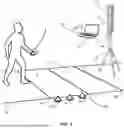
FIG. 1 is a perspective view of the visual cue-based fencing training system, showing the LED strip, tripod-mounted display, microcontroller, power source, user interface, and a fencer in position on the partial piste with physical distance markers and the defined engagement zone (“the box”). The fencer shown in FIG. 1 is provided for illustrative context only and is not claimed as part of the invention.
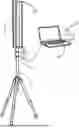
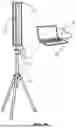
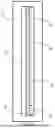
FIG. 1A is a perspective view of the training device in isolation, showing the LED strip, transparent acrylic panel, tripod support, microcontroller, power source, and control interface, without user or piste context.
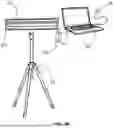
FIG. 1B is a perspective view of the training device in a horizontal orientation, illustrating the LED strip mounted on the acrylic panel affixed to the tripod, with connections to a microcontroller, power source, and user interface.
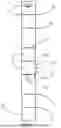
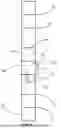
FIG. 1C is a front schematic view of the LED strip mounted on the acrylic panel, showing functionally defined LED zones including the start signal zone, referee signal zone, preparation interval zone, feint simulation zone, and tactical cue zone.
FIG. 2 is a top-down view of the fencing piste, showing the engagement zone, center line, en garde lines, warning lines, endlines, and floor cones used to assess distance control and footwork timing. The fencer shown in FIG. 2 is provided for illustrative context only and is not claimed as part of the invention.
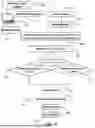
FIG. 3 is a flowchart illustrating the training sequence logic executed by the software logic module. The sequence includes system start, referee signal initiation, preparation interval timing, optional feint cues, randomized tactical cue output, user response, and a rest interval followed by system reset for loop continuation. An optional feedback evaluation step may also be included in future embodiments to assess user timing and distance alignment using motion sensors, manual input, or artificial intelligence analysis. In the current version, AI is not used; user evaluation is visual and based on alignment with physical floor markers. AI-based feedback is described as a potential enhancement for future versions to support adaptive training. In other contemplated embodiments, visual cue sequences may also be synchronized with video playback of fencing bouts, enabling gamified training interactions aligned with real match footage.
FIG. 4 is a top-down schematic view of a fencing piste with a display element, implemented in this embodiment as a visual cue strip, embedded into or positioned alongside one edge of the strip. The figure shows a fencer positioned at the en garde line and a distance marker placed in the first half of the engagement zone. This drawing illustrates an alternative embodiment in which the display element is integrated into or adjacent to the piste infrastructure to provide peripheral visual cues during footwork drills or live bouts, eliminating the need for freestanding hardware.
REFERENCE NUMERAL TABLE
The following reference numerals correspond to elements shown in the figures:
REFERENCE NUMBER
Element Description
-
- [10] Display element (e.g., LED strip or visual cue display)
- [11] Acrylic panel (transparent mounting surface)
- [12] Tripod mounting support
- [14] Microcontroller (e.g., Arduino Uno)
- [16] Portable power source (USB or battery pack)
- [18] User interface (computer, physical controls or app)
- [20] Floor cone—shallow prep marker
- [22] Floor cone—regular prep marker
- [24] Floor cone—step-lunge marker
- [25] Engagement zone (“the box”)
- [26] Fencing piste or floor surface: 14 m (l)×2 m (w)
- [28] En Garde line
- [29] Center line
- [30] Warning line
- [31] Endline
- [50] Software logic module (training code)
- [60] Start signal zone (white LED region)
- [62] Referee signal zone (white-yellow-green sequence)
- [64] Preparation interval zone
- [66] Feint cue zone (green flash)
- [68] Randomized Tactical cue zone (red or white flash)
- [82] User response (athletic decision/action)
- [84] Loop restart trigger
- [86] Feedback module
- [90] Rest interval
- [92] Piste-integrated or adjacent LED display strip
DETAILED DESCRIPTION OF THE INVENTION—FIGS. 1, 1A, 1B, 10, 2, 3
The best mode contemplated for carrying out the invention uses a strip of 33 individually addressable WS2812B Red-Green-Blue (RGB) LED lights 10 mounted on a transparent acrylic panel 11, controlled by an Arduino Uno microcontroller 14 programmed using the Arduino Integrated Development Environment (IDE) and FastLED or NeoPixel libraries. This panel is affixed to a camera tripod 12, which allows for adjustable height and orientation to align with the fencer's line of sight. This configuration, illustrated in FIG. 1A and FIG. 1B, offers a balance of affordability, portability, and timing precision.
The lighting panel is connected to a microcontroller 14, currently an Arduino Uno, selected for its reliability and ease of prototyping. In the current setup, the Arduino is connected to a computer 18 to provide both power and the ability to upload or modify code settings. However, the system is not limited to the Arduino Uno; any general-purpose microcontroller capable of controlling RGB LED outputs and executing programmable timing sequences may be used, such as the ESP32, Raspberry Pi Pico, or other comparable platforms. In future versions, a simplified and cost-effective embedded controller may be substituted to facilitate scalable production.
In some embodiments, the microcontroller may include wireless communication capabilities, such as Bluetooth, Wi-Fi, or other low-energy radio protocols. This allows the system to interface with a mobile application or computing device for real-time parameter updates, performance logging, or sequence control. In other embodiments, the system may operate using a direct USB or wired connection to a computer 18, providing power and programming access without requiring wireless functionality.
The system is powered via USB or an optional portable battery pack 16 and is compatible with various adapters for indoor or travel use. A future enhancement will include a user-friendly display and physical toggles for customizing training parameters without the need for coding.
As shown in FIG. 1A and FIG. 1B, the LED panel and strip may be mounted in either a vertical or horizontal orientation, depending on the user's height, training preferences, or environment. The mounting bracket allows for rotation and height adjustment to align the display element with the athlete's line of sight. This adjustability enables the device to be used in both individual and group settings, such as club warm-ups or confined home spaces.
FIG. 2 provides a top-down schematic of the fencing piste 26, showing the engagement zone 25 (“the box”), where most tactical exchanges occur in saber fencing. The visual cue-based training system is typically positioned just outside this zone, aligned with the athlete's line of sight, but is specifically designed to train footwork timing, preparation rhythm, and decision-making relevant to exchanges that take place within the engagement zone. For contextual clarity, FIG. 2 also includes standard piste elements such as the en garde lines 28, center line 29, warning lines 30, and endlines 31. These features are not part of the claimed invention but are shown to illustrate the system's environment and functional alignment with competitive fencing conditions.
Training Loop Operation—FIGS. 10 and 3
The training loop proceeds as follows:
-
- (a) System Start 60: The user activates the system via the user interface. A white LED in the start signal zone indicates readiness.
- (b) Referee Simulation 62: A sequence of white-yellow-green flashes across LEDs 1 to 3 simulates the fencing referee's verbal commands: “En garde,” “Ready,” and “Fence.”
- (c) Preparation Phase 64: LEDs 4 to 19 light up blue sequentially over a configurable time window (typically 500 to 1500 milliseconds), during which the user executes preparation footwork.
- (d) Optional Feint 66: LEDs 20 to 27 flash green for 200 milliseconds, signaling the fencer to perform a feint—an intentional deceptive movement meant to provoke a reaction from an imaginary opponent. This cue instructs the user to simulate the start of an attack without committing, training the ability to incorporate feints into their preparation rhythm. The green flash represents a deliberate tactical choice, not an ambiguous signal, and is used to reinforce tempo variation and deception techniques.
- (e) Tactical Cue 68: LEDs 28 to 33 flash red to prompt an offensive response, or white to signal a defensive pull or retreat. Cue selection may be randomized or preset. These tactical cues collectively represent a range of stimuli. Stimuli refer to any visual prompt delivered by the system that is intended to provoke a tactical or motor response from the fencer. This includes offensive, defensive, and feints that require interpretation and decision-making.
- (f) User Response 82: The athlete executes the appropriate footwork or decision in response to the cue.
- (g) Feedback and Evaluation (currently visual) 86: In the current embodiment, feedback is self-assessed using visual reference to the cone positions to determine whether the fencer completed the footwork within the appropriate timing and distance. In future embodiments, an optional feedback module may include motion sensors or software-based timing analysis to automate this evaluation. Additionally, artificial intelligence may be used to analyze performance trends, such as response timing, consistency, or accuracy, and adjust training parameters accordingly. These AI-driven adjustments could include modifying preparation windows, cue frequency, or complexity based on user error patterns or improvement over time.
- (h) Rest Interval 90: After the cue-response cycle, the system enters a rest period (typically 7000 milliseconds) to allow for recovery or repositioning.
- (i) Loop Restart 84: A trigger condition initiates the next training cycle automatically, allowing for continuous or semi-continuous repetition.
Color assignments (e.g., red, white, green) are illustrative only; any perceptible visual distinction may be used. Tactical cues may be conveyed through a variety of visual means, including but not limited to changes in color, brightness, flash timing, movement pattern, or position. The scope of the disclosed system encompasses any perceptible variation that enables the fencer to distinguish cue types and respond appropriately.
The method executed by the software logic system transforms programmed timing intervals and tactical decision sequences into physical light outputs emitted from an LED display element. This transformation of abstract logic into perceivable visual cues delivered by a hardware apparatus provides a practical application and technological improvement over traditional fencing training tools. The system's integration of software-driven timing logic with physical light hardware ensures that the disclosed system is not merely an abstract idea but a specific, tangible process consistent with Bilski v. Kappos and related USPTO guidance.
Training Modes
The system supports multiple training modes, including:
-
- Fixed Offensive/Defensive Mode: Predefined sequences for repetitive training.
- Randomized Cue Mode: Randomly selected cues after preparation to train decision-making.
- Rhythm Mode: Lights pulse during the preparation phase to simulate tempo and guide step rhythm.
- Custom Preset Mode: Includes user-defined sequences based on specific tactical scenarios or famous fencer rhythms.
Preset examples may include:
-
- 700 ms preparation, 200 ms feint, random attack or pull.
- 500 ms preparation followed directly by attack cue.
- 700 ms preparation, no feint, random attack or pull
- 800 ms preparation, 200 ms feint, second-intention cue.
- 800 ms preparation, 200 ms feint, random attack or pull.
- 800 ms preparation followed directly by attack cue
These presets help athletes train for realistic patterns found in competitive fencing, including false preparations, second-intention attacks, and distance-control scenarios. By varying timing windows, feint options, and cue types, the system allows users to simulate complex tactical situations that occur during live bouts.
Example Drills and Presets
For a setting of 700 ms prep+200 ms feint+random cue, a fencer may advance twice and then execute either an advance-lunge (if red) or pull-step (if white). Such drills teach spacing, response timing, and mental processing under pressure.
Additional Embodiments—FIG. 1, 2, 3
Additional features include cones 20, 22, 24 placed on the floor to provide physical distance markers, helping the fencer visualize the distance needed to complete an action. Future plans include emulation of specific fencing styles or famous athletes by modeling attack types and cue behaviors based on actual bout data. These cones are positioned at intervals along the piste or training surface to represent distance thresholds, such as one-step 20, two-step 22, or step-lunge 24 ranges. By combining timed visual cues with physical distance markers, fencers can verify whether their footwork completes the intended distance within the programmed preparation window. In some embodiments, the system evaluates whether the user reaches a defined marker, such as the step-lunge cone, within the programmed preparation window to validate timing and distance alignment. The movement is considered successful if the user reaches the appropriate cone marker within the active cue phase, demonstrating correct alignment of footwork distance and programmed timing. This real-time spatial-temporal alignment forms the basis for feedback and training adaptation. This allows for real-time assessment of whether a given preparation rhythm would be successful against an opponent moving at that simulated pace. Practicing against varied timing intervals and distances builds adaptability, helping the fencer choose effective tempos for different opponent styles.
A mobile app is under development to allow users to control light color, rhythm, cue timing, and training sequence through a wireless interface. This app will replace the need for direct coding and make the system accessible to a broader range of users.
The software logic 50 is written in Arduino IDE using libraries such as FastLED or NeoPixel. The term user-configurable refers to system parameters that can be adjusted by the user through the interface, including preparation duration, cue frequency, visual effect timing, and cue type selection. These settings may be changed manually or via software input. The core structure includes initialization (setup), the training loop (loop), and function modules such as startSignal( ), prepDelay( ), cueOutput( ), and userControl( ) Cue transitions are controlled with non-blocking timing functions using millis( ) to ensure accurate response intervals.
The design is modular and upgradable. In the current embodiment, user feedback is visual and self-directed, based on alignment with physical distance markers (e.g., cones 20, 22, 24) that help assess whether the fencer reached the appropriate target distance within the preparation interval. Future embodiments may include an optional feedback module 86 comprising motion sensors (e.g., ultrasonic or infrared) capable of detecting user movement, measuring response latency, and evaluating whether footwork was completed within the programmed timing window. Such a module may enable dynamic adjustment of training parameters, including cue intensity, preparation duration, or cue sequence frequency, based on observed performance data. Additional anticipated features include wireless connectivity, multiple synchronized display panels, and group training coordination functionality.
In further embodiments, the training system may be integrated with artificial intelligence (AI) algorithms capable of analyzing recorded bout footage or real-time match data. Based on this analysis, the AI system could recommend personalized footwork rhythms and tactical cue sequences using statistical models of timing consistency, preparation patterns, reaction success rates, opponent behaviors, and scoring probabilities derived from labeled performance data.
Opponent behavioral profiles refer to recurring patterns in bout footage, such as preferred tempos, initiation triggers, and typical responses, which the system extracts using feature recognition or statistical analysis. In some embodiments, the AI module may segment bout footage or motion sensor data into discrete fencing exchanges to isolate distinct tactical sequences for analysis. The system may also use statistical or machine learning classifiers to model opponent-specific tempo profiles and priority initiation behaviors, enabling more accurate emulation of competitive match conditions. In advanced AI-driven embodiments, the training system may utilize decision-tree branching logic to vary cue sequences based on user response patterns, simulating second-intention tactics or opponent modeling scenarios. The AI module may also incorporate fencing-specific attack priority rules—such as right-of-way logic in foil or saber—to generate training sequences that simulate realistic tactical scenarios and reinforce proper decision-making.
These AI-generated sequences may then be transmitted to the training system via a mobile app or software interface, enabling the athlete to practice scenarios tailored to their performance trends and competitive needs. In cloud-connected configurations, user performance data may be transmitted to a remote server, where server-side analysis applies machine learning models to generate updated training sequences. The training system may then synchronize with the server to retrieve optimized cue sets and performance feedback. For the purposes of adaptive training, target performance metrics may include consistent preparation timing, optimal reaction latency, cue interpretation accuracy, and execution within defined spatial zones. These metrics guide the AI module's adjustments to cue complexity, timing, or sequencing. User performance data may be stored in structured formats, such as time-stamped event logs or feature matrices, to support longitudinal analysis and facilitate synchronization with mobile or cloud-based training platforms. It should be noted that AI integration is not required for the operation of the current system. All core training functions, including visual cue delivery, programmable timing, and user-controlled adjustments, are fully operational without AI. The AI component is presented as a future enhancement to support adaptive, data-driven training progression.
In additional contemplated embodiments, the system may support a gamified training mode synchronized with fencing bout videos. In this mode, the user views prerecorded fencing exchanges while the system delivers visual cues aligned with the bout's tactical moments, allowing the user to “compete” against the onscreen fencer in timing and decision-making. Cue sequences may mirror the footwork or attack timing of the video fencer, enabling a comparative or simulated training experience, such as matching the tempo of an Olympic bout or training against a recorded opponent's attacks. While not part of the current implementation, this mode may be incorporated in future versions to promote reflex development and user engagement through real-bout emulation.
The system is portable and suitable for use in fencing clubs, at home, or in outdoor environments with adjustable lighting brightness to ensure visibility in various conditions.
The current configuration offers an effective, low-cost, and scalable solution to improve timing, rhythm, and decision-making in saber and foil fencing. The invention can evolve into an intelligent feedback system that supports advanced athlete training, performance analysis, and sport-specific motor learning.
Comparative systems found in the prior art, such as US20070191141A1 and U.S. Pat. No. 7,951,045B1, offer visual or interactive prompts for general athletic training but do not account for the tactical structure or timing conventions unique to saber fencing. Unlike U.S. Pat. No. 11,433,291B1, which simulates baseball scenarios with programmable LEDs, the disclosed system is optimized for the high-speed engagement dynamics and rule-based priority of fencing. Furthermore, while the fencing robot described by Weichenberger et al. (2015) employs visual targets and programmable sequences, it requires complex hardware unsuitable for portable or solo use. Similarly, the Bluetooth-based light system studied by Barañano-Alcaide et al. (2024) supports the classification of fencers by reaction type but lacks tactical programming, referee simulation, and any visual pacing that guides movement duration. These prior systems lack the modular, fencing-specific training loop of the present disclosed system, including referee-style cue simulation, configurable preparation intervals, and decision-tree-based tactical outputs.
General-purpose LED reaction systems, such as those promoted by MOTUS Physical Therapy (2023), and Training & Conditioning (2021), provide customizable light cues for reflex and agility training but do not simulate structured fencing sequences like referee commands, preparation phases, or feint-based decision-making. A more fencing-targeted system is seen in the Barañano-Alcaide et al. (2024) study, which uses Bluetooth-connected lights to measure fencer reaction time across various modalities. However, the stimuli in that system are isolated rather than sequential, providing no pacing information for how long the fencer has to complete an action. Additionally, the system does not integrate priority logic, footwork sequences, or spatial timing dynamics critical to saber fencing. In contrast, the disclosed system delivers dynamic, referee-cue-based simulations that guide footwork preparation, tactical decision-making, and timing rhythm, all critical for training without a partner or coach. These distinctions make this configuration the first known programmable light-based training tool to simulate real-time fencing bout rhythms and decision trees, optimized for saber's timing and spatial rules.
Software Logic and Control Sytstem—FIG. 3
The system is implemented using an Arduino Uno microcontroller 14 running custom firmware developed in the Arduino IDE. The code utilizes the Adafruit NeoPixel library to control a strip of 33 WS2812B individually addressable RGB LEDs.
The microcontroller 14 receives power either via USB connection to a computer 18 or through an optional portable battery pack 16. The system is initialized using a user interface 18, which may consist of a desktop computer interface 18, physical control panel, or app-based graphical user interface (GUI). This interface allows the user to upload code, configure training parameters such as cue timing and sequence type, and start the training sequence.
Upon initialization, the setup( ) function prepares the LED strip and ensures that all pixels are turned off. The main training logic is housed within the loop( ) function, which runs continuously.
The sequence begins with a single white LED illuminating in the start signal zone 60 to indicate that the system is powered on and ready. Once the user initiates the training via the control interface 18, a visual simulation of the referee command 62 follows, using white-yellow-green flashes on LEDs 1 to 3. This segment lasts approximately 2000 milliseconds, with subsequent phases separated by 500-millisecond intervals. These timing intervals are currently implemented using blocking delay( ) functions, which simplify sequencing but prevent concurrent processing, such as monitoring inputs or updating cues in real time. This limits adaptability and responsiveness during training.
To address this limitation, future firmware versions will transition to non-blocking timing logic using Arduino's millis( ) function. This change will enable the system to execute multiple tasks simultaneously, such as dynamic cue adjustment, motion sensor integration, or live user input during active sequences. The upgrade will improve interactivity and support advanced training configurations that more closely resemble real fencing bouts.
The preparation 64 and feint 66 phases are simulated through distinct lighting patterns and timing logic. Blue LEDs represent preparation timing, while green LEDs simulate a feint. These are activated sequentially across LED zones to simulate motion and build anticipation for the next phase.
LEDs 4 to 19 64 are illuminated in blue in timed intervals of 50 milliseconds, followed by green on LEDs 20 to 27 66, and finally red or white randomized cue signals 68 on LEDs 28 to 33. The color red indicates an attack opportunity, while white signals the need to pull or defend. The cue color is selected using a random logic block, simulating unpredictability in real fencing bouts.
The actual source code for the firmware is not included in this specification. Instead, the functional behavior and software logic are fully described in terms of system architecture, control sequences, and feature modules. This complies with the USPTO's guidance under 37 CFR § 1.96(c), which states that source code listings are not required when a detailed written description of the software's operation is provided. This programming is well within the skill level of a person of ordinary skill in microcontroller development.
In some embodiments, the feedback module evaluates whether the user's footwork is completed within a predefined timing window and whether the final position aligns with one or more physical distance markers (e.g., cones 20, 22, 24 in FIGS. 1 and 2) placed along the training surface. This coordination allows the system to assess whether the fencer reached the appropriate distance (such as step-lunge range) at the correct time in response to a cue. Such measurements may be obtained using user's vision, motion sensors, infrared gates, or app-based manual entry and provide the basis for real-time feedback or post-session analysis.
Key function modules include:
-
- setColor(start, end, color): A custom-defined function that activates a specified range of LEDs on the strip. The function accepts a starting index, an ending index, and an RGB color value, and iteratively assigns the selected color to each LED within that range. This enables dynamic cue creation, motion simulation across zones, and simplified control over lighting groups for different training phases such as preparation, feint, or cue output.
- Random cue logic: Chooses between attack and pull cues based on random binary values. In some embodiments, cue randomization is implemented using a pseudo-random function seeded with the session start time, enabling the generation of unpredictable cue sequences that mimic the variability of live fencing exchanges. Future implementations may include time-dependent seeding or conditional randomness based on user response history or opponent profiles.
- Sequential activation: Builds directional motion by lighting zones in steps, simulating distance progression.
After completing the full training sequence, the system includes a 7000 millisecond rest interval 90 before restarting the loop 84. This pause represents recovery or bout reset time.
Future firmware enhancements will support:
-
- App-based communication for live setting updates
- Non-blocking state machines for more flexible timing.
- State-based transitions, in which the system advances from one training phase to the next based on internal state variables rather than fixed delay functions. This architecture supports improved timing flexibility and real-time responsiveness.
- Modular code for supporting different training modes
- Motion detection input and feedback response features.
- Artificial intelligence modules that learn user patterns over time, enabling adaptive cue delivery and personalized training feedback based on historical performance data. Such training data may be stored in a structured format, meaning a standardized schema (e.g., timestamps, cue labels, response classifications) suitable for automated parsing and machine learning workflows.
The software is modular, allowing easy adaptation to new training scenarios or hardware upgrades. This logic is essential to ensuring the timing precision, visual clarity, and tactical realism necessary for effective fencing simulation.
Additional Embodiments and Flexible Configurations—FIG. 4
While the preferred embodiment utilizes LED strips as the display element, the system is not limited to this configuration. Other types of visual indicators may be used, such as laser projections, electronic ink (e-ink) surfaces, organic light-emitting diode (OLED) panels, mechanical shutters, liquid crystal display (LCD) bars, or other optoelectronic or electromechanical display technologies, without limitation to these examples. The display element may be mounted on various surfaces including walls, ceilings, or floors, or may be incorporated into wearable accessories such as headbands, armbands, or chest harnesses. These alternative embodiments allow the disclosed system to adapt to different training environments, support shared group instruction, or enable more immersive athlete-specific feedback systems.
In another embodiment, the display element may be embedded into or positioned alongside the fencing piste 26. A strip of light-emitting elements, such as RGB LEDs, may be installed along one or both longitudinal edges of the piste or recessed into the adjacent floor area. This configuration provides peripheral visual cues during footwork drills or live bouts, enabling uninterrupted training and reducing setup time. FIG. 4 illustrates this embodiment, showing a fencer positioned at the en garde line 28, facing into the engagement zone 25. A set of floor cones 20, 22, and 24 are placed within the first half of the engagement zone to help the user evaluate preparation length and tempo. Standard piste markings, including the en garde lines 28, center line 29, and warning lines 30, are visible for spatial reference and training fidelity. The embedded or adjacent display strip 92 eliminates the need for freestanding hardware and may be synchronized with external scoring systems or bout timers. In future embodiments, the system may incorporate motion sensors or feedback components for real-time performance evaluation, such as tracking movement timing or footwork completion accuracy. These enhancements may be further supported by artificial intelligence modules capable of analyzing movement patterns and delivering adaptive feedback based on historical training data.
Additional alternative configurations include:
-
- Wearable Display Version: Headband- or wrist-mounted lights for personal cue delivery.
- Ceiling or Wall-Mounted Display: For shared club training environments.
- Projection-Based Display: Laser or OLED-based cues projected onto the floor or wall surface.
- E-Ink or LCD Panels: For ultra-low power consumption and minimalistic visual interfaces in portable or resource-constrained setups.
Additional configurations of the training system may include:
-
- Coach Mode: A manual override feature allowing a coach or training partner to trigger specific visual cues in real time via a handheld remote or app interface. This mode supports customized drills, live feedback, and coach-led simulations of opponent behavior.
- Audio-Visual Cue Integration: In some embodiments, the display element may be supplemented with auditory signals such as beeps, pitch shifts, or voice-based referee commands. This configuration supports neurodivergent athletes, users with low vision or color perception challenges, or those training in low-light environments where visual cues alone may be insufficient.
- Team Training Synchronization: The system may be configured to operate in group mode, using wireless synchronization across multiple visual cue panels. This allows for simultaneous training of multiple fencers in team settings, enabling club-wide warmups, synchronized drills, or relay-style footwork sequences.
These additional embodiments support broader accessibility, enable collaborative training contexts, and extend the utility of the disclosed system beyond individual solo practice.
The best mode currently contemplated for carrying out the invention utilizes a WS2812B LED strip, an Arduino Uno microcontroller, and the FastLED software library to manage display logic.
Advantages
From the description above, a number of primary advantages of the visual cue-based fencing training system become evident:
-
- It allows the user to adjust the preparation time window to any desired duration (e.g., 500 to 1500 milliseconds or beyond), enabling realistic rhythm training tailored to different opponent tempos and tactical scenarios.
- It includes physical distance markers, such as cones, so fencers can assess whether they reach the optimal striking zone at the correct moment.
- It provides simulation of referee commands and tactical cues, helping fencers internalize real bout timing and improve decision-making.
- It supports training without a coach or partner, enabling consistent solo practice and reducing the reliance on external feedback.
- It is portable and configurable, with future plans for app-based control, allowing training in clubs, at home, or at competitions.
- It includes programmable modes for second-intention attacks, feints, pulls, and randomized cue logic, replicating complex fencing scenarios with variable tempo and deceptive cue patterns that challenge the fencer's decision-making and timing.
- It can be extended to other sports or disciplines that require decision-making under time and distance constraints, such as martial arts, soccer, or tactical training.
- While current performance assessment is visual and user-directed, the system may be enhanced in future embodiments with motion sensors and feedback logic for automated performance analysis.
- It may also incorporate artificial intelligence to analyze training patterns, personalize cue sequences, and deliver adaptive feedback based on user performance history.
- The visual cues promote spatial awareness and rhythm control, essential to mastering high-level fencing strategy.
Conclusion, Ramifications, and Scope
While the above description contains many specificities, these should not be construed as limitations on the scope of the disclosed system, but rather as examples of preferred embodiments. Many other variations are possible.
For example, the system may use different types of visual indicators such as lasers, OLED panels, e-ink displays, or floor projections; alternate mounting structures such as ceiling rigs, wall brackets, or wearable bands; and alternative microcontrollers or programming platforms beyond Arduino Uno. Preparation intervals may be configured beyond the disclosed 500 to 1500 milliseconds to suit different athlete needs, including youth, veteran, or parafencing categories. Tactical cues may be expanded to support AI-generated scenarios, user-uploaded bout data, or real-time opponent modeling.
Furthermore, the disclosed system has the following additional advantages and ramifications:
-
- It enables high-frequency, coach-free practice with immediate visual cues, accelerating timing, footwork precision, and decision-making reflexes.
- It provides structured simulations of referee commands and bout scenarios that are otherwise difficult to replicate during solo training.
- It allows users to verify whether their footwork reaches the optimal striking distance within the programmed time window using physical distance markers (e.g., cones).
- It permits deliberate practice of preparation footwork across a configurable range of tempos and distances, enhancing adaptability against different opponent styles.
- It supports cross-disciplinary applications requiring fast decision-making in confined spaces, such as martial arts, goalkeeper drills, or tactical training for law enforcement and military units.
- It is expandable with feedback modules capable of motion tracking, scoring accuracy, or real-time response evaluation, allowing users to monitor and refine performance.
- It may be integrated with artificial intelligence (AI) systems trained on bout footage or sensor data to generate personalized training sequences, enabling a dynamic and evolving training experience tailored to the athlete's performance trends and tactical needs.
- It may include a future “gamified bout mode,” in which the system synchronizes visual cues to prerecorded fencing match footage, enabling users to simulate exchanges and compare timing and decision-making against onscreen opponents for reflex and tactical training.
Accordingly, the scope of the claimed subject matter should be determined not by the embodiments illustrated, but by the appended claims and their legal equivalents, rather than by the examples given.
Claims
I claim:1. A visual cue-based training system for fencing, comprising:
a. a display element configured to emit visual indicators;
b. a support structure for positioning the display in a user's line of sight;
c. a microcontroller configured to control the display element;
d. a user interface configured to adjust training parameters; and
e. a software logic system stored on a non-transitory computer-readable medium and configured to:
i. simulate a start signal comprising referee-style visual prompts;
ii. deliver a user-configurable preparation interval; and
iii. output one or more tactical cues representing offensive, defensive, or stimuli, including but not limited to feints, timed to occur during or after the preparation interval.
2. The system of claim 1, wherein the preparation interval is user-adjustable and may be set to durations optimized for fencing performance, including but not limited to a range from approximately 500 to 1500 milliseconds.
3. The system of claim 1, wherein the visual indicators comprise changes in color, brightness, flash timing, movement pattern, or position.
4. The system of claim 1, wherein the tactical cues comprise:
a. a visual signal configured to prompt offensive action, such as a red light;
b. a visual signal configured to prompt retreat or defensive action, such as a white light; and
c. a visual signal representing a stimulus configured to simulate a tactical feint or tempo variations designed to elicit a decision-making response from the user based on subsequent cues, such as a green light.
5. The system of claim 1, wherein the display element comprises a plurality of individually addressable elements configured to emit visual cues, including but not limited to LED components.
6. The system of claim 1, wherein the display element is embedded into or affixed alongside a fencing piste to provide real-time footwork cues during movement without obstructing physical training.
7. The system of claim 1, further comprising:
a. one or more physical distance markers disposed along the training surface, each corresponding to a predefined footwork zone including, but not limited to, shallow preparation, standard preparation, and step-lunge ranges;
b. a software logic system configured to determine whether the user reaches a designated distance marker during the active preparation interval, based on timing alignment between visual cue initiation and footwork completion; and
c. a feedback module operatively linked to the software logic system and configured to:
i. evaluate the user's response based on measured timing and spatial position relative to said markers; and
ii. automatically adjust one or more training parameters including but not limited to preparation duration, cue intensity, or sequence complexity, in response to deviations from target performance metrics over time.
8. The system of claim 1, wherein the software logic system is configured to select tactical cues based on a pseudo-random function seeded with session time, thereby simulating unpredictable bout dynamics.
9. The system of claim 1, wherein the software logic is configured to manage transitions between training phases in a manner that enables real-time responsiveness and simultaneous input monitoring.
10. The system of claim 1, wherein the user interface is either a physical control panel or a digital application.
11. The system of claim 1, wherein the microcontroller communicates wirelessly with a computing device.
12. The system of claim 1, further comprising a portable power supply.
13. A method for simulating tactical decision-making in fencing, comprising:
a. displaying a start signal;
b. initiating a preparation window of programmable duration;
c. displaying a tactical cue;
d. prompting the user to execute a corresponding fencing action, including offensive footwork, defensive withdrawal, or interpretive response.
14. The method of claim 13, wherein the tactical cue is based on saber fencing timing patterns.
15. The method of claim 13, wherein the tactical cue is based on foil fencing timing patterns.
16. The method of claim 13, wherein the steps are executed using the system of claim 1.
17. The method of claim 13, further comprising:
a. placing one or more physical distance markers along the training surface to define target footwork zones; and
b. prompting the user, in response to a visual cue displayed after the preparation window, to complete a corresponding footwork action such that the final position of the user aligns with a target footwork zone defined by the distance marker.
18. The software logic system of claim 1, stored on a non-transitory computer-readable medium, comprising instructions configured to generate customizable visual cue sequences for timed-response athletic training, including non-blocking logic, randomized cue generation, and state-based transitions between phases.
19. The system of claim 1, wherein the software logic is implemented using a general-purpose microcontroller programming platform capable of real-time LED control and programmable timing sequences.
20. A fencing training system comprising:
a. a display element configured to emit visual cues;
b. a microcontroller configured to control said display;
c. a support structure for aligning the display in the user's line of sight; and
d. an artificial intelligence (AI) analysis module configured to:
i. implement a machine learning model trained on time-labeled fencing performance data, including video footage or motion sensor data;
ii. extract features from said data, including preparation timing, reaction latency, movement tempo, and scoring results associated with user performance;
iii. generate customized visual cue sequences based on said features by analyzing them in relation to tempo variation, attack priority rules, and opponent behavioral profiles; and
iv. transmit the generated cue sequences to the display element for execution during training.
21. The system of claim 20, wherein the AI analysis module is further configured to:
a. track user performance trends over time;
b. update cue sequences based on observed changes in preparation timing, reaction latency, or cue interpretation accuracy; and
c. modify one or more training parameters, including preparation duration, cue complexity, or decision-tree branching logic, to enable adaptive progression.
22. The system of claim 20, wherein the AI analysis module is further configured to:
a. segment input bout footage or sensor data into discrete fencing exchanges;
b. model opponent-specific movement tempo and priority initiation patterns using statistical classifiers or machine learning algorithms;
c. correlate user reaction timing, distance coverage, and cue accuracy with successful versus unsuccessful exchanges; and
d. generate training sequences designed to reinforce improved preparation rhythms, enhance cue interpretation, and address observed decision-making deficiencies.
23. The system of claim 22, wherein the AI analysis module is further configured to:
a. communicate with a remote server or mobile device;
b. store user performance data in a structured format; and
c. receive or transmit updated cue recommendations based on server-side analysis or synchronized cloud-based machine learning models.
Images & Drawings included:
Sources:
- United States Patent and Trademark Office - verify current appl. status at the USPTO↗
Recent applications in this class:
- » 20260069952 2026-03-12
FENCING SPORT MECHANICAL REEL AND LIGHT SYSTEM - » 20260027436 2026-01-29
FENCING REACTION TIME TRAINING ASSEMBLY AND METHOD OF USE - » 20250360387 2025-11-27
FENCING TRAINING APPARATUS - » 20250108281 2025-04-03
RUST BLOCKER - » 20240181316 2024-06-06
STRUCTURES FOR PERFORMING A SPORT - » 20230277907 2023-09-07
Fencing target assembly - » 20220323844 2022-10-13
Fencer Target Training System (FTTS) - » 20220266114 2022-08-25
Removable accessory for a fencing mask - » 20220212079 2022-07-07
Structures for sport fencing - » 20210291031 2021-09-23
Fencing training device and method of using the same