SELF-CONTAINED CLEANING SYSTEM
US20260101982A1
2026-04-16
19/325,159
2025-09-10
Smart Summary: A cleaning system comes in a special pouch that can be sealed and opened. Inside the pouch, there is a dry sponge with a cleaning solution, a towel, and a heating element. When you open the pouch, it can hold water, which the heating element warms up. This warm water is then used with the sponge and towel to help clean surfaces. It's a convenient way to clean things without needing extra tools or supplies. 🚀 TL;DR
Abstract:
A self-contained cleaning system utilizing a typically vacuum sealed resealable pouch including a dry sponge with a cleaning agent, a towel and a heating element. Once opened, the resealable pouch acts as a container for water which the heating element serves to heat. The water is then used on conjunction with the sponge and towel to clean with warmed water.
Inventors:
- Chris Wesselman 1 🇺🇸 Albuquerque, NM, United States
- Thomas Robinson 1 🇺🇸 Destin, FL, United States
- Tim Wesselman 1 🇺🇸 Albuquerque, NM, United States
Applicant:
Interested in similar patents?
Get notified when new applications in this technology area are published.
Classification:
A45C11/008 » CPC main
Receptacles for purposes not provided for in groups - Pocket toilet etuis
A47K7/02 » CPC further
Body washing or cleaning implements Bathing sponges, brushes, gloves, or similar cleaning or rubbing implements
B65D75/008 » CPC further
Packages comprising articles or materials partially or wholly enclosed in strips, sheets, blanks, tubes, or webs of flexible sheet material, e.g. in folded wrappers Standing pouches, i.e. "Standbeutel"
B65D81/3261 » CPC further
Containers, packaging elements, or packages, for contents presenting particular transport or storage problems, or adapted to be used for non-packaging purposes after removal of contents for packaging two or more different materials which must be maintained separate prior to use in admixture Flexible containers having several compartments
B65D2575/586 » CPC further
Packages comprising articles or materials partially or wholly enclosed in strips, sheets, blanks, tubes or webs of flexible sheet material, e.g. in folded wrappers; Details; Opening or contents-removing devices added or incorporated during package manufacture with means for reclosing
A45C11/00 IPC
Receptacles for purposes not provided for in groups -
B65D75/00 IPC
Packages comprising articles or materials partially or wholly enclosed in strips, sheets, blanks, tubes, or webs of flexible sheet material, e.g. in folded wrappers
B65D81/32 IPC
Containers, packaging elements, or packages, for contents presenting particular transport or storage problems, or adapted to be used for non-packaging purposes after removal of contents for packaging two or more different materials which must be maintained separate prior to use in admixture
Description
CROSS REFERENCE TO RELATED APPLICATION(S)
This application claims the benefit of U.S. Provisional Patent Application Ser. No. 63/693,048, filed Sep. 10, 2024, the entire disclosure of which is herein incorporated by reference.
BACKGROUND OF THE INVENTION
Field of the Invention
This disclosure is related to the field of personal hygiene, and more particularly to personal hygiene in remote areas where there is no readily accessible access to washing facilities, water, soap, and/or other personal hygiene necessities.
Description of the Related Art
Personal hygiene is important for maintaining a healthy body and a lack of personal hygiene can lead to infections, disease, and even death, in some circumstances. Unfortunately, the ability to shower or bathe is not always available, which results in many persons being unable to bathe and properly maintain their personal hygiene. This can lead to infection, illness, and even wide-spread disease in the communities where people do not or cannot adequately maintain their personal hygiene.
These situations are seen commonly throughout the world, in many different circumstances and situations. However, many situations are due to temporary circumstances as opposed to lack of water infrastructure. For instance, soldiers in areas of war may not have access to clean water (or any water, in some circumstances) or the ability to bathe themselves to maintain their personal hygiene for days, weeks, or even months, at a time. Similarly, during a natural disaster, such as a hurricane or tornado or snowstorm, an entire community's clean water infrastructure and/or supply may be disrupted, resulting in that entire community being unable to properly maintain their personal hygiene. Additionally, the inability to maintain personal hygiene can be the result of other situations, such as in austere environments, due to economic status, caused from political unrest, or simply due to cultural norms.
For a variety of reasons, the lack of access to facilities to maintain one's personal hygiene is, unfortunately, seen commonly throughout the world, and can last for days or weeks before access to bathing facilities is restored, or before access to the water supply is fully restored.
Without functioning clean water infrastructure, the ability to maintain one's personal hygiene is severely limited, thus in times of war, while camping, or during a natural disaster disrupting water supplies, or during other situations that impede a community's water supply access, many people are unable to bathe or otherwise maintain their personal hygiene.
Much of the reason for the disruption of personal hygiene is because clean water, when of limited supply, is boarded for drinking and cooking. A lack of consumable water can rapidly result in death. Lack of surface cleanliness, however, can often be tolerated for a much longer period of time. Further, bathing typically requires much larger amounts of water due to the surface area of the human body and the water is typically non-potable after bathing due to the removal of surface dirt and the addition of cleaning chemicals to the water to assist in hygiene. While people can typically go a long time without maintaining good body hygiene before permanent physical damage will occur, it should also not be underestimated that surface cleanliness, and the act of body cleaning itself, provides a psychological benefit. Humans are a social species and even under circumstances where it is known hygiene is limited, a lack of personal hygiene can result in social stress.
Alternative hygiene practices can be used in such situations where water is unavailable or only available in limited quantities. Such alternative practices generally include using multiple moist toilettes or wet wipes (e.g., wipes) to “bathe” oneself. However, these products are often ineffective at eliminating bacteria and, because the wipes or toilettes are small and dry out quickly, a thorough cleaning or washing of a large portion of the body (as opposed to just the hands) generally requires using a large quantity of these products, which is inconvenient for the user and produces a lot of waste (i.e., used toilettes or wet wipes). Additionally, these products, which primarily rely on alcohol and not water, are generally unsuitable to provide for adequate cleaning of a user because of their ineffective elimination of bacteria, and these products also are not suitable for some specific needs of the user, such as removing caustic elements, disinfecting an area of a body for emergency field surgery, or for providing anti-scent applications. Alcohol is also not generally good for the skin and can result in additional problems when used too frequently.
Another available alternative to conventional bathing is using a wetted sponge to bathe oneself. However, this option, like the other alternative hygiene products, is also an imperfect solution to maintaining personal hygiene when showering or bathing is unavailable. Use of a wetted sponge, while better than merely using wet wipes or moist toilettes, requires the user to carry the sponge, water, and soap (or some other cleaning agent). In many circumstances, particularly in times of war or situations where persons are travelling and have to physically carry all their supplies, carrying this combination of items can be inconvenient and cumbersome due to the weight of the items and ease of carrying them around.
Furthermore, even in situations where bathing is not readily available, the option of a wetted sponge will not always work for a variety of reasons. A major one is the source of water. As has probably been recognized, one option for personal hygiene is to simply bathe in available surface water (e.g. rivers, pools, or puddles). However, in situations where infrastructure has been damaged on may not exist, this water may be far from clean or safe. For example, the water may have attracted mosquitos or other insects or germs. Any container the water being carried in may not be sterile and may begin growing bacteria, which could cause more harm than good if a person bathes with bacteria-infested water. Even in the cases where the water does not become contaminated with insects or bacteria, this water still may not be desired to be used for bathing because the act of bathing in it will itself often serve to contaminate the water and, in dire situations, the same water source may need to be used for drinking rather than bathing.
Moreso, during a natural disaster, war, or similar situation that disrupts water supplies, there may not even be clean safe environmental water available in any circumstances. A user having only a sponge cannot bathe themselves. Similarly a user having a sponge and source of clean water without an adequate cleaning agent does not assist in maintaining personal hygiene because there is nothing to kill bacteria and the user may simply be spreading bacteria over themselves. Likewise, a user having a sponge and a cleaning agent, even if that cleaning agent is an antibacterial cleaning agent, cannot maintain their personal hygiene if there is no available clean water supply. While use of environmental water, such as water from puddles or rain or the like, may be available when there is no available clean water supply, environmental water is typically filled with bacteria, mud, dirt, or other contaminants.
A final issue with use of environmental water, or even clean available water, is that it will often be cold or at least no warmer than ambient air temperature. While cold water is fine for drinking (and usually preferred) cold water for bathing is generally unpleasant for the user and would not be as effective as hot water because cold water is less effective than hot water when it comes to maintaining personal hygiene and cleaning. This can lead to a desire not to bother with body cleaning and to not maintain hygiene. Further, as bathing necessarily makes the body wet, if ambient temperatures are sufficiently low, this can make the user themselves cold which can present a new set of challenges
SUMMARY OF THE INVENTION
The following is a summary of the invention in order to provide a basic understanding of some aspects of the invention. This summary is not intended to identify key or critical elements of the invention or to delineate the scope of the invention. The sole purpose of this section is to present some concepts of the invention in a simplified form as a prelude to the more detailed description that is presented later.
Because of these and other problems in the art, described herein, among other things, is a self-contained cleaning system utilizing a typically vacuum sealed resealable pouch including a dry sponge with a cleaning agent, a towel and a heating element. Once opened, the resealable pouch acts as a container for water which the heating element serves to heat. The water is then used on conjunction with the sponge and towel to clean with warmed water.
Described herein, among other things, is a self-contained cleaning system, the system comprising: an outer pouch formed of a main pouch and an auxiliary pouch interconnected with each other: a sponge, placed in said main pouch, said sponge having a cleaning agent impregnated therein; a towel, placed in said main pouch; and a heating element, placed in said auxiliary pouch; wherein, said outer pouch is placed under vacuum and sealed so as to compress said sponge and said towel.
In an embodiment of the system, the cleaning agent comprises a dry powder.
In an embodiment of the system, the cleaning agent comprises a gel.
In an embodiment of the system, the auxiliary pouch is not placed under vacuum.
In an embodiment of the system, the auxiliary pouch is placed under vacuum.
In an embodiment of the system, the main pouch and said auxiliary pouch share a wall.
In an embodiment of the system, the main pouch and said auxiliary pouch include closure mechanisms.
In an embodiment of the system, the closure mechanisms comprise resealable sliding closures.
In an embodiment of the system, the closure mechanism of said auxiliary pouch cannot be accessed when said closure mechanism of said main pouch is closed.
In an embodiment of the system, the said closure mechanism of said auxiliary pouch can be accessed when said closure mechanism of said main pouch is closed.
In an embodiment of the system, the closure mechanism of said auxiliary pouch can be accessed while said main pouch is still under vacuum.
In an embodiment of the system, the closure mechanism of said auxiliary pouch and said closure mechanism of said main pouch are the same closure mechanism.
In an embodiment, the system further comprises a sanitizing agent.
In an embodiment of the system, the sanitizing agent is also impregnated in said sponge.
In an embodiment of the system, the sanitizing agent is in a separate sealed packet.
In an embodiment of the system, the outer pouch is formed of a film including at least one material selected from the group consisting of: biaxially-oriented polyethylene terephthalate (BoPET), polyethylene, polypropylene and metal
In an embodiment of the system, the sponge is includes at least one material selected from the group consisting of: cotton, wood pulp, polyvinyl chloride, polyester, polyethylene, cellulose and polyurethane
In an embodiment of the system, the towel is a microfiber fabric
In an embodiment of the system, the towel includes at least one material selected from the group consisting of: polyester, polyamide, cotton, wood pulp, cellulose, viscose.
In an embodiment of the system, the heating element heats by an exothermic reaction of said heating element with water.
BRIEF DESCRIPTION OF THE DRAWINGS
FIG. 1 depicts a front view of an embodiment of a self-contained cleaning system.
FIG. 2 depicts a cut-away side view of the sealed outer pouch of the embodiment of FIG. 1.
FIG. 3 depicts a cut-away side view of an alternative embodiment of a sealed outer pouch of a self-contained cleaning system.
FIG. 4 depicts a cut-away reverse side view to the embodiment of FIG. 3 with the internal components present.
FIG. 5 depicts a cut-away side view of another embodiment of a self-contained cleaning system with the internal components present.
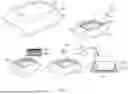
FIGS. 6A-6F depict an embodiment of steps of operation of a self-contained cleaning system, with FIG. 6A showing the outer pouch in its vacuum-sealed form, FIG. 6B showing the outer pouch opened by tearing the tear-strip above the resealable seal, FIG. 6C showing the main pouch being filled with water, FIG. 6D showing the auxiliary pouch opened to show the heating element, FIG. 6E showing the heating of the outer pouch, and FIG. 6F showing the main pouch filled with water to show the expanded gusset base.
FIG. 7 depicts steps of operation of an alternative embodiment of a self-contained cleaning system which utilizes a structural basin and an outer pouch which does not include a main pouch and auxiliary pouch.
DETAILED DESCRIPTION OF PREFERRED EMBODIMENT(S)
The following detailed description and disclosure illustrates by way of example and not by way of limitation. This description will clearly enable one skilled in the art to make and use the disclosed systems and methods, and describes several embodiments, adaptations, variations, alternatives, and uses of the disclosed systems and methods. As various changes could be made in the above constructions without departing from the scope of the disclosures, it is intended that all matter contained in the description or shown in the accompanying drawings shall be interpreted as illustrative and not in a limiting sense.
Described herein are a variety of embodiments of a self-contained cleaning system (100) that is light-weight, easy to carry, and utilizes a storage pouch (101) for initial transport. The storage pouch (101) is also constructed to allow for water management and heating during the cleaning process. The cleaning system (100) will typically allow for all needs for basic human body cleansing to be carried in a lightweight and highly compact device.
In alternative embodiments, the cleaning system (100) is not deigned for basic body cleansing, or only for that purpose, but may also be used to provide for specific types of cleansing. These specific types of cleansing may relate to specific needs of a likely user. For example, the system (100) may be designed to remove or neutralize specific elements which may get onto the body of a user in certain dangerous environments (for example, radioactive fallout or chemical or biological weapon agents) or in certain circumstances (for example, in the event of skin disease outbreaks or to remove or kill common microbial agents known to spread in natural disaster situations).
FIG. 1 provides an outer view of the cleaning system (100). At this stage and prior to use, only the storage pouch (101) is visible. The storage pouch (101) generally comprises a multi-layer film material which will typically be constructed to be suitable to withstand temperatures up to and exceeding the boiling point of water. In an embodiment, the storage pouch (101) may need to contain boiling water for a duration long enough to adequately sterilize enclosed water and without the outer layer melting or otherwise becoming unsuitable for use in accordance with the present disclosure. In alternative embodiments, the material does not need to resist exposure to these temperatures, but will still need to resist temperatures above typical ambient and be generally impermeable to water. Depending on embodiment, the material of the outer pouch (101) may comprise a variety of plastic films, metal foils, or combinations thereof. In various embodiments, the combination can comprise, but is not limited to, polyester, polypropylene, polyvinyl chloride, or other plastic films either alone or in combination with each other. In an embodiment, one of the film layers may comprise BoPET (biaxially-oriented polyethylene terephthalate) which is commonly sold under the name Mylar™. The films may or may not be metalized or the layers may include a layer of metal foil.
The outer pouch (101) will generally be in the configuration of a rectangular prism that is sized and shaped to contain the other elements of the disclosed system (100), as described further herein, and is generally configured to withstand forces that may cause the elements therein to rupture. However, this specific shape of the pouch (101) is by no means required. While the dimensions of the outer pouch (101) may vary depending on the specific contents to be contained, should a rectilinear shape be used, it may generally has a width of about 15-25 cm, a height of about 20-30 cm, and thickness of about 0.5-2 cm in an embodiment (when placed under vacuum and with other components of the system (100) therein). In the embodiment depicted in FIG. 1, the dimensions of the outer pouch (101) are about 20 cm by about 16 cm.
As can be seen in FIG. 1, the outer pouch (101) will typically not comprise a single pouch or bag structure but is actually in the form of two distinct pouches (111) and (121) which are attached to each other, may share a common side, and may be co-formed. In the embodiment of FIGS. 1 and 2, there is a larger or main pouch (111) and the smaller or auxiliary pouch (121) mounted external to the main pouch (111). The auxiliary pouch (121) in FIGS. 1 and 2 shares a common side with the main pouch (111) over the area that it covers. Each of the main pouch (111) and the auxiliary pouch (121) include a closure (211) and (221) which will usually be in the form of a resealable seal and is typically in the form of a zipper slider. The closures (211) and (221) may or may not be accessible from the outside of the outer pouch (101), or may only be accessible only once the outer pouch (101) has been opened.
In FIG. 1, the outer pouch (101) may further include one or more notches (103) positioned at an edge to facilitate tearing a tear-strip (117) off the upper edge (107) of the outer pouch (101) to open it. In the depicted embodiment, a material weak point (105) is provided to facilitate such tearing and inhibit tearing of the strip (117) from tearing into or below the closure (211). Opening the outer pouch (101) in FIGS. 2 and 3 grants access to the resealable closures (211) and/or (221) which serve to close the main pouch (111) and auxiliary pouch (121) respectively. It should be recognized that within this disclosure, while the outer pouch (101), main pouch (111), and auxiliary pouch (121) will be referred to separately, there is no need for them to be physically or even functionally separate objects. In most embodiments, the outer pouch (101) and main pouch (111) will share much, if not all, of the same structure. However, for ease of understanding, it is helpful to be able to refer to the outer enclosure of the system (100) as the outer pouch (101) and the component pouches (111) and (121), which have distinct functions, as separate components.
FIGS. 2 and 3 provide for additional detail of the interaction of the main (111) and auxiliary (121) pouches in some exemplary embodiments. As can be seen in FIG. 2, the auxiliary pouch (121) shares a common wall with the main pouch (111) with that common wall forming an inner wall of the auxiliary pouch (121). Further, the zipper closure (221) of the auxiliary pouch (121) is accessible from outside the main pouch (111) and may be opened and closed even if the tear-strip (117) is still present. However, the main pouch closure (211) is only accessible only once the tear-strip (117) has been torn away meaning that the main pouch (111) cannot be accessed until the outer pouch (101) has been opened, but the auxiliary pouch (121) can be accessed before the outer pouch (101) has been opened.
FIG. 3 provides a slightly different arrangement. In FIG. 3, while the auxiliary pouch (121) is still positioned similarly to FIG. 2 sharing a wall with the main pouch (111), the shared wall is now the external wall of the auxiliary pouch (121) and the auxiliary pouch (121) is effectively inside the main pouch (111). Thus, the closure (221) of the auxiliary pouch (121) also cannot be accessed until the tear off strip (117) has been removed. In the embodiment of FIG. 3, the closure (221) of the auxiliary pouch also cannot be accessed until the closure (211) of the main pouch (111) is opened. The effectively nests the auxiliary pouch (121) inside the main pouch (111)
FIG. 4 provides for a still further embodiment where the auxiliary pouch (121) is positioned similarly to that of FIG. 3 with the shared wall with the main pouch (111) being and outer wall of the auxiliary pouch (121), but the closures (211) and (221) are co-located and may be operated in any order, together, or comprise a single closure that closes both pouches (111) and (121) but separates their internal volumes. FIG. 5 provides for a still further embodiment where, like in FIG. 3, the auxiliary pouch (121) is nested internal to the main pouch (111). However, in this embodiment, the auxiliary pouch (121) does not share a wall with the main pouch (111) and shares only a small section. This produces an auxiliary pouch (121) which is not on the side of the main pouch (111), but is effectively suspended more in the internal volume (119) of the main pouch (111).
As can be seen in all of FIGS. 2-5, the outer pouch (101) preferably includes main sides which join together at the end (107). At the other end, however, the outer pouch (101) includes a gusseted base (115). The gusseted base (115) generally comprises a fold or pleat so that when mass is placed into the outer pouch (101) (specifically the main pouch (111)), the two sides of the outer pouch (101) will serve to move apart at the base (115). This can make the outer pouch (101) generally self-supporting. in an upright position such as is shown in FIGS. 2-5.
As can be best seen in FIGS. 4 and 5, prior to use, the main pouch (111) is typically used to initially house the cleaning components (301) and (401) of the system (100) while the auxiliary pouch (121) is typically used to house the heating element (501). This is, however, by no means required. In an alternative embodiment, for example, the auxiliary pouch (121) and/or heating element (501) may be separable or separate from the main pouch (111). For example, the main pouch (111) and auxiliary pouch (121) may be separate components not sharing any structure with each other. The heating element (501) may also be separate from the auxiliary pouch (121), main pouch (111), and outer pouch (101). In an embodiment, the heating element (501) may be taken from other sources and not part of the system (100). For example, the system (101) may be designed to be used with the heating element (501) supplied from a heated meal package (e.g. a meal-ready-to-eat or MRE) which may be used to heat both the meal and the cleaning water simultaneously or sequentially.
It can, however, be beneficial to initially house the components (301), (401), and (501) in this way as it can facilitate in vacuum sealing the outer pouch (101) and compressing the system (100) safely. For example, only the main pouch (111), and not the auxiliary pouch (121), may be directly placed under vacuum Typically, the cleaning system (100) will comprise a dry sponge (301), a towel (401), and a heating element (501). The cleaning system (100) may alternatively or additionally include other components including a structural basin, chemical agent packages, a separate rinse bag, or multiples of any other component.
In the embodiment of FIGS. 4 and 5 the structural basin is not included. FIG. 7 shows an alternative embodiment which uses a structural basin (901). The basin (901), when included, typically comprises a basin or bowl made from more rigid material than the outer pouch (101) which could be placed into the outer pouch (101) to provide it with a more defined and maintainable shape and structure. It may, as shown in FIG. 7, act as a separator of the outer pouch (101) for holding the heating element (501) away from the water (801) used for the sponge (301) avoiding the need to have the outer pouch (101) formed as the separate main pouch (111) and auxiliary pouch (121). In an embodiment, the structural basin may alternatively be used as an external basin outside the pouch (101).
In order to provide for washing, the system (100) does need access to a water source (801). While the water (801) is typically considered to be provided from another external source the system (100) may include a specific bottle or pouch of water that is for use with the system (100). In most cases, water (801) will be provided from an external source of potable water such as a canteen or water bottle which is not specifically part of the system, but would be generally available to a user.
As discussed above, in the embodiments of FIGS. 4 and 5, the dry sponge (301) and the towel (401) are packed snugly in the main pouch (111) while the heating element (501) is provided in the auxiliary pouch (121). The dry sponge (301) will also typically be impregnated with a dry cleaning additive. Before use, the outer pouch (101) will typically be vacuum sealed by methods currently known in the art. This may seal one or both of the main pouch (111) and auxiliary pouch (121) depending on embodiment. Alternatively, the outer pouch (101) may be placed under vacuum and hermetically sealed via a thermal seal, adhesive seal, or by similar methods known in the art. When placed under vacuum, the outer pouch (101) may have an internal pressure of between about 0.063 MPa absolute pressure and about 0.23 MPa absolute pressure when the outer ouch (101) is sealed.
By placing the outer pouch (101) under vacuum, either by vacuum sealing or otherwise, air that may be present in the outer pouch (101) may be removed and the system (100) may be compressed to facilitate easy carrying of the disclosed system (100). It should be recognized that depending on embodiment, the entire outer pouch (101) may be vacuum sealed as a single pouch. Alternatively, the main pouch (111) and auxiliary pouch (121) may be sealed differently. For example, they may be placed at different pressures or one may be sealed while the other is not. This may need to be the case, in certain embodiments, to avoid damage or premature activation of the heating element (501).
The dry sponge (301) of the embodiment depicted in FIGS. 4 and 5 is generally in the configuration of a rectangular prism. Depending on embodiment the dry sponge (301) may be a rectangular prism configuration with dimensions of about 10 cm in width, about 18 cm in height, and about 0.2 cm in thickness. However, these dimensions are illustrative only and any variety of dimensions that permits the dry sponge (301) to fit inside the main pouch (111) are also possible. For example, the dry sponge (301) may be about 8 cm in width, 20 cm in height, and about 0.5 cm in thickness. Additionally, this rectangular configuration of the dry sponge (301) is not required and in some embodiments, the dry sponge (301) may be in the configuration of a spherical prism, and in other embodiments the dry sponge (301) could be in the configuration of any other geometrically shaped prism. When placed in the main pouch (111) and vacuum, sealed, the dry sponge (301) will typically be in its flat generally planar configuration. However, in alternative embodiments, the dry sponge (301) may be folded and or crushed into different shapes because the main pouch (111) is placed under vacuum.
Regardless of the configuration of the shape of the dry sponge (301), the dry sponge (301) is generally placed inside the main pouch (111) alongside the towel (401). In order to facilitate transport and packing, the dry sponge (301) is generally made of a material that is highly compressible, such that the vacuum sealing of the main pouch (111) compresses the dry sponge (301) into an almost flat configuration. The particular material the dry sponge (301) is made from may be dependent on the intended environment of use and can include, but is not limited to, cotton, wood pulp, polyvinyl acetate (PVA), Nonwoven polyester fiber, nonwoven polyethylene fiber, cellulose, polyurethane, or any combination thereof. The dry sponge (301) may be a woven or non-woven material or may be a solidified foam.
As indicated, the dry sponge (301) material may be selected based on intended use. For example, in an embodiment of the disclosed system, the system (100) may be intended for use as a sterile disinfectant for in-field medical purposes. In such an embodiment, the dry sponge (301) may be made from a foamed polyester material or other material that typically does not shed fibers that is infused with silver nitrate. In other embodiments, the dry sponge (301) may be infused with an additive other than silver nitrate. In another embodiment, the dry sponge (301) may be made from a polyurethane foam of sufficient rigidity to scrub away contaminants. In yet other embodiments, the dry sponge (301) may be made from a typical polyester-type material, may be made from natural materials such as natural sponges, or may be made as a formed foam or non-woven fabric so as to provide relative large air-pockets and gaps within it.
In further embodiments, the dry sponge (301) may be made from material that is intended to rapidly degrade in prolonged exposure to water. Such an embodiment may be desirable for use in military activities where it is important for soldiers to leave no trace of their presence exposed when they depart a given area. The dry sponge (301) in this embodiment may be submerged in water until it rapidly degrades or may be buried and will degrade in the earth as it is exposed to ground water. It should also be recognized that while the dry sponge (301) is preferably dry, that term is used herein to mean that the dry sponge (301) may have little to no internal water but could alternatively include a small amount of water or other liquid to encourage flexibility of its structure.
The dry sponge (301), in addition to are alternatively to, having its structural composition infused with chemicals, may have materials impregnated into it. As opposed to infused chemicals, these material additives will not be a part of the dry sponge (301), but will typically be positioned within the air pockets within the dry sponge (301). When vacuum sealed, compression of the sponge (301) will generally serve to compress these air pockets (forcing out most of the air) around the additive which serves to both keep the additive within the structure, and to be maintained in a fixed position. The material additive will typically comprise a cleaning agent, but other materials may additional or alternatively be included.
The configuration and characteristics of the additive are varied but the additive will typically be a dry granular material and such as a dry granulated soap particle comprising chemicals suitable for cleaning a human body. In most embodiments the additive will be configured as a powder that is readily dissolvable in water. However, this is not limiting and in other embodiments the additive may be a gel or a liquid, and in further embodiments, the additive may be a larger solid.
The particular substances or chemicals included in the additive may vary, depending on the circumstances. Depending on embodiment, the additive may comprises a simple soap, an antibacterial soap, or a strong decontamination agent. For example, in some embodiments, the additive may be comprised of any of the following: an antibacterial agent, anti-fungal agent, anti-chemical agent, an anti-biological agent, a general anti-microbial agent, or any combination thereof. In other embodiments, the additive may further include different fragrances, may include no fragrance, or may include an insect repellent. In yet other embodiments, the additive may include a medical grade agent such as a medical grade soap, iodine, lye, disinfectants, or any combination thereof. In further embodiments, the additive may include a decontamination agent configured to provide decontamination of radioactive contamination, chemical weapon contamination, biological weapon contamination, or any combination thereof. In additional embodiments, the additive may contain a pigment, such as a green or black or brown pigment, to dye a user's skin temporarily. Such embodiments may be used to camouflage the user's skin for use in, for example, military or hunting applications. In still further embodiments, the additive may include any combination of the foregoing characteristics.
In some embodiments, a sterilization additive may be included in the sponge in addition to or instead of the cleaning additive. The sterilization additive may be intended to interact with environmental water or other, unclean (e.g. non-potable), water that is to be used with the disclosed system when potable water is not otherwise available. The sterilization additive may be comprised of a variety of substances suitable for adequately sterilizing unclean water. For example, the sterilization packet may include chlorine, chlorine dioxide, iodine, chloramine, or any other substance known to those of ordinary skill in the art to be suitable for disinfecting or sterilizing water. In an embodiment, the sterilization agent may be intended to also provide cleaning or sterilizing effect to the human body, or may be solely for the water.
Chemical agents, whether for sterilization, body cleansing, or both, will typically be included as part of the sponge (301) and sealed with the sponge (301) into the main pouch (111). However, in alternative embodiments cleaning, sterilization, or both agents may additionally or alternatively be included in separate packets. These packets will typically comprise sealed envelopes or the like which may contain the agents in any form including solids, liquids, and gels.
In addition to the sponge (301), there may also be included a towel (401). As opposed to the sponge (301), which will typically be in the form of a highly porous structure the towel (401) will typically be made from cloth and configured as a washcloth or washrag and may not be particularly absorbent, it may even be hydrophobic in an embodiment. In an embodiment, the towel (401) may comprise a polyester microfiber or polyamide microfiber fabric. It may also comprise a cotton, paper, wood-pulp cellulose, bonded cellulose, viscose, animal skin such as chamois, or similar material.
The towel (401) will typically be more flexible than the sponge (301), often of thinner construction but that is by no means required, and may be designed not so much to transfer water to the skin of a user, but to dry (absorb or adsorb) or sweep away such water. Similarly, the towel (401) will generally provide reduced mechanical exfoliation of human skin compared to the sponge (301). Similarly to the rapid degrading sponge (301) used in some embodiments as discussed above, there may also be embodiments where the towel (401) is designed for relatively rapid degradation such as a durable, disposable paper towel.
The heating element (501) of the present disclosure is generally a chemical package which is designed to produce heat via an exothermic reaction. The reaction will often be initiated and continued by the presence of water, but that need not be the case. In an embodiment, the heating element (501) is a package of chemicals comprised of a mixture of a magnesium-iron alloy and salt in an inert filler with an anti-foaming agent. However, these chemicals are not required and other types of chemicals that produce an exothermic reaction when mixed or exposed to water are possible. In the present embodiment, the heating element will produce heat when the chemical contents are exposed to water. This may be through submerging of the heating element into water, or may through the chemicals being removed from the heating element and placed directly into water. In alternative embodiments, the heating element may include two, separately packaged, chemicals that produce heat when the two chemicals are mixed together and need no require water contact to heat.
In the embodiment depicted in FIG. 3, the heating element (501) is a contained packet that may be made from polymetric films, or other film combinations with adequate strength and thickness to contain and protect the contents of the heating element while permitting an adequate water vapor transmission rate (WVTR). The WVTR of the film may be about 6.2 gm/m2/24 hrs/ 90% rh /° F. when tested in accordance with, for example, ASTM F 372, Standard Test Method for Water Vapor Transmission Rate of Flexible Barrier Materials Using an Infrared Detection Technique: ASTM E 96, Standard Test Methods for Water Vapor Transmission of Materials or Method 3030 of FED-STD-101, Test Procedures for Packaging Materials, the entire disclosures of which are hereby incorporated by reference. However, use of these testing standards is not required, and the heating element may be designed in accordance with other WVTR testing standards known to those of ordinary skill in the art.
One benefit from the configuration of the disclosed system (100), including the separate packaging of the components and the sealing of packaging, is an increased shelf life of the system (100). For instance, because the sponge (301) and towel (401) are within a vacuum seal, the general absence of air precludes the growth of bacteria, which extends the shelf life. Similarly, in the embodiments with a dry (powder or solid) cleaning agent, the shelf life is extended compared to embodiments with a liquid or gel additive because the dry additive is not at risk of drying out and becoming unusable.
The disclosed self-contained cleaning system (100) may be used in a variety of circumstances, such as for a general disinfectant, as a cleaning system to remove fragrance or to add fragrance, as a medical grade disinfectant, as a decontaminant, or for other uses suitable for the type and characteristics of the particular additive(s) included. While the system (100) may be used in a variety of circumstances, the method of using the cleaning system (100) is broadly similar in each circumstance of use.
It should be recognized that the cleaning system (100) will typically be used with water. Water for use with the system (100) may be from any source. Due to the system (100) being particularly useful remotely when no water infrastructure exists, provided water will commonly be from a pouch or a bottle that the user has to provide drinking water but that is by no means required. In some embodiments, a sealed pouch or bottle of water may be included with the system (100). In some embodiments, the water source may be contemplated to be environmental water that is gathered from a puddle, rainwater, or other environmental sources. In such an embodiment, a special additive and/or special heating element, as discussed elsewhere, may be included to ensure the environmental water is adequately sterilized for use in the disclosed system.
An embodiment of the a method of using the disclosed system (100) as shown in FIGS. 1-5 is provided in FIG. 6. This use method is only exemplary, but provides useful detail in understanding how components of the system (100) can operate in conjunction with each other. Initially, the outer pouch (101) is obtained in its vacuum-sealed form (A). The outer pouch (101) is opened by tearing the tear-strip (117) above the resealable seal (211) (B). As indicated in FIG. 1, in some embodiments the outer pouch (101) may include a notch (103) and a line of weakness (105) to facilitate tearing the outer pouch (101) open above the resealable seal (211) and not damaging the outer pouch (101) below the seal (211). In other embodiments, the outer pouch (101) may be sealed only by the resealable seals (211) and/or (221) and opening may not require tearing the pouch (101). Regardless, as the outer pouch (101) is opened, the vacuum seal in the main pouch (111) (and possibly in the auxiliary pouch (121)) is broken, and the contents of the main pouch (111) may be removed. The towel (411) will typically be removed at this stage and the sponge (301) allowed to remain in the main pouch (111). However, in alternative modes of operation the towel (401) may remain alone, both the towel (401) and sponge (301) may remain together, or both the towel (401) and sponge (301) may be removed.
The main pouch (111) is then filled with water (801) (typically around 6-10 fluid ounces) (C). (F) shows the pouch filled with water (801) to show that the water (801) has deformed the main pouch (111) expanding the gusset base (115). The auxiliary pouch (121) is then opened to expose the heating element (501) (D). Depending on the position of the auxiliary pouch (121) (e.g. comparing for example, the embodiments of FIG. 4 to FIG. 5), the timing of filing the main pouch (111) versus filing the auxiliary pouch (121) with water (801) may be altered. The auxiliary pouch (121) is filled with water to activate the heating element (501) which may be left in the auxiliary pouch (121), moved to the auxiliary pouch (121), or be added to the auxiliary pouch (121) after the water (801).
Once both pouches (111) and (121) are filed, the auxiliary (121) and main pouches (111) will typically both be resealed to keep the heating element (501) and associated water (801) in the auxiliary pouch (121) separate from the water (801) in the main pouch (111) during heating. The water (801) in the auxiliary pouch (121) will heat up due to activation of the heating element (501), and thermic transfer through the common wall (e.g. in FIGS. 2 and 3) or positioning of the auxiliary pouch (121) in the internal volume (119) (FIG. 5) will result in the water (801) in the main pouch (111) also heating up. The heating element (501), as described above, will typically produce an exothermic reaction when exposed to water (801), which may heat the water to approximately 100 degrees Fahrenheit in about 10 minutes. Alternatively different top temperatures and times may be provided based on desired use of the system (100) and the nature of the heating element (501). During the heating, the outer pouch (101) will generally be left alone. It may be stood up using the gusseted base (115), or may be laid on its side (E) or partially on its side to potentially facilitate thermic transfer between the auxiliary pouch (121) and the main pouch (111).
As mentioned in (B), the sponge (301) will generally be placed in the main pouch (111) (or will be left there) either while the water (801) is heating or after the heating is completed. As the sponge (301) becomes wet, absorbs water (801) in the main pouch (111), and expands, the cleaning agent in the sponge (301) will generally be freed from the sponge (301) and dissolve in the water (801) which will enter the voids int eh sponge (301). Dissolution of the dry cleaning agent will typically serve to create a cleaning solution in the main pouch (111). The sponge (301) may then be worked by hand while within the main pouch (111) to distribute the cleaning additive/water mixture until the sponge (301) becomes completely wetted. This can also allow the cleaning agent to better disperse from within the sponge (301) and increase the amount dissolved in the water (801) compared to the amount trapped and undissolved in the sponge (301). It may also prevent a particularly strong cleaning agent from being present in the sponge (301) during use in an amount that could be undesirable or dangerous.
Once the water (801) is heated. The main pouch (111) will typically be opened and the sponge (301) may then be removed from the main pouch (111) and used for cleaning or maintaining personal hygiene on the user's (on another's) body (or clothes) consistent with the circumstances of use of the system (i.e., disinfecting, sterilizing, decontaminating, etc.) (100). To get dirt collected by the sponge (301) out of the sponge (301), the sponge (301) may be returned to the main pouch (111) where the water (801)/cleaning solution mixture will serve to remove dirt from the sponge (301). Alternatively, the sponge (301) may simply be wrung out sperate from the main pouch (111) and returned to main pouch (111) in such state to absorb additional water and cleaning solution. Once the user has completed operation with the sponge (301) the remaining water (801) cleaning solution mixture in the main pouch (111) may be discarded or may be dumped on the body to provide a final rinse.
The towel (401), which has been kept separate, will typically be used to dry the user's body and remove cleaning agent which has remained on the body. In an embodiment, the water (801) in the auxiliary pouch (121) will not be used on the user as it may contain undesired chemicals from the heating element (501). For this reason, the auxiliary pouch (121) may remain closed. However, in an alternative embodiment, the water (801) in the auxiliary pouch (121) may be used as rinse water as it has not been exposed to the sponge (301) or cleaning agent. It may also be used to heat and/or dampen the towel (401), depending on desire and embodiment.
The towel (401) may also be placed on the outside of the main pouch (111) and auxiliary pouch (121) during the heating of the water (801) to provide some warmth to the towel (401) from thermic transfer through the outside of the outer pouch (101). Use of the towel (401) to dry the body, or at least remove excess surface material, may provide sufficient removal of the cleaning additive from the skin, which may prevent irritation from prolonged exposure to some chemicals included in the additive or may simply ensure an adequate rinse to remove any residual additive that may otherwise be left behind.
In some embodiments, the heating element (501) may be a high temperature heating element (501) that is designed to rapidly heat the water (801) to at or above the water's boiling point. In these embodiments, the heating of the water (801) to such a temperature may, among other things, effectively kill bacteria and other contaminants contained therein. The embodiments containing this high temperature heating element (501) may be used with environmental water that would not otherwise be suitable for bathing use because, as is known in the art, boiling water for a sufficient duration of time may sterilize the water boiled. Should the water (801) be heated sufficiently high to sterilize it, the system (100) may be allowed to cool to a temperature that would not injure the user before ethe system (100) is then used.
In embodiments intended for use with environmental water, the system (100) may contain an additional component of a mesh filter. The mesh filter may be the same general size and shape of the outer pouch (101), such that the mesh filter fits snugly in the outer pouch (101) without obstructing the closing of the outer pouch (101), main pouch (111), and/or auxiliary pouch (121). The mesh size of the mesh filter may sufficiently small enough to filter out larger containments in the environmental water, such as dirt and bugs. In embodiments using a mesh filter, the mesh may be placed in the outer pouch (101) or may be constructed as part of it, then environmental water may be added to the outer layer. The mesh filter may then be removed prior to heating the environmental water, which may remove the larger contaminants therein or it may be partially removed and inverted, for example, to remove items it has trapped.
Alternatively, in some embodiments described further herein, the mesh filter may remain in the environmental water during heating.
In the embodiments comprising a sterilization agent in the sponge (301) (or as a separate optional package) without the high temperature heating element (501), the additional steps may be allowing the water (801) in the main pouch (111) to be heated for approximately 10 minutes, adding a sterilization packet (a packet including sterilizing chemicals) to the heated water (801), closing the main pouch (111), shaking the system (100) or otherwise thoroughly mixing the sterilization packet contents in the water (801), and letting the mixture of the contents of the sterilization packet and water (801) stand for approximately about 20 to 30 minutes. In some embodiments, the sterilization packet may cause flocculation of small particles present in the water (801). In such an embodiment, a mesh filter, such as the one contemplated above, may be included and the mesh may be sized and shaped to be sufficiently small enough to remove the floc particles formed when the sterilization packet was added to the water (801). In this embodiment, the filter may remain in the main pouch (111) during the heating and addition of the sterilization packet, then removed (or inverted and cleaned) prior to adding the cleaning additive and further using the system (100).
When the filter is removed, larger floc particles may be removed with the filter, which may assist in sterilizing the environmental water prior to the water (801) being used for cleaning. Following removal of the filter, a portion of the water (801) (from either pouch (111) or (121)) may be used to rinse the mesh before the cleaning additive and/or sponge (301) is added to the main pouch (111).
Similarly, there may be some embodiments that comprise both a sterilization packet and a high temperature heating element (501). In these embodiments, which may include a mesh filter as described above in conjunction with the embodiment including a sterilization packet and no high temperature heating element, the sterilization packet may be added to the water concurrently with the heating element (501), the water (801) may be boiled for approximately about 20 minutes, then the mesh filter, if included, may be removed and the cleaning additive may be added to the main pouch (111).
After the system (100) has been used, the water (801)/cleaning agent mixture in the main pouch (111) may be dumped out, water (801) in the auxiliary pouch (121) may be poured out and the heating element (501) may be disposed of. In an embodiment, disposal of the heating element (501) may comprise tearing open the heating element and dispersing the chemical contents. Alternatively, the heating element (501) may be disposed of as a unit. The sponge (301) may be dried out by being left exposed to the atmosphere or may be torn into smaller pieces, buried, or otherwise modified to accelerate its degradation.
In an embodiment, the components of the system (100) may be repacked inside the main pouch (111) and/or auxiliary pouch (121) for easy storage and remote disposal of the used system (100). In some embodiments the system (100) may be reused multiple times. For instance, in an embodiment, the system (100) may contain multiple heating elements (501), sponges (301), and/or towels (401). Such an embodiment may allow components of the system (100) to be used more than once, which may reduce waste.
In a reuseable embodiment, prior to beginning the steps described above for using the disclosed system, the repeated copies of the contents would typically be removed from the outer pouch (101) and set aside for future use. After the system (100) is used the first time and the reuseable components (typically the sponge (301) and towel (401)) are repacked into he outer pouch (101), these additional heating elements (501) and/or cleaning additives may be put back in the outer pouch (101) for storage until it is desired to use the system (100) again.
Additionally, in embodiments that do not include additional heating elements (501), and/or cleaning additives, a separate replenish or refresh kit may be used. This separate replenish or refresh kit may be used in conjunction with the previously used system (100) to reduce waste by allowing reuse of, instead of disposal of, the outer pouch (101), sponge (301), and/or towel (401). The replenish kit may include one or more heating elements (501) and/or a packages of additional cleaning additives. Using the replenish kit generally follows the same steps as using the initial self-contained cleaning system (100) but may have particular cleaning additives for certain situations which are added to the water (801) in the main pouch (101) separately from the sponge (301). For instance, the initial self-contained cleaning system may have contained a cleaning additive comprised of lye and the refresh kit may contain a cleaning additive comprised of an anti-inflammatory substance. In this way, a replenish kit may allow the system to be used for a secondary purpose compared to the primary system (100).
While the invention has been disclosed in conjunction with a description of certain embodiments, including those that are currently believed to be useful embodiments, the detailed description is intended to be illustrative and should not be understood to limit the scope of the present disclosure. As would be understood by one of ordinary skill in the art, embodiments other than those described in detail herein are encompassed by the present invention. Modifications and variations of the described embodiments may be made without departing from the spirit and scope of the invention.
It will further be understood that any of the ranges, values, properties, or characteristics given for any single component of the present disclosure can be used interchangeably with any ranges, values, properties, or characteristics given for any of the other components of the disclosure, where compatible, to form an embodiment having defined values for each of the components, as given herein throughout. Further, ranges provided for a genus or a category can also be applied to species within the genus or members of the category unless otherwise noted.
The qualifier “generally,” and similar qualifiers as used in the present case, would be understood by one of ordinary skill in the art to accommodate recognizable attempts to conform a device to the qualified term, which may nevertheless fall short of doing so. This is because terms such as “spherical” are purely geometric constructs and no real-world component or relationship is truly “spherical” in the geometric sense. Variations from geometric and mathematical descriptions are unavoidable due to, among other things, manufacturing tolerances resulting in shape variations, defects and imperfections, non-uniform thermal expansion, and natural wear. Moreover, there exists for every object a level of magnification at which geometric and mathematical descriptors fail due to the nature of matter. One of ordinary skill would thus understand the term “generally” and relationships contemplated herein regardless of the inclusion of such qualifiers to include a range of variations from the literal geometric meaning of the term in view of these and other considerations.
Claims
1. A self-contained cleaning system, the system comprising:
an outer pouch formed of a main pouch and an auxiliary pouch interconnected with each other:
a sponge, placed in said main pouch, said sponge having a cleaning agent impregnated therein;
a towel, placed in said main pouch; and
a heating element, placed in said auxiliary pouch;
wherein, said outer pouch is placed under vacuum and sealed so as to compress said sponge and said towel.
2. The system of claim 1, wherein said cleaning agent comprises a dry powder.
3. The system of claim 1, wherein said cleaning agent comprises a gel.
4. The system of claim 1, wherein said auxiliary pouch is not placed under vacuum.
5. The system of claim 1, wherein said auxiliary pouch is placed under vacuum.
6. The system of claim 1, wherein said main pouch and said auxiliary pouch share a wall.
7. The system of claim 1, wherein said main pouch and said auxiliary pouch include closure mechanisms.
8. The system of claim 7, wherein said closure mechanisms comprise resealable sliding closures.
9. The system of claim 7, wherein said closure mechanism of said auxiliary pouch cannot be accessed when said closure mechanism of said main pouch is closed.
10. The system of claim 7, wherein said closure mechanism of said auxiliary pouch can be accessed when said closure mechanism of said main pouch is closed.
11. The system of claim 7, wherein said closure mechanism of said auxiliary pouch can be accessed while said main pouch is still under vacuum.
12. The system of claim 7, wherein said closure mechanism of said auxiliary pouch and said closure mechanism of said main pouch are the same closure mechanism.
13. The system of claim 1, further comprising a sanitizing agent.
14. The system of claim 13, wherein said sanitizing agent is also impregnated in said sponge.
15. The system of claim 13, wherein said sanitizing agent is in a separate sealed packet.
16. The system of claim 1, wherein said outer pouch is formed of a film including at least one material selected from the group consisting of: biaxially-oriented polyethylene terephthalate (BoPET), polyethylene, polypropylene and metal
17. The system of claim 1, wherein said sponge is includes at least one material selected from the group consisting of: cotton, wood pulp, polyvinyl chloride, polyester, polyethylene, cellulose and polyurethane
18. The system of claim 1, wherein said towel is a microfiber fabric
19. The system of claim 1, wherein said towel includes at least one material selected from the group consisting of: polyester, polyamide, cotton, wood pulp, cellulose, viscose.
20. The system of claim 1, wherein said heating element heats by an exothermic reaction of said heating element with water.
Images & Drawings included:






Sources:
- United States Patent and Trademark Office - verify current appl. status at the USPTO↗
Similar patent applications:
Recent applications in this class:
- » 20250017337 2025-01-16
SANITARY SUPPLY KIT - » 20240349857 2024-10-24
EYELASH STORAGE CONTAINER - » 20240251921 2024-08-01
BAG FOR CONTAINING BEAUTY AIDS - » 20230270218 2023-08-31
MAKEUP HOLDER DEVICE FOR CONNECTION WITH A CAR VISOR - » 20230060372 2023-03-02
Multi-Component Eyelash Case - » 20220400825 2022-12-22
Specialized tray device for eyelash extensions - » 20220015515 2022-01-20
READY HAND WASH BAG (PACKAGE) - » 20210386169 2021-12-16
Bundle Bags - » 20210378374 2021-12-09
Feminine hygiene storage assembly - » 20210298439 2021-09-30
SANITIZER SYSTEMS WITH REUSABLE WIPE STORAGE