SULFIDE SOLID ELECTROLYTE PRODUCTION METHOD
US20260142229A1
2026-05-21
19/450,993
2026-01-16
Smart Summary: A method has been developed to create a sulfide solid electrolyte. It involves heating and melting a mix of specific raw materials. The main ingredients are lithium sulfide (Li2S) and phosphorus sulfide (P2S5), both of which need to be small in size. After melting, the mixture is cooled down to solidify it into the desired electrolyte form. This process ensures the right particle sizes for effective production. 🚀 TL;DR
Abstract:
A method for producing a sulfide solid electrolyte includes: heating and melting a mixture of sulfide solid electrolyte raw materials; and cooling and solidifying resulting melt to obtain a sulfide solid electrolyte. The mixture of sulfide solid electrolyte raw materials includes Li2S and P2S5, and A<250 μm and B<250 μm are satisfied, where A is a volume-based average particle diameter of the Li2S as measured by using a laser diffraction particle size distribution measurement method, and B is a volume-based average particle diameter of the P2S5 as measured by using the laser diffraction particle size distribution measurement method.
Inventors:
- Naoki Fujii 38 🇯🇵 Tokyo, Japan
- Norifumi OMORI 8 🇯🇵 Tokyo, Japan
- Hidenobu SEKI 5 🇯🇵 Tokyo, Japan
Assignee:
- AGC Inc. 1,290 🇯🇵 Tokyo, Japan
Applicant:
Interested in similar patents?
Get notified when new applications in this technology area are published.
Classification:
H01M10/0562 » CPC main
Secondary cells; Manufacture thereof; Accumulators with non-aqueous electrolyte characterised by the materials used as electrolytes, e.g. mixed inorganic/organic electrolytes the electrolyte being constituted of inorganic materials only Solid materials
H01M10/0525 » CPC further
Secondary cells; Manufacture thereof; Accumulators with non-aqueous electrolyte; Li-accumulators Rocking-chair batteries, i.e. batteries with lithium insertion or intercalation in both electrodes; Lithium-ion batteries
H01M2300/0068 » CPC further
Electrolytes; Non-aqueous electrolytes; Solid electrolytes inorganic
Description
CROSS-REFERENCE TO RELATED APPLICATIONS
This is a bypass continuation of International Application No. PCT/JP2024/025078 filed on Jul. 11, 2024, and claims priority from Japanese Patent Application No. 2023-119363 filed on Jul. 21, 2023, the entire content of which is incorporated herein by reference.
TECHNICAL FIELD
The present invention relates to a method for producing a sulfide solid electrolyte.
BACKGROUND ART
Lithium ion secondary batteries are widely used in portable electronic devices such as a mobile phone and a notebook computer. In the related art, a liquid electrolyte has been used in a lithium ion secondary battery. On the other hand, in recent years, an all-solid-state lithium ion secondary battery in which a solid electrolyte is used as an electrolyte of the lithium ion secondary battery has attracted attention from the viewpoint that improvement of safety, high-speed charging and discharging, and a reduction in size of a case can be expected. Examples of the solid electrolyte used in the all-solid-state lithium ion secondary battery include a sulfide solid electrolyte.
In the case of producing the sulfide solid electrolyte by using a melting method, a mixed raw material of a sulfide solid electrolyte volatilizes when the mixed raw material is heated. In particular, since P2S5, which is one of the raw materials, has a low melting point and a low boiling point and easily volatilizes, the sulfide solid electrolyte obtained after heating and melting has a problem that a deviation from a target composition (hereinafter, also referred to as a composition deviation) occurs.
In contrast, for example, Patent Literature 1 discloses a method of preventing only a P2S5 component from volatilizing during melting by melting and vitrifying a composite compound containing lithium, phosphorus, and sulfur, and then rapidly cooling the molten glass.
Patent Literature 2 discloses a method of preventing volatilization of raw materials and preventing a composition deviation by heating a solid raw material while compressing the raw material to form a molten body.
-
- Patent Literature 1: JP2012-043654A
- Patent Literature 2: JP5640665B
SUMMARY OF INVENTION
However, in the method disclosed in Patent Literature 1, since it is necessary to synthesize the composite compound in advance, production steps are complicated. Further, volatilization of the raw material itself during melting cannot be prevented.
In the method disclosed in Patent Literature 2, since it is necessary to compress the raw material, the facility structure is very complicated, and thus it is difficult to produce a large number of solid electrolytes.
In view of the above, an object of the present invention is to provide a method for producing a sulfide solid electrolyte having a target composition by preventing volatilization of raw materials during melting without using a complicated facility in producing a sulfide solid electrolyte by using a melting method.
As a result of intensive studies, the present inventors have found that when an average particle diameter of Li2S and an average particle diameter of P2S5 used as sulfide solid electrolyte raw materials are less than predetermined values, volatilization of raw materials during melting can be prevented, and have completed the present invention.
That is, the present invention relates to a method for producing a sulfide solid electrolyte, including: heating and melting a mixture of sulfide solid electrolyte raw materials; and cooling and solidifying resulting melt to obtain a sulfide solid electrolyte, in which the mixture of sulfide solid electrolyte raw materials contains Li2S and P2S5, and A<250 μm and B<250 μm are satisfied, where A is a volume-based average particle diameter of the Li2S as measured by using a laser diffraction particle size distribution measurement method, and B is a volume-based average particle diameter of the P2S5 as measured by using the laser diffraction particle size distribution measurement method.
According to the present invention, it is possible to prevent volatilization of raw materials during melting and to produce a sulfide solid electrolyte having a target composition without using a complicated facility.
BRIEF DESCRIPTION OF DRAWINGS
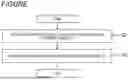
The FIGURE is a flow diagram showing a method for producing a sulfide solid electrolyte according to the present embodiment.
DESCRIPTION OF EMBODIMENTS
Hereinafter, the present invention is described in detail, but the present invention is not limited to the following embodiment, and can be freely modified and implemented without departing from the gist of the present invention.
“To” indicating a numerical range is used to include numerical values written before and after it as a lower limit value and an upper limit value.
<<Method for Producing Sulfide Solid Electrolyte>>
A production method according to the present embodiment is a method for producing a sulfide solid electrolyte, including: heating and melting a mixture of sulfide solid electrolyte raw materials; and cooling and solidifying resulting melt to obtain a sulfide solid electrolyte, in which the mixture of sulfide solid electrolyte raw materials contains Li2S and P2S5, and A<250 μm and B<250 μm are satisfied, where A is a volume-based average particle diameter of the Li2S as measured by using a laser diffraction particle size distribution measurement method, and B is a volume-based average particle diameter of the P2S5 as measured by using the laser diffraction particle size distribution measurement method.
As shown in the FIGURE, the production method according to the present embodiment includes the following steps.
-
- (Step S1) a step of heating and melting a mixture of sulfide solid electrolyte raw materials containing Li2S and P2S5
- (Step S2) a Step of Cooling and Solidifying Resulting Melt to Obtain a Sulfide Solid Electrolyte
Hereinafter, each step is described.
<Step S1: Step of Heating and Melting Mixture of Sulfide Solid Electrolyte Raw Materials Containing Li2S and P2S5>
Mixture of Sulfide Solid Electrolyte Raw Materials Containing Li2S and P2S5
The mixture (hereinafter, also referred to as the present mixture) of sulfide solid electrolyte raw materials containing Li2S and P2S5 (hereinafter, also referred to as the present raw materials) may be obtained by mixing at least a powder of Li2S as one of the raw materials contained in the present raw materials and a powder of P2S5 as one of the raw materials contained in the present raw materials. The heating and melting of the present mixture may be performed by charging the present raw materials in a state of a mixture into a heating furnace. Alternatively, the present raw materials may be charged into a heating furnace and mixed to obtain the present mixture, followed by heating and melting. Among these, from the viewpoint of improving homogeneity of the obtained sulfide solid electrolyte, it is preferable to charge the present mixture into the heating furnace and perform the heating and melting. In the production method according to the present embodiment, A<250 μm and B<250 μm are satisfied, where A is a volume-based average particle diameter of Li2S contained in the present mixture as measured by using a laser diffraction particle size distribution measurement method, and B is a volume-based average particle diameter of P2S5 contained in the present mixture as measured by using the laser diffraction particle size distribution measurement method. Accordingly, volatilization of the raw materials during melting is prevented, and a sulfide solid electrolyte having a target composition can be produced. This is presumed to be due to the following mechanism.
That is, by reducing the average particle diameters of Li2S and P2S5 in the mixture of sulfide solid electrolyte raw materials to less than predetermined values, specific surface areas of Li2S particles and P2S5 particles increase, and a mutual contact interface therebetween can be enlarged. Since a synthesis reaction of the sulfide solid electrolyte first proceeds at the contact interface between the particles, the reaction does not proceed and the particles volatilize in a non-contact portion. However, the non-contact portion between the particles can be reduced by enlarging the mutual contact interface between the Li2S particles and the P2S5 particles in the present mixture. Accordingly, it is believed that the synthesis reaction between the raw materials can be promoted before the raw materials volatilize, the volatilization of the raw materials during melting is prevented, and a sulfide solid electrolyte having a target composition can be obtained.
The production method according to the present embodiment is not construed as being limited to the above mechanism.
In addition, by reducing the average particle diameters of P2S5 and Li2S to less than the predetermined values, scattering of P2S5 and Li2S after charging into the heating furnace can be prevented, and thus it is possible to prevent volatilization of P2S5 and Li2S due to contact with a furnace wall.
In addition, by reducing the average particle diameters of P2S5 and Li2S to less than the predetermined values, the occurrence of unmelting can be reduced, and a more homogeneous sulfide solid electrolyte can be obtained.
In the production method according to the present embodiment, the A is less than 250 μm (A<250 μm). The A is preferably 200 μm or less, more preferably 150 μm or less, and still more preferably 100 μm or less. The A is preferably 1 μm or more, more preferably 2 μm or more, and still more preferably 5 μm or more. The A is preferably 1 μm or more and less than 250 μm (1 μm≤A<250 μm).
In the production method according to the present embodiment, the B is less than 250 μm (B<250 μm). The B is preferably 200 μm or less, more preferably 150 μm or less, and still more preferably 100 μm or less. The B is preferably 1 μm or more, more preferably 2 μm or more, and still more preferably 5 μm or more. The B is preferably 1 μm or more and less than 250 μm (1 μm≤B<250 μm).
A ratio (A/B) of A to B is not particularly limited, and may be in a range of 1/250 to 250/1.
The volume-based average particle diameters of Li2S and P2S5 in the present mixture as measured by using the laser diffraction particle size distribution measurement method means an average particle diameter in a powder of Li2S or a powder of P2S5 as one of the raw materials measured before mixing, and can be measured using, for example, MT3000II (manufactured by Microtrac). The average particle diameter means a D50 in a volume-based particle diameter distribution as measured by using the laser diffraction particle size distribution measurement method.
The present mixture preferably contains a lithium halide (LiHa) to be described later. That is, the present mixture is preferably obtained by mixing the powder of Li2S, the powder of P2S5, and a powder of LiHa as one of the raw materials contained in the present raw materials.
In this case, a volume-based average particle diameter of the powder of LiHa as measured by using the laser diffraction particle size distribution measurement method is preferably 0.1 μm to 2,000 μm. The average particle diameter is preferably 0.1 μm or more, more preferably 1 μm or more, and particularly preferably 2 μm or more. The average particle diameter is preferably 2,000 μm or less, more preferably 1,750 μm or less, and particularly preferably 1,500 μm or less.
As the present raw materials, as long as Li2S and P2S5 described above are contained, one or a plurality of other various raw materials can be used, and the sulfide solid electrolyte obtained using these raw materials may also be various sulfide solid electrolytes.
Each raw material contained in the present raw materials may be synthesized, or a commercially available product may be used. Each raw material may be powdery, and the present raw materials containing the raw materials may also be powdery. Further, the present raw materials may each be subjected to a known pretreatment. That is, the production method according to the present embodiment may appropriately include, as a step 0, which is a step of preparing the present raw materials, at least one of a step of producing the present raw materials and a step of performing a pretreatment on at least a part of the present raw materials before a step S1.
The sulfide solid electrolyte raw materials containing Li2S and P2S5 may be appropriately determined depending on a composition of the desired sulfide solid electrolyte.
One of the raw materials contained in the present raw materials includes, for example, a substance such as an alkali metal element (R) and a sulfur element(S). Examples of the alkali metal element (R) include substances such as a lithium element (Li), a sodium element (Na), and a potassium element (K). In the case where the sulfide solid electrolyte is applied to a lithium ion secondary battery, the alkali metal element (R) preferably contains a substance such as a lithium element (Li).
As an alkali metal element (R) source, substances containing an alkali metal element such as an elemental alkali metal element and compounds containing an alkali metal element can be appropriately combined and used. In the case where the alkali metal element (R) is a lithium element (Li), a Li-containing substance such as elemental Li or a Li-containing compound can be appropriately used in combination as a lithium element source. As described above, the present raw materials contain at least Li2S, which can be the lithium element (Li) source.
Examples of the lithium element (Li)-containing substance include lithium compounds such as lithium iodide (LiI), lithium carbonate (Li2CO3), lithium sulfate (Li2SO4), lithium oxide (Li2O), and lithium hydroxide (LiOH) in addition to lithium sulfide (Li2S) descried above, and metal lithium. The lithium element (Li)-containing substance may be used alone or in combination of two or more kinds thereof.
As the lithium element (Li)-containing substance, it is preferable to use lithium sulfide from the viewpoint of obtaining a sulfide material. In the case where the obtained sulfide solid electrolyte contains a halogen element, a lithium halide (LiHa, Ha is a halogen element) is also preferably contained as the lithium element (Li)-containing substance. The lithium halide is to be described later.
As a sulfur element(S) source, S-containing substances such as elemental S and a S-containing compound can be appropriately combined and used. The sulfur element(S)-containing substance may be used alone or in combination of two or more kinds thereof. As described above, the present raw materials contain at least Li2S and P2S5, which can be the sulfur element(S) source. Li2S is a compound serving as both the sulfur element(S)-containing substance and the lithium element (Li)-containing substance described above. P2S5 is a compound serving as both the sulfur element(S)-containing substance and a phosphorus element (P)-containing substance to be described later.
Examples of the sulfur element(S)-containing substance include phosphorus sulfides such as phosphorus trisulfide (P2S3) in addition to phosphorus pentasulfide (P2S5), other sulfur compounds containing phosphorus, elemental sulfur, and a sulfur-containing compound. Examples of the sulfur-containing compound include H2S, CS2, iron sulfides (such as FeS, Fe2S3, FeS2, and Fe1-xS), bismuth sulfide (Bi2S3), and copper sulfides (such as CuS, Cu2S, and Cu1-xS).
From the viewpoint of improving an ion conductivity and the like of the obtained sulfide solid electrolyte, it is preferable that the present raw materials further contain a phosphorus element (P). As a phosphorus element (P) source, P-containing substances such as elemental P and a P-containing compound can be appropriately combined and used. The phosphorus element (P)-containing substance may be used alone or in combination of two or more kinds thereof. As described above, the present raw materials contain at least P2S5, which can be the phosphorus element (P) source.
Examples of the phosphorus element (P)-containing substance include phosphorus sulfides such as phosphorus trisulfide (P2S3) in addition to phosphorus pentasulfide (P2S5) described above, phosphorus compounds such as sodium phosphate (Na3PO4), and elemental phosphorus.
In the case of charging the present mixture obtained by mixing the present raw materials into the heating furnace and then performing the heating and melting, for example, a mixing ratio of the present raw materials may be appropriately determined according to the composition of the target sulfide solid electrolyte. In the case of charging the present raw materials into the heating furnace and performing the mixing to obtain the present mixture and then performing the heating and melting, for example, a charging ratio of the present raw materials may be appropriately determined according to the composition of the target sulfide solid electrolyte.
The mixing ratio or the charging ratio of the present raw materials is not particularly limited. For example, a molar ratio S/R of the sulfur element(S) to the alkali metal element (R) in the present mixture is preferably 0.65/0.35 or less, and more preferably 0.5/0.5 or less, from the viewpoint of improving the ion conductivity and the like of the obtained sulfide solid electrolyte.
In the case of charging the present mixture obtained by mixing the present raw materials into the heating furnace, it is preferable to obtain the mixture by mixing at a predetermined stoichiometric ratio according to the present raw materials.
A mixing method for mixing the present raw materials to obtain the present mixture is not particularly limited, and examples thereof include mixing in a mortar, mixing using a medium such as a planetary ball mill, and medium-less mixing such as a pin mill, a powder stirrer, and air flow mixing.
Examples of a combination of the alkali metal element-containing substance and the sulfur element-containing substance when mixing or charging the present raw materials include a combination of Li2S and P2S5, and a combination of Li2S, P2S5, and LiHa in the case where the obtained sulfide solid electrolyte contains a halogen element as a constituent element.
In the combination of Li2S and P2S5, a molar ratio Li/P of Li to P is preferably 40/60 to 88/12, and more preferably 50/50 to 88/12. When the mixing ratio or the charging ratio is adjusted such that the amount of P2S5 is relatively smaller than the amount of Li2S, it is easier to prevent volatilization of the sulfur component and the phosphorus component during a heat treatment due to a lower boiling point of P2S5 compared to a melting point of Li2S.
On the other hand, since lithium sulfide is expensive, a lithium compound other than lithium sulfide, metal lithium, or the like may be used in addition to lithium sulfide, from the viewpoint of reducing a production cost of the sulfide solid electrolyte.
In this case, the raw material may include a Li-containing substance, such as metal lithium, a lithium halide (LiHa), lithium carbonate (Li2CO3), lithium sulfate (Li2SO4), lithium oxide (Li2O), or lithium hydroxide (LiOH). These may be used alone or in combination of two or more kinds thereof.
The present raw materials may further contain substances (compounds and the like) in addition to the above substances depending on the composition of the target sulfide solid electrolyte or as additives or the like. For example, in the case of producing a sulfide solid electrolyte containing a halogen element such as F, Cl, Br or I, the raw materials preferably contain a halogen element (Ha). In this case, a halogen element-containing compound is preferably contained as the present raw materials.
Examples of the halogen element-containing compound include lithium halides such as lithium fluoride (LiF), lithium chloride (LiCl), lithium bromide (LiBr), and lithium iodide (LiI), a phosphorus halide, a phosphoryl halide, a sulfur halide, a sodium halide, and a boron halide. Among these, from the viewpoint of reactivity, a lithium halide is preferred, LiCl, LiBr, and LiI are more preferred, and LiCl and LiBr are still more preferred. These compounds may be used alone or in combination of two or more kinds thereof.
An alkali metal halide such as a lithium halide is also a compound containing an alkali metal element such as Li, and thus can be the alkali metal element (R) source in the present raw materials.
In the case where the present mixture contains the halogen element (Ha) and the phosphorus element (P), a molar equivalent of the halogen element (Ha) to the phosphorus element (P) in the present mixture is preferably 0.2 to 4 molar equivalents, and more preferably 0.5 to 3 molar equivalents. Here, the molar equivalent of the halogen element is preferably 0.2 molar equivalents or more, and more preferably 0.5 molar equivalents or more, from the viewpoint of improving the ion conductivity and the like of the obtained sulfide solid electrolyte. The molar equivalent of the halogen element is preferably 4 molar equivalents or less, and more preferably 3 molar equivalents or less, from the viewpoint of stability of the obtained sulfide solid electrolyte. In the case where the powder raw material contains two or more kinds of halogen elements, a total content thereof preferably satisfies the above molar equivalent range.
The sulfide solid electrolyte obtained by the production method according to the present embodiment may be amorphous depending on the purpose. In the case where the sulfide solid electrolyte to be obtained has an amorphous phase, it is preferable to contain a sulfide such as SiS2, B2S3, GeS2, or Al2S3 as the present raw materials from the viewpoint of easily forming an amorphous phase and reducing a facility load even when a rapid cooling rate during rapid cooling is reduced. These may be used alone or in combination of two or more kinds thereof.
From the viewpoint of imparting moisture resistance to the obtained sulfide solid electrolyte, it is preferable to contain an oxide such as SiO2, B2O3, GeO2, Al2O3, or P2O5 as the present raw materials. These may be used alone or in combination of two or more kinds thereof.
In the case of charging the present mixture into the heating furnace, the sulfide and the oxide may be contained together in the mixture, or may be separately added during heating.
An addition amount of the sulfide and the oxide is preferably 0.1 mass % to 50 mass %, and more preferably 0.5 mass % to 40 mass %, with respect to a total of the present raw materials. Here, the addition amount is preferably 0.1 mass % or more, more preferably 0.5 mass % or more, and is preferably 50 mass % or less, more preferably 40 mass % or less.
The present mixture may further contain a compound to be a crystal nucleus to be described later.
The production method according to the present embodiment has an object of preventing a composition deviation caused by P2S5 having a low melting point and a low boiling point and easily volatilizing, but also has an effect of preventing a composition deviation due to a compound having high volatility other than P2S5. Examples of the compound having high volatility other than P2S5 include LiI, B2S3, S, Se, and Sb2S3. Therefore, even when the sulfide solid electrolyte is produced using a the present raw materials containing the compound having high volatility together with P2S5, the production method including the step S1 and the step S2 is effective.
Heating and Melting
In the step S1 in the present embodiment, the present raw materials or the present mixture is charged into the heating furnace, the present raw materials are mixed as necessary to obtain the present mixture, and then the present mixture is heated and melted.
As a furnace in the heating furnace for use in the heating and melting, a well known furnace including a heating unit can be appropriately used, and a material and a size of the furnace can be freely selected.
A temperature in the heating and melting is not particularly limited as long as the present mixture is melted, and is preferably 600° C. or higher, more preferably 600° C. to 1,000° C., still more preferably 630° C. to 950° C., even more preferably 650° C. or higher and lower than 900° C., and particularly preferably 650° C. or higher and lower than 850° C. Here, the temperature in the heating and melting preferably 600° C. or higher, more preferably 630° C. or higher, and still more preferably 650° C. or higher, from the viewpoint of homogenizing the melt in a short time. The temperature in the heating and melting is preferably 1,000° C. or lower, more preferably 950° C. or lower, still more preferably lower than 900° C., and particularly preferably lower than 850° C., from the viewpoint of preventing deterioration or decomposition of components in the melt.
The temperature in the heating and melting is the temperature of the melt generated in the furnace, and can be adjusted by the heating unit provided in the furnace.
A time for the heating and melting is not particularly limited as long as the present mixture is melted, and may be, for example, 0.5 hours or longer, 1 hour or longer, or 2 hours or longer.
A pressure during the heating and melting is not particularly limited as long as the present mixture is melted, and for example, a normal pressure or a slight pressure is preferred, and a normal pressure is more preferred.
From the viewpoint of preventing side reactions of the melt with water vapor, oxygen, and the like during the heating and melting, a dew point in the furnace is preferably −20° C. or lower. A lower limit of the dew point is not particularly limited, and is generally −80° C. or higher. An oxygen concentration in the furnace is preferably 1,000 ppm by volume or less.
The heating and melting is preferably performed in a sulfur element-containing gas atmosphere. By heating and melting the present mixture in the sulfur element-containing gas atmosphere, sulfur is introduced into the obtained melt, making it possible to prevent a change in sulfur composition due to volatilization. Examples of the sulfur element-containing gas include a gas containing a compound containing the sulfur element or elemental sulfur, such as a sulfur gas, a hydrogen sulfide gas, and a carbon disulfide gas.
The sulfur element-containing gas atmosphere may be obtained by supplying a sulfur source into the melt obtained by heating and melting the present mixture and heating the sulfur source to generate a sulfur element-containing gas. In this case, the sulfur source is not particularly limited as long as it is elemental sulfur or a sulfur compound from which the sulfur element-containing gas can be obtained by heating, and examples thereof include elemental sulfur, organic sulfur compounds such as hydrogen sulfide and carbon disulfide, iron sulfides (such as FeS, Fe2S3, FeS2, and Fe1-xS), bismuth sulfide (Bi2S3), copper sulfides (such as CuS, Cu2S, and Cu1-xS), polysulfides such as lithium polysulfide and sodium polysulfide, polysulfides, and a rubber subjected to a sulfur vulcanization treatment. The sulfur source is preferably a sulfur powder.
As another method, the sulfur element-containing gas atmosphere may be obtained by introducing a sulfur vapor obtained in advance into the furnace. For example, sulfur is heated at 200° C. to 450° C. to generate a sulfur vapor, and an inert gas such as a N2 gas, an argon gas, or a helium gas is used as a carrier gas to transport the sulfur vapor into the furnace to obtain the sulfur element-containing gas atmosphere.
As still another method, the sulfur element-containing gas atmosphere may be obtained by incorporating the sulfur source into the present mixture. Accordingly, when heating and melting the present mixture, the sulfur source is also heated, so that the present raw materials can be heated and melted in the generated sulfur element-containing gas atmosphere.
In the present production method, for obtaining the above sulfur element-containing gas atmosphere, any one of the methods may be used, or a plurality of methods may be used in combination.
<Step S2: Step of Cooling and Solidifying Resulting Melt to Obtain Sulfide Solid Electrolyte>
The production method according to the present embodiment includes a step of cooling and solidifying the melt obtained in the step S1 to obtain a sulfide solid electrolyte. By cooling the melt, a solid sulfide solid electrolyte is obtained.
In the step S2, the melt obtained in the step S1 is discharged through a discharge port provided in the furnace at any timing, and the production method proceeds to a step of cooling and solidifying the melt. The cooling of the melt can be performed by a known method and is not particularly limited. For example, from the viewpoint of increasing a cooling rate, cooling using a twin roller, which is generally said to have the highest rapid cooling rate, is preferred.
The cooling rate is preferably 0.01° C./sec or more, more preferably 0.05° C./sec or more, and still more preferably 0.1° C./sec or more, from the viewpoint of maintaining the composition of the melt obtained in the step S1. The upper limit value of the cooling rate is not particularly limited, and the cooling rate of the twin roller is, for example, 1,000,000° C./sec or less.
When it is desired to obtain an amorphous sulfide solid electrolyte, it is preferable to perform rapid cooling at a higher cooling rate. The cooling rate during the rapid cooling is preferably 10° C./sec or more, more preferably 100° C./sec or more, still more preferably 500° C./sec or more, and particularly preferably 700° C./sec or more. The upper limit value of the cooling rate during the rapid cooling is not particularly limited, and the cooling rate of the twin roller is, for example, 1,000,000° C./sec or less.
On the other hand, a sulfide solid electrolyte having a crystal phase may be obtained by slow cooling in the cooling and solidification step. The sulfide solid electrolyte may have a crystal phase and an amorphous phase.
A cooling rate in the case of the slow cooling is preferably 0.01° C./sec to 500° C./sec, and more preferably 0.05° C./sec to 450° C./sec. The cooling rate may be 0.01° C./sec to 10° C./sec or 0.05° C./sec to 5° C./sec.
Here, the cooling rate is preferably 0.01° C./sec or more, more preferably 0.05° C./sec or more, and is preferably 500° C./sec or less, more preferably 450° C./sec or less. The cooling rate may be 10° C./sec or less or 5° C./sec or less. The cooling rate may be appropriately adjusted according to crystallization conditions.
A crystal of the sulfide solid electrolyte is preferably an ion conductive crystal. Specifically, in the case where a carrier is a lithium ion, the ion conductive crystal is preferably a crystal having a lithium ion conductivity of more than 1.0×10⁻⁴ S/cm, and the lithium ion conductivity is more preferably more than 1.0×10⁻³ S/cm.
When it is desired to obtain the sulfide solid electrolyte having a crystal phase, it is preferable to contain a compound to be a crystal nucleus in the melt obtained in the step S1 in order to facilitate precipitation of crystals.
The method of incorporating the compound to be a crystal nucleus into the melt is not particularly limited, and examples thereof include a method of adding the compound to be a crystal nucleus to the present mixture in the step S1, and a method of directly adding the compound to be a crystal nucleus to the melt in the heating and melting.
Examples of the compound to be a crystal nucleus include oxides, oxynitrides, nitrides, carbides, other chalcogen compounds, and halides. The compound to be a crystal nucleus is preferably a compound having a certain degree of compatibility with the melt. A compound completely incompatible with the melt cannot serve as a crystal nucleus.
An addition amount of the compound to be a crystal nucleus with respect to the melt is preferably 0.01 mass % to 20 mass %, more preferably 0.1 mass % to 20 mass %, and still more preferably 1 mass % to 10 mass %. Here, the addition amount is preferably 0.01 mass % or more, more preferably 0.1 mass % or more, and still more preferably 1 mass % or more, from the viewpoint of suitably forming a crystal phase in the obtained sulfide solid electrolyte. The addition amount is preferably 20 mass % or less, and more preferably 10 mass % or less, from the viewpoint of preventing a decrease in lithium ion conductivity.
When it is desired to obtain a sulfide solid electrolyte having a large amount of an amorphous phase, the compound to be a crystal nucleus is not added to the melt, or even when the compound is added, the addition amount is preferably 1 mass % or less, and more preferably 0.1 mass % or less. The addition amount may be 0.01 mass % or less.
The cooling and solidification is preferably performed under a normal pressure. The normal pressure means that the pressure is not controlled during the cooling. Specifically, the pressure is about 0.8 atm to 1.2 atm.
In the production method according to the present embodiment, the sulfide solid electrolyte obtained in the step S2 may be heated again for a heat treatment. In the case where the sulfide solid electrolyte is amorphous or has an amorphous phase, the heat treatment may be particularly performed.
The lithium ion conductivity may be increased by rearranging ions in the crystal structure by the heat treatment.
The heat treatment refers to at least one of a heat treatment for crystallizing the obtained solid and a heat treatment for rearranging the ions in the crystal structure. That is, the heat treatment also includes a crystallization treatment by heating the amorphous sulfide solid electrolyte or the sulfide solid electrolyte having an amorphous phase.
In the production method according to the present embodiment, the step S1 and the step S2 are preferably performed as a continuous process. That is, it is preferable to continuously obtain the sulfide solid electrolyte by continuously charging the present raw materials or the present mixture into the furnace, mixing the present raw materials as necessary to obtain the present mixture, then heating and melting the present mixture, and thereafter shifting to a step of continuously discharging the obtained melt and cooling and solidifying the melt. In this manner, it is preferable to continuously produce the sulfide solid electrolyte.
By continuously producing the sulfide solid electrolyte, a series of steps of heating and melting the present mixture, and discharging and cooling and solidifying the melt are continuously performed, and a large number of sulfide solid electrolytes can be produced more efficiently in a short time.
In a more preferred embodiment of the continuous process, in the step S1, first, the present mixture is heated and melted in an amount that allows the melt obtained by heating and melting the present mixture to form at least a melt surface in the furnace. Here, the melt surface means a liquid surface formed by the melt covering the entire bottom surface of the furnace. Once the melt surface is formed in the furnace, the present raw materials or the present mixture to be additionally charged into the melt undergoes a rapid increase in temperature and is instantaneously melted. Therefore, according to the addition of the present raw materials or the present mixture, the melt is continuously and successively generated, and the melt is continuously discharged and subjected to the cooling and solidification step, whereby the sulfide solid electrolyte is continuously obtained in a short time.
By continuous production of the sulfide solid electrolyte, a large number of sulfide solid electrolytes can be produced in a short time. In addition, the volatilization of the raw materials in the production steps can be prevented with the shortening in time of the production steps.
In the production method according to the present embodiment, the processes in the step S1 and the step S2 may be performed in a batch manner. The batch manner is a method in which the sulfide solid electrolyte raw materials or a mixture thereof is charged into a furnace, and then heated and melted to discharge the whole amount, and means a method in which all contents in the furnace are replaced every time the production method according to the present embodiment is performed.
<Sulfide Solid Electrolyte>
Examples of the sulfide solid electrolyte obtained by the production method according to the present embodiment include a sulfide solid electrolyte containing elements of Li, P, and S, for example, a sulfide solid electrolyte having an LGPS crystal structure such as Li10GeP2S12, a sulfide solid electrolyte having an argyrodite crystal structure such as Li6PS5Cl, Li5.4PS4.4Cl1.6, and Li5.4PS4.4Cl0.8Br0.8, a Li—P—S-Ha-based (Ha represents at least one element selected from halogen elements) crystallized glass, and an LPS crystallized glass such as Li2P3S11.
Depending on the purpose, the sulfide solid electrolyte may be an amorphous sulfide solid electrolyte, a sulfide solid electrolyte having a specific crystal structure, or a sulfide solid electrolyte having a crystal phase and an amorphous phase. The crystal phase is more preferably an argyrodite crystal phase from the viewpoint of the lithium ion conductivity.
From the viewpoint of the lithium ion conductivity, a sulfide solid electrolyte containing elements of Li, P, S, and Ha is preferred, and a sulfide solid electrolyte having a crystal phase is more preferred. The halogen element is preferably derived from one or more selected from the group consisting of lithium chloride, lithium bromide, and lithium iodide.
The lithium ion conductivity of the sulfide solid electrolyte is preferably 1.0×10⁻⁴ S/cm or more, more preferably 5.0×10⁻⁴ S/cm or more, still more preferably 1.0×10⁻³ S/cm or more, and particularly preferably 5.0×10⁻³ S/cm or more, from the viewpoint of battery properties when used in a lithium ion secondary battery.
The lithium ion conductivity in the present description is a value measured using an AC impedance measurement apparatus (for example, potentiostat/galvanostat VSP, manufactured by Bio-Logic Sciences Instruments) under the following conditions: measurement frequency: 100 Hz to 1 MHz, measurement voltage: 100 mV, measurement temperature: 25° C.
The obtained sulfide solid electrolyte can be identified by analyzing the crystal structure by X-ray diffraction (XRD) measurement, and analyzing the elemental composition using various methods such as ICP emission spectrometry, atomic absorption spectrometry, and ion chromatography. For example, P and S can be measured by ICP emission spectrometry, Li can be measured by atomic absorption spectrometry, and Ha can be measured by ion chromatography.
The present invention is not limited to the above embodiment, and various modifications can be adopted within the scope of the present invention. For example, the present invention is not limited to the above embodiment, and may be modified and improved as appropriate. In addition, the material, shape, size, number, arrangement place, and the like of each component in the above embodiment are optional as long as the present invention can be achieved, and are not limited.
As described above, the following matters are disclosed in the present description.
-
- 1. A method for producing a sulfide solid electrolyte, including:
- heating and melting a mixture of sulfide solid electrolyte raw materials; and
- cooling and solidifying resulting melt to obtain a sulfide solid electrolyte,
- in which the mixture of sulfide solid electrolyte raw materials includes Li2S and P2S5, and A<250 μm and B<250 μm are satisfied, where A is a volume-based average particle diameter of the Li2S as measured by using a laser diffraction particle size distribution measurement method, and B is a volume-based average particle diameter of the P2S5 as measured by using the laser diffraction particle size distribution measurement method.
- 2. The method for producing a sulfide solid electrolyte according to the above 1, in which 1 μm≤A<250 μm and 1 μm≤B<250 μm are satisfied.
- 3. The method for producing a sulfide solid electrolyte according to the above 1 or 2, in which a sulfur source is supplied into the melt obtained by heating and melting the mixture of sulfide solid electrolyte raw materials.
- 4. The method for producing a sulfide solid electrolyte according to any one of the above 1 to 3, in which a sulfur source is incorporated into the mixture of sulfide solid electrolyte raw materials, followed by heating and melting.
- 5. The method for producing a sulfide solid electrolyte according to any one of the above 1 to 4, in which the mixture of sulfide solid electrolyte raw materials is heated and melted at 600° C. or higher.
- 6. The method for producing a sulfide solid electrolyte according to any one of the above 1 to 5, in which the sulfide solid electrolyte raw materials or the mixture of sulfide solid electrolyte raw materials is continuously charged into a furnace, heated and melted, and the resulting melt is continuously discharged to continuously obtain the sulfide solid electrolyte.
- 1. A method for producing a sulfide solid electrolyte, including:
EXAMPLES
Hereinafter, the present invention is specifically described with reference to Examples, but the present invention is not limited thereto. Examples 1 and 2 are Inventive Examples, and Examples 3 and 4 are Comparative Examples.
<Lithium Ion Conductivity Evaluation>
The sulfide solid electrolyte obtained in each example was further pulverized in a mortar and passed through a sieve having a mesh of 100 μm to obtain a sulfide solid electrolyte powder having a D50 of 10 μm in a volume-based particle size distribution as measured by the laser diffraction particle size distribution measurement method, the powder was formed into a powder compact under a pressure of 380 MPa as a measurement sample, and the lithium ion conductivity was measured using an AC impedance measurement apparatus (for example, potentiostat/galvanostat VSP, manufactured by Bio-Logic Sciences Instruments) and evaluated according to the following criteria.
Measurement conditions were a measurement frequency of 100 Hz to 1 MHz, a measurement voltage of 100 mV, and a measurement temperature of 25° C.
<ICP Emission Spectrometry and Ion Chromatography>
For the sulfide solid electrolyte obtained in each example, a P/Ha (Cl) molar ratio was measured by ICP emission spectrometry for the amount of the P element and by ion chromatography for the amount of the Cl element. Whether P/Ha (Cl) was a target composition was evaluated according to the following criteria.
-
- A: the P/Ha (Cl) molar ratio is different from a molar ratio during charging by less than 5%
- B: the P/Ha (Cl) molar ratio is different from the molar ratio during charging by 5% or more
Example 1
(Pulverization of Li2S, P2S5, and LiCl)
First, in order to reduce the diameters of Li2S, P2S5, and LiCl, a Li2S raw material, a P2S5 raw material, and a LiCl raw material were pulverized under conditions at a rotation speed of 24,000 rpm for 300 sec using MX1100XTM manufactured by WARING. The D50 of each of the pulverized Li2S, P2S5, and LiCl in the volume-based particle diameter distribution was measured by a laser diffraction particle size distribution measurement method using MT3000II manufactured by Microtrac, using dibutyl ether as a measurement solvent, at a particle refractive index of 1.81 and a solvent refractive index of 1.353, and the D50 was 12 μm, 16.5 μm, and 10 μm, respectively.
(Mixing of Raw Materials)
In a glove box adjusted to a nitrogen atmosphere environment at a dew point of −50° C., raw material powders of pulverized Li2S, P2S5, and LiCl were blended in order at a molar ratio of 1.9:0.5:1.6, and sufficiently stirred and mixed to obtain a mixture. The ratio of each raw material powder is designed such that the P/Ha (Cl) molar ratio is within a range of 0.59375+0.00059.
Into a carbon container that had been replaced with a nitrogen atmosphere having a dew point of −50° C. or lower, 200 g of the obtained mixture was charged.
(Heating and Melting)
A sulfur powder in an amount of 10 mass % based on a total weight of the mixture obtained above was added thereto, heated together with the mixture, and held at 700° C. for 1 hour.
(Discharging and Cooling and Solidification)
The melt was flowed out through a discharge port of the container and recovered in a water-cooled carbon container to obtain a solid of sulfide solid electrolyte having an amorphous phase and an argyrodite crystal phase.
Example 2
A sulfide solid electrolyte in Example 2 was obtained in the same manner as in Example 1 except that only Li2S and P2S5 were pulverized under conditions same as in Example 1, and the Li2S raw material having a D50 of 12 μm, the P2S5 raw material having a D50 of 16.5 μm, and the LiCl raw material not pulverized and having a D50 of 380 μm in a volume-based particle diameter distribution as measured by a laser diffraction particle size distribution measurement method using MT3000II manufactured by Microtrac, using dibutyl ether as a measurement solvent, at a particle refractive index of 1.81 and a solvent refractive index of 1.353, were used.
Example 3
A sulfide solid electrolyte in Example 3 was obtained in the same manner as in Example 1 except that no pulverization was performed on raw materials, and a Li2S raw material having a D50 of 720 μm, a P2S5 raw material having a D50 of 900 μm, and a LiCl raw material having a D50 of 380 μm in a volume-based particle diameter distribution as measured by a laser diffraction particle size distribution measurement method using MT3000II manufactured by Microtrac, using dibutyl ether as a measurement solvent, at a particle refractive index of 1.81 and a solvent refractive index of 1.353, were used.
Example 4
A sulfide solid electrolyte in Example 4 was obtained in the same manner as in Example 1 except that no pulverization was performed on raw materials, only the Li2S raw material was passed through a sieve having a mesh of 500 μm, and the Li2S raw material having a D50 of 300 μm, the P2S5 raw material having a D50 of 300 μm, and the LiCl raw material having a D50 of 380 μm in a volume-based particle diameter distribution as measured by a laser diffraction particle size distribution measurement method using MT3000II manufactured by Microtrac, using dibutyl ether as a measurement solvent, at a particle refractive index of 1.81 and a solvent refractive index of 1.353, were used.
The composition (P/Ha (Cl) molar ratio), lithium ion conductivity, and the like in each example are summarized in Table 1.
| TABLE 1 | ||||||
| Li2S | P2S5 | LiCl | ||||
| particle | particle | particle | Target | |||
| diameter | diameter | diameter | Composition | composition | Li ion | |
| (D50) | (D50) | (D50) | (P/Ha) | evaluation | conductivity | |
| Example 1 | 12 | μm | 16.5 | μm | 10 | μm | 0.59375 | A | 5 mS/cm |
| Example 2 | 12 | μm | 16.5 | μm | 380 | μm | 0.59375 | A | 5 mS/cm |
| Example 3 | 720 | μm | 900 | μm | 380 | μm | 0.53125 | B | 1 mS/cm |
| Example 4 | 300 | μm | 300 | μm | 380 | μm | 0.54375 | B | 2 mS/cm |
As can be seen from the results shown in Table 1, in Examples 1 and 2, since the D50 of Li2S and P2S5 in the mixture of raw material powders was less than 250 μm, the P/Ha (Cl) molar ratio was within the range of the target composition. In addition, the lithium ion conductivity was also good.
On the other hand, in Examples 3 and 4, since the D50 of each of Li2S and P2S5 in the mixture of raw material powders was more than 250 μm, the P/Ha (Cl) molar ratio deviated from the target composition. In addition, the lithium ion conductivity was also poor.
Although various embodiments have been described above, it is needless to say that the present invention is not limited to such examples. It is obvious for a person skilled in the art that various modifications and variations can be made within the scope of claims and it is understood that such modifications and variations naturally belong to the technical scope of the present invention. Further, the components described in the above embodiment may be combined in any manner without departing from the gist of the invention.
The present application is based on a Japanese Patent Application (No. 2023-119363) filed on Jul. 21, 2023, the content of which is incorporated herein by reference.
Claims
What is claimed is:1. A method for producing a sulfide solid electrolyte, comprising:
heating and melting a mixture of sulfide solid electrolyte raw materials; and
cooling and solidifying resulting melt to obtain a sulfide solid electrolyte,
wherein the mixture of sulfide solid electrolyte raw materials comprises Li2S and P2S5, and A<250 μm and B<250 μm are satisfied, where A is a volume-based average particle diameter of the Li2S as measured by using a laser diffraction particle size distribution measurement method, and B is a volume-based average particle diameter of the P2S5 as measured by using the laser diffraction particle size distribution measurement method.
2. The method for producing a sulfide solid electrolyte according to claim 1, wherein 1 μm≤A<250 μm and 1 μm≤B<250 μm are satisfied.
3. The method for producing a sulfide solid electrolyte according to claim 1, wherein a sulfur source is supplied into the melt obtained by heating and melting the mixture of sulfide solid electrolyte raw materials.
4. The method for producing a sulfide solid electrolyte according to claim 1, wherein a sulfur source is incorporated into the mixture of sulfide solid electrolyte raw materials, followed by heating and melting.
5. The method for producing a sulfide solid electrolyte according to claim 1, wherein the mixture of sulfide solid electrolyte raw materials is heated and melted at 600° C. or higher.
6. The method for producing a sulfide solid electrolyte according to claim 1, wherein the sulfide solid electrolyte raw materials or the mixture of sulfide solid electrolyte raw materials is continuously charged into a furnace, heated and melted, and the resulting melt is continuously discharged to continuously obtain the sulfide solid electrolyte.
Images & Drawings included:
Sources:
- United States Patent and Trademark Office - verify current appl. status at the USPTO↗
Similar patent applications:
- » 20200168944
Alkali metal halide production method, and sulfide solid electrolyte production method - » 20250316750
MODIFIED SULFIDE SOLID ELECTROLYTE, PRODUCTION METHOD FOR SAME, ELECTRODE MIXTURE, AND LITHIUM-ION BATTERY - » 20180016185
Sulfide glass and crystalline solid electrolyte production method, crystalline solid electrolyte, sulfide glass and solid-state battery - » 20250051176
PRODUCTION METHOD FOR SULFIDE SOLID ELECTROLYTE AND SULFIDE SOLID ELECTROLYTE - » 20250349883
MODIFIED SULFIDE SOLID ELECTROLYTE AND PRODUCTION METHOD THEREFOR, AND ELECTRODE COMPOSITE MATERIAL AND LITHIUM ION BATTERY - » 20230299335
PRODUCTION METHOD FOR SULFIDE SOLID ELECTROLYTE - » 20230317920
PRODUCTION METHOD FOR SULFIDE SOLID ELECTROLYTE - » 20250253333
MODIFIED SULFIDE SOLID ELECTROLYTE AND PRODUCTION METHOD FOR SAME, AND ELECTRODE COMBINED MATERIAL AND LITHIUM-ION BATTERY - » 20240356089
SULFIDE-BASED SOLID ELECTROLYTE AND PRODUCTION METHOD FOR SAME, SOLID ELECTROLYTE LAYER, AND LITHIUM-ION SECONDARY BATTERY - » 20250070235
SULFIDE-BASED SOLID ELECTROLYTE POWDER PRODUCTION METHOD AND PRODUCTION DEVICE
Recent applications in this class:
- » 20260142228 2026-05-21
ORGANIC SOLID ELECTROLYTE AND ALL-SOLID-STATE SODIUM-ION BATTERY - » 20260142227 2026-05-21
HALIDE SOLID ELECTROLYTE, METHOD FOR PRODUCING SAME, AND SECONDARY BATTERY COMPRISING SAME - » 20260142226 2026-05-21
NEW Li-CONDUCTOR PROTOTYPES IN THE Li-Mg-Na-C1 CHEMICAL SPACE FOR SOLID-STATE BATTERIES - » 20260142225 2026-05-21
SOLID-STATE BATTERY WITH ENHANCED SOLID ELECTROLYTE - » 20260135146 2026-05-14
GRAPHENE SOLID STATE BATTERY - » 20260135145 2026-05-14
OXIDE MATERIAL - » 20260135144 2026-05-14
NASICON-TYPE SOLID-STATE ELECTROLYTE, AND PREPARATION METHOD AND APPLICATION THEREOF - » 20260135143 2026-05-14
METHOD FOR PRODUCING HALIDE SOLID ELECTROLYTE, HALIDE SOLID ELECTROLYTE, POSITIVE ELECTRODE MATERIAL, AND BATTERY - » 20260135142 2026-05-14
SULFIDE SOLID ELECTROLYTES, PREPARATION METHODS THEREOF, AND ALL-SOLID-STATE RECHARGEABLE BATTERIES - » 20260135141 2026-05-14
SOLID ELECTROLYTE MATERIAL AND SOLID-STATE BATTERY MADE THEREWITH
Recent applications for this Assignee:
- » 20260140291 2026-05-21
OPTICAL MEMBER AND FAR-INFRARED SENSOR MODULE - » 20260139155 2026-05-21
POLISHING AGENT AND METHOD FOR PRODUCING THE SAME, METHOD FOR PRODUCING POLISHING AGENT ADDITIVE LIQUID, POLISHING METHOD, AND METHOD FOR MANUFACTURING SEMICONDUCTOR COMPONENT - » 20260132323 2026-05-14
THERMAL CYCLING SYSTEM AND THERMAL CYCLING METHOD - » 20260132322 2026-05-14
THERMAL CYCLING SYSTEM AND THERMAL CYCLING METHOD - » 20260132295 2026-05-14
COMPOUND, COMPOSITION, SURFACE TREATMENT AGENT, METHOD FOR MANUFACTURING ARTICLE, AND ARTICLE - » 20260132259 2026-05-14
COMPOUND, COMPOSITION, SURFACE TREATMENT AGENT, ARTICLE, AND METHOD FOR MANUFACTURING ARTICLE - » 20260132258 2026-05-14
COMPOUND, COMPOSITION, SURFACE TREATMENT AGENT, METHOD FOR MANUFACTURING ARTICLE, AND ARTICLE - » 20260132233 2026-05-14
RESIN COMPOSITION AND MOLDED PRODUCT - » 20260132231 2026-05-14
METHOD FOR PRODUCING FLUORINATED ELASTOMER, AQUEOUS DISPERSION, AND SOLID COMPOSITION - » 20260132155 2026-05-14
COMPOUND, COMPOSITION, SURFACE TREATMENT AGENT, ARTICLE, AND METHOD FOR MANUFACTURING ARTICLE