Method For Reducing Or Eliminating Additive Components Or/And Impurities In Aluminum Alloys
US20260146352A1
2026-05-28
19/452,497
2026-01-19
Smart Summary: A new way to clean aluminum alloys has been developed. It uses a special three-layer process involving electricity. The bottom layer is made of a tin-aluminum alloy that acts as a positive part, while the top layer is pure aluminum that serves as the negative part. In between these layers, there is a molten liquid that helps with the cleaning process. This method helps to remove unwanted materials and improve the quality of aluminum alloys. 🚀 TL;DR
Abstract:
A method for reducing or eliminating additive components or/and impurities in aluminum alloys based on a three-layer electrolytic process is provided. The method uses a Sn—Al system alloy layer of a bottom layer as an anode, a refined Al layer of a top layer as a cathode, and a middle layer as a molten electrolytic bath.
Applicant:
Interested in similar patents?
Get notified when new applications in this technology area are published.
Classification:
C25C3/12 » CPC main
Electrolytic production, recovery or refining of metals by electrolysis of melts of aluminium; Cell construction, e.g. bottoms, walls, cathodes Anodes
Description
CROSS REFERENCE TO RELATED APPLICATIONS
This application is a continuation of International Patent Application No. PCT/JP 2024/038451, having an international filing date of Oct. 29, 2024, which designated the United States, the entirety of which is incorporated herein by reference. Japanese Patent Application No. 2023-186216 filed on Oct. 31, 2023 is also incorporated herein by reference in its entirety.
BACKGROUND OF THE INVENTION
The present disclosure relates to a method for reducing or eliminating alloying elements in aluminum alloy materials.
Aluminum alloys are broadly divided into two types: wrought materials such as extruded materials and rolled materials, and casting materials such as die-castings.
Among these, to the casting materials, a relatively large amount of Si is added for the purpose of improving the flowability of molten metal in casting, reducing the coefficient of thermal expansion, improving wear resistance, and the like.
In some cases, Cu is also added for the purpose of improving strength.
When a product is die-cast, gates/overflows and runner parts are produced in addition to the product part, and the parts other than this product are re-melted and used repeatedly, thus an Fe component tends to be mixed therein.
Therefore, for example, in JIS ADC12 alloy, as shown in, by mass, 9.6 to 12.0% of Si, 1.05 to 3.05% of Cu, and 1.3% or less of Fe, the amount and its acceptable range of components such as Si, Cu, and Fe are relatively large and wide, and a recycling rate of scrap materials is also high.
In contrast, for example, as a typical example of the wrought materials, JIS A6063has, by mass, 0.20 to 0.6% of Si, 0.35% or less of Fe, 0.10% or less of Cu, and 0.45 to 0.9% of Mg, so the amounts added are small and their acceptable ranges are relatively small.
Under such circumstances, it is one of the reasons why the recycling rate of wrought materials has not been improved.
Therefore, if it is possible to reduce or eliminate the content of Si, Fe, and Cu from aluminum alloys, it is expected that not only the recycling of wrought materials will be improved, but also the value added as high-purity aluminum raw materials will be enhanced.
A previously proposed method for reducing or eliminating impurities in aluminum alloys is to add Mn to a molten aluminum alloy to form intermetallic compounds with an Fe component, and then crystallize and separate them (JP-A-8-35021).
A method has also been proposed where Mg is added to form intermetallic compounds with Fe and Si components and to crystallize and separate them (JP-A-2022-83833).
However, such methods of crystallization and separation of intermetallic compounds consume large amounts of added Mn or Mg and the recycling is difficult.
BRIEF DESCRIPTION OF THE DRAWINGS
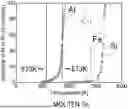
FIG. 1 is solubility curves of Al, Cu, Si, and Fe in molten Sn.
FIG. 2 is a schematic diagram of electrolytic equipment according to the disclosure
DETAILED DESCRIPTION
The following disclosure provides many different embodiments, or examples, for implementing different features of the provided subject matter. These are, of course, merely examples and are not intended to be limiting. In addition, the disclosure may repeat reference numerals and/or letters in the various examples. This repetition is for the purpose of simplicity and clarity and does not in itself dictate a relationship between the various embodiments and/or configurations discussed. Further, when a first element is described as being “connected” or “coupled” to a second element, such description includes embodiments in which the first and second elements are directly connected or coupled to each other, and also includes embodiments in which the first and second elements are indirectly connected or coupled to each other with one or more other intervening elements in between.
An objective of the disclosure is to provide a novel method using molten Sn to reduce or eliminate additive components and impurities in aluminum alloys.
A method for reducing or eliminating additive components or/and impurities in aluminum alloys according to the disclosure is based on a three-layer electrolytic process using a Sn—Al system alloy layer of a bottom layer as an anode, a refined Al layer of a top layer as a cathode, and a middle layer as a molten electrolytic bath.
The principle of the three-layer electrolytic process, as disclosed in Hiroaki HOSHIKAWA, Ichiro TANAKA, Tomohiro MEGUMI: SUMITOMO KAGAKU (2013), 10-19, also referred to as the three-layer electrolytic refining process, is one that was originally established to further increase the purity of electrolytic aluminum produced by the Hall-Heroult process.
For the anode alloy layer of the bottom layer, an Al—Cu alloy containing 30 to 40% of Cu is used, and its specific gravity is about 3.0.
The process involves the electrolytic movement of Al in this Al—Cu alloy through the electrolytic bath of the middle layer to the refined Al cathode layer of the top layer.
Since the specific gravity of the refined Al of the top layer is about 2.3, the molten electrolytic bath of the middle layer must be lighter than the specific gravity of the anode alloy layer of the bottom layer and heavier than the specific gravity of the refined Al of the cathode side of the top layer, and thus the specific gravity of the molten electrolytic bath of the middle layer is about 2.7.
In addition, salts of metals that are more active and have a higher electrical conductivity than aluminum are used.
The disclosure includes the use of a Sn—Al alloy containing 0 to about 50% of Al instead of the Al—Cu alloy used in the three-layer electrolytic process described in this Hiroaki HOSHIKAWA, Ichiro TANAKA, Tomohiro MEGUMI: SUMITOMO KAGAKU (2013), 10-19.
The specific gravity of this molten Sn—Al system alloy is about 3.5 (according to W. J Coy and R. S. Mateer: Trans. ASM, 58(1965), 99. and A. E. Schwaneke, W. L. Falke and V. R. Miller: J. Chem. Eng. Data, 23(1978), 298-301.).
In the disclosure, aluminum alloy materials supplied to the bottom layer can be a molten alloy that solid Si or/and solid Fe are crystallized and separated in the molten Sn—Al system alloy.
If the Sn—Al system alloy layer of the bottom layer contains a large amount of Si, the density of the anode alloy may decrease due to the specific gravity of Si of about 2.3, and electrolysis is likely to become difficult.
However, from the phase diagram of Al and Sn disclosed in A. J. McAlister and D. J. Kahan: Bulletin of Alloy Phase Diagram, 4(1983), 410, the phase diagram of Si and Sn disclosed in R. W. Olesinski and G. J. Abbaschian: Bulletin of Alloy Phase Diagram, 5(1984), 273, the phase diagram of Fe and Sn disclosed in K. C. Hari Kumar, P. Wollants, and L. Delaey: Calphad, 20(1996), pp. 139-149., and the phase diagram of Cu and Sn disclosed in S. Furtauer, D. Li, D. Cupid, H. Flandorfer: Intermetallics, 34(2013), 142-147,the solubility curves of Al, Cu, Fe, and Si versus a temperature of molten Sn as shown in FIG. 1 can be obtained.
From this solubility curve in FIG. 1, the following can be seen.
When the temperature of molten Sn is raised to 1,000 K or more, Al, Cu, Si, and Fe are dissolved.
When the temperature of molten Sn is lowered to about 873 K, about 50% of Al and about 30% of Cu are dissolved, but Si and Fe are not dissolved but crystallized and separated as solid Si and Fe.
Since the specific gravity of Si is 2.3, relatively light, it can be floated and separated, and on the other hand, since the specific gravity of Fe is 7.9, relatively heavy, it can be sedimented and separated.
This has already been demonstrated in JP-2023-077600, previously filed for a patent application by the present inventors.
In the disclosure, therefore, the Sn—Al alloy layer of the bottom layer, eliminating Si and Fe in advance with molten Sn—Al, can be used, but if a melt temperature of the molten Sn—Al system alloy is a temperature at which solid Si and solid Fe are crystallized, solid Si and solid Fe can be separated in a supply section that supplies aluminum raw material corresponding to Al moving from the anode Sn—Al alloy to the cathode side, resulting in continuous supply of aluminum raw material.
In the disclosure, since Cu contained in the aluminum raw material is dissolved in the molten Sn—Al alloy layer, the Sn—Al system alloy layer can be a Sn—Al—Cu system alloy layer.
In the disclosure, since the Sn—Al system alloy layer or the Sn—Al—Cu system alloy layer is used as the anode of the bottom layer in the three-layer electrolytic process, setting a melt temperature in a predetermined range makes it possible to recover further higher purity aluminum, to improve horizontal recycling of wrought materials and to obtain further higher purity aluminum, while reducing or eliminating Si and Fe components of the aluminum raw materials that are recycled raw materials.
Exemplary embodiments are described below. Note that the following exemplary embodiments do not in any way limit the scope of the content defined by the claims laid out herein. Note also that all of the elements described in the present embodiment should not necessarily be taken as essential elements.
FIG. 2 is a schematic diagram of electrolytic equipment of a method for reducing or eliminating additive components or impurities in an aluminum alloy based on a three-layer electrolytic process according to the disclosure.
The principle is to apply a voltage between the cathode and the anode and electrolyze molten salt.
The equipment includes an electrolytic cell 1 made of refractory bricks and the like, and a charging furnace 2 that supplies a molten alloy to an anode alloy cell of a bottom layer of the electrolytic cell 1.
The electrolytic cell 1 has, as an anode alloy layer that is an anode side, a Sn—Al system alloy layer in which Al is dissolved in Sn, or a Sn—Al—Cu system alloy layer in which Cu is further dissolved, and the specific gravity of these is about 3.5 to 6.1.
A refined Al layer is formed by electrolysis in a top layer that is a cathode side.
The specific gravity of the refined Al layer is about 2.3.
A middle layer has a molten electrolytic bath composed of molten salt.
This molten electrolytic bath uses a known electrolytic bath as described in JP-A-2000-192278 and Hiroaki HOSHIKAWA, Ichiro TANAKA, Tomohiro MEGUMI: SUMITOMO KAGAKU (2013), 10-19.
For example, fluorides and chlorides of Na, Ba, Al, Ca, and Mg, or mixed salts thereof, are used, and those with the specific gravity of about 2.7, that are more active than aluminum and have good conductivity, are selected.
In the three-layer electrolytic process, the Al dissolved in the molten Sn moves to the refined Al (cathode) side as Al3+ ions by molten salt electrolysis, and high-purity aluminum is obtained.
As Al is decreased in the anode alloy layer by molten electrolysis, aluminum raw material M containing components (impurities) such as Si, Fe, and Cu in Al is charged from the charging furnace 2.
In this charging furnace 2, the molten Sn—Al alloy held at a temperature of about 873 K, is stored in advance.
At this temperature of about 873 K, about 50% by mass of Al is dissolved in the molten Sn, and as the electrolysis proceeds, the dissolved Al decreases; and when the aluminum raw material containing impurities such as Si, Fe, and Cu in Al is charged from the top of the charging furnace 2, the Al dissolves but the Si does not dissolve and floats to the top side of the charging furnace 2 as solid Si with the specific gravity of 2.3 to be separated.
This solid Si can be used as a Si raw material.
In addition, Fe sediments and separates, because Fe does not dissolve and has the specific gravity of 7.9.
This makes it possible to suppress Si and Fe to be mixed to the anode alloy layer side, thus the three-layer electrolytic refining can be realized.
The disclosure makes it possible to recycle as aluminum materials of high purity because the disclosure can reduce or eliminate components in aluminum alloys collected from cities and the like.
Although only some embodiments of the present disclosure have been described in detail above, those skilled in the art will readily appreciate that many modifications are possible in the embodiments without materially departing from the novel teachings and advantages of this disclosure. Accordingly, all such modifications are intended to be included within scope of this disclosure.
Claims
1. A method for reducing or eliminating additive components or/and impurities in aluminum alloys based on a three-layer electrolytic process, the three-layer electrolytic process using:
a Sn—Al system alloy layer of a bottom layer as an anode;
a refined Al layer of a top layer as a cathode; and
a middle layer as a molten electrolytic bath.
2. The method for reducing or eliminating additive components or/and impurities in aluminum alloys according to claim 1, wherein an aluminum alloy material supplied to the bottom layer is a molten alloy, in which solid Si or/and solid Fe are crystallized and separated in a molten Sn—Al system alloy.
3. The method for reducing or eliminating additive components or/and impurities in aluminum alloys according to claim 1, wherein the Sn—Al system alloy layer is a Sn—Al—Cu system alloy layer.
4. The method for reducing or eliminating additive components or/and impurities in aluminum alloys according to claim 2, wherein a melt temperature of the molten Sn—Al system alloy is a temperature at which the solid Si and the solid Fe are crystallized.
Images & Drawings included:

Sources:
- United States Patent and Trademark Office - verify current appl. status at the USPTO↗
Recent applications in this class:
- » 20250116023 2025-04-10
METHOD FOR OPERATING AN ELECTROLYTIC CELL - » 20240352611 2024-10-24
AN ELECTRODE BODY OF AN ELECTRODE FOR THE ELECTROLYTIC PRODUCTION OF A METAL - » 20220275528 2022-09-01
Apparatus and method for operating an electrolytic cell - » 20220056605 2022-02-24
Anode for aluminium electrolysis - » 20220002892 2022-01-06
METHOD AND APPARATUS FOR PRODUCING ALUMINUM MATERIAL - » 20200115812 2020-04-16
Metal inert anode for aluminum production of by the electrolysis of a melt - » 20200063279 2020-02-27
ANODE APPARATUS AND METHODS REGARDING THE SAME - » 20200040476 2020-02-06
Anode clamping device - » 20200032408 2020-01-30
SYSTEM AND METHOD FOR MEASURING ANODE CURRENT OF ALUMINUM ELECTROLYTIC CELL - » 20190078223 2019-03-14
ANODE-STIFFENING DEVICE AND STIFFENING SYSTEM THAT USES SAID DEVICE