NONWOVEN ROLLED PRODUCT AND METHOD OF DISPENSING THE SAME
US20260167446A1
2026-06-18
19/414,577
2025-12-10
Smart Summary: A container holds a rolled product made of nonwoven sheets. These sheets are connected by small holes, making it easy to tear off one at a time. Users can pull out the sheets whenever they need them. To help users find where to grab the sheets, there are special indicators that can be seen while the product is still in the container. These indicators can be either visible marks or changes in the product's structure. 🚀 TL;DR
Abstract:
A system includes a container and a rolled product in the container. The rolled product is a nonwoven rolled product that includes numerous sheets coupled to adjacent sheets via perforations. The nonwoven rolled product can be removed from the container when desired by a user. The location on the nonwoven rolled product that a user can grab to fill out one or more sheets can be identified by one or more indicators. The indicators can be visual or structural, and are located so that a user can see an indicator when the nonwoven rolled product is in the container.
Inventors:
- EDWARD JASON WHITE 9 🇺🇸 PLEASANTON, CA, United States
- Nikhil Dani 11 🇺🇸 Pleasanton, CA, United States
- Timothy Audiss 2 🇺🇸 Pleasanton, CA, United States
- Kira Pyronneau 2 🇺🇸 Pleasanton, CA, United States
Applicant:
Interested in similar patents?
Get notified when new applications in this technology area are published.
Classification:
B65H16/005 » CPC main
Unwinding, paying-out webs Dispensers, i.e. machines for unwinding only parts of web roll
B65H16/00 IPC
Unwinding, paying-out webs
B65H16/00 IPC
Feeding webs to or from machines; Winding or unwinding webs; Splicing webs
Description
CROSS-REFERENCE TO RELATED APPLICATION
This patent application is a non-provisional application of, and claims priority to and the benefit of, U.S. Patent App. No. 63/735,124, entitled “Nonwoven Rolled Product and Method of Dispensing the Same”, filed Dec. 17, 2024, the entire disclosure of which is incorporated herein by reference in its entirety.
FIELD OF THE INVENTION
The present invention is directed generally to a nonwoven rolled product, and more specifically, to a fibrous web or nonwoven rolled product that contains one or more features that facilitate a consumer removing the product from a container.
BACKGROUND
Nonwoven rolled products are well known. In some instances, a nonwoven rolled product may include a liquid that has particular characteristics and properties, such as for cleaning or disinfecting a surface. The nonwoven rolled product may be a plurality of interconnected sheets or wipes. Current rolled products that are dispensed from a canister or container sometimes are difficult find the start of the product to withdrawn it from the container.
There is a need to provide a user with an easier way to start the process of withdrawing the fibrous web or nonwoven rolled product from a container.
SUMMARY
The present invention relates to nonwoven rolled products in a dispensing container, and a method of dispensing the nonwoven rolled products from the dispensing container.
In one aspect of the present disclosure, a system for dispensing a nonwoven rolled product comprises a container, and a nonwoven rolled product disposed in the container, the nonwoven rolled product including a body having a first end defining a top of the nonwoven rolled product, a second end opposite the first end and defining a bottom of the nonwoven rolled product, an interior region, a side defining an outer perimeter of the nonwoven rolled product, and an indicator that identifies an initial part of the nonwoven rolled product for a user to grab to pull the nonwoven rolled product out of the container, wherein the indicator is located on the outer perimeter of the nonwoven rolled product.
In one embodiment, the indicator is a bent portion that extends in a direction opposite to a remainder of the nonwoven rolled product.
In another embodiment, the bent portion is located between the container and a remainder of the body, and creates spacing between the nonwoven rolled product and the container.
In an alternative embodiment, the indicator is located on the first end.
In yet another embodiment, the indicator is a first indicator, and the body includes a second indicator that also identifies an initial part of the nonwoven rolled product for a user to grab to pull the nonwoven rolled product out of the container.
In another embodiment, the second indicator is located proximate to the first end of the body.
In an alternative embodiment, the container has a first end and a second end opposite to its first end, the container first end includes an opening through which the nonwoven rolled product can be withdrawn from the container, and the second indicator is closer to the container first end than to the container second end.
In another embodiment, the second indicator is located on at least one of the top or the side of the body.
In an alternative embodiment, the body has a first color or pattern, and the second indicator is a second color or pattern that is different from the first color or pattern.
In another embodiment the body has a first surface texture pattern, and the second indicator is a second surface texture pattern that is different from the first surface texture pattern.
In one embodiment, the container includes a side wall, and the indicator engages the side wall to create spacing between the nonwoven rolled product and the side wall of the container.
In an alternative embodiment, the indicator, also called a starter panel, is a bent portion that forms a space between the first end and a remainder of the nonwoven rolled product.
In another aspect of the present disclosure, a system for dispensing a nonwoven rolled product comprises a container, and a nonwoven rolled product disposed in the container, the nonwoven rolled product including a first feature that identifies an initial part of the nonwoven rolled product for a user to grab to pull the nonwoven rolled product out of the container; and a second feature that creates spacing between the nonwoven rolled product and the container.
In one embodiment, the nonwoven rolled product has a first end defining a top of the nonwoven rolled product, a second end opposite the first end and defining a bottom of the nonwoven rolled product, an interior region, and a side defining an outer perimeter of the nonwoven rolled product, and the first feature is located proximate to the first end of the nonwoven rolled product.
In another embodiment, the container has a first end and a second end opposite to its first end, the container first end includes an opening through which the nonwoven rolled product can be withdrawn from the container, and the first feature is located proximate to the first end of the nonwoven rolled product that is closer to the container first end than to the container second end.
In an alternative embodiment, the first feature is located on the top of the nonwoven rolled product.
In one embodiment, the first feature is located on the side of the nonwoven rolled product.
In another embodiment, the second feature is located on the outer perimeter of nonwoven rolled product.
In an alternative embodiment, the first feature includes an indicator that is perceivable by a user.
In another embodiment, the nonwoven rolled product has a first color or pattern, and the indicator is a second color or pattern that is different from the first color or pattern.
In yet another embodiment, the nonwoven rolled product has a first surface texture pattern, and the indicator is a second surface texture pattern that is different from the first surface texture pattern.
In an alternative embodiment, the container includes a side wall, and the second feature engages the side wall to create the spacing between the nonwoven rolled product and the side wall of the container.
In another embodiment, the second feature includes the nonwoven rolled product having a bent portion that extends away from a remainder of the nonwoven rolled product.
In yet another embodiment, the bent portion of the nonwoven rolled product forms a flap that is located between a side wall of the container and a remainder of the nonwoven rolled product.
In an alternative embodiment, the second feature is a panel that is coupled to the nonwoven rolled product and is folded back. In this embodiment, the folded back portion acts like a starter panel that enables a user to easily locate and grab a first one of the detachable sheets.
In another aspect of the present disclosure, a nonwoven rolled product for use with a dispensing container comprises a body including a roll of detachable sheets, a first feature disposed on the body that identifies an initial part of the body for a user to grab to pull a first one of the detachable sheets out of the dispensing container, and a second feature coupled to the body that creates spacing between the body and the dispensing container.
In one embodiment, the body has a first end defining a top of the body, a second end opposite the first end and defining a bottom of the body, an interior region, and a side defining an outer perimeter of the body, the first feature is located proximate to the first end of the body, and the second feature is located on the outer perimeter of the body.
In another embodiment, the first feature is located at least one of the top or the side of the body.
In an alternative embodiment, the first feature includes an indicator that is perceivable by a user, and the second feature is a bent portion.
In another aspect of the present disclosure, a nonwoven rolled product comprises a body having a plurality of sheets coupled together by rows of perforations and in a rolled configuration, one or more of the rows of perforations varies in strength along the same row from the top of the body to the bottom of the body, an indicator disposed on the body that identifies an initial part of the plurality of sheets for a user to grab to pull one or more of the plurality of sheets, and a grabbable structure coupled to the body that is located on an outside of the body.
In one embodiment, the body has a first end defining a top of the body, a second end opposite the first end and defining a bottom of the body, an interior region, and a side defining an outer perimeter of the body, the indicator is located proximate to the first end of the body, and the grabbable structure is located on the outer perimeter of the body.
In another embodiment, the indicator is located at least one of the top or the side of the body, the indicator including one of a color, a pattern, or a textured surface, and the grabbable structure is a bent portion.
In an alternative embodiment, one or more of the rows of perforations varies in strength along the same row from the top of the body to the bottom of the body.
In another embodiment, spacing between perforations varies along one or more of the rows of perforations.
In an alternative embodiment, a size of the perforations varies along one or more of the rows of perforations.
BRIEF DESCRIPTION OF THE FIGURES
FIG. 1 is a front view of an exemplary conventional dispensing container.
FIG. 2A is an exploded front perspective view of the conventional dispensing container illustrated in FIG. 1 with a roll of wipes.
FIG. 2B is a top view showing part of the wipes illustrated in FIG. 2A located inside another conventional container.
FIG. 3 is a plan view of several sheets during a manufacturing process according to the present disclosure.
FIG. 4 is a schematic block diagram illustrating an embodiment of a dispensing system according to the present disclosure.
FIG. 5A is a front perspective view of an embodiment of a nonwoven rolled product according to the present disclosure.
FIG. 5B is a rear perspective view of the nonwoven rolled product illustrated in FIG. 5A.
FIG. 6A is a front perspective view of another embodiment of a nonwoven rolled product according to the present disclosure.
FIG. 6B is a rear perspective view of the nonwoven rolled product illustrated in FIG. 6A.
FIG. 7A is a top perspective view of the nonwoven rolled product illustrated in FIG. 6A disposed in a container.
FIG. 7B is a top perspective view of another embodiment of a nonwoven rolled product disposed in a container according to the present disclosure.
FIG. 8 is a top perspective view of another embodiment of a nonwoven rolled product according to the present disclosure.
FIG. 9 is a top perspective view of the nonwoven rolled product illustrated in FIG. 8 disposed in a container.
FIG. 10A is a front perspective view of another embodiment of a nonwoven rolled product according to the present disclosure.
FIG. 10B is a top view of the nonwoven rolled product illustrated in FIG. 10A.
FIG. 11 is a top schematic view of manufacturing stages of an embodiment of a nonwoven rolled product according to the present disclosure.
FIG. 12 is a top view of the nonwoven rolled product illustrated in FIGS. 10A and 10B disposed in a container.
FIG. 13 is a top perspective view of another embodiment of a nonwoven rolled product disposed in a container according to the present disclosure.
FIG. 14A is a front perspective view of another embodiment of a nonwoven rolled product according to the present disclosure.
FIG. 14B is a top view of the nonwoven rolled product illustrated in FIG. 14A.
FIG. 14C is a top perspective view of the nonwoven rolled product illustrated in FIG. 14A disposed in a container.
DETAILED DESCRIPTION
The present invention is described more fully hereinafter with reference to the accompanying drawings, in which embodiments of the invention are shown. This invention may, however, be embodied in many different forms and should not be construed as limited to the embodiments set forth herein; rather, these embodiments are provided so that this disclosure will be thorough and complete, and will fully convey the scope of the invention to those skilled in the art.
In some implementations, nonwoven products are rolled into a donut shape and can be disposed in a cavity or receptacle of a container or canister. The nonwoven rolled product can be referred to as a “donut” and includes numerous sheets that are coupled to adjacent sheets via perforations. In some embodiments, there is a desire to increase the quantity of sheets in a roll of nonwoven products. Conventional nonwoven rolled products in a dispensing canister are configured for dispensing the product out of the center of the donut.
However, in the present disclosure, the nonwoven rolled product are configured to be dispensed from the outside of the donut or nonwoven rolled product. By dispensing at a different location (the outside of the donut vs. the center of the donut), the user experience is improved and a higher density donut package can be provided because the core or interior region can collapse on itself, thereby allowing a higher count of sheets in a rolled package
In one embodiment, a nonwoven rolled product according to the present disclosure includes an indicator that shows a user the desired starting location for the nonwoven rolled product. The desired starting location is where a user should grab a portion of the nonwoven rolled product to begin the process of dispensing the nonwoven rolled product from a container. In one implementation, the indicator is a visual cue located on the nonwoven rolled product. The indicator can be a structural feature on the nonwoven rolled product, such as an end sheet of the nonwoven rolled product folded back to form a flap or panel. The indicator can also be a part of the nonwoven rolled product that has a different color, pattern, and/or a textured surface relative to the remainder of the nonwoven rolled product. In the present disclosure, the indicator can be located on the outside or outer surface of the nonwoven rolled product and/or the top of the nonwoven rolled product proximate to its outside or outer surface.
Referring to FIG. 1, a front view of an exemplary conventional canister is illustrated. The canister can be referred to alternatively as a container. The canister 10 includes a housing or body 12 and a removable lid 14 that can be coupled to the housing 12. The lid 14 can be opened or closed to control access to the interior of body 12 and any product located in the body 12 of the canister 10. The housing may be a soft or substantially rigid material. In one embodiment, the lid is more rigid than the housing material so that the housing material may flex to connect to the lid to form a sealed container. To make the lid more rigid than the housing material the thickness of material used for the lid may be greater than the thickness of the material for the housing. In addition, the lid may be formed by an injection molding process whereas the housing may be formed using a blow molding process.
Exemplary canisters having different features are disclosed in the following patents: U.S. Design Pat. No. D 771,489, issued Nov. 15, 2016, entitled “Wipes Dispenser Container Lid”; U.S. Design Pat. No. D773,930, issued Dec. 13, 2016, entitled “Lid With An Orifice”; U.S. Pat. No. 9,974,419, issued May 22, 2018, entitled “Disinfecting Wipes Dispenser”; U.S. Pat. No. 10,327,602, issued Jun. 25, 2019, entitled “Disinfecting Wipes Dispenser”; U.S. Pat. No. 10,806,309, issued Oct. 20, 2020, entitled “Disinfecting Wipes Dispenser”; and U.S. Pat. No. 11,439,281, issued Sep. 13, 2022, entitled “Disinfecting Wipes Dispenser”. The entire disclosure of each of the six patents identified in this paragraph is incorporated by reference herein in its entirety.
FIG. 2A is an exploded front perspective view of the conventional canister 10 and an exemplary product that can be located in the canister 10. The body 12 of the canister 10 includes a wall 18 with an inner surface 20 that defines an interior region or receptacle 22. A product 30 can be inserted into the interior region 22. Typically, the product 30 is a rolled product that is inserted into the canister 10 prior to the canister 10 being transported. Alternatively, the rolled product may be a replacement product that is transported and/or purchased separately from the canister 10 and subsequently inserted therein. A user can access the product 30 in the canister 10 through an opening 15 in the lid 14 when the closure element 16 of the lid 14 is opened. The closure element 16 may be hinged to the base of the lid 14. In different embodiments, the shape and configuration of the lid 14 can vary. For example, the lid 14 have a landing member that may define a space or a gap through which the product 30 may be pulled.
In one embodiment, the product 30 is a continuous rolled product that includes several layers 32 that define an interior region 36 and an outer perimeter 38. The outer perimeter 38 is sized so that the product 30 can fit within the receptacle 22 of the canister 10. The product 30 includes an end 34 that can be grabbed and pulled by a user along the direction of arrow “A” to remove a portion of the product 30 from the container 10. Notably, the end 34 is located in the interior region 36 of the product 30. In one embodiment, the product 30 is a continuous nonwoven rolled product, such as a roll of disinfecting or cleaning wipes.
Referring to FIG. 2B, a conventional canister 50 is illustrated with the product 30 disposed therein. In this example, the product 30 may be wipes that are wound in the shape of a donut. Canister 50 includes a body and a lid 52 coupled to the body. The lid 52 has a landing member 54 formed therewith. The landing member 54 has two portions 56 and 58 that define therebetween a space or gap 60 through which the end 34 of the product 30 may be pulled from the interior region 36 of the product 30 in the canister 50. The space or gap 60 may be referred to alternatively as a gripping channel. The space or gap 60 is sized so that the edges of the opposing portions 56 and 58 of the landing member 54 frictionally engage the product 30 passing therethrough and enhance the ability of a user to pull the product 30 from the canister 50 in a substantially vertical direction, while limiting any tendency of the interconnected wipes to “rope,” to disengage from gripping channel 60 and fall back into container 50, or both. The gripping channel 60 is configured to separate a lead wipe from a following wipe as the lead wipe is pulled through gripping channel 60. In other embodiments, a container aperture may be used without a gripping channel and the container aperture or other suitable dispensing feature may be configured to separate the lead wipe from the following wipe as the lead wipe is pulled away from the container. In a further embodiment of the invention, the container may include a rip fence that is designed to help separate a lead wipe from the following wipe as the wipes are dispensed from the container.
The present disclosure relates to a nonwoven rolled product that can be dispensed from a container. The nonwoven rolled product includes a plurality of sheets that are detachably coupled to adjacent sheets via perforations. As will be described in detail below with respect to various embodiments of nonwoven rolled products, the present disclosure relates to identifying a part of the nonwoven rolled product for a user to grab and pull to dispense the product from a container. The part to be grabbed is on the outside of the nonwoven rolled product. One or more indicators or locating features can be provided on the nonwoven rolled product to assist a user to identify what part is to be grabbed. The indicators can vary in terms of types and locations, as described below as well.
One aspect of outside dispensing as disclosed herein is the direction change during dispensing. Dispensing works well if a consumer changes direction or pulls down a bit while dispensing wipes to increase the friction against the rim of the canister or lids. As described below, the concept of a row of perforations having an inconsistent strength helps to have the wipe still attached to the donut and be pulled away from the body of the donut, thereby making it easier to dispense the next wipe. In one embodiment, outside dispensing utilizes an overall stronger row of perforations that has a concentrated area of strength, with the wipes dispensed from the outside of the donut and interacting with a rim of the canister or lid as the consumer changes direction during dispensing.
By having a user pull sheets from the outside of the nonwoven rolled product, the perforation strength must be increased compared to conventional products to allow the perforations to be strong enough to spin the nonwoven rolled product during dispensing, and to prevent the wipes from separating prior to being fully removed from the container. In one embodiment, the perforation pattern is consistent across the width of the wipe (i.e., from the top of the body to the bottom of the body). In another embodiment, the perforation pattern is inconsistent across the width of the wipe (i.e., from the top of the body to the bottom of the body). An area of strength, caused by an increase in the quantity of perforation tabs, or an increase in perforation tab size, or a combination of both, can allow for the wipe to tear at a different location or spot relative to the height of the donut as it is dispensed, leaving the tail of the next wipe positioned towards the top, or on top of the donut, to be more accessible to the consumer for the next wipe to be dispensed. By creating a localized area of strength along the width of the wipe (or length of the body), when the wipe tears, the wipe is not stuck to the side of the body and it is separate and presents itself to the consumer for the next dispensing event.
In one embodiment, for the perforation strength to change or be inconsistent across the width of the wipe, the spacing the perforations may vary along a row of perforations. In another embodiment, for the perforation strength to change or be inconsistent across the width of the wipe, the size of the perforation tabs may vary along a row of perforations. Thus, in different embodiments, a donut may be a roll of sheets that has one or more of the rows of perforations that vary in strength along the same row from the top of the body of the donut to the bottom of the body of the donut.
Referring to FIG. 3, a plan view of several sheets during a manufacturing process is illustrated. In this embodiment, the product 100 includes several sets of sheets 110, 120, and 130 that are processed along the machine direction (see arrow “G”). Each set of sheets 110, 120, and 130 will be rolled up in a subsequent manufacturing step to form a donut. During manufacturing, splitters (not shown) are utilized to make cuts along lines 140, 142, 144, and 146 between adjacent sets of sheets. The lines 140, 142, 144, and 146 define the width of the sheets for a donut, and in this example embodiment, the width “d1” can be seven inches. In alternative embodiments, the width “d1”0 of the sheets can vary provided that the sheets are sized to fit into a package or container.
Sheet set 110 includes numerous sheets continuously connected along the direction of arrow “G” between lines 140 and 142. However, in the view shown in FIG. 3, only two of the numerous sheets of sheet set 110 are illustrated. Sheet set 110 includes sheets 112 and 114 coupled together by several perforations 116. Similarly, sheet set 120 includes sheets 122 and 124 coupled together by several perforations 126, and sheet set 130 includes sheets 132 and 134 coupled together by several perforations 136. The different sets of perforations 116, 126, and 136 illustrate the changing of perforations to achieve different strength areas.
For applications where it is desired to have more strength in the perforations toward the top of a rolled product, the top of the rolls would be along the left edges of the sheets in FIG. 3. In that implementation, line 140 is the top of sheets 112 and 114, line 142 is the top of sheets 122 and 124, and line 144 is the top of sheets 132 and 134. In an alternative implementation, the increased perforation strength areas can be closer to the bottom of the donut. In that implementation, lines 140 and 142, and 144 would be the bottoms of the respective sheets. When the sets of sheets or substrates are processed, the manufacturing equipment can be configured to insert the donut into a canister in either orientation, up or down.
Perforation row 116A is illustrative of perforations 116 between sheets 112 and 114. In this embodiment, the row 116A includes a portion 118 that has more tabs or perforations between the sheets 112 and 114 and the spacing is varied relative to the rest of the row to increase the strength in the area of portion 118. Perforation row 126A is illustrative of perforations 126 between sheets 122 and 124. In this embodiment, the row 126A includes a portion 128 that has bigger or wider tabs or perforations between the sheets 122 and 124 to increase the strength in the area of portion 128. Perforation row 136A is illustrative of perforations 136 between sheets 132 and 134 that have a constant spacing and width relative to each other. As a result, perforation row 136A does not have an increased strength area. In one embodiment, perforations 136 are at a constant spacing of 0.5″ therebetween.
In one embodiment, the sheets of a nonwoven rolled product may be unwound in a clockwise direction, which is easier for a right-handed person. Alternatively, in another embodiment, the sheets of a nonwoven rolled product may be unwound in a counter-clockwise direction, which is easier for a left-handed person
Turning to FIG. 4, a schematic block diagram shows an embodiment of a dispensing system according to the present disclosure. In this embodiment, the dispensing system 190 includes a container 200 and a nonwoven rolled product 300 located in a cavity or receptacle in the container 200. The container 200 can be referred to alternative as a canister. It is to be understood that the various components and parts of the container 200 and the nonwoven rolled product 300 illustrated in FIG. 4 are not drawn to scale and any illustrated spacing between them is exemplary.
In this embodiment, the container 200 has an upper end 202 and a lower end 204 opposite to the upper end 202. The upper end 202 includes an opening 206 formed therein through which the nonwoven rolled product 300 can be withdrawn or dispensed along the direction of arrow “A”. While not illustrated in FIG. 4, the container 200 may have a lid coupled to upper end 202 that has a selectively openable and closeable closure element coupled thereto to cover or close the opening 206. Container 200 also includes a side wall 208 that has an inner surface 210. In one embodiment, the container 200 can be generally cylindrical. In an alternative embodiment, the container 200 may have a shape other than a cylinder, such as cross-section that is an oval, square, or the like.
Nonwoven rolled product 300 includes a body 310 that is formed by numerous sheets that are detachably connected to adjacent sheets via perforations. The body 310 is a roll of those sheets and is generally cylindrical in its overall shape. The body 310 has a first end 312 that defines the top 314 of the body, and an opposite second end 316 that defines the bottom 318 of the body. In addition, the body 310 has a side or outer side 322 that defines an outer perimeter 324 of the nonwoven rolled product 300.
In one embodiment, the nonwoven rolled product 300 includes an indicator or locating feature 350 that is perceivable by a user to identify the starting location on the nonwoven rolled product 300. The indicator 350 can be a visual indicator, such as a different color or pattern relative to the rest or remainder of the nonwoven rolled product 300. Alternatively, or in addition, the indicator 350 can be an indicator that can be touched, such as a textured surface that has a different feel and/or appearance relative to the surface of the rest or remainder of the nonwoven rolled product 300. Indicator 350 is located in a position in which a user can see indicator 350 to identify where on the outside of the body 310 is the starting location for the nonwoven rolled product 300 in the container 200. Indicator 350 can be located on the top 314 and/or side 322 of the body 310, as represented by the dashed lines in FIG. 4.
In one embodiment, the nonwoven rolled product 300 includes an indicator or locating feature 360 that is also perceivable by a user to identify the starting location on the nonwoven rolled product 300. Indicator 360 is a structural feature or component that is located on or coupled to the body 310 of the nonwoven rolled product 300. Indicator 360 is located on a side 322 of the body 310, and identifies the location on the body 310 that can be grabbed by a user to pull or dispense the nonwoven rolled product 300 from the container 200. In one implementation, indicator 360 is located between the side 322 of the body 310 and the inner surface 210 of the side wall 208 of the container 200. Indicator 360 is located in a position in which a user can see indicator 360 to identify where on the outside of the body 310 is the starting location for the nonwoven rolled product 300 in the container 200.
In an alternative embodiment, the nonwoven rolled product 300 may include both indicator or feature 350 as well as indicator or feature 360. Various embodiments of nonwoven rolled products are illustrated in FIGS. 5A-14C and described in detail below.
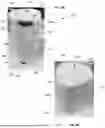
One embodiment of a nonwoven rolled product according to an aspect of the present disclosure is illustrated in FIGS. 5A and 5B. FIG. 5A is a front perspective view of nonwoven rolled product 400, and FIG. 5B is a rear perspective view of nonwoven rolled product 400. In FIG. 5A, the body 410 has a first end 412 that defines the top 414 of the body 410 and an opposite second end 416 that defines the bottom 418 of the body 410. As the body 410 is in a rolled configuration, the body 410 has an interior region or center region 420. The body 410 has a generally cylindrical configuration and has a side or side wall 422 that defines an outer perimeter 424 of the body 410. In this embodiment, nonwoven rolled product 400 includes a body 410 that includes a plurality of detachable sheets in the form of a roll that are connected by a row of perforations 411 (see FIG. 5B). The roll includes numerous rows of perforations 411 that are located between adjacent detachable sheets. In one embodiment, the nonwoven rolled product 400 includes one or more rows of perforations 411 that varies in strength along the same perforation row 411 from the top 414 of the body 410 to the bottom 418 of the body 410. As shown in FIG. 5B, perforation row 411 includes a first portion 411A in which the perforations are stronger than the perforations in a second portion 411B of the perforation row 411. In one implementation, the perforations 411 may include the first portion 411A and the second portion 411B that have different strength perforations. In another implementation, the strength of the perforations 411 in the row can gradually transition along the row 411 from the first portion 411A to the second portion 411B.
The body 410 also has an end 426 that is the initial edge of the nonwoven rolled product 400 to be used by a user to pull the nonwoven rolled product 400 out of a container. The first sheet 430 of the nonwoven rolled product 400 that has end 426 is retained to the rest of the body 410 by an adhesive 428 located between the first sheet 430 and a side 422 of the body 410. The first sheet 430 is referred to as the first sheet because it is intended to be the first sheet pulled or dispensed out of the container. However, the first sheet 430 is the last or outermost sheet of the roll after the manufacturing process of the nonwoven rolled product 400. The adhesive 428 extends along the side 422 of the body 410 and is spaced slightly away from the end 426 so that the distal part of end 426 forms a slight gap or space with respect to the side 422 of body 410.
Nonwoven rolled product 400 has an initial part 440 that is to be grabbed by a user to start dispensing and pulling the nonwoven rolled product 400 from a container. The initial part 440 can be referred to alternatively as a first pick point from the container. The initial part 440 is located on the outside of the body 410 and can be referenced as being on the outer perimeter of the body 410. In this embodiment, a user can identify the initial part 440 by way of an indicator or locating feature 450. When a user opens a closure mechanism of a lid on a container and looks through the opening of the lid, the user can see the indicator 450 and easily identify the first part of the nonwoven rolled product 400 to grab, which is the initial part 440. Indicator 450 is a visual cue in this embodiment and is a change in color relative to the remainder of the body 410. As shown, body 410 has a first color 470 and indicator 450 has a second color 472. In one implementation, the first color 470 can be white and the second color 472 can be black. In other implementations, the colors of first color 470 and second color 472 can vary so long as they are different from each other. In other embodiments, indicator 450 may be a pattern that is visually distinguishable from the remainder of the body 410 of the nonwoven rolled product 400. For example, the body 410 may have a generally smooth texture and the indicator 450 may have a rougher texture, such as raised bumps, that can be felt and identified by a user by touching indicator 450 and body 410.
In FIG. 5A, the body 410 of nonwoven rolled product 400 includes a second indicator 452 that is proximate to the second end 416 of the body 410. Indicator 452 is similar to indicator 450 in that indicator 452 is a perceivable color difference relative to the remainder of the body 410. Also, indicator 452 is located on the outer side 422 of the body 410. In a nonwoven rolled product 400 that has both indicator 450 and indicator 452, the body 410 can be placed into a receptacle of a container in either orientation because one of the indicators 450 and 452 would be proximate to the upper end of the container and therefore be viewable by a user to identify the initial part 440. It is to be understood that in different implementations, nonwoven rolled product 400 may include only one of indicator 450 or indicator 452. The initial part 440 can be grabbed by a user and pulled to dispense the sheets of the body 410 from the outside or outer perimeter of the body 410 of the nonwoven rolled product 400.
Another embodiment of a nonwoven rolled product according to an aspect of the present disclosure is illustrated in FIGS. 6A and 6B. FIG. 6A is a front perspective view of nonwoven rolled product 500, and FIG. 6B is a rear perspective view of nonwoven rolled product 500. In this embodiment, nonwoven rolled product 500 has several structural similarities to nonwoven rolled product 400, and as a result, only some of the features of nonwoven rolled product 500 are described in detail.
Nonwoven rolled product 500 includes a body 510 that includes a plurality of detachable sheets in the form of a roll. The body 510 has a first end 512 that defines the top 514 of the body 510 and an opposite second end that defines the bottom. Body 510 has an interior region or center region 520. The body 510 has a generally cylindrical configuration with a side that defines an outer perimeter of the body 510.
The body 510 also has an end 526 that is the initial edge of the nonwoven rolled product 500 to be used by a user to pull the nonwoven rolled product 500 out of a container. Similar to nonwoven rolled product 400, the first sheet or end panel 530 of the nonwoven rolled product 500 that has end 526 is retained to the rest of the body 510 by an adhesive 528 located between the first sheet 530 and a side of the body 510. The adhesive 528 extends along the side of the body 510 and is spaced slightly away from the end 526 so that the distal part of end 526 forms a slight gap or space with respect to the side of body 510. In this embodiment, the adhesive 528 ends at location 529, which results in an upper portion of the first sheet 530 leaning or hanging away from the body 510.
Nonwoven rolled product 500 has an initial part 540 that is to be grabbed by a user to start dispensing and pulling the nonwoven rolled product 500 from a container. As shown in FIG. 6A, the leaning or hanging away portion is an initial part 540 of the body 510 to be grabbed by a user. As shown in FIG. 6B, the initial part 540 hangs away from the body 510, which makes it more visible to a user.
In addition, a user can identify the initial part 540 by way of an indicator or locating feature 550. When a user opens a closure mechanism of a lid on a container and looks through the opening of the lid, the user can see the initial part 540 because it leans away from the body 510 and because it has an indicator 550 as well. In this embodiment, indicator 550 is a visual cue that is a change in color relative to the remainder of the body 510. As shown, body 510 has a first color and indicator 550 has a second color that is different from the first color. As noted above, in various implementations, the colors of first color and second color can vary so long as they are different from each other.
In this implementation, indicator 550 is provided proximate to the upper edge 527 and distal end 526 of the end panel 530. While indicator 550 is located on the outer side of the body 510, it is also located adjacent to the upper edge 527 proximate to the top 514 of the body 510. By being proximate to upper edge 527 and to distal end 526, indicator 550 is easily identifiable by a user because the initial part 540 leans away from the body 510 and is on the outside our outer perimeter of the body 510. In one embodiment, indicator 550 is provided on the outer side and the inner side of end panel 530. In an alternative embodiment, indicator 550 is provided only on one of the outer side or the inner side of end panel 530.
Turning to FIG. 7A, nonwoven rolled product 500 is disposed in a container 580. Container 580 includes a wall or side wall 582 that has an inner surface 584. Nonwoven rolled product 500 includes a body 510 that is a roll of many detachable sheets connected by perforations. The body 510 has a center region or interior region 520 that is shown collapsed upon itself. In other words, the body 510 is not configured for any sheets to be withdrawn or pulled from the interior region 520. In FIG. 7A, the upper end 512 of the body 510 is shown with the initial part 540 of the first sheet 530 hanging away from the remainder of the body 510 and being located on the outside or on the outer perimeter of the body 510. Indicator 550 is proximate to end 526 and viewable while body 510 is in the container 580. In this embodiment, the sheets of body 510 are wrapped or oriented along the direction of arrow “B”. In addition, first sheet 530 is oriented along the direction of arrow “B” as well. In this arrangement, the donut is unwound in a counter-clockwise direction, which is easier for a left-handed user.
Turning to FIG. 7B, an alternative embodiment of a nonwoven rolled product disposed in a container is illustrated. For the features of nonwoven rolled product 500A that are similar to features of nonwoven rolled product 500, the same reference numbers are used. As shown, nonwoven rolled product 500A has a body 510 with an upper end 512 and an initial part 540 with an indicator 550 proximate to end 527. The body 510 is located in a receptacle of a container 580 that has a side wall 582 with an inner surface 584. In this embodiment, the sheets of body 510 are wrapped or oriented along the direction of arrow “C”. First sheet 530 of nonwoven rolled product 500A is oriented along the direction of arrow “C” as well. In this arrangement, the donut is unwound in a clockwise direction, which is easier for a right-handed user.
In one implementation, this orientation change between FIGS. 7A and 7B can be accomplished by inserting opposite ends of the nonwoven rolled product 500 into the container 580 first, provided that indicators 550 are located on both the upper end and the lower end of the first sheet 530. In another implementation, nonwoven rolled product 500A can be wound or rolled in an opposite direction to nonwoven rolled product 500. As noted above, the change in orientation may be helpful to different ones of right-handed or left-handed users.
Turning to FIG. 8, a top perspective view of another embodiment of a nonwoven rolled product is illustrated. In this embodiment, nonwoven rolled product 600 includes a body 610 with an upper end 612 defining a top 614 of the body 610. The body 610 has a center region or interior region 620 as shown. The body 610 also has a side or outer side 622 that defines an outside or outer perimeter 624 of the body 610. A first sheet 630 of the body 610 includes an end or distal end 626.
Body 610 also has an initial part 640 that is identifiable by an indicator or feature 650. In this embodiment, indicator 650 includes a first indicator portion 650A that is located on the outer surface of the first sheet 630 and the outer perimeter 624 of the body 610. The first indicator portion 650A is a different color than the remainder of the body 610. In addition, indicator 650 includes a second indicator portion 650B that is located on the top 614 of the body 610. Similar to first indicator portion 650A, second indicator portion 650B is also a different color than the remainder of the body 610. The combination of the first indicator portion 650A and the second indicator portion 650B on body 610 makes it even easier for a user to identify the initial part 640 on the outside of the body 610 to be grabbed and pulled. A benefit of putting second indicator portion 650B on top 614 is that a user can see indicator 650 even if the nonwoven rolled product is turned so that indicator 650 is located away from the user.
Turning to FIG. 9, nonwoven rolled product 600 is disposed in a container 680 that includes a wall 682 with an inner surface 684. When the body 610 is located in the container 680, the initial part 640 is disposed between the inner surface 684 of the wall 682 and the side 622 of the body 610. Indicator 650 can be seen when body 610 is in container 680. As shown in FIG. 9, indicator portion 650A on the top 614 is easily viewable as well as indicator portion 650B on first sheet 630 proximate to end 626. Indicator portions 650A and 650B help the user identify the initial part 640 to be grabbed on the outside of the body 610.
Turning to FIGS. 10A and 10B, a front perspective view and a top perspective view, respectively, of another embodiment of a nonwoven rolled product are illustrated. In this embodiment, nonwoven rolled product 700 includes a body 710 with an upper or first end 712 and a lower or second end 716 opposite to the upper or first end 712. The body 710 also includes a center region or interior region 720 that is best seen in FIG. 10B. Similar to the previously described nonwoven rolled products, body 710 also includes a side 722 that defines an outer side or outer perimeter 724 of the body 710. A first sheet 730 includes a distal end 726 as well.
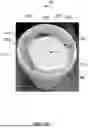
Nonwoven rolled product 700 includes an initial part 740 that is identifiable by indicator or feature 760. In this embodiment, indicator or locating feature 760 is a structure feature or component of the body 710. In particular, indicator 760 is a bent portion or folded back panel or flap 770 that is formed by a fold 772, which is an outward fold because the starter panel is located on the outside of the body 710. During the manufacturing process, part of the first sheet 730 is folded back relative to the remainder of the first sheet 730. A fold 772 is formed by that manufacturing step, which results in the folded back part of the first sheet 730 being a bent portion 770.
In one implementation, the fold 772 is located approximately 1 to 3 inches from the end 726. The fold 772 creates a thick spot that pushes away from the outer perimeter of the body 710, making it more visible to a user from the top of the container.
Referring to FIG. 11, two exemplary manufacturing steps relating to nonwoven rolled product 700 are illustrated in top views. The upper end 712 of body 710 as well as the side 722 and outer perimeter 724 are shown. Nonwoven rolled product 700 is wound or rolled so that the sheets forming the body 710 are along the direction of arrow “D” in both parts of FIG. 11. In the upper part of FIG. 11, the end 726 is moved away from the outer perimeter 724 of the body 710 and a fold 772 is formed. In one embodiment, the fold 772 is located in the first sheet 730 spaced apart from any perforations connecting the first sheet 730 to its adjacent sheet. By introducing the fold 772, a bent portion or folded back panel or flap 770 is formed, which identifies the initial part 740 for a user to grab. In the lower part of FIG. 11, a force along the direction of arrow “E” is applied to the bent portion 770, which increases the clarity of the fold 772. As a result, the bent portion 770 is proximate to the outer perimeter 724 of the body 710.
Referring to FIG. 12. nonwoven roll product 700 is placed into a container 780 and the bent portion or panel 770 is located between the side 722 and outer perimeter 724 of the body 710 and an inner surface 784 of wall 782 of container 780. The bent portion 770 extends in an opposite direction to the rest of the sheets of the body 710 as shown by fold 772 and distal end 726. Not only does the bent portion 770 in this position push away from the wall 782 to create spacing between the wall 782 and the side 722 of the body 710, it is also visually identifiable because it is on the outside of the body 710 and oriented in a different direction than the other sheets in the body 710. In this position, indicator 760, which is a structural component of body 710, can be grabbed by a user as it indicates the initial part 740 and the sheets of the body 710 can be pulled out of the container 780 from the outside of the nonwoven rolled product 700.
Turning to FIG. 13, another embodiment of a nonwoven rolled product disposed in a container is illustrated. In this embodiment, nonwoven rolled product 900 has a body 910 and a center region or interior region 920 that has collapsed, as discussed above for a different embodiment. The body 910 is located in a container 980 that has a wall 982 defining an inner surface 984, similar to the previously described containers.
In this embodiment, nonwoven rolled product 900 includes multiple indicators or features that are used to identify initial part 940. In particular, nonwoven rolled product 900 includes indicator 960, which is a structural indicator that is viewable by a user. Indicator 960 includes a bent portion or folded back panel 970 that is defined in part by a fold 972. The bent portion 970 is located between an outer perimeter of body 910 and the inner surface 784 of wall 782. In addition, nonwoven rolled product 900 includes indicator 950 which is a visual cue for a user. In this embodiment, indicator 950 is a different color than the rest or remainder of the body 910. As shown in FIG. 13, indicator 950 is placed on indicator 960 between the fold 972 and the distal end 926.
Turning to FIGS. 14A-14B, a front perspective view and a top view, respectively, of another embodiment of a nonwoven rolled product according to the present disclosure are illustrated. Nonwoven rolled product 1000 has many similar structures to the previously described embodiments. Nonwoven rolled product 1000 has a body 1010 with opposite ends 1012 and 1016 and a side 1022 that defines an outer perimeter 1024. The body 1010 includes a center region or interior region 1020 that is collapsed (see FIG. 14B).
Nonwoven rolled product 1000 has an initial part 1040 to be grabbed by a user. Initial part 1040 can be identified by indicator or feature 1060 which is a structural feature. Indicator 1060 includes a bent portion or folded back panel 1070 that is formed by a fold 1072 in the first sheet 1030. In this embodiment, unlike the fold 772 in FIGS. 10A, 10B, and 11, fold 1072 is in the opposite direction to fold 772, and is an inside fold. Referring to FIG. 14B, fold 1072 is made along the direction of arrow “F”. The result is that the distal end 1026 of the first sheet 1030 is located inside of the remainder of the first sheet 1030. By placing distal end 1026 inside of the first sheet 1030, the remainder of the first sheet 1030 is biased outwardly from the body 1010, which makes the initial part 1040 easier for a user to identify. In addition, folding back part of the first sheet 1030 makes it thicker and it can provide spacing between the body 1010 and a container side wall.
Referring to FIG. 14C, nonwoven rolled product 1000 is placed into a container 1080 having a wall 1082 with an inner surface 1084. The initial part 1040 can be easily identified by indicator 1060, which shows the portion of the first sheet 1030 folded back inside of the remainder of the first sheet 1030. The bent portion 1070 formed by fold 1072 is shown inside of the first sheet 1030. This arrangement of the bent portion 1070 biases or moves the remainder of the first sheet 1030 away from body 1010 and toward the inner surface 1084 of the wall 1082.
The various indicators that involve the use of a different color material can be printed onto the first sheet and/or top of a nonwoven rolled product. In some implementations, the different color can be printed on the inside and the outside of the first sheet to make it most visible in the container.
It is to be understood that in various embodiments, different combinations of indicators can be provided on a nonwoven rolled product to indicate the initial part or location on the outside of the roll for a user to grab and pull to dispense one or more sheets or portions of the nonwoven rolled product from a container.
Like numbers refer to like elements throughout. The terminology used herein is for the purpose of describing particular embodiments only and is not intended to be limiting of the invention. Unless otherwise defined, all terms (including technical and scientific terms) used herein have the same meaning as commonly understood by one of ordinary skill in the art to which this invention belongs. It will be further understood that terms, such as those defined in commonly used dictionaries, should be interpreted as having a meaning that is consistent with their meaning in the context of the specification and relevant art and should not be interpreted in an idealized or overly formal sense unless expressly so defined herein. Well-known functions or constructions may not be described in detail for brevity and/or clarity.
As used herein, the singular forms “a”, “an” and “the” are intended to include the plural forms as well, unless the context clearly indicates otherwise. It will be further understood that the terms “comprises” and/or “comprising,” when used in this specification, specify the presence of stated features, integers, steps, operations, elements, and/or components, but do not preclude the presence or addition of one or more other features, integers, steps, operations, elements, components, and/or groups thereof. As used herein, the term “and/or” includes any and all combinations of one or more of the associated listed items. As used herein, phrases such as “between X and Y” and “between about X and Y” should be interpreted to include X and Y. As used herein, phrases such as “between about X and Y” mean “between about X and about Y.” As used herein, phrases such as “from about X to Y” mean “from about X to about Y.”
It will be understood that when an element is referred to as being “on”, “attached” to, “connected” to, “coupled” with, “contacting”, etc., another element, it can be directly on, attached to, connected to, coupled with or contacting the other element or intervening elements may also be present. In contrast, when an element is referred to as being, for example, “directly on”, “directly attached” to, “directly connected” to, “directly coupled” with or “directly contacting” another element, there are no intervening elements present. It will also be appreciated by those of skill in the art that references to a structure or feature that is disposed “adjacent” another feature may have portions that overlap or underlie the adjacent feature.
Spatially relative terms, such as “under”, “below”, “lower”, “over”, “upper”, “lateral”, “left”, “right” and the like, may be used herein for ease of description to describe one element or feature's relationship to another element(s) or feature(s) as illustrated in the figures. It will be understood that the spatially relative terms are intended to encompass different orientations of the device in use or operation in addition to the orientation depicted in the figures. For example, if the device in the figures is inverted, elements described as “under” or “beneath” other elements or features would then be oriented “over” the other elements or features.
It will also be understood that, as used herein, the terms “alternative,” example,” “exemplary,” and derivatives thereof are intended to refer to non-limiting examples and/or variants embodiments discussed herein, and are not intended to indicate preference for one or more embodiments discussed herein compared to one or more other embodiments. The invention being thus described, it will be apparent that the same may be varied in many ways. Such variations are not to be regarded as a departure from the spirit and scope of the invention, and all such modifications as would be obvious to one skilled in the art are to be included within the scope of the following claims.
Claims
What is claimed is:1. A system for dispensing a nonwoven rolled product, comprising:
a container; and
a nonwoven rolled product disposed in the container, the nonwoven rolled product including a body having:
a first end defining a top of the nonwoven rolled product;
a second end opposite the first end and defining a bottom of the nonwoven rolled product;
an interior region;
a side defining an outer perimeter of the nonwoven rolled product; and
an indicator that identifies an initial part of the nonwoven rolled product for a user to grab to pull the nonwoven rolled product out of the container, wherein the indicator is located on the outer perimeter of the nonwoven rolled product.
2. The system of claim 1, wherein the indicator is a bent portion that extends in a direction opposite to a remainder of the nonwoven rolled product.
3. The system of claim 2, wherein the bent portion is located between the container and a remainder of the body, and creates spacing between the nonwoven rolled product and the container.
4. The system of claim 2, wherein the indicator is located on the first end.
5. The system of claim 1, wherein the indicator is a first indicator, and the body includes a second indicator that also identifies an initial part of the nonwoven rolled product for a user to grab to pull the nonwoven rolled product out of the container, wherein the second indicator is located proximate to the first end of the body.
6. The system of claim 5, wherein the container has a first end and a second end opposite to its first end, the container first end includes an opening through which the nonwoven rolled product can be withdrawn from the container, and the second indicator is closer to the container first end than to the container second end.
7. The system of claim 5, wherein the second indicator is located on at least one of the top or the side of the body.
8. The system of claim 7, wherein the body has a first color or pattern, and the second indicator is a second color or pattern that is different from the first color or pattern.
9. The system of claim 7, wherein the body has a first surface texture pattern, and the second indicator is a second surface texture pattern that is different from the first surface texture pattern.
10. The system of claim 1, wherein the container includes a side wall, and the indicator engages the side wall to create spacing between the nonwoven rolled product and the side wall of the container, wherein the indicator is a bent portion that forms a space between the first end and a remainder of the nonwoven rolled product.
11. A system for dispensing a nonwoven rolled product, comprising:
a container; and
a nonwoven rolled product disposed in the container, the nonwoven rolled product including:
a first feature that identifies an initial part of the nonwoven rolled product for a user to grab to pull the nonwoven rolled product out of the container; and
a second feature that creates spacing between the nonwoven rolled product and the container.
12. The system of claim 11, wherein the nonwoven rolled product has a first end defining a top of the nonwoven rolled product, a second end opposite the first end and defining a bottom of the nonwoven rolled product, an interior region, and a side defining an outer perimeter of the nonwoven rolled product, and the first feature is located proximate to the first end of the nonwoven rolled product.
13. The system of claim 12, wherein the container has a first end and a second end opposite to its first end, the container first end includes an opening through which the nonwoven rolled product can be withdrawn from the container, and the first feature is located proximate to the first end of the nonwoven rolled product that is closer to the container first end than to the container second end.
14. The system of claim 12, wherein the first feature is located on one of the top or the side of the nonwoven rolled product, and the second feature is located on the outer perimeter of nonwoven rolled product.
15. A nonwoven rolled product, comprising:
a body having a plurality of sheets coupled together by rows of perforations and in a rolled configuration, wherein one or more of the rows of perforations varies in strength along the same row from a top of the body to a bottom of the body;
an indicator disposed on the body that identifies an initial part of the plurality of sheets for a user to grab to pull one or more of the plurality of sheets; and
a grabbable structure coupled to the body that is located on an outside of the body.
16. The nonwoven rolled product of claim 15, wherein the body has a first end defining a top of the body, a second end opposite the first end and defining a bottom of the body, an interior region, and a side defining an outer perimeter of the body, the indicator is located proximate to the first end of the body, and the grabbable structure is located on the outer perimeter of the body.
17. The nonwoven rolled product of claim 16, wherein the indicator is located at least one of the top or the side of the body, the indicator including one of a color, a pattern, or a textured surface, and the grabbable structure is a bent portion.
18. The nonwoven rolled product of claim 15, wherein one or more of the rows of perforations varies in strength along the same row from the top of the body to the bottom of the body.
19. The nonwoven rolled product of claim 15, wherein spacing between perforations varies along one or more of the rows of perforations.
20. The nonwoven rolled product of claim 15, wherein a size of the perforations varies along one or more of the rows of perforations.
Images & Drawings included:







Sources:
- United States Patent and Trademark Office - verify current appl. status at the USPTO↗
Recent applications in this class:
- » 20260138841 2026-05-21
DISPENSING ASSEMBLY FOR SELECTIVELY DISPENSING A PLURALITY OF SUPPLIES OF ROLLED SHEET MATERIAL - » 20260028200 2026-01-29
MATERIAL WRAPPING SYSTEM AND WRAPPING A MATERIAL SHEET AROUND A LONGITUDINAL COMPONENT - » 20260021988 2026-01-22
ALUMINUM TRIM COIL DISPENSING DEVICE - » 20260008640 2026-01-08
Tape Dispensing Device - » 20250326597 2025-10-23
Wonderful Wraps - » 20250178852 2025-06-05
Media Cartridge Assembly - » 20240417200 2024-12-19
IN-LINE PACKING MATERIAL DISPENSER - » 20240317523 2024-09-26
DISPENSING ASSEMBLY FOR SELECTIVELY DISPENSING A PLURALITY OF SUPPLIES OF ROLLED SHEET MATERIAL - » 20240317522 2024-09-26
ROLLED MATERIAL OR SCREEN MESH DISPENSER - » 20240279014 2024-08-22
MODULAR SLIT-SHEET PACKAGING STATION SYSTEMS, INCLUDING PACKING STATION SYSTEMS THAT ARE SELECTIVELY CONFIGURABLE WITH SLITSHEET WRAP EXPANDERS, SLIT-SHEET VOID-FILL DISPENSERS AND/OR RELATED PACKAGING FEATURES