SECURE AI-BASED DOCUMENT MANAGEMENT AND INTELLIGENT CONTENT CLASSIFICATION SYSTEM FOR REGULATED ENTERPRISES
US20260178744A1
2026-06-25
19/534,522
2026-02-09
Smart Summary: A secure system uses artificial intelligence to manage and classify documents in regulated industries. It collects digital documents from various sources and converts them into a standard format for easier analysis. The system analyzes the content to identify its structure, meaning, and important details. It then classifies the documents based on their category, sensitivity, and compliance with regulations, ensuring that the classification process is reliable and can be audited. Additionally, the system monitors document integrity and compliance in real-time to prevent unauthorized changes or mishandling. 🚀 TL;DR
Abstract:
The present invention relates to a secure artificial intelligence based document management and intelligent content classification system implemented within a controlled enterprise computing environment for regulated industries. The system is configured to receive digital documents from multiple enterprise sources, normalize heterogeneous document formats into a standardized internal representation, and perform multi-dimensional content analysis to extract structural, semantic, and metadata characteristics. Adaptive artificial intelligence based classification logic is applied to determine document category, sensitivity, and regulatory relevance, followed by computational validation procedures that ensure deterministic and auditable classification outcomes. The invention further incorporates document content fingerprinting, continuous integrity monitoring, and real-time regulatory compliance evaluation to prevent unauthorized modification, misclassification, or non-compliant document handling.
Applicant:
Interested in similar patents?
Get notified when new applications in this technology area are published.
Classification:
G06F21/577 » CPC main
Security arrangements for protecting computers, components thereof, programs or data against unauthorised activity; Monitoring users, programs or devices to maintain the integrity of platforms, e.g. of processors, firmware or operating systems; Certifying or maintaining trusted computer platforms, e.g. secure boots or power-downs, version controls, system software checks, secure updates or assessing vulnerabilities Assessing vulnerabilities and evaluating computer system security
G06F21/57 » CPC further
Security arrangements for protecting computers, components thereof, programs or data against unauthorised activity; Monitoring users, programs or devices to maintain the integrity of platforms, e.g. of processors, firmware or operating systems Certifying or maintaining trusted computer platforms, e.g. secure boots or power-downs, version controls, system software checks, secure updates or assessing vulnerabilities
G06Q30/018 » CPC further
Commerce, e.g. shopping or e-commerce; Customer relationship, e.g. warranty Business or product certification or verification
Description
FIELD OF THE INVENTION
The present invention relates to secure document processing technologies and, more particularly, to a machine-implemented secure AI-based document management and intelligent content classification system configured for deployment within regulated enterprise environments. The invention pertains to the technical field of enterprise computing devices that perform adaptive document characterization, regulatory-compliant classification, content fingerprinting, and security validation through integrated artificial intelligence and computational verification processes executed on specialized hardware structures.
The invention further relates to physically instantiated document management devices capable of performing continuous content determination, metadata correlation, and classification verification using embedded processors, secure memory subsystems, and controlled execution logic while maintaining operational integrity, regulatory compliance, and enterprise-grade security.
BACKGROUND OF THE INVENTION
Existing enterprise document management systems primarily rely on software-centric architectures operating on general-purpose computing platforms, resulting in fragmented security enforcement, limited adaptability to evolving regulatory constraints, and insufficient computational rigor for content characterization. Such systems typically fail to provide deterministic validation of document classification outcomes, lack continuous learning mechanisms bound to regulatory logic, and exhibit vulnerabilities when handling sensitive or compliance-bound documentation.
Furthermore, conventional document processing infrastructures do not adequately integrate hardware-level security controls with intelligent classification logic, leading to increased exposure to unauthorized access, misclassification risks, and incomplete audit trails. In regulated enterprises, where document integrity, traceability, and classification accuracy are mandatory, these limitations significantly hinder operational reliability and regulatory assurance.
Accordingly, there exists a need for a dedicated machine-based document management system that structurally integrates artificial intelligence-driven classification, computational validation, and security enforcement within a unified hardware and software execution environment capable of continuous, adaptive, and compliant document intelligence.
Contemporary enterprise document management environments have evolved rapidly in response to increasing digitalization, regulatory oversight, and the exponential growth of unstructured data. Organizations operating in regulated sectors such as finance, healthcare, insurance, energy, pharmaceuticals, and government administration rely heavily on document-centric workflows for compliance reporting, contractual enforcement, audit preparation, risk management, and operational continuity. Existing document management solutions predominantly focus on basic storage, retrieval, and keyword-based indexing, with incremental additions of rule-based classification and access control. While these systems provide foundational document handling capabilities, they are fundamentally limited in their ability to deliver intelligent, adaptive, and regulation-aware document understanding, particularly in environments where document semantics, contextual interpretation, and continuous compliance validation are critical.
Traditional document management systems typically employ static metadata tagging and predefined taxonomies to classify documents. These approaches depend heavily on manual input or rigid rule sets configured during system deployment. As document volumes scale and document formats diversify, such static mechanisms fail to capture nuanced content relationships, contextual dependencies, and evolving regulatory interpretations. As a result, documents may be incorrectly categorized, overlooked during compliance audits, or misrouted within enterprise workflows, leading to operational inefficiencies and increased regulatory risk. Furthermore, manual or semi-automated classification processes introduce human error, inconsistency, and delays, which are particularly problematic in high-throughput or time-sensitive regulatory environments.
More recent solutions attempt to incorporate artificial intelligence and machine learning to improve document classification and content extraction. These systems often rely on supervised learning models trained on historical datasets to identify document types, extract entities, or infer classifications. However, many such solutions operate as software overlays on general-purpose computing infrastructure, lacking tight integration with security enforcement and validation mechanisms. Consequently, classification outputs may be probabilistic rather than deterministic, offering limited guarantees regarding correctness, reproducibility, or auditability. In regulated enterprises, where decisions must be explainable and defensible, such opacity introduces compliance challenges and undermines trust in automated document processing.
Another significant limitation of existing AI-driven document solutions is their dependence on centralized cloud-based processing architectures. While cloud deployment offers scalability and ease of integration, it raises concerns related to data sovereignty, confidentiality, and regulatory compliance, particularly in jurisdictions that mandate on-premise data handling or restrict cross-border data transfer. Cloud-centric systems may also introduce latency, availability risks, and exposure to external attack surfaces, making them unsuitable for mission-critical document processing involving sensitive or classified information. Moreover, security controls in such systems are often implemented at the application layer rather than being enforced through integrated computational and architectural constraints.
Current solutions also exhibit limited capabilities in continuous compliance monitoring. Regulatory frameworks are dynamic, frequently updated, and subject to interpretation based on jurisdiction, industry, and organizational context. Existing document management platforms generally treat compliance as a post-processing or reporting function rather than an intrinsic component of document classification and handling. As a result, documents may be correctly stored and indexed but still violate regulatory requirements related to retention periods, access permissions, data minimization, or disclosure controls. The absence of real-time compliance validation increases the burden on manual audits and exposes organizations to penalties, reputational damage, and legal liabilities.
Security mechanisms in conventional document management systems further highlight structural deficiencies. Many platforms rely on perimeter-based access control, user authentication, and role-based permissions without integrating content-level security validation. Such approaches fail to detect unauthorized modifications, subtle content tampering, or contextual misuse of legitimately accessed documents. Additionally, audit logs generated by these systems are often fragmented, incomplete, or vulnerable to alteration, limiting their effectiveness for forensic investigation and regulatory inspection. The lack of robust document fingerprinting and integrity verification mechanisms allows malicious or accidental content changes to go unnoticed until downstream failures occur.
Scalability challenges also persist in existing solutions. As enterprises accumulate vast repositories of documents across multiple departments, subsidiaries, and geographic locations, traditional systems struggle to maintain classification consistency and performance. Distributed document repositories often operate with heterogeneous configurations, inconsistent classification rules, and varying security postures. Synchronizing classification logic and compliance policies across such environments is complex and error-prone, resulting in fragmented document intelligence and uneven regulatory adherence. Moreover, retraining AI models or updating rule sets in response to new regulations or document patterns often requires significant manual intervention and system downtime.
Another drawback of prevailing document management technologies lies in their limited adaptability to evolving document behavior and usage patterns. Documents are not static artifacts; they are created, revised, shared, referenced, and repurposed over time. Existing systems typically treat documents as isolated objects rather than dynamic entities with lifecycle-dependent characteristics. Consequently, classification decisions made at ingestion may become outdated or incorrect as document context changes. The absence of self-optimizing mechanisms capable of learning from document history, access patterns, and compliance outcomes restricts the long-term effectiveness of these platforms.
Furthermore, many solutions prioritize functional features such as searchability and collaboration over computational validation and classification assurance. While full-text search and collaboration tools improve productivity, they do not address the fundamental requirement for accurate content determination and regulatory defensibility. In audit scenarios, organizations must demonstrate not only those documents exist and are accessible, but also that they have been correctly classified, securely handled, and consistently managed in accordance with applicable regulations. Existing platforms often lack the mathematical validation, traceable decision logic, and immutable records necessary to support such demonstrations.
In addition, existing document management architectures rarely integrate energy efficiency and resource optimization considerations into their design. As enterprises increasingly focus on sustainable computing practices, the inefficiencies of always-on, resource-intensive document processing systems become more pronounced. Many AI-based solutions consume substantial computational resources regardless of document criticality, leading to unnecessary energy consumption and infrastructure costs. The absence of adaptive processing strategies that selectively engage computational resources based on document importance or regulatory sensitivity further exacerbates this issue.
Finally, the lack of dedicated machine-level integration in current solutions limits their reliability and predictability. Software-only implementations running on shared infrastructure are subject to interference from unrelated workloads, configuration drift, and external dependencies. This lack of isolation undermines performance consistency and complicates certification or validation efforts required in regulated environments. Enterprises seeking high assurance document processing require systems that combine intelligent software logic with controlled, purpose-built computing structures capable of enforcing execution boundaries, security constraints, and validation pathways at a fundamental level.
In view of these limitations, it is evident that existing document management solutions do not adequately address the combined challenges of intelligent content classification, continuous regulatory compliance, robust security validation, and enterprise-grade reliability. The drawbacks of static classification, probabilistic AI outputs, fragmented security controls, limited auditability, and insufficient adaptability highlight the need for a fundamentally new approach. Such an approach must integrate artificial intelligence, computational validation, security enforcement, and compliance awareness within a unified, machine-implemented architecture capable of delivering deterministic, auditable, and scalable document intelligence tailored to the demands of regulated enterprises.
SUMMARY OF THE INVENTION
The present invention addresses the foregoing deficiencies by providing a secure AI-based document management and intelligent content classification system embodied as a specialized enterprise device. The device comprises a structural computing unit housing multiple coordinated processing components that collectively execute document ingestion, content analysis, classification determination, security validation, and regulatory compliance monitoring in real time.
The invention implements adaptive classification logic that dynamically adjusts classification thresholds and content determination parameters based on document type, metadata attributes, historical classification outcomes, and regulatory policies. These operations are executed through computational validation pathways that ensure classification determinism, consistency, and auditability.
The system further introduces secure document fingerprinting and content signature generation mechanisms that uniquely characterize each document instance, enabling robust verification, anomaly detection, and unauthorized modification prevention. Continuous learning routines embedded within the device refine classification accuracy over time while preserving content confidentiality and compliance boundaries.
The primary object of the present invention is to provide a secure, machine-implemented document management and intelligent content classification system that overcomes the limitations of conventional document processing solutions by delivering accurate, adaptive, and regulation-aware document identification within regulated enterprise environments. The invention aims to establish a technically robust framework capable of performing continuous document analysis, classification, and validation while ensuring that document handling processes remain aligned with evolving regulatory requirements and enterprise governance policies.
Another object of the invention is to enable precise and deterministic document classification through the integration of artificial intelligence-driven content analysis with computational validation mechanisms. By combining adaptive learning models with mathematically verifiable classification logic, the invention seeks to reduce classification ambiguity, minimize false assignments, and ensure reproducible outcomes that can be reliably audited and defended during regulatory inspections, legal proceedings, and internal compliance reviews.
A further object of the invention is to enhance document security by implementing content-level integrity verification, document fingerprinting, and continuous monitoring of document state and behavior. The invention is intended to detect unauthorized modifications, contextual misuse, and anomalous access patterns in real time, thereby strengthening enterprise defenses against data breaches, insider threats, and inadvertent compliance violations while preserving the confidentiality and integrity of sensitive documents.
An additional object of the invention is to provide a self-adaptive classification and compliance monitoring capability that dynamically adjusts classification parameters, validation thresholds, and regulatory rules based on document history, usage patterns, and external regulatory changes. This object ensures that the system remains effective over time without requiring extensive manual reconfiguration, retraining, or operational downtime, thereby supporting long-term scalability and resilience in complex enterprise environments.
Another object of the invention is to facilitate seamless integration with existing enterprise infrastructure, including document repositories, identity management systems, audit platforms, and regulatory reporting tools, without compromising security or performance. The invention aims to operate as a dedicated, interoperable system that enhances existing workflows while maintaining strict execution isolation, controlled data exchange, and consistent classification logic across distributed enterprise systems.
A further object of the invention is to provide comprehensive auditability and traceability of all document processing activities, including ingestion, classification, validation, access, and modification events. By maintaining immutable and verifiable records of classification decisions and security actions, the invention seeks to support forensic analysis, compliance reporting, and governance oversight, enabling enterprises to demonstrate adherence to regulatory obligations with confidence and transparency.
Another object of the invention is to optimize computational resource utilization by employing adaptive processing strategies that selectively engage analytical and validation mechanisms based on document criticality, regulatory sensitivity, and operational context. This object supports efficient system performance, reduced energy consumption, and sustainable computing practices while maintaining high levels of accuracy and security for mission-critical document processing tasks.
A further object of the invention is to deliver a dedicated machine-based document management solution that integrates intelligent software logic with purpose-built hardware structures. By embedding classification, validation, and security enforcement within a controlled execution environment, the invention aims to provide predictable performance, enhanced reliability, and stronger assurance than software-only implementations operating on shared or uncontrolled infrastructure.
Another object of the invention is to enable continuous improvement of document intelligence through self-learning mechanisms that analyze historical classification outcomes, compliance results, and operational feedback. This object ensures that the system evolves in response to changing document patterns and regulatory expectations while maintaining explainability, accountability, and alignment with enterprise policies.
Finally, an overarching object of the invention is to provide a unified, secure, and intelligent document management system that supports regulated enterprises in managing complex document ecosystems with greater accuracy, efficiency, and regulatory confidence. The invention seeks to transform document processing from a static, reactive function into a proactive, adaptive, and verifiable enterprise capability that reduces risk, enhances governance, and supports sustainable digital operations.
BRIEF DESCRIPTION OF FIGURES
These and other features, aspects, and advantages of the present invention will become better understood when the following detailed description is read concerning the accompanying drawings in which like characters represent like parts throughout the drawings, wherein:
FIG. 1 displays a block diagram of a system for a secure artificial intelligence based document management system for regulated enterprises;
FIG. 2 displays flow chart of a method for a computer-implemented method for secure artificial intelligence based document management and intelligent content classification in a regulated enterprise environment.
Further, skilled artisans will appreciate that elements in the drawings are illustrated for simplicity and may not have been necessarily been drawn to scale. For example, the flow charts illustrate the method in terms of the most prominent steps involved to help to improve understanding of aspects of the present disclosure. Furthermore, in terms of the construction of the device, one or more components of the device may have been represented in the drawings by conventional symbols, and the drawings may show only those specific details that are pertinent to understanding the embodiments of the present disclosure so as not to obscure the drawings with details that will be readily apparent to those of ordinary skill in the art having benefit of the description herein.
DETAILED DESCRIPTION OF THE INVENTION
For the purpose of promoting an understanding of the principles of the invention, reference will now be made to the embodiment illustrated in the drawings and specific language will be used to describe the same. It will nevertheless be understood that no limitation of the scope of the invention is thereby intended, such alterations and further modifications in the illustrated system, and such further applications of the principles of the invention as illustrated therein being contemplated as would normally occur to one skilled in the art to which the invention relates.
It will be understood by those skilled in the art that the foregoing general description and the following detailed description are exemplary and explanatory of the invention and are not intended to be restrictive thereof.
Reference throughout this specification to “an aspect”, “another aspect” or similar language means that a particular feature, structure, or characteristic described in connection with the embodiment is included in at least one embodiment of the present disclosure. Thus, appearances of the phrase “in an embodiment”, “in another embodiment” and similar language throughout this specification may, but do not necessarily, all refer to the same embodiment.
The terms “comprises”, “comprising”, or any other variations thereof, are intended to cover a non-exclusive inclusion, such that a process or method that comprises a list of steps does not include only those steps but may include other steps not expressly listed or inherent to such process or method. Similarly, one or more devices or sub-systems or elements or structures or components proceeded by “comprises . . . a” does not, without more constraints, preclude the existence of other devices or other sub-systems or other elements or other structures or other components or additional devices or additional sub-systems or additional elements or additional structures or additional components.
Unless otherwise defined, all technical and scientific terms used herein have the same meaning as commonly understood by one of ordinary skill in the art to which this invention belongs. The system, methods, and examples provided herein are illustrative only and not intended to be limiting.
Embodiments of the present disclosure will be described below in detail with reference to the accompanying drawings.
Referring to FIG. 1, a block diagram of a system for a secure artificial intelligence based document management system for regulated enterprises is illustrated. The system 100 comprises: a document ingestion unit (102) configured to receive digital documents from one or more enterprise sources through secured communication interfaces; a content analysis processor (104) operatively coupled to the document ingestion unit and configured to extract structural content, semantic context, and metadata attributes from each received document; a classification processor (106) configured to perform adaptive content classification by executing artificial intelligence based decision logic over the extracted structural content, semantic context, and metadata attributes; a computational validation unit (108) operatively coupled to the classification processor and configured to verify consistency, determinism, and integrity of classification outcomes using rule-based and calculation-based validation procedures; a security verification unit (110) configured to generate and store unique document content fingerprints and to continuously compare subsequent document states against the stored fingerprints for detecting unauthorized modification; a regulatory compliance monitoring unit (112) configured to evaluate classified documents against predefined and dynamically updated regulatory rule sets; a secure memory unit configured to store documents, fingerprints, classification results, and audit records in encrypted form; and
-
- a control processor (114) configured to coordinate execution flow among the document ingestion unit, content analysis processor, classification processor, computational validation unit, security verification unit, and regulatory compliance monitoring unit, wherein the system performs real-time document classification, validation, and compliance assurance within a controlled enterprise computing environment.
In an embodiment, the document ingestion unit (102) is further configured to normalize received documents into a standardized internal representation by converting heterogeneous document formats into a uniform processing structure while preserving original content fidelity and metadata integrity prior to analysis by the content analysis processor.
In an embodiment, the content analysis processor (104) is configured to perform multi-layer document examination including textual structure parsing, semantic relationship identification, contextual dependency extraction, and metadata correlation, such that each document is represented as a composite content profile usable for downstream classification and validation operations.
In an embodiment, the classification processor (106) is configured to dynamically adjust classification thresholds and decision parameters based on historical classification outcomes, document usage patterns, and regulatory sensitivity indicators, thereby enabling adaptive classification behavior without manual reconfiguration.
In an embodiment, the computational validation unit (108) is configured to execute parallel validation paths including consistency checking across multiple classification passes, cross-verification with predefined compliance rules, and detection of classification conflicts arising from ambiguous or overlapping document characteristics.
In an embodiment, the security verification unit (110) is configured to generate document fingerprints derived from combined structural attributes, semantic content characteristics, and metadata values, and to store the fingerprints in a tamper-resistant storage region within the secure memory unit.
In an embodiment, the security verification unit (110) is further configured to initiate a controlled revalidation process when a mismatch between a stored fingerprint and a current document state is detected, thereby preventing unauthorized document propagation or modification within the enterprise environment.
In an embodiment, the regulatory compliance monitoring unit (112) is configured to continuously compare document classification outcomes against jurisdiction-specific, industry-specific, and enterprise-specific regulatory constraints, and to flag non-compliant documents prior to authorization for access, distribution, or archival.
In an embodiment, the regulatory compliance monitoring unit (112) is further configured to update regulatory rule sets in response to externally supplied regulatory changes while preserving historical compliance evaluations for audit traceability.
In an embodiment, the secure memory unit comprises segregated storage regions for document content, classification metadata, security fingerprints, and audit logs, each storage region being independently encrypted and access-controlled by the control processor.
In an embodiment, the document ingestion unit is further configured to perform staged ingestion by first receiving a document stream into a temporary secured buffer, segmenting the document stream into discrete content blocks, and executing integrity-preserving reassembly into the standardized internal representation, and wherein the content analysis processor is configured to sequentially traverse the reassembled content blocks to identify structural hierarchies including headings, sub-sections, embedded objects, tabular elements, and contextual linkages, and to construct the composite content profile by mapping interdependencies between the identified structural hierarchies, semantic relationships, and correlated metadata attributes for downstream processing by the classification processor.
In an embodiment, the staged ingestion is carried out through a controlled intake pipeline in which an incoming document stream is first directed into a protected intermediate memory region that functions as a temporary secured buffer, allowing the system to isolate the received data from direct processing until structural integrity checks are completed. The document ingestion unit divides the incoming stream into discrete content blocks based on identifiable boundaries such as format markers, encoding transitions, embedded object delimiters, and structural separators, and assigns sequential identifiers to each block so that positional continuity can be preserved. During the integrity-preserving reassembly phase, the system reconstructs the document by aligning the segmented blocks according to their sequence identifiers while verifying completeness and consistency through calculated block-level verification values, thereby ensuring that the reconstructed internal representation accurately reflects the original document without data omission, reordering, or corruption. This normalized representation allows heterogeneous document formats to be handled uniformly and processed in a consistent computational environment. The content analysis processor then performs a sequential traversal of the reassembled content blocks by scanning structural indicators such as heading patterns, indentation structures, section demarcations, embedded images, tables, and object references, and organizes these into a hierarchical model that captures parent-child relationships among document elements. For example, in a complex regulatory filing containing multiple chapters, sub-sections, cross-referenced tables, and annexures, the processor identifies and organizes each structural layer into a coherent hierarchy and associates each structural component with relevant metadata such as creation date, author identity, and source origin. The processor further detects contextual linkages by identifying textual references between sections and mapping semantic relationships among related content segments. By correlating these structural hierarchies with semantic context and metadata attributes, the system constructs a composite content profile that reflects the internal organization, meaning, and contextual dependencies of the document.
In an embodiment, the content analysis processor is further configured to generate contextual dependency chains by identifying relational associations between extracted textual entities, document sections, and metadata elements, and to encode the contextual dependency chains into a multi-dimensional representation that captures positional relevance, semantic proximity, and hierarchical nesting, and wherein the classification processor is configured to utilize the multi-dimensional representation to perform adaptive classification by iteratively evaluating decision outcomes across multiple content dimensions within a single classification cycle.
In an embodiment, the content analysis processor constructs contextual dependency chains by first extracting identifiable textual entities such as key terms, phrases, numerical values, and referenced identifiers from different sections of the document and correlating them with the structural location in which they appear and the metadata associated with their origin. The processor determines relational associations by examining how frequently specific entities co-occur within particular sections, whether they are referenced across multiple document regions, and how they relate to metadata attributes such as document source, creation time, or access classification. For example, when processing a contractual document, a defined term appearing in an introductory definition section is linked to its occurrences in obligation clauses, annexures, and referenced schedules, thereby forming a chain of dependencies that reflects how meaning is distributed across the document. These contextual dependency chains are then encoded into a multi-dimensional representation in which one dimension represents positional relevance based on where the entity occurs in relation to structural boundaries, another dimension represents semantic proximity by evaluating how closely related entities appear within textual context, and another dimension represents hierarchical nesting by mapping how content segments are embedded within larger structural units. This representation enables the system to preserve the relationship between content segments rather than treating them as isolated fragments. The classification processor operates on this encoded structure by iteratively evaluating classification outcomes across the multiple contextual dimensions within a single processing cycle, comparing how variations in positional context, semantic closeness, and structural placement influence the classification result. For instance, the same term appearing within a confidential appendix and in a general summary section is interpreted differently based on its positional and hierarchical significance. By analyzing decision outcomes across these dimensions and refining the interpretation of the document content within the same cycle, the processor achieves a more accurate classification that reflects the true contextual meaning of the document. This approach improves the ability to correctly categorize documents containing interdependent sections, reduces misclassification caused by isolated keyword interpretation, and allows the system to process complex enterprise documents in a manner that closely mirrors the contextual reasoning applied by domain experts.
In an embodiment, the classification processor is further configured to construct and maintain an evolving internal decision state model based on historical classification outputs stored in the secure memory unit, and to dynamically recalibrate classification thresholds by computing weighted influence parameters derived from prior document handling patterns, frequency of classification adjustments, and observed classification conflicts, and wherein the recalibrated thresholds are applied in real time to subsequent classification decisions without interrupting system execution flow.
In an embodiment, the classification processor maintains an evolving internal decision state model by continuously retrieving prior classification outputs stored within the secure memory unit and organizing them into a structured historical reference dataset that reflects how different document types were previously categorized under varying contextual conditions. The processor evaluates patterns in this historical data by examining how frequently certain document attributes led to reclassification, how often classification decisions were overridden during validation, and how content characteristics influenced final categorization outcomes. Based on this analysis, the processor computes weighted influence parameters that quantify the relative importance of structural content features, semantic indicators, metadata attributes, and prior decision corrections. For example, if documents originating from a specific department repeatedly contained mixed-sensitivity sections that resulted in frequent classification conflicts, the processor increases the influence weight assigned to contextual dependency indicators associated with that department's documents. These weighted parameters are then used to dynamically recalibrate classification thresholds, allowing the processor to refine decision boundaries in response to observed operational behavior. The recalibration process is executed as a background computational task that updates threshold values in memory without halting or restarting the system, enabling the processor to apply updated decision parameters immediately to newly ingested documents. As an illustration, when processing a newly received financial disclosure document that shares characteristics with previously conflicting classifications, the recalibrated thresholds allow the processor to interpret the content more precisely and assign a classification that aligns with prior validated outcomes. By continuously adapting decision parameters based on real operational history, the system improves stability in classification results, reduces the likelihood of repeated misclassification in similar contexts, and enables sustained accuracy in environments where document content characteristics evolve over time.
In an embodiment, the computational validation unit is further configured to execute a deterministic validation sequence by generating independent validation instances corresponding to multiple classification passes performed by the classification processor, computing correlation values between the independent validation instances, and identifying inconsistencies by detecting divergence beyond predefined tolerance bounds, and wherein the computational validation unit is configured to initiate an internal reclassification trigger when such divergence is detected, thereby enforcing validation-driven classification correction.
In an embodiment, the computational validation unit performs a deterministic validation sequence by creating multiple independent validation instances that correspond to separate classification passes carried out by the classification processor over the same composite content profile. Each validation instance is generated by capturing the classification outcome along with the underlying decision parameters and contextual indicators used during that specific pass, and storing these as distinct evaluation records. The validation unit then computes correlation values between the independent validation instances by comparing classification labels, confidence measures, contextual relevance scores, and associated metadata interpretations across the multiple passes. This comparison is performed using structured numerical matching routines that quantify the level of agreement between outcomes, enabling the system to detect even subtle variations in classification reasoning. For example, if a document containing both financial and personal data is classified differently across separate passes due to variations in contextual interpretation, the validation unit identifies the divergence by measuring the degree of mismatch among the classification outcomes. Predefined tolerance bounds are used to determine whether the variation falls within acceptable limits or represents a meaningful inconsistency that could affect downstream compliance evaluation. When the measured divergence exceeds these tolerance limits, the computational validation unit automatically initiates an internal reclassification trigger, which prompts the classification processor to reprocess the document using refined contextual weighting or adjusted decision parameters. This reclassification is performed within the same processing cycle without requiring external intervention, ensuring that the final classification outcome reflects a stable and repeatable decision state. Through this controlled validation-driven correction mechanism, the system reduces variability in classification outcomes, strengthens consistency across repeated evaluations of similar content, and enhances the reliability of document categorization in environments where content ambiguity or overlapping characteristics could otherwise lead to uncertain results.
In an embodiment, the computational validation unit is further configured to perform rule-linked computational verification by retrieving relevant regulatory rule constraints from the regulatory compliance monitoring unit, executing calculation-based verification routines over the classification outputs to confirm alignment between document characteristics and regulatory constraints, and generating a validation state vector representing rule conformance, logical consistency, and outcome determinism for each classified document.
In an embodiment, the computational validation unit performs rule-linked computational verification by actively interfacing with the regulatory compliance monitoring unit to retrieve applicable regulatory constraints that correspond to the classification outcome assigned to a document. The retrieved constraints include structured rule parameters defining allowable access categories, retention conditions, handling requirements, and jurisdiction-linked restrictions. The computational validation unit then applies calculation-based verification routines that process the classification outputs alongside extracted document characteristics such as content sensitivity indicators, contextual entity presence, and associated metadata values. These routines compute alignment measures by evaluating whether the assigned classification properly reflects the document's inherent attributes when compared against the retrieved regulatory parameters. For instance, if a document classified as general access contains embedded personal identification details detected during content analysis, the computational validation unit performs a structured evaluation to determine whether the classification is consistent with the rule constraints governing sensitive personal data. The verification process involves calculating conformance scores by mapping classification attributes against rule-defined thresholds and checking logical consistency across multiple dimensions including content type, data category, and contextual sensitivity. The unit aggregates these computational outcomes into a validation state vector, which is a structured representation containing multiple parameters that reflect the degree of rule adherence, logical alignment between classification and content characteristics, and consistency of decision outcomes across validation steps. This state vector becomes an internal reference for downstream processing, allowing subsequent system components to interpret whether the classification outcome is stable and properly aligned with regulatory expectations. By integrating classification outputs with rule-linked verification calculations, the system strengthens the reliability of compliance assessment, reduces the risk of misalignment between document categorization and applicable regulatory requirements, and provides a structured basis for traceable and repeatable validation across varied document types.
In an embodiment, the security verification unit is further configured to generate layered document fingerprints by computing a first fingerprint derived from structural arrangement patterns, a second fingerprint derived from semantic content characteristics, and a third fingerprint derived from metadata value distributions, and to combine the first, second, and third fingerprints into a composite fingerprint structure that is stored in the tamper-resistant storage region of the secure memory unit.
In an embodiment, the security verification unit derives a layered fingerprint by independently analyzing multiple intrinsic characteristics of a document and converting them into distinct signature representations that collectively define the document's identity. The first fingerprint is generated by examining structural arrangement patterns, which involves encoding the positional layout of headings, section boundaries, paragraph distributions, tabular placements, and embedded object locations into a structured pattern signature that reflects how the document is physically organized. This structural signature remains stable even when minor textual edits occur but changes significantly if sections are rearranged, removed, or inserted. The second fingerprint is produced by analyzing semantic content characteristics, where the system evaluates the distribution of key terms, contextual relationships among entities, and thematic consistency across sections to form a semantic signature representing the conceptual identity of the document. This process captures the meaning and context of the content rather than its exact wording, allowing the system to recognize documents that retain the same conceptual structure even if phrasing is slightly altered. The third fingerprint is created from metadata value distributions by aggregating attributes such as creation timestamps, author identifiers, document origin markers, and revision indicators into a metadata-based signature that reflects the document's historical and contextual attributes. These three fingerprint components are then combined using a structured aggregation routine that aligns structural, semantic, and metadata signatures into a unified composite fingerprint structure, which uniquely characterizes the document across multiple dimensions. The composite fingerprint is stored within a tamper-resistant storage region of the secure memory unit, where access and modification are restricted to controlled system processes to prevent unauthorized alteration. For example, when a financial compliance document containing structured sections, specialized terminology, and origin metadata is processed, the system creates a composite fingerprint that reflects its layout, meaning, and associated attributes. If a portion of the document is later modified, such as the addition of a new clause or change in content meaning, the layered nature of the fingerprint allows the system to detect the change by identifying variation in one or more of the component signatures. This multi-layer fingerprinting approach increases resilience against attempts to disguise document modification, improves precision in identifying document versions, and supports reliable tracking of document integrity across storage and access operations.
In an embodiment, the security verification unit is further configured to perform continuous fingerprint verification by periodically reconstructing a current composite fingerprint from a document under access or modification, comparing the current composite fingerprint with the stored composite fingerprint using a multi-stage comparison procedure including structural comparison, semantic comparison, and metadata comparison, and initiating the controlled revalidation process only upon detecting mismatch patterns exceeding predefined comparison variance thresholds.
In an embodiment, the security verification unit carries out continuous fingerprint verification by actively monitoring documents whenever they are accessed, edited, transmitted, or prepared for archival, and reconstructing a current composite fingerprint from the latest document state using the same multi-layer generation process applied during initial fingerprint creation. This reconstruction involves recalculating the structural signature by analyzing the arrangement and positioning of document elements, regenerating the semantic signature by evaluating content distribution and contextual relationships, and recomputing the metadata signature by extracting the latest associated attribute values. The unit then performs a multi-stage comparison in which each component of the current composite fingerprint is evaluated against the corresponding stored component within the secure memory unit. The structural comparison examines whether the hierarchical organization, section alignment, and object placements remain consistent, the semantic comparison evaluates whether the meaning and contextual associations of the content have shifted beyond acceptable tolerance, and the metadata comparison determines whether changes in timestamps, authorship, or origin indicators reflect legitimate system operations or unexpected alterations. The comparison process produces variance measurements for each fingerprint layer, and these are collectively assessed against predefined thresholds that define acceptable levels of deviation. For example, a minor formatting adjustment such as font modification may produce a negligible structural variance while leaving semantic and metadata signatures unchanged, resulting in the document being treated as intact. Conversely, insertion of an unauthorized clause into a regulatory report would create a detectable semantic and structural deviation that exceeds permissible limits. When such mismatch patterns surpass the defined variance thresholds, the system automatically initiates a controlled revalidation process, which may involve routing the document back through content analysis, classification reassessment, and compliance rechecking before allowing further use. This continuous verification approach ensures that integrity checks are performed dynamically rather than only at the time of storage, enabling early detection of unauthorized or unintended changes and maintaining consistency between stored and active document states across the enterprise environment.
In an embodiment, the regulatory compliance monitoring unit is further configured to execute layered compliance evaluation by decomposing each document classification outcome into multiple compliance parameters including sensitivity classification level, access eligibility constraints, retention requirements, and jurisdictional applicability, and performing sequential rule matching across jurisdiction-specific, industry-specific, and enterprise-specific regulatory rule sets to determine a cumulative compliance status.
In an embodiment, the regulatory compliance monitoring unit performs layered compliance evaluation by first receiving the classification outcome associated with a processed document and decomposing that outcome into a set of structured compliance parameters that reflect how the document is expected to be handled within the enterprise environment. These parameters include the sensitivity classification level assigned to the content, the access eligibility constraints derived from the classification context, the retention duration requirements inferred from document type and regulatory relevance, and the jurisdictional applicability determined from metadata such as document origin, involved entities, and operational scope. The unit then processes these parameters through a sequential rule matching mechanism in which each parameter is evaluated against multiple regulatory rule sets arranged in layers corresponding to jurisdiction-specific, industry-specific, and enterprise-specific requirements. During this process, the unit retrieves the relevant rule definitions and executes structured comparisons between document attributes and rule conditions, verifying whether the document classification aligns with permissible access categories, whether retention requirements are correctly interpreted, and whether jurisdictional restrictions have been appropriately applied. For example, when handling a document containing financial disclosures generated in one jurisdiction but accessed in another, the system evaluates whether the classification level reflects the stricter of the applicable regional regulations, whether access permissions comply with cross-border handling constraints, and whether the retention schedule satisfies both industry and organizational policies. Each stage of rule matching produces an intermediate compliance assessment that is carried forward to the next layer, allowing the unit to progressively refine the compliance determination. The final cumulative compliance status is generated by aggregating the outcomes from all rule layers, resulting in a comprehensive evaluation that accounts for overlapping and interdependent regulatory requirements. This structured decomposition and layered matching approach enables the system to interpret classification outcomes in the context of complex regulatory environments, improves consistency in applying multiple rule sets simultaneously, and supports accurate determination of whether a document is suitable for access, distribution, or archival under prevailing operational conditions.
In an embodiment, the regulatory compliance monitoring unit is further configured to implement dynamic rule adaptation by receiving externally supplied regulatory changes, parsing the received regulatory changes into machine-interpretable rule fragments, integrating the rule fragments into the dynamically updated regulatory rule sets, and re-evaluating previously classified documents in a background execution cycle to update compliance status while preserving prior compliance records in the secure memory unit.
In an embodiment, the regulatory compliance monitoring unit supports dynamic rule adaptation by continuously accepting externally supplied regulatory changes through controlled update channels and converting these updates into structured rule fragments that can be processed by the system. The received regulatory changes may include new policy conditions, revised compliance thresholds, modified retention requirements, or updated access constraints, which are initially parsed into smaller machine-interpretable components representing individual rule conditions, parameter values, and logical dependencies. The unit then aligns these rule fragments with the existing regulatory framework by mapping them to corresponding compliance parameters such as sensitivity levels, jurisdictional indicators, and operational categories, ensuring that the updated rules are integrated without disrupting previously established rule relationships. Once integrated, the updated rule sets are activated for future compliance evaluations while also triggering a background execution cycle in which previously classified documents stored in the secure memory unit are selectively re-evaluated against the revised regulatory parameters. During this re-evaluation process, the system retrieves historical classification outcomes and associated document attributes, applies the newly incorporated rule fragments to reassess compliance conditions, and updates the compliance status where changes are identified. For example, if a newly introduced regulation imposes stricter handling requirements for documents containing certain categories of data, previously archived documents are automatically rechecked to determine whether their existing classification and access conditions remain valid under the updated rules. At the same time, the system preserves earlier compliance records by maintaining prior evaluation states as historical references within the secure memory unit, allowing traceability of how compliance status evolved over time. This adaptive mechanism enables the system to remain aligned with evolving regulatory landscapes, reduces the need for manual intervention in updating compliance assessments, and ensures that both newly ingested and previously processed documents consistently reflect the most current regulatory expectations while maintaining an auditable record of prior compliance determinations.
In an embodiment, the control processor is further configured to regulate inter-unit data exchange by enforcing controlled data flow pathways between the segregated storage regions of the secure memory unit and the document ingestion unit, content analysis processor, classification processor, computational validation unit, security verification unit, and regulatory compliance monitoring unit, and to sequence read and write operations using execution tokens that define access context, processing stage, and authorization state.
In an embodiment, the control processor regulates inter-unit data exchange by establishing predefined and isolated data flow pathways that govern how information moves between the segregated storage regions of the secure memory unit and the processing components responsible for ingestion, analysis, classification, validation, verification, and compliance evaluation. Each storage region is logically associated with a specific category of information such as document content, metadata, fingerprints, and audit records, and the control processor ensures that data from one region is accessed only through controlled interaction sequences. This is achieved by assigning execution tokens to every processing request, where each token carries contextual attributes that indicate the current processing stage, the identity of the requesting unit, and the level of authorization permitted for that operation. When a unit requests to read or write data, the control processor validates the execution token to confirm that the request corresponds to an authorized stage in the document processing workflow. For instance, a content analysis operation may be granted read access to normalized document content but restricted from modifying fingerprint storage regions, while a validation operation may be permitted to retrieve classification results but not alter original document data. The sequencing of read and write operations is performed by the control processor through token-based coordination, ensuring that each processing unit accesses the correct data at the appropriate stage without overlap or conflict. As an example, once a document has been ingested and stored in the content region, an execution token is generated that allows the content analysis processor to retrieve the document for structural parsing, after which a new token is issued enabling the classification processor to access the derived composite profile. By controlling these transitions, the system maintains consistent processing order, prevents unauthorized data access, and avoids race conditions where multiple units attempt to modify the same data simultaneously. This structured regulation of data exchange strengthens operational stability, ensures that each unit operates only within its permitted scope, and maintains integrity across the entire document processing lifecycle by tightly managing how information is shared and transformed between system components.
In an embodiment, the secure memory unit is further configured to maintain time-sequenced audit trails by recording event-linked entries corresponding to document ingestion, analysis completion, classification decisions, validation outcomes, fingerprint generation events, and compliance evaluations, and wherein the control processor is configured to associate each event-linked entry with a processing context identifier enabling reconstruction of the complete document processing lifecycle.
In an embodiment, the secure memory unit maintains time-sequenced audit trails by continuously recording event-linked entries whenever a document progresses through each stage of the system workflow, including the moment of ingestion, completion of structural and semantic analysis, classification outcome generation, validation results, fingerprint creation, and compliance evaluation. Each event is captured with an associated timestamp and stored in a protected log structure within a designated audit storage region, ensuring that the sequence of operations can be preserved in chronological order. The control processor generates and assigns a unique processing context identifier to each document at the time of intake, and this identifier is attached to every subsequent event entry related to that document as it moves through different operational stages. As processing occurs, the identifier acts as a linkage mechanism that connects multiple event records into a unified sequence, allowing the system to reconstruct the full lifecycle of a document from initial receipt to final storage or distribution. For example, when a document is received, analyzed, classified, validated, and later accessed for review, each of these actions results in a corresponding event record that carries the same processing context identifier, making it possible to trace the document's entire journey across system components. The storage mechanism ensures that each entry is written in a sequential manner so that no event overwrites or disrupts the order of prior records, thereby maintaining an accurate historical progression of actions. This continuous recording approach allows administrators or automated processes to retrospectively examine how and when specific decisions were made, identify the sequence of processing stages applied to a document, and verify whether any anomalies occurred during its handling. By linking all operational events through a consistent context identifier and preserving them in time-sequenced form, the system supports reliable reconstruction of document handling history, improves traceability of internal processing activities, and provides a dependable reference for reviewing how classification, validation, and compliance determinations were reached over time.
In an embodiment, the control processor is further configured to orchestrate a synchronized processing pipeline by assigning execution priorities to the document ingestion unit, content analysis processor, classification processor, computational validation unit, security verification unit, and regulatory compliance monitoring unit, and dynamically reallocating processing sequences based on document sensitivity classification, detected validation conflicts, and compliance evaluation outcomes.
In an embodiment, the control processor manages a synchronized processing pipeline by continuously coordinating the operational order and execution priority of the document ingestion unit, content analysis processor, classification processor, computational validation unit, security verification unit, and regulatory compliance monitoring unit so that document handling occurs in a controlled and adaptive sequence. When a document enters the system, the control processor initially assigns a baseline execution priority based on intake conditions and preliminary indicators such as source metadata and document type. As processing progresses and additional attributes become available, the control processor dynamically adjusts the execution order of subsequent stages by evaluating the sensitivity classification level, the presence of validation discrepancies, and the results of compliance evaluation. This is implemented through an internal scheduling mechanism that allocates processing resources and determines which unit receives execution precedence at any given time. For instance, if the classification processor identifies a document as containing highly sensitive content, the control processor elevates the priority of the security verification unit and regulatory compliance monitoring unit, ensuring that integrity verification and compliance checks are executed earlier and more frequently in the pipeline. Similarly, if the computational validation unit detects conflicting classification signals, the control processor can temporarily shift priority toward additional validation and reclassification cycles before allowing the document to proceed to downstream storage or access stages. The pipeline remains synchronized by maintaining state awareness of each document's current processing stage and coordinating handoffs between units so that no stage begins processing until prerequisite operations are completed. For example, compliance evaluation is triggered only after classification and validation results have reached a stable state, and fingerprint verification may be scheduled repeatedly for documents marked as sensitive while allowing less critical documents to proceed through standard sequencing. This dynamic reallocation of processing sequences allows the system to respond in real time to changing document characteristics and processing conditions, ensuring that system resources are directed toward operations that require immediate attention while maintaining continuity in overall workflow execution.
In an embodiment, the classification processor is further configured to perform iterative classification refinement by executing multiple classification cycles over the composite content profile, adjusting internal decision parameters between cycles based on validation feedback received from the computational validation unit, and finalizing a classification outcome only after convergence of classification results across the multiple classification cycles.
In an embodiment, the classification processor performs iterative classification refinement by repeatedly evaluating the composite content profile generated from structural, semantic, and metadata analysis in a sequence of classification cycles, where each cycle represents a progressively refined interpretation of the document characteristics. During the initial cycle, the processor assigns a preliminary classification based on the available content indicators and contextual relationships. This preliminary outcome, along with the associated decision parameters and confidence measures, is then forwarded to the computational validation unit, which examines the result for consistency and alignment with validation criteria. The feedback received from the validation unit may include indicators of ambiguity, contextual conflict, or marginal confidence levels associated with certain content segments. Using this feedback, the classification processor adjusts its internal decision parameters for the next cycle by recalibrating how specific contextual dependencies, structural hierarchies, and metadata attributes influence the classification determination. For example, if validation feedback indicates that certain sections of a document contribute to uncertainty due to overlapping sensitivity indicators, the processor may increase the weighting assigned to contextual relationships associated with those sections in the next cycle. This process is repeated across multiple classification cycles, with each iteration refining the interpretation of the document until successive classification outcomes stabilize and no further significant variation is observed. The convergence condition is determined when the classification results from consecutive cycles fall within a defined consistency range, indicating that the decision parameters have aligned with the content characteristics in a stable manner. At that point, the classification processor finalizes the outcome and records it as the definitive classification state. This iterative refinement mechanism allows the system to resolve ambiguity in complex documents that contain mixed content types or overlapping contextual indicators, improves the reliability of classification outcomes by incorporating validation-informed adjustments, and enables the processor to arrive at a stable and consistent decision through controlled repeated evaluation rather than relying on a single-pass determination.
In an embodiment, the security verification unit is further configured to enforce controlled propagation of documents by intercepting document transfer requests within the enterprise computing environment, performing an immediate fingerprint comparison prior to permitting propagation, and conditionally routing the document to the computational validation unit and regulatory compliance monitoring unit for additional verification processing upon detection of any fingerprint inconsistency.
In an embodiment, the security verification unit enforces controlled propagation by actively monitoring internal transfer channels within the enterprise computing environment and intercepting document transfer requests before the document is allowed to move between storage locations, user access points, or external communication interfaces. When a transfer request is detected, the unit immediately reconstructs a current fingerprint from the document in its present state by extracting structural patterns, semantic content characteristics, and metadata attributes, and compares this reconstructed fingerprint against the previously stored composite fingerprint associated with the same document. This comparison is executed in real time as part of the transfer authorization sequence, ensuring that the document's integrity is evaluated before any propagation occurs. If the comparison indicates consistency within acceptable limits, the transfer is permitted to proceed under the supervision of the control processor. However, if any deviation is detected, such as an unexpected structural change, semantic alteration, or metadata inconsistency that was not part of an authorized processing stage, the system conditionally halts the transfer and initiates an internal routing process. The document is then forwarded to the computational validation unit for reassessment of classification stability and to the regulatory compliance monitoring unit to verify whether the detected change affects handling permissions, access eligibility, or retention conditions. For example, if a document originally classified and stored as a finalized compliance report is later modified prior to distribution, the fingerprint comparison identifies the discrepancy and prevents the document from being transmitted until revalidation confirms whether the modification is legitimate and whether the classification remains appropriate. This controlled interception mechanism ensures that propagation decisions are always based on verified document integrity, prevents unintended distribution of altered or unauthorized content, and maintains continuity between document state, classification validity, and compliance status before allowing the document to circulate within or beyond the enterprise environment.
In an implementation, each functional unit of the system is realized through dedicated hardware circuitry and interconnected electronic modules operating within a controlled computing architecture. The document ingestion unit is implemented as a physical input interface comprising network interface controllers, input buffering circuits, and communication transceivers configured to receive document streams through secured channels and temporarily store incoming data in hardware-managed buffer memory. The content analysis processor is embodied as a processing circuitry including one or more microprocessors or digital processing cores coupled with hardware-accelerated parsing logic that performs structural scanning, entity extraction, and contextual mapping operations directly on the incoming data. The classification processor is implemented as a programmable processing module comprising arithmetic and logic circuitry, hardware-based instruction execution units, and memory access controllers configured to execute adaptive decision logic over processed content profiles. The computational validation unit is formed by a dedicated verification processor including calculation engines, comparator circuits, and parallel execution logic capable of generating multiple validation instances and performing correlation computations in hardware-supported processing cycles. The security verification unit is realized as a specialized integrity monitoring module incorporating hashing circuits, pattern generation hardware, and comparison engines configured to produce and evaluate document fingerprints using structural, semantic, and metadata-derived inputs. The regulatory compliance monitoring unit is implemented as a rule-processing hardware subsystem comprising lookup engines, rule storage registers, and evaluation circuitry that performs rule matching and compliance assessment through structured hardware-driven computations. The secure memory unit is embodied as physically segregated storage hardware including encrypted memory arrays, protected storage controllers, and access-regulated memory partitions that store document content, classification results, fingerprints, and audit records in isolated regions. The control processor is implemented as a central coordination hardware controller including task scheduling logic, execution sequencing circuits, and interconnect management interfaces that regulate communication between the various processing modules and control the timing and authorization of read and write operations across system components. Together, these hardware-based elements operate through defined electrical interconnections, bus architectures, and control signaling pathways to ensure that document processing, classification, validation, verification, and compliance evaluation are performed through tangible computing mechanisms rather than abstract logic alone.
Referring to FIG. 2, a flow chart for a computer-implemented method for secure artificial intelligence based document management and intelligent content classification in a regulated enterprise environment, the method comprising the steps of is illustrated. The method 200 comprises:
At step 202, the method 200 includes receiving, by a document ingestion unit, one or more digital documents from internal or external enterprise sources through secured communication interfaces;
At step 204, the method 200 includes converting the received digital documents into a standardized internal representation while preserving original content structure and metadata attributes;
At step 206, the method 200 includes extracting, by a content analysis processor, structural characteristics, semantic context, contextual dependencies, and metadata relationships from each standardized document; and
At step 208, the method 200 includes generating a composite content profile corresponding to each document for subsequent processing.
In an embodiment, further comprises performing, by a classification processor, adaptive document classification by applying artificial intelligence based decision logic to the composite content profile, wherein classification parameters are dynamically adjusted based on document type, historical classification outcomes, document usage patterns, and regulatory sensitivity indicators to generate a deterministic classification result for each document.
In an embodiment, further comprises validating, by a computational validation unit, the generated classification result through execution of consistency verification procedures, rule-based conformity checks, and repeatability assessments to confirm that the classification result satisfies predefined accuracy, determinism, and integrity requirements prior to acceptance.
In an embodiment, further comprises generating, by a security verification unit, a unique document content fingerprint derived from a combination of structural attributes, semantic characteristics, and metadata values associated with each document, and securely storing the generated fingerprint within an encrypted memory region for future integrity verification.
In an embodiment, further comprises continuously monitoring subsequent document access, modification, or transfer events by comparing current document states against the stored document content fingerprint, and initiating a controlled revalidation or restriction process upon detection of any inconsistency indicating unauthorized modification.
In an embodiment, further comprises evaluating, by a regulatory compliance monitoring unit, the validated classification result against one or more regulatory rule sets corresponding to jurisdictional requirements, industry standards, and enterprise governance policies to determine a compliance status for each document.
In an embodiment, further comprises dynamically updating regulatory rule sets in response to regulatory changes and re-evaluating affected documents to maintain continuous compliance without requiring manual reclassification of unaffected documents.
In an embodiment, further comprises selectively controlling access, distribution, storage, or archival of documents based on the determined classification result, compliance status, and security verification outcome to prevent unauthorized handling of regulated documents.
In an embodiment, further comprises recording, within an audit logging unit, document ingestion events, classification decisions, validation outcomes, security verification results, compliance evaluations, and access activities as immutable audit records that are cryptographically associated with corresponding document fingerprints.
In an embodiment, further comprises generating time-ordered audit records that enable forensic reconstruction of document processing history for regulatory inspection, compliance reporting, and governance oversight.
In an embodiment, further comprises coordinating, by a control processor, execution flow among document ingestion, content analysis, classification, validation, security verification, compliance monitoring, and audit logging operations to enforce execution isolation and prevent unauthorized interference between processing stages.
Once normalization is complete, the standardized document representation is transferred to the content analysis processor, which executes a multi-stage analytical technique to derive a comprehensive content profile. The processor parses the document to identify structural components such as sections, clauses, tables, headers, and embedded references, while concurrently performing semantic interpretation to extract contextual meaning, entity relationships, and domain-specific terminology. Metadata attributes, including creation timestamps, authorship information, version history, and source identifiers, are correlated with the extracted content to form a multi-dimensional representation. This composite content profile is stored temporarily in secure working memory and serves as the foundational input for subsequent classification and validation operations.
The classification processor then applies artificial intelligence based decision logic to the composite content profile. The technique evaluates the structural, semantic, and metadata features against learned classification patterns and predefined enterprise classification criteria. Classification parameters are not fixed; instead, the technique dynamically adjusts threshold values, weighting factors, and decision boundaries based on historical classification outcomes, observed document usage patterns, and regulatory sensitivity indicators associated with similar documents. This adaptive mechanism enables the system to refine classification precision over time while avoiding overfitting or uncontrolled drift. The classification processor produces a deterministic classification output that assigns each document to one or more regulated categories, sensitivity levels, or compliance domains.
Following classification, the computational validation unit executes a verification technique designed to confirm the reliability and consistency of the classification outcome. The technique performs multiple validation passes, including re-evaluating the document using alternative internal decision pathways, checking classification consistency against rule-based constraints, and verifying that the assigned classification aligns with regulatory and enterprise-defined policies. Any detected inconsistency, ambiguity, or deviation beyond acceptable tolerance limits triggers a controlled reclassification sequence or escalates the document for further analysis. Only classification results that satisfy all validation criteria are marked as accepted and forwarded for security and compliance processing.
In parallel with classification validation, the security verification unit generates a unique document content fingerprint using a deterministic derivation process that combines structural identifiers, semantic signatures, and selected metadata values. The technique ensures that the fingerprint uniquely represents the document's content state at the time of classification. The generated fingerprint is securely stored in an encrypted memory region and cryptographically associated with the accepted classification result. Thereafter, the technique continuously monitors document access, modification, or transfer events by recomputing content fingerprints and comparing them with the stored reference. Any mismatch detected by the technique indicates a potential unauthorized modification, prompting immediate restriction of further processing and initiation of a controlled revalidation or alert sequence.
The regulatory compliance monitoring unit then evaluates the validated classification result using a rule-matching process against applicable regulatory rule sets. These rule sets may include jurisdiction-specific regulations, industry standards, contractual obligations, and enterprise governance policies. The technique assesses whether the document's classification, storage location, access permissions, and intended usage conform to the applicable rules. Compliance status is determined in real time and is dynamically updated whenever regulatory rules change or when document attributes evolve. Documents failing compliance evaluation are restricted from further distribution or flagged for corrective action.
Throughout the entire processing lifecycle, the control processor orchestrates technique execution by enforcing strict execution isolation between ingestion, analysis, classification, validation, security verification, and compliance evaluation stages. The control processor also manages computational resource allocation, selectively increasing analytical depth for documents identified as high-risk or highly regulated while conserving resources for low-risk documents. This adaptive resource management technique ensures optimal system performance without compromising accuracy or security.
All technique actions, including ingestion events, classification decisions, validation results, fingerprint generation, compliance evaluations, access attempts, and detected anomalies, are recorded by the audit logging unit. The logging technique generates time-ordered, immutable audit records that are cryptographically linked to corresponding document fingerprints and classification identifiers. These records provide a complete and verifiable processing history that supports forensic analysis, regulatory audits, and governance oversight.
The technique further supports continuous learning by periodically analyzing validated classification outcomes and compliance confirmations to refine internal decision parameters. This learning process operates under controlled conditions to preserve explainability and prevent unintended behavioral changes. Additionally, the technique re-evaluates document classification, compliance status, and security integrity throughout the document lifecycle in response to revisions, access pattern changes, or regulatory updates, thereby maintaining sustained accuracy and regulatory alignment.
In accordance with the invention, the secure AI-based document management system is implemented as a dedicated enterprise device configured to receive documents through one or more secure input interfaces, including network-based transfer channels, local data ingestion ports, or enterprise document repositories. Upon receipt, each document is converted into an internal representation and stored within a protected memory space governed by access control and encryption policies.
The device incorporates a document processing unit that performs multi-dimensional content analysis by examining textual structure, semantic composition, metadata relationships, and contextual attributes. This processing unit executes artificial intelligence-based classification logic trained to identify document categories, regulatory relevance, sensitivity levels, and compliance obligations. Classification decisions are not static but are dynamically recalibrated using adaptive thresholds informed by historical data, regulatory rule sets, and real-time system feedback.
A computational validation unit operates in parallel with the classification process to verify the integrity and consistency of classification outputs. This unit applies mathematical validation routines, cross-checks content fingerprints, and enforces rule-based consistency constraints to prevent misclassification and ensure deterministic outcomes. Any detected anomalies trigger controlled re-evaluation sequences or security alerts.
The device further integrates a security validation subsystem that generates unique content fingerprints for each processed document. These fingerprints are derived from structural, semantic, and metadata characteristics and are stored in a secure registry within the device. Subsequent document access, modification, or redistribution attempts are continuously monitored against these fingerprints to detect unauthorized changes or policy violations.
A regulatory compliance processing unit maintains continuously updated compliance profiles corresponding to applicable regulations, industry standards, and enterprise policies. This unit evaluates classification outcomes against compliance requirements, ensuring that document handling, storage, access, and retention adhere to mandated rules. Compliance status indicators are logged and made available for audit and reporting purposes.
All document processing activities, classification decisions, validation results, and security events are recorded within an immutable audit trail maintained by the device. This audit trail supports forensic analysis, regulatory inspections, and internal governance reviews without exposing sensitive document content.
The device is further configured to integrate with enterprise infrastructure through secure communication interfaces, enabling interoperability with document repositories, identity management systems, and compliance monitoring platforms while preserving strict execution isolation and data integrity.
The drawings and the forgoing description give examples of embodiments. Those skilled in the art will appreciate that one or more of the described elements may well be combined into a single functional element. Alternatively, certain elements may be split into multiple functional elements. Elements from one embodiment may be added to another embodiment. For example, orders of processes described herein may be changed and are not limited to the manner described herein. Moreover, the actions of any flow diagram need not be implemented in the order shown; nor do all of the acts necessarily need to be performed. Also, those acts that are not dependent on other acts may be performed in parallel with the other acts. The scope of embodiments is by no means limited by these specific examples. Numerous variations, whether explicitly given in the specification or not, such as differences in structure, dimension, and use of material, are possible. The scope of embodiments is at least as broad as given by the following claims.
Benefits, other advantages, and solutions to problems have been described above with regard to specific embodiments. However, the benefits, advantages, solutions to problems, and any component(s) that may cause any benefit, advantage, or solution to occur or become more pronounced are not to be construed as a critical, required, or essential feature or component of any or all the claims.
Claims
1. A secure artificial intelligence based document management system for regulated enterprises, the system comprising:
a document ingestion unit configured to receive digital documents from one or more enterprise sources through secured communication interfaces;
a content analysis processor operatively coupled to the document ingestion unit and configured to extract structural content, semantic context, and metadata attributes from each received document;
a classification processor configured to perform adaptive content classification by executing artificial intelligence based decision logic over the extracted structural content, semantic context, and metadata attributes;
a computational validation unit operatively coupled to the classification processor and configured to verify consistency, determinism, and integrity of classification outcomes using rule-based and calculation-based validation procedures;
a security verification unit configured to generate and store unique document content fingerprints and to continuously compare subsequent document states against the stored fingerprints for detecting unauthorized modification;
a regulatory compliance monitoring unit configured to evaluate classified documents against predefined and dynamically updated regulatory rule sets;
a secure memory unit configured to store documents, fingerprints, classification results, and audit records in encrypted form; and
a control processor configured to coordinate execution flow among the document ingestion unit, content analysis processor, classification processor, computational validation unit, security verification unit, and regulatory compliance monitoring unit, wherein the system performs real-time document classification, validation, and compliance assurance within a controlled enterprise computing environment, wherein the control processor is further configured to orchestrate a synchronized processing pipeline by assigning execution priorities to the document ingestion unit, content analysis processor, classification processor, computational validation unit, security verification unit, and regulatory compliance monitoring unit, and dynamically reallocating processing sequences based on document sensitivity classification, detected validation conflicts, and compliance evaluation outcomes.
2. The system of claim 1, wherein the document ingestion unit is further configured to normalize received documents into a standardized internal representation by converting heterogeneous document formats into a uniform processing structure while preserving original content fidelity and metadata integrity prior to analysis by the content analysis processor, and wherein the content analysis processor is configured to perform multi-layer document examination including textual structure parsing, semantic relationship identification, contextual dependency extraction, and metadata correlation, such that each document is represented as a composite content profile usable for downstream classification and validation operations.
3. The system of claim 1, wherein the classification processor is configured to dynamically adjust classification thresholds and decision parameters based on historical classification outcomes, document usage patterns, and regulatory sensitivity indicators, thereby enabling adaptive classification behavior without manual reconfiguration, and wherein the computational validation unit is configured to execute parallel validation paths including consistency checking across multiple classification passes, cross-verification with predefined compliance rules, and detection of classification conflicts arising from ambiguous or overlapping document characteristics.
4. The system of claim 1, wherein the security verification unit is configured to generate document fingerprints derived from combined structural attributes, semantic content characteristics, and metadata values, and to store the fingerprints in a tamper-resistant storage region within the secure memory unit, and wherein the security verification unit is further configured to initiate a controlled revalidation process when a mismatch between a stored fingerprint and a current document state is detected, thereby preventing unauthorized document propagation or modification within the enterprise environment.
5. The system of claim 1, wherein the regulatory compliance monitoring unit is configured to continuously compare document classification outcomes against jurisdiction-specific, industry-specific, and enterprise-specific regulatory constraints, and to flag non-compliant documents prior to authorization for access, distribution, or archival, and wherein the regulatory compliance monitoring unit is further configured to update regulatory rule sets in response to externally supplied regulatory changes while preserving historical compliance evaluations for audit traceability.
6. The system of claim 1, wherein the secure memory unit comprises segregated storage regions for document content, classification metadata, security fingerprints, and audit logs, each storage region being independently encrypted and access-controlled by the control processor.
7. The system of claim 2, wherein the document ingestion unit is further configured to perform staged ingestion by first receiving a document stream into a temporary secured buffer, segmenting the document stream into discrete content blocks, and executing integrity-preserving reassembly into the standardized internal representation, and wherein the content analysis processor is configured to sequentially traverse the reassembled content blocks to identify structural hierarchies including headings, sub-sections, embedded objects, tabular elements, and contextual linkages, and to construct the composite content profile by mapping interdependencies between the identified structural hierarchies, semantic relationships, and correlated metadata attributes for downstream processing by the classification processor.
8. The system of claim 2, wherein the content analysis processor is further configured to generate contextual dependency chains by identifying relational associations between extracted textual entities, document sections, and metadata elements, and to encode the contextual dependency chains into a multi-dimensional representation that captures positional relevance, semantic proximity, and hierarchical nesting, and wherein the classification processor is configured to utilize the multi-dimensional representation to perform adaptive classification by iteratively evaluating decision outcomes across multiple content dimensions within a single classification cycle.
9. The system of claim 3, wherein the classification processor is further configured to construct and maintain an evolving internal decision state model based on historical classification outputs stored in the secure memory unit, and to dynamically recalibrate classification thresholds by computing weighted influence parameters derived from prior document handling patterns, frequency of classification adjustments, and observed classification conflicts, and wherein the recalibrated thresholds are applied in real time to subsequent classification decisions without interrupting system execution flow.
10. The system of claim 3, wherein the computational validation unit is further configured to execute a deterministic validation sequence by generating independent validation instances corresponding to multiple classification passes performed by the classification processor, computing correlation values between the independent validation instances, and identifying inconsistencies by detecting divergence beyond predefined tolerance bounds, and wherein the computational validation unit is configured to initiate an internal reclassification trigger when such divergence is detected, thereby enforcing validation-driven classification correction; and wherein the computational validation unit is further configured to perform rule-linked computational verification by retrieving relevant regulatory rule constraints from the regulatory compliance monitoring unit, executing calculation-based verification routines over the classification outputs to confirm alignment between document characteristics and regulatory constraints, and generating a validation state vector representing rule conformance, logical consistency, and outcome determinism for each classified document.
11. The system of claim 4, wherein the security verification unit is further configured to generate layered document fingerprints by computing a first fingerprint derived from structural arrangement patterns, a second fingerprint derived from semantic content characteristics, and a third fingerprint derived from metadata value distributions, and to combine the first, second, and third fingerprints into a composite fingerprint structure that is stored in the tamper-resistant storage region of the secure memory unit; and wherein the security verification unit is further configured to perform continuous fingerprint verification by periodically reconstructing a current composite fingerprint from a document under access or modification, comparing the current composite fingerprint with the stored composite fingerprint using a multi-stage comparison procedure including structural comparison, semantic comparison, and metadata comparison, and initiating the controlled revalidation process only upon detecting mismatch patterns exceeding predefined comparison variance thresholds.
12. The system of claim 5, wherein the regulatory compliance monitoring unit is further configured to execute layered compliance evaluation by decomposing each document classification outcome into multiple compliance parameters including sensitivity classification level, access eligibility constraints, retention requirements, and jurisdictional applicability, and performing sequential rule matching across jurisdiction-specific, industry-specific, and enterprise-specific regulatory rule sets to determine a cumulative compliance status; and wherein the regulatory compliance monitoring unit is further configured to implement dynamic rule adaptation by receiving externally supplied regulatory changes, parsing the received regulatory changes into machine-interpretable rule fragments, integrating the rule fragments into the dynamically updated regulatory rule sets, and re-evaluating previously classified documents in a background execution cycle to update compliance status while preserving prior compliance records in the secure memory unit.
13. The system of claim 6, wherein the control processor is further configured to regulate inter-unit data exchange by enforcing controlled data flow pathways between the segregated storage regions of the secure memory unit and the document ingestion unit, content analysis processor, classification processor, computational validation unit, security verification unit, and regulatory compliance monitoring unit, and to sequence read and write operations using execution tokens that define access context, processing stage, and authorization state; and wherein the secure memory unit is further configured to maintain time-sequenced audit trails by recording event-linked entries corresponding to document ingestion, analysis completion, classification decisions, validation outcomes, fingerprint generation events, and compliance evaluations, and wherein the control processor is configured to associate each event-linked entry with a processing context identifier enabling reconstruction of the complete document processing lifecycle.
14. The system of claim 3, wherein the classification processor is further configured to perform iterative classification refinement by executing multiple classification cycles over the composite content profile, adjusting internal decision parameters between cycles based on validation feedback received from the computational validation unit, and finalizing a classification outcome only after convergence of classification results across the multiple classification cycles.
15. The system of claim 4, wherein the security verification unit is further configured to enforce controlled propagation of documents by intercepting document transfer requests within the enterprise computing environment, performing an immediate fingerprint comparison prior to permitting propagation, and conditionally routing the document to the computational validation unit and regulatory compliance monitoring unit for additional verification processing upon detection of any fingerprint inconsistency.
Images & Drawings included:

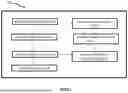

Sources:
- United States Patent and Trademark Office - verify current appl. status at the USPTO↗
Recent applications in this class:
- » 20260178747 2026-06-25
SYSTEM AND METHOD FOR GENERATING REMEDIATION EVIDENCE OBJECT IN CLOUD PLATFORMS - » 20260178746 2026-06-25
IDENTIFYING VULNERABILITIES IN BINARY FILES USING A CODE SIGNATURE - » 20260178745 2026-06-25
ORCHESTRATED EXECUTION OF CODE BY A CLOUD-BASED DATA INTAKE AND QUERY SYSTEM - » 20260178743 2026-06-25
ESTIMATION OF EFFORTS IN MIGRATING APPLICATIONS TO POST QUANTUM CRYPTOGRAPHY (PQC) STATE - » 20260178742 2026-06-25
TECHNIQUES FOR RISK AND CONSTRAINT-BASED INSPECTION - » 20260178741 2026-06-25
Reachability Analysis for Binary Executables - » 20260178740 2026-06-25
PREEMPTIVE SECURITY SCANS OF SOFTWARE PACKAGES - » 20260178739 2026-06-25
PRIORITIZED PATCH MANAGEMENT IN A DATACENTER - » 20260170153 2026-06-18
TEXT-BASED TAGGING OF SECURITY DEFICIENCIES USING GENERATIVE MACHINE LEARNING MODELS - » 20260170152 2026-06-18
ENHANCING CONTAINER SECURITY BY PERFORMING CONTAINER VULNERABILITY REDUCTION BASED ON LIBRARY AND/OR FUNCTION REMOVAL AND SYSTEM CALL BLOCKING