ABSORBENT ARTICLES WITH REFASTENABLY CONNECTED WAIST REGIONS AND METHODS AND APPARATUSES FOR MAKING ABSORBENT ARTICLES
US20260183153A1
2026-07-02
19/551,870
2026-02-27
Smart Summary: Absorbent articles, like diapers, can be designed with waist regions that can be easily reattached. Each article has two flanges that connect to belts at the front and back. The first ends of these flanges stick to the first belt, while the second ends connect to the second belt. This setup allows the second ends to be refastened, making it easier to adjust the fit. Overall, this design improves comfort and usability for the wearer. 🚀 TL;DR
Abstract:
The present disclosure relates to methods for assembling absorbent articles having refastenably connected front and back waist regions. The absorbent article may comprise a first and second flanges, each flange comprising a first surface and a second surface, and each flange comprising a first end region and a second end region. The first surfaces of the first end regions of the first and second flanges are bonded with a wearer facing surface of a first belt. The second surfaces of the second end regions of the first and second flanges are in a facing relationship with a wearer facing surface of the second belt. The second end regions of the first and second flanges are refastenably connected with the second end region of the second belt.
Inventors:
- Uwe SCHNEIDER 230 🇺🇸 Cincinnati, OH, United States
- Clifford Theodore Papsdorf 49 🇺🇸 Loveland, OH, United States
- Michael Brian Quade 20 🇺🇸 Blue Ash, OH, United States
- Joseph Leslie Grolmes 15 🇺🇸 Madeira, OH, United States
- John Andrew Strasemeier 44 🇺🇸 Aurora, IN, United States
- Robert Haines Turner 76 🇺🇸 Cincinnati, OH, United States
- Christopher KRASEN 6 🇺🇸 Cincinnati, OH, United States
- Ray Dennis Dria 10 🇺🇸 Mason, OH, United States
- Fredrick William Gibson 8 🇺🇸 Cincinnati, OH, United States
- William Winfield Cheeseman 3 🇺🇸 Springboro, OH, United States
- Todd M. Fegelman 5 🇺🇸 Wyoming, OH, United States
- Matthew Alexander Gittings 8 🇺🇸 Cincinnati, OH, United States
- Michael Devin Long 38 🇺🇸 Harrison Township, OH, United States
- Mark Thomas STILLWAGON 3 🇺🇸 Hamilton, OH, United States
- Koichi MORIMOTO 15 🇺🇸 Cincinnati, OH, United States
- Jose Luis SANTILLAN 2 🇺🇸 Cincinnati, OH, United States
Applicant:
Interested in similar patents?
Get notified when new applications in this technology area are published.
Classification:
A61F13/15804 » CPC main
Bandages or dressings ; Absorbent pads; Absorbent pads, e.g. sanitary towels, swabs or tampons for external or internal application to the body ; Supporting or fastening means therefor; Tampon applicators; Apparatus or processes for manufacturing Plant, e.g. involving several steps
A61F13/15723 » CPC further
Bandages or dressings ; Absorbent pads; Absorbent pads, e.g. sanitary towels, swabs or tampons for external or internal application to the body ; Supporting or fastening means therefor; Tampon applicators; Apparatus or processes for manufacturing; Mechanical treatment, e.g. notching, twisting, compressing, shaping Partitioning batts; Cutting
A61F13/15747 » CPC further
Bandages or dressings ; Absorbent pads; Absorbent pads, e.g. sanitary towels, swabs or tampons for external or internal application to the body ; Supporting or fastening means therefor; Tampon applicators; Apparatus or processes for manufacturing; Mechanical treatment, e.g. notching, twisting, compressing, shaping Folding; Pleating; Coiling; Stacking; Packaging
A61F13/15764 » CPC further
Bandages or dressings ; Absorbent pads; Absorbent pads, e.g. sanitary towels, swabs or tampons for external or internal application to the body ; Supporting or fastening means therefor; Tampon applicators; Apparatus or processes for manufacturing Transferring, feeding or handling devices; Drives
A61F2013/1591 » CPC further
Bandages or dressings ; Absorbent pads; Absorbent pads, e.g. sanitary towels, swabs or tampons for external or internal application to the body ; Supporting or fastening means therefor; Tampon applicators; Apparatus or processes for manufacturing characterized by the apparatus for manufacturing for bonding via adhesive
A61F13/15 IPC
Bandages or dressings ; Absorbent pads Absorbent pads, e.g. sanitary towels, swabs or tampons for external or internal application to the body ; Supporting or fastening means therefor; Tampon applicators
Description
CROSS REFERENCE TO RELATED APPLICATION
This application is a continuation of Patent Application No. PCT/CN2023/123202, filed on Oct. 7, 2023, which claims the benefit of U.S. Provisional Application No. 63/540,448, filed on Sep. 26, 2023, which are incorporated herein by reference.
FIELD
The present disclosure relates to absorbent articles, and more particularly, to absorbent articles having refastenably connected front and back waist regions.
BACKGROUND
Along an assembly line, various types of articles, such as for example, diapers and other absorbent articles, may be assembled by adding components to and/or otherwise modifying an advancing, continuous web of material. For example, in some processes, advancing webs of material are combined with other advancing webs of material. In other examples, individual components created from advancing webs of material are combined with advancing webs of material, which in turn, are then combined with other advancing webs of material. In some cases, individual components created from an advancing web or webs are combined with other individual components created from other advancing webs. Webs of material and component parts used to manufacture diapers may include: backsheets, topsheets, leg cuffs, waist bands, absorbent core components, front and/or back ears, fastening components, and various types of elastic webs and components such as front and/or back waist panels, leg elastics, barrier leg cuff elastics, stretch side panels, and waist elastics. Once the desired component parts are assembled, the advancing web(s) and component parts are subjected to a final knife cut to separate the web(s) into discrete diapers or other absorbent articles.
Some absorbent articles have components that include elastomeric laminates. Such elastomeric laminates may include an elastic material bonded to one or more nonwovens. The elastic material may include an elastic film and/or elastic strands. In some laminates, a plurality of elastic strands are joined to a nonwoven while the plurality of strands are in a stretched condition so that when the elastic strands relax, the nonwoven gathers, and in turn, forms corrugations and rugosities. The resulting elastomeric laminate is stretchable to the extent that the corrugations allow the elastic strands to elongate.
Absorbent articles in the form of diaper pants may also be configured with an absorbent chassis connected with front and back elastic belts, wherein opposing end regions of the front and back belts are connected with each other at side seams. In some instances, the elasticity of the front and back belts is removed in regions where the chassis connects with the belts. Thus, in some converting configurations adapted to assemble such diaper pants, stretched elastic strands are glued between two continuous nonwoven webs to form an elastic laminate. Regions of the elastic strands may then be intermittently deactivated along the length of the elastic laminate by cutting the elastic strands in areas to be connected with the chassis, sometimes referred to as tummy elastic cutting.
Some caregivers of older incontinent babies or toddlers may prefer a closed, pant-style disposable absorbent article to enable application to, and removal from, a child while the child is in a standing position. One disadvantage of this product form is that the removal and disposal of feces-containing products may be unhygienic and inconvenient. For example, pulling the product down could cause feces to smear down the legs of a user. In other examples, a caregiver may tear open the bonded sides using force. In turn, the force used can lead to a rapid release of energy from the diaper, causing the caregiver to lose control of the product and allowing feces to spill out. In contrast, removal and disposal of traditional open or taped diaper forms with fasteners may be readily accomplished while the child is laying on their back. In this case, the fasteners are opened, the diaper is removed from under the child, rolled into a roughly cylindrical shape, and then the fasteners are secured around the rolled, soiled diaper, closing the leg openings for hygienic disposal.
In order to avoid having to remove soiled diaper pants from a wearer by sliding the soiled diaper pant down the wearer's legs or tearing bonded side seams, some diaper pants may be configured with refastenable seams between the front belt and the back belt. Such refastenable seams may allow a caregiver to more easily separate the belts from each other. Once the belts are separated, the diaper pant can be more easily removed from the wearer without having to slide the diaper pant down the wearer's legs, in a similar manner as a traditional open taped diaper form.
Consequently, it would be beneficial to create pant-style articles that provide the caregiver the ability to remove and dispose soiled products in a similar manner to traditional open diaper forms.
SUMMARY
In aspect, a method of assembling absorbent articles comprising steps of: providing a discrete part comprising a first surface and an opposing second surface, the discrete part further comprising a first side region and a second side region separated from the first side region in a cross direction by a central region; providing at least one stripe of adhesive on the first surface of the central region of the discrete part; advancing the discrete part in a machine direction on a first roll such that the at least one stripe of adhesive extends in the machine direction, and wherein the first surface of the discrete part is facing radially outward; transferring the discrete part from the first roll to a rotatable transfer device, wherein the first surface of the discrete part is facing radially inward; turning the discrete part such that the at least one stripe of adhesive extends in the cross direction while rotating the transfer device; transferring the discrete part from the transfer device to a second roll, wherein the first surface of the discrete part is facing radially outward; advancing a carrier substrate adjacent the second roll, the carrier substrate comprising a first outer region separated from a second outer region in the cross direction by a central region; advancing the discrete part between the second roll and the carrier substrate such that the at least one stripe of adhesive extends in the cross direction across the first outer region of the carrier substrate; adhesively bonding the central region of the discrete part with the carrier substrate with the at least one stripe of adhesive; folding the central region of the carrier substrate to position the second outer region of the carrier substate into a facing relationship with the first outer region of the carrier substrate and the second surface of the discrete part; and refastenably connecting the second outer region of the carrier substrate with the discrete part.
In another aspect, a method of assembling absorbent articles comprises steps of: advancing a carrier substrate at a first speed in a machine direction, the carrier substrate comprising a first outer region separated from a second outer region in a cross direction by a central region, wherein the first outer region and the second outer region are continuous in the machine direction and wherein the central region is discontinuous in the machine direction; advancing a continuous substrate at a second speed in the machine direction, the continuous substrate comprising a first surface and an opposing second surface; applying a first stripe of adhesive and a second stripe of adhesive to the first surface of the continuous substrate, the first and second stripes of adhesive separated from each other in the cross direction; cutting a discrete part from the continuous substrate, the discrete part comprising a first side region and a second side region separated from the first side region in the cross direction by a central region, wherein the first and second stripes of adhesive extend across the central region in the machine direction; changing a speed of the discrete part from the second speed to the first speed; turning the discrete part such that the first and second stripes of adhesive extend in the cross direction; bonding the discrete part with the first and second stripes of adhesive to the first outer region of the carrier substrate; folding the central region of the carrier substrate to position the second outer region of the carrier substate into a facing relationship with the first outer region of the carrier substrate and the second surface of the discrete part; and dividing the discrete part between the first and second stripes of adhesive into a first flange and a second flange by cutting the first substrate along the cross direction through first outer region, the second outer region, and the discrete part to form individual absorbent articles.
In yet another aspect, a method of assembling absorbent articles comprising steps of: advancing a carrier substrate at a first speed in a machine direction, the carrier substrate comprising a first outer region separated from a second outer region in a cross direction by a central region, wherein the first outer region and the second outer region are continuous in the machine direction and wherein the central region is discontinuous in the machine direction; advancing a continuous substrate at a second speed in the machine direction; providing a first fastener component and a second fastener component on the continuous substrate; cutting a discrete part from the continuous substrate, the discrete part comprising a first surface and an opposing second surface, and further comprising a first side region and a second side region separated from the first side region in the cross direction by a central region, wherein the first fastener component is positioned on the second surface of the first side region of the discrete part and the second fastener component is positioned on the second surface of the second side region of the discrete part; turning the discrete part such that the first side region and the second side region are separated from each other in the machine direction; bonding the first surface of the central region of the discrete part with the first outer region of the carrier substrate; folding the central region of the carrier substrate to position the second outer region of the carrier substate into a facing relationship with the first outer region of the carrier substrate and the second surface of the discrete part; refastenably connecting the second outer region with the first and second fastener components; and forming individual absorbent articles by cutting the first substrate along the cross direction through first outer region, the second outer region, and the discrete part between the first and second fastener components.
BRIEF DESCRIPTION OF THE DRAWINGS
FIG. 1 shows a perspective view of a refastenable diaper pant in a pre-fastened configuration.
FIG. 2A shows a top view of the diaper pant of FIG. 1.
FIG. 2B shows a top view of the diaper pant of FIG. 2A in a compressed state.
FIG. 2C1 is a cross-sectional view of the diaper pant of FIG. 2B taken along line 2C-2C showing details of a flange connection with a first configuration of belt laminate structures.
FIG. 2C2 is a cross-sectional view of the diaper pant of FIG. 2B taken along line 2C-2C showing details of a flange connection with a second configuration of belt laminate structures.
FIG. 2C3 is a cross-sectional view of the diaper pant of FIG. 2B taken along line 2C-2C showing details of a flange connection with a third configuration of belt laminate structures.
FIG. 2D is a detailed sectional view of a bond structure between substrates of the flange and first belt comprising substantially tackifier free adhesive.
FIG. 2E is a detailed view of the bond structure of FIG. 2D applied between two nonwoven substrates.
FIG. 2F is a scanning electron microscope (“SEM”) photograph of a cross sectional view of an example bond comprising a layer of substantially tackifier free adhesive between a first nonwoven and a second nonwoven.
FIG. 2G is a detailed view of the bond structure of FIG. 2D applied between two nonwoven substrates, wherein one of the nonwoven substrates comprises a meltblown layer.
FIG. 2H is a detailed view of the bond structure of FIG. 2D applied between two nonwoven substrates, wherein both of the nonwoven substrates comprise a meltblown layer.
FIG. 3A shows a plan view of a diaper pant with the portion of the diaper that faces away from a wearer oriented toward the viewer.
FIG. 3B shows a plan view of a diaper pant with the portion of the diaper that faces toward a wearer oriented toward the viewer.
FIG. 3C shows a plan view of a diaper pant with the portion of the diaper that faces away from a wearer oriented toward the viewer, illustrating example elastic material arrangements in the first and second belts.
FIG. 3D shows a plan view of a diaper pant with the portion of the diaper that faces away from a wearer oriented toward the viewer, illustrating first and second belt size and shape features.
FIG. 3E shows a plan view of a diaper pant with the portion of the diaper that faces away from a wearer oriented toward the viewer, illustrating first and second belt size and shape features.
FIG. 3F shows a plan view of a diaper pant with the portion of the diaper that faces away from a wearer oriented toward the viewer, illustrating first and second belt size and shape features.
FIG. 4 is a cross-sectional view of the diaper pant of FIG. 4A taken along line 4-4 showing first and second elastic belts provided with panel layers.
FIG. 4A is a cross-sectional detailed view of a first belt provided with panel layers wherein one panel layer is folded over another panel layer.
FIG. 4A1 is a cross-sectional detailed view of another example configuration wherein the first belt is provided with panel layers wherein one panel layer is folded over another panel layer.
FIG. 4A2 is a cross-sectional detailed view of another example configuration wherein the first belt is provided with panel layers wherein one panel layer is folded over another panel layer.
FIG. 4B is a cross-sectional detailed view of a second belt provided with panel layers wherein one panel layer is folded over another panel layer.
FIG. 5A shows a perspective view of a diaper pant with a continuous outer cover in a pre-fastened configuration.
FIG. 5B shows a plan view of a diaper pant with a continuous outer cover with the portion of the diaper that faces away from a wearer oriented toward the viewer.
FIG. 5C is a cross-sectional view of the diaper pant of FIG. 5B taken along line 5C-5C showing first and second elastic belts provided with panel layers and a continuous outer cover.
FIG. 5D is a cross-sectional view of a diaper pant of showing first and second elastic belts provided with panel layers formed with a continuous inner layer and a continuous outer cover.
FIG. 6A is a perspective view of the diaper pant of FIG. 1 showing a first end region of the second belt partially disconnected from a first flange.
FIG. 6B is a perspective view of the diaper pant of FIG. 6A showing a second end region of the second belt partially disconnected from a second flange.
FIG. 7A is a detailed view of a diaper pant showing a flange bonded with a first belt and refastenably connected with a second belt.
FIG. 7B is a detailed view of the diaper pant of FIG. 7A showing the second belt partially disconnected from the flange.
FIG. 7C is a detailed view of the diaper pant of FIG. 7B showing the second belt completely disconnected from the flange.
FIG. 8 is a planar view of a fastener component on a flange.
FIG. 9A cross-sectional view of an example configuration of the flange and fastener component of FIG. 8 taken along line 9-9 showing a base of the fastener component bonded with the flange.
FIG. 9B cross-sectional view of an example configuration of the flange and fastener component of FIG. 8 taken along line 9-9 showing a base of the fastener component extrusion bonded with a backing layer that is bonded with the flange.
FIG. 9C cross-sectional view of an example configuration of the flange and fastener component of FIG. 8 taken along line 9-9 showing a base of the fastener component extrusion bonded with the flange.
FIG. 9D cross-sectional view of an example configuration of the flange and fastener component of FIG. 8 taken along line 9-9 showing a base of the fastener component extrusion bonded with the flange.
FIG. 9E cross-sectional view of an example configuration of the flange and fastener component of FIG. 8 taken along line 9-9 showing a fastener component comprising hooks formed directly from material of the flange.
FIG. 10A is a detailed view of a diaper pant showing a belt directly refastenably connected with a fastener component on a flange.
FIG. 10B is a detailed view of a diaper pant showing a fastener component on a belt directly refastenably connected with a flange.
FIG. 10C is a detailed view of a diaper pant showing a fastener component comprising loops on a belt refastenably connected with a fastener component comprising hooks on a flange.
FIG. 10D is a detailed view of a diaper pant showing a fastener component comprising hooks on a belt refastenably connected with a fastener component comprising loops on a flange.
FIG. 11 is a schematic side view of an apparatus for bonding discrete parts to an advancing carrier substrate.
FIG. 11A is a detailed schematic view of a bonding apparatus with a pressing surface comprising an ultrasonic bonding device.
FIG. 12 is a view of a carrier substrate taken along section 12-12 in FIG. 11.
FIG. 13 is a view of a second surface of a continuous substrate taken along section 13-13 in FIG. 11.
FIG. 14 is a view of a first surface of the continuous substrate taken along section 14-14 in FIG. 11.
FIG. 15 is a view of a first surface of a discrete part with first and second stripes of adhesive thereon taken along section 15-15 in FIG. 11.
FIG. 15A is a view of a second surface of the discrete part shown in FIG. 15.
FIG. 16 is a schematic side view of a transfer device.
FIG. 16A is a view of a carrier surface from FIG. 16 taken along line 16A-16A.
FIG. 16A1 is a view of a cross sectional view of the carrier surface from FIG. 16A taken along line 16A1-16A1.
FIG. 16B is a view of a carrier surface from FIG. 16 taken along line 16B-16B.
FIG. 16C is a view of a carrier surface from FIG. 16 taken along line 16C-16C.
FIG. 17 is a detailed view of an anvil roll, transfer device, and bonding roll from FIG. 11.
FIG. 17A is a view showing a first orientation of a discrete part and carrier surface from FIG. 17 taken along line 17A-17A.
FIG. 17A1 is a view of a cross sectional view of the discrete part on the carrier surface from FIG. 17A taken along line 17A1-17A1.
FIG. 17B is a view showing a second orientation of the discrete part and carrier surface from FIG. 17 taken along line 17B-17B.
FIG. 18 is a view of a laminate including the discrete part and the carrier substrate taken along section 18-18 in FIG. 11.
FIG. 18A1 is a view of the discrete part and the carrier substrate taken along section 18A1-18A1 in FIG. 18.
FIG. 18A2 is a view of the discrete part and the carrier substrate with a frangible bond between the discrete part and the carrier substrate taken along section 18A2-18A2 in FIG. 18.
FIG. 19 is a view of the laminate being folded taken along section 19-19 in FIG. 11.
FIG. 19A is a view of the discrete part and the carrier substrate taken along section 18A-18A in FIG. 19.
FIG. 20 is a view of discrete absorbent articles cut from the laminate taken along section 20-20 in FIG. 11.
FIG. 20A is a view of the discrete part after the final knife cut and severed into a first flange and a second flange taken along section 20A-20A in FIG. 20.
FIG. 21A is a detailed view a first conveyor applying a vacuum force adapted to hold the discrete part against the carrier substrate while the laminate is advancing from a bonding device to a folding apparatus.
FIG. 21B is a detailed view a first conveyor with a movable surface adapted to hold the discrete part against the carrier substrate while the laminate is advancing from a bonding device to a folding apparatus.
FIG. 21C is a detailed view of the discrete part and the carrier substrate held between a first conveyor and a second conveyor while the laminate is advancing from a bonding device to a folding apparatus.
FIG. 22 is a schematic side view of an apparatus for bonding discrete fastener components to an advancing continuous substrate.
DETAILED DESCRIPTION
Definitions
The following term explanations may be useful in understanding the present disclosure:
“Absorbent article” refers to devices, which absorb and contain body exudates and, more specifically, refers to devices, which are placed against or in proximity to the body of the wearer to absorb and contain the various exudates discharged from the body. Exemplary absorbent articles include diapers, training pants, pull-on pant-type diapers (i.e., a diaper having a pre-formed waist opening and leg openings such as illustrated in U.S. Pat. No. 6,120,487), refastenable diapers or pant-type diapers, incontinence briefs and undergarments, diaper holders and liners, feminine hygiene garments such as panty liners, absorbent inserts, menstrual pads and the like.
“Body-facing” and “garment-facing” refer respectively to the relative location of an element or a surface of an element or group of elements. “Body-facing” implies the element or surface is nearer to the wearer during wear than some other element or surface. “Garment-facing” implies the element or surface is more remote from the wearer during wear than some other element or surface (i.e., element or surface is proximate to the wearer's garments that may be worn over the disposable absorbent article).
The terms “elastic,” “elastomer” or “elastomeric” refers to materials exhibiting elastic properties, which include any material that upon application of a force to its relaxed, initial length can stretch or elongate to an elongated length more than 10% greater than its initial length and will substantially recover back to about its initial length upon release of the applied force. Elastomeric materials may include elastomeric films, scrims, nonwovens, ribbons, strands and other sheet-like structures.
As used herein, the term “joined” encompasses configurations whereby an element is directly secured to another element by affixing the element directly to the other element, and configurations whereby an element is indirectly secured to another element by affixing the element to intermediate member(s) which in turn are affixed to the other element.
As used herein, the term “distal” is used to describe a position situated away from a center of a body or from a point of attachment, and the term “proximal” is used to describe a position situated nearer to a center of a body or a point of attachment.
The term “substrate” is used herein to describe a material which is primarily two-dimensional (i.e., in an XY plane) and whose thickness (in a Z direction) is relatively small (i.e., 1/10 or less) in comparison to its length (in an X direction) and width (in a Y direction). Non-limiting examples of substrates include a web, layer or layers or fibrous materials, nonwovens, films and foils such as polymeric films or metallic foils. These materials may be used alone or may comprise two or more layers laminated together. As such, a web is a substrate.
The term “nonwoven” refers herein to a material made from continuous (long) filaments (fibers) and/or discontinuous (short) filaments (fibers) by processes such as spunbonding, meltblowing, carding, and the like. Nonwovens do not have a woven or knitted filament pattern.
The term “machine direction” (MD) is used herein to refer to the direction of material flow through a process. In addition, relative placement and movement of material can be described as flowing in the machine direction through a process from upstream in the process to downstream in the process.
The term “cross direction” (CD) is used herein to refer to a direction that is generally perpendicular to the machine direction.
“Pre-strain” refers to the strain imposed on an elastic or elastomeric material prior to combining it with another element of the elastomeric laminate or the absorbent article. Pre-strain is determined by the following equation Pre-strain=((extended length of the elastic-relaxed length of the elastic)/relaxed length of the elastic)*100.
“Decitex” also known as Dtex is a measurement used in the textile industry used for measuring yarns or filaments. 1 Decitex=1 gram per 10,000 meters. In other words, if 10,000 linear meters of a yarn or filament weights 500 grams that yarn or filament would have a decitex of 500.
The term “taped diaper” (also referred to as “open diaper”) refers to disposable absorbent articles having an initial front waist region and an initial back waist region that are not fastened, pre-fastened, or connected to each other as packaged, prior to being applied to the wearer. A taped diaper may be folded about the lateral centerline with the interior of one waist region in surface to surface contact with the interior of the opposing waist region without fastening or joining the waist regions together. Example taped diapers are disclosed in various suitable configurations U.S. Pat. Nos. 5,167,897, 5,360,420, 5,599,335, 5,643,588, 5,674,216, 5,702,551, 5,968,025, 6,107,537, 6,118,041, 6,153,209, 6,410,129, 6,426,444, 6,586,652, 6,627,787, 6,617,016, 6,825,393, and 6,861,571; and U.S. Patent Publication Nos. 2013/0072887 A1; 2013/0211356 A1; and 2013/0306226 A1, all of which are incorporated by reference herein.
The term “pant” (also referred to as “training pant”, “pre-closed diaper”, “diaper pant”, “pant diaper”, and “pull-on diaper”) refers herein to disposable absorbent articles having a continuous perimeter waist opening and continuous perimeter leg openings designed for infant or adult wearers. A pant can be configured with a continuous or closed waist opening and at least one continuous, closed, leg opening prior to the article being applied to the wearer. A pant can be preformed or pre-fastened by various techniques including, but not limited to, joining together portions of the article using any refastenable and/or permanent closure member (e.g., seams, heat bonds, pressure welds, adhesives, cohesive bonds, mechanical fasteners, etc.). A pant can be preformed anywhere along the circumference of the article in the waist region (e.g., side fastened or seamed, front waist fastened or seamed, back waist fastened or seamed). Example diaper pants in various configurations are disclosed in U.S. Pat. Nos. 4,940,464; 5,092,861; 5,246,433; 5,569,234; 5,897,545; 5,957,908; 6,120,487; 6,120,489; 7,569,039 and U.S. Patent Publication Nos. 2003/0233082 A1; 2005/0107764 A1, 2012/0061016 A1, 2012/0061015 A1; 2013/0255861 A1; 2013/0255862 A1; 2013/0255863 A1; 2013/0255864 A1; and 2013/0255865 A1, all of which are incorporated by reference herein.
“Closed-form” means opposing waist regions are joined, as packaged, either permanently or refastenably to form a continuous waist opening and leg openings.
“Open-form” means opposing waist regions are not initially joined to form a continuous waist opening and leg openings but comprise a closure means such as a fastening system to join the waist regions to form the waist and leg openings before or during application to a wearer of the article.
The present disclosure relates to absorbent articles, and more particularly, to absorbent articles having refastenably connected front and back waist regions. In some configurations, an absorbent article may comprise: a chassis comprising a topsheet, a backsheet, and an absorbent core positioned between the topsheet and the backsheet. The chassis may further comprise a first end region and a second end region longitudinally separated from the first end region by a crotch region. The absorbent article may comprise a first belt and a second belt, each belt comprising a garment facing surface and an opposing wearer facing surface and each belt comprising a first end region and a second end region laterally separated from the first end region by a central region. The first end region of the chassis may be connected with the central region of the first belt, and the second end region of the chassis may be connected with the central region of the second belt. The absorbent article may also comprise a first flange and a second flange, each flange comprising a first surface and a second surface opposite the first surface, and each flange comprising a first end region and a second end region. The first surface of the first end region of the first flange is bonded with the wearer facing surface of the first end region of the first belt, and the second surface of the second end region of the first flange is in a facing relationship with the wearer facing surface of the second belt. The second end region of the first flange is refastenably connected with the first end region of the second belt. In addition, the first surface of the first end region of the second flange may be bonded with the wearer facing surface of the second end region of the first belt, and the second surface of the second end region of the second flange is in a facing relationship with the wearer facing surface of the second belt. The second end region of the second flange is refastenably connected with the second end region of the second belt.
FIGS. 1-3B show an example of an absorbent article 100 in the form of a diaper pant 100P that may include components constructed in accordance with the configurations disclosed herein. In particular, FIG. 1 shows a perspective views of a diaper pant 100P in a pre-fastened configuration. FIG. 2A shows a top view of the diaper pant of FIG. 1, and FIG. 2B shows a top view of the diaper pant of FIG. 2A in a compressed state. FIG. 3A shows a plan view of the diaper pant 100P with the portion of the diaper that faces away from a wearer oriented toward the viewer, and FIG. 3B shows a plan view of the diaper pant 100P with the portion of the diaper that faces toward a wearer oriented toward the viewer. The diaper pant 100P includes a chassis 102 and a ring-like elastic belt 104. As discussed below in more detail, a first elastic belt 106 and a second elastic belt 108 are refastenably connected together to form the ring-like elastic belt 104.
With continued reference to FIGS. 1-3B, the diaper pant 100P and the chassis 102 each include a first waist region 116, a second waist region 118, and a crotch region 119 disposed intermediate the first and second waist regions. It may also be described that the chassis 102 includes a first end region 116a, a second end region 118a, and a crotch region 119 disposed intermediate the first and second end regions 116a, 118a. The first waist region 116 may be configured as a front waist region, and the second waist region 118 may be configured as back waist region. The diaper 100P may also include a laterally extending front waist edge 121 in the front waist region 116 and a longitudinally opposing and laterally extending back waist edge 122 in the back waist region 118. To provide a frame of reference for the present discussion, the diaper 100P and chassis 102 of FIGS. 3A and 3B are shown with a longitudinal axis 124 and a lateral axis 126. In some embodiments, the longitudinal axis 124 may extend through the front waist edge 121 and through the back waist edge 122. And the lateral axis 126 may extend through a first longitudinal or right side edge 128 and through a second longitudinal or left side edge 130 of the chassis 102. As previously mentioned, the longitudinal axis 124 extends perpendicularly through the front waist edge 121 and the back waist edge 122, and the lateral axis 126 extends perpendicularly to the longitudinal axis 124. When the diaper pant 100P is worn, the longitudinal direction may extend from the wearer's front waist, through the crotch, to the wearer's back waist.
As shown in FIGS. 1-3B, the diaper pant 100P may include an inner, body facing surface 132, and an outer, garment facing surface 134. The chassis 102 may include a backsheet 136 and a topsheet 138. The chassis 102 may also include an absorbent assembly 140, including an absorbent core 142, disposed between a portion of the topsheet 138 and the backsheet 136. As discussed in more detail below, the diaper 100P may also include other features, such as leg elastics and/or leg cuffs to enhance the fit around the legs of the wearer.
As shown in FIG. 3A, the periphery of the chassis 102 may be defined by the first longitudinal side edge 128, a second longitudinal side edge 130, a first laterally extending end edge 144 disposed in the first waist region 116, and a second laterally extending end edge 146 disposed in the second waist region 118. Both side edges 128 and 130 extend longitudinally between the first end edge 144 and the second end edge 146. As shown in FIG. 3A, the laterally extending end edges 144 and 146 may be located longitudinally inward from the laterally extending front waist edge 121 in the front waist region 116 and the laterally extending back waist edge 122 in the back waist region 118. In some configurations, the laterally extending end edges 144 and 146 may be coterminous with or located longitudinally outward from the laterally extending front waist edge 121 in the front waist region 116 and the laterally extending back waist edge 122 in the back waist region 118. When the diaper pant 100P is worn on the lower torso of a wearer, the front waist edge 121 and the back waist edge 122 may encircle a portion of the waist of the wearer. At the same time, the side edges 128 and 130 may encircle at least a portion of the legs of the wearer. And the crotch region 119 may be generally positioned between the legs of the wearer with the absorbent core 142 extending from the front waist region 116 through the crotch region 119 to the back waist region 118.
As previously mentioned, the diaper pant 100P may include a backsheet 136. The backsheet 136 may also define the outer, garment facing surface 134 of the chassis 102. The backsheet 136 may also comprise a woven or nonwoven material, polymeric films such as thermoplastic films of polyethylene or polypropylene, and/or a multi-layer or composite materials comprising a film and a nonwoven material. The backsheet may also comprise an elastomeric film. An example backsheet 136 may be a polyethylene film having a thickness of from about 0.012 mm (0.5 mils) to about 0.051 mm (2.0 mils). Further, the backsheet 136 may permit vapors to escape from the absorbent core (i.e., the backsheet is breathable) while still preventing exudates from passing through the backsheet 136.
Also described above, the diaper pant 100P may include a topsheet 138. The topsheet 138 may also define all or part of the inner, wearer facing surface 132 of the chassis 102. The topsheet 138 may be liquid pervious, permitting liquids (e.g., menses, urine, and/or runny feces) to penetrate through its thickness. A topsheet 138 may be manufactured from a wide range of materials such as woven and nonwoven materials; apertured or hydroformed thermoplastic films; apertured nonwovens, porous foams; reticulated foams; reticulated thermoplastic films; and thermoplastic scrims. Woven and nonwoven materials may comprise natural fibers such as wood or cotton fibers; synthetic fibers such as polyester, polypropylene, or polyethylene fibers; or combinations thereof. If the topsheet 138 includes fibers, the fibers may be spunbond, carded, wet-laid, meltblown, hydroentangled, or otherwise processed as is known in the art. Topsheets 138 may be selected from high loft nonwoven topsheets, apertured film topsheets and apertured nonwoven topsheets. Exemplary apertured films may include those described in U.S. Pat. Nos. 5,628,097; 5,916,661; 6,545,197; and 6,107,539, all of which are incorporated by reference herein.
As mentioned above, the diaper pant 100P may also include an absorbent assembly 140 that is joined to the chassis 102. As shown in FIG. 3A, the absorbent assembly 140 may have a laterally extending front edge 148 in the front waist region 116 and may have a longitudinally opposing and laterally extending back edge 150 in the back waist region 118. The absorbent assembly may have a longitudinally extending right side edge 152 and may have a laterally opposing and longitudinally extending left side edge 154, both absorbent assembly side edges 152 and 154 may extend longitudinally between the front edge 148 and the back edge 150. The absorbent assembly 140 may additionally include one or more absorbent cores 142 or absorbent core layers. The absorbent core 142 may be at least partially disposed between the topsheet 138 and the backsheet 136 and may be formed in various sizes and shapes that are compatible with the diaper. Exemplary absorbent structures for use as the absorbent core of the present disclosure are described in U.S. Pat. Nos. 4,610,678; 4,673,402; 4,888,231; and 4,834,735, all of which are incorporated by reference herein.
Some absorbent core embodiments may comprise fluid storage cores that contain reduced amounts of cellulosic airfelt material. For instance, such cores may comprise less than about 40%, 30%, 20%, 10%, 5%, or even 1% of cellulosic airfelt material. Such a core may comprise primarily absorbent gelling material in amounts of at least about 60%, 70%, 80%, 85%, 90%, 95%, or even about 100%, where the remainder of the core comprises a microfiber glue (if applicable). Such cores, microfiber glues, and absorbent gelling materials are described in U.S. Pat. Nos. 5,599,335; 5,562,646; 5,669,894; and 6,790,798 as well as U.S. Patent Publication Nos. 2004/0158212 A1 and 2004/0097895 A1, all of which are incorporated by reference herein.
As previously mentioned, the diaper 100P may also include elasticized leg cuffs 156. It is to be appreciated that the leg cuffs 156 can be and are sometimes also referred to as leg bands, side flaps, barrier cuffs, elastic cuffs or gasketing cuffs. The elasticized leg cuffs 156 may be configured in various ways to help reduce the leakage of body exudates in the leg regions. Example leg cuffs 156 may include those described in U.S. Pat. Nos. 3,860,003; 4,909,803; 4,695,278; 4,795,454; 4,704,115; 4,909,803; and U.S. Patent Publication No. 2009/0312730 A1, all of which are incorporated by reference herein.
As mentioned above, diaper pants may be manufactured with a ring-like elastic belt 104 and provided to consumers in a configuration wherein the front waist region 116 and the back waist region 118 are connected to each other as packaged, prior to being applied to the wearer. As such, diaper pants may have a continuous perimeter waist opening 110 and continuous perimeter leg openings 112 such as shown in FIG. 1. The ring-like elastic belt may be formed by joining a first elastic belt to a second elastic belt with an openable and reclosable fastening system disposed at or adjacent the laterally opposing sides of the belts.
As previously mentioned, the ring-like elastic belt 104 may be defined by a first elastic belt 106 connected with a second elastic belt 108. As shown in FIGS. 3A and 3B, the first elastic belt 106 extends between a first longitudinal side edge 111a and a second longitudinal side edge 111b and defines first and second opposing end regions 106a, 106b and a central region 106c. And the second elastic 108 belt extends between a first longitudinal side edge 113a and a second longitudinal side edge 113b and defines first and second opposing end regions 108a, 108b and a central region 108c. As measured in an extended state, the distance between the first longitudinal side edge 111a and the second longitudinal side edge 111b defines the pitch length, PL, of the first elastic belt 106, and the distance between the first longitudinal side edge 113a and the second longitudinal side edge 113b defines the pitch length, PL, of the second elastic belt 108. The central region 106c of the first elastic belt is connected with the first waist region 116 or first end region 116a of the chassis 102, and the central region 108c of the second elastic belt 108 is connected with the second waist region 118 or second end region 118a of the chassis 102.
As shown in FIGS. 1-2B, flanges 300 bonded with opposing end regions of the first belt 106 are refastenably connected with opposing end regions of the second belt 108 to define the ring-like elastic belt 104 as well as the waist opening 110 and leg openings 112. For example, a first flange 300a may be bonded with the first end region 106a of the first belt 106 at a first flange seam 302a, and a second flange 300b may be bonded with the second end region 106b of the first belt 106 at a second flange seam 302b. In turn, the first flange 300a may be refastenably connected with the first end region 108a of the second belt 108, and the second flange 300b may be refastenably connected with the second end region 108b of the second belt 108. For example, as shown in FIGS. 1-2B, a first fastener component 304a on the first flange 300a may refastenably connect the first flange 300a with the second belt 108, and a second fastener component 304b on the second flange 300b may refastenably connect the second flange 300b with the second belt 108. In the configurations shown in FIGS. 2A and 2B, the fastener components 304 may be adapted to refastenably connect directly with the second belt 108. It is to be appreciated that various configurations of fastener components 304 may be located on the flanges 300, the first belt 106, and/or the second belt 108, as discussed in more detail below. It is also to be appreciated that in some configurations, flanges 300 may be bonded with the opposing end regions of the second belt 108 and may be adapted to refastenably connect with opposing end regions of the first belt 106. It is further to be appreciated that the first belt may be positioned in a front waist region or a back waist region, and the second belt may be positioned in a front waist region or a back waist region.
It is also to be appreciated that the fastener components 304 may be configured in various ways, such as hooks, loops, and/or adhesive. For example, the fastener components 304 may comprise hook elements or adhesive adapted to refastenably connect with another surface of the diaper pant 100P. In some configurations, the fastener component 304 may comprise loop elements adapted to refastenably connect with a hook surface on the diaper pant 100P. The fastener component 304 may be a separate element connected with the first bel 106, the second belt 108, and/or the flange 300 in various ways, such as mechanical bonding, adhesive bonding, or both. In some configurations, the fastener component 304 may be integrally formed from materials of the first bel 106, the second belt 108, and/or the flange 300. In some configurations, the flange 300 and/or fastener component 304 may be printed and/or comprise materials of various different colors to help enhance visibility from outside the diaper pant 100P.
It is to be appreciated that the flanges 300 may be constructed from various types of materials, such as plastic films; apertured plastic films; woven or nonwoven webs of natural materials (e.g., wood or cotton fibers), synthetic fibers (e.g., polyolefins, polyamides, polyester, polyethylene, or polypropylene fibers) or a combination of natural and/or synthetic fibers; or coated woven or nonwoven webs. In some configurations, the flanges 300 may comprise various types of nonwovens, such as spunbond, carded, wet-laid, meltblown, hydroentangled. The flanges 300 may be configured to be stretchable or non-stretchable and/or hydrophilic or hydrophobic. In some configurations, the flanges 300 may be configured as a single layer of material or a laminate comprising two or more layers of material.
It is also to be appreciated that various types of bonds 306 such as illustrated in FIGS. 2A and 2B may be used to bond the flanges 300 with the first belt 106 at the flange seams 302. For example, the bonds 306 at the flange seams 302 may comprise mechanical, thermal, pressure, and/or adhesive bonds.
In some configurations, the bonds 306 may comprise a bond structure 903 that comprises substantially tackifier free adhesives or tackifier free adhesives, such as discussed in U.S. Patent Application No. 63/540,448, which is incorporated herein by reference. The term “tackifier free adhesive” is used herein to refer to an adhesive composition comprising a polymer and/or a copolymer, wherein the adhesive composition if free of or devoid of tackifiers. Examples of such tackifier free adhesives are disclosed in U.S. Patent Publication Nos. 2019/0322900 A1; 2019/0322901 A1; 2019/0322909 A1; 2019/0321241 A1; 2019/0321242 A1; 2020/0047420 A1; and 2020/0108167 A1, all of which are incorporated by reference herein. “Devoid of,” “free of,” and the like, as those terms are used herein, means that the adhesive composition does not have more than trace amounts of background levels of a given material, ingredient, or characteristic following these qualifiers; the amount of the material or ingredient does not cause harm or irritation that consumers typically associate with the material or ingredient; or the material or ingredient was not added to the adhesive composition intentionally. In some applications, “devoid of” and “free of” can mean there is no measurable amount of the material or ingredient. For example, the adhesive composition in some forms can contain no measurable amount of a tackifier. “Substantially tackifier free adhesive” is used herein to refer to an adhesive composition comprising a polymer and/or a copolymer, wherein the adhesive composition comprises less than 10% tackifiers by weight. As such, a “tackifier free adhesive” is also a “substantially tackifier free adhesive.” The term “tackifier” means those conventional tackifier resins commonly available in the adhesive art and industry that are used in typical hot melt adhesives. Examples of conventional tackifier resins include aliphatic hydrocarbon resins, aromatic modified aliphatic hydrocarbon resins, hydrogenated poly-cyclopentadiene resins, poly-cyclopentadiene resins, gum rosins, gum rosin esters, wood rosins, wood rosin esters, tall oil rosins, tall oil rosin esters, poly-terpene, aromatic modified poly-terpene, terpene-phenolic, aromatic modified hydrogenated poly-cyclopentadiene resins, hydrogenated aliphatic resins, hydrogenated aliphatic aromatic resins, hydrogenated terpene and modified terpene, and hydrogenated rosin esters.
When the flange 300 and the first belt 106 include nonwoven layers, penetration of the substantially tackifier free adhesive into the nonwovens may cause the tackifier free adhesive to intermesh with and bond with fibers within the nonwovens to help strengthen bonds therebetween. FIG. 2D illustrates an example of a bond 306 comprising a bond structure 903 that comprises a substantially tackifier free adhesive 900 between a first substrate 800 of the flange 300 a second substrate 802 of the first belt 106. In particular, FIG. 2D shows an example of a detailed sectional view of a layer 901 of substantially tackifier free adhesive 900 after pressure has been exerted on the first and second substrates 800, 802 to form the bond structure 903 between the first and second substrates 800, 802. As shown in FIG. 2D, the bond 903 comprises a first portion 901a of the layer 901 of substantially tackifier free adhesive 900 that has penetrated into the first substrate 800, and a second portion 901b of the layer 901 of substantially tackifier free adhesive 900 that has penetrated into the second substrate 802. In particular, the first portion 901a of the layer 901 substantially tackifier free adhesive 900 has penetrated through a second surface 808 of first substrate 800 without reaching or exiting a first surface 806 of the first substrate 800. And the second portion 901b of the layer 901 of the substantially tackifier free adhesive 900 has penetrated through a first surface 812 of the second substrate 802 without reaching or exiting a second surface 814 of the second substrate 802. As such, the first portion 901a of the layer 901 of the substantially tackifier free adhesive 900 does not penetrate entirely through the thickness of the first substrate 800, and the second portion 901b of the layer 901 of the substantially tackifier free adhesive 900 does not penetrate entirely through the thickness of the second substrate 802. With continued reference to FIG. 2D, the bond 903 also comprises a central portion 901c of the layer 901, wherein the layer 901 of the substantially tackifier free adhesive 900 comprises a central portion 901c extends between the first portion 901a and the second portion 901b. As illustrated, the second surface 808 of the first substrate 800 and the first surface 812 of the second substrate 802 are separated from each other by the central portion 901c of the layer 901 of the substantially tackifier free adhesive 900.
As previously mentioned, the first substrate 800 may comprise a first nonwoven 800′ and/or the second substrate 802 may comprise a second nonwoven 802′ such as shown in FIG. 2E, wherein the portions of the bond 903 comprises the substantially tackifier free adhesive 900 that is intermeshed with fibers of the first nonwoven 800′ and the second nonwoven 802′. As shown in FIG. 2E, the first nonwoven 800′ may comprise first fibers 820, and the second nonwoven comprises second fibers 822. The first portion 901a of the layer 901 of substantially tackifier free adhesive 900 is intermeshed with the first fibers 820 at the second surface 808 of the first nonwoven 800′, and the second portion 901b of the layer 901 of the substantially tackifier free adhesive 900 is intermeshed with the second fibers 822 at first surface 812 of the second nonwoven 802′. As shown in FIG. 2E, one or more first fibers 820 at and/or adjacent the second surface 808 of the first nonwoven 800′ may comprise an outer perimeter 821 that is completely surrounded by the substantially tackifier free adhesive 900 of the first zone 901a of the layer 901. And one or more second fibers 822 at and/or adjacent the first surface 812 of the second nonwoven 802′ may comprise an outer perimeter 823 that is completely surrounded by the substantially tackifier free adhesive 900 of the second zone 901b of the layer 901. It is to be appreciated that the substantially tackifier free adhesive 900 may completely surround the outer perimeters 821 of additional first fibers 820 positioned away from the second surface 808 and further into the interior thickness of the first nonwoven 800′, and/or the substantially tackifier free adhesive 900 may completely surround the outer perimeters 823 of additional second fibers 822 positioned away from the first surface 812 and further into the interior thickness of the second nonwoven 802′. It is to be appreciated that the substantially tackifier free adhesive 900 may partially surround the outer perimeters 821 of additional first fibers 820 positioned away from the second surface 808 and further into the interior thickness of the first nonwoven 800′, and/or the substantially tackifier free adhesive 900 may partially surround outer perimeters 823 of additional second fibers 822 positioned away from the first surface 812 and further into the interior thickness of the second nonwoven 802′. For additional perspective, FIG. 2F shows a scanning electron microscope (“SEM”) photograph of a cross sectional view of an example bond 903 comprising a layer 901 of substantially tackifier free adhesive 900 between a first nonwoven 800′ and a second nonwoven 802′.
With continued reference to FIG. 2E, the first fibers 820 may comprise first diameters D1, and the second fibers 822 may comprise second diameters D2. The first diameters D1 may be the same or different than the second diameters D1. It is to be appreciated that the central portion 901c of the layer 901 of substantially tackifier free adhesive 900 may comprise a thickness Tc. In some configurations, the thickness Tc is greater than the first diameters D1 and/or the second diameters D2. In some configurations, the thickness Tc may be greater than 3 times the first diameters D1 and/or 3 times the second diameters D2.
As discussed above, bond structures between two nonwoven substrates comprising substantially tackifier free adhesive 900 may be made with compressive pressures so as to avoid penetration of the substantially tackifier free adhesive 900 completely through the nonwovens. It is to be appreciated that control of process conditions and material variables such as compressive forces and properties of the substantially tackifier free adhesive, for example, temperature and basis weight, may need to be taken into consideration and/or controlled when creating such bond structures.
In some configurations, substrates comprising barrier properties may be used when creating bonds. Such barrier properties may help reduce the need to precisely control process conditions and material properties when creating bond structures while avoiding penetration completely through the nonwovens. Some nonwovens may be configured with meltblown layers that provide such barrier properties. For example, some nonwoven fabric webs may comprise spunbond, meltblown, spunbond (“SMS”) webs comprising outer layers of spunbond thermoplastics (e.g., polyolefins) and an interior layer of meltblown thermoplastics. Such SMS nonwoven fabric webs may comprise spunbond layers which are durable and an internal meltblown layer which is porous but which may inhibit fast strikethrough of fluids, such as bodily fluids, for example, or the penetration of bacteria through the fabric webs. In some configurations, the meltblown layer may have a fiber size and a porosity that assures breathability of the nonwoven fabric web while at the same time inhibiting the strikethrough of fluids. In some configurations, a nonwoven component layer may comprise fine fibers (“N-fibers”) with an average diameter of less than 1 micron (an “N-fiber layer”) that may be added to, or otherwise incorporated with, other nonwoven component layers to form a nonwoven web of material. For example, the N-fiber layer may be used to produce a SNS nonwoven web or a SMNS nonwoven web. As such, nonwoven web materials may be an SMS material, comprising a spunbonded, a melt-blown and a further spunbonded stratum or layer or any other combination of spunbonded and melt-blown layers, such as a SMMS or SSMMS. Some examples may include one or more layers of fibers with diameters below 1 micron (nanofibers and nanofiber layers); examples of these rise in combinations of SMS, SMNS, SSMNS or SMNMS nonwoven webs (where “N” designates a nanofiber layer). Various examples of nonwovens, fiber compositions, formations of fibers, and nonwovens and related methods are described in U.S. Pat. Nos. 6,645,569; 6,863,933; 7,112,621; and 8,728,051, which are incorporated by reference herein.
FIG. 2G illustrates a bond structure formed wherein the first substrate 800 comprises a first nonwoven 800′ and/or the second substrate 802 comprises a second nonwoven 802′, wherein the first nonwoven 800′ comprises a first meltblown layer 824, such as discussed above. As such, the first nonwoven 800′ may comprise a layered structure wherein the first meltblown layer 824 is sandwiched between layers of first fibers 820. Portions of the bond 903 comprise the substantially tackifier free adhesive 900 that is intermeshed with first fibers 820 of the first nonwoven 800′ and the second fibers 822 of the second nonwoven 802′. The first portion 901a of the layer 901 of substantially tackifier free adhesive 900 is intermeshed with the first fibers 820 between the second surface 808 of the first nonwoven 800′ and the first meltblown layer 824, and the second portion 901b of the layer 901 of the substantially tackifier free adhesive 900 is intermeshed with the second fibers 822 at first surface 812 of the second nonwoven 802′. As discussed above, one or more first fibers 820 at and/or adjacent the second surface 808 of the first nonwoven 800′ may comprise an outer perimeter 821 that is completely surrounded by the substantially tackifier free adhesive 900 of the first zone 901a of the layer 901. And one or more second fibers 822 at and/or adjacent the first surface 812 of the second nonwoven 802′ may comprise an outer perimeter 823 that is completely surrounded by the substantially tackifier free adhesive 900 of the second zone 901b of the layer 901. As shown in FIG. 2G, the first portion 901a of the layer 901 of substantially tackifier free adhesive 900 may penetrate into the first nonwoven 800′ up to the first meltblown layer 824. In turn, the first meltblown layer 824 may act as a barrier to help prevent the substantially tackifier free adhesive 900 from penetrating completely through the first nonwoven 800′.
FIG. 2H illustrates another example bond structure formed wherein the first substrate 800 comprises a first nonwoven 800′ and/or the second substrate 802 comprises a second nonwoven 802′, wherein the first nonwoven 800′ comprises a first meltblown layer 824 and wherein the second nonwoven 802′ comprises a second meltblown layer 826. As such, the first nonwoven 800′ may comprise a layered structure wherein the first meltblown layer 824 is sandwiched between layers of first fibers 820, and the second nonwoven 802′ may comprise a layered structure wherein the second meltblown layer 822 is sandwiched between layers of second fibers 822. The first portion 901a of the layer 901 of substantially tackifier free adhesive 900 is intermeshed with the first fibers 820 between the second surface 808 of the first nonwoven 800′ and the first meltblown layer 824, and the second portion 901b of the layer 901 of the substantially tackifier free adhesive 900 is intermeshed with the second fibers 822 between first surface 812 of the second nonwoven 802′ and the second meltblown layer 826. As shown in FIG. 2H, the first portion 901a of the layer 901 of substantially tackifier free adhesive 900 may penetrate into the first nonwoven 800′ up to the first meltblown layer 824, and the second portion 901b of the layer 901 of substantially tackifier free adhesive 900 may penetrate into the second nonwoven 802′ up to the second meltblown layer 826. In turn, the first meltblown layer 824 and the second meltblown layer 826 may act as barriers to help prevent the substantially tackifier free adhesive 900 from penetrating completely through the first nonwoven 800′ and the second nonwoven 802′.
As such, having a nonwoven with a meltblown layer, such as the various web constructions discussed above, may help ensure that sufficient amounts of substantially tackifier free adhesive 900 and higher compression may be used to form a bond structure while helping to reduce the risk of the substantially tackifier free adhesive 900 penetrating completely through the nonwovens. It is also to be appreciated that other type of web constructions may be utilized to help achieve similar results, such as laminate structures comprising films, topical coatings, etc.
Referring now to FIGS. 3A and 3B, the first elastic belt 106 also defines an outer laterally extending edge 107a and an inner laterally extending edge 107b, and the second elastic belt 108 defines an outer laterally extending edge 109a and an inner laterally extending edge 109b. The outer edge 107a of the first belt 106 is positioned longitudinally outward of the inner edge 107b, and the outer edge 109a of the second belt 108 is positioned longitudinally outward of the inner edge 109b. As such, as shown in FIG. 1, a perimeter edge 112a of one leg opening may be defined by portions of the inner laterally extending edge 107b of the first elastic belt 106, the inner laterally extending edge 109b of the second elastic belt 108, and the first longitudinal or right side edge 128 of the chassis 102. And a perimeter edge 112b of the other leg opening may be defined by portions of the inner laterally extending edge 107b, the inner laterally extending edge 109b, and the second longitudinal or left side edge 130 of the chassis 102. The outer laterally extending edges 107a, 109a may also define the front waist edge 121 and the laterally extending back waist edge 122 of the diaper pant 100P.
It is to be appreciated that the first elastic belt 106 and the second elastic belt 108 may define different sizes and shapes. In some configurations, the first elastic belt 106 and/or second elastic belt 108 may define curved contours. For example, the inner lateral edges 107b, 109b of the first and/or second elastic belts 106, 108 may include non-linear or curved portions in the first and second opposing end regions. Such curved contours may help define desired shapes to leg opening 112, such as for example, relatively rounded leg openings. In addition to having curved contours, the elastic belts 106, 108 may include elastic strands 168 that extend along non-linear or curved paths that may correspond with the curved contours of the inner lateral edges 107b, 109b.
FIG. 3D shows a configuration wherein the first elastic belt 106 and the second elastic belt 108 both define generally rectangular shapes. For example, as shown in FIG. 3D, the outer laterally extending edge 107a of the first elastic belt 106 may comprise a lateral width of W1D and the inner laterally extending edge 107b may comprise a lateral width of W1P, wherein W1D and W1P are equal or substantially equal. In addition, the outer laterally extending edge 109a of the second elastic belt 108 may comprise a lateral width of W2D and the inner laterally extending edge 109b may comprise a lateral width of W2P, wherein W2D and W2P are equal or substantially equal.
In some configurations, at least one of the first elastic belt 106 and the second elastic belt 108 may comprise lateral edges having different lengths. For example, FIG. 3E shows a configuration wherein the first elastic belt 106 defines a generally rectangular shape, such as described with reference to FIG. 3D, and wherein the outer laterally extending edge 109a of the second elastic belt 108 and the inner laterally extending edge 109b have different lengths. As shown in FIG. 3E, the outer laterally extending edge 109a of the second elastic belt 108 may comprise a lateral width of W2D and the inner laterally extending edge 109b may comprise a lateral width of W2P, wherein W2D is greater than W2P.
In some configurations, both the first elastic belt 106 and the second elastic belt 108 may comprise lateral edges having different lengths. For example, FIG. 3F shows a configuration wherein the outer laterally extending edge 107a of the first elastic belt 106 and the inner laterally extending edge 107b have different lengths, and wherein the outer laterally extending edge 109a of the second elastic belt 108 and the inner laterally extending edge 109b have different lengths. As shown in FIG. 3F, the outer laterally extending edge 107a of the first elastic belt 107 may comprise a lateral width of W1D and the inner laterally extending edge 107b may comprise a lateral width of W1P, wherein W1D is greater than W1P, and wherein the outer laterally extending edge 109a of the second elastic belt 108 may comprise a lateral width of W2D and the inner laterally extending edge 109b may comprise a lateral width of W2P, wherein W2D is greater than W2P.
With reference to FIGS. 3D-3F, the first elastic belt 106 may define a longitudinal length LT1 extending between outer laterally extending edge 107a and the inner laterally extending edge 107b, and the second elastic belt 108 may define a longitudinal length LT2 extending between outer laterally extending edge 109a and the inner laterally extending edge 109b. In some configurations, LT1 may be equal to LT2. In some configurations, LT1 may be less or greater than LT2. With continued reference to FIGS. 3D-3F, in some configurations, W1D may be equal to W1P, or W1D may be different than W1P. In some configurations, W2D may be equal to W2P, or W2D may be different than W2P. In some configurations, W1D and/or W1P may be equal to or different W2D and/or W2P.
With reference to FIGS. 3A, 3B, and 4, the first elastic belt 106 and the second elastic belt 108 may also each include a first substrate 162 and a second substrate 164. The first substrates 162 may be oriented to define at least a portion of a garment facing surface 115a of the first elastic belt 106 and a garment facing surface 117a of the second elastic belt 108, and the second substrates 164 may be oriented to define at least a portion of a wearer facing surface 115b of the first elastic belt 106 and a wearer facing surface 117b of the second elastic belt 108. The first substrate 162 may extend from a proximal edge 162b to a distal edge 162a for a maximum length L1, and the second substrate 164 may extend from a proximal edge 164b to a distal edge 164a for a maximum length L2. It is to be appreciated that the distal edge 162a and/or the proximal edge 162b of the first substrate 162 may be straight and/or curved and/or may be parallel or unparallel to each other. It is also to be appreciated that the distal edge 164a and/or the proximal edge 164b of the second substrate 164 may be straight and/or curved and/or may be parallel or unparallel to each other. As such, the maximum length L1 refers to the longest distance extending longitudinally between the distal edge 162a and the proximal edge 162b of the first substrate 162, and the maximum length L2 refers to the longest distance extending longitudinally between the distal edge 164a and the proximal edge 164b of the second substrate 164. In some configurations, L1 may be equal to, less than, or greater than L2. In some configurations, L1 may be equal to or less than LT1, and L2 may be equal to or less than LT2. In some configurations, the distal edge 162a of the first substrate 162 may define at least a portion of the front waist edge 121 and/or at least a portion of back waist edge 122, and/or the distal edge 164a of the second substrate 164 may define at least a portion of the front waist edge 121 and/or at least a portion of back waist edge 122. As such, in some configurations, the distal edge 162a of the first substrate 162 and/or the distal edge 164a of the second substrate 164 may define at least a portion of the waist opening 110.
It is to be appreciated that the first substrate 162 and the second substrate 164 may define various lateral widths that may or may not be equal. For example, as shown in FIG. 3B, the first substrate 162 may extend laterally between a first longitudinal edge 162e and a second longitudinal edge 162f to define a first lateral width W1, and the second substrate 164 may extend laterally between a first longitudinal edge 164e and a second longitudinal edge 164f to define a second lateral width W2.
In some configurations, the proximal edge 162b of the first substrate 162 and/or the proximal edge 164b of the second substrate 164 may extend laterally across the backsheet 136. As shown in FIGS. 3A, 3B, and 4, the first substrate 162 includes a garment facing surface 162c and an opposing wearer facing surface 162d, and the second substrate 164 includes a garment facing surface 164c and an opposing wearer facing surface 164d.
In some configurations, the first elastic belt 106 and/or the second elastic belt 108 may include a folded portion of at least the first substrate 162 and/or the second substrate 164. For example, as shown in FIGS. 4A and 4B, the first elastic belt 106 and/or the second elastic belt 108 may include a folded portion 162g of the first substrate 162 extending longitudinally between a fold line 162h in the first substrate 162 and a lateral edge 162i. As such, the folded portion 162g of the first substrate 162 may be connected with the wearer facing surface 164d of the second substrate 164. In some configurations, the folded portion 162g of the first substrate 162 may also be connected with and/or overlap the chassis 102. In some configurations, the folded portion 162g of the first substrate 162 may also be connected with the wearer facing surface 162d of the first substrate 162. In some configurations, a portion of the folded portion 162g of the first substrate 162 may be left unbonded to the chassis 102 and/or the second substrate 164, forming a pocket having an opening oriented toward the lateral centerline 162c of the chassis 102. In another example, the first elastic belt 106 and/or the second elastic belt 108 may include a folded portion of the second substrate 164 extending longitudinally between a fold line in the second substrate 164 and a lateral edge. As such, the folded portion of the second substrate 164 may be connected with the garment facing surface 162c of the first substrate 162. As such, in some configurations, a fold line of the first substrate 162 and/or a fold line of the second substrate 164 may define at least a portion of the waist opening 110. It is to be appreciated that various waist configurations may be utilized. For example, as shown in FIG. 4A1, the folded portion 162g may be sandwiched between the second substrate 164 and the backsheet 136. In another example shown in FIG. 4A2, the second substrate 164 may be sandwiched between the folded portion 162g and the backsheet 136. Although FIGS. 4A1 and 4A2 show configurations of the first belt 106, it is to be appreciated that such configurations may be applied with the second belt 108.
It is to be appreciated that the first elastic belt 106 and the second elastic belt 108 may comprise the same materials and/or may have the same structure. In some embodiments, the first elastic belt 106 and the second elastic belt may comprise different materials and/or may have different structures. It should also be appreciated that components of the first elastic belt 106 and the second elastic belt 108, such as the first substrate 162, and/or second substrate 164 may be constructed from various materials. For example, the first and/or second belts may include a first substrate 162, and/or second substrate 164 that may be manufactured from materials such as plastic films; apertured plastic films; woven or nonwoven webs of natural materials (e.g., wood or cotton fibers), synthetic fibers (e.g., polyolefins, polyamides, polyester, polyethylene, or polypropylene fibers) or a combination of natural and/or synthetic fibers; or coated woven or nonwoven webs. In some configurations, the first and/or second belts may include a first substrate 162, and/or second substrate 164 comprising a nonwoven web of synthetic fibers, and may include a stretchable nonwoven. In some configurations, the first and second elastic belts may include an inner hydrophobic, non-stretchable nonwoven material and an outer hydrophobic, non-stretchable nonwoven material. It is to be appreciated that the belts may configured in various ways, such as disclosed for example, in U.S. Patent Publication No. 2022/0142828 A1, which is incorporated by reference.
Elastic material 167 may be positioned between the wearer facing surface 162d of the first substrate 162 and the garment facing surface 164c of the second substrate 164. It is to be appreciated that the elastic material 167 may include one or more elastic elements such as strands, ribbons, elastic films, or panels extending along the lengths of the elastic belts. As shown in FIGS. 3C and 4, the elastic material 167 may include a plurality of elastic strands 168. In some configurations, the elastic material 167 may be an elastic film used to form a zero-strain elastic laminate comprising an elastic film bonded to one or more nonwoven layers and subsequently subjected to mechanical deformation or activation sufficient to weaken the nonwoven layer(s) and enable the laminate to stretch and recover elastically.
It is also to be appreciated that the first substrate 162, second substrate 164, and/or elastic material 167 of the first elastic belt 106 and/or second elastic belt 108 may be bonded together and/or with other components, such as the chassis 102, with adhesive and/or mechanical bonds. It is to be appreciated that adhesive and mechanical bonding methods may be utilized alone or in combination with each other.
In some configurations, adhesive may be applied to at least one of the first substrate 162, second substrate 164, and/or elastic material 167 when being combined to form the first elastic belt 106 and/or second elastic belt 108. In some configurations, mechanical bonding devices may apply mechanical bonds to the to at least one of the first substrate 162, second substrate 164, and/or elastic material 167 when being combined to form the first elastic belt 106 and/or second elastic belt 108. Such mechanical bonds may be applied with heat, pressure, and/or ultrasonic devices. In some configurations, mechanical bonding devices may apply bonds that bond the first substrate 162, second substrate 164, and/or elastic material 167 together and/or may act to trap or immobilize discrete lengths of the contracted elastic strands in the first elastic belt 106 and/or second elastic belt 108.
It is to be appreciated that components of the first elastic belt 106 and/or the second elastic belt 108 may be assembled in various ways and various combinations to create various desirable features that may differ along the lateral width and/or longitudinal length of the first elastic belt 106 and/or the second elastic belt 108. Such features may include, for example, Dtex values, bond patterns, aperture arrangements, elastic positioning, Average Dtex values, Average Pre-Strain values, rugosity frequencies, rugosity wavelengths, height values, and/or contact area. It is to be appreciated that differing features may be imparted to various components, such as for example, the first substrate 162, second substrate 164, and elastic material 167 before and/or during stages of assembly of the first elastic belt 106 and/or the second elastic belt 108.
It is to be appreciated that the first elastic belt 106 and/or the second elastic belt 108 may include various configurations of belt elastic materials 167 arranged in relation to each other and to the first substrate 162, and the second substrate 164. As discussed above, the elastic material 167 may include configurations of one or more elastic elements such as strands, ribbons, films, or panels positioned in various arrangements. In some configurations, the elastic material 167 may comprise various elastics, elastic features and arrangements, and processes for assembly, such as described in 2018/0168889 A1; 2018/0168874 A1; 2018/0168875 A1; 2018/0168890 A1; 2018/0168887 A1; 2018/0168892 A1; 2018/0168876 A1; 2018/0168891 A1; 2019/0298586 A1; 2019/0070042 A1; 2018/0168878 A1; 2018/0168877 A1; 2018/0168880 A1; 2018/0170027 A1; 2018/0169964 A1; 2018/0168879 A1; 2018/0170026 A1; 2019/0070041 A1; 2021/0282979 A1; and 2021/0275362 A1, which are all incorporated by reference. It is also to be appreciated the elastic materials 167 herein may be configured with identical or different colors in various different locations on the first elastic belt 106 and/or the second elastic belt 108.
In some configurations, the elastic material 167 may be configured as elastic strands 168 disposed at a constant interval in the longitudinal direction. In other embodiments, the elastic strands 168 may be disposed at different intervals in the longitudinal direction. In some configurations, the Dtex values of the elastic strands 168 may be constant or varied along the longitudinal direction. In some configurations, the elastic material 167 in a stretched condition may be interposed and joined between uncontracted substrate layers. When the elastic material 167 is relaxed, the elastic material 167 returns to an unstretched condition and contracts the substrate layers. The elastic material 167 may provide a desired variation of contraction force in the area of the ring-like elastic belt. It is to be appreciated that the chassis 102 and elastic belts 106, 108 may be configured in different ways other than as depicted in attached Figures. It is also to be appreciated that the elastic material 167 material may be joined to the substrates continuously or intermittently along the interface between the elastic material 167 material and the substrates. In some configurations, the elastic strands 168 may be in the form of extruded elastic strands, which may also be bonded with the first substrate 162 and/or second substrate 164 in a pre-corrugated configuration, such as disclosed for example in U.S. Pat. No. 5,681,302, which is incorporated by reference herein.
As discussed above for example with reference to FIGS. 3C and 4, the elastic material 167 discussed herein may be in the form of elastic strands 168. In some configurations, the elastic strands 168 may be parallel with each other and/or with the lateral axis 126. It is to be appreciated that the first elastic belt 106 and/or second elastic belt 108 may be configured to include various quantities of elastic strands 168. In some configurations, elastic strands 168 may be grouped in pairs. In some configurations, the first elastic belt 106 and/or second elastic belt 108 may comprise from about 10 to about 1500 elastic strands 168. It is also to be appreciated that elastic strands 168 herein may comprise various Dtex values, strand spacing values, and pre-strain values and such elastic strands 168 may utilized with other elastic strands to create first and second elastic belts 106, 108 comprising elastic strands 168 in various combinations of Dtex values, strand spacing values, and pre-strain values. For example, in some configurations, the Average-Dtex of one or more elastic strands 168 may be greater than 500. In some configurations, the Average-Dtex of one or more elastic strands 168 may be from about 10 to about 1500, specifically reciting all 1 Dtex increments within the above-recited range and all ranges formed therein or thereby. In some configurations, a plurality of elastic strands 168 may comprise an Average-Strand-Spacing of less than or equal to 4 mm. In some configurations, a plurality of elastic strands 168 may comprise an Average-Strand-Spacing from about 0.25 mm to about 4 mm, specifically reciting all 0.01 mm increments within the above-recited range and all ranges formed therein or thereby. In some configurations, a plurality of elastic strands 168 may comprise an Average-Strand-Spacing of greater than 4 mm. In some configurations, the Average-Pre-Strain of each of a plurality of elastic strands may be from about 50% to about 400%, specifically reciting all 1% increments within the above-recited range and all ranges formed therein or thereby. In some configurations, the elastic strands 168 comprise an Average-Strand-Spacing from about 0.25 mm to about 4 mm and an Average-Dtex from about 10 to about 500. In some configurations, the elastic strands 168 may comprise an Average-Pre-Strain from about 75% to about 300%.
In some configurations, a first plurality of elastic strands may comprise a first Average-Pre-Strain from about 75% to about 300%, and a second plurality of elastic strands may comprise a second Average-Pre-Strain that is greater than first Average-Pre-Strain. In some configurations, a first plurality of elastic strands comprises an Average-Strand-Spacing from about 0.25 mm to about 4 mm and an Average-Dtex from about 10 to about 500; and a second plurality of elastic strands may comprise an Average-Strand-Spacing greater than about 4 mm and an Average-Dtex greater than about 450.
In some configurations, such as shown in FIG. 3C, the elastic strands 168 may be referred to herein as outer waist elastics 170 and inner waist elastics 172. Elastic strands 168, such as the outer waist elastics 170, may continuously extend laterally between the first and second opposing end regions 106a, 106b of the first elastic belt 106 and between the first and second opposing end regions 108a, 108b of the second elastic belt 108. Some elastic strands 168, such as the inner waist elastics 172, may be configured with discontinuities in areas, such as for example, where the first and second elastic belts 106, 108 overlap portions of the chassis 102, such as the absorbent assembly 140. In some configurations, some outer waist elastics 170 and/or inner waist elastics 172 may be configured with discontinuities in areas adapted to refastenably connect with the flanges 300.
As shown in FIG. 3C, the first elastic belt 106 and/or the second elastic belt 108 may be configured with low-stretch zones 701 and high-stretch zones 703. The first elastic belt 106 and/or the second elastic belt 108 may include a first high-stretch zone 703a and a second high-stretch zone 703b separated laterally by a central low-stretch zone 701a. Portions of the chassis 102, such as the backsheet 136 and absorbent assembly 140, may be connected with the first elastic belt 106 and/or the second elastic belt 108 in the central low-stretch zones 701a in the first waist region 116 and/or the second waist region 118. The first elastic belt 106 and/or the second elastic belt 108 may also include a first lateral low-stretch zone 701a and a second lateral low-stretch zone 701b. In some configurations, the second belt 108 may include first and second lateral low-stretch zones 701a, 701b located in areas where flanges 300 may be refastenably connected with the second belt 108. The high-stretch zones 703 are elasticated by the elastic material 167, such as the elastic strands 168, 172; and the low-stretch zones 701 may comprise cut lines separating the elastic material 167, such as the elastic strands 168, 172. In some configurations, the elastic material 167 may be cut in an unbonded region where the elastic material is not bonded with first substrate 162 and the second substrate 164. Thus, the elastic material 167 retracts from the unbonded region and form low-stretch zone 701. In some configurations, the elastic material 167 may be cut into several discrete pieces. In turn, the low-stretch zones 701 define regions of the first elastic belt 106 and/or the second elastic belt 108 that have relatively less elasticity than the high-stretch zones 703. The discrete elastic material 167 that has been cut and which are elastically contracted do not add any substantial amount of elastication to the low-stretch zone 701. As such, upon application of a force, the high-stretch zones 703 will elongate more than the low-stretch zones 701. As provided above, the terms “elastic,” “elastomer” or “elastomeric” refers to materials exhibiting elastic properties, which include any material that upon application of a force to its relaxed, initial length can stretch or elongate to an elongated length more than 10% greater than its initial length and will substantially recover back to about its initial length upon release of the applied force. In some configurations, the first elastic belt 106 and/or the second elastic belt 108 may be configured with high-stretch zones 703 that are elastic and may be configured with low-stretch zones 701 that are not elastic or “inelastic.”
It is also to be appreciated diaper pants 100P may be configured with the first substrate 162 and/or the second substrate 164 that may extend continuously from the first belt 106 to the second belt 108. For example, the first substrate 162 may be configured to define a continuous outer cover 162′ that extends contiguously from the first waist edge 121 to the second waist edge 122, such as shown in FIGS. 5A-5C. FIG. 5D shows a diaper pant 100P with both the first substrate 162 configured to define a continuous outer cover 162′ and the second substrate 164 configured to define a continuous inner layer 164′ that extend contiguously from the first waist edge 121 to the second waist edge 122. It is also to be appreciated that diaper pants 100P with continuous outer covers, such as shown in FIGS. 5A-5D may also be configured to include various aspects of the elastic material 167, flanges 300, and fastener components 304 discussed herein as well as waist edge configurations described about with reference to FIGS. 4 though 4A2.
As discussed above, the diaper pant 100P may include flanges 300 bonded with opposing end regions of the first belt 106, and the flanges 300 may be refastenably connected with opposing end regions of the second belt 108. As shown in FIGS. 2A and 2B, the flanges 300 may each include a first surface 308 and an opposing second surface 310. The flanges 300 may further comprise a first lateral end region 312 and a second lateral end region 314. The first surface 308 of the first lateral end region 312 of the first flange 300a may be bonded with the first end region 106a of the first belt 106 at the first flange seam 302a, and the second surface 310 of the second lateral end region 314 of the first flange 300a may be refastenably connected with the first end region 108a of the second belt 108. In some configurations, a first fastener component 304a on the second surface 310 of the second lateral end region 314 of the first flange 300a may be refastenably connected with first end region 108a of the second belt 108. In addition, the first surface 308 of the first lateral end region 312 of the second flange 300b may be bonded with the second end region 106b of the first belt 106 at the second flange seam 302b, and the second surface 310 of the second lateral end region 314 of the second flange 302b may be refastenably connected with the second end region 108b of the second belt 108. In some configurations, a second fastener component 304b on the second surface 310 of the second lateral end region 314 of the second flange 300a may be refastenably connected with second end region 108b of the second belt 108.
With reference to FIG. 2B, when the diaper pant 100P is in a compressed, folded state, such as when placed in a package, with the wearer facing surface 115b of the first belt 106 placed in a direct facing relationship with the wearer facing surface 117b of the second belt 108, the first surfaces 308 of the first flange 300a and the second flange 300b are in a direct facing relationship with the wearer facing surface 115b of the first belt 106. In addition, the second surfaces 310 of the first flange 300a and the second flange 300b are in a direct facing relationship with the wearer facing surface 117b of the second belt 108. As shown in FIG. 2A, when the diaper pant 100P is in an expanded state, such as when being worn or being placed on a wearer, with the wearer facing surface 115b of the first belt 106 separated from the wearer facing surface 117b of the second belt 108, the first surfaces 308 of the first flange 300a and the second flange 300b define wearer facing surfaces and may be in a direct facing relationship with a wearer. In addition, the second surfaces 310 of the first flange 300a and the second flange 300b define garment facing surfaces and are maintained in a direct facing relationship with the wearer facing surface 117a of the second belt 108.
As discussed herein and as illustrated in the accompanying figures, it is to be appreciated that the first belt 106 and/or second belt 108 may be configured as laminates that may comprise regions having different numbers of layers of substrates. As such, it is to be appreciated that flanges may be bonded with and refastenably connected with various arrangements of layers of substrates of the first belt 106 and/or the second belt 108.
For example, FIG. 2C1 is a cross sectional view of first and second belts 106, 108 configured with laminate structures that correspond with laminate structures shown and described above with reference to FIG. 4. As shown in FIG. 2C1, the first surface 308 of the flange 300 may be bonded with the wearer facing surface 115b of the first belt 106, and the second surface 310 of the flange 300 may be refastenably connected with the wearer facing surface 117b of the second belt 108. More particularly, the first surface 308 of the flange 300 may be bonded with the second substrate 164 of the first belt 106, and a fastener component 304 on the second surface 310 of the flange 300 may be refastenably connected with the second substrate 164 of the second belt 108.
In other configurations described above, at least one substrate of a first belt 106 and/or a second belt 108 may be folded to partially overlap itself and/or another substrate, which in turn may define regions of the belt having different numbers of layers of substrates. For example, FIG. 2C2 is a cross sectional view of first and second belts 106, 108 configured with laminate structures that correspond with laminate structures shown and described above with reference to FIGS. 4A, 4B, and 4A1. As shown in FIG. 2C2, the first surface 308 of the flange 300 may be bonded with the second substrate 164 as well as the folded portion 162g of the first substrate 162 of the first belt 106. In addition, a fastener component 304 on the second surface 310 of the flange 300 may be refastenably connected with the second substrate 164 as well as the folded portion 162g of the first substrate 162 of the second belt 108.
FIG. 2C3 shows yet another cross sectional view of first and second belts 106, 108 configured with laminate structures that correspond with laminate structures shown and described above with reference to FIG. 4A2. As shown in FIG. 2C3, the first surface 308 of the flange 300 may be bonded with the second substrate 164 in regions where the second substrate 164 overlaps the folded portion 162g of the first substrate 162 of the first belt 106. In addition, a fastener component 304 on the second surface 310 of the flange 300 may be refastenably connected with the second substrate 164 in regions where the second substrate 164 overlaps the folded portion 162g of the first substrate 162 of the second belt 108.
As discussed above, the diaper pants 100P described herein may include one or more refastenable connections between the first belt 106 and the second belt 108. For example, FIGS. 1, 6A, and 6B show an example diaper pant 100P with a first belt 106 refastenably connected with the second belt 108. The refastenable connections between the belts may allow the first elastic belt 106 and the second belt 108 to be partially or completely separated from each other, such as when inspecting a diaper pant 100P while being worn in order to determine if the diaper pant 100P may be soiled. If it is determined that the diaper pant 100P is suitable for continued use, the first and second belts 106, 108 may be reconnected with each other. For example, FIG. 6A is a perspective view of the diaper pant 100P of FIG. 1 showing the first end region 108a of the second belt 108 partially disconnected from the first flange 300a. From the configuration shown in FIG. 6A, it is to be appreciated that the disconnected portion of the first end region 108a of the second belt 108 may be reconnected with the first fastener component 304a with the application of forces to the second belt 108 generically represented by a bi-directional arrow. It is also to be appreciated that the remaining connected portion of the first end region 108a of the second belt 108 may be further disconnected from the first fastener component 304a with the application of forces to the second belt 108 generically represented by a bi-directional arrow.
FIG. 6B is a perspective view of the diaper pant of FIG. 6A showing the first end region 108a of the second belt 108 having been completely disconnected from the first fastener component 304a on the first flange 300a. FIG. 6B also shows the second end region 108b of the second belt 108 partially disconnected from a second flange 300b. From the configuration shown in FIG. 6B, it is to be appreciated that the disconnected portions of the first end region 108a and the second end region 108b of the second belt 108 may be reconnected with the first and second fastener components 304a, 304b, respectively, with the application of forces to the second belt 108 generically represented by the bi-directional arrows. It is also to be appreciated that the remaining connected portion of the second end region 108b of the second belt 108 may be further disconnected from the second fastener component 304b with the application of forces to the second belt 108 generically represented by a bi-directional arrow.
As previously discussed, the refastenable connections between the belts 106, 108 may be configured to allow the first elastic belt 106 and the second belt 108 to be relatively easily and completely separated from each other, such as when removing the diaper pant 100P from a wearer. For example, FIGS. 7A-7C illustrate a progression whereby the first belt 106 and the second belt 108 may be completely disconnected from each other. In particular, FIG. 7A is a detailed view of a diaper pant 100P showing a flange 300 bonded with a first belt 106 and refastenably connected with a second belt 108. FIG. 7B is a detailed view of the diaper pant 100P of FIG. 7A showing the second belt 108 partially disconnected from the flange 300, and FIG. 7C is a detailed view of the diaper pant 100P of FIG. 7B showing the second belt 108 completely disconnected from the flange 300. As such, once the opposing end portions of the first elastic belt 106 and the second elastic belt 108 are completely disconnected, the diaper pant 100P may be removed from a wearer in a similar fashion to a taped diaper.
It is to be appreciated that the flange 300 and/or the fastener component 304 may comprise any of a wide variety of shapes, including rectangles or other polygons, circles, ovals, shapes having exterior convexities or concavities or combinations thereof, or one or a plurality of lines or geometric shapes forming an array. It is also to be appreciated that more than one fastener component 304 may be positioned on a flange. It is also to be appreciated that the fastener component 304 and the flange 300 may be configured with various sizes and shapes. For example, FIG. 8 illustrates a detailed planar view of a fastener component 304 positioned on the second surface 310 of a flange 300. To provide a frame of reference, a longitudinal axis 124 and a lateral axis 126 are illustrated in FIG. 8 and correspond with the directional frames of reference provided by the longitudinal axis 124 and lateral axis 126, respectively, shown in other figures herein. As shown in FIG. 8, the flange 300 may define a long lateral width FW and longitudinal length FL, and the fastener component 304 may define a lateral width FTW and a longitudinal length FTL. In some configurations, FW may be equal to or greater than FTW, and FL may be equal to or greater than FTL. In some configurations, gap regions 340 may be defined on the flange 300 by the absence of portions of the fastener component 304.
With continued reference to FIG. 8, the flange 300 may comprise a first side edge 316 laterally separated from a second side edge 318 and may comprise a first end edge 320 longitudinally separated from a second end edge 322. In addition, the fastener component 304 may comprise a first side edge 324 laterally separated from a second side edge 326 and may comprise a first end edge 328 longitudinally separated from a second end edge 330. In some configurations, the first side edge 324 of fastener component 304 may be coterminous with or laterally inboard from the first side edge 316 of the flange 300, and/or the second side edge 326 of the fastener component 304 may be coterminous with or laterally inboard from the second side edge 318 of the flange 300. In some configurations, the first end edge 328 of the fastener component 304 may be coterminous with or longitudinally inboard from first end edge 320 of the flange 300, and/or the second end edge 330 of the fastener component 304 may be coterminous with or longitudinally inboard from second end edge 322 of the flange 300.
It is also to be appreciated that the fastener component may be configured in various ways and may be connected with the flange in various ways. As discussed above, the fastener component may comprise a hook material that can refastenably engage with substrates, such as nonwovens for example. For example, the fastener component may comprise a base or laminate structure comprising hooks, wherein the base or laminate structure is bonded with the flange (or a belt), which may comprise a nonwoven. It is to be appreciated that the base or laminate structure may be bonded with the flange (or a belt) in various ways, such as for example, with mechanical bonds, thermal bonds, ultrasonic bonds, and/or adhesive bonds or combinations thereof.
For example, as shown in FIG. 9A, the fastener component 300 may comprise hooks 332 protruding from a base 334, and adhesive 336 may connect the base 334 of the fastener component 304 with the second surface 310 of the flange 300. It is to be appreciated that the fastener component 304 may be connected with flange 300 by mechanical bonding in addition to or instead of adhesive 336. It is also to be appreciated that the base 334 may be configured in various ways. For example, the base 334 may comprise a thermoplastic film. In addition, the adhesive 336 between the base 334 and the flange 300 may extend longitudinally for the entire length FTL or less than the entire length FTL of the base. Further, the adhesive 336 between the base 334 and the flange 300 may extend laterally for the entire width FTW or less than the entire length FTW of the base.
In some configurations, the base 334 may comprise a laminate with various layers bonded together. It is also to be appreciated that such layers may be bonded together in various ways, such as with adhesive, mechanical bonding, and/or extrusion bonding. In some configurations, layers of the base 334 may be bonded together with extrusion or melt type bonding such as disclosed for example in U.S. Patent Publication No. 2021/0045931 A1. For example, as shown in FIG. 9B, the base 334 may comprise a thermoplastic film layer 334a and a nonwoven backing layer 334b, wherein the thermoplastic film layer 334a is bonded with the nonwoven backing layer 334b with extrusion bonds 338. In turn, the nonwoven backing layer 334b may be bonded with the flange 300 with adhesive 336.
In some configurations, such as shown in FIGS. 9C and 9D for example, the base may be bonded directly with the flange with extrusion or melt type bonding, such as disclosed for example in U.S. Patent Publication No. 2021/0045931 A1. For example, the base 334 may comprise a thermoplastic film layer and the flange 300 may comprise a nonwoven layer, wherein the thermoplastic film base 334 is bonded with the nonwoven flange 300 with extrusion bonds 338. In some configurations, such as shown in FIG. 9C, the base 334 may extend longitudinally for the entire length FL of the flange 300, such as from the first end edge 320 of the flange 300 to the second end edge 322 of the flange 300, and the hooks 332 may extend longitudinally for less than the entire length FL of the flange 300. In addition, the extrusion bonds 338 between the base 334 and the flange 300 may extend longitudinally for the entire lengths FL, FTL of the flange 300 and base 334. Further, the extrusion bonds 338 between the base 334 and the flange 300 may extend laterally for the entire width FTW or less than the entire length FTW of the base 334. In some configurations, such as shown in FIG. 9D, the base 334 may extend longitudinally for a length FTL that is less than the entire length FL of the flange 300. In addition, the extrusion bonds 338 between the base 334 and the flange 300 may extend longitudinally for the entire length FTL or less than the entire length FTL of the base 334. Further, the extrusion bonds 338 between the base 334 and the flange 300 may extend laterally for the entire width FTW or less than the entire length FTW of the base 334. As such, in some configurations, edge regions 342 of the base 334 adjacent the first side edge 324, the second side edge 326, the first end edge 328, and/or the second end edge 330 may not be bonded with the flange 300.
In some configurations, hooks 332 may be integrally formed from the flange 300, which may for example be in the form of a nonwoven. For example, as shown in FIG. 9E, the fastener component 304 may be integrally formed from materials of the flange 300 or may be integrally formed from other materials that may then be attached with the flange 300.
It is to be appreciated that the discussions and descriptions above with regard to bonding arrangements and configurations between the fastener components 304 and the flange 300 are also applicable to bonding arrangements and configurations between the fastener components 304 and materials of first and/or second belts 106, 108.
As discussed above, it is to be appreciated that the various arrangements and types of fastener components 304 and flanges 300 may be configured to refastenably connect opposing end regions of the first belt 106 with the second belt 108. For example, FIG. 10A is a detailed view of a diaper pant 100P showing a second belt 108 directly refastenably connected with a fastener component 304 on a flange 300. The fastener component 304 may comprise hooks 332 adapted to directly refastenably connect with material defining the wearer facing surface 117b of the second belt 108, such as for example the first substrate 162 and/or 164 of the second belt 108. In another example, FIG. 10B shows a detailed view of a diaper pant 100P with a fastener component 304 comprising hooks 332 on a wearer facing surface 117b of the second belt 108 that may be adapted to directly refastenably connect with material defining the second surface 310 of the flange 300. In yet another example, FIG. 10C shows a detailed view of a diaper pant 100P with a fastener component 304 comprising hooks 332 on the second surface 310 of the flange 300 and a fastener component 304 comprising loops 344 on the wearer facing surface 117b of the second belt 108, wherein the hooks 332 are adapted to refastenably connect with the loops 344. In still another example, FIG. 10D a detailed view of a diaper pant 100P with a fastener component 304 comprising loops 332 on the second surface 310 of the flange 300 and a fastener component 304 comprising hooks 344 on the wearer facing surface 117b of the second belt 108, wherein the hooks 332 are adapted to refastenably connect with the loops 344. It is to be appreciated that in some configurations, adhesive may be used in place of or in addition to the hooks as described above with reference to FIGS. 10A-10D.
As previously mentioned, absorbent articles may be assembled with various components described herein. Thus, in the context of the previous discussion, various apparatuses and methods may be used to assemble parts that may be combined with advancing carrier substrates during the assembly of refastenable diaper pants 100P, such as described above. For example, apparatuses and methods herein may be utilized to bond discrete parts with carrier substrates that may be converted to flanges 300, fastener components 304, first belts 106, second belts 108, and chassis 102 during the manufacture of diaper pants 100P. It is to be appreciated that the systems and methods disclosed herein are applicable to work with various types of converting processes and/or machines. For example, FIG. 11 shows a schematic representation of a converting process including an apparatus or system 500 that bonds discrete parts 200 with an advancing carrier substrate 202 to form a laminate 204, which may be subjected to further converting operations, such as final knife cutting to form discrete refastenable diaper pants 100P.
As shown in FIGS. 11 and 12, the carrier substrate 202 may advance in a machine direction MD at a first speed S1. The carrier substrate may comprise a first longitudinal edge 206 and a second longitudinal edge 208 separated from the first longitudinal edge 206 in a cross direction CD. The carrier substrate 202 also includes a first surface 210 and an opposing second surface 212. The carrier substrate 202 may comprise a first outer region 214 separated from a second outer region 216 in the cross direction CD by a central region 218. In some configurations, the first outer region 214 and the second outer region 216 are continuous in the machine direction MD and the central region 218 is discontinuous in the machine direction MD. As discussed in more detail below, discrete parts 200 are bonded with the first surface 210 of the carrier substrate 202 to form the laminate 204.
As shown in FIGS. 11 and 13, a continuous substrate 200a may be advanced at a second speed S2 in the machine direction MD, wherein the second speed S2 is less than the first speed S1. The continuous substrate 200a comprises a first longitudinal edge 220 and a second longitudinal edge 222 separated from the first longitudinal edge 220 in the cross direction CD to define various widths WCS. For example, in some configurations, the width WCS may be from about 50 mm to about 250 mm, specifically reciting all 0.1 mm increments within the above-recited range and all ranges formed therein or thereby. The continuous substrate 200a also comprises a first side region 224 and a second side region 226 separated from the first side region 224 in a cross direction by a central region 228. The continuous substrate 200a may further comprise a first surface 230 and an opposing second surface 232. As shown in FIG. 13, fastener components 304 may be positioned on the second surface 232 of the continuous substrate 200a in the first side region 224 and second side region 226.
As discussed in more detail below, a discrete part 200 may be cut from the continuous substrate 200a and bonded with the carrier substrate 202. Thus, in the context of components of absorbent articles 100 discussed above and as related to the assembly processes discussed below, the discrete parts 200 may be converted to and configured as flanges 300 with fastener components 304, and the carrier substrate 202 may be converted to and configured as a continuous assembly of diaper pant 100P components. For example, in the context of the diaper pant components described above with reference to FIGS. 1-5D and as shown in FIG. 12, the first outer region 214 of the carrier substrate 202 may comprise a first continuous belt 106, the second outer region 216 may comprise a second continuous belt 108; and the central region may comprise a plurality of chassis 102 spaced apart from each other along the machine direction MD. As such, the first surface 210 of the first region 214 of the carrier substrate 202 may correspond with the wearer facing surface 115b of the first elastic belt 106, and the first surface 210 of the second region 216 of the carrier substrate 202 may correspond with the wearer facing surface 117b of the second elastic belt 108. In addition, the first surface 210 of the central region 218 of the carrier substrate 202 may correspond with the topsheet 138 of the chassis 102.
With continued reference to FIGS. 11 and 14, the apparatus 500 may include an adhesive applicator device 502 that deposits adhesive 234 onto the first surface 230 of the continuous substrate 200a. It is to be appreciated that the adhesive applicator device 502 may be configured in various way, such as for example, as a spray nozzle and/or a slot coating device. In some configurations, the adhesive applicator device 502 may be configured in accordance with the apparatuses and/or methods disclosed in U.S. Pat. Nos. 8,186,296; 9,265,672; 9,248,054; and 9,295,590 and U.S. Patent Publication No. 2014/0148773 A1, which are all incorporated by reference herein.
It is to be appreciated that the adhesive 234 may be applied to the continuous substrate 200a to define at least one stripe 236 of adhesive 234 on the first surface 230 having various shapes and sizes relative to the continuous substrate 200a. For example, as shown in FIG. 14, the adhesive 234 may be applied to the first surface 230 of the continuous substrate 200a to define a first stripe 236a of adhesive 234 and a second stripe 236b of adhesive 234 extending continuously in the machine direction MD along the central region 228. The stripes 236 of adhesive 234 may extend in the cross direction CD to define various widths WADH. For example, in some configurations, the width WADH of the stripe 236 of adhesive 234 may be from about 1 mm to about 30 mm, specifically reciting all 0.1 mm increments within the above-recited range and all ranges formed therein or thereby. Instead of being applied so as to extend continuously in the machine direction MD, it is to be appreciated that the first stripe 236a and/or the second stripe 236b may applied as discrete lengths. It is also to be appreciated that in some configurations, a single relatively wide stripe 236 of adhesive 234 may be applied, as opposed to applying separate first and second stripes 236a, 236b of adhesive 234.
As shown in FIGS. 11, 15, and 15A, the continuous substrate 200a may advance in the machine direction MD from the adhesive applicator device 502 to a cutting device 504 that cuts and separates discrete parts 200 from the continuous substrate 200a. As such, the discrete parts 200 each include a first end edge 238 and a second end edge 240 and define a length FL in the machine direction MD extending from the first end edge 238 to the second end edge 240. The discrete part 200 also includes first and second longitudinal edges 220, 222 that correspond with the longitudinal edges 220, 222 of the continuous substrate 200a. In addition, the discrete part 200 includes first and second surfaces 230, 232 that correspond with the first and second surfaces 230, 232 of the continuous substrate 200a. Further, the discrete part includes a first side region 224, a second side region 226, and a central region 228 that correspond with the first side region 224, the second side region 226, and the central region 228, respectively, of the continuous substrate 200a.
As discussed above, adhesive 234 may be applied to the first surface 230 of the continuous substrate 200a upstream of the cutting device 504. Thus, as shown in FIG. 15, first and second stripes 236a, 236b of adhesive 234 may be positioned on the first surface 230 of the central region 228 of the discrete part 200. In addition, as shown in FIG. 15A, fastener components 304 may be positioned on the second surface 232 of the discrete part 200.
As shown in FIG. 11, the cutting device 504 may include a knife roll 506 positioned adjacent an anvil roll 508 to define a nip 510 therebetween. The knife roll 506 may include an outer circumferential surface 512 and one or more blades 514 adapted to rotate about an axis 516 in a first direction Dir1. The anvil roll 508 may include an outer circumferential surface 518 adapted to rotate about an axis 520 in a second direction Dir2 opposite the first direction Dir1 such that the outer circumferential surface 518 advances at a third speed S3, wherein the third speed S3 is greater than the second speed S2. With continued reference to FIG. 11, as the continuous substrate 200a advances through the nip 510 between the knife roll 506 and the anvil roll 510, the blade 514 operates to cut the discrete part 200 from the continuous substrate 200a. Because the outer circumferential surface 518 of the anvil roll 508 advances at the third speed S3, the cut discrete part 200 may then accelerate from the second speed S2 to the third speed S3 on the outer circumferential surface 518 of the anvil roll 508.
In some configurations, the third speed S3 may be equal to the first speed S1 of the advancing carrier substrate 202. In some configurations, the third speed S3 may be less than or greater than the first speed S1 of the advancing carrier substrate 202, and as such, the discrete part 200 may be accelerated or decelerated downstream of the anvil roll 508 from the third speed S3 to the first speed S1 before being combined with the carrier substrate 202. Because the first speed S1 of the carrier substrate is greater than the second speed S2, the discrete parts 200 are accelerated from the second speed S2 to the first speed S1 before bonding with the carrier substrate 202. By accelerating discrete parts 200 from the second speed S2 to the first speed S1 and by rotating the discrete parts 200 from a first orientation to a second orientation, second longitudinal edges 222 (or first longitudinal edges 220) of consecutively cut discrete parts 200 may be separated from each other in the machine direction MD by a pitch distance PD, such as shown in FIG. 18, which may correspond with the pitch length PL described above with reference to FIG. 3B. The anvil roll 508 may also be configured to apply vacuum pressure to the discrete parts 200 to help hold the discrete parts 200 on the outer circumferential surface 518 as the anvil roll 508 rotates.
It is to be appreciated that the cutting device 504 may be configured in various ways. For example, in some configurations, the blade 514 may be configured such that resulting cut lines and corresponding first end edges 238 and second end edges 240 of the discrete parts 200 may be straight and/or curved. The cutting device 504 may also be adapted to cut the discrete parts 200 such that material along the cut line adjacent first end edges 238 and second end edges 240 is fused and/or pressure bonded together. It is also to be appreciated that the positions of the knife roll 506 and anvil roll 508 may be opposite to that which is illustrated in FIG. 11, and as such, the discrete parts 200 may remain on the outer circumferential surface 512 of the knife roll 506 as opposed to the anvil roll 508. It is also to be appreciated that the cutting device 504 may be configured to convey and/or cut the discrete parts 200 in different ways. For example, the cutting device 504 may be adapted to advance the continuous substrate 200a and/or the discrete parts 200 on one or more conveyor belts. In another example, the cutting device 504 may include a laser adapted to cut the discrete parts 200 from the continuous substrate 200a. It is also to be appreciated that one or more components of the cutting device 504 may be configured to operate at constant and/or variable speeds. For example, the knife roll 506 and/or the anvil roll 508 may be connected with various types of motors, such as servo motors for example, that may rotate the knife roll 506 and/or the anvil roll 508 at constant and/or variable angular velocities.
With reference to FIG. 11, the apparatus 500 may include a rotatable transfer device 522 that transfers the discrete parts 200 from the cutting device 504 to a bonding device 524, which in turn, combines the discrete parts 200 with the carrier substrate 202. The transfer device 522 may also be configured to turn or pivot the discrete parts 200 such that first longitudinal edge 220 and the second longitudinal edge 222 extend in the cross direction CD and/or such that the first end edge 238 and the second end edge 240 extend in the machine direction MD. As discussed in more detail below with reference to FIGS. 11 and 16, the transfer device 522 may comprise at least one transfer member 570 with a carrier surface 572 that rotates about a first axis 574 while advancing the discrete part 200 from the cutting device 504 to the bonding device 524 while also simultaneously rotating about a second axis 576 to turn or pivot the discrete part 200, such as shown in FIGS. 16A-16C and 17A-17B. With continued reference to FIG. 11, the transfer device 522 may be positioned adjacent the anvil roll 508 to define a nip 528 therebetween. In some configurations, the anvil roll 508 may be configured to apply positive air pressure, sometimes referred to as blow-off air, to the discrete parts 200 adjacent the nip 528 to help remove the discrete parts 200 from the anvil roll 508 during transfer to the transfer device 522. As discussed in more detail below, the discrete parts 200 are received from the anvil roll 508 onto the carrier surface 572, which rotates the discrete parts 200 about the second axis 576 while advancing radially about the first axis 574. The rotated discrete parts 200 are then advanced from the carrier surface 572 and onto a rotating component of the bonding device 524, which in turn, bonds the discrete parts 200 with the carrier substrate 202. As shown in FIG. 11, the bonding device 524 may be positioned adjacent the transfer device 522 to define a nip 538 therebetween.
FIG. 16 shows an example of a transfer device 522 that may be configured to transport a discrete part in a machine direction MD from a first position P1 to a second position P2. For example, the transfer device 522 may be configured to advance a discrete part 200 from a first position P1, such as adjacent the nip 510 between the transfer device 522 and the cutting device 504, to a second position P2, such as adjacent the nip 538 between the transfer device 522 and the bonding device 524. With continued reference to FIGS. 16-16C, the transfer device 522 may include a frame 578 comprising a first axis 574 and one or more transfer members 570 movably and/or rotatably connected with the frame 578. The transfer members 570 may be adapted to rotate as indicated by directional arrow Dir3a in a machine direction MD about the first axis 574. Each transfer member 570 may include a carrier surface 572 adapted to engage the discrete part 200. The transfer member 570 may also comprise a channel 580. As such, the channel 580 may separate a first region 582a of the carrier surface 572 from a second region 582b of the carrier surface 572. As discussed in more detail below, the channel 580 may help to prevent adhesive 234 on the discrete part 200 from contacting the carrier surface 572 while the discrete part 200 is held on the carrier surface 572. As shown in FIGS. 16-16C, the carrier surface 572 may also be rotatable about a second axis 576 as indicated by directional arrow Dir3b between a first orientation, such as shown in FIG. 16A, and a second orientation, such as shown in FIG. 16C. Apertures 584 in the carrier surface 572 may be configured to be in communication with a vacuum source 586, and as such, vacuum pressure created by the vacuum source 586 may draw air through the apertures 584. The vacuum pressure created by the vacuum source 586 in the apertures 584 may help to hold the discrete part 200 on the carrier surface 572.
Referring now to FIGS. 11 and 17-17B, discrete parts 200 may be transferred from the cutting device 504 to the transfer device 522 at the nip 510. As such, the first surface 230 of the discrete part 200 may be positioned in a facing relationship with and in direct contact with the carrier surface 572 on the transfer device 522. As shown in FIGS. 17A, 17A1, and 17B, the first surface 230 of the first side region 224 of the discrete part 200 may be positioned on the first region 582a of the carrier surface 572, and the first surface 230 of the second side region 226 of the discrete part 200 may be positioned on the second region 582b of the carrier surface 572. In addition, first surface 230 of the central region 228 of the discrete part 200 may be positioned over the channel 580. Thus, the first stripe 236a and the second stripe 236b of adhesive 234 on the first surface 230 of discrete part 200 may not be in contact the first region 582a and/or the second region 582b of the carrier surface 572.
As shown in FIGS. 17 and 17A, the discrete part 200 may be in a first orientation when transferred from the cutting device 504 to the transfer device 522, wherein the first end edge 238 and the second end edge 240 of the discrete part 200 are oriented to extend in the cross direction CD, and wherein the first side edge 220 and the second edge 222 of the discrete part 200 are oriented to extend in the machine direction MD. In the first orientation, the channel along 580 with the first stripe 236a of adhesive 234 and the second stripe 236b of adhesive 234 may also be oriented to extend in the machine direction MD.
As shown in FIGS. 17 and 17A1, the carrier surface 572 and the discrete part 200 positioned on the carrier surface 572 orbit in the machine direction MD about the first axis 574 from a first position adjacent the nip 510 between the transfer device 522 and the cutting device 504 to a second position adjacent the nip 538 between transfer device 522 and the bonding device 524. As previously discussed, once transferred to the transfer device 522, the discrete parts 200 may be oriented such that the second surface 232 and fastener components 304 thereon may be facing radially outward, and the first surface 230 and the adhesive 234 may be facing radially inward. As such, the channeled configuration of the transfer member 570 may help provide the ability to rotatably convey the discrete parts 200 from the cutting device 504 to the bonding device 524 with adhesive 234 that faces radially inward without having to contact the adhesive 234 with the carrier surface 572. While orbiting from the first position P1 to the second position P2, the carrier surface 572 and the discrete part 200 are rotated about the second axis of rotation 576 to place the carrier surface 572 and the discrete part 200 in a second orientation such as shown in FIGS. 17 and 17B, wherein the first end edge 238 and the second end edge 240 of the discrete part 200 are oriented to extend in the machine direction MD, and the first side edge 220 and the second edge 222 of the discrete part 200 are oriented to extend in the cross direction CD. In the second orientation, the channel 580 along with the first stripe 236a of adhesive 234 and the second stripe 236b of adhesive 234 may also be oriented to extend in the cross direction CD. The discrete part 200 in the second orientation may then be transferred to the bonding device 524 at the nip 538.
It is to be appreciated that apparatuses and processes described above may be configured and/or arranged in various ways to transport a discrete part 200 from a first position P1 to a second position P2; reorienting the discrete part 200 from a first orientation to a second orientation; and transferring the discrete part 200 to a bonding device 524 while in the second orientation. For example, it is to be appreciated that the carrier surfaces 572 disclosed herein may operate with transfer assemblies configured in various ways, such as disclosed for example in U.S. Pat. Nos. 5,025,910; 5,224,405; 6,450,321; 6,604,623; 6,722,494; 7,650,984; 7,770,712; and 8,720,666, all of which are incorporated by reference herein. It is also to be appreciated that the carrier surface 572 may advance at various speeds while orbiting about the first axis 574. In some embodiments, the transfer device 522 may be configured to rotate the carrier surface 572 about the first axis 574 at a constant or variable angular velocity. In some embodiments, the carrier surface 572 may orbit the first axis 574 at a constant or variable angular velocity and/or at a constant or variable speed. In some embodiments, the carrier surface 572 may orbit the first axis 574 at a constant or variable distance from the first axis 574.
As discussed above, the cut discrete parts 200 accelerate from the second speed S2 to the third speed S3 on the outer circumferential surface 518 of the anvil roll 508, and in some configurations, the third speed S3 may be less than or greater than the first speed S1 of the advancing carrier substrate 202. Thus, the transfer device 522 may be configured to rotate at a variable angular velocity to accelerate or decelerate the discrete parts 200 to the first speed S1. For example, if the third speed S3 is less than the first speed S1, the transfer device 522 may be configured to receive the discrete part 200 from the anvil roll 508 while the carrier surface 572 is advancing through the nip 510 at the third speed S3. The angular velocity of the carrier surface 572 may then be changed to accelerate the discrete part 200 to the first speed S1 before transferring the discrete part 200 to the bonding device 524. In another example, if the third speed S3 is greater than the first speed S1, the angular velocity of the carrier surface 572 may be changed to decelerate the discrete part 200 to the first speed S1 before transferring the discrete part 200 to the bonding device 524. In situations where the third speed S3 is equal to the first speed S1, the carrier surface 572 may rotate at a constant angular velocity. It is to be appreciated that the transfer device 522 may be configured in various ways to accommodate a need to rotate at variable angular velocities, such as, for example, such as being drive by a servo motor. The ability to rotate at the transfer device 522 at variable angular velocities may help reduce the need to replace components of the apparatus 500 when assembling absorbent articles 100P of smaller or larger sizes, which in turn, may require a reduction or increase in the pitch distances between consecutively cut discrete parts 200.
As previously mentioned, the rotatable transfer device 522 may be configured to transfer the discrete parts 200 from the cutting device 504 to a bonding device 524. As shown in FIGS. 11 and 17, the bonding device 524 may be positioned adjacent the carrier surface 572 of the transfer device 522 to define the nip 538 therebetween. In some configurations, the carrier surface 572 may be configured to apply positive air pressure, sometimes referred to as blow-off air, to the discrete part 200 adjacent the nip 538 to help remove the discrete parts 200 from the carrier surface 572 during transfer to the bonding device 524. As discussed in more detail below, the discrete parts 200 are received from the transfer device 522, and the bonding device 524 transfers and bonds the discrete parts 200 in the to the advancing carrier substrate 202.
It is to be appreciated that the bonding device 524 may be configured in various ways. For example, as shown in FIG. 11, the bonding device 524 may be configured with a bonding roll 540 and a pressing surface 542 adjacent the pattern roll 540 to define a nip 544 therebetween. The bonding roll 540 includes an outer circumferential surface 546 and rotates about an axis of rotation 548, wherein the bonding roll 540 may rotate in a fourth direction Dir4 that is opposite the third direction Dir3a. In addition, bonding roll 540 may rotate such that the outer circumferential surface 546 advances at or about the first speed S1. During operation, discrete parts 200 in the second orientation, such as discussed above with reference to FIG. 17B, are transferred from the carrier surface 572 of the transfer device 522 to the outer circumferential surface 546 of the bonding roll 540. The bonding roll 540 rotates to advance the discrete parts 200 between the outer circumferential surface 546 of the bonding roll 540 and the advancing carrier substrate 202.
In particular, the second surface 232 of the discrete part 200 may be positioned in a facing relationship with and in direct contact with the outer circumferential surface 546 of the bonding roll 540. As such, the first stripe 236a and the second stripe 236b of adhesive 234 and the first surface 230 of the discrete part 200 may be facing radially outward from the rotation axis 548. In addition, the carrier substrate 202 advances to the bonding roll 540 such that the first surface 210 of the carrier substrate 202 is in direct contact with and in a facing relationship with the outer circumferential surface 546 of the bonding roll 540. As the bonding roll 540 rotates, the first surface 230 of the discrete part 200 is positioned in direct contact with and in a facing relationship with the first surface 210 of the carrier substrate 202. The combined discrete part 200 and the carrier substrate 202 advance through the nip 544 between the bonding roll 540 and the pressing surface 542 to bond the discrete part 200 and the carrier substrate 202 together.
As shown in FIG. 11, the bonding device 524 may be configured to include an anvil roll 550. The anvil roll 550 may include an outer circumferential surface 552 and rotates about an axis of rotation 554, wherein the anvil roll 550 may rotate in a fifth direction Dir5 that is opposite the fourth direction Dir4. The outer circumferential surface 552 of the anvil roll 550 may define the pressing surface 542 operating in conjunction with outer circumferential surface 546 of the bonding roll 540. As the bonding roll 540 rotates, the discrete parts 200 and the carrier substrate 202 are advanced between the outer circumferential surface and the pressing surface 542 to exert pressure on the combined discrete part 200 and carrier substrate 202 to adhesively bond the discrete part 200 and the carrier substrate 202 together. As discussed in more detail below, the bonds created at the first stripe 236a and second stripe 236b of adhesive 234 may correspond with bonds 306 at the flange seams 302 discussed above.
In some configurations, the stripes 236 of adhesive 234 on the discrete part 200 may comprise a layer 901 of substantially tackifier free adhesive 900. In turn, the bonding roll 540 and the anvil roll 550 may press the discrete part 200 and the carrier substrate 202 against each other to force the substantially tackifier free adhesive 900 to penetrate into the discrete part 200 and the carrier substrate 202 to form bond structures 903 such as described above with reference to FIGS. 2D-2H. As such, a first portion 901a of the layer 901 of the substantially tackifier free adhesive 900 may penetrate into the discrete part 200 and a second portion 901b of the layer 901 of the substantially tackifier free adhesive 900 may penetrate into the carrier substrate 202, wherein the discrete part 200 and the carrier substrate 202 are separated from each other by a central portion 901c of the layer 901 of the substantially tackifier free adhesive 900. When the discrete part 200 and the carrier substrate 202 include nonwoven layers, penetration of the substantially tackifier free adhesive 900 into the nonwoven layers may cause the substantially tackifier free adhesive 900 to intermesh with and bond with fibers within the nonwoven layers to help strengthen bonds therebetween. It is also to be appreciated that the apparatus 500 may be configured with one or more nips positioned downstream of the nip 544 adapted to press the discrete part 200 and the carrier substrate 202 against each other. Such nips may be configured in various ways and may be defined between various types of apparatuses, such as discussed herein.
In some configurations, the bonding roll 540 may be configured to apply vacuum pressure to the discrete parts 500 to help hold the discrete parts 200 on the outer circumferential surface 546 as the bonding roll 540 rotates. It is also to be appreciated that one or more components of the bonding device 524 may be configured to operate at constant and/or variable speeds. For example, the bonding roll 540 and/or the anvil roll 550 may be connected with various types of motors, such as servo motors for example, that may rotate the bonding roll 540 and/or the anvil roll 550 at constant and/or variable angular velocities.
It is also to be appreciated that the bonding device 524 may be configured to bond the discrete part 200 and the carrier substrate 202 together in various different ways that may be in addition to or instead of adhesive bonding. For example, the bonding device 524 may be configured as a mechanical bonding device wherein the bonding roll 540 may be configured as a pattern roll. As such, the outer circumferential surface 546 of the bonding roll 540 may also comprise one or more bonding surfaces defined by bonding elements extending radially outward. As the bonding roll 540 rotates, the discrete parts 200 and the carrier substrate 202 are advanced between the bonding surfaces and the pressing surface 542 to mechanically bond or weld the part 200 and the carrier substrate 202 together to create bonds between the part 200 and the carrier substrate 202. Heat and/or pressure between the pressing surface 542 and the bonding roll 540 may melt and bond the carrier substrate 202 and the discrete part 200 together in areas supported by the bonding surfaces on the pattern roll 540. It is to be appreciated that the mechanical bonds and/or bond regions may have shapes that correspond with and may mirror shapes of the bonding surfaces. It is to be appreciated that the bonding device 524 herein may be configured in various ways with various features described herein to bond the discrete parts 200 with the carrier substrate 202. As such, the bonding roll 540 and/or anvil roll 550 may be configured to apply heat and pressure in various ways to perform mechanical bonding, such as for example, the mechanical bonding devices and methods disclosed in in U.S. Pat. Nos. 4,854,984; 6,248,195; 8,778,127; 9,005,392; 9,962,297; and 10,052,237. It is also to be appreciated that the positions of the bonding roll 540 and anvil roll 550 may be opposite to that which is described above, and as such, the discrete parts 200 may be transferred from the transfer device 522 to the outer circumferential surface 552 of the anvil roll 550 as opposed to the bonding roll 540.
It is to be appreciated that the bonding device 524 may be configured in various ways, such as with heated or unheated pattern rolls, anvil rolls and/or ultrasonic bonding devices. For example, the bonding device 524 schematically shown in FIG. 11A may include the bonding roll 540 configured as a pattern roll and wherein a pressing surface 542 that comprises an energy transfer surface 562 of an ultrasonic bonding device 564. As such, the ultrasonic bonding device 564 may include a horn 566 and may be configured to impart ultrasonic energy to the combined discrete part 200 and the carrier substrate 202 on the bonding roll 540. It is to be appreciated that aspects of the ultrasonic bonding device 564 may be configured in various ways, such as for example linear or rotary type configurations, and such as disclosed for example in U.S. Pat. Nos. 3,113,225; 3,562,041; 3,733,238; 5,110,403; 6,036,796; 6,508,641; and 6,645,330. In some configurations, the ultrasonic bonding device 564 may be configured as a linear oscillating type sonotrode, such as for example, available from Herrmann Ultrasonic, Inc. In some configurations, the sonotrode may include a plurality of sonotrodes nested together in the cross direction CD. It is also to be appreciated that rotary horns may also be configured to rotate at constant and/or variable angular velocities.
In some configurations, the carrier substrate 202 may be partially wrapped around the outer circumferential surface 546 of the bonding roll 540. As such, the bonding device 524 may include one or more rolls that help guide the carrier substrate 202 to and/or from the bonding roll 540. For example, as shown in FIG. 11, the bonding device may include a guide roll 560 that helps to guide the carrier substrate 202 onto the outer circumferential surface 546 of the bonding roll 540 downstream of the nip 538 where the discrete parts 200 are received from the transfer device 522 and upstream of the nip 544 between the bonding roll 540 and the pressing surface 542. The guide roll 560 may also be configured to apply pressure against the carrier substrate 202 and the discrete part 200 to help enhance the bonding of the adhesive 234 on the discrete part 200 and the carrier substrate 202.
As discussed above with reference to FIG. 11, the apparatus 500 may include an adhesive applicator device 502 that may be configured to apply adhesive 234 to the continuous substrate 200a upstream of the nip 510 between the knife roll 506 and anvil roll 508. In turn, the discrete parts 200 separated from the continuous substrate 200a may include at least one stripe 236 of adhesive 234 that is adapted to adhesively bond the discrete part 200 with the carrier substrate 202. It is to be appreciated that the at least one stripe 236 of adhesive 234 may comprise adhesive 234 applied to the continuous substrate 200a, the discrete part 200, and/or the carrier substrate 202 in various configurations and/or positions in the assembly process. For example, as shown in FIG. 11, the system 500 may include an adhesive applicator device 502a that may be configured to apply adhesive 234 to the discrete part 200 at a position downstream of the nip 510 between the knife roll 506 and anvil roll 508. In another example, shown in FIG. 11, the apparatus 500 may include an adhesive applicator device 502b that deposits adhesive 234 onto the first surface 210 of the carrier substrate 202 to define the at least one stripe 236 of adhesive 234 that bonds the discrete part 200 with the carrier substrate 202. It is to be appreciated that the adhesive applicator device 502a may be configured to operate in addition to or in place of the adhesive applicators 502, 502b; and adhesive applicator device 502b may be configured to operate in addition to or in place of the adhesive applicators 502, 502a. It is also to be appreciated that the adhesive applicator devices 502a, 502b may be configured in various ways, such as the adhesive applicator 502 described above, such as for example, as a spray nozzle and/or a slot coating device. It is also to be appreciated that in some configurations, the discrete parts 200 may be combined with the carrier substrate 202 with only mechanical bonds and without the use of adhesive.
As shown in FIG. 11, after the discrete part 200 is bonded with the carrier substrate 202 to form the laminate 204. The laminate 204 may continue to advance in the machine direction MD from the bonding device 524 and may be subjected to additional converting operations, such as folding, compression, cutting, and/or packaging operations. In some configurations, the laminate 204 may define a continuous length of absorbent articles or may be combined with additional substrates and/or components to define a continuous length of absorbent articles. In some configurations, the laminate 204 may advance from the bonding device 524 to a folding device 588. From the folding device 588, the folded laminate 204 may be subjected to a final knife cut that separates discrete absorbent articles 100P from the continuous length of absorbent articles. In some configurations wherein the laminate 204 is configured to be assembled into an absorbent article with a continuous outer cover, such as discussed above with reference to FIGS. 5A-5D, the carrier substate 202 may be subjected to a leg hole cutting process upstream or downstream of the bonding device 524 to create leg holes in the central region 218 of the carrier substrate 202.
Referring again to FIG. 11, as the laminate 204 advances from the bonding device 524, the first surface 230 of the discrete part 200 is in a facing relationship with the first surface 210 of the carrier substrate 202. As shown in FIGS. 11, 18, and 18A1, the first surface 230 of the central region 228 of the discrete part 200 may be bonded with the first surface 210 of the first outer region 214 of the carrier substrate 202. In addition, the first end edge 238 and the second end edge 240 of the discrete part 200 are oriented to extend in the machine direction MD, and the first side edge 220 and the second edge 222 of the discrete part 200 are oriented to extend in the cross direction CD. The first stripe 236a of adhesive 234 and the second stripe 236b of adhesive 234 may extend in the cross direction CD. Further, a first fastener component 304a may be located on the second surface 232 of the first side region 224 of the discrete part 200, and a second fastener component 304b may be located on the second surface 232 of the second side region 226 of the discrete part 200.
As shown in FIGS. 11, 18, 19, and 19A, the laminate 204 may advance in the machine direction MD from the bonding device 524 to the folding device 588. In turn, the folding device 588 may operate to fold the laminate 504 at the central region 218 of the carrier substrate 202 so as to position the first surface 210 of the second outer region 216 of the carrier substate 202 into a facing relationship with first surface 210 of the first outer region 214 of the carrier substrate 202 and the second surface 232 of the discrete part 200. In turn, the first surface 210 of the second outer region 216 of the carrier substrate 202 may be refastenably connected with the first and second fastener components 308a, 308b. It is to be appreciated that the folding apparatus 588 may be configured in various ways, such as a wedge or a bar, for example as may be disclosed in U.S. Patent Publication Nos. 2013/0203580 A1 and 2017/0304124 A1, which are incorporated by reference. It is to be appreciated that the apparatus 500 may be configured with one or more nips positioned downstream of the folding device 588 adapted to press the discrete part 200 and the carrier substrate 202 against each other. Such nips may be configured in various ways and may be defined between various types of apparatuses, such as discussed herein.
From the folding device 588, the folded laminate 204 may advance to a cutting device 590 that performs a final knife cut operation to create discrete diaper pants 100P, such as describe above with reference to FIGS. 1-10D. As shown in FIGS. 11, 20, and 20A, the cutting device 590 may operate to form individual absorbent articles 100P by cutting the folded carrier substrate 202 along a cut line 592 extending in the cross direction CD through first outer region 214, the second outer region 216, and the discrete part 200. Thus, the first outer region 214 and the second outer region 216 of the carrier substrate 202 may be cut into discrete pieces to form first and second belts 106, 108 on individual absorbent articles 100P. It is to be appreciated that the cutting device 590 may be configured in various ways, and may for example, comprise a knife roll 594 and an anvil roll 596. During the cutting operation, the cut line 592 may extend in the cross direction CD through the discrete part 200 and between the first and second stripes 236a, 236b of adhesive 234 as well as between the first and second fastener components 304a, 304b. In turn, the discrete part may be divided into a first flange 300a on an absorbent article 100P and a second flange 300b on a subsequently advancing absorbent article 100P. Thus, the bond formed by the first stripe 236a of adhesive 234 may correspond with a first flange seam 302a, and the bond formed by the second stripe 236b of adhesive 234 may correspond with a second flange seam 302b.
As previously mentioned, it is to be appreciated that a single relatively wide stripe 236 adhesive may be utilized instead of two individual stripes 236 of adhesive 234. As such, during the cutting operation, the cut line 592 may extend in the cross direction CD through the discrete part 200 and through the single stripe 236 of adhesive 234 as well as between the first and second fastener components 304a, 304b. As such, the single stripe 236 of adhesive 234 may be divided into two separate stripes 236a, 236b of adhesive 234 as a result of the cutting operation.
It is to be appreciated that a process configured to continuously apply stripes 236 of adhesive 234 to the continuous substrate 200a while advancing the machine direction MD may help provide the ability to create flange seams 302 with relatively narrow widths than may otherwise be created with a process configuration requiring an intermittent application of adhesive to a substrate. In some configurations, the stripes 236 of adhesive 234 and flange seams 302 defined thereby may comprise a lateral width that may be from about 1 mm to about 25 mm, specifically reciting all 0.1 mm increments within the above-recited range and all ranges formed therein or thereby. In addition, the stripes 236 of adhesive 234 and flange seams 302 defined thereby may extend the entire length FL of the flange 300. In some configurations, the stripes 236 of adhesive 234 and flange seams 304 defined thereby may comprise a longitudinal length that may be from about 75 mm to about 200 mm, specifically reciting all 0.1 mm increments within the above-recited range and all ranges formed therein or thereby. Further, in some configurations, the flange seams 302 may define a ratio of length to width that is greater than about 7.
As previously discussed, the bonding device 524 may operate to bond the central region 228 of the discrete part 200 to the carrier substrate 202, and as such, the first side region 224 and the second side region 226 of the discrete part 200 may remain unbonded with or unattached to the carrier substrate 202. It is to be appreciated that advancing the laminate 204 with discrete parts 200 having unattached edges or side regions may create certain production challenges, which may be exacerbated at the high speed production rates. For example, as shown in FIGS. 11, 18, and 18A1, as the laminate 204 advances in the machine direction MD from the bonding device 524 to the folding apparatus 588, the first side region 224 of the discrete part 200 may define a leading end region and the second side region 226 of the discrete part 200 may define a trailing end region. As such, in some instances, air may be forced between the unattached leading edge region and the carrier substrate 202 while the laminate 204 is advancing in machine direction MD, causing the discrete part 200 to act like a sail or parachute by repeatedly lifting and/or separating from the carrier substrate 202 and/or otherwise deforming the shape of the discrete part 200. Such repeated lifting and/or deformation may cause the discrete part 200 to be partially or wholly torn away from the carrier substrate 202. In some instances, an unattached edge of the discrete part 200 may be forced into areas of the carrier substrate 202 with freshly applied adhesive between the carrier substrate 202 and the discrete part 200, causing a portion of the unattached edge to be unintentionally bonded with carrier substrate 202. In some configurations, frictional forces acting on diaper components advancing along various assembly apparatuses, such as folding plows, may drag or pull on an unattached edge of the discrete part 200, in turn, causing permanent deformation and/or removal of a portion or an entirety of the discrete part 200. As discussed below, the apparatuses and processes may be configured in various ways to help prevent and/or reduce instances of separation of the discrete part 200 from the carrier substrate 202 during assembly.
In some configurations, the apparatus 500 may be adapted to hold unattached edges and/or side regions of the discrete part 200 against the carrier substrate 202 until the folding operation is complete or nearly complete before the discrete part 200 is sandwiched between the first outer region 214 and the second outer region 216 of the carrier substrate 202. For example, as shown in FIG. 21A, the apparatus 500 may include a first conveyor 600 with one or more movable surfaces 602 that advance with the laminate 204 from the bonding device 524 to the folding device 588. It is to be appreciated that the first conveyor 598 may be configured as one or more belts and/or rolls with one or more movable surfaces 602. It is also to be appreciated that the first conveyor 600 may comprise a portion of the folding apparatus 588. In some configurations, the movable surfaces 602 of the first conveyor 600 may be oriented in a facing relationship with the second surface 212 of the carrier substrate 202. In addition, the first conveyor 600 may include a vacuum system that draws air 604 through the first outer region 214 of the carrier substrate 202 and apply a vacuum force to the discrete part 200 to help hold the discrete part 200 against the carrier substrate 202.
In some configurations, such as shown in FIG. 21B, the movable surface 602 of the first conveyor 600 may be oriented in a facing relationship with the first surface 210 of the carrier substrate 202. As such, the discrete part 200 may be sandwiched between the first conveyor 600 and the first outer region 214 of the carrier substrate 202. In some configurations, the apparatus 500 may also include a second conveyor 606 with one or more movable surfaces 608 that advance with the laminate 204 from the bonding device 524 to the folding apparatus 588. It is also to be appreciated that the second conveyor 606 may be configured as one or more belts and/or rolls with one or more movable surfaces 608. As shown in FIG. 21C, in some configurations, the movable surfaces 608 of the second conveyor 606 may be oriented in a facing relationship with the second surface 212 of the carrier substrate 202. In turn, the laminate 204 may advance from the bonding device 524 between the first conveyor 600 and the second conveyor 606. As such, the discrete part 200 and the first outer region 214 of the carrier substrate 202 may be sandwiched between the first conveyor 600 and the second conveyor 606.
It is to be appreciated that the devices described herein such as conveyors, folders, and compression nips for example, may be arranged relatively close to each other to help mitigate problems with transferring the discrete parts 200 from one device to another. In some configurations, minimum transfer gaps between nips, conveyors, and/or folding devices may be less than half of a machine direction MD length of the discrete part 200.
In some configurations, frangible bonds may be utilized in addition to or in place of conveyance devices to hold unattached edges and/or side regions of the discrete part 200 against the carrier substrate 202 until the folding operation is complete or nearly complete. For example, as shown in FIG. 18A2, the apparatuses 500 herein may be adapted to apply frangible bonds 242 to releasably bond the first side region 224 and/or the second side region 226 of the discrete part 200 with the carrier substrate 202. As used herein, a “permanent bond” refers to attachment of two or more elements or portions of elements together in a manner in which the elements are not intended to be separated during normal use. Separation of such a permanent bond results in degradation of not only the attachment, but of at least portions of the elements. In contrast to a permanent bond, a “frangible bond” refers to attachment of two or more elements or portions of elements together in which the elements may be separated during: production, normal use, or after a predetermined period of time due to bond degradation; but upon separation, the elements cannot be re-attached with the frangible bond.
In some configurations, a frangible bond 242 may be configured to be broken by a consumer at some point during normal use of the article comprising elements bonded together with the frangible bond. In another example, a frangible bond 242 may be configured to be broken by a producer of articles at some point during assembly of the article comprising elements bonded together with the frangible bond. In yet another example, a frangible bond 242 may be configured to be broken as a result of degradation of bond strength over a period of time. It is to be appreciated that in some configurations, the frangible bond 242 may not be intended to impact the performance of an article during use, but rather, the frangible bond 242 may be intended to be used as a production aid. Thus, the unbonded regions of the discrete part 200 described above refers to regions of the discrete part that are not permanently bonded with other elements of the absorbent article 100, such as the first and/or second belts 106, 108 bonded with permanent bonds such a flange seam 302. However, the unbonded regions described herein may be releasably bonded with other elements of the absorbent article 100, such as the first or second belts 106, 108 with frangible bonds 242.
It is to be appreciated that frangible bonds 242 may be configured as adhesive bonds and/or mechanical bonds. For example, the frangible bond may be a mechanical bond created with various methods that may utilize the application of pressure (and optionally heat) in various ways, such as ultrasonic bonds and others discussed above. In some configurations, the frangible bond may be created with static charges. For example, a static charge may be applied to at least one of the discrete part 200 and the carrier substrate 202. In some configurations, frangible bonds may comprise an entanglement of fibers from at least two substrates, such as nonwovens. In some configurations, frangible bonds may be configured as an adhesive bond that decays and fails after a period of time, such as disclosed in U.S. Pat. No. 9,610,202, which is incorporated by reference herein. For example, the frangible bond may comprise a first bond strength that decays to a second bond strength that is less than the first bond strength after a period of time. Such a frangible bond may be configured to decay and break while the absorbent article is contained within a package. In some configurations, the frangible bond may comprise a first bond strength that decays to a second bond strength that is less than the first bond strength as a result of being exposed to humidity and/or heat that may be created in an absorbent article being worn by a user. In another example, permanent bond regions may be created with a first adhesive, and the frangible bonds may be created with a second adhesive, wherein the first adhesive and the second adhesive may be identical or different from each other. In some configurations, the first adhesive may comprise a first basis weight and the second adhesive may comprise a second basis weight, wherein the first basis weight is greater than the second basis weight. In some configurations, the frangible bond may be formed with the application of lotion to one or more components of an absorbent article, such as for example, lotions described in U.S. Pat. Nos. 5,607,760; 5,609,587; 5,635,191; 5,643,588; and 6,498,284, and PCT Patent Publication No. WO 2020/247980 A1, all of which are hereby incorporated by reference herein. In some configurations, the frangible bond may be formed with hot melt adhesives, such as disclosed in U.S. Pat. No. 8,702,900, which is hereby incorporated by reference herein.
It is to be appreciated that absorbent articles 100 may be assembled with various components, including flanges 300, described herein in various ways. Thus, in the context of the previous discussion, various apparatuses and methods may be adapted to assemble absorbent articles 100 with frangible bonds 242 on the first belt 106, second belt 108, and/or flanges 300. For example, the apparatus 500 shown in FIG. 11 may include one or more frangible bond applicators that may be adapted to bond discrete parts 200 to the carrier substrate 202 with frangible bonds 242. It is to be appreciated that the frangible bond applicators may be adapted to form the various types of frangible bonds discussed above. As such, the frangible bond applicators may be configured to apply adhesive bonds and/or mechanical bonds, and thus, may be configured as devices such as adhesive applicators and/or mechanical bond applicators that may utilize the application of pressure (and optionally heat) in various ways, such as ultrasonic bonds and others discussed above.
It is also to be appreciated that frangible bond applicators may be in various locations along an assembly apparatus 500, such as shown in FIG. 11. For example, the apparatus 500 may include a frangible bond applicator upstream of nip 510 that may be adapted to impart adhesive to the substrate 200a that may create frangible bonds 242 between the discrete part 200 and the carrier substrate 202. In some configurations, a frangible bond applicator may be incorporated as part of the adhesive applicator device 502 or may be a separate device. In some configurations, a frangible bond applicator may be downstream of nip 510 that may be adapted to impart adhesive to the discrete part 200 that may create frangible bonds 242 between the discrete part 200 and the carrier substrate 202. In some configurations, a frangible bond applicator may be incorporated as part of the adhesive applicator device 302a or may be a separate device. A frangible bond applicator may be positioned upstream of nip 544 that may be adapted to impart adhesive to the carrier substrate 202 that may create frangible bonds between the discrete part 200 and the carrier substrate 202. A frangible bond applicator may be positioned downstream of nip 544 that may be adapted to impart bonds to the laminate 204 to create frangible bonds 242 between the discrete part 200 and the carrier substrate 202. With continued reference to FIG. 11, the bonding apparatus 524 may also be configured as a frangible bond applicator that may be adapted to impart frangible bonds 242 to the discrete part 200 and the carrier substrate 202 during bonding at the nip 544.
It is to be appreciated that the continuous substrate 200a and the discrete parts 200 herein may be configured in various ways. For example, the continuous substrate 200a and discrete parts 200 are converted into the flanges 300 as discussed above, and thus, may comprise single layers or laminates of materials and types of materials described above with reference to the flanges. In addition, the continuous substrates 200a and discrete parts 200 are described as including fastener components 304 on the second surface 232. It is to be appreciated that the fastener components 304 on the continuous substrate 200a and discrete parts 200 may correspond with the fastener components 304 on the flanges 300 described above, and thus, may comprise the same types of fastener components described above. It is also to be appreciated that the fastener components 304 may be bonded with or formed from materials of the continuous substrates 200a and discrete parts 200 in various ways as described above with reference to the fastener components 304 on the flanges 300 described above.
In some configurations, a cut and slip process and apparatus may be used to apply discrete lengths of fastener components to an advancing continuous substrate 200a. For example, FIG. 22 shows a configuration of an apparatus 700 adapted to bond fastener components 304 with the second surface 232 of the continuous substrate 200a advancing at the second speed S2. The apparatus 700 may include a cutting device 702 comprising a knife roll 704 positioned adjacent an anvil roll 706 to define a nip 708 therebetween. A continuous length of fastener component material 304a may advance in a machine direction MD to the cutting device 702 at a fourth speed S4 that is slower than the second speed S2. The knife roll 704 may include one or more blades 710 adapted to rotate about an axis 712 in a direction DirA. The anvil roll 706 may include an outer circumferential surface 714 adapted to rotate about an axis 716 in a second direction DirB opposite the first direction DirA such that the outer circumferential surface 714 advances at the fifth speed S5, wherein the fifth speed S5 is greater than the fourth speed S4.
With continued reference to FIG. 22, as the continuous length of fastener component material 304a advances through the nip 708 between the knife roll 704 and the anvil roll 706, the blade 710 operates to cut the discrete fastener component 304 from the continuous length of fastener component material 304a. Because the outer circumferential surface 714 of the anvil roll 706 advances at the fifth speed S5, the cut discrete fastener component 304 may then accelerate from the fourth speed S4 to the fifth speed S5 on the outer circumferential surface 714 of the anvil roll 706. From the nip 708, the discrete fastener component 304 may be advanced on the outer circumferential surface 714 of the anvil roll 706 to be combined with the advancing continuous substrate 200a. As shown in FIG. 22, the discrete fastener component 304 and the continuous substrate 200a may advance through a nip 718 between the anvil roll 706 and a press roll 720 to be combined and bonded together. The press roll 720 may be adapted to rotate about an axis 722 in a third direction DirC opposite the second direction DirB. It is also to be appreciated that the discrete fastener component 304 and continuous substrate 200a may be pressed together by additional or other devices downstream of the anvil roll 706. It is also to be appreciated that the fifth speed S5 may be equal to the second speed S2. In some configurations, the fifth speed S5 may be less than or greater than the second speed S2, and as such, the anvil roll 706 may be configured operate at variable angular velocities so that the discrete fastener component 304 may be accelerated or decelerated to the second speed S2 before being combined with the continuous substrate 200a.
It is also to be appreciated that the apparatus and process illustrated in FIG. 22 may be adapted to adhesively and/or mechanically bond discrete fastener components 304 with the continuous substrate 200a in various ways. For example, adhesive may be applied to the continuous length of fastener material 304a upstream of the nip 708. In some configurations, adhesive may be applied to the discrete fastener component 304 downstream of the nip 708. And in some configurations, adhesive may be applied to the continuous substrate 200a upstream of the nip 718. Such adhesive applied to the continuous length of fastener component material 304a, the discrete fastener component 304, and/or the continuous substrate 200a may be used to bond the discrete fastener components 304 with the continuous substrate 200a.
It is also to be appreciated that the fastener component 304 may be mechanically bonded with the continuous substrate 200a in place of or in addition to adhesive bonding. For example, apparatuses may be utilized to apply heat and pressure to the discrete fastener component 304 and continuous substrate 200a in various ways to perform mechanical bonding. For example, the anvil roll 706 and press roll 720 may be configured as a mechanical bonding apparatus, such as discussed herein. In some configurations, the combined fastener component 304 and continuous substrate 200a may advance from the anvil roll 706 to a separate mechanical bonding apparatus.
It is also to be appreciated that instead of bonding discrete fastener components 304 to the advancing continuous substrate 200a, a continuous length of fastener component material 304a may be adhesively and/or mechanically bonded with the continuous substrate 200a. In turn, the cutting apparatus 504 discussed above with reference to FIG. 11 may operate to simultaneously cut the discrete parts 200 and the discrete fastener components 304 from the advancing continuous substrate 200a. It is to be appreciated various apparatuses and methods may be adapted to bond fastener component materials together with the continuous substrate in various ways, such as with adhesive, mechanical bonding, and/or extrusion bonding. And in some configurations, hooks 332 may be integrally formed from the continuous substrate 200a, which may for example be in the form of a nonwoven. In some examples, fastener components 304 may be integrally formed from other materials that may then be attached with the continuous substrate 200a.
It is also to be appreciated that the continuous substrate 200a shown in FIG. 22 may advance from the nip 718 and may be accumulated, such as for example, by being wound onto a roll 200R or being festooned in a container. The accumulated continuous substrate 200a may be stored and/or moved to a location for incorporation into an absorbent article assembly process wherein the continuous substrate 200a may be converted into an absorbent article component, such as discussed above. It is also to be appreciated that the continuous substrate 200a may advance from the nip 718 and directly to absorbent article assembly processes. It is to be appreciated that the apparatus 700 may be configured to assemble continuous substrates 200a in a single lane and may also be configured to assemble continuous substrates 200a in multiple lanes, and as such, the continuous substrate 200a may be cut along the machine direction MD between such lanes to create multiple individual continuous substrates 200a.
It is to be appreciated that the apparatuses and processes discussed above may be modified to operate with different assembly operations. For example, the apparatus 500 shown in FIG. 11 may be modified to apply fastener components 304 to the second outer region 216 of the carrier substrate 202 that are adapted to refastenably connect with fastener components 304 on the discrete parts 200. In another configuration, the apparatus 500 shown in FIG. 11 may be modified to such that no fastener components are positioned on the discrete parts 200. Such an apparatus may also be modified to apply fastener components 304 to the second outer region 216 of the carrier substrate 202 that are adapted to refastenably connect directly with material of the discrete parts 200.
Average Decitex (Average-Dtex)
The Average Decitex Method is used to calculate the Average-Dtex on a length-weighted basis for elastic fibers present in an entire article, or in a specimen of interest extracted from an article. The decitex value is the mass in grams of a fiber present in 10,000 meters of that material in the relaxed state. The decitex value of elastic fibers or elastic laminates containing elastic fibers is often reported by manufacturers as part of a specification for an elastic fiber or an elastic laminate including elastic fibers. The Average-Dtex is to be calculated from these specifications if available. Alternatively, if these specified values are not known, the decitex value of an individual elastic fiber is measured by determining the cross-sectional area of a fiber in a relaxed state via a suitable microscopy technique such as scanning electron microscopy (SEM), determining the composition of the fiber via Fourier Transform Infrared (FT-IR) spectroscopy, and then using a literature value for density of the composition to calculate the mass in grams of the fiber present in 10,000 meters of the fiber. The manufacturer-provided or experimentally measured decitex values for the individual elastic fibers removed from an entire article, or specimen extracted from an article, are used in the expression below in which the length-weighted average of decitex value among elastic fibers present is determined.
The lengths of elastic fibers present in an article or specimen extracted from an article is calculated from overall dimensions of and the elastic fiber pre-strain ratio associated with components of the article with these or the specimen, respectively, if known. Alternatively, dimensions and/or elastic fiber pre-strain ratios are not known, an absorbent article or specimen extracted from an absorbent article is disassembled and all elastic fibers are removed. This disassembly can be done, for example, with gentle heating to soften adhesives, with a cryogenic spray (e.g., Quick-Freeze, Miller-Stephenson Company, Danbury, CT), or with an appropriate solvent that will remove adhesive but not swell, alter, or destroy elastic fibers. The length of each elastic fiber in its relaxed state is measured and recorded in millimeters (mm) to the nearest mm.
Calculation of Average-Dtex
For each of the individual elastic fibers fi of relaxed length Li and fiber decitex value di (obtained either from the manufacturer's specifications or measured experimentally) present in an absorbent article, or specimen extracted from an absorbent article, the Average-Dtex for that absorbent article or specimen extracted from an absorbent article is defined as:
Average - Dtex = ∑ i = 1 n ( L i × d i ) ∑ i = 1 n L i
where n is the total number of elastic fibers present in an absorbent article or specimen extracted from an absorbent article. The Average-Dtex is reported to the nearest integer value of decitex (grams per 10 000 m).
If the decitex value of any individual fiber is not known from specifications, it is experimentally determined as described below, and the resulting fiber decitex value(s) are used in the above equation to determine Average-Dtex.
Experimental Determination of Decitex Value for a Fiber
For each of the elastic fibers removed from an absorbent article or specimen extracted from an absorbent article according to the procedure described above, the length of each elastic fiber Lk in its relaxed state is measured and recorded in millimeters (mm) to the nearest mm. Each elastic fiber is analyzed via FT-IR spectroscopy to determine its composition, and its density ρk is determined from available literature values. Finally, each fiber is analyzed via SEM. The fiber is cut in three approximately equal locations perpendicularly along its length with a sharp blade to create a clean cross-section for SEM analysis. Three fiber segments with these cross sections exposed are mounted on an SEM sample holder in a relaxed state, sputter coated with gold, introduced into an SEM for analysis, and imaged at a resolution sufficient to clearly elucidate fiber cross sections. Fiber cross sections are oriented as perpendicular as possible to the detector to minimize any oblique distortion in the measured cross sections. Fiber cross sections may vary in shape, and some fibers may consist of a plurality of individual filaments. Regardless, the area of each of the three fiber cross sections is determined (for example, using diameters for round fibers, major and minor axes for elliptical fibers, and image analysis for more complicated shapes), and the average of the three areas ak for the elastic fiber, in units of micrometers squared (μm2), is recorded to the nearest 0.1 μm2. The decitex dk of the kth elastic fiber measured is calculated by:
d k = 10000 m × a k × ρ k × 1 0 - 6
where dk is in units of grams (per calculated 10,000 meter length), ak is in units of μm2, and ρk is in units of grams per cubic centimeter (g/cm3). For any elastic fiber analyzed, the experimentally determined Lk and dk values are subsequently used in the expression above for Average-Dtex.
Average-Strand-Spacing
Using a ruler calibrated against a certified NIST ruler and accurate to 0.5 mm, measure the distance between the two distal strands within a section to the nearest 0.5 mm, and then divide by the number of strands in that section−1
Average-Strand-Spacing=d/(n−1) where n>1
report to the nearest 0.1 mm.
Average-Pre-Strain
The Average-Pre-Strain of a specimen are measured on a constant rate of extension tensile tester (a suitable instrument is the MTS Insight using Testworks 4.0 Software, as available from MTS Systems Corp., Eden Prairie, MN) using a load cell for which the forces measured are within 1% to 90% of the limit of the cell. Articles are conditioned at 23° C.±2° C. and 50%±2% relative humidity for 2 hours prior to analysis and then tested under the same environmental conditions.
Program the tensile tester to perform an elongation to break after an initial gage length adjustment. First raise the cross head at 10 mm/min up to a force of 0.05N. Set the current gage to the adjusted gage length. Raise the crosshead at a rate of 100 mm/min until the specimen breaks (force drops 20% after maximum peak force). Return the cross head to its original position. Force and extension data is acquired at a rate of 100 Hz throughout the experiment.
Set the nominal gage length to 40 mm using a calibrated caliper block and zero the crosshead. Insert the specimen into the upper grip such that the middle of the test strip is positioned 20 mm below the grip. The specimen may be folded perpendicular to the pull axis, and placed in the grip to achieve this position. After the grip is closed the excess material can be trimmed. Insert the specimen into the lower grips and close. Once again, the strip can be folded, and then trimmed after the grip is closed. Zero the load cell. The specimen should have a minimal slack but less than 0.05 N of force on the load cell. Start the test program.
From the data construct a Force (N) verses Extension (mm). The Average-Pre-Strain is calculated from the bend in the curve corresponding to the extension at which the nonwovens in the elastic are engaged. Plot two lines, corresponding to the region of the curve before the bend (primarily the elastics), and the region after the bend (primarily the nonwovens). Read the extension at which these two lines intersect, and calculate the % Pre-Strain from the extension and the corrected gage length. Record as % Pre-strain 0.1%. Calculate the arithmetic mean of three replicate samples for each elastomeric laminate and Average-Pre-Strain to the nearest 0.1%.
Combinations
A1. A method of assembling absorbent articles, the method comprising steps of: providing a discrete part comprising a first surface and an opposing second surface, the discrete part further comprising a first side region and a second side region separated from the first side region in a cross direction by a central region; providing at least one stripe of adhesive on the first surface of the central region of the discrete part; advancing the discrete part in a machine direction on a first roll such that the at least one stripe of adhesive extends in the machine direction, and wherein the first surface of the discrete part is facing radially outward; transferring the discrete part from the first roll to a rotatable transfer device, wherein the first surface of the discrete part is facing radially inward; turning the discrete part such that the at least one stripe of adhesive extends in the cross direction while rotating the transfer device; transferring the discrete part from the transfer device to a second roll, wherein the first surface of the discrete part is facing radially outward; advancing a carrier substrate adjacent the second roll, the carrier substrate comprising a first outer region separated from a second outer region in the cross direction by a central region; advancing the discrete part between the second roll and the carrier substrate such that the at least one stripe of adhesive extends in the cross direction across the first outer region of the carrier substrate; adhesively bonding the central region of the discrete part with the carrier substrate with the at least one stripe of adhesive; folding the central region of the carrier substrate to position the second outer region of the carrier substate into a facing relationship with the first outer region of the carrier substrate and the second surface of the discrete part; and refastenably connecting the second outer region of the carrier substrate with the discrete part.
A2. The method of paragraph A1, wherein the step of providing the discrete part further comprises cutting the discrete part from a continuous substrate.
A3. The method of paragraph A2, further comprising steps of: advancing the carrier substrate at a first speed in the machine direction; advancing the continuous substrate at a second speed in the machine direction; and changing a speed of the discrete part from the second speed to the first speed.
A4. The method of paragraph A3, wherein the step of cutting the discrete part from the continuous substrate further comprises advancing the continuous substrate between a rotating knife roll and anvil roll.
A5. The method of paragraph A4, wherein the step of changing the speed of the discrete part further comprises accelerating the discrete part on the knife roll or the anvil roll.
A6. The method of paragraph A3, wherein the step of changing the speed of the discrete part further comprises rotating the transfer device at a variable angular velocity.
A7. The method of paragraph A2, wherein the step of providing the at least one stripe of adhesive further comprises applying the at least one stripe of adhesive to the continuous substrate before the step of cutting the discrete part from the from the continuous substrate.
A8. The method of paragraph A1, wherein the at least one stripe of adhesive comprises a first stripe of adhesive and a second stripe of adhesive.
A9. The method of paragraph A8, further comprising a step of dividing the discrete part between the first and second stripes of adhesive into a first flange and a second flange by cutting the carrier substrate along the cross direction through first outer region, the second outer region, and the discrete part to form individual absorbent articles.
A10. The method of paragraph A8, wherein the wherein the first stripe of adhesive and the second stripe of adhesive each define a width from about 1 mm to about 10 mm and a length from about 75 mm to about 200 mm.
A11. The method of paragraph A10, wherein the first stripe of adhesive and the second stripe of adhesive each define a ratio of length to width that is greater than about 7.
A12. The method of paragraph A1, wherein the transfer device comprises a transfer member comprising a carrier surface and a channel, wherein the channel separates a first region of the carrier surface from a second region of the carrier surface.
A13. The method of paragraph A12, wherein the step of transferring the discrete part from the first roll to the rotatable transfer device further comprises positioning the first surface of first side region of the discrete part on the first region of the carrier surface and positioning the first surface of second side region of the discrete part on the second region of the carrier surface, wherein the at least one stripe of adhesive is aligned with the channel without adhesive contacting the carrier surface.
A14. The method of paragraph A12, wherein the step of turning the discrete part further comprises rotating the transfer member about a first axis while pivoting the transfer member about a second axis.
A15. The method of paragraph A1, wherein the at least one stripe of adhesive comprises a layer of substantially tackifier free adhesive and further comprising a step of pressing the discrete part and the carrier substrate against each other to force the substantially tackifier free adhesive to penetrate into the discrete part and the carrier substrate.
A16. The method of paragraph A15, wherein a first portion of the layer of the substantially tackifier free adhesive penetrates into the discrete part and a second portion of the layer of the substantially tackifier free adhesive penetrates into the carrier substrate, wherein the discrete part and the carrier substrate are separated from each other by a central portion of the layer of the substantially tackifier free adhesive.
A17. The method of paragraph A16, wherein the first portion of the substantially tackifier free adhesive is intermeshed with fibers of the discrete part and wherein the second portion of the substantially tackifier free adhesive is intermeshed with fibers of the carrier substrate.
A18. The method of paragraph A1, wherein the first outer region and the second outer region of the carrier substrate are continuous in the machine direction and wherein the central region is discontinuous in the machine direction.
A19. The method of paragraph A18, wherein the first outer region comprises a first continuous elastic belt, the second outer region comprises a second continuous elastic belt; and the central region comprises a plurality of chassis spaced apart from each other along the machine direction.
A20. The method of paragraph A1, further comprising a step of providing a first fastener component on the first side region of the discrete part and a second fastener component on the second side region of the discrete part.
A21. The method of paragraph A20, wherein the step of refastenably connecting the second outer region of the carrier substrate with the discrete part further comprises refastenably connecting the second outer region of the carrier substrate with the first and second fastener components.
A22. The method of paragraph A20, wherein the first fastener component and the second fastener component are at least one of adhesively bonded and mechanically bonded with the discrete part.
A23. The method of paragraph A20, wherein the first fastener component and the second fastener component are extrusion bonded with the discrete part.
A24. The method of paragraph A20, wherein the first fastener component and the second fastener component comprise hooks.
A25. The method of paragraph A24, wherein the hooks are formed from material of the discrete part.
A26. The method of paragraph A1, subsequent to the step of adhesively bonding the central region of the discrete part with the carrier substrate, further comprising a step of advancing the carrier substrate to a folding apparatus that performs the step of folding the central region of the carrier substrate.
A27. The method of paragraph A26, wherein the step of advancing the carrier substrate to the folding apparatus further comprises a step of holding the first side region of the discrete part against the first outer region of the carrier substrate.
A28. The method of paragraph A27, wherein the step of holding further comprises a step of releasably bonding the first side region of the discrete part with the first outer region with at least one frangible bond.
A29. The method of paragraph A28, wherein the at least one frangible bond comprises a lotion.
A30. The method of paragraph A28, wherein the at least one frangible bond comprises at least one of an adhesive bond and a mechanical bond.
A31. The method of paragraph A27, wherein the step of holding further comprises a step of applying a static charge to at least one of the discrete part and the carrier substrate.
A32. The method of paragraph A27, wherein the step of holding further comprises applying a vacuum force through the first outer region and on the discrete part.
A33. The method of paragraph A27, wherein the step of advancing the carrier substrate to the folding apparatus further comprises transferring the first outer region of the carrier substrate from the second roll to a first conveyor.
A34. The method of paragraph A33, wherein the step of holding further comprises sandwiching the discrete part between the first conveyor and the first outer region of the carrier substrate.
A35. The method of paragraph A33, wherein the step of holding further comprises sandwiching the discrete part and the first outer region of the carrier substrate between the first conveyor and a second conveyor.
A36. The method of paragraph A26, wherein the first side region of the discrete part comprises a leading end region and the second side region of the discrete part comprises a trailing end region while advancing the carrier substrate to the folding apparatus.
A37. The method of according to paragraph A1, wherein at least one of the discrete part and the carrier substrate comprise a nonwoven.
A38. The method of according to paragraph A37, wherein the nonwoven comprises a meltblown layer.
B1. A method of assembling absorbent articles, the method comprising steps of: advancing a carrier substrate at a first speed in a machine direction, the carrier substrate comprising a first outer region separated from a second outer region in a cross direction by a central region, wherein the first outer region and the second outer region are continuous in the machine direction and wherein the central region is discontinuous in the machine direction; advancing a continuous substrate at a second speed in the machine direction, the continuous substrate comprising a first surface and an opposing second surface; applying a first stripe of adhesive and a second stripe of adhesive to the first surface of the continuous substrate, the first and second stripes of adhesive separated from each other in the cross direction; cutting a discrete part from the continuous substrate, the discrete part comprising a first side region and a second side region separated from the first side region in the cross direction by a central region, wherein the first and second stripes of adhesive extend across the central region in the machine direction; changing a speed of the discrete part from the second speed to the first speed; turning the discrete part such that the first and second stripes of adhesive extend in the cross direction; bonding the discrete part with the first and second stripes of adhesive to the first outer region of the carrier substrate; folding the central region of the carrier substrate to position the second outer region of the carrier substate into a facing relationship with the first outer region of the carrier substrate and the second surface of the discrete part; and dividing the discrete part between the first and second stripes of adhesive into a first flange and a second flange by cutting the first substrate along the cross direction through first outer region, the second outer region, and the discrete part to form individual absorbent articles.
B2. The method of paragraph B1, wherein the step of cutting the discrete part from the continuous substrate further comprises advancing the continuous substrate between a rotating knife roll and anvil roll.
B3. The method of paragraph B2, wherein the step of changing the speed of the discrete part further comprises accelerating the discrete part on the knife roll or the anvil roll.
B4. The method of paragraph B1, further comprising a step of rotating the discrete part around a first axis of rotation wherein the first and second stripes of adhesive are facing radially inward.
B5. The method of paragraph B4, wherein the step of changing the speed of the discrete part further comprises rotating the discrete part at a variable angular velocity around the first axis of rotation.
B6. The method of paragraph B4, wherein the step of turning the discrete part further comprises pivoting the discrete part about a second axis while rotating the discrete about the first axis.
B7. The method of paragraph B1, wherein the wherein the first stripe of adhesive and the second stripe of adhesive each define a width from about 1 mm to about 10 mm and a length from about 75 mm to about 200 mm.
B8. The method of paragraph B7, wherein the first stripe of adhesive and the second stripe of adhesive each define a ratio of length to width that is greater than about 7.
B9. The method of paragraph B1, wherein the first and second stripes of adhesive each comprise a substantially tackifier free adhesive.
B10. The method of paragraph B9, further comprising a step of pressing the discrete part and the carrier substrate against each other to force the substantially tackifier free adhesive to penetrate into the discrete part and the carrier substrate.
B11. The method of paragraph B1, wherein the first outer region comprises a first continuous elastic belt, the second outer region comprises a second continuous elastic belt; and the central region comprises a plurality of chassis spaced apart from each other along the machine direction.
B12. The method of paragraph B1, further comprising a step of refastenably connecting the second outer region of the carrier substrate with the discrete part.
B13. The method of paragraph B12, further comprising a step of providing a first fastener component on the first side region of the discrete part and a second fastener component on the second side region of the discrete part.
B14. The method of paragraph B13, wherein the step of refastenably connecting the second outer region of the carrier substrate with the discrete part further comprises refastenably connecting the second outer region of the carrier substrate with the first and second fastener components.
B15. The method of paragraph B13, wherein the first fastener component and the second fastener component are at least one of adhesively bonded and mechanically bonded with the discrete part.
B16. The method of paragraph B13, wherein the first fastener component and the second fastener component are extrusion bonded with the discrete part.
B17. The method of paragraph B16, wherein the first fastener component and the second fastener component comprise hooks.
B18. The method of paragraph B17, wherein the hooks are formed from material of the discrete part.
B19. The method of paragraph B12, further comprising a step of providing a first fastener component and a second fastener component on the second outer region of the carrier substrate.
B20. The method of paragraph B19, wherein the step of refastenably connecting the second outer region of the carrier substrate with the discrete part further comprises refastenably connecting the first side region of the discrete part with the first fastener component and refastenably connecting the second side region of the discrete part with the second fastener component.
C1. A method of assembling absorbent articles, the method comprising steps of: advancing a carrier substrate at a first speed in a machine direction, the carrier substrate comprising a first outer region separated from a second outer region in a cross direction by a central region, wherein the first outer region and the second outer region are continuous in the machine direction and wherein the central region is discontinuous in the machine direction; advancing a continuous substrate at a second speed in the machine direction; providing a first fastener component and a second fastener component on the continuous substrate; cutting a discrete part from the continuous substrate, the discrete part comprising a first surface and an opposing second surface, and further comprising a first side region and a second side region separated from the first side region in the cross direction by a central region, wherein the first fastener component is positioned on the second surface of the first side region of the discrete part and the second fastener component is positioned on the second surface of the second side region of the discrete part; turning the discrete part such that the first side region and the second side region are separated from each other in the machine direction; bonding the first surface of the central region of the discrete part with the first outer region of the carrier substrate; folding the central region of the carrier substrate to position the second outer region of the carrier substate into a facing relationship with the first outer region of the carrier substrate and the second surface of the discrete part; refastenably connecting the second outer region with the first and second fastener components; and forming individual absorbent articles by cutting the first substrate along the cross direction through first outer region, the second outer region, and the discrete part between the first and second fastener components.
C2. The method of paragraph C1, wherein the step of bonding the first surface of the central region of the discrete part further comprises providing adhesive on the first surface of the central region of the discrete part.
C3. The method of paragraph C2, wherein the adhesive comprises a tackifier free adhesive.
C4. The method of paragraph C3, further comprising a step of pressing the discrete part and the carrier substrate against each other to force the substantially tackifier free adhesive to penetrate into the discrete part and the carrier substrate.
C5. The method of paragraph C1, wherein the step of bonding the first surface of the central region of the discrete part further comprises mechanically bonding the discrete part with the carrier substrate.
C6. The method of paragraph C1, wherein the first outer region comprises a first continuous elastic belt, the second outer region comprises a second continuous elastic belt; and the central region comprises a plurality of chassis spaced apart from each other along the machine direction.
C7. The method of paragraph C1, further comprising a step of changing a speed of the discrete part from the second speed to the first speed.
C8. The method of paragraph C1, further comprising a step of comprising positioning a third fastener component and a fourth fastener component on the second outer region of the carrier substrate, and wherein the step of refastenably connecting further comprises refastenably connecting the first fastener component with the third fastener component and refastenably connecting the second fastener component with the fourth fastener component.
C9. The method of paragraph C1, subsequent to the step of bonding the central region of the discrete part with the carrier substrate, further comprising a step of advancing the carrier substrate to a folding apparatus that performs the step of folding the central region of the carrier substrate.
C10. The method of paragraph C9, wherein the step of advancing the carrier substrate to the folding apparatus further comprises a step of holding the first side region of the discrete part against the first outer region of the carrier substrate.
C11. The method of paragraph C10, wherein the step of holding further comprises a step of releasably bonding the first side region of the discrete part with the first outer region with at least one frangible bond.
C12. The method of paragraph C11, wherein the at least one frangible bond comprises a lotion.
C13. The method of paragraph C11, wherein the at least one frangible bond comprises at least one of an adhesive bond and a mechanical bond.
C14. The method of paragraph C10, wherein the step of holding further comprises a step of applying a static charge to at least one of the discrete part and the carrier substrate.
C15. The method of paragraph C10, wherein the step of holding further comprises applying a vacuum force through the first outer region and on the discrete part.
C16. The method of paragraph C10, wherein the step of advancing the carrier substrate to the folding apparatus further comprises advancing the first outer region of the carrier substrate with a first conveyor.
C17. The method of paragraph C16, wherein the step of holding further comprises sandwiching the discrete part between the first conveyor and the first outer region of the carrier substrate.
C18. The method of paragraph C16, wherein the step of holding further comprises sandwiching the discrete part and the first outer region of the carrier substrate between the first conveyor and a second conveyor.
C19. The method of paragraph C9, wherein the first side region of the discrete part comprises a leading end region and the second side region of the discrete part comprises a trailing end region while advancing the carrier substrate to the folding apparatus.
Bio-Based Content for Components
Components of the absorbent articles described herein may at least partially be comprised of bio-based content as described in U.S. Pat. Appl. No. 2007/0219521 A1. For example, the superabsorbent polymer component may be bio-based via their derivation from bio-based acrylic acid. Bio-based acrylic acid and methods of production are further described in U.S. Pat. Appl. Pub. No. 2007/0219521 and U.S. Pat. Nos. 8,703,450; 9,630,901 and 9,822,197. Other components, for example nonwoven and film components, may comprise bio-based polyolefin materials. Bio-based polyolefins are further discussed in U.S. Pat. Appl. Pub. Nos. 2011/0139657, 2011/0139658, 2011/0152812, and 2016/0206774, and U.S. Pat. No. 9,169,366. Example bio-based polyolefins for use in the present disclosure comprise polymers available under the designations SHA7260™, SHE150™, or SGM9450F™ (all available from Braskem S.A.).
An absorbent article component may comprise a bio-based content value from about 10% to about 100%, from about 25% to about 100%, from about 40% to about 100%, from about 50% to about 100%, from about 75% to about 100%, or from about 90% to about 100%, for example, using ASTM D6866-10, method B.
Recycle Friendly and Bio-Based Absorbent Articles
Components of the absorbent articles described herein may be recycled for other uses, whether they are formed, at least in part, from recyclable materials. Examples of absorbent article materials that may be recycled are nonwovens, films, fluff pulp, and superabsorbent polymers. The recycling process may use an autoclave for sterilizing the absorbent articles, after which the absorbent articles may be shredded and separated into different byproduct streams. Example byproduct streams may comprise plastic, superabsorbent polymer, and cellulose fiber, such as pulp. These byproduct streams may be used in the production of fertilizers, plastic articles of manufacture, paper products, viscose, construction materials, absorbent pads for pets or on hospital beds, and/or for other uses. Further details regarding absorbent articles that aid in recycling, designs of recycle friendly diapers, and designs of recycle friendly and bio-based component diapers, are disclosed in U.S. Pat. Appl. Publ. No. 2019/0192723, published on Jun. 27, 2019.
The dimensions and values disclosed herein are not to be understood as being strictly limited to the exact numerical values recited. Instead, unless otherwise specified, each such dimension is intended to mean both the recited value and a functionally equivalent range surrounding that value. For example, a dimension disclosed as “40 mm” is intended to mean “about 40 mm.”
Every document cited herein, including any cross referenced or related patent or application and any patent application or patent to which this application claims priority or benefit thereof, is hereby incorporated herein by reference in its entirety unless expressly excluded or otherwise limited. The citation of any document is not an admission that it is prior art with respect to any invention disclosed or claimed herein or that it alone, or in any combination with any other reference or references, teaches, suggests or discloses any such invention. Further, to the extent that any meaning or definition of a term in this document conflicts with any meaning or definition of the same term in a document incorporated by reference, the meaning or definition assigned to that term in this document shall govern.
While particular embodiments of the present invention have been illustrated and described, it would be obvious to those skilled in the art that various other changes and modifications can be made without departing from the spirit and scope of the invention. It is therefore intended to cover in the appended claims all such changes and modifications that are within the scope of this invention.
Claims
What is claimed is:1. A method of assembling absorbent articles, the method comprising steps of:
providing a discrete part comprising a first surface and an opposing second surface, the discrete part further comprising a first side region and a second side region separated from the first side region in a cross direction by a central region;
providing at least one stripe of adhesive on the first surface of the central region of the discrete part;
advancing the discrete part in a machine direction on a first roll such that the at least one stripe of adhesive extends in the machine direction, and wherein the first surface of the discrete part is facing radially outward;
transferring the discrete part from the first roll to a rotatable transfer device, wherein the first surface of the discrete part is facing radially inward;
turning the discrete part such that the at least one stripe of adhesive extends in the cross direction while rotating the transfer device;
transferring the discrete part from the transfer device to a second roll, wherein the first surface of the discrete part is facing radially outward;
advancing a carrier substrate adjacent the second roll, the carrier substrate comprising a first outer region separated from a second outer region in the cross direction by a central region;
advancing the discrete part between the second roll and the carrier substrate such that the at least one stripe of adhesive extends in the cross direction across the first outer region of the carrier substrate;
adhesively bonding the central region of the discrete part with the carrier substrate with the at least one stripe of adhesive;
folding the central region of the carrier substrate to position the second outer region of the carrier substate into a facing relationship with the first outer region of the carrier substrate and the second surface of the discrete part; and
refastenably connecting the second outer region of the carrier substrate with the discrete part.
2. The method according to claim 1, wherein the step of providing the discrete part further comprises cutting the discrete part from a continuous substrate; and further comprising steps of:
advancing the carrier substrate at a first speed in the machine direction;
advancing the continuous substrate at a second speed in the machine direction; and
changing a speed of the discrete part from the second speed to the first speed.
3. The method according to claim 2, wherein the step of cutting the discrete part from the continuous substrate further comprises advancing the continuous substrate between a rotating knife roll and anvil roll, and wherein the step of changing the speed of the discrete part further comprises accelerating the discrete part on the knife roll or the anvil roll.
4. The method according to claim 2, wherein the step of changing the speed of the discrete part further comprises rotating the transfer device at a variable angular velocity.
5. The method according to claim 1, wherein the at least one stripe of adhesive comprises a first stripe of adhesive and a second stripe of adhesive.
6. The method according to claim 5, further comprising a step of dividing the discrete part between the first and second stripes of adhesive into a first flange and a second flange by cutting the carrier substrate along the cross direction through first outer region, the second outer region, and the discrete part to form individual absorbent articles.
7. The method according to claim 6, wherein the first stripe of adhesive and the second stripe of adhesive each define a ratio of length to width that is greater than about 7.
8. The method according to claim 1, wherein the transfer device comprises a transfer member comprising a carrier surface and a channel, wherein the channel separates a first region of the carrier surface from a second region of the carrier surface; and wherein the step of transferring the discrete part from the first roll to the rotatable transfer device further comprises positioning the first surface of first side region of the discrete part on the first region of the carrier surface and positioning the first surface of second side region of the discrete part on the second region of the carrier surface, wherein the at least one stripe of adhesive is aligned with the channel without adhesive contacting the carrier surface.
9. The method according to claim 1, wherein the at least one stripe of adhesive comprises a layer of substantially tackifier free adhesive, and further comprising a step of pressing the discrete part and the carrier substrate against each other to force the substantially tackifier free adhesive to penetrate into the discrete part and the carrier substrate.
10. The method according to claim 9, wherein a first portion of the layer of the substantially tackifier free adhesive penetrates into the discrete part and a second portion of the layer of the substantially tackifier free adhesive penetrates into the carrier substrate, wherein the discrete part and the carrier substrate are separated from each other by a central portion of the layer of the substantially tackifier free adhesive.
11. The method according to claim 10, wherein the first portion of the substantially tackifier free adhesive is intermeshed with fibers of the discrete part and wherein the second portion of the substantially tackifier free adhesive is intermeshed with fibers of the carrier substrate, preferably at least one of the discrete part and the carrier substrate comprising a nonwoven, preferably the nonwoven comprising a meltblown layer.
12. The method according to claim 1, wherein the first outer region and the second outer region of the carrier substrate are continuous in the machine direction and wherein the central region is discontinuous in the machine direction.
13. The method according to claim 1, wherein the first outer region comprises a first continuous elastic belt, the second outer region comprises a second continuous elastic belt; and the central region comprises a plurality of chassis spaced apart from each other along the machine direction.
14. The method according to claim 1, further comprising a step of providing a first fastener component on the first side region of the discrete part and a second fastener component on the second side region of the discrete part; and wherein the step of refastenably connecting the second outer region of the carrier substrate with the discrete part further comprises refastenably connecting the second outer region of the carrier substrate with the first and second fastener components.
15. The method according to claim 1, subsequent to the step of adhesively bonding the central region of the discrete part with the carrier substrate, further comprising a step of advancing the carrier substrate to a folding apparatus that performs the step of folding the central region of the carrier substrate; and wherein the step of advancing the carrier substrate to the folding apparatus further comprises a step of holding the first side region of the discrete part against the first outer region of the carrier substrate.
Images & Drawings included:









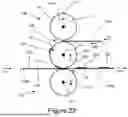
Sources:
- United States Patent and Trademark Office - verify current appl. status at the USPTO↗
Recent applications in this class:
- » 20260076838 2026-03-19
Airlaid produced in line - » 20240091071 2024-03-21
PLANT AND PROCESS FOR PRODUCING PULL-UP DIAPERS - » 20230046265 2023-02-16
ABSORBENT ARTICLES COMPRISING GRAPHICS - » 20220409441 2022-12-29
Machine and a method for manufacturing sanitary products - » 20210251814 2021-08-19
SHAPED PERMEABLE MATERIAL COMPOSITE FOR USE IN AN ABSORBENT ARTICLE - » 20210161728 2021-06-03
Elastic composite sheet manufacturing method - » 20210161727 2021-06-03
Absorbent article with channels and method for manufacturing thereof - » 20210128367 2021-05-06
CLOTHING MANUFACTURING APPARATUS AND CLOTHING MANUFACTURING METHOD - » 20210045932 2021-02-18
Method of producing a chassis web with a waistband component and disposable pant article produced from the chassis web - » 20200345559 2020-11-05
Manufacturing method and manufacturing apparatus for disposable wearable article