Patent Applications published on May 12, 2005
Explore the 5,079 U.S. Patent Applications published on the 19th week of 2005, including 3,285 applications that subsequently received a Patent Grant.
Featured patent applications from May 12, 2005
US20050101965A1
Human necessities
Apparatus and method for sealing and cutting tissue
An axial elongate bipolar tissue sealer/cutter and method of use by a surgeon for electrosurgery on tissue. A chassis on a handle extends axially for axial movement. An effector on a distal end of the chassis first contacts tissue with axial movement. The effector provides bipolar electrosurgery. A member extending from the distal end is opposite the patient end of a tube. First and second bipolar electrodes on the effector and a part on the member electrically isolated. A generator supplies the electrodes. An activator is movably supported on the handle and connects to the tube and/or chassis to axially move the effector relative to the part. Tissue and bodily fluid therebetween are sealed or cut through application of compression and bipolar electrosurgery between the first and second electrodes. The effector and the part have complimentary sealing or cutting surfaces for partial mating engagement upon axial movement toward one another.
Published: 2005-05-12 Assignee: Applied Medical Resources Corporation.US20050101991A1
Human necessities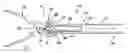
Overmolded grasper jaw
The invention is directed to a surgical instrument comprising an elongate tube extending along an axis including a camming rod and an actuation mechanism operably connected to the camming rod, the camming rod having a camming pin and a camming projection; a first jaw spine having a first cam slot, a first interior camming surface, and a first exterior camming surface; and a second jaw spine having a second cam slot, a second interior camming surface, and a second exterior camming surface, the second jaw spine pivotally connected to the first jaw spine at a common pivot pin operably connected to the elongate tube to open and close the jaw spines in response to movement of the actuation mechanism. The camming pin rides along the first and second interior camming surfaces and operates to close the jaw spines when the camming rod is moved proximally. When the camming rod moves distally, the camming projection rides on the first and second exterior camming surfaces formed on the proximal sides of the respective first and second jaw spines and operates to open the jaw spines. A feature of the invention is one camming surface on each jaw spine can facilitate closing the jaw spines while the other camming surface on each jaw spine can facilitate opening the jaw spines. These two camming surfaces on each jaw spine can be widely separated. The jaw spines can be formed of a metallic material and are overmolded with an atraumatic plastic material. By overmolding the plastic onto the metal spine, an atraumatic outer surface can be formed of the plastic material along with a high degree of detail.
Published: 2005-05-12 Assignee: BIOSENSE WEBSTER, INC..US20050099290A1
Human necessities
Digital wireless position sensor
A method is provided for tracking an object, including positioning a radio frequency (RF) driver to radiate an RF driving field toward the object, and fixing to the object a wireless transponder that includes a power coil and at least one sensor coil. The method also includes receiving the RF driving field using the power coil and storing electrical energy derived therefrom. A plurality of field generators are driven to generate electromagnetic fields at respective frequencies in a vicinity of the object that induce a voltage drop across the at least one sensor coil. A digital output signal is generated at the wireless transponder indicative of the voltage drop across the sensor coil, and the generation of the digital output signal is powered using the stored electrical energy. The digital output signal is transmitted from the wireless transponder using the power coil, and the transmission of the digital output signal is powered using the stored electrical energy. The digital output signal is received and processed to determine coordinates of the object.
Published: 2005-05-12 Assignee: COVIDIEN AG.US20050101952A1
Human necessities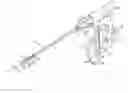
Vessel sealing wave jaw
A forceps for clamping, grasping, manipulating, coagulating/desiccating and cutting tissue includes a shaft portion having a proximal end, a distal end and first and second jaw members pivotally attached to the distal end of the shaft by a pivot assembly. Each of the jaw members including an opposing inner facing surface having a plurality of wave forms disposed thereon for engaging tissue therebetween. The wave forms disposed on the inner facing surface of the second jaw member being complimentary to the wave forms on the inner facing surface of first jaw member. A handle portion having an actuating assembly is attached to the proximal end of the shaft for imparting movement of the first and second jaw members from a first open position wherein the jaw members are disposed in spaced relation relative to one another to a second clamping position wherein the jaw members cooperate to grasp tissue therebetween. One embodiment of the forceps includes a pair of electrodes clamped on the inner facing surface of each jaw member for imparting electrosurgical energy to the tissue grasped therebetween.
Published: 2005-05-12 Assignee: The Research Foundation of State University of New York at Stony Brook.US20050102024A1
Human necessities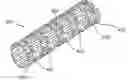
Apparatus and method for fixation of vascular grafts
An apparatus for facilitating securement of a vascular graft within a blood vessel, includes a shaft dimensioned for passage within a blood vessel and having an expansion member movable between a contracted condition and an expanded condition and a fastener array comprising at least one fastener disposed about a peripheral portion of the expansion member. The one fastener is deployable into a wall of the blood vessel upon movement of the expansion member to the expanded condition thereof, to thereby engage the vascular graft to secure the vascular graft to a wall of the blood vessel. The fastener array preferably includes a plurality of fasteners. The fasteners may be operatively connected to each other and releasably secured to the peripheral portion of the expansion member.
Published: 2005-05-12 Assignee: Agere Systems Inc..US20050100022A1
Electricity
Media delivery using quality of service differentiation within a media stream
A WLAN system adapted to apply QoS differentiation to a media stream to be transmitted from a transmitting station (STA) to a receiving STA of that system. The transmitting STA processes the media stream to generate a base sub-stream and one or more enhancement sub-streams for subsequent transmission over a wireless communication channel and assigns different priorities to different sub-streams. Depending on the channel conditions, the transmitting STA may select to discard, without transmission, portions of data from enhancement sub-streams. The selection process is based on the assigned priority and operates to preserve as much of relatively high-priority data as possible. The receiving STA then processes the received data to generate a reconstructed media stream, which provides signal quality equal to or better than the signal quality supported by the base sub-stream. Advantageously, a WLAN system of the invention is adapted to change signal quality dynamically and incrementally in a manner commensurate with current channel conditions without the need for communication between the higher and lower network layers. In addition, it provides gradual and graceful degradation of signal quality when channel conditions deteriorate as opposed to abrupt degradation inherent in analogous prior art systems.
Published: 2005-05-12 Assignee: MASIMO CORPORATION.US20050101849A1
Human necessities
Pulse oximetry data capture system
A data capture system utilizes a sensor with emitters adapted to transmit light into a fleshy medium and a detector adapted to generate intensity signals in response to receiving light after absorption by the fleshy medium. A monitor is configured to input the intensity signals, generate digitized signals from the intensity signals at a sampling rate and compute at least one physiological parameter responsive to magnitudes of the digitized signals. A data storage device is integrated with the monitor and is adapted to record data derived from the digitized signals on a removable storage media at the sampling rate.
Published: 2005-05-12 Assignee: SMITHS MEDICAL ASD, INC..US20050101912A1
Human necessities
Device and method for insertion of a cannula of an infusion device
A device for inserting a cannula of a subcutaneous infusion device into a subcutaneous layer of skin of a patient. For example, some devices automatically retract a needle used to introduce the cannula of a subcutaneous infusion device into the subcutaneous layer of skin of a patient. The device can include a housing with an internal cavity, as well as a needle coupled to the housing. The needle can be coupled to a cannula of a subcutaneous infusion device. A member can move the needle. Upon full introduction of the needle and associated cannula of the subcutaneous infusion device into a subcutaneous layer of skin of a patient, the member is automatically actuated to move the needle into the internal cavity of the housing into the retracted state while leaving the cannula of the subcutaneous infusion device in the subcutaneous layer of skin of the patient.
Published: 2005-05-12 Assignee: MASIMO CORPORATION.US20050101848A1
Human necessities
Pulse oximeter access apparatus and method
Access is provided to certain pulse oximetry systems utilizing a keyed sensor and a corresponding locked sensor port of a restricted access monitor. In such systems, the keyed sensor has a key comprising a memory element, and the monitor has a memory reader associated with the sensor port. The monitor is configured to function only when the key is in communications with the locked sensor port, and the memory reader is able to retrieve predetermined data from the memory element. The monitor is accessed by providing the key separate from the keyed sensor, integrating the key into an adapter cable, and connecting the adapter cable between the sensor port and an unkeyed sensor so that the monitor functions with the unkeyed sensor.
Published: 2005-05-12 Assignee: HELICOS BIOSCIENCES CORPORATION.US20050100932A1
Chemistry; metallurgy
Short cycle methods for sequencing polynucleotides
The invention provides methods for sequencing a polynucleotide comprising stopping an extension cycle in a sequence by synthesis reaction before the reaction has run to near or full completion.