Patent Applications published on May 19, 2005
Explore the 6,074 U.S. Patent Applications published on the 20th week of 2005, including 3,925 applications that subsequently received a Patent Grant.
Featured patent applications from May 19, 2005
US20050103819A1
Human necessities
Surgical stapling device with independent tip rotation
A surgical stapling device is disclosed which includes a handle assembly, an endoscopic body portion and a tool assembly. The tool assembly is rotatably and pivotally supported on a distal end of the endoscopic body portion. A tool assembly rotation mechanism is provided which includes a rotation knob, a substantially rigid tube and a flexible member interconnecting the rigid tube to the tool assembly. The substantially rigid tube translates rotation of the rotation knob to rotation of the flexible member and provides a channel for passage of other components of the surgical stapling device.
Published: 2005-05-19 Assignee: Cerebral Vascular Applications, Inc..US20050107824A1
Human necessities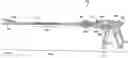
Medical instrument
A hydraulically actuated medical instrument includes an elongated shaft having proximal and distal ends, a hydraulically actuated end effector at the distal end of the shaft and a fluid flow path extending through the shaft to the end effector. The end effector may be directly manually operated by way of a handle located at the proximal end of the shaft or remotely, for example, via robotic controller. Articulation joints may be provided along the shaft, between the shaft and end effector or handle, or elsewhere. The hydraulic actuation of the present invention permits multiple axis instrument articulation, miniaturization and simplified instrument fabrication.
Published: 2005-05-19 Assignee: GYRUS ENT, L.L.C..US20050107814A1
Human necessities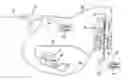
Powered surgical apparatus, method of manufacturing powered surgical apparatus, and method of using powered surgical apparatus
A powered surgical apparatus can be used with a source of irrigation fluid and a source of suction. The powered surgical apparatus can include a cutting blade assembly and a handle. The handle can include an upper portion defining a distal section connectable to the cutting blade assembly and a lower portion extending downwardly from the upper portion. The handle can be connectable to the source of irrigation fluid and the source of suction. The system can also include a manually actuable input device that provides at least one signal relevant to at least one operation of the system, and a controller that receives the at least one input signal and provides an output signal to perform the at least one operation of the system.
Published: 2005-05-19 Assignee: Novare Surgical Systems, Inc..US20050107667A1
Human necessities
Hand-actuated device for remote manipulation of a grasping tool
The invention provides an articulating mechanism useful, for example, for remote manipulation of various surgical instruments and diagnostic tools within, or to, regions of the body. Movement of segments at the proximal end of the mechanism results in a corresponding, relative movement of segments at the distal end of the mechanism. The proximal and distal segments are connected by a set of cables in such a fashion that each proximal segment forms a discrete pair with a distal segment. This configuration allows each segment pair to move independently of one another and also permits the articulating mechanism to undergo complex movements and adopt complex configurations. The articulating mechanisms may also be combined in such a way to remotely mimic finger movements for manipulation of an object or body tissue.
Published: 2005-05-19US20050107001A1
Mechanical engineering
Grinding apparatus for blending defects on turbine blades and associated method of use
A grinding apparatus for use with an endoscope for viewing and blending defects on a turbine engine blade is provided. In one preferred embodiment air pulses from an air supply cause a grinding head on the end of a grinding tool to reciprocate at a predetermined speed. The position of the grinding head is fixed via the operator via a trigger on the grinding tool which articulates an outer portion of a support tube of the grinding tool. In another preferred embodiment, fluid is used to reciprocate the grinding head.
Published: 2005-05-19 Assignee: DexCom, Inc..US20050103625A1
Physics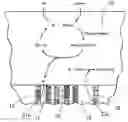
Sensor head for use with implantable devices
The present invention provides a sensor head for use in an implantable device that measures the concentration of an analyte in a biological fluid which includes: a non-conductive body; a working electrode, a reference electrode and a counter electrode, wherein the electrodes pass through the non-conductive body forming an electrochemically reactive surface at one location on the body and forming an electronic connection at another location on the body, further wherein the electrochemically reactive surface of the counter electrode is greater than the surface area of the working electrode; and a multi-region membrane affixed to the nonconductive body and covering the working electrode, reference electrode and counter electrode. In addition, the present invention provides an implantable device including at least one of the sensor heads of the invention and methods of monitoring glucose levels in a host utilizing the implantable device of the invention.
Published: 2005-05-19 Assignee: Texturgy AS.US20050108001A1
Physics
Method and apparatus for textual exploration discovery
The present invention relates to a method and system for textual exploration and discovery. More specifically, the method and system provide a text-driven and grammar based tool for textual exploration and textual navigation. The facilities for textual exploration and textual navigation are based on a system of index entries that are connected to the underlying text segments from which the index entries are derived. Text units with particular grammatical, semantic, and/or pragmatic features constitute bundles of sentences or text zones.
Published: 2005-05-19US20050107871A1
Human necessities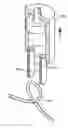
Apparatus and methods for valve repair
A valve implant or prosthesis includes a skirt or prosthetic valve leaflet configured to cover one of the leaflets of the valve to be repaired in a patient's heart. In one embodiment, a heart valve prosthesis includes a curved member and a skirt. The curved member can have first and second ends and be adapted to form a partial ring along a portion of one of the valve annulae in the patient's heart. Alternatively, the curved member can form a full ring that is adapted to extend along the entire valve annulus. The skirt extends along the curved member and depends therefrom. This prosthesis is especially useful in treating mitral valve insufficiency. In this case, the skirt can be configured so that when the prosthesis is secured to the mitral valve along the mitral valve annulus, the skirt covers the posterior leaflet and the opposed edges of the skirt and the anterior leaflet coapt. In addition, when the curved member is secured to the posterior portion of the mitral valve annulus, further annulus dilation can be minimized or eliminated. Implant delivery apparatus is provided for rapid implant delivery and securement to the valve.
Published: 2005-05-19 Assignee: Sherwood Services AG.US20050107784A1
Human necessities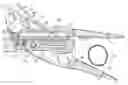
Open vessel sealing instrument with cutting mechanism and distal lockout
An open electrosurgical forceps for sealing tissue includes a pair of first and second shaft members each having a jaw member disposed at a distal end thereof. The jaw members are movable from a first position in spaced relation relative to one another to a subsequent position wherein the jaw members cooperate to grasp tissue therebetween. Each of the jaw members includes an electrically conductive sealing plate for communicating electrosurgical energy through tissue held therebetween. At least one of the jaw members includes a knife channel defined along a length thereof which is dimensioned to reciprocate a cutting mechanism therealong for cutting tissue disposed between jaw members. An actuator having a rack and pinion system advances the cutting mechanism from a first position wherein the cutting mechanism is disposed proximal to tissue held between the jaw members to at least one subsequent position wherein the cutting mechanism is disposed distal to tissue held between the jaw members.
Published: 2005-05-19 Assignee: METROLOGIC INSTRUMENTS, INC..US20050103854A1
Physics
Hand-supportable digital imaging-based bar code symbol reader supporting narrow-area and wide-area modes of illumination and image capture
A hand-supportable digital imaging-based bar code symbol reading device comprises: an ir-based object presence and range detection subsystem; a multi-mode area-type image formation and detection subsystem having narrow-area and wide area image capture modes of operation; a multi-mode LED-based illumination subsystem having narrow-area and wide area illumination modes of operation; an automatic light exposure measurement and illumination control subsystem; an image capturing and buffering subsystem; a multi-mode image-processing bar code symbol reading subsystem; an input/output subsystem; a manually-activatable trigger switch; a system mode configuration parameter table; and a system control subsystem integrated with each of the above-described subsystems. The digital imaging-based bar code reading device supports narrow-area and wide-area modes of illumination and image capture, and can be configured and operated in numerous programmable modes of system operation to automatically read 1D and 2D bar code symbologies in a high-speed manner.