Patent Applications published on Aug 24, 2006
Explore the 5,995 U.S. Patent Applications published on the 34th week of 2006, including 3,640 applications that subsequently received a Patent Grant.
Featured patent applications from Aug 24, 2006
US20060190031A1
Human necessities
Surgical instrument with articulating shaft with rigid firing bar supports
A surgical stapling and severing instrument particularly suited to endoscopic use includes a proximal portion that is manipulated external to a patient to position an attached elongate shaft and end effector to a desired surgical site inside of the patient. An articulation joint pivotally attaches the end effector to the elongate shaft to give further clinical flexibility in reaching tissue at a desired angle. A firing bar translates within the elongate shaft and articulates through the articulation joint with a reduced force to fire, supported within a knife slot formed in a link that pivots at both ends, thereby reducing the radius of curvature of the firing bar by half at a particular location. One version includes a link that connects across portions of a closure sleeve assembly and another version includes a link that connects proximal and frame ground portions.
Published: 2006-08-24 Assignee: ETHICON ENDO-SURGERY, INC..US20060190028A1
Human necessities
Surgical instrument incorporating a fluid transfer controlled articulation mechanism
A surgical instrument particularly suited to endoscopic use articulates an end effector by including a fluid transfer articulation mechanism that is proximally controlled. A fluid control, which is attached to a proximal portion, transfers fluid through the elongate shaft through a first fluid passage to a first fluid actuator that responds by articulating an articulation joint. Two opposing fluid actuators may respond to differential fluid transfer to effect articulation. Thereby, design flexibility is achieved by avoiding the design constraints of transferring a mechanical motion through the tight confines of the elongate shaft sufficient to effect articulation.
Published: 2006-08-24 Assignee: ETHICON ENDO-SURGERY, INC..US20060190029A1
Human necessities
Surgical instrument with laterally moved shaft actuator coupled to pivoting articulation joint
A surgical instrument particularly suited to endoscopic use articulates an end effector by including a laterally sliding member in a proximal portion of a shaft that pivots the end effector to a selected side. Differentially opposing actuating forces (e.g., hydraulic, fluidic, mechanical) act against the laterally sliding member without binding by incorporating guidance mechanisms between the laterally sliding member and a frame of the shaft.
Published: 2006-08-24US20060185682A1
Human necessities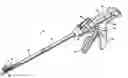
Surgical stapling apparatus with locking mechanism
The present disclosure provides for a loading unit for use with and/or supportable on a distal end of a surgical stapling apparatus. The loading unit includes a housing portion including a distal end and a proximal end, a drive assembly slidably supported within the housing portion of the loading unit, and a locking mechanism supported on the housing portion of the loading unit. The locking mechanism has a first position wherein the locking mechanism engages the drive assembly and maintains the position of the drive assembly in a ready-to-load position relative to the housing portion of the loading unit. The locking mechanism is pivotable to a second position wherein the locking mechanism disengages the drive assembly and enables the drive assembly to move relative to the housing portion.
Published: 2006-08-24 Assignee: Allergan, Inc..US20060190039A1
Human necessities
Implantable device fastening system and methods of use
A surgical fastening system for implantable devices is disclosed. The implantable device may contain a plurality of fasteners in pre-deployment position, may have a housing fitted over or around it which contains a plurality of fasteners in pre-deployment position, or may be a part of a two-part system into which it fits. Accordingly, the present invention also encompasses a deployment system or tool that optionally positions the implantable device, and which causes the fasteners to move into post-deployment position. The fasteners may be staples, metal loops, coils, springs or hooks formed of biocompatible materials, including shape memory alloys such as NiTi.
Published: 2006-08-24 Assignee: ABBOTT DIABETES CARE INC..US20060189863A1
Human necessities
Analyte monitoring device and methods of use
An analyte monitor includes a sensor, a sensor control unit, and a display unit. The sensor has, for example, a substrate, a recessed channel formed in the substrate, and conductive material disposed in the recessed channel to form a working electrode. The sensor control unit typically has a housing adapted for placement on skin and is adapted to receive a portion of an electrochemical sensor. The sensor control unit also includes two or more conductive contacts disposed on the housing and configured for coupling to two or more contact pads on the sensor. A transmitter is disposed in the housing and coupled to the plurality of conductive contacts for transmitting data obtained using the sensor. The display unit has a receiver for receiving data transmitted by the transmitter of the sensor control unit and a display coupled to the receiver for displaying an indication of a level of an analyte. The analyte monitor may also be part of a drug delivery system to alter the level of the analyte based on the data obtained using the sensor.
Published: 2006-08-24 Assignee: IGT.US20060189382A1
Physics
Method and apparatus for registering a mobile device with a gaming machine
Disclosed are methods, apparatus, and systems, including computer program products, implementing techniques for securing a gaming machine for a player of the gaming machine using a mobile device such as a cell phone associated with the player. A player input requests securing of the gaming machine. Responsive to the player input, an access code and a security code are retrieved. The access code defines an access point of a communication system. The security code is specific to a game play session for the player at the gaming machine. The retrieved access code and security code are provided for the player. When the mobile device accesses the communications system and submits the security code, a secure signal is sent to the gaming machine, instructing the gaming machine to enter a remote game play state. The gaming machine can be released from the remote game play state responsive to a releasing event. In one implementation, a wireless interface enables communication between the mobile device and gaming machine according to a wireless protocol such as Bluetooth.
Published: 2006-08-24 Assignee: OBLONG INDUSTRIES, INC..US20060187196A1
Physics
System and method for gesture based control system
The system provides a gestural interface to various visually presented elements, presented on a display screen or screens. A gestural vocabulary includes ‘instantaneous’ commands, in which forming one or both hands into the appropriate ‘pose’ results in an immediate, one-time action; and ‘spatial’ commands, in which the operator either refers directly to elements on the screen by way of literal ‘pointing’ gestures or performs navigational maneuvers by way of relative or “offset” gestures. The system contemplates the ability to identify the users hands in the form of a glove or gloves with certain indicia provided thereon, or any suitable means for providing recognizable indicia on a user's hands or body parts. A system of cameras can detect the position, orientation, and movement of the user's hands and translate that information into executable commands.
Published: 2006-08-24 Assignee: MASIMO CORPORATION.US20060189859A1
Human necessities
Pulse oximetry sensor adapter
An adapter allows the interconnection of a sensor originating from one manufacturer to be coupled with conventionally incompatible monitors originating from other manufacturers to form a properly functioning pulse oximetry system. The adapter matches a sensor driver in a monitor to the current requirements and light source configuration of a sensor. The adapter also matches a sensor's light detector signal level to the dynamic range requirements of a monitor preamplifier. Further, the adapter provides compatible sensor calibration, sensor type and security information to a monitor. The adapter may have a self-contained power source or it may derive power from the monitor, allowing both passive and active adapter components. The adapter is particular suited as an adapter cable, replacing a conventional patient cable or sensor cable as the interconnection between a sensor to a monitor in a pulse oximetry system.
Published: 2006-08-24 Assignee: SMITHS MEDICAL ASD, INC..US20060190065A1
Human necessities
System for providing actuated optimal inflation to multiple temperature regulated blankets and method therefor
A convective warmer to which blankets of different dimensions may be connected is capable of providing air to the various blankets at flow rates that optimally inflate those blankets to achieve the optimal clinical result for the patients covered by those blankets. The blanket connected to the warmer may range from a full size adult warming blanket to a pediatric warming blanket. The convection warmer may have multiple fixed air flow rates each selectable by a user, via switch(es) either electronically or mechanically. For the electronic selection of a given flow rate, a motor adaptable to rotate a different speeds is used. To vary the flow rate mechanically, a valve is controlled to vary the amount of air that may pass to the blanket. Instead of different fixed flow rates, variable air flow rates, selectable by the user, may be used. Also, a feedback circuit that maintains the pressure sensed at the outlet of the warmer to a preset pressure may be used to eliminate the need for user intervention.