Patent Applications published on Sep 1, 2011
Explore the 4,953 U.S. Patent Applications published on the 35th week of 2011, including 3,401 applications that subsequently received a Patent Grant.
Featured patent applications from Sep 1, 2011
US20110210156A1
Human necessities
Electrically self-powered surgical instrument with manual release
A method for operating a surgical instrument includes mechanically coupling a manual release to a transmission of a surgical instrument having a self-contained power supply disposed entirely within a handle thereof. The transmission translates movement of an electrically powered motor inside the handle to movement of a part of a surgical end effector connected to the handle. The part is operable to move anywhere between a start position and a fully actuated position. The method further includes selectively interrupting the transmission with the manual release to move the part towards the start position independent of motor operation.
Published: 2011-09-01US20110213384A1
Human necessities
Surgical robot system having tool for minimally invasive surgery
The present invention relates to a surgical robot system having a tool for minimally invasive surgery. More specifically, the present invention relates to a surgical robot system that helps a user such as a surgeon control the tool for minimally invasive surgery in a dexterous and convenient manner.
Published: 2011-09-01 Assignee: Covidien LP.US20110213363A1
Human necessities
Drive mechanism for articulation of a surgical instrument
A surgical instrument includes a housing, an end effector and an elongated shaft extending therebetween. The shaft includes a distal portion movable between aligned and articulated configurations. First and second drive cables are coupled to the distal portion such that reciprocal longitudinal motion of the drive cables induces movement of the distal portion between the aligned and articulated configurations. An articulation drive mechanism is operable to induce reciprocal longitudinal motion of the drive cables. The drive mechanism includes an actuator and a pair pulleys operatively coupled to the actuator to rotate about an axle. The first and second drive cables are coupled to the pulleys such that the drive cables extend on opposite lateral sides of the axle. A biasing mechanism is configured to bias the first and second pulleys to at least one discrete orientation to maintain the distal portion of the elongated shaft in a discrete articulated position.
Published: 2011-09-01 Assignee: OSTERHOUT GROUP, INC..US20110213664A1
Physics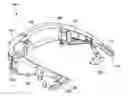
LOCAL ADVERTISING CONTENT ON AN INTERACTIVE HEAD-MOUNTED EYEPIECE
This disclosure concerns an interactive head-mounted eyepiece including an optical assembly through which the user views a surrounding environment and displayed content. The displayed content includes a local advertisement, wherein the location of the eyepiece is determined by an integrated location sensor and wherein the local advertisement has a relevance to the location of the eyepiece. The head mounted eyepiece may also include an audio device and the displayed content may comprise local advertisements and audio.
Published: 2011-09-01 Assignee: DIGIMARC CORPORATION.US20110212717A1
Physics
Methods and systems for content processing
Mobile phones and other portable devices are equipped with a variety of technologies by which existing functionality can be improved, and new functionality can be provided. Some aspects relate to visual search capabilities, and determining appropriate actions responsive to different image inputs. Others relate to processing of image data. Still others concern metadata generation, processing, and representation. Yet others concern user interface improvements. Other aspects relate to imaging architectures, in which a mobile phone's image sensor is one in a chain of stages that successively act on packetized instructions/data, to capture and later process imagery. Still other aspects relate to distribution of processing tasks between the mobile device and remote resources (“the cloud”). Elemental image processing (e.g., simple filtering and edge detection) can be performed on the mobile phone, while other operations can be referred out to remote service providers. The remote service providers can be selected using techniques such as reverse auctions, through which they compete for processing tasks. A great number of other features and arrangements are also detailed.
Published: 2011-09-01 Assignee: MASIMO CORPORATION.US20110213271A1
Human necessities
Acoustic respiratory monitoring sensor having multiple sensing elements
According to certain described aspects, multiple acoustic sensing elements are employed in a variety of beneficial ways to provide improved physiological monitoring, among other advantages. In various embodiments, sensing elements can be advantageously employed in a single sensor package, in multiple sensor packages, and at a variety of other strategic locations in the monitoring environment. According to other aspects, to compensate for skin elasticity and attachment variability, an acoustic sensor support is provided that includes one or more pressure equalization pathways. The pathways can provide an air-flow channel from the cavity defined by the sensing elements and frame to the ambient air pressure.
Published: 2011-09-01 Assignee: MASIMO CORPORATION.US20110213272A1
Human necessities
Acoustic patient sensor
According to certain described aspects, multiple acoustic sensing elements are employed in a variety of beneficial ways to provide improved physiological monitoring, among other advantages. In various embodiments, sensing elements can be advantageously employed in a single sensor package, in multiple sensor packages, and at a variety of other strategic locations in the monitoring environment. According to other aspects, to compensate for skin elasticity and attachment variability, an acoustic sensor support is provided that includes one or more pressure equalization pathways. The pathways can provide an air-flow channel from the cavity defined by the sensing elements and frame to the ambient air pressure.
Published: 2011-09-01 Assignee: MASIMO CORPORATION.US20110213273A1
Human necessities
Acoustic respiratory monitoring sensor having multiple sensing elements
According to certain described aspects, multiple acoustic sensing elements are employed in a variety of beneficial ways to provide improved physiological monitoring, among other advantages. In various embodiments, sensing elements can be advantageously employed in a single sensor package, in multiple sensor packages, and at a variety of other strategic locations in the monitoring environment. According to other aspects, to compensate for skin elasticity and attachment variability, an acoustic sensor support is provided that includes one or more pressure equalization pathways. The pathways can provide an air-flow channel from the cavity defined by the sensing elements and frame to the ambient air pressure.
Published: 2011-09-01 Assignee: MASIMO CORPORATION.US20110213274A1
Human necessities
Acoustic respiratory monitoring sensor having multiple sensing elements
According to certain described aspects, multiple acoustic sensing elements are employed in a variety of beneficial ways to provide improved physiological monitoring, among other advantages. In various embodiments, sensing elements can be advantageously employed in a single sensor package, in multiple sensor packages, and at a variety of other strategic locations in the monitoring environment. According to other aspects, to compensate for skin elasticity and attachment variability, an acoustic sensor support is provided that includes one or more pressure equalization pathways. The pathways can provide an air-flow channel from the cavity defined by the sensing elements and frame to the ambient air pressure.
Published: 2011-09-01 Assignee: MASIMO CORPORATION.US20110209915A1
Electricity
Pulse oximetry system with low noise cable hub
A pulse oximetry system for reducing the risk of electric shock to a medical patient can include physiological sensors, at least one of which has a light emitter that can impinge light on body tissue of a living patient and a detector responsive to the light after attenuation by the body tissue. The detector can generate a signal indicative of a physiological characteristic of the living patient. The pulse oximetry system may also include a splitter cable that can connect the physiological sensors to a physiological monitor. The splitter cable may have a plurality of cable sections each including one or more electrical conductors that can interface with one of the physiological sensors. One or more decoupling circuits may be disposed in the splitter cable, which can be in communication with selected ones of the electrical conductors. The one or more decoupling circuits can electrically decouple the physiological sensors.