Patent Applications published on May 17, 2012
Explore the 7,011 U.S. Patent Applications published on the 20th week of 2012, including 4,758 applications that subsequently received a Patent Grant.
Featured patent applications from May 17, 2012
US20120123203A1
Human necessities
Device for treatments of endoscopic resection/removal of tissues
A device (1) for treatments of endoscopic resection/removal of tissues, includes: a handpiece apt to be held by an user; an external tubular element (3) having a proximal end, a distal end and a cutting aperture disposed at the distal end; an internal tubular element (4) apt to be pivotally housed in the external tubular element (3) and having a proximal end, a distal end and a cutting tip at its distal end. The device also includes guide elements (5) for rotating and/or oscillating the internal tubular element (4) with respect to the external tubular element (3). The guide elements (5) include an electric motor (19) and electric feeding element for the electric motor (19) and are contained completely inside the handpiece (2).
Published: 2012-05-17 Assignee: HARTFORD FIRE INSURANCE COMPANY.US20120123806A1
Physics
Systems and methods for providing a safety score associated with a user location
Pursuant to some embodiments, insurance systems, methods and devices are provided which include a data storage device for storing, updating and providing access to loss risk score data. In some embodiments, a request for information associated with a user's location identified by user location data may be received over a communications network. A computer processing system may then be operated to generate a safety score associated with said use location data, the safety score being based on a plurality of loss risk factors associated with the user location data. A response, including the safety score, may then be transmitted to the user over the communications network.
Published: 2012-05-17 Assignee: Edwards Lifesciences Corporation.US20120123529A1
Human necessities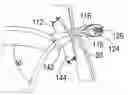
Prosthetic heart valve
Embodiments of a radially collapsible and expandable prosthetic heart valve are disclosed. A valve frame can have a tapered profile when mounted on a delivery shaft, with an inflow end portion having a smaller diameter than an outflow end portion. The valve can comprise generally V-shaped leaflets, reducing material within the inflow end of the frame. An outer skirt can be secured to the outside of the inflow end portion of the frame, the outer skirt having longitudinal slack when the valve is expanded and lying flat against the frame when the valve is collapsed. A diagonally woven inner skirt can elongate axially with the frame. Side tabs of adjacent leaflets can extend through and be secured to window frame portions of the frame to form commissures. The window frame portions can be depressed radially inward relative to surrounding frame portions when the valve is crimped onto a delivery shaft.
Published: 2012-05-17 Assignee: PELLENC (SOCIETE ANONYME).US20120118595A1
Performing operations; transporting
MULTIFUNCTIONAL PORTABLE ELECTRIC APPARATUSES
The invention relates to portable electric apparatuses of the kind including a tool driven by an electric motor, and a battery supplying the electric power necessary for the operation of said tool, characterised in that said portable electric apparatuses include a communication system enabling, on the one hand, the exchange of information relative to the type, the state and the operation of the tool and of the battery when connected together and, on the other hand, the adjusting if need be of the operation parameters of said tool based on the characteristics of said battery and/or the operation parameters of the battery based on the operation parameters of said tool.
Published: 2012-05-17US20120123463A1
Human necessities
MECHANICALLY-GUIDED TRANSORAL BOUGIE
The present invention is referred to a mechanically-guided transoral bougie, comprising an elongated body with an external end and a distal end; said external end includes a guiding mechanism mechanically connected to said distal end to allow the surgeon to move said distal end in any direction once the bougie is inserted into the stomach. Said guiding mechanism includes a manually operated guiding control.
Published: 2012-05-17US20120124458A1
PhysicsSocial networking website & web-based system for collecting & presenting real-time user generated information on parties & events.
This invention is a social networking website & web-based system that allows users to post ‘party reports’—detailed, real-time information about current ongoing parties and events that they know of; allows users to comment and upload pictures & videos on the posted information in real-time; and presents this information in an organized fashion—by city, school or location, by date & time, or by both. The system also contains algorithms used to determine the top or best party cities, schools or locations based on predetermined formulas & user posted information. The website also allows users to connect with other registered users on the website and define them as their ‘peeps’ as well as create ‘crews’, which are close-knit groups of people that they usually party to go out with.
Published: 2012-05-17 Assignee: MICROSOFT CORPORATION.US20120124126A1
Electricity
CONTEXTUAL AND TASK FOCUSED COMPUTING
Concepts and technologies are described herein for contextual and task-focused computing. In accordance with the concepts and technologies disclosed herein, a discovery engine analyzes application data describing applications, recognizes tasks associated with the applications, and stores task data identifying and describing the tasks in a data storage location. The task data is searchable by search engines, indexing and search services, and task engines configured to provide tasks to one or more client devices operating alone or in a synchronized manner, the tasks being provided on demand or based upon activity associated with the one or more client devices. A task engine receives or obtains contextual data describing context associate with the client devices and/or social networking data associated with one or more users of the client devices. Based upon the contextual data and/or the social networking data, the task engine identifies one or more relevant tasks and provides to the client devices information for accessing the relevant tasks, or packaged data corresponding to the relevant tasks.
Published: 2012-05-17 Assignee: MASIMO CORPORATION.US20120123278A1
Human necessities
Low-noise optical probes for reducing ambient noise
An optical probe, which is particularly suited to reduce noise in measurements taken on an easily compressible material, such as a finger, a toe, a forehead, an earlobe, or a lip, measures characteristics of the material. A neonatal and adult disposable embodiment of the probe include adhesive coated surfaces to securely affix the probe onto the patient. In addition, the surface of the probe is specially constructed to reduce the effect of ambient noise.
Published: 2012-05-17 Assignee: Applied Materials, Inc..US20120122302A1
Electricity
Methods for deposition of silicon carbide and silicon carbonitride films
Methods for deposition of silicon carbide films on a substrate surface are provided. The methods include the use of vapor phase carbosilane precursors and may employ plasma enhanced atomic layer deposition processes. The methods may be carried out at temperatures less than 600° C., for example between about 23° C. and about 200° C. or at about 100° C. This silicon carbide layer may then be densified to remove hydrogen content. Additionally, the silicon carbide layer may be exposed to a nitrogen source to provide reactive N—H groups, which can then be used to continue film deposition using other methods. Plasma processing conditions can be used to adjust the carbon, hydrogen and/or nitrogen content of the films.
Published: 2012-05-17 Assignee: TEANECK ENTERPRISES, LLC, IKORONGO TECHNOLOGY, LLC..US20120124176A1
Physics
Automatic check-ins and status updates
Methods and Devices are disclosed for performing automatic check-ins for a user associated with a mobile device. In some embodiments, the process is completely automated with no user intervention once the process has started. In some embodiments, the user is prompted for confirmation before the check-in is generated. The automatic check-in is performed based on detecting a social context which includes a current location of the user of the mobile device and applying rules. The rules may include an action part, a condition part, and qualifier part. The rules and the individual parts of the rules may be independently editable by the user.