Patent Applications published on Apr 17, 2014
Explore the 7,469 U.S. Patent Applications published on the 16th week of 2014, including 5,256 applications that subsequently received a Patent Grant.
Featured patent applications from Apr 17, 2014
US20140107640A1
Human necessities
Motorized surgical cutting and fastening instrument
A surgical cutting and fastening instrument comprises an end effector, a shaft connected to the end effector, and a handle connected to the shaft. The handle comprises an electric, DC motor connected to a drive train for powering the drive train and a plurality of series-connected DC power source connected to the motor for supplying electrical power to the motor. The handle also comprises a power source selection switch for connecting, when in a first state, all of the DC power sources to the motor, and, when in a second state, a subset of the DC power sources to the motor. Also disclosed are means for actuating a RF electrode in the end effector and means for indicating actuation of the RF electrode.
Published: 2014-04-17 Assignee: ETHICON ENDO-SURGERY, INC., Ethicon Endo-Surgery, LLC.US20140103093A1
Human necessities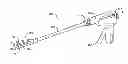
Surgical cutting instrument
A surgical cutting instrument includes a first jaw member, a second jaw member movably supported relative to the first jaw member for selective movement between an open position and a closed position to clamp tissue therebetween upon application of a closing motion thereto, and a cutting member comprising a tissue cutting edge to cut the tissue clamped between the first jaw member and the second jaw member upon application of a retraction motion to the cutting member.
Published: 2014-04-17 Assignee: Covidien LP.US20140103092A1
Human necessities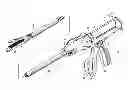
In-situ loaded stapler
In one aspect of the present disclosure a surgical stapling apparatus is disclosed including a cartridge assembly. The cartridge assembly includes at least one cartridge having a first half and a second half, a first row of retention slots disposed in the first half, a second row of retention slots disposed in the second half, a third row of retention slots being alternately disposed in the first half and the second half of the at least one cartridge between the first and second rows of staple receiving slots, a plurality of fasteners disposed in the retention slots of the first, second and third rows, and a plurality of pushers disposed in each of the first and second halves of the cartridge.
Published: 2014-04-17 Assignee: BOARD OF REGENTS OF THE UNIVERSITY OF NEBRASKA.US20140107471A1
Human necessities
On-board tool tracking system and methods of computer assisted surgery
A number of improvements are provided relating to computer aided surgery utilizing an on tool tracking system. The various improvements relate generally to both the methods used during computer aided surgery and the devices used during such procedures. Other improvements relate to the structure of the tools used during a procedure and how the tools can be controlled using the OTT device. Still other improvements relate to methods of providing feedback during a procedure to improve either the efficiency or quality, or both, for a procedure including the rate of and type of data processed depending upon a CAS mode.
Published: 2014-04-17 Assignee: TransEnterix Surgical, Inc..US20140107665A1
Human necessities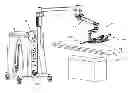
Mechanized multi-instrument surgical system
A surgical system includes an instrument driver having a distal end positionable in a body cavity and a user input device. The instrument driver and user input device are positioned to removably receive distal and proximal portions, respectively, of a surgical instrument. The user input device is configured to generate movement signals in response to manual manipulation of the proximal portion of the surgical instrument. At least one motor operable to actuate the instrument driver in response to the movement signals and to thereby change position of the distal portion of the surgical instrument within the body cavity.
Published: 2014-04-17 Assignee: Black & Decker, Inc..US20140102742A1
Performing operations; transporting
Power tool having rotary input control
A power tool includes a housing, a motor, an output member driven by the motor, and a reaming attachment coupled to the output member. The reaming attachment has a front end portion selectively driven in rotation by the output member to drive a fastener into a workpiece, and a reaming portion selectively driven in rotation by the output member to remove material from an end surface of a conduit. A rotational motion sensor in the housing is operable to detect rotational motion of the housing about an axis. A controller receives a signal indicative of rotational motion from the sensor, determines a direction of the rotational motion of the housing, and drives the motor in a direction corresponding to the direction of rotational motion of the housing.
Published: 2014-04-17 Assignee: SANOFI-AVENTIS DEUTSCHLAND GMBH.US20140107585A1
Human necessities
Medicament delivery device with cap
The invention resides in a hand-held medicament delivery device which comprises a housing containing a first electrical circuit and a battery, a medicament delivery mechanism, and a protective cap releasably securable to the housing. The housing also includes a contactless switch and the cap a switch actuator. The switch is operable between an on state in which the first electrical circuit is connected to the battery and an off state in which the first electrical circuit is disconnected from the battery. The invention also resides in a method of controlling power in a hand held medicament delivery device comprising the steps of actuating a contactless switch in the housing by an actuator in a housing cap when the switch and actuator are in proximity, the actuation of the switch signalling to a microprocessor that the cap is on the housing, detecting the status of the device by the microprocessor, and only if the microprocessor determines the device is inactive, powering down the device.
Published: 2014-04-17 Assignee: CASTLE SURGICAL, INC..US20140107697A1
Human necessities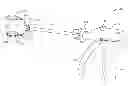
Clamping Forceps and Associated Methods
Clamping forceps and associated methods are provided that generally include a head section including first and second clamp members configured to cooperatively clamp so as to at least partially encircle a tumor or other structure, an elongated body section in cooperation with the head section, and a clamping mechanism at least partially movably mounted with respect to the elongated body section. The clamping forceps may include a control mechanism for variably controlling the clamping force, at least one sensor mounted with respect to the clamp member(s), means for fixating the clamp member(s) relative to tissue, the first and second clamp members structured to define a variable perimeter extent, and a clamping mechanism which accommodates variable rates of clamping action. Actuation of the clamping mechanism generally maintains substantially parallel actuation of the first and second clamp members with respect to the tumor or the other anatomical structure. Methods for use of the clamping forceps may include introducing the head section to the surgical site through an incision; positioning a trocar port at the surgical site; introducing at least a portion of the elongated body section to the surgical site through the trocar port; intra-corporeally connecting the head section with respect to the elongated body section; and extra-corporeally actuating the clamping mechanism so as to actuate the first and second clamp members into a clamping position around the tumor or other anatomical structure.
Published: 2014-04-17 Assignee: FISHER-ROSEMOUNT SYSTEMS, INC..US20140108985A1
Physics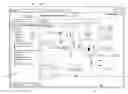
Configurable user displays in a process control system
A display configuration system enables plant operators to create their own process displays called dashboards during run-time of the plant and in the same interface that these operators use to view operation of the process plant. This display configuration system makes the operators more productive because the operators can quickly create and implement their own specialized dashboards, as these operators determine these dashboards are needed. Each dashboard has a defined layout specifying locations or regions at which display elements can be shown in the dashboard, and this layout is operator modifiable. Operators can easily create content on their own dashboards using predefined but configurable display building blocks called gadgets, which can be pre-stored in a library and can be made available for the operator during dashboard creation activities. A gadget can be dragged and dropped onto a dashboard at one of the regions or locations of the dashboard to be installed in that region or location of the dashboard. The display configuration system may automatically size the gadgets based on the selected dashboard layout, and operators can modify an existing dashboard by adding, modifying, moving, minimizing or deleting gadgets on the dashboard.
Published: 2014-04-17 Assignee: INTERMEC IP CORP..US20140108010A1
Physics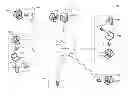
VOICE-ENABLED DOCUMENTS FOR FACILITATING OPERATIONAL PROCEDURES
A voice-enabled document system facilitates execution of service delivery operations by eliminating the need for manual or visual interaction during information retrieval by an operator. Access to voice-enabled documents can facilitate operations for mobile vendors, on-site or field-service repairs, medical service providers, food service providers, and the like. Service providers can access the voice-enabled documents by using a client device to retrieve the document, display it on a screen, and, via voice commands initiate playback of selected audio files containing information derived from text data objects selected from the document. Data structures that are components of a voice-enabled document include audio playback files and a logical association that links the audio playback files to user-selectable fields, and to a set of voice commands.