Patent Applications published on Jun 11, 2015
Explore the 7,044 U.S. Patent Applications published on the 24th week of 2015, including 4,924 applications that subsequently received a Patent Grant.
Featured patent applications from Jun 11, 2015
US20150157354A1
Human necessities
Battery-powered hand-held ultrasonic surgical cautery cutting device
A battery-powered, modular surgical device comprising an electrically powered surgical instrument that requires a pre-determined minimum amount of electrical energy to complete a surgical procedure, and a power module assembly that has a battery that powers the surgical instrument and has a current state of electrical charge, and a control circuit that is electrically coupled to the battery and the surgical instrument and has a memory and a microprocessor. The microprocessor determines the current state of electrical charge of the battery, compares the current state of electrical charge to the pre-determined minimum amount of electrical energy, permits the battery to discharge if the current state of electrical charge is above the pre-determined minimum amount of electrical energy, and maintains the battery in a non-discharge state if the current state of electrical charge is below the pre-determined minimum amount of electrical energy.
Published: 2015-06-11 Assignee: MEDOS INTERNATIONAL SÁRL.US20150157352A1
Human necessities
Tissue shaving device having a fluid removal path
A handle assembly for use in conjunction with a surgical cutting device is provided. The handle assembly can generally include two, detachable pieces or housings. The first housing can include electrical and mechanical components for driving a cutting assembly, such as a motor, while the second housing can include a fluid flow path that allows fluid to flow from the surgical site to a location outside of the cutting device. At least a portion of the fluid flow path can extend substantially adjacent to at least a portion of one or more components used to drive the cutting assembly to help manage the heat output of the components. The fluid flow path allows the fluid to exit the device without coming into contact with components like a motor, while also helping to cool the handle assembly. Systems and methods for cutting tissue are also provided.
Published: 2015-06-11 Assignee: AT&T Intellectual Property I, LP.US20150162988A1
Electricity
Quasi-optical coupler
A quasi-optical coupling system launches and extracts surface wave communication transmissions from a wire. At millimeter-wave frequencies, where the wavelength is small compared to the macroscopic size of the equipment, the millimeter-wave transmissions can be transported from one place to another and diverted via lenses and reflectors, much like visible light. Transmitters and receivers can be positioned near telephone and power lines and reflectors placed on or near the cables can reflect transmissions onto or off of the cables. The lenses on the transmitters are focused, and the reflectors positioned such that the reflected transmissions are guided waves on the surface of the cables. The reflectors can be polarization sensitive, where one or more of a set of guided wave modes can be reflected off the wire based on the polarization of the guided wave modes and polarization and orientation of the reflector.
Published: 2015-06-11 Assignee: Applied Materials, Inc..US20150162214A1
Electricity
Methods of selective layer deposition
Provided are methods for selective deposition. Certain methods describe providing a first substrate surface; providing a second substrate surface; depositing a first layer of film over the first and second substrate surfaces, wherein the deposition has an incubation delay over the second substrate surface such that the first layer of film over the first substrate surface is thicker than the first layer of film deposited over the second substrate surface; and etching the first layer of film over the first and second substrate surfaces, wherein the first layer of film over the second substrate surface is at least substantially removed, but the first layer of film over the first substrate is only partially removed.
Published: 2015-06-11 Assignee: LOOKOUT, INC..US20150163121A1
Electricity
Distributed monitoring, evaluation, and response for multiple devices
Data is collected from a set of devices. The data is associated with the devices, mobile application programs (apps), web applications, users, or combinations of these. A norm is established using the collected data. The norm is compared with data collected from a particular device. If there is a deviation outside of a threshold deviation between the norm and the data collected from the particular device, a response is initiated.
Published: 2015-06-11 Assignee: MASIMO CORPORATION.US20150157245A1
Human necessities
System and method for monitoring the life of a physiological sensor
Aspects of the present disclosure include a sensor configured to store in memory indications of sensor use information and formulas or indications of formulas for determining the useful life of a sensor from the indications of sensor use information. A monitor connected to the sensor monitors sensor use and stores indications of the use on sensor memory. The monitor and/or sensor compute the useful life of the sensor from the indications of use and the formulas. When the useful life of the sensor is reached, an indication is given to replace the sensor.
Published: 2015-06-11 Assignee: ASM IP Holding B.V..US20150162185A1
Electricity
Atomic layer deposition of silicon carbon nitride based materials
A process for depositing a silicon carbon nitride film on a substrate can include a plurality of complete deposition cycles, each complete deposition cycle having a SiN sub-cycle and a SiCN sub-cycle. The SiN sub-cycle can include alternately and sequentially contacting the substrate with a silicon precursor and a SiN sub-cycle nitrogen precursor. The SiCN sub-cycle can include alternately and sequentially contacting the substrate with carbon-containing precursor and a SiCN sub-cycle nitrogen precursor. The SiN sub-cycle and the SiCN sub-cycle can include atomic layer deposition (ALD). The process for depositing the silicon carbon nitride film can include a plasma treatment. The plasma treatment can follow a completed plurality of complete deposition cycles.
Published: 2015-06-11 Assignee: Covidien LP.US20150157321A1
Human necessities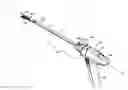
Adapter assembly for interconnecting electromechanical surgical devices and surgical loading units, and surgical systems thereof
The present disclosure relates to adapter assemblies for use with and to electrically and mechanically interconnect electromechanical surgical devices and surgical loading units, and to surgical systems including hand held electromechanical surgical devices and adapter assemblies for connecting surgical loading units to the hand held electromechanical surgical devices.
Published: 2015-06-11 Assignee: University of Maryland, College Park.US20150162168A1
Electricity
Reactor for plasma-based atomic layer etching of materials
Plasma-based atomic layer etching of materials may be of benefit to various semiconductor manufacturing and related technologies. For example, plasma-based atomic layer etching of materials may be beneficial for adding and/or removing angstrom thick layers from a surface in advanced semiconductor manufacturing and related technologies that increasingly demand atomistic surface engineering. A method may include depositing a controlled amount of a chemical precursor on an unmodified surface layer of a substrate to create a chemical precursor layer and a modified surface layer. The method may also include selectively removing a portion of the chemical precursor layer, a portion of the modified surface layer and a controlled portion of the substrate. Further, the controlled portion may be removed to a depth ranging from about 1/10 of an angstrom to about 1 nm. Additionally, the deposition and selective removal may be performed under a plasma environment.
Published: 2015-06-11US20150161429A1
Physics
HIGH DYNAMIC-RANGE INDICIA READING SYSTEM
An indicia-reading system is provided that adjusts the intensity of an indicia signal to an optimal level in an efficient and timely manner. The indicia-reading system incorporates an indicia-capturing subsystem for acquiring an indicia signal, a gain adjustment subsystem, and an indicia decoding subsystem. The gain adjustment subsystem derives a plurality of derivative signals from the indicia signal. At least two of the derivative signals have different gain adjustments from one another. The indicia-decoding subsystem is configured to decode at least one of the derivative signals.