Patent Applications published on Dec 10, 2015
Explore the 7,851 U.S. Patent Applications published on the 50th week of 2015, including 5,676 applications that subsequently received a Patent Grant.
Featured patent applications from Dec 10, 2015
US20150351765A1
Human necessities
Authentication and information system for reusable surgical instruments
An authentication and information system for use in a surgical stapling device includes a handle assembly having a controller, the controller having at least one program and a memory, an adapter assembly, and a loading unit having a tool assembly mounted for articulation and a member for actuating articulation of the tool assembly, the loading unit having at least one chip assembly having a chip storing data indicating a position of the member when the tool assembly is in a fully articulated position.
Published: 2015-12-10 Assignee: ETHICON ENDO-SURGERY, INC..US20150351755A1
Human necessities
Surgical instrument system
A surgical cutting and fastening instrument is disclosed. The surgical cutting and fastening instrument comprises a pair of jaws comprising a distal end, a motor-powered firing member configured to move longitudinally along the pair of jaws toward the distal end, and a sensor configured to sense a fully-closed state of the pair of jaws. The surgical cutting and fastening instrument further comprises, one, a control circuit electrically coupled to the sensor, wherein the control circuit is configured to prevent a longitudinal movement of the firing member toward the distal end if the pair of jaws is not in the fully-closed state and, two, a remote user-controlled console.
Published: 2015-12-10 Assignee: Ethicon LLC.US20150351758A1
Human necessities
Adjunct materials and methods of using same in surgical methods for tissue sealing
Surgical methods involving cutting and sealing tissue include affixing a first adjunct material to tissue at a treatment site, such as by stapling the adjunct to tissue. A second adjunct material is applied to at least a portion of the first adjunct material such that the second adjunct material interacts with the first adjunct material to form a seal in an area of the tissue covered by at least one of the first and the second adjunct material. The resulting tissue sealing structure, which includes a combination of the two adjuncts, is believed to be superior to the sealing properties of either adjunct alone.
Published: 2015-12-10 Assignee: Ethicon LLC.US20150351763A1
Human necessities
Devices and methods for sealing staples in tissue
Devices and methods for sealing staples in tissue using a plurality of adjunct segments are described herein. In one embodiment, an end effector for a surgical instrument is described that can include first and second jaws, where the first jaw has a cartridge body removably attached thereto and the cartridge body has a plurality of staple cavities configured to seat staples therein. The second jaw can have an anvil with a plurality of staple forming openings formed therein, and at least one of the first and second jaws can be movable relative to the other jaw. The end effector can also include a plurality of sealing adjunct segments coupled to one another and at least one of the first and second jaws such that a staple ejected from the cartridge body passes through one of the plurality of sealing adjunct segments and tissue disposed between the first and second jaws.
Published: 2015-12-10 Assignee: Ethicon LLC.US20150351764A1
Human necessities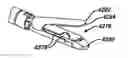
Devices for sealing staples in tissue
Devices and methods for forming an anastomosis between two body lumens are described herein. In one embodiment, an anastomosis can be formed by transecting a body lumen using a linear surgical stapler that delivers a plurality of sealing adjuncts in combination with a plurality of surgical staples along a staple line, where the plurality of sealing adjuncts are coupled to one another by a suture. A circular surgical stapler can be used to create an anastomosis with a second body lumen across the staple line. Before actuating the circular stapler, the proximal and distal ends of the staple line can be drawn into a central lumen of the circular stapler using the suture extending between the plurality of sealing adjuncts such that the staple line is resected when the circular stapler is actuated.
Published: 2015-12-10 Assignee: Ethicon LLC.US20150351762A1
Human necessities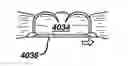
Devices and methods for sealing staples in tissue
Devices and methods for sealing staples in tissue using adjuncts coupled to an individual staple are described herein. In one embodiment, a staple cartridge assembly is described that can include a cartridge body having a plurality of staple cavities, where each staple cavity has a surgical staple disposed therein. The assembly can also include a plurality of adjuncts, where each adjunct is disposed around at least one leg of a surgical staple such that each adjunct forms a seal around the at least one leg of the surgical staple upon deployment of the surgical staple from the cartridge body.
Published: 2015-12-10 Assignee: Intuitive Surgical Operations, Inc..US20150351854A1
Human necessities
Tool with articulation lock
The invention provides surgical or diagnostic tools and associated methods that offer user control for operating remotely within regions of the body. These tools include a proximally-located actuator for the operation of a distal end effector, as well as proximally-located actuators for articulational and rotational movements of the end effector. Control mechanisms and methods refine operator control of end effector actuation and of these articulational and rotational movements. An articulation lock allows the fixing and releasing of both neutral and articulated configurations of the tool and of consequent placement of the end effector. The tool may also include other features. A multi-state ratchet for end effector actuation provides enablement-disablement options with tactile feedback. A force limiter mechanism protects the end effector and manipulated objects from the harm of potentially excessive force applied by the operator. A rotation lock provides for enablement and disablement of rotatability of the end effector.
Published: 2015-12-10US20150352699A1
Performing operations; transporting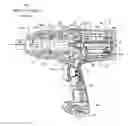
Power Tool
A power tool includes a housing, a motor, a hammer, an anvil, and a controller. The motor is accommodated in the housing. The hammer is configured to be rotated by the motor. The anvil is configured to be rotated in one of a rotational mode in which the anvil is rotated together with the hammer and a striking mode in which the anvil is rotated upon being struck by the hammer. The controller is configured to control the motor to be braked in the striking mode.
Published: 2015-12-10 Assignee: Ethicon LLC.US20150351760A1
Human necessities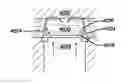
Devices and methods for sealing staples in tissue
Devices and methods for applying sealants to surgical instruments. In one embodiment, a surgical device is described that can include at least one nozzle formed at a proximal end of the device that is configured to receive a sealant, as well as an applicator formed at a distal end of the device that is configured to deliver the sealant received by the at least one nozzle. The applicator can be configured to interface with at least one of a first and second jaw of a surgical stapler such that the sealant delivered from the applicator can be deposited into a plurality of openings formed in the surgical stapler.
Published: 2015-12-10 Assignee: Ethicon LLC.US20150351754A1
Human necessities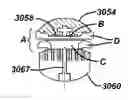
Woven and fibrous materials for reinforcing a staple line
Adjunct materials and methods of using adjunct material to reinforce a staple line are provided. In general, an adjunct material can be used to maintain a seal in tissue and can prevent stapled tissue from tearing. In some embodiments, a surgical stapler can include a jaw having an adjunct material associated with the jaw. The adjunct material can be attached to tissue via staples deployed by the stapler. In some embodiments, an adjunct material can be a woven material having a single layer or multiple layers, and each layer can have different mechanical properties. In other embodiments, an adjunct material can have a single layer or multiple layers of nonwoven material, such as suture compressed into a three dimensional structure.