Patent Applications published on Dec 8, 2016
Explore the 7,039 U.S. Patent Applications published on the 49th week of 2016, including 5,355 applications that subsequently received a Patent Grant.
Featured patent applications from Dec 8, 2016
US20160354085A1
Human necessities
End effector for use with a surgical fastening instrument
A staple cartridge comprising a cartridge body is disclosed. The cartridge body comprises staple cavities defined in the cartridge body. The staple cavities are arranged in an inner longitudinal row of staple cavities, a middle longitudinal row of staple cavities, and an outer longitudinal row of staple cavities. The staple cartridge also comprises a proximal staple driver configured to eject a first quantity of staples. The staple cartridge also comprises an intermediate staple driver positioned distally to the proximal staple driver, wherein the intermediate staple driver is configured to eject a second quantity of staples. The staple cartridge further comprises a distal staple driver positioned distally to the intermediate staple driver, wherein the distal staple driver is configured to eject a third quantity of staples.
Published: 2016-12-08 Assignee: Covidien LP.US20160354088A1
Human necessities
Adapter, extension, and connector assemblies for surgical devices
A surgical assembly for operably connecting an end effector to an electrosurgical instrument includes an adapter assembly and an extension assembly. The adapter assembly includes a drive coupling assembly, a drive transfer assembly operably received through the drive coupling assembly and including a first rotatable shaft, and a first pusher assembly operably connected to the first rotatable shaft for converting rotational motion from the first rotatable shaft to longitudinal movement to perform a first function. The first pusher assembly includes a first pusher member having an outer housing formed of a first material, and a threaded insert formed of a second material and disposed within the outer housing. The extension assembly is operably connected to a distal end of the adapter assembly, and includes a flexible band assembly operably connectable to the first pusher member of the first pusher assembly.
Published: 2016-12-08 Assignee: Covidien LP.US20160354160A1
Human necessities
Medical instrument with sensor for use in a system and method for electromagnetic navigation
A medical instrument includes a printed sensor, a surface, at least one non-conductive material, and at least one pair of contacts. The sensor has at least one coil formed on a conductive material. The surface is suitable for receiving the printed sensor and can be placed in an EM field. The at least one non-conductive material covers the at least one coil of the sensor. The medical instrument contains multiple conductive and nonconductive layers. The at least one pair of contacts are electrically connected to the at least one coil and connectable to the conductive layer, the conductive layer coupled to a measurement device, which senses an induced electrical signal based on a magnetic flux change of the EM field. The location of the medical instrument in a coordinate system of the EM filed is identified based on the induced electrical signal in the sensor.
Published: 2016-12-08 Assignee: CISCO TECHNOLOGY, INC..US20160359872A1
Electricity
System for monitoring and managing datacenters
An example method includes detecting, using sensors, packets throughout a datacenter. The sensors can then send packet logs to various collectors which can then identify and summarize data flows in the datacenter. The collectors can then send flow logs to an analytics module which can identify the status of the datacenter and detect an attack.
Published: 2016-12-08 Assignee: AT&T Intellectual Property I, LP.US20160360511A1
Electricity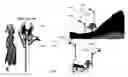
Remote distributed antenna system
A distributed antenna system is provided that frequency shifts the output of one or more microcells to a 60 GHz or higher frequency range for transmission to a set of distributed antennas. The cellular band outputs of these microcell base station devices are used to modulate a 60 GHz (or higher) carrier wave, yielding a group of subcarriers on the 60 GHz carrier wave. This group will then be transmitted in the air via analog microwave RF unit, after which it can be repeated or radiated to the surrounding area. The repeaters amplify the signal and resend it on the air again toward the next repeater. In places where a microcell is required, the 60 GHz signal is shifted in frequency back to its original frequency (e.g., the 1.9 GHz cellular band) and radiated locally to nearby mobile devices.
Published: 2016-12-08 Assignee: AT&T Intellectual Property I, LP.US20160359542A1
Electricity
Host node device and methods for use therewith
Aspects of the subject disclosure may include, for example, a host node device having a terminal interface that receives downstream channel signals from a communication network and send upstream channel signals to the communication network. An access point repeater launches the downstream channel signals as guided electromagnetic waves on a guided wave communication system and to extract a first subset of the upstream channel signals from the guided wave communication system. A radio wirelessly transmits the downstream channel signals to at least one client node device and to wirelessly receive a second subset of the upstream channel signals from the at least one client node device. Other embodiments are disclosed.
Published: 2016-12-08 Assignee: AT&T Intellectual Property I, LP.US20160360533A1
Electricity
Network termination and methods for use therewith
Aspects of the subject disclosure may include, for example, a repeater device having a first coupler to extract downstream channel signals from first guided electromagnetic waves bound to a transmission medium of a guided wave communication system. An amplifier amplifies the downstream channel signals to generate amplified downstream channel signals. A channel selection filter selects one or more of the amplified downstream channel signals to wirelessly transmit to the at least one client device via an antenna. A second coupler guides the amplified downstream channel signals to the transmission medium of the guided wave communication system to propagate as second guided electromagnetic waves. Other embodiments are disclosed.
Published: 2016-12-08 Assignee: AT&T Intellectual Property I, LP.US20160359547A1
Electricity
Host node device and methods for use therewith
Aspects of the subject disclosure may include, for example, a repeater device having a first coupler to extract downstream channel signals from first guided electromagnetic waves bound to a transmission medium of a guided wave communication system. An amplifier amplifies the downstream channel signals to generate amplified downstream channel signals. A channel selection filter selects one or more of the amplified downstream channel signals to wirelessly transmit to the at least one client device via an antenna. A second coupler guides the amplified downstream channel signals to the transmission medium of the guided wave communication system to propagate as second guided electromagnetic waves. Other embodiments are disclosed.
Published: 2016-12-08 Assignee: AT&T Intellectual Property I, LP.US20160359523A1
Electricity
Network termination and methods for use therewith
Aspects of the subject disclosure may include, for example, a network termination includes a downstream channel modulator modulates downstream data into downstream channel signals to convey the downstream data via a guided electromagnetic wave that is bound to a transmission medium of a guided wave communication system. A host interface sends the downstream channel signals to the guided wave communication system and receives upstream channel signals corresponding to upstream frequency channels from the guided wave communication system. An upstream channel demodulator demodulates upstream channel signals into upstream data. Other embodiments are disclosed.
Published: 2016-12-08 Assignee: AT&T Intellectual Property I, LP.US20160359546A1
Electricity
Client node device with frequency conversion and methods for use therewith
Aspects of the subject disclosure may include, for example, a repeater device having a first coupler to extract downstream channel signals from first guided electromagnetic waves bound to a transmission medium of a guided wave communication system. An amplifier amplifies the downstream channel signals to generate amplified downstream channel signals. A channel selection filter selects one or more of the amplified downstream channel signals to wirelessly transmit to the at least one client device via an antenna. A second coupler guides the amplified downstream channel signals to the transmission medium of the guided wave communication system to propagate as second guided electromagnetic waves. Other embodiments are disclosed.