Shims, particularly for laterally placed artificial disc replacements (ADRS)
US20050102027A1
2005-05-12
10/987,914
2004-11-12
Abstract:
Shims are placed between the lateral edge of the vertebra and the plate of a laterally placed ADR. The shims assist in the placement of the ADR center of rotation (COR) in the mid-sagittal line. The shims also customize the fit between the lateral surface of the vertebral body and the plate portion of the ADR, since the lateral surface of a vertebral body often has a central concavity. The modular shims also help reduce ADR inventory by facilitating customization of standard ADRs.
Interested in similar patents?
Get notified when new applications in this technology area are published.
Classification:
A61F2/4425 » CPC main
Filters implantable into blood vessels; Prostheses, i.e. artificial substitutes or replacements for parts of the body; Appliances for connecting them with the body; Devices providing patency to, or preventing collapsing of, tubular structures of the body, e.g. stents; Prostheses implantable into the body; Joints for the spine, e.g. vertebrae, spinal discs; Intervertebral or spinal discs, e.g. resilient made of articulated components
A61F2/30734 » CPC further
Filters implantable into blood vessels; Prostheses, i.e. artificial substitutes or replacements for parts of the body; Appliances for connecting them with the body; Devices providing patency to, or preventing collapsing of, tubular structures of the body, e.g. stents; Prostheses implantable into the body; Joints; Accessories Modular inserts, sleeves or augments, e.g. placed on proximal part of stem for fixation purposes or wedges for bridging a bone defect
A61B17/86 » CPC further
Surgical instruments, devices or methods, e.g. tourniquets; Surgical instruments or methods for treatment of bones or joints; Devices specially adapted therefor for osteosynthesis, e.g. bone plates, screws, setting implements or the like; Internal fixation devices, including fasteners and spinal fixators, even if a part thereof projects from the skin; Fasteners therefor or fasteners being internal fixation devices Pins or screws or threaded wires; nuts therefor
A61F2002/30092 » CPC further
Filters implantable into blood vessels; Prostheses, i.e. artificial substitutes or replacements for parts of the body; Appliances for connecting them with the body; Devices providing patency to, or preventing collapsing of, tubular structures of the body, e.g. stents; Prostheses implantable into the body; Joints; Additional features of subject-matter classified in , and subgroups thereof; Material related properties of the prosthesis or of a coating on the prosthesis; Properties of materials and coating materials using shape memory or superelastic materials, e.g. nitinol
A61F2002/30736 » CPC further
Filters implantable into blood vessels; Prostheses, i.e. artificial substitutes or replacements for parts of the body; Appliances for connecting them with the body; Devices providing patency to, or preventing collapsing of, tubular structures of the body, e.g. stents; Prostheses implantable into the body; Joints; Accessories; Modular inserts, sleeves or augments, e.g. placed on proximal part of stem for fixation purposes or wedges for bridging a bone defect Augments or augmentation pieces, e.g. wedges or blocks for bridging a bone defect
A61F2210/0014 » CPC further
Particular material properties of prostheses classified in groups - or or or or subgroups thereof using shape memory or superelastic materials, e.g. nitinol
A61F2230/0019 » CPC further
Geometry of prostheses classified in groups - or or or or subgroups thereof; Two-dimensional shapes, e.g. cross-sections; Angular shapes rectangular
A61F2310/00023 » CPC further
Prostheses classified in or - being constructed from or coated with a particular material; The prosthesis being constructed from a particular material; Metals or alloys Titanium or titanium-based alloys, e.g. Ti-Ni alloys
A61F2310/00029 » CPC further
Prostheses classified in or - being constructed from or coated with a particular material; The prosthesis being constructed from a particular material; Metals or alloys Cobalt-based alloys, e.g. Co-Cr alloys or Vitallium
A61F2310/00179 » CPC further
Prostheses classified in or - being constructed from or coated with a particular material; The prosthesis being constructed from a particular material Ceramics or ceramic-like structures
Description
REFERENCE TO RELATED APPLICATIONSThis application claims priority from U.S. Provisional Patent Application Ser. No. 60/519,372, filed Nov. 12, 2003, the entire content of which are incorporated herein by reference.
FIELD OF THE INVENTIONThis invention relates generally to artificial disc replacements (ADRs) and, in particular, to shims applicable to laterally placed ADRs.
BACKGROUND OF THE INVENTIONMany spinal conditions, including degenerative disc disease, can be treated by spinal fusion or through artificial disc replacement (ADR). ADR has several advantages over spinal fusion. The most important advantage of ADR is the preservation of spinal motion. Spinal fusion eliminates motion across the fused segments of the spine. Consequently, the discs adjacent to the fused level are subjected to increased stress. The increased stress increases the changes of future surgery to treat the degeneration of the discs adjacent to the fusion. However, motion through an ADR also allows motion through the facet joints. Motion across arthritic facet joints could lead to pain following ADR. Some surgeons believe patients with degenerative disease and arthritis of the facet joints are not candidates for ADR.
Current ADR designs do not attempt to limit the pressure across the facet joints or facet joint motion. Indeed, prior art ADRs generally do not restrict motion. For example, some ADR designs place bags of hydrogel into the disc space which do not limit motion in any direction. In fact, ADRs of this kind may not, by themselves, provide sufficient distraction across the disc space. ADR designs with metal plates and polyethylene spacers may restrict translation but they do not limit the other motions mentioned above. The articular surface of the poly spacer is generally convex in all directions. Some ADR designs limit motion translation by attaching the ADR halves at a hinge.
One of the most important features of an artificial disc replacement (ADR) is its ability to replicate the kinematics of a natural disc. ADRs that replicate the kinematics of a normal disc are less likely to transfer additional forces above and below the replaced disc. In addition, ADRs with natural kinematics are less likely to stress the facet joints and the annulus fibrosus (AF) at the level of the disc replacement. Replicating the movements of the natural disc also decreases the risk of separation of the ADR from the vertebrae above and below the ADR.
Compared to spinal fusion and other techniques, prosthetic artificial disc replacements (ADRs) offers many advantages. The prosthetic disc attempts to eliminate a patient's pain while preserving the disc's function. Current prosthetic disc implants either replace the nucleus or the nucleus and the annulus. Current procedures typically remove the degenerated disc component to allow room for the prosthetic component.
Laterally placed ADRs have become more popular, particularly in conjunction with minimally invasive surgical procedures. To ensure proper articulation, however, the center of rotation (COR) should be placed in the mid-sagittal plane. Therefore, a laterally placed ADR must be inserted the proper distance into the disc space to place the COR of the ADR in the mid-sagittal line. Thus, the need remains for further improvements in the way in which prosthetic components are incorporated into the disc space, since the prosthesis may be subjected to 100,000,000 compression cycles over the life of the implant.
SUMMARY OF THE INVENTIONTo address problems associated with the existing art, this invention uses shims between the lateral edge of the vertebra and the plate of a laterally placed ADR. The shims assist in the placement of the ADR center of rotation (COR) in the mid-sagittal line. The shims also customize the fit between the lateral surface of the vertebral body and the plate portion of the ADR, since the lateral surface of a vertebral body often has a central concavity. The modular shims also help reduce ADR inventory by facilitating customization of standard ADRs.
Shims according to the invention could be made of any suitable material, including ceramics, metals such as titanium or chrome-cobalt, or polymers, including in-situ curing polymers. The shims would be available in various shim sizes and shapes.
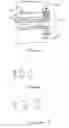
BRIEF DESCRIPTION OF THE DRAWINGSFIG. 1 is a view of the anterior surface of the spine, a laterally placed ADR, and shims according to the invention;
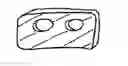
FIG. 2 is a view of the front of shims in various sizes;
FIG. 3 is a view of the front shims in various shapes;
FIG. 4 is an anterior view of the shim drawn in FIG. 2; and
FIG. 5 is an anterior view of the spine and an exploded anterior view of the invention.
DETAILED DESCRIPTION OF THE INVENTIONFIG. 1 is a view of the anterior surface of the spine, a laterally placed ADR 100, and shims 102, 104. The trajectory of the screws 106, 108 is illustrated in the upper vertebra. Note that although shims are shown in conjunction with both the upper and lower vertebra, only a single shim may be indicated. FIG. 2 is a view of the front of shims in various sizes. FIG. 3 is a view of the front shims in various shapes. FIG. 4 is an anterior view of the shim drawn in FIG. 2.
FIG. 5 is an anterior view of the spine and an exploded anterior view of the invention. Although the drawings illustrate the use of screws to hold the shims between the ADR and the vertebrae, the invention may include other fastening mechanisms to hold the shims between the ADR and the vertebrae. Alternative embodiments may include the use of shims or ADR components with spring properties, shape-memory properties, plastic deformation, etc. The shims may also be placed between a plate-like component of an ADR and the anterior portion of the spine.
Claims
1. Apparatus for use in conjunction with a laterally placed artificial disc replacement (ADR) having a plate with a surface facing the lateral edge of a vertebral body, comprising:
a shim adapted for placement between the plate and the lateral edge of the vertebral body.
2. The apparatus of claim 1, wherein the shim places the center of rotation (COR) of the ADR substantially in the mid-sagittal line.
3. The apparatus of claim 1, including a plurality of differently sized shims to accommodate different plate-vertebrae spacings.
4. The apparatus of claim 1, including a plurality of differently shaped shims to accommodate various lateral edge configurations.
Images & Drawings included:

Sources:
- United States Patent and Trademark Office - verify current appl. status at the USPTO↗
Recent applications in this class:
- » 20250152376 2025-05-15
EXPANDABLE INTERVERTEBRAL IMPLANT AND INSTRUMENTS FOR INSTALLING THE SAME - » 20250127625 2025-04-24
SPINAL IMPLANT DEVICE FOR MOTION PRESERVATION/DISC STABILIZATION - » 20250114213 2025-04-10
EXPANDABLE INTERBODY DEVICE - » 20250107902 2025-04-03
EXPANDABLE INTERVERTEBRAL IMPLANT - » 20250099258 2025-03-27
EXPANDABLE IMPLANT - » 20250082478 2025-03-13
DRIVE INSTRUMENTS WITH RETENTION MECHANISMS, MEDICAL IMPLANTS, AND RELATED TECHNOLOGIES - » 20250057663 2025-02-20
INTRA-VERTEBRAL BODY DEVICE FOR VERTEBRAL KYPHOPLASTY WITH DUAL EXPANSION (CRANIO-CAUDAL AND MEDIO-LATERAL) CAPABILITY - » 20250032271 2025-01-30
EXPANDABLE INTERVERTEBRAL IMPLANT - » 20250032270 2025-01-30
EXPANDABLE INTERBODY IMPLANT - » 20250025315 2025-01-23
EXPANDABLE IMPLANT ASSEMBLY