Method for eliminating mercaptan from crude gas
US20050103194A1
2005-05-19
10/505,493
2003-01-22
✅ Patent granted
US 7,189,282 B2
2007-03-13
WO; PCT/EP03/00582; 20030122
WO; WO03/072225; 20030904
Duane Smith | Ives Wu
2024-01-21
Abstract:
This invention relates to a process for cleaning gas, in particular hydrocarbonaceous gas such as e.g. natural gas, which is contaminated with sulfur in the form of H2S and mercaptans as well as CO2.
To remove the undesired sulfur-containing substances in the form of H2S and mercaptan from crude gas, it is proposed in accordance with the invention that the crude gas is introduced into an absorption and regeneration column and washed therein, three gas streams being withdrawn from this absorption and regeneration column, a first exhaust gas stream being introduced into a Claus plant, a second sour gas stream with a low H2S concentration being introduced into another absorption plant, and a third gas stream, the valuable gas with the mercaptans, being cooled and supplied to an adsorption plant, that from this adsorption plant a cleaned valuable gas is withdrawn, and a mercaptan-containing gas stream is subjected to washing, that this concentrated mercaptan-containing gas is supplied to the Claus plant.
Interested in similar patents?
Get notified when new applications in this technology area are published.
Classification:
B01D47/00 IPC
Separating dispersed particles from gases, air or vapours by liquid as separating agent
B01D53/14 IPC
Separation of gases or vapours; Recovering vapours of volatile solvents from gases; Chemical or biological purification of waste gases, e.g. engine exhaust gases, smoke, fumes, flue gases, aerosols, by absorption
B01D53/56 IPC
Separation of gases or vapours; Recovering vapours of volatile solvents from gases; Chemical or biological purification of waste gases, e.g. engine exhaust gases, smoke, fumes, flue gases, aerosols,; Chemical or biological purification of waste gases; Removing components of defined structure; Nitrogen compounds Nitrogen oxides
C01B17/20 IPC
Sulfur; Compounds thereof Methods for preparing sulfides or polysulfides, in general
C10L3/102 » CPC main
Gaseous fuels; Natural gas; Synthetic natural gas obtained by processes not covered by subclass , ; Liquefied petroleum gas; Natural gas; Synthetic natural gas obtained by processes not covered by , or; Working-up natural gas or synthetic natural gas; Removal of contaminants of acid contaminants
B01D53/1406 » CPC further
Separation of gases or vapours; Recovering vapours of volatile solvents from gases; Chemical or biological purification of waste gases, e.g. engine exhaust gases, smoke, fumes, flue gases, aerosols, by absorption Multiple stage absorption
B01D53/1462 » CPC further
Separation of gases or vapours; Recovering vapours of volatile solvents from gases; Chemical or biological purification of waste gases, e.g. engine exhaust gases, smoke, fumes, flue gases, aerosols, by absorption; Removing acid components Removing mixtures of hydrogen sulfide and carbon dioxide
C01B17/0408 » CPC further
Sulfur; Compounds thereof; Preparation of sulfur; Purification from gaseous sulfur compounds including gaseous sulfides by processes comprising a dry catalytic conversion of hydrogen sulfide-containing gases, e.g. the Claus process Pretreatment of the hydrogen sulfide containing gases
C10L3/10 » CPC further
Gaseous fuels; Natural gas; Synthetic natural gas obtained by processes not covered by subclass , ; Liquefied petroleum gas; Natural gas; Synthetic natural gas obtained by processes not covered by , or Working-up natural gas or synthetic natural gas
B01D2257/304 » CPC further
Components to be removed; Sulfur compounds Hydrogen sulfide
B01D2257/306 » CPC further
Components to be removed; Sulfur compounds Organic sulfur compounds, e.g. mercaptans
B01D2257/504 » CPC further
Components to be removed; Carbon oxides Carbon dioxide
Y02C20/40 » CPC further
Capture or disposal of greenhouse gases of CO
Y02C20/40 » CPC further
Capture or disposal of greenhouse gases of CO
Y02P20/151 » CPC further
Technologies relating to chemical industry Reduction of greenhouse gas [GHG] emissions, e.g. CO
Y02P20/151 » CPC further
Technologies relating to chemical industry Reduction of greenhouse gas [GHG] emissions, e.g. CO
B01D53/50 IPC
Separation of gases or vapours; Recovering vapours of volatile solvents from gases; Chemical or biological purification of waste gases, e.g. engine exhaust gases, smoke, fumes, flue gases, aerosols,; Chemical or biological purification of waste gases; Removing components of defined structure; Sulfur compounds Sulfur oxides
Description
This invention relates to a process of cleaning gas, in particular hydrocarbonaceous gas such as e.g. natural gas, which is contaminated with sulfur in the form of H2S and mercaptan as well as CO2.
The document WO 97/26069 describes a process of cleaning carbon dioxide and sulfur-containing gases, in which there are sulfur-contaminated impurities in the form of mercaptans and H2S. In a first absorption, the sulfur-contaminated impurities are removed from the gas, in order to produce a clean gas stream and a sour gas stream, the sour gas being hydrogenated in order to convert a major amount of mercaptans to H2S. The hydrogenated sour gas is introduced into a second absorption/regeneration plant, in which the sour gas is separated into a first gas stream rich in H2S, which is introduced into a Claus plant, and a second gas stream containing little H2S, which is supplied to the postcombustion. The Claus plant is followed by a tail gas aftertreatment, in wich the H2S is reduced further and a gas rich in H2S is withdrawn.
What is disadvantageous in this process is the too small amount of sulfur and mercaptans which can be removed from the gas. In accordance with the prior art, it is only possible with a large effort to remove the sulfur from the crude gas for more than 95 wt-%.
It is the object underlying the invention to create an improved process for cleaning hydrocarbonaceous gas, in which the undesired sulfur-containing substances in the form of H2S and mercaptan are removed.
In accordance with the invention, this object is solved in that crude gas is introduced into an absorption and regeneration column and washed therein, three gas streams being withdrawn from this absorption and regeneration column, a first exhaust gas stream being introduced into a Claus plant, a second sour gas stream with a low H2S concentration of 10-30 vol-% being introduced into another absorption plant, and a third gas stream, the valuable gas with the mercaptans, being cooled and supplied to an adsorption plant, that from this adsorption plant a sweet gas is withdrawn and a gas stream containing mercaptan is subjected to washing. As washing stage, there is preferably used a physical washing stage, e.g. a Purisol plant, with which a small amount of gas with a high concentration of mercaptan is introduced into the Claus plant and part of the coadsorbed valuable gas from the regeneration of the adsorption plant is recovered as fuel gas. In the Claus plant, the mercaptan gas is burnt completely.
Due to the fact that before being introduced into the Claus plant, the second sour gas stream is first fortified in an absorption and the solution is regenerated in a fortification washing stage, the Claus plant can be designed smaller, as the sour gas stream has a higher concentration of H2S. The processing of concentrated H2S-containing gas and the mercaptan stream in the Claus plant as well as the processing of the gas stream from the first absorption and of the Claus exhaust gas in a tail gas washing stage increases the degree of sulfur recovery of the entire plant.
To achieve that the absorption plant for the sour gas to be fortified consumes less lye and only one regeneration column is required, the H2S-containing solution is withdrawn from the absorption plant, which is disposed behind the hydrogenation of the residual Claus gas, and introduced into the absorption plant for fortifying the sour gas.
The degree of sulfur recovery is increased in that the gas from the absorption of the fortification is introduced into the hydrogenation, in order to convert sulfur components into H2S, and subsequently into the absorption of the tail gas aftertreatment.
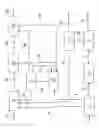
Embodiments of the process will be explained by way of example with reference to the drawing.
Through line (1), crude gas is introduced into a first washing stage comprising an absorption and regeneration column (2) and washed therein. A first exhaust gas stream (5) from the regeneration is directly introduced into a Claus plant (14). This exhaust gas stream (5) chiefly consists of up to 80 vol-% hydrocarbon and up to 20 vol-% CO2 with small amounts of mercaptans (up to 0.3 vol-%) and H2S (up to 5 vol-%).
A second sour gas stream (4) with a low H2S concentration of up to 30 vol-% H2S is introduced into another absorption plant (15) and fortified there with a non-loaded solvent from lines (26) and (27). From the absorption plant (15), the solvent (16) loaded with H2S is introduced into a regeneration plant (17). The gas (up to 97 vol-% CO2 and 0.2 vol-% mercaptan) from the absorption plant (15) is supplied to a hydrogenation (22) via line (18).
From the regeneration (17), sour gas with a high H2S concentration of up to 60 vol-% H2S is introduced into the Claus plant (14) via line (19).
From the absorption and regeneration column (2) a third gas stream (3), the valuable gas with the largest content of mercaptans, is withdrawn, cooled (6) and supplied to an adsorption (8) via line (7). From this adsorption (8), the valuable gas is supplied to further processes, e.g. a liquefaction, via line (9). The mercaptan-containing gas stream (10) is subjected to a physical washing stage, from which the coadsorbed valuable gas is recovered as fuel gas via line (12), and the highly concentrated mercaptan gas is supplied to the Claus plant (14) via line (13). The mercaptan stream is recovered in the regeneration of the Purisol solvent. The amount is small, but with a very high mercaptan concentration of 10 vol-% to 60 vol-%. As an alternative to the Purisol plant (11), another physical or physical-chemical washing stage is possible. However, the same have the disadvantage that too much CH4 is absorbed. In the Claus plant (14), the mercaptan is burnt completely. The SO2 obtained therefrom is reacted with the H2S from the sour gas of line (19) to form sulfur. The liquid sulfur obtained is withdrawn via line (21) and supplied to a further use. Thus, a high degree of sulfur recovery is achieved. The Claus plant (14) is a plant known per se, which consists of a combustion furnace as well as a plurality of catalytic reactors for performing the reaction. In the Claus plant (14), there is always obtained a so-called residual Claus gas, which apart from non-condensed elementary sulfur contains unreacted sulfur dioxide and H2S. This residual gas is withdrawn via line (20) and subjected to an aftertreatment, in order to increase the degree of sulfur recovery. Via line (20), the residual Claus gas is supplied to a hydrogenation plant (22), which is also supplied with the gas from the absorption plant (15) via line (18). In the hydrogenation, SO2 is converted to H2S and supplied to an absorption plant (24) via line (23). From the absorption plant (24), a solution is introduced into the fortification absorption (15) via line (26) for the further absorption of H2S. The remaining H2S-containing gas is withdrawn from the absorption plant (24) via line (25) and supplied to a combustion.
EXAMPLEThe following Table shows an analysis of the gas streams in the individual lines. The liquid process streams in lines (16), (26), (27) and (28) are not shown.
| Line No.: | 1 | 3 | 4 | 5 | 7 |
| Process | First Exhaust | Cooled | |||
| stream | Crude Gas | Valuable Gas | Sour gas | Gas Stream | Valuable Gas |
| Components | Nm3/h | Vol-% | Nm3/h | Vol-% | Nm3/h | Vol-% | Nm3/h | Vol-% | Nm3/h | Vol-% |
| CO2 | 21680 | 2.59 | 41 | 0.005 | 21542.7 | 75.90 | 97.13 | 13.10 | 41 | 0.005 |
| N2 | 29102 | 3.48 | 29092 | 3.59 | 9.88 | 1.33 | 29092 | 3.59 | ||
| CH4 | 705460 | 84.26 | 704924 | 86.97 | 38.41 | 81.43 | 498.24 | 67.22 | 704924 | 87.06 |
| C2H6 | 45661 | 5.45 | 45610 | 5.63 | 5.49 | 5.27 | 45.08 | 6.08 | 45610 | 5.63 |
| C3H8 | 18593 | 2.22 | 18573 | 2.29 | 2.74 | 2.15 | 17.35 | 2.34 | 18573 | 2.29 |
| i-C4 | 2981 | 0.36 | 2979 | 0.37 | 2.70 | 0.36 | 2979 | 0.37 | ||
| n-C4 | 4333 | 0.52 | 4329 | 0.53 | 3.91 | 0.53 | 4329 | 0.53 | ||
| i-C5 | 1203 | 0.14 | 1202 | 0.15 | 1.11 | 0.15 | 1202 | 0.15 | ||
| n-C5 | 1040 | 0.12 | 1039 | 0.13 | 0.96 | 0.13 | 1039 | 0.13 | ||
| C6 cut | 751 | 0.09 | 750 | 0.09 | 0.71 | 0.10 | 750 | 0.09 | ||
| C7 cut | 379 | 0.05 | 379 | 0.05 | 0.28 | 0.04 | 379 | 0.05 | ||
| C8 | 140 | 0.02 | 140 | 0.02 | 0.14 | 0.02 | 140 | 0.02 | ||
| C9 | 93 | 0.01 | 93 | 0.01 | 0.07 | 0.01 | 93 | 0.01 | ||
| H2S | 5851 | 0.699 | 2 | 0 | 5816.5 | 20.49 | 31.74 | 4.28 | 2 | 0 |
| COS | 2.5 | 0.000 | 0.8 | 0 | 1.7 | 0.006 | 0.01 | 0.002 | 0.8 | 0 |
| CH3SH | 21.8 | 0.003 | 17.0 | 0.002 | 4.5 | 0.016 | 0.21 | 0.028 | 17.0 | 0.002 |
| C2H5SH | 117.2 | 0.014 | 93.0 | 0.011 | 23.1 | 0.081 | 1.12 | 0.151 | 93.0 | 0.011 |
| C3H7SH | 47.7 | 0.006 | 45.0 | 0.006 | 2.3 | 0.008 | 0.41 | 0.055 | 45.0 | 0.006 |
| C4H9SH | 5.0 | 0.001 | 4.7 | 0.001 | 0.3 | 0.001 | 0.04 | 0.006 | 4.7 | 0.001 |
| CS2 | ||||||||||
| SO2 | ||||||||||
| SX | ||||||||||
| CO | ||||||||||
| H2 | ||||||||||
| O2 | ||||||||||
| H2O | 1182 | 0.15 | 946 | 3.33 | 30.16 | 4.07 | 383 | 0.05 | ||
| Line No.: | 9 | 10 | 12 | 13 | 18 |
| Mercaptan- | Enriched | Residual | |||
| Process | Containing | Mercaptan | Absorption | ||
| Stream | Sweet Gas | Gas Stream | Fuel Gas | Gas | Gas |
| Components | Nm3/h | Vol-% | Nm3/h | Vol-% | Nm3/h | Vol-% | Nm3/h | Vol-% | Nm3/h | Vol-% |
| CO2 | 41 | 0.005 | 16588 | 96.11 | ||||||
| N2 | 29077 | 3.60 | 7814.5 | 29.35 | 7812.2 | 29.65 | 2.3 | 0.82 | ||
| CH4 | 704571 | 87.12 | 18552.5 | 69.68 | 18446.7 | 70.01 | 105.8 | 37.00 | 38 | 0.22 |
| C2H6 | 45587 | 5.64 | 22.8 | 0.09 | 22.3 | 0.08 | 0.5 | 0.17 | 5 | 0.03 |
| C3H8 | 18559 | 2.29 | 13.9 | 0.05 | 11.9 | 0.05 | 2.0 | 0.70 | 3 | 0.02 |
| i-C4 | 2977 | 0.37 | 1.5 | 0.01 | 1.0 | 0 | 0.4 | 0.16 | ||
| n-C4 | 4327 | 0.53 | 2.2 | 0.01 | 1.8 | 0.01 | 0.4 | 0.13 | ||
| i-C5 | 1201 | 0.15 | 0.6 | 0 | 0.3 | 0 | 0.3 | 0.12 | ||
| n-C5 | 1038 | 0.13 | 0.5 | 0 | 0.2 | 0 | 0.3 | 0.11 | ||
| C6 cut | 749 | 0.09 | 1.3 | 0 | 1.3 | 0.45 | ||||
| C7 cut | 377 | 0.05 | 2.1 | 0.01 | 2.1 | 0.73 | ||||
| C8 | 138 | 0.02 | 1.7 | 0.01 | 1.7 | 0.61 | ||||
| C9 | 89 | 0.01 | 4.3 | 0.02 | 4.3 | 1.51 | ||||
| H2S | 2.4 | 0.000 | 8.6 | 0.05 | ||||||
| COS | 0.8 | 0.000 | 1.5 | 0.009 | ||||||
| CH3SH | 0.2 | 0.000 | 16.8 | 0.063 | 0.2 | 0.001 | 16.6 | 5.80 | 4.1 | 0.024 |
| C2H5SH | 1.4 | 0.000 | 91.6 | 0.344 | 0.3 | 0.001 | 91.3 | 31.95 | 20.7 | 0.120 |
| C3H7SH | 0.7 | 0.000 | 44.3 | 0.167 | 0.9 | 0.003 | 43.4 | 15.20 | 2.1 | 0.012 |
| C4H9SH | 0.1 | 0.000 | 4.6 | 0.017 | 0.7 | 0.003 | 4.0 | 1.39 | 0.2 | 0.001 |
| CS2 | 10.0 | 0.03 | ||||||||
| SO2 | 74.0 | 0.20 | ||||||||
| SX | 15.0 | 0.04 | ||||||||
| CO | 852.0 | 2.30 | ||||||||
| H2 | 501.0 | 1.35 | ||||||||
| O2 | ||||||||||
| H2O | 0.8 | 0.000 | 51 | 0.19 | 51 | 0.19 | 9 | 3.16 | 588 | 3.41 |
| Line No.: | 19 | 20 | 23 | 25 | 21 |
| Concentrated | |||||
| H2S- | Residual | Hydrogenated | |||
| Process | containing | Claus | Residual | Liquid | |
| stream | Gas | Gas | Claus Gas | Exhaust Gas | Sulfur |
| Components | Nm3/h | Vol-% | Nm3/h | Vol-% | Nm3/h | Vol-% | Nm3/h | Vol-% | Nm3/h | Vol-% |
| CO2 | 7550.4 | 53.02 | 7909 | 21.36 | 25955.6 | 42.66 | 23360 | 47.71 | ||
| N2 | 17518 | 47.31 | 21717.3 | 35.69 | 21717 | 44.36 | ||||
| CH4 | 41.3 | 0.07 | 41 | 0.08 | ||||||
| C2H6 | 20.4 | 0.03 | 20 | 0.04 | ||||||
| C3H8 | 4.3 | 0.01 | 4 | 0.01 | ||||||
| i-C4 | ||||||||||
| n-C4 | ||||||||||
| i-C5 | ||||||||||
| n-C5 | ||||||||||
| C6 cut | ||||||||||
| C7 cut | ||||||||||
| C8 | ||||||||||
| C9 | ||||||||||
| H2S | 6238.5 | 43.80 | 148 | 0.40 | 455.2 | 0.75 | 24.48 | 0.05 | 0.09 | 0.00 |
| COS | 0.2 | 0.001 | 65 | 0.18 | 4.6 | 0.01 | 4.56 | 0.01 | ||
| CH3SH | 0.5 | 0.003 | 0.97 | 0.00 | 0.97 | 0.00 | ||||
| C2H5SH | 2.3 | 0.016 | 5.78 | 0.01 | 5.78 | 0.01 | ||||
| C3H7SH | 0.2 | 0.002 | 0.49 | 0.00 | 0.49 | 0.00 | ||||
| C4H9SH | 0.0 | 0.000 | ||||||||
| CS2 | 10 | 0.03 | ||||||||
| SO2 | 74 | 0.20 | ||||||||
| SX | 15 | 0.04 | 8579.2 | 100.00 | ||||||
| CO | 852 | 2.30 | 149.73 | 0.25 | 149.73 | 0.31 | ||||
| H2 | 501 | 1.35 | 1380.53 | 2.27 | 1380.53 | 2.82 | ||||
| O2 | ||||||||||
| H2O | 450 | 3.16 | 9936 | 26.83 | 11103.9 | 18.25 | 2251 | 4.60 | ||
Corresponding to the values represented in the Table, crude gas is introduced into an absorption and regeneration column (2) via line (1) and washed therein. The first exhaust gas stream (5) from the regeneration, which consists of about 76 vol-% hydrocarbon and about 13 vol-% CO2 with small amounts of mercaptans and H2S, is directly introduced into a Claus plant (14).
A second sour gas stream (4) with a low H2S concentration (20.5 vol-%) is introduced into an absorption plant (15), where it is fortified with a non-loaded or hardly loaded solvent from lines (26) and (27). From the absorption plant (15), the solvent (16) loaded with H2S is introduced into a regeneration plant (17). The gas with about 96 vol-% CO2 and 0.2 vol-% mercaptan from the absorption plant (15) is supplied to a hydrogenation (22) via line (18). From the regeneration (17), sour gas with a high H2S concentration (43.8 vol-%) is introduced into the Claus plant (14) via line (19).
From the absorption and regeneration column (2), a third gas stream (3) with a mercaptan content of about 0.01 vol-% is withdrawn, cooled (6) and supplied to an adsorption (8) via line (7). From this adsorption (8), the valuable gas is supplied to further processes, e.g. a liquefaction, via line (9). The mercaptan-containing gas stream is subjected to a physical washing stage, from which part of the valuable gas is recovered as fuel gas via line (12), and via line (13) the highly concentrated mercaptan gas is supplied to the Claus plant (14). The mercaptan stream is recovered in the regeneration of the Purisol solvent. The amount is small, but with a very high mercaptan concentration of about 54 vol-%. In the Claus plant (14), the mercaptan is burnt completely. The resulting SO2 is reacted with the H2S from the sour gas of line (19) to obtain sulfur. The liquid sulfur obtained is withdrawn via line (21) and supplied to a further use. The residual gas of the Claus plant chiefly consists of the components CO2, N2 and H2O and is withdrawn via line (20).
Claims
1. A process of removing mercaptan from crude gas, in which crude gas is introduced into an absorption and regeneration column (2) and washed therein, three gas streams (3, 4, 5) being withdrawn from this absorption and regeneration column (2), a first exhaust gas stream (5) being introduced into a Claus plant (14), a second gas stream (4) with a H2S concentration of up to 30 vol-% being introduced into another absorption plant (15), characterized in that a third gas stream (3), the valuable gas with the mercaptans, is cooled (6) and supplied to an adsorption plant (8), that from this adsorption plant (8) the cleaned valuable gas (9) is withdrawn, and a mercaptan-containing gas stream (10) is subjected to a washing stage (11), and that this concentrated mercaptan-containing gas (13) is supplied to the Claus plant (14).
2. The process as claimed in claim 1, characterized in that the washing stage (11) is a physical washing stage.
3. The process as claimed in claim 1, characterized in that the second gas stream (4) is fortified in an absorption plant (15), the resulting solution (16) is supplied to a regeneration (17), and the resulting gas (19) concentrated with H2S is supplied to the Claus plant (14).
4. The process as claimed in claim 1, characterized in that from the absorption plant (24), which is disposed behind the hydrogenation (22) of the residual Claus gas (20), the H2S-containing solution (26) is withdrawn and introduced into the absorption plant (15) for the sour gas.
5. The process as claimed in claim 1, characterized in that the gas from the absorption of the fortification (15) is introduced into the hydrogenation (22) and then into the absorption plant (24).
Images & Drawings included:

Sources:
- United States Patent and Trademark Office - verify current appl. status at the USPTO↗
Recent applications in this class:
- » 20240279563 2024-08-22
Generate Hydrogen as Fuel at Natural Gas Processing Plant to Reduce Carbon Dioxide Emissions - » 20200347311 2020-11-05
Process for natural gas production - » 20200002634 2020-01-02
Hybrid tray for introducing a low CO2 feed stream into a distillation tower - » 20190112538 2019-04-18
COMPOSITION AND USE THEREOF FOR THE REMOVAL OF ACID GASES FROM HYDROCARBON FLUID STREAMS - » 20180223204 2018-08-09
Gas separation by vaporized compound - » 20170081603 2017-03-23
Gas separation by vaporized compound - » 20150119623 2015-04-30
Biogas purification system and methods of use thereof - » 20140275693 2014-09-18
Auxiliary acid and sour gas treatment system and method - » 20120321538 2012-12-20
Gas separation by vaporized compound - » 20120047943 2012-03-01
Process for natural gas liquefaction
Recent applications for this Assignee:
- » 20100234655 2010-09-16
Process for preparing Cto Colefins from a feed stream comprising oxygenates and steam - » 20090137856 2009-05-28
Method and device for producing lower olefins from oxygenates - » 20090076265 2009-03-19
Method for producing melamine - » 20090050531 2009-02-26
Method for the production of synthetic fuels from oxygenates - » 20090030201 2009-01-29
Method for producing melamine with heat recovery - » 20080207948 2008-08-28
Method for the production of urea from natural gas - » 20070299144 2007-12-27
Coproduction of methanol and ammonia from natural gas - » 20060075976 2006-04-13
Heat-recovery boiler - » 20060067875 2006-03-30
Method for purifying gas containing hydrocarbons - » 20050107480 2005-05-19
Installation and method for producing and disaggregating synthesis gases from natural gas