Drawer interlock mechanism
US20050104485A1
2005-05-19
10/706,958
2003-11-14
✅ Patent granted
US 6,979,064 B2
2005-12-27
-
-
Lanna Mai | Hanh V. Tran
2024-01-21
Abstract:
A drawer interlock mechanism comprises a fixation base, an axial cam, two braking slides and a guiding switch. The axial cam is put into a holding groove of the fixation base, so a big column and a small column are respectively placed into the position-limiting groove on top surface of the holding groove. The two braking slides are put in a slide groove of the fixation base, so when the axial cam rotates 90 degrees, its moving and stopping blocks move the two braking slides outward. The guiding switch is locked with the slide at the front. Its side has a guiding groove and a curved groove, which correspondingly match the big column and the small column, so they move according to the path lead by the curved slide groove and the guiding slide groove and the axial cam can rotate 90 degrees.
Assignee:
- Nan Juen International Co., Ltd. 3 🇹🇼 Taipei, Taiwan
Interested in similar patents?
Get notified when new applications in this technology area are published.
Classification:
E05B65/464 » CPC main
Locks or fastenings for special use for drawers for two or more drawers; Drawer interlock or anti-tilt mechanisms, i.e. when one drawer is open, at least one of the remaining drawers is locked comprising two or more lock elements aligned in end-to-end abutting relation
Description
FIELD OF THE INVENTIONThe present invention is related to a drawer interlock mechanism. Especially, it has a simplified design for positioning axial cam and facilitating the assembly of connecting components.
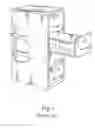
BACKGROUND OF THE INVENTIONPresently, for multiple drawers lined up vertically to effectively prevent simultaneous opening of the drawer above or underneath, an interlock mechanism is implemented.
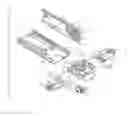
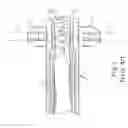
As shown in FIG. 1, a traditional drawer interlock mechanism 1 is implemented for multiple drawers lined up vertically. FIG. 2 shows the traditional drawer interlock mechanism 1′, mainly composed of a fixation base 11′, an axial cam 12′, two braking slides 13′ and a switch 21′ of a slide 2′. The axial cam 12′ uses an axle 121′ to place in an axial hole 111′ of the fixation base 11′, so when a top convex 122′ is being moved by the switch 21′ of the slide 2′ and locking into or taking off the top guiding groove 22′, the axial cam can make 90-degree rotation.
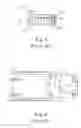
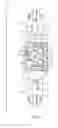
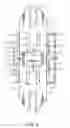
However, as shown in FIG. 3 and FIG. 4, the above-mentioned axial cam 12′ has a steel ball 125′ that is in the bottom groove hole 123′ and subject to regular push by a spring 124′. It also has a bottom convex point 126′ on the other side of the bottom. On the sticking plate at the front end of the rail 3′, there are two grooves 31′ separated by 90 degrees, a guiding groove 32 and a penetrating hole 33′. The bottom convex 126′ corresponds to the guiding groove 32′ in the rail 3′ and serves to limit the position of the axial cam 12′ in rotation. The steel ball 125′ is subject to regular push against the sticking plate at the front end of the rail 3″, so when the axial cam 12′ is rotating, it can be positioned in the two groove 31′ for making 90-degree rotation. Thus, such a way to achieve positioning of the axial cam 12′ in 90-degree rotation involves many components and complicated design. Furthermore, such design needs riveting to place the axis 121′ in the penetrating hole 33′ on the sticking plate at the front end of the rail 3′ as shown in FIG. 4. This causes a tedious process of assembly and relatively high manufacturing cost, which lowers the product competitiveness.
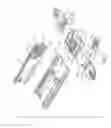
Please refer to FIG. 2 and FIG. 5. The above-mentioned braking slides 13′ are inserted into the slide groove holes 112′ of the fixation base 111′ and fit each other to be against the axial cam 12′. When the axial cam 12′ is making 90-degree rotation, it moves the two braking slides 13′ outward and drives the braking rod 4′ on the axial cam 12′ to activate with the locking mechanism for the top or bottom drawer. Because the braking slide 13′ has one sticking positioning component 131′ on one side that needs special orientation for assembly, it causes inconvenience. Furthermore, when the drawer interlock mechanism 1′ is integrated with the slide 2′ and the rail 3′ to form a single unit configuration, the entire unit is placed on the drawer and the two braking slides 13′ do not provide effective blockage. As a result, the braking slide 13′ underneath falls off the fixation base 11′. It requires separate assembly for the braking slide 13′ and takes much labor.
SUMMARY OF THE INVENTIONThe present invention aims to improve the deficiency of the above-mentioned traditional drawer interlock mechanism based on user's demands, so the design for the positioning mechanism of axial cam is simplified. Furthermore, the assembly will be facilitated by the new connection components to effectively reduce manufacturing cost and assembly time. As a result, the product competitiveness will be significantly improved and benefit the industry.
BRIEF DESCRIPTION OF THE DRAWINGSFIG. 1 is an example of embodiment of a traditional drawer interlock mechanism.
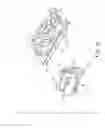
FIG. 2 is an illustration of the configuration for a traditional drawer interlock mechanism.
FIG. 3 is an illustration of the cross-section of the axial cam for a traditional drawer interlock mechanism.
FIG. 4 is an illustration for the configuration that shows positioning groove holes on the front sticking plate in a traditional drawer interlock mechanism.
FIG. 5 is an example of embodiment of the configuration for a traditional drawer interlock mechanism.
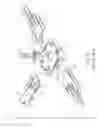
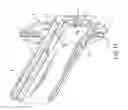
FIG. 6 is an illustration of the configuration for the drawer interlock mechanism in the present invention.
FIG. 7 is an illustration of the two braking slides installed on the fixation base for the present invention.
FIG. 8 is an illustration of the two braking slides that are not moved by the moving and stopping blocks in the present invention.
FIG. 9 is an illustration of the two braking slides that are moved by the moving and stopping blocks in the present invention.
FIG. 10 is an illustration of the assembly of the guiding switch and the axial cam in the present invention.
FIG. 11 is an illustration of the assembly of the sliding components and the slide rail in the drawer interlock mechanism for the present invention.
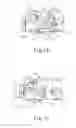
FIG. 12 is the first illustration of the status that the guiding switch advances to rotate the axial cam in the present invention.
FIG. 13 is the second illustration of the status that the guiding switch advances to rotate the axial cam in the present invention.
FIG. 14 is the third illustration of the status that the guiding switch advances to rotate the axial cam in the present invention.
FIG. 15 is the forth illustration of the status that the guiding switch advances to rotate the axial cam in the present invention.
DETAILED DESCRIPTION OF THE INVENTIONPlease refer to the figures from FIG. 6 to FIG. 15. The drawer interlock mechanism in the present invention mainly comprises a fixation base 1, an axial cam 2, two braking slides 3 and a guiding switch 4.
The fixation base 1 is fixed at one end of the rail 6. In the center of the fixation base 1, there is the holding groove 11, which has concave openings 111 every 90-degree angle along the inner periphery. There is a penetrating hole 112 in the center of top face along with two corresponding position-limiting curved grooves 113. At the bottom of the fixation base 1, there is a slide groove 12 in longitudinal direction. On the each side of the slide grooves 12, there is a convex point 121. The two convex points 121 face each other in a decline angle. The rail 6 also has correspondent groove holes 61 to the slide grooves 12. The fixation base 1 has a sticking block 13 on each side of the top face in the longitudinal direction.
The axial cam 2 has an expandable tenon 21 extending along the outer edge of each side. On the two outer edges formed in the direction of 90-degree intersecting lines from the axial cam 2 and the expandable tenon 21, there are a big column 22 and a small column 23. In the middle of the big column 22 and the small column 23, there is a rotation axis 24. A moving and stopping block 25 is situated at the bottom of the axial cam 2. The top face of the axial cam 2 is inserted into the holding groove 11 of the fixation base 1. The rotation axis 24 is placed in the axis hole 112. The big column 22 and the small column 23 are inserted into the position-limiting groove 113 respectively. The expandable tenon 21 can be correspondingly inserted into the concave opening 111, so the axial cam 2 can rotate on the fixation base 1. The big column 22 and the small column 23 inserted to the position-limiting curved groove 113 are subject to path restriction. So the axial cam 2 set onto the fixation base 1 can only make 90-degree rotation. For every 90-degree rotation, the expandable tenon 21 sets into the correspondent concave opening 111, so the axial cam 2 is subject to positioning after 90-degree rotation.
When we compare the axial cam 2 in the present invention to the traditional axial cam 12′, its positioning after 90-degree rotation does not rely on the axis 121′, the spring 124′, the steel ball 125′ and bottom convex point 126′, but only on the expandable tenon 21 on the periphery of the axial cam 2, and the locking and positioning by the sticking big column 22, the small column 23 and the fixation base 1. In this way, the design of the locking mechanism of rotating cam is simplified.
The two braking slides 3 are inserted into the slide groove 12 of the fixation base 1. Its external holding groove 31 can hold a braking stick for movement. On each of the two sides of the two braking slides 3, there is an extending blockage 32, so the two braking slides 3 connect to form a rectangular frame (as shown in FIG. 8) to accommodate the stopping block 25 of the axial cam 2.
Furthermore, the two braking slides 3 have two correspondent guiding groove 33 on both sides of the plate, so no matter the front or back face of the braking slide 3 is inserted in the slide groove 12, the guiding groove 33 can fit the convex point 121 on the slide groove 12. On the groove surface at the introduction end of the guiding groove 33, there is a locking point 331 to stop the convex point 121. Thus, when the two braking slides 3 are sliding outward, they are subject to position limitation by the blockage of the locking point 331 and the convex point 121 of the slide groove 12. So the two braking slides 3 through the correspondent groove holes 61 on the two sides of the rail 6 are forced to lock into the slide grooves 12 of the fixation base 1. Through the locking mechanism of the locking point 331 and the convex point 121 of the slide groove 12, they do not fall off the slide groove 12 and the rail 6. The entire mechanism is set on the slide 5 and the rail 6 to form a unit configuration, which can be assembled with the drawer. Thus, the two braking slides 3 do not need a separate assembly procedure and simplify and facilitate the assembly process.
As shown in FIG. 8 and FIG. 9, when the axial cam 2 rotates 90 degrees and is positioned, the stopping block 25 can move the two matching braking slides 3 outward, so the braking stick in the groove 31 can assure the closure of the top or bottom drawer. In this way, when one drawer is opened, it prevents the opening of the top or bottom drawer and provides an interlock protection.
Therefore, the two braking slides 32 adopt the design of symmetric blockage 32, so any of the braking slides 3 can be placed into any slide groove 12 of the fixation base 11. It does not need to identify the insertion direction and simplifies assembly process. It also offers convenience in practical application.
Please refer to FIG. 6. The guiding switch 4 is set to the front end of the slide 5. The side has a guiding slide groove 41 and a curved slide groove 42. The guiding slide groove 41 has a front guiding groove 411 and a rear guiding groove 412. When the slide 5 is moving toward the fixation base 1, the guiding slide groove 41 for the guiding switch 4 can fit the small column 23 of the axial cam 2, while the curved slide groove 42 can fit the big column 22 of the axial cam 2 (as shown in FIG. 10).
As shown in the embodiments from FIG. 11 to FIG. 15, when the slide 5 is moving forward and is placed in the bottom edge of the block 13 of the fixation base 1, if the stopping block 25 of the axial cam 2 under external influence remains in an unusual position as shown in FIG. 12, the small column 23 of the axial cam 2 in the present invention is moved by the front guiding groove 411 of the guiding switch 4, which makes the axial cam 2 in a rotation state as shown in FIG. 13. The big column 22 can be introduced into the entrance of the curved slide groove 42. Thus, the stopping block 25 of the axial cam 2 still moves the two braking slides 3 forward and makes the top or bottom drawer in a closure status in a vertical layout. Therefore, the drawer interlock mechanism of the present invention has a design of fault prevention measure to assure the repositioning of the axial cam 2. So even under improper use, the stopping block 25 of the axial cam 2 can be recovered to original state and move the two braking slides 3 outward. So the top or bottom drawer is in closure state as shown in FIG. 9, which is subject to unlocking process for the top or bottom drawer.
When the slide 5 continues to move forward, it makes the big column 22 in the curved slide groove 42 subject to push as shown in FIG. 14. Through the guiding of the curved path of the curved slide groove 42, the small uses the rear guiding groove 412 of the guiding slide groove 41 to continue the rotation of the stopping block 25 of the axial cam 2, which is a 90-degree rotation as shown in FIG. 15. This makes the two braking slides 3 against each other inward (as shown in FIG. 8) and prevents the top or bottom drawer from a closure state.
On the contrary, when the guiding switch 4 is moving backward and takes off, the big column 22 of the axial cam 2 uses the curved slide groove 42 in the same way for guiding. The small column 23 uses the rear guiding groove 412 of the guiding groove 41 for guiding. So the stopping block 25 of the axial cam 2 rotates in sequence as shown in figures from FIG. 13 to FIG. 15 and provides a positioning effect after 90-degree rotation. As a result, the two braking slides 3 again are subject to the push by the moving and stopping block 26 to move outward (as shown in FIG. 9). The top or bottom drawer remains in a closure state and can not be open.
To sum up, the drawer interlock mechanism in the present invention can achieve an interlock effect for the top or bottom drawer in closure or opening state. Besides, the design of the axial cam positioning mechanism is simplified. The connection components can facilitate assembly and effectively lower the manufacturing cost and significantly increase product competitiveness. It has a great value for practical application.
Claims
1. A drawer interlock mechanism comprises
A fixation base is fixed at one end of the rail. In the center of the fixation base, there is the holding groove, which has concave openings every 90-degree angle along the inner periphery. There is a penetrating hole in the center of top face along with two corresponding position-limiting curved grooves. At the bottom of the fixation base, there is a slide groove in longitudinal direction. The fixation base has a sticking block on each side of the top face in the longitudinal direction.
An axial cam has an expandable tenon extending along the outer edge of each side. On the two outer edges formed in the direction of 90-degree intersecting lines from the axial cam and the expandable tenon, there are a big column and a small column. In the middle of the big column and the small column, there is a rotation axis. A moving and stopping block is situated at the bottom of the axial cam. The top face of the axial cam is inserted into the holding groove of the fixation base. The axis is used as a rotation axle.
Two braking slides are inserted into the slide groove of the fixation base. Its external holding groove can hold a braking stick for movement. On each of the two sides of the two braking slides, there is an extending blockage, so the two braking slides connect to form a rectangular frame to accommodate the stopping block of the axial cam.
A guiding switch is set to the front end of the slide. The side has a guiding slide groove and a curved slide groove. The guiding slide groove has a front guiding groove and a rear guiding groove . When the slide is moving toward the fixation base, the guiding slide groove for the guiding switch can fit the small column of the axial cam, while the curved slide groove can fit the big column of the axial cam. So the small column can follow the front guiding groove to drive the big column into the curved slide groove. The big column follows the curved slide groove and the small column follows the rear guiding groove to make 90-degree rotation for the axial cam.
2. As described in claim 1 for a drawer interlock mechanism, the slide groove of the fixation base has a convex point on each side and the two points are positioned in a decline angle.
3. As described in claim 1 for a drawer interlock mechanism, the two braking slides have two correspondent guiding groove on both sides of the plate, so no matter the front or back face of the braking slide is inserted in the slide groove, the guiding groove can fit the convex point on the slide groove. On the groove surface at the introduction end of the guiding groove, there is a locking point to stop the convex point. Thus, when the two braking slides are sliding outward, they are subject to position limitation by the blockage of the locking point and the convex point of the slide groove.
4. As described in claim 1 for a drawer interlock mechanism, the guiding switch has a decline guiding surface on the front guiding groove of the guiding slide groove.
5. As described in claim 1 for a drawer interlock mechanism, the path formed by the curved slide groove of the guiding switch can provide the big column of the axial cam with 90-degree rotation.
6. As described in claim 1 for a drawer interlock mechanism, the front guiding groove of the guiding slide groove of the guiding switch has a decline surface, which can move the small column and drive the rotation of the axial cam. It also drives the big column to smoothly enter the curved slide groove. So even under improper operation, it provides the axial cam with protection measure to recover to the normal position. So it can continue to control the axial cam in the guiding groove and the curved slide groove making 90-degree rotation.
Images & Drawings included:

Sources:
- United States Patent and Trademark Office - verify current appl. status at the USPTO↗
Similar patent applications:
- » 20050023941
Drawer interlocking mechanism - » 20090160298
Drawer interlock mechanism - » 20090179534
Drawer interlocking mechanism apparatus - » 20070182292
Interlock mechanism for drawer slide rail - » 20070284976
Drawer slide structure having homing interlocking mechanism
Recent applications in this class:
- » 20250179838 2025-06-05
INTERLOCKING ANTI-TIPPING CABINET - » 20250034909 2025-01-30
INTERLOCKING MECHANISM FOR A CABINET - » 20250019999 2025-01-16
ARRANGEMENT FOR TIPPING OVER PREVENTION OF A CHEST OF DRAWERS AND A CHEST OF DRAWERS COMPRISING SUCH ARRANGEMENT - » 20240376749 2024-11-14
Furniture assembly - » 20240279963 2024-08-22
DRAWER GUIDE RAIL WITH INTERLOCKING FUNCTION - » 20240263489 2024-08-08
Slide rail mechanism - » 20240167301 2024-05-23
COUPLING ELEMENT, LOCKING SYSTEM AND FURNITURE - » 20230407680 2023-12-21
Locking device for movable furniture parts - » 20230383576 2023-11-30
Closing device for movable furniture parts and method for locking at least one movable furniture part - » 20140265761 2014-09-18
LOCKING DEVICE
Recent applications for this Assignee:
- » 20050023941 2005-02-03
Drawer interlocking mechanism - » 10879006 2005-10-25
Braking slide structure for drawer interlock