Flow machine with a ceramic abradable
US20050196271A1
2005-09-08
11/015,144
2004-12-16
✅ Patent granted
US 7,223,067 B2
2007-05-29
-
-
Edward K. Look | Devin Hanan
2025-08-29
Abstract:
The flow machine is furnished with an abradable (10) made of a particle composite material. This so-called composite (1) contains granular core particles (2) of a ceramic material. The surfaces (20) of the granular core particles carry functional layers (22) which form an intermediate phase of the composite which is stable at a high operating temperature. The intermediate phase in this process has been produced in situ at least in part by a chemical reaction of a precursor material (22′) and material (21) of the granular core particles on the particle surfaces (20). Bonds (23) are formed between the granular core particles arranged in a porous composite by the intermediate phase. These bonds have a breaking characteristic for abradables.
Inventors:
- Scott Wilson 3 🇨🇭 Winterthur, Switzerland
- Andreas Franz-Josef Kaiser 2 🇩🇰 Roskilde, Denmark
Assignee:
- SULZER METCO (US) INC. 40 🇺🇸 Westbury, NY, United States
Interested in similar patents?
Get notified when new applications in this technology area are published.
Classification:
C04B35/6281 » CPC main
Shaped ceramic products characterised by their composition ; Ceramics compositions ; Processing powders of inorganic compounds preparatory to the manufacturing of ceramic products; Forming processes; Processing powders of inorganic compounds preparatory to the manufacturing of ceramic products; Preparing or treating the powders individually or as batches ; preparing or treating macroscopic reinforcing agents for ceramic products, e.g. fibres; mechanical aspects section; Coating the powders or the macroscopic reinforcing agents; Powder coating materials; Oxide ceramics Alkaline earth metal oxides
C04B35/62805 » CPC further
Shaped ceramic products characterised by their composition ; Ceramics compositions ; Processing powders of inorganic compounds preparatory to the manufacturing of ceramic products; Forming processes; Processing powders of inorganic compounds preparatory to the manufacturing of ceramic products; Preparing or treating the powders individually or as batches ; preparing or treating macroscopic reinforcing agents for ceramic products, e.g. fibres; mechanical aspects section; Coating the powders or the macroscopic reinforcing agents; Powder coating materials Oxide ceramics
C04B35/62813 » CPC further
Shaped ceramic products characterised by their composition ; Ceramics compositions ; Processing powders of inorganic compounds preparatory to the manufacturing of ceramic products; Forming processes; Processing powders of inorganic compounds preparatory to the manufacturing of ceramic products; Preparing or treating the powders individually or as batches ; preparing or treating macroscopic reinforcing agents for ceramic products, e.g. fibres; mechanical aspects section; Coating the powders or the macroscopic reinforcing agents; Powder coating materials; Oxide ceramics Alumina or aluminates
C04B35/62815 » CPC further
Shaped ceramic products characterised by their composition ; Ceramics compositions ; Processing powders of inorganic compounds preparatory to the manufacturing of ceramic products; Forming processes; Processing powders of inorganic compounds preparatory to the manufacturing of ceramic products; Preparing or treating the powders individually or as batches ; preparing or treating macroscopic reinforcing agents for ceramic products, e.g. fibres; mechanical aspects section; Coating the powders or the macroscopic reinforcing agents; Powder coating materials; Oxide ceramics Rare earth metal oxides
C04B35/62884 » CPC further
Shaped ceramic products characterised by their composition ; Ceramics compositions ; Processing powders of inorganic compounds preparatory to the manufacturing of ceramic products; Forming processes; Processing powders of inorganic compounds preparatory to the manufacturing of ceramic products; Preparing or treating the powders individually or as batches ; preparing or treating macroscopic reinforcing agents for ceramic products, e.g. fibres; mechanical aspects section; Coating the powders or the macroscopic reinforcing agents by gas phase techniques
C04B35/62886 » CPC further
Shaped ceramic products characterised by their composition ; Ceramics compositions ; Processing powders of inorganic compounds preparatory to the manufacturing of ceramic products; Forming processes; Processing powders of inorganic compounds preparatory to the manufacturing of ceramic products; Preparing or treating the powders individually or as batches ; preparing or treating macroscopic reinforcing agents for ceramic products, e.g. fibres; mechanical aspects section; Coating the powders or the macroscopic reinforcing agents by wet chemical techniques
C09K3/1436 » CPC further
Materials not provided for elsewhere; Anti-slip materials; Abrasives Composite particles, e.g. coated particles
C23C4/11 » CPC further
Coating by spraying the coating material in the molten state, e.g. by flame, plasma or electric discharge characterised by the coating material; Oxides, borides, carbides, nitrides or silicides; Mixtures thereof Oxides
C23C4/18 » CPC further
Coating by spraying the coating material in the molten state, e.g. by flame, plasma or electric discharge After-treatment
C23C8/02 » CPC further
Solid state diffusion of only non-metal elements into metallic material surfaces ; Chemical surface treatment of metallic material by reaction of the surface with a reactive gas, leaving reaction products of surface material in the coating, e.g. conversion coatings, passivation of metals Pretreatment of the material to be coated
C04B2235/3217 » CPC further
Aspects relating to ceramic starting mixtures or sintered ceramic products; Composition of constituents of the starting material or of secondary phases of the final product; Constituents and secondary phases not being of a fibrous nature; Metal oxides, mixed metal oxides, or oxide-forming salts thereof, e.g. carbonates, nitrates, (oxy)hydroxides, chlorides Aluminum oxide or oxide forming salts thereof, e.g. bauxite, alpha-alumina
C04B2235/3244 » CPC further
Aspects relating to ceramic starting mixtures or sintered ceramic products; Composition of constituents of the starting material or of secondary phases of the final product; Constituents and secondary phases not being of a fibrous nature; Metal oxides, mixed metal oxides, or oxide-forming salts thereof, e.g. carbonates, nitrates, (oxy)hydroxides, chlorides; Refractory metal oxides, their mixed metal oxides, or oxide-forming salts thereof Zirconium oxides, zirconates, hafnium oxides, hafnates, or oxide-forming salts thereof
C04B2235/5427 » CPC further
Aspects relating to ceramic starting mixtures or sintered ceramic products; Composition of constituents of the starting material or of secondary phases of the final product; Constituents or additives of the starting mixture chosen for their shape or used because of their shape or their physical appearance; Particle size related information expressed by the size of the particles or aggregates thereof millimeter or submillimeter sized, i.e. larger than 0,1 mm
C04B2235/5436 » CPC further
Aspects relating to ceramic starting mixtures or sintered ceramic products; Composition of constituents of the starting material or of secondary phases of the final product; Constituents or additives of the starting mixture chosen for their shape or used because of their shape or their physical appearance; Particle size related information expressed by the size of the particles or aggregates thereof micrometer sized, i.e. from 1 to 100 micron
Y02T50/60 » CPC further
Aeronautics or air transport Efficient propulsion technologies, e.g. for aircraft
Y02T50/60 » CPC further
Aeronautics or air transport Efficient propulsion technologies, e.g. for aircraft
Y10T428/2991 » CPC further
Stock material or miscellaneous articles; Coated or structually defined flake, particle, cell, strand, strand portion, rod, filament, macroscopic fiber or mass thereof; Particulate matter [e.g., sphere, flake, etc.] Coated
F01D11/08 IPC
Preventing or minimising internal leakage of working-fluid, e.g. between stages for sealing space between rotor blade tips and stator
Description
The invention relates to a flow machine with a ceramic abradable and to a method for the manufacture of materials which can be used for the abradable.With flow machines such as aeroplane engines, stationary gas turbines, turbocompressors and pumps, it is necessary for a high efficiency for a sealing gap or clearance between vane tips and housing at the periphery of a rotor bearing runner vanes to be very narrow during operation. By using an abradable on the inner surface of the housing over which the tips of the runner vanes move, it is possible to produce a minimum clearance without the runner vanes being damaged in the process. The abradables must be made of ceramic material for high operating temperatures lying above 800° C. This can be applied by means of thermal spraying process, flame spraying or atmospheric plasma spraying (APS). Porosity, and so friability, of the abradable can be produced by mixing a phase which can be burned out (polymer powder) to a ceramic spray powder. Fine particles from the surface of the abradable are released by the vane tips of the rotating rotor due to this friability.
Abradables are known from EP-A-1 111 195 (=P.7006) and EP-A-0 935 009 (=P.6861) which are known as structured surfaces. Ceramic abradables with non-structured surfaces are also used. The vane tips usually have to be armoured in these so that they are not damaged during abrasion. (Armouring can be produced, for example, by laser remelting with the simultaneous addition of hard particles.) Released abrasion particles must be able to escape from the clearance without any significant resistance. Armouring of the vane tips can be omitted with an abradable having a suitably structured surface, since abrasion particles escape from the clearance without any damaging effect.
It is the object of the invention to provide a flow machine with a ceramic abradable for high operating temperatures of approximately 1200° C. with which no structuring of the surface has to be present for the abradable, on the one hand, and for which armouring of the vane tips is not necessary, where possible, on the other hand. This object is satisfied by the flow machine defined in claim 1.
The flow machine is furnished with an abradable made of a particle composite material. This so-called composite contains granular core particles of a ceramic material. The surfaces of the granular core particles carry functional layers which form an intermediate phase of the composite which is stable at a high operating temperature. The intermediate phase in this process has been produced in situ at least in part by a chemical reaction of a precursor material and material of the granular core particles on the particle surfaces. Compounds are formed between the granular core particles arranged in a porous composite by the intermediate phase. These compounds have a breaking characteristic for abradables.
High operating temperatures can result in transformations which compact the structure and which can also be observed in ceramic thermal barrier coatings (TBC). By embedding materials in the structure which have an inhibiting effect on a sintering activity, it is possible to maintain porosity. The porosity improves the thermal barrier in TBCs. The friability is maintained in the abradables thanks to the porosity. Materials which inhibit sintering and are suitable for TBC, such as pyrochlore compounds (see DE-A-102 00 803), can therefore be used.
Dependent claims 2 to 6 relate to advantageous embodiments of the flow machine in accordance with the invention. Claims 7 to 10 relate to methods for the manufacture of a material for the ceramic abradable which is provided for the flow machine in accordance with the invention.
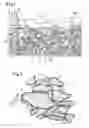
The invention will be explained in the following with reference to the drawings. There are shown:
FIG. 1 in section, an abradable of a flow machine in accordance with the invention with a vane tip moved over the coating; and
FIG. 2 an illustration of the porous structure of the abradable.
The abradable 10 shown sectionally in the two Figures consists of a particle composite material 1 which is termed a composite 1 in brief. This composite 1 contains granular core particles 2 of a ceramic material 21. Grinding grains, for example made from a synthetic corundum, can be used as granular core particles 2, with these grinding grains being larger than 50 and smaller than 200 μm and preferably having mean diameters with values in the range from approximately 90 to 130 μm. The surfaces 20 of the granular core particles 2 carry functional layers 22 which form an intermediate phase of the composite 1 which is stable at a high operating temperature. The intermediate phase in this process has been produced in situ at least in part by a chemical reaction of a precursor material 22′ and material 21 of the granular core particles 2 on the particle surfaces 20.
Compounds 23 are formed between the granular core particles 2 arranged in a porous composite (pores 4) by the intermediate phase; these compounds have a breaking characteristic for abradables. If a vane tip 5, which is moved in the direction of the arrow 6, is moved over the abradable in a grazing manner, granular core particles 2′ are broken off from the surface 100, with a peeling of a rim zone (particle 2′ drawn in chain dotting) as a rule taking place over a plurality of sweeps.
The ceramic material 21 of the granular core particles 2 largely consists, in an advantageous embodiment, of aluminium oxide Al2O3 (corundum) and the layers 22 of a spinel MeAl2O4— where Me=Ni, Mg, Mn or La. It is sufficient if, at least in one layer (not shown) on the surface 20, aluminium oxide Al2O3 is contained as the main component—more than 50 volume percent. The intermediate phase formed by the spinel has been produced in situ on the particle surfaces 20 by the precursor material 22′ which is an oxide of the metal Me, and by aluminium oxide The spinel is a material which inhibits sintering. It therefore forms an intermediate phase of the composite 1 which is stable at a high operating temperature. Other materials inhibiting sintering such as are known from the TBCs can also be used instead of the spinel. The pyrochlore compounds have already been named above (DE-A-102 00 803). One pyrochlore compound is, for example, lanthanum zirconate La2Zr2O7, a ceramic material with a pyrochlore structure (see also U.S. Pat. No. 6,117,560). The pyrochlore structure is specifically given by the formula A2B2O7, where A and B are elements which are present in a cationic form An+ or Bm+ and to whose charges n+ and m+ the value pairs (n, m)=(3, 4) or (2, 5) apply. The formula for the pyrochlore structure is more generally A2−xB2+xO7−y, where x and y are positive numbers which are small in comparison with 1. The following elements can be chosen for A and B: A=La, Ce, Pr, Nd, Sm, Eu, Gd, Tb, Dy, Ho, Er, Tm, Yb or a mixture of these chemical elements and B═Zr, Hf, Ti.
The granular core particles 2 are advantageously coated with the precursor material 22′ by means of a so-called “aerocoating process”. In this method, the particles 2 are fluidised and sucked in by an air flow through an annular clearance at the base of a combining tube, with them being conveyed through the tube against gravitational force into a large chamber from which they again drop back into a fluidisation zone. The particles 2 move out of this zone back into the combining tube into which a suspension of the coating material 22′ is additionally sprayed as very fine droplets by means of a spray nozzle. The droplets are deposited on the particles 2 in a mixing in the combining tube. The coated particles 2 dry during the flight through the large chamber. The air which brings about a conveying and drying of the particles 2 is allowed to escape at the head of the chamber separately from the treated particles 2. The latter can run through the described coating process a plurality of times. As a rule, it cannot be avoided that some of the particles 2 ball together to form agglomerates during coating. Such agglomerates are advantageously removed, for example, by screening. The US corporation Aeromatic-Fielder Division Niro, Inc. sells apparatuses with which the “aerocoating method” can be carried out.
Multilayer coatings can also be applied using the “aerocoating method” with individual layers which consist of different materials. For example, a granular core particle 2, which does not consist of aluminium oxide, or which does not contain such, can thus have a first layer of this material applied to it. This granular core particle 2 coated in this manner then has a material property required for the method in accordance with the invention. The core material of such a heterogeneous granular core particle 2 naturally has to have a thermal stability required with respect to the operating temperature.
The intermediate phase can also be made from a mixture of precursor material 22′ and ceramic material 21, with the precursor material 22′ and the ceramic material 21, in particular aluminium oxide, consisting of fine grain particles whose diameters are smaller than 1 μm. This coating material is prepared together with water and auxiliary materials to form the suspension required for the “aerocoating method”. The additional aluminium oxide is suitable for an accelerated function of the spinel. At the same time, the bonds between the granular core particles 2 are also improved by the additional aluminium oxide.
As shown in FIG. 2, uncoated particles 3 can also be embedded in the composite 1. If aluminium oxide is likewise selected for the material of the particles 3 in the case of the pairing of aluminium oxide with spinel, these particles 3 contribute to improved bonds 23 between the granular core particles 2.
The material for the abradable used in a flow machine in accordance with the invention is produced in steps. The method steps are, for example:
-
- a) production of an atomisable or sprayable mixture in the form of a slip or of a suspension in which fine-grain particles of the precursor material 22′ are dispersed;
- b) coating of the granular core particles 2 by application of the said mixture and subsequent drying of the particles 2;
- c) calcining the coated granular core particles 2 at a temperature at which the intermediate phase is formed in situ at the surfaces from precursor material 22′ and material of the granular core particle 21 (and, in addition, auxiliary substances of the suspension are thermally eliminated); and
- d) sintering of the calcined granular core particles 2, in particular at a temperature between 1200 and 1500° C. when NiO is used for the manufacture of spinel, with the sintering being able to take place at and/or after a thermal spraying of the abradable.
In step a), the fine grain particles can be produced mixed with a solvent, preferably water, while using a mill, in particular an agitating ball mill. The very fine particles are kept dispersed in the solvent without any formation of agglomerates. These very fine particles must be sufficiently small so that the granular core particles 2 (size 40-120 μm) can still be coated effectively. Moreover, the very fine particles should be sinter-active in the subsequent calcination step, i.e. should permit a bonding of the coating to the material 21 of the granular core material 2 at as low a temperature as possible. Subsequent to step c) and instead of step d), the following three steps can also be carried out:
-
- d′) mixing of the calcined particles with a fine Al2O3 powder and portion-wise solidifying of the batch to green compacts by compression;
- e) sintering of the green compacts, in particular at a temperature between 1200 and 1500° C., when NiO is used to make the spinel; and
- f) reshaping of the sintered product to an end product in that a granulate-like spray powder is produced by crushing which can be used for a thermal spraying method.
The following alternative of the method is also possible:
-
- a) coating of the granular core particle 2 by application of metallic skins by an electrochemical, chemical or physical process (CVD or PVD), with the metal of the skin forming the precursor 22′ of the intermediate phase in oxidised form;
- b) oxidising the metal of the skins to form the precursor material 22′, with the intermediate phase being able to be produced at least in part subsequently by means of a treatment at an elevated temperature;
- c) sintering of the coated granular core particles 2, in particular at a temperature between 1200 and 1500° C., when NiO is used for the manufacture of the spinel, with the sintering being able to take place at and/or after a thermal spraying of the abradable.
To produce the abradable on a substrate—e.g. on an inner surface of the housing of the flow machine in accordance with the invention—the coated granular core particles 2 can be applied by means of a thermal spraying method, for example by means of flame spraying or APS “atmospheric plasma spraying”. To obtain a high porosity of the abradable, coating is advantageously carried out by means of flame spraying, since in this process the particles 2 impact on the substrate with a much smaller kinetic energy (factor 0.1 to 0.01) than in the APS process. The forming of the intermediate phase can result by the thermal effect in flame spraying. A granulate can also be used in the thermal spraying method instead of a spray powder, which is composed of loose particles 2, with the individual granulate particles being sintered together in each case from a plurality of granular core particles 2, thereby forming the structure of the composite 1.
In the flow machine in accordance with the invention, vane tips of a rotor can be unarmoured. They can also carry a coating whose melting point lies at least 100 K above that of the intermediate phase. At a sufficiently high melting point, practically no material is removed from the vane tip on frictional contact with the abradable, but only from the abradable.
Partly stabilised or fully stabilised zirconium oxide (YSZ) can also be used as the ceramic material 21 for the granular core particles. Further examples for the coating material are: La2O3, MgO, mullite (3Al2O3.2SiO2) and perovskite.
The materials produced with the methods in accordance with the invention can also be used as materials for TBCs. Since a TBC has a different function from an abradable and is exposed to larger temperature gradients, the materials provided for abradables is, however, not ideally formed with respect to a use for TBCs.
Claims
1. A flow machine with an abradable (10) of a particle composite material, a so-called composite (1) which contains granular core particles (2) of ceramic material whose surfaces (20) carry functional layers (22), wherein these layers form an intermediate phase of the composite which is stable at a high operating temperature, the intermediate phase is produced in situ on the particle surfaces (20) at least in part by a chemical reaction of a precursor material (22′) and material (21) of the granular core particles, wherein bonds (23) are formed between the granular core particles arranged in a porous composite by the intermediate phase and these bonds have a breaking characteristic of abradables.
2. A flow machine in accordance with claim 1, characterised in that the granular core particle (2) contains, at least in a layer at its surface (20), aluminium oxide Al2O3 as a main component—more than 50 volume percent; in that the precursor material (22′) contains an oxide of a metal Me-where Me=Ni, Mg, Mn or La— and in that the intermediate phase is produced at least in part from Al2O3 and the metal oxide by the said reaction in which a spinel MeAl2O4 is created as the reaction product.
3. A flow machine in accordance with claim 1, characterised in that grinding grains, for example from a synthetic corundum, are used as the granular core particles (2) and the grinding grains are larger than 50 and smaller than 200 μm, with the diameters of the granular core particles preferably having values in the range from approximately 90 to 130 μm.
4. A flow machine in accordance with claim 1, characterised in that the granular core particles (2) are coated with a mixture of precursor material (22′) and ceramic material (21) prior to a formation of the composite (1), with the precursor material and the ceramic material consisting of fine grain particles whose diameters are smaller than 1 μm.
5. A flow machine in accordance with claim 1, characterised in that the coated granular core particles (2) or a granulate consisting of the composite (1) is applied by means of a thermal spraying process, by means of APS or preferably by means of flame spraying.
6. A flow machine in accordance with claim 1, characterised in that vane tips (5) of a rotor are unarmoured or carry a coating whose melting point lies at least 100 K above that of the intermediate phase.
7. A method for the manufacture of a material for a ceramic abradable in a flow machine in accordance with claim 1, including the following steps:
a) production of an atomisable or sprayable mixture in the form of a slip or of a suspension in which fine-grain particles of the precursor material are dispersed;
b) coating of the granular core particles by application of the said mixture and subsequent drying of the particles;
c) calcining the coated granular core particles at a temperature at which the intermediate phase is formed in situ at the surfaces of precursor material and material of the granular core particle; and
d) sintering of the calcined granular core particles, in particular at a temperature between 1200 and 1500° C. when NiO is used for the manufacture of spinel, with the sintering being able to take place at and/or after a thermal spraying of the abradable.
8. A method for the manufacture of a material for a ceramic abradable in a flow machine in accordance with claim 1, including the following steps:
a) coating of the granular core particles by application of metallic skins by an electrochemical, chemical or physical process, with the metal of the skin forming the precursor material of the intermediate phase in oxidised form;
b) oxidising the metal of the skins to form the precursor material, with the intermediate phase being able to be produced at least in part subsequently by means of a treatment at an elevated temperature;
c) sintering of the coated granular core particles, in particular at a temperature between 1200 and 1500° C., when NiO is used for the manufacture of the spinel, with the sintering being able to take place at and/or after a thermal spraying of the abradable.
9. A method in accordance with claim 7, characterised in that, in step a), the fine grain particles are produced using a mill, in particular an agitating ball mill, in a solvent, preferably water, and the very fine particles are kept dispersed in this solvent.
10. A method in accordance with claim 7, characterised in that, in step b), the granular core particles are sprayed in a fluidised state, i.e. are coated in a so-called aerocoating method.
Images & Drawings included:
Sources:
- United States Patent and Trademark Office - verify current appl. status at the USPTO↗
Recent applications in this class:
- » 20100216627 2010-08-26
Method of making mixed metal oxide ceramics
Recent applications for this Assignee:
- » 20140332177 2014-11-13
Closed loop cooling of a plasma gun to improve hardware life - » 20140329020 2014-11-06
Thermo spray gun with removable nozzle tip and method making and using the same - » 20140326703 2014-11-06
EXTENDED CASCADE PLASMA GUN - » 20140234651 2014-08-21
PROTECTIVE COATINGS AND METHODS OF FORMING SAME - » 20140167597 2014-06-19
Cathode interface for a plasma gun and method of making and using the same - » 20130270355 2013-10-17
Pressure based liquid feed system for suspension plasma spray coatings - » 20130193229 2013-08-01
THERMAL SPRAY COMBUSTION GUN WITH A TOLERANCE COMPENSATION SPRING - » 20130056446 2013-03-07
METAL MATRIX CERAMIC WIRE MANUFACTURING TECHNOLOGY AND USAGE - » 20120298217 2012-11-29
Plume shroud for laminar plasma guns - » 20120295825 2012-11-22
Abradable composition and method of manufacture