Anti-slip support structure of a webpad
US20050257341A1
2005-11-24
10/841,635
2004-05-10
Abstract:
An anti-slip support structure includes a locating block fixedly fastened to the back panel of a webpad and provided with a pin, a back support pivoted to the pin and adapted to support the webpad on a flat surface in a tilted position, two anti-slip blocks provided at the bottom side of the back panel of the webpad, and two anti-slip rubber feet fixedly provided at the bottom side of the back support and adapted to increase friction between the back support and the flat surface on which the web stands.
Assignee:
- Tatung Co., Ltd. 116 🇹🇼 Taipei City, Taiwan
Interested in similar patents?
Get notified when new applications in this technology area are published.
Classification:
G06F1/1613 » CPC main
Details not covered by groups - and; Constructional details or arrangements for portable computers
F16M11/10 » CPC further
Stands or trestles as supports for apparatus or articles placed thereon Stands for scientific apparatus such as gravitational force meters; Heads; Means for attachment of apparatus; Means allowing adjustment of the apparatus relatively to the stand allowing pivoting around a horizontal axis
F16M13/005 » CPC further
Other supports for positioning apparatus or articles ; Means for steadying hand-held apparatus or articles integral with the apparatus or articles to be supported
G06F1/1656 » CPC further
Details not covered by groups - and; Constructional details or arrangements for portable computers; Constructional details or arrangements of portable computers not specific to the type of enclosures covered by groups - Details related to functional adaptations of the enclosure, e.g. to provide protection against EMI, shock, water, or to host detachable peripherals like a mouse or removable expansions units like PCMCIA cards, or to provide access to internal components for maintenance or to removable storage supports like CDs or DVDs, or to mechanically mount accessories
G06F1/166 » CPC further
Details not covered by groups - and; Constructional details or arrangements for portable computers; Constructional details or arrangements of portable computers not specific to the type of enclosures covered by groups - ; Details related to functional adaptations of the enclosure, e.g. to provide protection against EMI, shock, water, or to host detachable peripherals like a mouse or removable expansions units like PCMCIA cards, or to provide access to internal components for maintenance or to removable storage supports like CDs or DVDs, or to mechanically mount accessories related to integrated arrangements for adjusting the position of the main body with respect to the supporting surface, e.g. legs for adjusting the tilt angle
Y10T16/14 » CPC further
Miscellaneous hardware [e.g., bushing, carpet fastener, caster, door closer, panel hanger, attachable or adjunct handle, hinge, window sash balance, etc.] Carpet stiffener or anti-slip device
Description
BACKGROUND OF THE INVENTION1. Field of the Invention
The present invention is directed toward a webpad and more particularly, to an anti-slip support structure of a webpad.
2. Description of Related Art
Comparing to a laptop, tablet PC, or PDA, a webpad is a product of new technology. A laptop or tablet PC has a high-level data processing capability, and is superior to a conventional desktop computer in mobility. Further, a tablet PC has a touch screen for handwritten input. These two products are designed for use by the general public. A PDA emphasizes low-level word processing such as, for example, address book, notebook, and other electronicalized word works. It is also designed for use by the general public.
The so-called webpad according to the present invention is a device oriented between a laptop and a PDA. It has a weight lighter than a laptop, and provides a touch-control input function as a tablet PC does. More important, a webpad has a wireless Internet connection function. When installed with an 802.11b wireless network card, a webpad can accurately and rapidly fetch data from a remote place connected with the Internet while having the complex data processing handled by the remote mainframe. Unlike the laptop, tablet PC or PDA designed for the public, a webpad is particularly designed for specific purposes in certain fields such as hospitals, sales centers, distributors and netlibraries.
Structurally, a webpad is a laptop computer without a top cover. It combines a display panel and a base member into a tablet PC, and relies on touch screen for user input. While sitting at a desk to use a webpad to process data, the user may feel it more convenient to have the display screen set in the upright mode. However, a conventional webpad either provides no support or cannot stand on a flat surface stably. Further, a webpad user may need to change the standing angle of the webpad from time to time subject to the change of the sitting posture. However, a conventional webpad having a back support does not allow the user to adjust the standing angle of the webpad as precisely as desired.
SUMMARY OF THE INVENTIONThe present invention is designed to overcome the drawbacks of the prior art discussed above. It is the main object of the present invention to provide an anti-slip support structure of a webpad, which enables the user to put the webpad on a flat surface firmly in a standing position.
It is another object of the present invention to provide an anti-slip support structure of a webpad, which enables the user to adjust the standing angle of the webpad on a flat surface.
To achieve these and other objects of the present invention, the anti-slip support structure of a webpad comprises a front cover; a locating block fixedly provided at an outer side of a back panel of said webpad, said locating block further comprising a pin fixedly fastened to and partially extended out of said locating block; and a stand pivoted to said pin and rotatable relative to said back panel; wherein said stand comprises at least one anti-slip rubber foot at a bottom side thereof; said front cover comprises at least one anti-slip stub at the bottom side thereof; and said back panel comprises at least one anti-slip block at a bottom side thereof; said anti-slip stub and block adapted to work with said at least one anti-slip rubber foot for increasing the friction between said webpad and a surface on which the webpad is mounted.
Furthermore, the friction-type connection between the pin and the stand of the present invention enables the user to adjust the view angle according to different conditions.
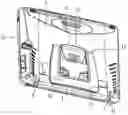
BRIEF DESCRIPTION OF THE DRAWINGSFIG. 1 is a rear elevational view of a webpad constructed according to the present invention.
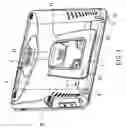
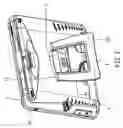
FIG. 2 is a schematic drawing showing the webpad supported on the back support on a flat surface in a tilted position.
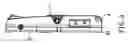
FIG. 3 is a right side view of the webpad shown in FIG. 1.
DETAILED DESCRIPTION OF THE PREFERRED EMBODIMENTReferring to FIG. 1, the body of a webpad is shown comprising a front panel 31 and a back panel 3. The back panel 3 is provided with a locating block 2 around the central area at a relatively lower side. A pin 21 is fixedly fastened to the locating block 2 to hold a back support 1. The back support 1 has two coupling portions 11 respectively pivotally coupled to the two distal ends of the pin 21 outside the locating block 2. Therefore, the back support 1 can be turned about the pin 21 to an extended position.
Referring to FIG. 2, the back support 1 has the bottom side mounted with two anti-slip rubber feet 13. The back panel 3 has the bottom corners respectively mounted with respective anti-slip blocks 4. When the back support 1 is extended out to support the webpad on a flat surface in an inclined position, the anti-slip rubber feet 13 and the anti-slip blocks 4 are in contact with the flat surface. By means of the friction resistance between the anti-slip rubber feet 13 and anti-slip blocks 4 and the flat surface, the webpad firmly stands on the flat surface.
As indicated above, the pivot connection between the back support 1 and the locating block 2 is stepless. When turning the back support 1 outwards from the back panel 3 to a relatively bigger extended angle, a relatively bigger horizontal component of force is employed to the flat surface by the back support 1. If the back support 1 does not have the aforesaid anti-slip rubber feet 13, it tends to slip on the flat surface, resulting in falling of the webpad to the flat surface. The friction force between the anti-slip rubber feet 13, the anti-slip blocks 4 and the flat surface work with the friction force between the coupling portions 11 of the back support 1 and the pin 21, preventing slipping of the back support 1 on the flat surface, and therefore the back support 1 supports the webpad on the flat surface positively in a standing position.
Referring to FIG. 3 and FIG. 2 again, in addition to the anti-slip blocks 4 in the two bottom corners of the back panel 3, the front panel 31 of the webpad has the two bottom corners respectively provided with a respective anti-slip block 41. The anti-slip blocks 41 of the front panel 31 are disposed in flush with the bottom side of the front panel 31. By means of the anti-slip blocks 41 of the front panel 31 and the anti-slip blocks 4 of the back panel 3, the webpad can stand on a flat surface in an upright position positively after the back support 1 has been turned inwards and closely received to the back panel 3.
According to the present preferred embodiment, the pin 21 extends out of the two opposite lateral sides of the locating block 2 in a horizontal direction, and the back support 1 has two coupling portions 11 respectively pivoted to the two distal ends of the pin 21. Alternatively, the pin 21 can be affixed to the locating block 2 in vertical or at a specific angle, and the back support 1 be made to match with the pin 21. The connection between the pin 21 and the back support 1 may be variously embodied and a friction connection is a choice. Multi-step tongue and groove engagement or gear engagement arrangement may be employed to substitute for friction connection. However, a stepless friction connection is the best choice to enable the optimum inclination to be achieved. The anti-slip rubber feet 13 may be fastened to the back support 1 by a hook joint, plug joint, screw joint, adhesive, or any of a variety of mounting methods. Most preferably, the anti-slip rubber feet 13 are formed integral with the bottom side of the back support 1. The anti-slip blocks 4 can be made of any of a variety of materials having a high friction coefficient. Preferably, the anti-slip blocks 4 are molded from rubber. The quantity of the anti-slip blocks 41 at the front panel 31 is not limited to two. However, the arrangement of the anti-slip blocks 41 must enable the webpad to stand upright on a flat surface. The anti-slip blocks 41 can be made of any of a variety of materials having a high friction coefficient. Preferably, the anti-slip blocks 41 are molded from rubber.
Although the present invention has been explained in relation to its preferred embodiment, it is to be understood that many other possible modifications and variations can be made without departing from the spirit and scope of the invention as hereinafter claimed.
Claims
1. An anti-slip support structure of a webpad comprising:
a front cover;
a locating block fixedly provided at an outer side of a back panel of said webpad, said locating block further comprises a pin fixedly fastened to and partially extended out of said locating block; and
a stand pivoted to said pin and rotatable relative to said back panel;
wherein said stand comprises at least one anti-slip rubber foot at a bottom side thereof; said front cover comprises at least one anti-slip stub at the bottom side thereof; and said back panel comprises at least one anti-slip block at a bottom side thereof; said anti-slip stub and block adapted to work with said at least one anti-slip rubber foot for increasing frictional contact between said webpad and a surface on which the webpad is stood.
2. The anti-slip support structure of a webpad as claimed in claim 1, wherein said pin extends out of said locating block in horizontal direction for enabling said back support to be turned upwardly/downwardly about said pin.
3. The anti-slip support structure of a webpad as claimed in claim 1, wherein said at least one anti-slip rubber foot is respectively formed integral with the bottom side of said back support.
4. The anti-slip support structure of a webpad as claimed in claim 1, wherein said at least one anti-slip block is respectively molded from rubber.
5. The anti-slip support structure of a webpad as claimed in claim 1, wherein said front panel comprises at least one anti-slip block at a bottom side thereof adapted to support the webpad on a flat surface in vertical.
6. The anti-slip support structure of a webpad as claimed in claim 1, wherein the at least one anti-slip block of said back panel is respectively molded from rubber.
Images & Drawings included:
Sources:
- United States Patent and Trademark Office - verify current appl. status at the USPTO↗
Recent applications in this class:
- » 20230393616 2023-12-07
DISPLAYING APPLICATION VIEWS - » 20230176611 2023-06-08
Protective case for a computing device and method of use - » 20230161376 2023-05-25
Electronic Device With Sensors and Display Devices - » 20210397217 2021-12-23
Electronic device with sensors and display devices - » 20210373597 2021-12-02
Portable computer unified top case - » 20210124392 2021-04-29
Protective case for a computing device and method of use - » 20210116961 2021-04-22
ACTUATING USER INTERFACE FOR MEDIA PLAYER - » 20200379509 2020-12-03
Docking apparatus for handheld computer and mobile payment terminal - » 20200326748 2020-10-15
Molecular scrivener for reading or writing data to a macromolecule - » 20200057468 2020-02-20
MID-FRAME MEMBERS
Recent applications for this Assignee:
- » 20060238952 2006-10-26
Corona discharge apparatus - » 20060198093 2006-09-07
Cover positioning structure of a dual-usage portable computer - » 20060158334 2006-07-20
Enhanced mechanism for radio frequency identification reader - » 20060151502 2006-07-13
Box and cover structure - » 20060150114 2006-07-06
Method for selecting multiple electronic files - » 20060150101 2006-07-06
Method for a continuous repeat segment playback of an electronic file - » 20060149908 2006-07-06
Method of providing a sport mode of a portable electronic device - » 20060146507 2006-07-06
Dual-usage fastener - » 20060146489 2006-07-06
Common lock for dual-usage portable computer - » 20060146203 2006-07-06
Television with the frequency modulation receiver