Ballistic performance enhancement of fiber structure
US20050282007A1
2005-12-22
11/159,286
2005-06-21
Abstract:
A fiber structure made of fiber and about 1 to about 15 wt % of a polymer that has a Tg in the range of −60 to about 10° C.
Inventors:
- Kalika Ranjan Samant 13 🇺🇸 Hockessin, DE, United States
- Bryan Benedict Sauer 18 🇺🇸 Boothwyn, PA, United States
- Joseph D. Trentacosta 12 🇺🇸 Wilmington, DE, United States
Interested in similar patents?
Get notified when new applications in this technology area are published.
Classification:
B32B5/26 » CPC main
Layered products characterised by the non- homogeneity or physical structure, i.e. comprising a fibrous, filamentary, particulate or foam layer; Layered products characterised by having a layer differing constitutionally or physically in different parts characterised by the presence of two or more layers which are next to each other and are fibrous, filamentary, formed of particles or foamed one layer being a fibrous or filamentary layer another layer also being fibrous or filamentary
B32B5/28 » CPC further
Layered products characterised by the non- homogeneity or physical structure, i.e. comprising a fibrous, filamentary, particulate or foam layer; Layered products characterised by having a layer differing constitutionally or physically in different parts characterised by the presence of two or more layers which are next to each other and are fibrous, filamentary, formed of particles or foamed one layer being a fibrous or filamentary layer impregnated with or embedded in a plastic substance
C08J5/04 » CPC further
Manufacture of articles or shaped materials containing macromolecular substances Reinforcing macromolecular compounds with loose or coherent fibrous material
C08J5/24 » CPC further
Manufacture of articles or shaped materials containing macromolecular substances Impregnating materials with prepolymers which can be polymerised , e.g. manufacture of prepregs
D02G3/047 » CPC further
Yarns or threads, e.g. fancy yarns; Processes or apparatus for the production thereof, not otherwise provided for; Yarns or threads characterised by the material or by the materials from which they are made; Blended or other yarns or threads containing components made from different materials including aramid fibres
D06M15/00 » CPC further
Treating fibres, threads, yarns, fabrics, or fibrous goods made from such materials, with macromolecular compounds; Such treatment combined with mechanical treatment
D06M15/263 » CPC further
Treating fibres, threads, yarns, fabrics, or fibrous goods made from such materials, with macromolecular compounds; Such treatment combined with mechanical treatment with synthetic macromolecular compounds; Macromolecular compounds obtained by reactions only involving carbon-to-carbon unsaturated bonds of unsaturated carboxylic acids; Salts or esters thereof
D06M15/277 » CPC further
Treating fibres, threads, yarns, fabrics, or fibrous goods made from such materials, with macromolecular compounds; Such treatment combined with mechanical treatment with synthetic macromolecular compounds; Macromolecular compounds obtained by reactions only involving carbon-to-carbon unsaturated bonds of unsaturated carboxylic acids; Salts or esters thereof containing fluorine
D06M15/31 » CPC further
Treating fibres, threads, yarns, fabrics, or fibrous goods made from such materials, with macromolecular compounds; Such treatment combined with mechanical treatment with synthetic macromolecular compounds; Macromolecular compounds obtained by reactions only involving carbon-to-carbon unsaturated bonds of unsaturated nitriles
D06M15/327 » CPC further
Treating fibres, threads, yarns, fabrics, or fibrous goods made from such materials, with macromolecular compounds; Such treatment combined with mechanical treatment with synthetic macromolecular compounds; Macromolecular compounds obtained by reactions only involving carbon-to-carbon unsaturated bonds of unsaturated alcohols or esters thereof
F41H5/0478 » CPC further
Armour; Armour plates; Plate construction composed of more than one layer; Layered armour containing fibre- or fabric-reinforced layers Fibre- or fabric-reinforced layers in combination with plastics layers
F41H5/0485 » CPC further
Armour; Armour plates; Plate construction composed of more than one layer; Layered armour containing fibre- or fabric-reinforced layers all the layers being only fibre- or fabric-reinforced layers
B32B2260/021 » CPC further
Layered product comprising an impregnated, embedded, or bonded layer wherein the layer comprises an impregnation, embedding, or binder material; Composition of the impregnated, bonded or embedded layer Fibrous or filamentary layer
B32B2260/046 » CPC further
Layered product comprising an impregnated, embedded, or bonded layer wherein the layer comprises an impregnation, embedding, or binder material; Impregnation, embedding, or binder material Synthetic resin
B32B2262/02 » CPC further
Composition or structural features of fibres which form a fibrous or filamentary layer or are present as additives Synthetic macromolecular fibres
B32B2307/718 » CPC further
Properties of the layers or laminate; Other properties Weight, e.g. weight per square meter
B32B2571/02 » CPC further
Protective equipment defensive, e.g. armour plates, anti-ballistic clothing
Y10T428/29 » CPC further
Stock material or miscellaneous articles Coated or structually defined flake, particle, cell, strand, strand portion, rod, filament, macroscopic fiber or mass thereof
Y10T428/2913 » CPC further
Stock material or miscellaneous articles; Coated or structually defined flake, particle, cell, strand, strand portion, rod, filament, macroscopic fiber or mass thereof Rod, strand, filament or fiber
Y10T428/2915 » CPC further
Stock material or miscellaneous articles; Coated or structually defined flake, particle, cell, strand, strand portion, rod, filament, macroscopic fiber or mass thereof; Rod, strand, filament or fiber including textile, cloth or fabric
Y10T428/2969 » CPC further
Stock material or miscellaneous articles; Coated or structually defined flake, particle, cell, strand, strand portion, rod, filament, macroscopic fiber or mass thereof; Rod, strand, filament or fiber; Coated or with bond, impregnation or core; Artificial fiber or filament; Synthetic resin or polymer Polyamide, polyimide or polyester
Y10T442/20 » CPC further
Fabric [woven, knitted, or nonwoven textile or cloth, etc.] Coated or impregnated woven, knit, or nonwoven fabric which is not [a] associated with another preformed layer or fiber layer or, [b] with respect to woven and knit, characterized, respectively, by a particular or differential weave or knit, wherein the coating or impregnation is neither a foamed material nor a free metal or alloy layer
Y10T442/2525 » CPC further
Fabric [woven, knitted, or nonwoven textile or cloth, etc.]; Coated or impregnated woven, knit, or nonwoven fabric which is not [a] associated with another preformed layer or fiber layer or, [b] with respect to woven and knit, characterized, respectively, by a particular or differential weave or knit, wherein the coating or impregnation is neither a foamed material nor a free metal or alloy layer Coating or impregnation functions biologically [e.g., insect repellent, antiseptic, insecticide, bactericide, etc.]
Y10T442/30 » CPC further
Fabric [woven, knitted, or nonwoven textile or cloth, etc.] Woven fabric [i.e., woven strand or strip material]
Description
FIELD OF THE INVENTIONThe present invention is related to a fiber structure impregnated with a low glass transition temperature viscous liquid polymer fluid, and to articles made there from. Certain low glass transition viscous polymer fluids impregnated into fiber structures, such as apolyaramid fabric, essentially act as a friction modifier with the result that, because of the moderate molecular weight and moderate adhesive strength of the polymer fluid, an optimal ballistic resistance and protection against blunt trauma is found in an article such as body armor.
BACKGROUND OF THE INVENTIONU.S. Pat. No. 3,649,426 and Lee, Y. S. et al (N.J. Advanced Body Armor Utilizing Shear Thickening Fluids, 23rd Army Science Conference, 2002) consider shear thickening suspensions of particles in conjunction with ballistic fibers.
WO 00/46303 and U.S. Pat. No. 3,649,426 describe polyaramid fabrics with liquids in pouches or in back of polyaramide panels.
U.S. Pat. No. 5,776,839 applied dilatant powders, with a typical composition consisting of carbon black, fumed silica (nano-silica) and a small amount of “glue”, to ballistic fibers and fabrics.
U.S. Pat. No. 5,229,199 considered rigid composites of woven aramid fabrics coated with an adhesion modifier and imbedded in a matrix resin. The reduced friction and weakened interfaces led to improved ballistic performance. If friction is too high in a fabric, or if the matrix is too stiff, ballistic resistance is severely compromised.
U.S. Pat. No. 5,354,605 used low Tg, high molecular weight elastomers as adhesive matrix materials for fiber layers. These provided flexibility in unidirectional ballistic layers.
U.S. Pat. No. 5,854,143 describes material for antiballistic protective clothing comprising, in a single-layer or multi-layer package or laminate, at least one layer of a flat structure containing an organic dilatancy agent.
Although many flexible body armor constructions adequately stop ballistic projectiles, blunt trauma can still cause substantial injury or death at a given basis weight of the fabric in an article such as a vest. Reducing the large level of blunt trauma can be accomplished by dissipating and spreading out the energy of impact. The goal is to improve resistance to blunt trauma in flexible body armor, while retaining the high ballistic resistance of systems such as polyaramid fabric. Comfort and weight of ballistic vests are critical properties affected by this technology
Previous work has attempted to implement stiffer layers near the body to reduce blunt trauma, but this is known to significantly compromise ballistic resistance to penetration, and to add to the weight of the body armor while reducing comfort.
In contrast, the present invention uses a fiber structure, such as one or more layers of polyaramide fabric, impregnated with certain low glass transition temperature viscous polymer fluids. Excellent ballastic resistance is preserved while blunt trauma resistance is improved.
SUMMARY OF THE INVENTIONThe present invention is an article comprising one or more layers of a high performance fiber structure impregnated with about 1 to 14 percent by weight of a viscous polymer fluid with a glass transition temperature between 10 and −60 C.
In another embodiment of the present invention, the article comprises poly (vinyl propionate).
In yet another embodiment of the present invention, the article comprises poly (hexyl methacrylate).
In a further embodiment, the article comprises poly (isopropyl acrylate)
In a yet further embodiment, the article comprises poly (acrylonitrile-butadiene).
In a still further embodiment, the article comprises ethylene/methyl acrylate (38/62)(8%) copolymer.
In a further embodiment, the article is body armor.
A further embodiment of this invention is a fiber structure comprising a fiber and about 1 to about 15 wt % of a polymer that has a Tg in the range of −60 to about 10° C.
A further embodiment of this invention is a fiber structure as described above in the form of a knitted fabric, a woven fabric, a uniweave structure, a unidirectional sheet, a multi-directional sheet, a non-woven layer, or a single fiber.
A further embodiment of this invention is an article comprising one or more layers of the fiber structure described above.
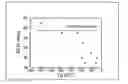
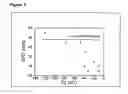
BRIEF DESCRIPTION OF THE DRAWINGFIG. 1 is a plot of back face deformation as a function of glass transition temperature.
DETAILED DESCRIPTION OF PREFERRED EMBODIMENTSIn this invention, one or more low glass transition, viscous polymer fluids, as a liquid adhesive additive, have been impregnated into a fiber structure such as a polyaramid fabric. A desirable maximum in ballistic penetration resistance and minimum in back face deformation (“BFD”, a measure of blunt trauma measured in depth in millimeters where low depth indicates low levels of blunt trauma) is found at level of content of generally about 15 wt % or less of the liquid adhesive additive level in the fiber structure. Unlike prior-art systems, this low level of content has been found to be effective in many different types of fiber structures.
A liquid adhesive impregnated into a fiber structure such as a polyaramid fabric at low levels essentially acts as friction enhancer under ballistic impact conditions, and relative to previous technologies minimizes the weight added to an article made from the fiber structure. This resulted in a reduction in back face deformation (BFD), while retaining or slightly improving ballistic resistance to penetration. The moderate molecular weight polymers used herein provide intermediate adhesive strength, and thus result in an optimal performance. By contrast, materials with very high viscosities product reduced ballistic penetration resistance, as do other stiffer additives and systems that are made too stiff or too high in friction by the presence of more than about 15 wt % of the adhesive additive. As discussed below, such behavior is expected for very high friction in impregnated fabrics.
The glass transition temperature of the viscous fluid polymer used in this invention falls in the range of about −60 to about 10° C., and preferably in the range of about −40 to about −5° C. The polymers should be viscous fluids. They should not be elastic solids, very high molecular weight polymers, semi-crystalline elastic solids, or cross-linked elastic solids.
These lower viscosity fluid polymers give moderate friction. For viscous fluid polymers having a Tg in the range of about −60 to about 10° C., elevated friction over the dry fabric control correlates well with BFD and contributes to a performance advantage. Viscosity of the impregnated additive also correlates with fabric stiffness. Glass transition is not the only important variable because of the MW and viscosity variations of chosen polymers.
In addition to Tg, the viscous fluid polymer(s) used in this invention may also be characterized by molecular weight and viscosity. Molecular wieghts are typically determined by gel permeation chromatography. The molecular weight of the viscous fluid polymer may, for example, be in the range of about 40,000 to 100,000. The desired viscosity range for the viscous fluid polymer(s) is about 104 to about 1013 poise. Viscosity is measured at room temperature unless the viscosity is too high in which case it is estimated by extrapolating from high temperature melt viscosity, melt flow index characterization or other qualitative Theological characterization. One typical method applied for zero shear viscosity characterization of polymer fluids is cone-and-plate rheometry. A viscosity outside the above range will typically reduce performance such as in the case of very low glass transition siloxane fluid, which reduces friction due to lubrication. This has been correlated with poor ballistic performance as is well known.
Liquid adhesives with appropriate properties can be formed in many ways including as a suspension, emulsion or melt, and in the form of blend or a copolymer.
Examples of polymers useful as viscous fluid polymers herein are poly(vinyl propionate), poly(hexyl methacrylate), poly(isopropyl acrylate), poly(acrylonitrile-butadiene) copolymer and ethylene/methyl acrylate copolymer (such as a copolymer in which the ethylene content is 38 weight percent and the methyl acrylate content is 62 weight percent).
A fiber structure may be prepared from a fiber made from a polymer such as a polyolefin (such as polyethylene or polypropylene), polyimide, polyester, poly(vinyl alcohol), PBI, M-5, or polyaramid. The tenacity of a fiber should be at least about 900 MPa according to ASTM D-885 in order to provide superior ballistic penetration resistance. Preferably a fiber also has a modulus of at least about 10 MPa.
High performance fiber structures can take many forms such as knitted fabric, woven fabric, uniweave structures, unidirectional sheets, multi-directional sheets (those, for example, having fibers crossing over at an angle between about 20 and 90 degrees), a non-woven layer (for example, felt), or even as single fibers. A fiber structure may take the form of more 10, 20, 40 or 60 layers of individual fiber structures of this invention.
Protective body armor is a major application for this invention. The impregnated high performance fiber structure may be manufactured into body armor by a standard vest-making process such as stitching. Body armor is constructed by body armor manufacturers in order to meet penetration resistance, blunt trauma and other requirements as established by the National Institute of Justice via NIJ 100-98. According to NIJ 100-98, the manner in which the ballistic panels are assembled into a single unit differs from one manufacturer to another. In some cases, the multiple layers are bias stitched around the entire edge of the panel; in others, the layers are tack stitched together at several locations. Some manufacturers assemble the fabrics with a number of rows of vertical or horizontal stitching; some may even quilt the entire ballistic panel. No evidence exists that stitching impairs the ballistic-resistant properties of a panel. Instead, stitching tends to improve the overall performance, especially in cases of blunt trauma, depending upon the type of fabric used.
Treated layers may be placed at the back, away from the point of impact, or may be placed in the middle, or in any other fashion in order to optimize performance in the body armor. The treatment concentration may be same for each of the treated layers, or may vary from layer to layer so as to provide a desired variation of stiffness through the pack. Treated layers can be used in a pack consisting of types f fabric structures that may vary from layer to layer.
Viscous polymer fluids with flow and modulus properties distinctly different than solid elastomers were impregnated into ballistic fabrics. A desirably high level of both ballistic penetration resistance and back face deformation (a measure of blunt trauma) was found in the range of about 6 to about 10 wt % additive level in polyaramid fabric. This type of system would provide about a 20-30% weight savings compared to the area density needed to provide satisfactory blunt trauma protection in vests currently in use.
Several examples are provided with viscous liquid polymers to demonstrate various polymers that impart improved BFD. These systems have not previously been studied in the art, partly because much of the literature suggests that adding “adhesive” matrix or elastomer resins to polyaramide fabric reduces ballistic performance, as shown in U.S. Pat. No. 5,229,199. For example, if friction is too high in the fabric, or if the matrix is too stiff, ballistic resistance of polyaramid fabric vests is severely compromised. Systems listed in Table 5 with strong adhesives and/or high concentrations added to polyaramid fabric verify that elevated stiffness leads to poorer ballistic penetration resistance. This was done by showing that high viscosity solid elastomers or adhesives like those used in the literature lead to reduced ballistic penetration resistance and increased stiffness in these fabrics. Also, liquid adhesives that impart high fabric stiffness or are present at high concentration can lead to diminished properties.
EXAMPLES Example 1Fabrics for ballistic, pullout, and other tests are impregnated with organic solvents containing 5-20 wt % of the polymer with the remainder solvent. The fabrics are soaked in the polymer solutions. After soaking, the solvent is allowed to evaporate. Similar impreganation could be accomplished by brushing, spraying or dipping in order to contact the viscous polymer fluid solution with the high performance fiber structure. The volume of polymer solution added is used to control the final weight percent of additive in a polyaramid fabric such as Kevlar® brand fabric from DuPont.
Fiber pullout tests are conducted on an Instron to probe yarn friction modification as a result of fabric surface treatments by lubricants and adhesives. This test considers friction as a single 840 denier polyaramid filament is pulled through a 100 mm wide single layer of fabric clamped as described in Bazhenov, S. Dissipation of Energy by Bulletproof Aramid Fabric, J. Mat. Sci., 32, 1997, 4167. Essentially the maximum force to pull out the single polyaramid strand is recorded on an Instron or other load sensing device. For a viscous liquid polymer such as poly(vinyl propionate) (“PVP”, obtained from Scientific Polymer Products Inc. of Ontario, N.Y.) applied to fabrics, friction increases substantially with concentration even at very low concentrations as shown in Table 1. The weight percent PVP in this table is based on dry levels of additive versus weight of polyaramid fabric.
| TABLE 1 |
| Concentration Dependence of Pullout data for Poly(vinyl propionate) |
| (PVP) on 840 denier polyaramid fabric |
| (Maximum force for 100 mm fabric pull out length, |
| 100 mm/min. pull out rate) |
| Weight % PVP | Maximum Force(N) | |
| 0% | 6 | |
| 1% | 6 | |
| 4% | 30 | |
| 7% | 55 | |
Ballistic tests are conducted in order to develop technology for reducing back face deformation for National Institute of Justice level 11 protection using Magnum 357 copper jacketed lead bullet. Back face deformation tests are performed by impacting multi-layer of polyaramid fabric panels held against a clay bed and measuring the depth of indentation (BFD in mm) due to the ballistic event with a nominal strike velocity of about 1425 ft/sec. Fabric had a plain weave construction using 840 denier polyaramid yarn and had a nominal face weight of 5.8 oz/sq. yd. Twenty-one such layers measuring 15 in×15 in were sewn in an “X” pattern using polyaramid sewing thread after having taped the edges of the panel. Ten of the 21 layers were treated and were placed closest to the clay bed.
V50 is defined as the critical velocity where half of the bullets are completely stopped, and half penetrate through the construction. In some studies V50 is measured for systems backed by air, but in the following examples the V50 was measured for panels backed by clay.
Viscous fluid polymers as used in this invention have a glass transition temperature (Tg) that enables them to give desirable liquid adhesive performance in this invention, and control back face deformation through viscosity and friction effects in a fiber structure, as demonstrated in FIG. 1.
Polyaramide fabrics were impregnated with low weight fractions of low glass transition polymers such as PVP, poly(hexyl methacrylate), and others as listed in Table 4. PVP, poly (hexyl methacrylate), poly (isopropyl acrylate), poly (acrylonitrile-butadiene) copolymer, and poly (dimethyl siloxane) were obtained from Scientific Polymer Products Inc. of Ontario, N.Y. Poly(phenyl methyl siloxane) and poly(diphenyl siloxane-co-dimethyl siloxane) were obtained from Gelest Inc. of Tullytown, Pa. The ethylene/methyl acrylate (38/62) copolymer was obtained from DuPont of Wilmington, Del. The moderate increase in friction contributes to an improvement of back face deformation (BFD) for the case of systems containing polyaramid fabric layers impregnated with up to 10 wt % of the liquid adhesive as shown in Table 2 and Table 4. This is accomplished while retaining and even improving ballistic penetration resistance as measured by V50 in Table 2. This can be compared to the almost universal deterioration of V50 with addition of increasing concentration of matrix resin to polyaramid fabric in the comparative example in Table 3.
Good performance in ballistic penetration resistance and back face deformation (a measure of blunt trauma) is found at about 8-10 wt % additive (PVP) level in Kevlar® fabric as shown in Table 2. Seven additives are listed at the top of Table 4. They are polymers, which include PVP, PHM and others and have sufficient viscosity to impart improvement in BFD over the additive-free control. The bottom three entries in Table 4 are siloxanes with low to very low glass transition temperatures. Even though one is fairly viscous because of its high molecular weight (polydimethyl siloxane, i.e., silicone oil, MW=94 Kg/mol), all three lead to no improvement in BFD.
As was discussed above, concentrations of PVP greater than 15 wt % impart high friction leading to reduced ballistic penetration resistance (lower V50, Table 2). Also, the solid adhesives in Table 5 contribute to lower V50 at relatively low weight fractions. These systems are also substantially stiffer than those treated with liquid adhesives and this will affect comfort.
| TABLE 2 |
| Ballistic Studies of Flexible Armor |
| ˜0.8 pound per square ft. (psf) basis weight. |
| 21 total layers 840 denier polyaramide fabric: |
| 11 control/10 treated with PVP |
| V50 | |||
| wt. % PVP | B.F.D. | (at 1425 ft/s) | |
| 0% | 44 mm | 1430 ft/s | |
| 8% | 36 | 1480 | |
| 10% | 34.6 | 1480 | |
| 15% | fail | 1360 | |
| TABLE 3 |
| 1.26 pound per square ft. (psf) basis weight |
| polyaramid 29/Vinyl Ester matrix |
| wt. % vinyl ester | V50 | |
| 0% | 1580 ft/s | |
| 20% | 1200 | |
| 30% | 1120 | |
| TABLE 4 |
| Physical properties of liquid adhesives and |
| ballistic performance |
| (21 layers total, in the case of panels containing |
| adhesives, 10 out of 21 fabric layers were treated) |
| V50 | ||||
| Tg | MW/visc | ft/s | BFD | |
| ° C. | kg mol−1/Poise | 1425 ft/s | (mm) | |
| 21 layers 840d control | — | — | 1390 | 44.3 |
| Poly vinylpropionate (9%) | −10 | 30k/106 | 1480 | 35.1 |
| Poly vinylpropionate (15%) | −10 | 30k/106 | 1340 | — |
| Poly hexyl methacrylate | −20 | 400k/109 | 1440 | 36.4 |
| (10%) | ||||
| Poly isopropyl acrylate | −8 | 120k/108 | 1425 | 36.5 |
| (8%) | ||||
| Poly acrylonitrile-butadiene | −37 | 8k/104 | 1370 | 36 |
| (8%) liquid | ||||
| Poly acrylonitrile-butadiene | −39 | ˜600k/1011 | 1440 | 40 |
| (8.6%) slab | ||||
| Ethylene/methyl acrylate | −32 | 40k,108 | 1440 | 36 |
| (38/62)(8%) Copolymer | ||||
| Poly(phenyl methyl | −57 | 5k/10 poise | 1420 | 44 |
| siloxane),. | ||||
| Poly(diphenyl siloxane-co- | −78 | 10k/10 poise | 1420 | 44 |
| dimethyl siloxane),. | ||||
| Poly(dimethyl siloxane) | −120 | 94k/103 poise | 1390 | 45 |
| TABLE 5 |
| 840d Fabric treated with “Solid” Adhesives, |
| 21 total fabric layers |
| V50 | ||||
| Tg | ft/s | BFD | ||
| ° C. | MW/visc | 1385 ft/s | (mm) | |
| 21 control | 1390 | 40.6 | ||
| Polyurethane (9%) (solvent | −70 | solid, | 0 | 31 |
| applied) | “x-link” | |||
| Elastic Surlyn ® (12%) | −50 | solid, | 1300 | none* |
| (melt applied) | crystalline | |||
*All shots penetrated through panel so BFD wasn't determined. |
Claims
1. A fiber structure comprising a fiber and about 1 to about 15 wt % of a polymer that has a Tg in the range of −60 to about 10° C.
2. A fiber structure according to claim 1 wherein the polymer has a molecular weight of about 40,000 to 100,000.
3. A fiber structure according to claim 1 wherein the polymer has a viscosity of about 104 to about 1013 poise.
4. A fiber structure according to claim 1 wherein the polymer is selected from one or more members of the group consisting of poly(vinyl propionate), poly(hexyl methacrylate), poly(isopropyl acrylate), poly(acrylonitrile-butadiene) copolymer and ethylene/methyl acrylate copolymer.
5. A fiber structure according to claim 1 wherein the fiber is spun from one or members of the group consisting of a polyolefin (such as polyethylene or polypropylene), polyimide, polyester, poly(vinyl alcohol), PBI, M-5, or polyaramid.
6. A fiber structure according to claim 1 in the form of a knitted fabric, a woven fabric, a uniweave structure, a uni-directional sheet, a multi-directional sheet, a non-woven layer, or a single fiber.
7. An article comprising one or more layers of the fiber structure of claim 1.
8. The article of claim 7 wherein the polymer is poly(vinyl propionate).
9. The article of claim 7 wherein the polymer is poly(hexyl methacrylate).
10. The article of claim 7 wherein the polymer is poly(isopropyl acrylate).
11. The article of claim 7 wherein the polymer is poly(acrylonitrile-butadiene).
12. The article of claim 7 wherein the article is body armor.
13. The article of claim 7 wherein the article is body armor comprising a combination of treated and untreated layers.
Images & Drawings included:
Sources:
- United States Patent and Trademark Office - verify current appl. status at the USPTO↗
Recent applications in this class:
- » 20250144911 2025-05-08
HIGH-DURABILITY DUAL COMPOSITE WATERPROOF STRUCTURE THROUGH INORGANIC ELASTIC UNDERCOAT BODY AND COMPOSITE SHEET WATERPROOF STRUCTURE WITH HEAT SHIELDING AND HEAT DISSIPATION PERFORMANCE - » 20250100247 2025-03-27
COMPOSITE LAMINATE BODY AND DISPOSABLE DIAPER - » 20250083408 2025-03-13
STRETCHY THERMAL INSULATION COMPOSITE MATERIAL - » 20250042128 2025-02-06
CELLULOSE PRECURSOR MATERIAL AND APPARATUS AND METHOD FOR FIELD CONVERSION OF THE PRECURSOR INTO CELLULOSE INSULATION - » 20250026104 2025-01-23
POROSITY GRADIENT PREFORM ARCHITECTURE FOR HIGH TEMPERATURE COMPOSITES - » 20250026103 2025-01-23
POROSITY GRADIENT PREFORM ARCHITECTURE FOR HIGH TEMPERATURE COMPOSITES - » 20250010575 2025-01-09
Near Infrared Reflecting Composition and Coverings for Architectural Openings Incorporating Same - » 20240416617 2024-12-19
BULLETPROOF, STAB-PROOF, AND CUT-PROOF STRUCTURE - » 20240399705 2024-12-05
PROTECTIVE COMPOSITE FABRICS AND METHODS OF MANUFACTURE AND USE - » 20240367412 2024-11-07
COMPRESSION MEMBERS