Elevated Building Foundation
US20060101732A1
2006-05-18
10/904,142
2004-10-26
Abstract:
A part of a building structure called the “elevated building foundation” to shield the building structure against 3D components of destructive earthquakes, comprising a massive horizontal plate (1) raised above the level of the ground and underpinned by multiple abutments (2); those abutments (2) are resting on individual footings at the level of the ground (3); the top surface of plate (1) is bearing a protected building superstructure (4). Due to a proper use of materials, sizes, and configuration of the elevated building foundation, the value of impedance of seismic waves that propagate vertically through the horizontal stratum of the elevated building foundation encompassing the abutments (2) is secured such low in comparison with the corresponding values of the stratum of footings in the ground (3) or the stratum of plate (1), that any transmission of seismic wave energy into the superstructure (4) furnished with an elevated building foundation per the current invention will be decreased considerably as a result of reflections, diffractions, and dissipations of the stress energy in a process of multiple wave transformations.
Interested in similar patents?
Get notified when new applications in this technology area are published.
Classification:
E04H9/021 » CPC main
Buildings, or groups of buildings, or shelters adapted to withstand or provide protection against abnormal external influences, e.g. war-like action, earthquake, extreme climate withstanding earthquake or sinking of ground Bearing, supporting or connecting constructions specially adapted for such buildings
E02D27/34 » CPC further
Foundations as substructures; Foundations for special purposes Foundations for sinking or earthquake territories
E04B9/00 IPC
Ceilings; Construction of ceilings, e.g. false ceilings; Ceiling construction with regard to insulation
Description
CROSS-REFERENCE TO RELATED APPLICATIONSU.S. Patent Documents
5,881,507 March 1999 Yoo et al. 52/167.8
5,816,559 October 1998 Fujimoto 248/636
5,740,216 April 1998 Morishita 376/285
BACKGROUND OF INVENTION1. Field of the Invention
The present invention relates to the 3D earthquake protection of building structures. More particularly, the invention relates to the passive structural control technique.
2. Description of the Prior Art
The concept of suppression of seismic energy or diverting its flow from entering a building structure is known as a seismic or base isolation. Normally, this technique needs some sort of pads to be inserted under all major load-carrying elements in a basement of the building. In most of the cases, those pads act as horizontal springs to create a sizable frequency separation required for effective protection of a building structure against lateral earthquake forces. To protect the structure against vertical shaking, a similar approach is engaged: a variety of vertical springs are proposed for underpinning a building superstructure (see, e.g., Yoo et al. 1999, Fujimoto 1998, and Marishita 1998).
However, due to enormous weight of a building superstructure, its soft suspension happens to be very expensive.
BRIEF DESCRIPTION OF DRAWINGSIn the description of invention herein presented, references are made to the accompanying drawings, in which:
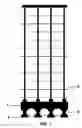
FIG. 1 is a 2D view of a building superstructure mounted on an Elevated Building Foundation.
FIG. 2 depicts an exploded 2D view of a building superstructure mounted on an Elevated Building Foundation.
DETAILED DESCRIPTIONThe present invention will be described with reference to the accompanying drawings. As illustrated at FIG. 1 and FIG. 2, the elevated building foundation, according to the invention, incorporates a massive horizontal plate (1) raised above the ground and supported by multiple abutments (2), those abutments resting on individual footings in the ground (3). The top surface of the plate (1) bears a protected building superstructure (4). Due to a significantly lower impedance of seismic waves that propagate vertically through the horizontal stratum of the elevated building foundation encompassing the abutments (2), in comparison with the stratum of footings in the ground (3) or the stratum of plate (1), any transmission of seismic wave energy into the superstructure (4) furnished with the elevated building foundation will be decreased considerably.
During an earthquake, both P- and S-waves propagating from the ground vertically into the building superstructure (4) will have to go first through the strata (3), (2) and (1), which constitute the elevated building foundation, having an effect of a seismic barrier that mitigates all three linear components of earthquake shaking. Material, dimensions, and configuration of each elevated building foundation should satisfy a requirement of proper vertical load bearing capacity and that of adequate compression and shearing forces being transmitted through the elevated building foundation into the superstructure. Unlike its predecessors, the elevated building foundation is equally effective for any direction of shaking, and relatively simple for both construction and reconstruction. Besides, it incorporates no moving parts, remains ever ready for performance, and does not require any maintenance during a lifetime of a building structure.
Claims
What is claimed is:1. A system of properly assembled structural elements called an “elevated building foundation” adapted for a 3D protection of a building superstructure against a damaging effect of a strong earthquake and comprising the following features:
a massive horizontal plate (1) raised above the level of the ground and underpinned by multiple abutments (2);
individual footings at the level of the ground (3) supporting the abutments (2);
the top surface of the plate (1) bearing a protected building superstructure (4);
as a result of a proper choice of materials, dimensions, and configuration of the elevated building foundation, the value of impedance of seismic waves that propagate vertically through the horizontal stratum of the elevated building foundation encompassing the abutments (2) has to be secured at such a low level in comparison with the corresponding impedances at the stratum of footings on the ground (3) or the stratum of plate (1), that any transmission of seismic wave energy into the superstructure (4) furnished with the elevated building foundation will be decreased considerably.
Images & Drawings included:


Sources:
- United States Patent and Trademark Office - verify current appl. status at the USPTO↗
Recent applications in this class:
- » 20250154788 2025-05-15
DIRECTION-ADJUSTABLE BOLTED SPHERICAL JOINT FOR COLLAPSE RESISTANCE AND EARTHQUAKE RESISTANCE - » 20250137275 2025-05-01
SEISMIC ANCHOR SYSTEM, APPARATUS, AND STRUCTURE INCLUDING SAME - » 20250092708 2025-03-20
SEISMIC-RESISTANT JOINT STRUCTURE OF PC COLUMN AND PC BEAM USING STEEL BRACKET - » 20240426125 2024-12-26
COMPOSITE MATERIAL REINFORCEMENT DEVICE FOR BOX-TYPE CONCRETE STRUCTURE AND METHOD OF CONSTRUCTING THE SAME - » 20240417992 2024-12-19
Prefabricated infilled panel-frame structure capable of accommodating seismic loading and seismic energy dissipation, and construction method - » 20240401362 2024-12-05
RESILIENT SLIP FRICTION JOINT - » 20240401361 2024-12-05
MULTIDIRECTIONAL HYSTERETIC DAMPER ENDOWED WITH NEGATIVE STIFFNESS - » 20240384554 2024-11-21
Structural strengthening device - » 20240337130 2024-10-10
REINFORCED TIE ROD AND A BUILDING WALL USING THE SAME - » 20240337129 2024-10-10
RESILIENT SLIP FRICTION JOINT