Method for the application of reusable fasteners on diapers
US20060237116A1
2006-10-26
10/573,640
2004-09-24
✅ Patent granted
US 7,655,102 B2
2010-02-02
WO; PCT/EP2004/010775; 20040924
WO; WO2005/030104; 20050407
James Sells
2024-09-24
Abstract:
The invention relates to a method for the application of a reusable fastener, comprising a sealing band and a sealing strip, to a diaper. According to the invention, strips, comprising a support and a backed material with sealing elements in the form of loops or hooks, are fixed to the diaper without adhesive. In a first method step the strips are attached by means of thermobonding or ultrasound welding. In a second methods step, the above are then fixed to the counter-surface by cold pressing or ultrasound welding.
Assignee:
- NORDENIA DEUTSCHLAND GRONAU GMBH 21 🇩🇪 Gronau, Germany
Interested in similar patents?
Get notified when new applications in this technology area are published.
Classification:
A61F13/15756 » CPC main
Bandages or dressings ; Absorbent pads; Absorbent pads, e.g. sanitary towels, swabs or tampons for external or internal application to the body ; Supporting or fastening means therefor; Tampon applicators; Apparatus or processes for manufacturing Applying tabs, strips, tapes, loops; Knotting the ends of pads
B29C65/02 » CPC further
Joining of preformed parts ; Apparatus therefor by heating, with or without pressure
B29C65/086 » CPC further
Joining of preformed parts ; Apparatus therefor by heating, with or without pressure using ultrasonic vibrations using a rotary sonotrode or a rotary anvil using a rotary anvil
B29C65/087 » CPC further
Joining of preformed parts ; Apparatus therefor by heating, with or without pressure using ultrasonic vibrations using a rotary sonotrode or a rotary anvil using both a rotary sonotrode and a rotary anvil
B29C66/0322 » CPC further
General aspects of processes or apparatus for joining preformed parts; General aspects dealing with the joint area or with the area to be joined; After-treatments in the joint area; Mechanical after-treatments Post-pressing without reshaping, i.e. keeping the joint under pressure after joining
B29C66/1122 » CPC further
General aspects of processes or apparatus for joining preformed parts; General aspects dealing with the joint area or with the area to be joined; Particular design of joint configurations particular design of the joint cross-sections; Joint cross-sections comprising a single joint-segment, i.e. one of the parts to be joined comprising a single joint-segment in the joint cross-section; Single lapped joints Single lap to lap joints, i.e. overlap joints
B29C66/21 » CPC further
General aspects of processes or apparatus for joining preformed parts; General aspects dealing with the joint area or with the area to be joined; Particular design of joint configurations particular design of the joint lines, e.g. of the weld lines said joint lines being formed by a single dot or dash or by several dots or dashes, i.e. spot joining or spot welding
B29C66/4722 » CPC further
General aspects of processes or apparatus for joining preformed parts; General aspects of joining substantially flat articles, e.g. plates, sheets or web-like materials; Making flat seams in tubular or hollow articles; Joining single elements to substantially flat surfaces; Joining single elements to sheets, plates or other substantially flat surfaces said single elements being substantially flat Fixing strips to surfaces other than edge faces
B29C66/723 » CPC further
General aspects of processes or apparatus for joining preformed parts characterised by the composition, physical properties or the structure of the material of the parts to be joined; Joining with non-plastics material characterised by the structure of the material of the parts to be joined being multi-layered
B29C66/8322 » CPC further
General aspects of processes or apparatus for joining preformed parts; General aspects of machine operations or constructions and parts thereof characterised by the movement of the joining or pressing tools; Reciprocating joining or pressing tools Joining or pressing tools reciprocating along one axis
B29C66/83411 » CPC further
General aspects of processes or apparatus for joining preformed parts; General aspects of machine operations or constructions and parts thereof characterised by the movement of the joining or pressing tools moving with the parts to be joined; Roller, cylinder or drum types; Band or belt types; Ball types Roller, cylinder or drum types
B29C66/83413 » CPC further
General aspects of processes or apparatus for joining preformed parts; General aspects of machine operations or constructions and parts thereof characterised by the movement of the joining or pressing tools moving with the parts to be joined; Roller, cylinder or drum types; Band or belt types; Ball types; Roller, cylinder or drum types cooperating rollers, cylinders or drums
B29C69/006 » CPC further
Combinations of shaping techniques not provided for in a single one of main groups - , e.g. associations of moulding and joining techniques; Apparatus therefore cutting-off or cutting-out a part of a strip-like or sheet-like material, transferring that part and fixing it to an article rotating transfer means
B29C65/7443 » CPC further
Joining of preformed parts ; Apparatus therefor by welding and severing, or by joining and severing, the severing being performed in the area to be joined, next to the area to be joined, in the joint area or next to the joint area using the same tool for both joining and severing, said tool being monobloc or formed by several parts mounted together and forming a monobloc by means of ultrasonic vibrations
B29C66/7392 » CPC further
General aspects of processes or apparatus for joining preformed parts characterised by the composition, physical properties or the structure of the material of the parts to be joined; Joining with non-plastics material characterised by the intensive physical properties of the material of the parts to be joined, by the optical properties of the material of the parts to be joined, by the extensive physical properties of the parts to be joined, by the state of the material of the parts to be joined or by the material of the parts to be joined being a thermoplastic or a thermoset characterised by the material of the parts to be joined being a thermoplastic or a thermoset characterised by the material of at least one of the parts being a thermoplastic
B29K2023/00 » CPC further
Use of polyalkenes or derivatives thereof as moulding material
B29L2031/4878 » CPC further
Other particular articles; Wearing apparel; Underwear Diapers, napkins
Y10T156/1077 » CPC further
Adhesive bonding and miscellaneous chemical manufacture; Methods of surface bonding and/or assembly therefor with cutting, punching, tearing or severing; Prior to assembly of plural laminae from single stock and assembling to each other or to additional lamina Applying plural cut laminae to single face of additional lamina
B29C66/71 » CPC further
General aspects of processes or apparatus for joining preformed parts characterised by the composition, physical properties or the structure of the material of the parts to be joined; Joining with non-plastics material characterised by the composition of the plastics material of the parts to be joined
B29K2023/06 » CPC further
Use of polyalkenes or derivatives thereof as moulding material; Polymers of ethylene PE, i.e. polyethylene
B32B37/06 IPC
Methods or apparatus for laminating, e.g. by curing or by ultrasonic bonding characterised by the heating method
B32B37/16 IPC
Methods or apparatus for laminating, e.g. by curing or by ultrasonic bonding characterised by the properties of the layers with all layers existing as coherent layers before laminating
B32B38/04 IPC
Ancillary operations in connection with laminating processes Punching, slitting or perforating
B32B37/00 IPC
Methods or apparatus for making layered products; Treatment of the layers or of the layered products
B32B37/00 IPC
Methods or apparatus for laminating, e.g. by curing or by ultrasonic bonding
Description
The invention relates to a method for affixing a reusable fastener that consists of a fastener tape and a fastener strip to a baby diaper, whereby strips that consist of a carrier and a material laminated on, having fastener elements in the form of loops or hooks, are attached to the baby diaper without adhesive.
The material of the fastener band, i.e. fastener strip that can be laminated on can be produced by means of textile technology. The loops or hooks, which are produced by means of warp-knitting, for example, interact in the manner of a hook-and-loop system, whereby hook-shaped fastener elements of the one textile material engage into loops of the other textile material. The carrier of the fastener band and/or fastener strip can consist of a single-layer or multi-layer film, a textile material, or a laminate of a carrier film and a textile material laminated onto one side or both sides. Furthermore, the carrier can have a region having differing elasticity in the longitudinal direction of the strip. However, it is practical if at least the connection regions of the carrier, at which the bond with the baby diaper is produced, are configured as low-stretch regions. Polyolefins are particularly suitable as materials for the carrier of the fastener band and fastener strip.
Within the framework of the known measures, the fastener bands and the fastener strips are attached to the diaper by means of an adhesive that is applied to the back of the carrier. Attachment takes place on the outer skin of the diaper, or on a component that is configured as a diaper ear, for example (DE 199 40 185 A1). Handling of materials provided with an adhesive makes great demands on processing. In particular, it must be assured that the adhesive parts are either covered with release films during processing, or only come into contact with other materials, with the adhesive side, at the desired point in time. Because of these problems, it is proposed in DE 199 52 417 A1 to coat the strips with a parting layer that contains silicone, on the side of the fastener elements, which layer must be cured after coating. This method is complicated.
From DE 197 03 557 A1, it is known to attach fastener strips to the outside of a baby diaper using ultrasound bonding. As another possibility for the production of mechanical bonds, bonding by means of heat and/or pressure can be considered (EP 0 877 589 B1). Ultrasound bonding as well as bonding by means of heat and pressure are relatively slow attachment methods. The required dwell time for the production of a firm bond is clearly longer than the time required for contact gluing. Attachment of a strip forming a reusable fastener to baby diapers by means of heat and pressure therefore appears not to be very suitable for practice, and has not been able to establish itself.
The invention is based on the task of simplifying the attachment of the fastener bands and fastener strips on the baby diaper. The method is supposed to be able to be integrated into the diaper production, and is not allowed to impair the production speed of the diaper production.
This task is accomplished, according to the invention, in the case of the method described initially, in that the strips are basted on in a first method step, by means of thermobonding or ultrasound bonding, and firmly bonded to the counter-surface in a second method step, by means of cold pressing or ultrasound bonding. The two method steps are carried out in spatially separate workstations.
In the case of thermobonding, bonding of the materials takes place using hot tools. In the case of ultrasound bonding, stamping dies that oscillate at high frequency are used, which produce friction heat. By means of local melting and flow processes, the materials to be bonded are merely fixed in place in a first method step. In a second method step, in a spatially separate workstation, the materials are subsequently firmly bonded by means of cold pressing or ultrasound bonding. In a continuous diaper production, the two method steps can be carried out at the same time, in the separate workstations. By dividing the attachment method into two method steps, the dwell time that is required for applying and attaching the fastener strips and fastener bands in the case of a continuous diaper production can be reduced by up to 50%.
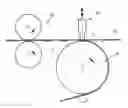
According to a preferred embodiment of the invention, the strips are cut from a material web, with a cut transverse to the web running direction, and passed to the first workstation by means of a transfer device, in which the strips are applied to a web from which the diapers or parts of the diapers are produced, and basted on by means of thermobonding or ultrasound bonding. A rotating transfer device can be used, in particular, as the transfer device, which passes the strips to the workstation with a rotational movement in the same direction as the running direction of the web. Afterwards, the web is passed through the second workstation, in which the strips are firmly bonded to the web.
Using the method according to the invention, bonds between strips and diapers can be produced, which consist of attachment points disposed densely next to one another.
In the following, the invention will be explained using a drawing that presents an exemplary embodiment merely as an example. The drawing schematically shows:
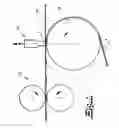
FIG. 1 a method for affixing a reusable fastener that consists of a fastener tape and a fastener strip to a baby diaper,
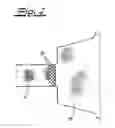
FIG. 2 the method product produced according to the method described.
In the case of the method shown in FIG. 1, strips 1 are cut from a material web 2, with a cut crosswise to the running direction of the web, and passed to a first workstation 4 by means of a rotating transfer device 3. The strips 1 cut from the material web 2 consist of a carrier and a material laminated on, having fastener elements in the form of loops or hooks. In the first workstation 4, they are applied to a web 5 from which diapers or parts of diapers are produced, and basted on by means of thermobonding or ultrasound bonding. The bond produced in the first workstation 4 merely serves to fix the strips 1 in place on a surface that forms the outside of the diaper. Afterwards, the web is passed through a second workstation 6, in which the strips 1 are firmly bonded to the web 5 by means of cold pressing or ultrasound bonding. In the exemplary embodiment, a station for pressing is represented.
The method product produced according to the method described is shown in FIG. 2. FIG. 2 schematically shows a detail of a baby diaper having a lateral fastener band 7, which is attached to a connection region of the diaper configured as a diaper ear 8, and works together with a fastener strip disposed on the outside of the diaper, not shown in the figure, as a hook-and-loop fastener. The fastener band 7 consists of a carrier and a material laminated on, having hook-shaped fastener elements that work together with loop-shaped fastener elements of the fastener strip attached to the outside of the diaper. The material that is laminated on can be produced by means of textile technology.
The carrier of the fastener band can consist of a single-layer or multi-layer film, a textile material, e.g. nonwoven or knitted fabric, or a laminate of a carrier film and a textile material laminated on, on one or both sides. The carrier can have regions having differing elasticity in the longitudinal direction of the strip. Preferably, the connection region of the carrier that is used for attaching the carrier to the baby diaper is configured as a low-stretch region.
The bond between strip and diaper that is produced according to the method described above consists of attachment points 9 disposed densely next to one another, which were produced by means of local melting and/or flow processes, with the application of pressure.
The fastener strip that consists of a carrier and a material laminated on, having female fastener elements in the form of loops, is also attached to the outside skin of the diaper without adhesive, in the manner described, whereby the fastener strip is only basted on, in a first method step, by means of thermobonding or ultrasound bonding, and is then firmly bonded to the counter-surface in a second method step, by means of cold pressing or ultrasound bonding.
Claims
1. Method for affixing a reusable fastener that consists of a fastener tape and a fastener strip to a baby diaper, whereby strips that consist of a carrier and a material laminated on, having fastener elements in the form of loops or hooks, are attached to the baby diaper without adhesive, wherein the strips are basted on in a first method step, by means of thermobonding, and firmly bonded to the counter-surface in a second method step, by means of cold pressing or ultrasound bonding.
2. Method according to claim 1, wherein the strips are cut from a material web, with a cut transverse to the web running direction, and passed to the first workstation by means of a transfer device, in which the strips are applied to a web from which the diapers or parts of the diapers are produced, and basted on by means of thermobonding or ultrasound bonding, and that afterwards, the web is passed through the second workstation, in which the strips are firmly bonded to the web.
3. Method according to claim 2, wherein a rotating transfer device is used, which passes the strips to the workstation with a rotational movement in the same direction as the running direction of the web.
4. Method according to claim 1, wherein a bond is produced between strip and diaper, which consists of attachment points disposed densely next to one another.
Images & Drawings included:
Sources:
- United States Patent and Trademark Office - verify current appl. status at the USPTO↗
Recent applications in this class:
- » 20230338199 2023-10-26
Method for producing absorbent sanitary articles with side panels - » 20230329920 2023-10-19
Method and apparatus for producing absorbent sanitary articles, and relative absorbent sanitary product - » 20230293357 2023-09-21
Process for making a refastenable side seam, apparatus and article having that refastenable side seam - » 20230248582 2023-08-10
Transfer Pad with Moisture Control - » 20230143833 2023-05-11
ELASTICIZED WAISTBAND FOR USE IN AN ABSORBENT GARMENT AND METHOD OF MAKING SAME - » 20220409440 2022-12-29
PROCESS FOR INTEGRATION OF A SIGNAL CONNECTION, IN AN INCONTINENCE SENSING PRODUCT, USING A UNI-FASTENER INTO A HIGH-SPEED MANUFACTURING LINE - » 20210154053 2021-05-27
Method and apparatus for producing absorbent sanitary articles, and relative absorbent sanitary product - » 20200330287 2020-10-22
Methods and Apparatus for Making Elastic Laminates - » 20200297546 2020-09-24
Absorbent article with a fastening system with reduced waste and method of manufacturing the same - » 20200237573 2020-07-30
METHOD OF APPLYING FASTENER ELEMENTS FOR DISPOSABLE ABSORBENT GARMENT
Recent applications for this Assignee:
- » 20120189830 2012-07-26
Label film - » 20120152435 2012-06-21
Method of making a textile web from which elastically stretchable diaper closures can be stamped - » 20120088061 2012-04-12
LAMINATE MATERIAL ELEMENT FOR A HOOK-AND-LOOP CLOSURE - » 20100175825 2010-07-15
Laminate material element for a hook and loop closure, particularly a diaper closure - » 20100119788 2010-05-13
Packing material for corrosible metallic objects - » 20090068393 2009-03-12
Loop tape for hook/eye fastener - » 20080128077 2008-06-05
Method for producing a laminate material web having elastic and non-elastic regions - » 20080048670 2008-02-28
Method for contact-free testing of antennas applied to a material web - » 20060292328 2006-12-28
Laminate material web having elastic and non-elastic regions - » 20060247567 2006-11-02
Fastener strips for diapers