Method for installing an elevator
US20060243530A1
2006-11-02
11/393,896
2006-03-31
✅ Patent granted
US 8,118,138 B2
2012-02-21
-
-
Michael Mansen | Stefan Kruer
2026-03-31
Abstract:
An elevator, preferably without counterweight, comprising a number of diverting pulleys in the upper part of the elevator shaft or equivalent, a number of diverting pulleys in the lower part of the elevator shaft and a number of diverting pulleys on the elevator car. The rope portions between the upwards-directed diverting pulleys on the elevator car and the diverting pulleys in the upper part of the elevator shaft are rigged when the car is in the upper part of the shaft, and the diverting pulleys between the downwards-directed diverting pulleys on the elevator car and the diverting pulleys in the lower part of the elevator shaft are rigged when the car is in the lower part of the shaft.
Inventors:
- Teuvo Väntänen 6 🇫🇮 Hyvinkaa, Finland
- Osmo Björni 18 🇫🇮 Hyvinkaa, Finland
- Esko AULANKO 99 🇫🇮 Kerava, Finland
- Jorma MUSTALAHTI 79 🇫🇮 Hyvinkaa, Finland
Assignee:
- KONE CORPORATION 1,228 🇫🇮 Helsinki, Finland
Interested in similar patents?
Get notified when new applications in this technology area are published.
Classification:
B66B11/007 » CPC main
Main component parts of lifts in, or associated with, buildings or other structures; Roping for counterweightless elevators
B66B19/007 » CPC further
Mining-hoist operation method for modernisation of elevators
Y10S187/90 » CPC further
Elevator, industrial lift truck, or stationary lift for vehicle Temporary construction elevator for building
Y10T29/49828 » CPC further
Metal working; Method of mechanical manufacture; Assembling or joining Progressively advancing of work assembly station or assembled portion of work
B66B11/08 IPC
Main component parts of lifts in, or associated with, buildings or other structures; Driving gear ; Details thereof, e.g. seals with hoisting rope or cable operated by frictional engagement with a winding drum or sheave
B66B7/10 IPC
Other common features of elevators; Arrangements of ropes or cables for equalising rope or cable tension
B66B19/00 IPC
Mining-hoist operation
B23P11/00 IPC
Connecting or disconnecting metal parts or objects by metal-working techniques not otherwise provided for
E04G21/00 IPC
Preparing, conveying, or working-up building materials or building elements ; Other devices or measures for constructional work
Description
The present invention relates to a method as defined in the preamble of claim 1 and to an elevator created by this method.
One of the objectives in elevator development work is to achieve an efficient and economical utilization of building space. In recent years, this development work has produced various elevator solutions without machine room, among other things. Good examples of elevators without machine room are disclosed in specifications EP 0 631 967 (A1) and EP 0 631 968. The elevators described in these specifications are fairly efficient in respect of space utilization as they have made it possible to eliminate the space required by the elevator machine room in the building without a need to enlarge the elevator shaft. In the elevators disclosed in these specifications, the machine is compact at least in one direction, but in other directions it may have much larger dimensions than a conventional elevator machine.
In these basically good elevator solutions, the space required by the hoisting machine limits the freedom of choice in elevator lay-out solutions. Some space is needed to provide for the passage of the hoisting ropes. It is difficult to reduce the space required by the elevator car itself on its track and likewise the space required by the counterweight, at least at a reasonable cost and without impairing the performance and operational quality of the elevator. In the case of a traction sheave elevator without machine room, mounting the hoisting machine in the elevator shaft is difficult, especially in a solution with machine above, because the hoisting machine is a sizeable body of considerable weight. Especially in the case of larger loads, speeds and/or hoisting heights, the size and weight of the machine are a problem regarding installation, even so much so that the required machine size and weight have in practice limited the sphere of application of the concept of elevator without machine room or at least retarded the introduction of said concept in larger elevators. In modernization of elevators, the space available in the elevator shaft has often limited the sphere of application of the concept of elevator without machine room. Often, especially when hydraulic elevators have had to be modernized or replaced, it has not been practical to apply a roped elevator solution without machine room due to insufficient space in the elevator shaft, particularly when no counterweight has been used in the hydraulic elevator solution to be modernized/replaced. The drawbacks of elevators with counterweight are the cost of the counterweight and the space required for the counterweight in the elevator shaft. Drum driven elevators, which are nowadays rather seldom installed, have the drawbacks of heavy and complicated hoisting machines and their large power and/or torque requirement. Prior-art elevators without counterweight are exotic and no proper solutions are known. So far it has not been technically or economically reasonable to make elevators without counterweight. One solution like this is disclosed in specification WO9806655. The recent international patent application PCT/FI03/00818 discloses a feasible elevator solution without counterweight differing from prior-art solutions. In prior-art elevator solutions without counterweight, the tensioning of the hoisting rope is implemented using a weight or spring, and that is not an attractive approach to implementing the tensioning of the hoisting rope. Another problem with elevators without counterweight, when long ropes are used e.g. due to a large hoisting height or large suspension ratios used, the compensation of rope elongations and at the same time the friction between the traction sheave and the hoisting ropes is insufficient for the operation of the elevator. In the case of a hydraulic elevator, especially a hydraulic elevator with lifting power applied from below, the shaft efficiency, i.e. the ratio of the cross-sectional shaft area taken up by the elevator car to the total cross-sectional area of the elevator shaft, is fairly high. This has traditionally been a significant reason why expressly a hydraulic elevator has been selected for a building. On the other hand, hydraulic elevators have many drawbacks related to their lifting principle and use of oil. Hydraulic elevators have high energy consumption, a possible leakage of oil from the equipment is an environmental hazard, the periodically required oil change involves a high cost, even an elevator installation in good condition causes olfactory disadvantages as small amounts of oil escape into the elevator shaft or machine room and from there further to other parts of the building and into the environment and so on. Due to the shaft efficiency of a hydraulic elevator, modernization of the elevator by replacing it with another type of elevator that would allow the drawbacks of the hydraulic elevator to be avoided but would necessitate the use of a smaller elevator car is not an attractive solution to the owner of the elevator. Hydraulic elevators also have small machine spaces, which may be located at a distance from the elevator shaft, making it difficult to change the elevator type.
There are very large numbers of traction sheave elevators installed and in use. They were made at their time to meet the proposed needs of users and the intended uses of the buildings concerned. Later, both user needs and the practical requirements of the buildings have changed in many cases and an old traction sheave elevator may have become insufficient in respect of size of the elevator car or in other respects. For example, older elevators of a rather small size are not necessarily suited for transporting perambulators or roller chairs. On the other hand, in older buildings that have been converted from residential use to office or other use, the originally installed smaller elevator is no longer sufficient in capacity. As is known, increasing the size of such a traction sheave elevator is practically impossible because the elevator car and counterweight already fill the cross-sectional area of the elevator shaft and the car can not be reasonably enlarged.
The general aim of the invention is to achieve at least one the following objectives. An objective of the invention is develop the elevator without machine room so as to achieve more efficient space utilization in the building and in the elevator shaft than before. This means that the elevator should permit of being installed in a relatively narrow elevator shaft if necessary. One objective is to achieve an elevator in which the elevator hoisting rope has a good hold/grip on the traction sheave. A further objective of the invention is to create an elevator solution without counterweight without compromising on the properties of the elevator. It is also an objective to eliminate the undesirable effects of rope elongations. An additional objective of the invention is to achieve a more efficient utilization of the elevator shaft spaces above and below the elevator car than before in the case of elevators without counterweight. A specific objective is to create an effective method of installing a traction sheave elevator without counterweight in an elevator shaft. It is also an objective to reduce the labor input and time required for the actual installation.
The objective or objectives of the invention should be achieved without compromising on the possibility of varying the basic layout of the elevator.
The method of the invention is characterized by what is disclosed in the characterization part of claim 1. Other embodiments of the invention are characterized by what is disclosed in the other claims. Inventive embodiments are also presented in the description part of the present application. The inventive content disclosed in the application can also be defined in other ways than is done in the claims below. The inventive content may also consist of several separate inventions, especially if the invention is considered in the light of expressed or implicit sub-tasks or in respect of advantages or sets of advantages achieved. The features of different embodiments and applications of the invention may also be combined in other ways in addition to those described here. Some of the attributes contained in the claims below may be superfluous from the point of view of separate inventive concepts. The invention can also be regarded as an arrangement whereby an elevator is delivered or as a way of configuring an elevator and/or elevator installation work. The elevator achieved by the invention can also be considered as an assembly containing certain structures and not only as a result of the installation method.
By applying the invention, one or more of the following advantages, among others, can be achieved:
-
- the invention enables a simple manner of installing an elevator while also reducing the installation time; the installation time is shortened and the total installation costs are reduced
- the roping of the elevator, i.e. the mounting of the hoisting ropes of the elevator on the rope pulleys of the elevator can be implemented without very long distances between successive rope pulleys, thus allowing faster installation and preventing installation errors
- so-called “one-man installation” becomes possible for a significant portion of the installation time or even for the entire installation work, so the progress of the installation work is not retarded by waiting times incurred when several persons are working together; a saving on installation time of up to one third can be achieved; work safety is improved as the working time in the elevator shaft is reduced
- as the diverting pulleys in the upper part of the shaft and the machine are mounted on the guide rails, no separate steel structures reducing the shaft space above the elevator car need to be provided at the upper end of the elevator shaft
- by applying the invention, efficient utilization of the cross-sectional area of the shaft is achieved
- installation in the shaft is easy because a module comprising car structures, e.g. car frame and/or car ceiling and/or car floor, as well as the rope pulleys for the upper part of the shaft, the rope pulleys for the lower part of the shaft and the rope pulleys of the elevator car, preferably also the hoisting machine, can be brought into the shaft via a shaft door opening by using a pump hoist truck or equivalent or via the shaft ceiling by means of a hoist
- although the invention primarily intended for use in elevators without machine room, it can also be applied for use in elevators with machine room, in which case the hoisting ropes have to be passed separately via the hoisting machine in the machine room or the traction sheave of the hoisting machine has to be arranged to be mounted in the elevator shaft
- Preferable suspension ratios above and below the elevator car are 2:1, 6:1, 10:1 and so on. Other suspension ratios may also be used, e.g. 8:1 or other even ratios. In rope suspension, if the end of the hoisting ropes is attached to the elevator car, the suspension ratio may be an odd ratio, e.g. 7:1 or 9:1.
- Symmetrical suspension of the elevator car relative to the elevator car is easily achieved at least in the preferred embodiments of the invention.
The primary area of application of the invention is elevators designed for transporting people and/or freight. A normal area of application of the invention is in elevators whose speed range is about or below 1.0 m/s but may also be higher. For example, an elevator traveling at a speed of 0.6 m/s is easy to implement according to the invention.
In the elevator of the invention, normal elevator ropes, such as generally used steel wire ropes, are applicable. The elevator may use ropes of synthetic material and rope structures with a synthetic-fiber load-bearing part, such as e.g. so-called “aramid” ropes, which have recently been proposed for use in elevators. Applicable solutions are also steel-reinforced flat belts, especially because of the small deflection radius they permit. Particularly advantageously applicable for use in the elevator of the invention are elevator hoisting ropes twisted from e.g. round and strong wires. In this way it is possible to achieve thinner ropes and, due to the smaller rope thicknesses, also smaller diverting pulleys and drive sheaves. Using round wires, the rope can be twisted in many ways using wires of the same or different thicknesses. In ropes well applicable with the invention, the wire thickness is below 0.4 mm on an average. Well-suited ropes made from strong wires are those in which the average wire thickness is under 0.3 mm or even under 0.2 mm. Applicable for use in the invention are thin ropes of a thickness under 8 mm, preferably ropes of a thickness between 3 mm . . . 6 mm, e.g. 4 mm or 5 mm, made from wires that are stronger than those conventionally used at present in the most strong-wired elevator hoisting ropes, so the ropes should have a strength exceeding 1770 N/mm2. The advantages of thin and strong wires are already obvious in ropes made from wires having a strength of about 2000 N/mm2 or more, which allows a sufficient load-bearing capacity of the hoisting ropes to be achieved with a reasonable number of parallel hoisting ropes and a reasonable width of the set of hoisting ropes. Appropriate rope wire strengths are 2100-2700 N/mm2. In principle, it is possible to use rope wires of a strength of about 3000 N/mm2 or even more. In practice, a rope with a wire strength of about 2100 N/mm2 is chosen rather than a rope with a very much greater wire strength, e.g. about 3000 N/mm2, because a stronger rope is generally more expensive and its quality can not necessarily be as easily standardized as the quality of a less strong rope. A significant factor in this context is whether a sufficient load-bearing capacity of the hoisting ropes is achieved in relation to the width of the set of hoisting ropes.
By increasing the contact angle using a rope pulley functioning as a diverting pulley, the grip between the traction sheave and the hoisting ropes can be improved. A contact angle of over 180° between the traction sheave and the hoisting rope is achieved by using a diverting pulley or diverting pulleys. In this way, a lighter car of a reduced weight can be used, thus increasing the space-saving potential of the elevator.
The elevator applying the invention is preferably an elevator without counterweight and with an elevator car guided by guide rails and suspended by means of diverting pulleys on a set of hoisting ropes in such manner that that the set of hoisting ropes of the elevator comprises rope portions going upwards and downwards from the elevator car. The elevator comprises a number of diverting pulleys in the upper and lower parts of the elevator shaft. The elevator has a drive machine provided with a traction sheave and placed in the elevator shaft. The elevator comprises a compensating device acting on the hoisting ropes to equalize and/or compensate the rope tension and/or rope elongation. The diverting pulleys are preferably mounted on the elevator car near the two side walls.
According to the invention, the delivery and installation of the elevator may proceed as follows:
-
- 1. A rope for a hoist is mounted in the elevator shaft e.g. by fastening to the ceiling a pulley block to which the rope is passed, and a hoisting device suited for the installation work is introduced to drive the rope.
- 2. An overspeed governor—safety gear system is installed in the shaft so that the elevator car to be installed or a part of it that is going to be used in the installation work can be protected against uncontrolled movement already during the installation work.
- 3. Plumb lines, laser sources, preferably two, or similar devices to be used for checking the straightness of the shaft and in the installation and alignment of the car guide rails are mounted in the shaft.
- 4. The lowest car guide rail sections are installed and aligned into position.
- 5. On the first installed guide rail sections are placed the car on buffers, a frame supporting the car and also functioning as safety gear frame, or in the case of a self-supporting car at least a beam or beams to which the diverting pulleys placed on the car are to be mounted. Preferably a solution is used wherein the car frame or other car-supporting structure is clearly lower than it will be in the finished elevator; for example, the car frame may be a telescopic structure. During installation, the mutual positions of the car an guide rails is controlled by means of conventional sliding or roller guides mounted on the car/car frame.
- 6. The diverting pulleys needed on the car are mounted on the car frame or other car part installed on the guide rails and, using temporary support blocks or by other means, the diverting pulleys to be installed at the upper end of the elevator shaft, and preferably the elevator hoisting machine as well, are also fastened to the said car frame or other part.
- 7. Using the hoist, a hoisting operation is performed by hoisting by the upper part of the car frame or by the beam structure at the upper part of the car so that the preferably telescopically constructed car frame is stretched/the top beam of the car comes to a sufficient height, preferably to a height that, in respect of the construction of the car, corresponds to the final car height from the structure of the lower part of the car/car frame to allow the car to be constructed. The beam of the upper part of the car frame/car is firmly secured to the lower part of the car frame/car, using a fastening arrangement either final or temporary in respect of installation of the elevator. In the case of a car frame, it is preferable to lock the telescoping car frame to its final height at this stage, whereas in the case of a self-supporting car the top beam of the car and a working surface in the lower part of the car, e.g. the car floor can be fastened together by the car walls or by other means, e.g. with temporary beams or tension bars. The car floor is preferably installed at this stage, both in the case of a car with a car frame and in the case of a self-supporting car construction. To the structure thus obtained are fastened boxes or holders on which the car guide rails are carried along. In an installation with a car frame, conventional rubber insulators or other suitable vibration insulating elements are placed between the car floor and the car frame.
- 8. The car walls are installed, preferably starting from the back wall. The walls and the floor preferably constitute in themselves a structure relatively rigid against torsion, but if necessary the structure can be stiffened by means of separate reinforcing elements.
- 9. The ceiling of the car is mounted in place, preferably by a final arrangement, thus making the car itself quite stiff, so it will be well able to withstand-all the stress it is subjected to during installation and subsequent operation.
- 10. The overspeed governor—safety gear system is activated in its function of controlling the motion of the car.
- 11. An installation-time safety device acting on the safety gear or other means locking the elevator car to the guide rails is added to the elevator. The installation-time safety device may be automatic, such that whenever the rope of the hoist used to lift the elevator car becomes loose or the force supporting the elevator car falls below a certain limit, the safety device causes the car to be immovably locked to the guide rail. The safety device may be a pedal or other coupling means that is used by the installer to keep the safety gear or other safety device in a state permitting movement of the elevator as he/she is driving the elevator by means of the hoist, and at other times the safety device automatically prevents movement of the elevator car.
- 12. In a preferable case, all the guide rails are loaded onto the car and the installation of the car guide rails is started by installing new guide rails above those already installed, using the elevator car as a working platform and raising the elevator upwards car by means of the hoist as the installation work is progressing.
- 13. The guide rails are aligned with the help of laser beams and/or other means conventionally used for the alignment of guide rails.
- 14. When the upper end of the shaft is reached, the diverting pulleys brought on the car for the upper part of the shaft are mounted in the upper part of the shaft, preferably on diverting pulley supporters secured to the upper part of the elevator guide rails. The drive machine of the elevator is also preferably mounted on a guide rail. The drive machine and at least one of the diverting pulleys may have a common supporter by which they are supported on the guide rail. If necessary, a suitable hoist or other hoisting tool is utilized.
- 15. Once the pulleys in the upper part have been secured in place, the ropes needed between the diverting pulleys in the upper part of the shaft and the up-direction diverting pulleys of the elevator car are rigged and the rope ends are secured as necessary.
- 16. The elevator car is lowered while at the same time dispensing more rope from rope reels, the length of the rope portions between the car and the upper part of the shaft thus correspondingly increasing.
- 17. Once the elevator car has descended to a suitable height in the lower part of the shaft, the diverting pulleys for the lower part of the shaft are released from the elevator car from their temporary mounting and mounted on the lower part of the elevator car. The diverting pulleys for the lower part of the elevator shaft may also have been secured to the lower part of the elevator shaft earlier, especially if they were not already secured to the elevator car structure when delivered to the site of installation.
- 18. In the lower part of the elevator shaft, the rope portions of the hoisting ropes between the down-direction diverting pulleys of the elevator car and the diverting pulleys mounted in the lower part of the shaft are rigged.
- 19. The equipment equalizing rope forces and compensating rope elongations is installed so that it will act on the ropes unless this has already been done, and the ends of the ropes in the set of ropes are secured to the positions determined by the roping diagram.
The installation work will not necessarily follow the above-described procedure in all the various stages of installation and/or not all the stages of installation are necessary, at least quite in the form described above. For example, the ropes in the installation may have been rigged previously on some of the diverting pulleys of the elevator, in which case the rest of the diverting pulleys have to be rigged during installation. Likewise, the stages of installation differ if the rope portions below the elevator car are rigged first and only then the rope portions above the elevator car, in which case, instead of increasing the length of the rope portions above the elevator car as the elevator car is moved, the length of the rope portions below the elevator car is increased, supplying more rope from the rope reels into the roping arrangement. When a new elevator is installed in place of an old one but the old guide rails are used, the installation of guide rails would be left out completely from the stages of the method.
In simplified terms it could be stated that, in installing an elevator without counterweight, the main components of the elevator are at first installed on the bottom of the shaft between the first guide rails, in which case the two first guide rail sections, typically of a length of a few meters, preferably equal to about one floor-to-floor height or distance. Often the guide rails are delivered in sections of a length of about five meters, which are then joined together during installation to form a guide rail line extending from the lower part of the elevator shaft to its upper part. In less spacious environments shorter guide rail sections of length of about 2½ meters are easier to handle. Between the first guide rails is assembled a car supporting frame, a safety gear frame, an elevator car or equivalent, which is used as an “installation tool” and/or as an installation carriage, to which are secured in a temporary manner the diverting pulleys of the car as well as the hoisting machine together with the associated equipment. After the ropes have been installed, the hoisting ropes are rigged on the rope pulleys first at one end of the shaft, whereupon the ropes already rigged are “stretched” by moving the elevator car to the other end of the shaft, where the rigging of the hoisting ropes for this other end is performed.
In the following, the invention will be described in detail with reference to a few embodiment examples and the attached drawings, wherein
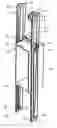
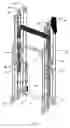
FIG. 1 is a diagram representing an elevator achieved by the invention,
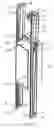
FIG. 2 is a diagram representing the elevator of FIG. 1 as seen from another angle,
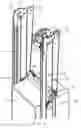
FIG. 3 is a diagram representing the elevator of FIGS. 1 and 2 as seen from a third angle,
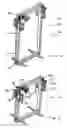
FIG. 4 presents a car supporting frame according to the invention, extended to a height at which the car can be installed in the frame,
FIG. 5 presents the car supporting frame of the invention in a collapsed form,
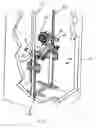
FIG. 6 presents the car supporting frame of the invention on the bottom of the shaft, and
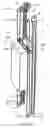
FIG. 7 is a diagrammatic representation of rope rigging implemented according to the invention.
FIGS. 1, 2 and 3 illustrate the structure of an elevator achieved by the invention. The elevator is preferably an elevator without machine room and with a drive machine 4 placed in the elevator shaft. The elevator presented in the figures is a traction sheave elevator without counterweight and with machine above, in which the elevator car 1 moves along guide rails 2. In FIGS. 1, 2 and 3, the hoisting ropes run as follows: One end of the hoisting ropes is fixed to a wheel of a smaller diameter comprised in a compensating gear functioning as a compensating device 8, said wheel being fixedly attached to a second wheel of a larger diameter comprised in the compensating gear 8. This compensating gear 8 functioning as a compensating device has been fitted to be fastened to the elevator shaft via a supporting element 7 immovably fixed to an elevator guide rail 2. The compensating gear is used, among other things, to adjust the difference of rope tension between the rope portions below and above the elevator car, or rather the mutual relationship between the rope tensions. From the compensating gear 8 wheel of smaller diameter, the hoisting ropes 3 go downwards to a diverting pulley 12 mounted on the elevator car, preferably on a beam 20 fitted in place in the upper part of the elevator car, and pass around the diverting pulley 12 along rope grooves provided in it. In the rope wheels used as diverting pulleys, these rope grooves may be coated or uncoated, e.g. with a friction-increasing material, such as polyurethane or some other appropriate material. From diverting pulley 12, the ropes go further upwards to a diverting pulley 19 in the elevator shaft, said pulley being mounted in place on the supporting element 7, via which the diverting pulley 19 is mounted in place on the elevator guide rail. Having passed around diverting pulley 19, the ropes go further downwards to a diverting pulley 14 which has also been fitted in place on a beam 20 fitted in place on the elevator car, preferably in the upper part of the elevator car. Having passed around diverting pulley 14, the rope goes further transversely relative to the elevator shaft and elevator car to a diverting pulley 15 mounted in place on the same beam 20 on the other side of the elevator car, and after passing around this diverting pulley the hoisting ropes go further upwards to a diverting pulley 10 mounted in place in the upper part of the elevator shaft. Diverting pulley 10 has been fitted in place on a supporting element 5. Via the supporting element 5, the diverting pulley is supported by the elevator guide rails 2. Having passed around diverting pulley 10, the hoisting ropes go further downwards to a diverting pulley 17 mounted on the elevator car 1 and also fitted in place on the beam 20. Having passed around diverting pulley 17, the hoisting ropes go further upwards to a diverting pulley 9 preferably mounted in place near the hoisting machine 4. Between diverting pulley 9 and the traction sheave 10, the figure shows Double Wrap (DW) roping. From diverting pulley 9, the hoisting ropes go further to the traction sheave 10 after first passing via diverting pulley 9 in “tangential contact” with it. This means that the ropes 3 going from the traction sheave 10 to the elevator car 1 pass via the rope grooves of diverting pulley 9 and the deflection of the rope 3 caused by the diverting pulley 9 is very small. It could be stated that the ropes 3 going from the traction sheave 10 only come into “tangential contact” with the diverting pulley 9. Such “tangential contact” functions as a solution for damping rope vibrations and it can also be applied in other roping solutions. The ropes pass over the traction sheave 10 of the hoisting machine 4 along the rope grooves on the traction sheave 10. From the traction sheave 10, the ropes 3 go further downwards to diverting pulley 9, passing around it along the rope grooves of the diverting pulley 9 and returning back up to the traction sheave 10, over which the ropes pass along the rope grooves of the traction sheave. From the traction sheave 10, the ropes 3 go further downwards in “tangential contact” with diverting pulley 9 past the elevator car 1 moving along the guide rails 2 to a diverting pulley 18 placed in the lower part of the elevator shaft. The hoisting machine and diverting pulley 9 are mounted in place on the supporting element 5, which in turn is fixed in place on the elevator guide rails 2. Diverting pulleys 12,19,14,15,10,17,9 and the wheel of smaller diameter comprised in the compensating gear 8 together with the traction sheave 10 of the hoisting machine 4 form the suspension above the elevator car, which has the same suspension ratio as the suspension below the elevator car, which in FIGS. 1, 2 and 3 has a suspension ratio of 6:1. The hoisting ropes pass around diverting pulley 18 along rope grooves provided on it, which has been fitted in place preferably in the lower part of the elevator shaft on a supporting element 6 fixed in place to an elevator guide rail 2. Having passed around diverting pulley 18, the ropes 3 go further upwards to diverting pulley 17 fitted in place on the elevator car and mounted on the beam 20, and having passed around said diverting pulley 17 the ropes go further downwards to a diverting pulley 16 in the lower part of the elevator shaft, which has been fitted in place on supporting element 6. Having passed around diverting pulley 16, the ropes return to diverting pulley 15 fitted in place on the elevator car, said pulley being mounted on the beam 20. From diverting pulley 15, the hoisting ropes 3 go further transversely across the elevator car to the diverting pulley 14 mounted in place on the beam 20 on the other side of the elevator car. Having passed around this diverting pulley, the ropes go further downwards to a diverting pulley 13 fitted in place in the lower part of the elevator shaft, said pulley being mounted in place on a supporting element 22, which supporting element 22 in turn has been fixed in place to the elevator guide rail 2. Having passed around diverting pulley 13, the ropes go further upwards to diverting pulley 12 fitted in place on the elevator car, said pulley being mounted on the beam 20. Having passed around diverting pulley 12, the ropes 3 go further downwards to a diverting pulley 11 mounted in place on a supporting element 22 in the lower part of the elevator shaft. Having passed around diverting pulley 11, the hoisting ropes 3 go further upwards to the compensating gear 8 mounted in place in the upper part of the shaft, the second end of the hoisting rope being fixed to the compensating gear 8 wheel of larger diameter. The compensating gear functioning as a compensating device 8 is mounted in place on supporting element 7. Diverting pulleys 18,17,16,15,14,.13,19,11 and the wheel of larger diameter in the compensating gear 8 functioning as a compensating device form the suspension below the elevator car, which has the same suspension ratio as the suspension above the elevator car, this suspension ratio being 6:1 in FIGS. 1, 2 and 3.
In FIGS. 1, 2 and 3, the compensating gear 8 consists of two wheel-like bodies, preferably wheels, of different diameters and immovably fixed to each other, which compensating gear 8 has been fitted in place on the supporting element 7, which again is mounted in place on the elevator guide rails 2. Of the wheel-like bodies comprised in the compensating gear 8, the wheel connected to the hoisting rope below the elevator car has a larger diameter than the wheel connected to the hoisting rope above the elevator car. The diameter ratio between the diameters of the wheels of the compensating gear defines the measured of the tensioning force acting on the hoisting rope and therefore also the force of compensation of the elongations of the hoisting rope and at the same time the magnitude of the rope elongation to be compensated. The use of a compensating gear 8 provides the advantage that this structure will compensate even very large rope elongations. By varying the size of the diameters of the wheels of the compensating gear 8, it is possible to exert an influence on the magnitude of the rope elongation to be compensated and on the ratio between the rope forces T1 and T2 acting over the traction sheave, which ratio can be standardized by the arrangement in question. Due to a large suspension ratio or a large hoisting height, the length of the rope used in the elevator is large. Therefore, it is essential for the operation and safety of the elevator that the hoisting rope portion below the elevator car is held under a sufficient tension and that the amount of rope elongation to be compensated is large. Often this can not be implemented using a spring or a simple lever. With odd suspension ratios above and below the elevator car, the compensating gear functioning as a compensating device in the elevator depicted in FIGS. 1, 2 and 3 has been fitted in place on the elevator car by means of a transfer gear, and with even suspension ratios the compensating gear functioning as a compensating device in the elevator of the invention has been fitted in place in the elevator shaft, preferably on the elevator guide rails. In the compensating gear 8 of the invention it is possible to use wheels, the number of which is two, but the number of wheel-like bodies used may vary, for example it is possible to use only one wheel with hoisting rope fixing points fitted on it at different positions regarding the diameter. It is also possible to use more than two wheels if it is desirable e.g. to vary the ratio between the diameters of the wheels by only changing the diameters of the wheels in the compensating gear. The elevator without counterweight presented in FIGS. 1, 2 and 3 is not provided with traditional springs for compensating the rope forces, but instead it uses a compensating gear 8 as a compensating device. Consequently, the ropes comprised in the set of hoisting ropes 3 can be secured directly to the compensating gear 8. Besides a compensating gear as presented in the figures, the compensating device of the invention may also consist of a suitable lever or other appropriate compensating device with several compensating wheels. The beam 20 presented in the figures which is fixed in place in conjunction with the elevator car may also be mounted elsewhere than in the place above the elevator car as shown in the figures. It may also be placed e.g. below the elevator car or somewhere between these positions. The diverting pulleys may have a plurality of grooves and the same diverting pulley can be used to guide both the passage of the hoisting ropes comprised in the suspension above the elevator car and the passage of the hoisting ropes comprised in the suspension below the elevator car, as illustrated e.g. in the figures in connection with diverting pulleys 12,14,15,17.
A preferred embodiment of the elevator of the invention is an elevator without counterweight and with machine above, which elevator has a drive machine with a coated traction sheave and thin hoisting ropes of a substantially round cross-section. The contact angle of the hoisting ropes on the traction sheave of the elevator is greater than 180°. The elevator comprises a unit comprising the drive machine, the traction sheave and a diverting pulley, all fitted in place by means of a supporting element, the diverting pulley being ready fitted in a correct angle relative to the traction sheave. This unit is secured to the elevator guide rails. The elevator is implemented without counterweight with a suspension ratio of 6:1. The compensation of rope forces and elongations is implemented using a compensating device according to the invention. The diverting pulleys in the elevator shaft are fitted in place by means of supporting elements on the elevator guide rails and the diverting pulleys on the elevator car are all mounted in place on the beam on the elevator car, said beam also forming a structure bracing the elevator car.
The elevator car 1 is suspended on the hoisting ropes via the beam 20 and the diverting pulleys mounted on the beam. The beam 20 is part of the load-bearing structure of the elevator car, which may be in the form of a self-supporting car or a framework of beams or the like joined or integrated to the elevator car. The elevator is preferably installed by first rigging the ropes and only then completing the elevator car, because some structures of the completed elevator car may impede installation. The floor 24 of the elevator car 1 can be initially placed as a working platform. The diverting pulleys in the upper part of the elevator shaft are mounted in place by utilizing the elevator car or otherwise. The diverting pulleys of the elevator car are hoisted together with the beam 20 to a distance from the floor 24 of the elevator car and the elevator car 1 is assembled by joining the walls 25 to the floor and mounting the beam 20 and the ceiling 23 in the upper part of the elevator car. After the hoisting ropes have been mounted on the diverting pulleys in the upper or lower part of the elevator shaft, the diverting pulleys in the upper part of the elevator shaft and on the elevator car, or respectively the diverting pulleys in the lower part of the elevator shaft and on the elevator car, can be moved further away from each other while at the same time supplying more rope into the elongating roping, whereupon the rope portions in the other end of the shaft are rigged.
FIG. 7 illustrates how the ropes of an elevator implemented according to the invention are passed over different diverting pulleys and rope pulleys of the hoisting machine, and FIGS. 4, 5 and 6 show the car supporting frame 30, which in FIG. 4 is presented in a length in which the car can be installed inside the frame while FIG. 5 presents it in a collapsed or lower form that makes the frame easy to transport, as far as the frame is transported as a complete assembly, with diverting pulleys mounted on it, allowing the ropes to be easily passed to them. FIGS. 4 and 5 do not show the diverting pulleys in the upper and lower parts of the elevator shaft. FIG. 6 presents the car supporting frame in a situation where the frame is on the bottom of the elevator shaft 31. The car supporting frame is provided with guides 32, by means of which the car is positioned and controlled as it is moving vertically along the elevator guide rails 33. The upper part 34 and lower part 35 of the car supporting frame are telescopically joined together by beam sections 36 and 37 of the side beams of the car frame. The telescopic or otherwise variable-length joining together of the upper and lower parts can also be implemented in other ways. The car supporting frame is provided with diverting pulleys intended for the suspension of the elevator car on the ropes, comprising a first set of diverting pulleys 38, from which the ropes of the set of hoisting ropes go upwards, and a second set of diverting pulleys 39, from which the ropes of the set of hoisting ropes go downwards. FIG. 6 shows the diverting pulleys 42 to be installed in the upper part of the shaft but which are temporarily mounted on the car supporting frame, the hoisting machine 40 with a traction sheave (not shown) and preferably an auxiliary diverting pulley 41, which allows the roping on the machine to be implemented as so-called Double Wrap roping or the contact angle between the traction sheave and the ropes to be changed in other ways, and the diverting pulleys 43 to be installed in the lower part of the elevator shaft. Attached to the car frame are preferably other parts of the car, such as the car floor, which can thus be used as a working platform. In conjunction with the car frame or separately from it, the required amount of hoisting rope for the set of hoisting ropes is delivered on reels to the elevator shaft or to a place near it. The reels are not shown in the figure. In FIG. 7, the set of hoisting ropes 44 is depicted diagrammatically as a single rope with arrowheads indicating the passage of the rope, starting from the rope end fixing point 45 in the lower part of the shaft and finally ending up at a rope force differentiating arrangement 46, which consists of a tackle system designed to maintain the relative rope tension difference between the rope portions above and below the elevator car. The rope force differentiating arrangement can also be implemented in other ways, which may involve a different solution regarding the fixing of the rope ends. Starting from the fixing point 45, the ropes go first to a rope wheel comprised in the differentiating arrangement 46, then continuing first to the diverting pulley 43 in the lower part of the shaft, from where the rope goes further to a down-direction diverting pulley 39 of the car and further, passing one by one over the diverting pulleys in the lower part of the shaft and the down-direction diverting pulleys of the car, until from the last diverting pulley in the lower part of the shaft the ropes go up to the machine 40. From the machine 40, the ropes run further to the first up-direction diverting pulley 38 of the car, passing by turns over the diverting pulleys 42 in the upper part of the shaft and each up-direction diverting pulley 38 until from the last diverting pulley in the upper part of the shaft the ropes terminate at the differentiating arrangement 46.
It is obvious to the person skilled in the art that different embodiments of the invention are not limited to the examples described above, but that they may be varied within the scope of the claims presented below. For example, the number of times the hoisting ropes are passed between the diverting pulleys in the upper part of the elevator shaft and those on the elevator car and between the diverting pulleys in the lower part of the elevator shaft and those on the elevator car is not a very decisive question as regards the basic advantages of the invention, although it is possible to achieve some additional advantages by using multiple and even numbers of rope portions. It is also obvious to the skilled person that an embodiment according to the invention can also be implemented using odd suspension ratios above and below the elevator car, in which case the compensating device is mounted in conjunction with the elevator car or its structures. In accordance with the examples described above, a skilled person can vary the embodiment of the invention as the traction sheaves and rope pulleys, instead of being coated metal pulleys, may also be uncoated metal pulleys or uncoated pulleys made of some other material suited to the purpose.
It is further obvious to the person skilled in the art that the metallic traction sheaves and rope wheels used as diverting pulleys in the invention, which are coated with a non-metallic material at least in the area of their grooves, may be implemented using a coating material consisting of e.g. rubber, polyurethane or some other material suited to the purpose.
It is also obvious to the person skilled in the art that the elevator car and the machine unit may be laid out in the cross-section of the elevator shaft in a manner differing from the lay-out described in the examples. The skilled person also understands that ‘elevator car’ may refer to a self-supporting car structure, an assembly consisting of an elevator car and a car supporting frame, or also a car structure mounted inside a car supporting frame.
It is obvious to the skilled person that an elevator applying the invention may be equipped differently from the examples described above. It is further obvious to the skilled person that the elevator of the invention can be implemented using as hoisting ropes almost any flexible hoisting means, e.g. a flexible rope of one or more strands, a flat belt, a cogged belt, a trapezoidal belt or some other type of belt suited to the purpose.
It is further obvious to the skilled person that the elevator of the invention may also be provided with a counterweight, in which case the counterweight of the elevator preferably has a weight below that of the car and is suspended by a separate set of ropes. The skilled person understands that a regular elevator shaft surrounding the elevator car from all sides is not strictly necessary for the elevator, provided that sufficient safety and protection of the technical parts are achieved.
Claims
1. A method for installing an elevator, preferably an elevator without counterweight, in which method the elevator to be installed comprises a number of diverting pulleys in the upper part of an elevator shaft or equivalent, a number of diverting pulleys in the lower part of an elevator shaft or equivalent and a number of diverting pulleys on an elevator car, wherein
the elevator car or a partially completed elevator car is parked in the upper part of the elevator shaft,
the rope portions of the hoisting ropes between the elevator car and the diverting pulleys in the upper part of the elevator shaft are rigged so that they pass via the diverting pulleys in the upper part of the elevator shaft and the upwards-directed diverting pulleys on the elevator car,
the elevator car or the partially completed elevator car is moved to the lower part of the elevator shaft while at the same time supplying ropes from rope reels into the hoisting rope portions between the elevator car and the upper part of the elevator shaft, said rope portions becoming longer due to the movement,
the rope portions of the hoisting ropes between the elevator car and the diverting pulleys in the lower part of the elevator shaft are rigged so that they pass via the diverting pulleys in the lower part of the elevator shaft and the downwards-directed diverting pulleys on the elevator car.
2. A method for installing an elevator, preferably an elevator without counterweight, in which method the elevator to be installed comprises a number of diverting pulleys in the upper part of an elevator shaft or equivalent, a number of diverting pulleys in the lower part of an elevator shaft or equivalent and number of diverting pulleys on an elevator car, wherein
the elevator car or a partially completed elevator car is parked in the lower part of the elevator shaft,
the rope portions of the hoisting ropes between the elevator car and the diverting pulleys in the lower part of the elevator shaft are rigged so that they pass via the diverting pulleys in the lower part of the elevator shaft and the downwards-directed diverting pulleys on the elevator car,
the elevator car or the partially completed elevator car is moved to the upper part of the elevator shaft while at the same time supplying ropes from rope reels into the hoisting rope portions between the elevator car and the lower part of the elevator shaft, said rope portions becoming longer due to the movement,
the rope portions of the hoisting ropes between the elevator car and the diverting pulleys in the upper part of the elevator shaft are rigged so that they
pass via the diverting pulleys in the upper part of the elevator shaft and the upwards-directed diverting pulleys on the elevator car,
3. A method according to claim 1, wherein the car guide rails of the elevator are installed before the rigging of the hoisting ropes.
4. A method according to claim 1, wherein the car guide rails of the elevator are installed by utilizing the elevator car or a structure
comprising parts of the elevator car, e.g. a partially completed elevator car.
5. A method according to claim 3, wherein, in the method, the lowest car guide rail sections are installed in the elevator shaft first, whereupon an elevator car or car blank formed from the structure comprising parts of the elevator car is mounted in place so that it can be guided by the car guide rails, the elevator car or blank is raised by means of a hoist in the elevator shaft and the rest of the car guide rails are installed by working from a working platform formed in the elevator car, e.g. from the top of the elevator car.
6. A method according to claim 1, wherein the diverting pulleys for the upper part of the elevator shaft are hoisted to the upper part of the elevator shaft by utilizing the elevator car or the structure comprising parts of the elevator car.
7. A method according to any claim 1, wherein the drive machine of the elevator is hoisted to the upper part of the elevator shaft or equivalent together with the diverting pulleys for the upper part of the elevator shaft and mounted in place and that the ropes are mounted on the traction sheave of the drive machine while the elevator car is standing parked to allow the diverting pulleys in the upper part of the elevator shaft to be rigged.
8. A method according to claim 1, wherein the diverting pulleys in the upper part of the elevator shaft and preferably also those in the lower part of the elevator shaft are mounted on the guide rails or the mountings of said pulleys are connected via supporting elements to the guide rails.
9. An elevator installed according to claim 1.
10. An elevator according to claim 9, wherein the elevator has a telescopic car supporting frame.
Images & Drawings included:
Sources:
- United States Patent and Trademark Office - verify current appl. status at the USPTO↗
Similar patent applications:
- » 10864131
Elevator installation, a method of operating this elevator installation, and method of modernizing an elevator installation - » 20250128914
APPARATUS FOR MEASURING A FORCE ON AN ELEVATOR INSTALLATION, METHOD FOR CHECKING BALANCING OF AN ELEVATOR INSTALLATION, AND AN ELEVATOR INSTALLATION FOR IMPLEMENTING THE METHOD - » 20080017457
MOUNTING SLIDE INSERT FOR USE IN A GUIDE SHOE OF AN ELEVATOR INSTALLATION, METHOD FOR PLACING AN ELEVATOR INSTALLATION INTO OPERATION, AND CORRESPONDING MOUNTING SET AND AN ASSOCIATED ELEVATOR INSTALLATION - » 10300497
System for security control and/or transportation of persons with an elevator installation, method of operating this system, and method of retrofitting an elevator installation with this system - » 20210309490
Elevator car, elevator installation, method for operating an elevator system and door drive - » 20080116014
ELEVATOR INSTALLATION WITH A BELT, BELT FOR SUCH AN ELEVATOR INSTALLATION, METHOD OF PRODUCING SUCH A BELT, COMPOSITE OF SUCH BELTS AND METHOD FOR ASSEMBLY OF SUCH A COMPOSITE IN AN ELEVATOR INSTALLATION - » 20100287876
Method for installing an elevator and method for installing the guide rails of an elevator - » 20190248624
ELEVATOR INSTALLATION METHOD AND APPARATUS - » 20060201750
Elevator apparatus drive unit, elevator apparatus, elevator apparatus installation method, and elevator apparatus maintenance inspection method - » 20250270068
ELEVATOR INSTALLATION METHOD AND APPARATUS
Recent applications in this class:
- » 20090250298 2009-10-08
Set of elevators and method for controlling a set of elevators - » 20090229923 2009-09-17
Traction sheave elevator without counterweight - » 20080041666 2008-02-21
Set of elevators with common control system and method for controlling a set of elevators with common control system - » 20070012524 2007-01-18
Elevator without a counterweight - » 20060243540 2006-11-02
Elevator - » 20050284705 2005-12-29
Elevator - » 20050224301 2005-10-13
Elevator - » 20050217944 2005-10-06
Elevator cable tensioning device
Recent applications for this Assignee:
- » 20250289687 2025-09-18
METHOD OF INSTALLING ROPES OF AN ELEVATOR AND ARRANGEMENT THEREFOR - » 20250263269 2025-08-21
ELEVATOR CAR MOVEMENT MONITORING SYSTEM AND A METHOD FOR MONITORING ELEVATOR CAR MOVEMENT - » 20250256941 2025-08-14
CONTROLLING AN ENERGY SAVING MODE OF AN ELEVATOR - » 20250239664 2025-07-24
SOLUTION FOR CONTROLLING A SUPPLY OF ELECTRICAL ENERGY TO AN ELEVATOR SYSTEM FROM A BATTERY SYSTEM - » 20250238769 2025-07-24
PROVISION OF MAINTENANCE DATA - » 20250238287 2025-07-24
METHOD, AN ARRANGEMENT AND A PEOPLE CONVEYOR AND/OR AN ACCESS GATE SYSTEM FOR HANDLING APPLICATION PROGRAMMING INTERFACE REQUESTS - » 20250236489 2025-07-24
ELEVATOR CAR AND ELEVATOR - » 20250236488 2025-07-24
ELEVATOR SAFETY APPARATUS AND ELEVATOR WITH SAID SAFETY APPARATUS - » 20250236487 2025-07-24
LOAD MEASUREMENT ARRANGEMENT OF AN ELEVATOR AND A METHOD - » 20250230013 2025-07-17
ELEVATOR CALL ALLOCATION