Method and device for multi-user detection with simplified de-correlation in a CDMA system
US20060246837A1
2006-11-02
10/540,692
2003-12-29
✅ Patent granted
US 7,433,687 B2
2008-10-07
WO; PCT/IB03/06246; 20031229
WO; WO2004/059863; 20040715
Tan Trinh
2024-07-02
Abstract:
A simplified de-correlation method in CDMA multi-user detection comprises: a. receive wireless symbols S; b. obtain a channel correlation matrix R, take a part from R to get a partial correlation matrix RP; c. do inversion operation to the partial correlation matrix RP, then obtain matrix V(m); d. recover original data symbols D from received symbols S by V(m) that the location of original data symbols D corresponds to.
Inventors:
- Jingxin LIANG 6 🇨🇳 Shanghai, China
- Xiaojun Yin 6 🇨🇳 Shanghai, China
- Zhiyu Zhang 2 🇨🇳 Shanghai, China
- Jiangxin Liang 1 🇨🇳 Shanghai, China
Assignee:
- NXP B.V. 5,639 🇳🇱 Eindhoven, Netherlands
Interested in similar patents?
Get notified when new applications in this technology area are published.
Classification:
H04B1/71052 » CPC main
Details of transmission systems, not covered by a single one of groups - ; Details of transmission systems not characterised by the medium used for transmission; Spread spectrum techniques using direct sequence modulation; Interference-related aspects the interference being multiple access interference; Joint detection techniques, e.g. linear detectors using decorrelation matrix
H04B2201/70707 » CPC further
Indexing scheme relating to details of transmission systems not covered by a single group of - ; Orthogonal indexing scheme relating to spread spectrum techniques in general relating to direct sequence modulation Efficiency-related aspects
H04B1/00 IPC
Details of transmission systems, not covered by a single one of groups - ; Details of transmission systems not characterised by the medium used for transmission
Description
FIELD OF THE INVENTIONThe invention relates to a de-correlation method and relative device in CDMA, especially relates to a simplified de-correlation method and relevant device in TD-SCDMA multi-user detection.
BACKGROUND OF THE INVENTION Under the collective influence of channel multi-path dispersion, Inter-Symbol Interference and Multiple Access Interference, it becomes a key of that the multi-user detection is practical or not, that how to depress the complexity of the multi-user detection cancellation algorithm, namely the de-correlation method, to acceptable degree. A received symbol vector can be expressed as the sum of a noise vector and the product that a transmitted symbol vector D left multiply by a channel correlation matrix R. Among the algorithm of demodulating the received symbol vector and getting the estimation {circumflex over (D)} of the transmitted symbol, the most complex step is getting the inverse matrix R−1 of the channel correlation matrix R. For example, usually existing technology adopts the following method: in downlink spreading factor is SF=16. Assuming there are K users in one time slot and 1≦K≦16, in each of the data part, there are K*N data symbols altogether, each user has N=22 data symbols. Let the nth transmitted data symbols of all the K users be
D(n)=(d1(n),d2(n),d3(n), . . . dk(n)), n=1, . . . ,K (1)
The symbol sequence of each user consists of N elements with intervals Ts. The elements are taken from a complex alphabet (1,j,−1,−j). Each data symbols of user K is multiplied by the user specific signature sequence. The specific signature sequence is expressed as:
C(k)=(c1(k), c2(k), . . . , cQ(k))T, k=1, . . . ,K (2)
Here [·]T means vector/matrix transposition. The user specific signature sequence consists of Q chips at chip interval T c that is equal to Ts/Q. Each of the K channels is characterized by its discrete impulse response. The discrete impulse response of the kth channel is expressed as:
H(k)=(h1(k), h2(k), . . . , hw(k))T, k=1, . . . ,K (3)
The discrete impulse response consists of W samples at chip rate interval Tc. The channel impulse response is assumed to be unchanged during one time slot.
It is very obviously that ISI arises when W>1, at one time, MAI arises due to channel distortion and non-orthogonal symbol C(k). The combined channel impulse response is defined by the convolution:
B(k)=(b1(k),b2(k), . . . ,bQ+W−1(k))T=C(k)*H(k), k=1, . . . ,K (4)
The received sequence e is obtained at the chip rate. It is a sum of K sequences, each of length (N·Q+W−1), that are assumed to be arrive synchronously, perturbed by an noise sequence with same length:
n=(n1,n2, . . . , nN·Q+W−1)T (5)
The received sequence can be written as
e=(e1, e2, . . . eN·Q+W−1)T=A·D+n (6)
With transmitted data vector
D=(D(1), D(2), . . . , D(N))T={d1(1),d2(1), . . . dK(1), . . . d1(n),d2(n), . . . d1(N),d2(N), . . . ,dK(N)}T=(d1, d2, . . . , dKN)T (7)
Where d1(n), d2(n), . . . dk(n) is the nth symbol of all the K users, and
djdef=dk(n); j=k+K·(n−1), k=1, . . . K, n=1 . . . N (8)
With the matrix A = ( a ij ) ; i = 1 … ( N · Q + W - 1 ) , j = 1 … K · N a Q ( n - 1 ) + 1 , k + K ( n - 1 ) = { B l ( k ) , when { n = 1 … N , k = 1 … K 1 = 1 … ( Q + W - 1 ) 0 , other ( 9 )
The received sequence e has to be processed to obtain a decision on the transmitted data symbol D under the assumption that the user-specific signature sequences C(k) and the channel cross-correlation H(k), k=1 . . . K are known at receivers.
At the same time zero-forcing method is used to eliminate MAI and ISI. It is based on minimizing
∥A{circumflex over (D)}−e∥2 (10)
Here {circumflex over (D)} is the estimation of transmitted symbols of all the K users. So
{circumflex over (D)}=(AHA)−1AHe=D+(AHA)−1AHn (11)
Here [·]H means Hermit transposition and AH e is the output of match filter, (AHA)−1AHn is noise term. Above {circumflex over (D)} contains desired output D and noise, without MAT and ISI. Its covariance matrix δ2(AHA)−1 gives the correlation of the noise term. Generally, the variance of the noise term is more than the noise term which is obtained because of using match filter method. The SNR per-symbol at the output of the de-correlation is equal to
γ(k, n)=/δ2[(AHA)−1]i,jj=n+N·(k−1), k=1 . . . K, n=1 . . . N (12)
Let
R=AHA (13)
Then (Eq.11) becomes
{circumflex over (D)}=(R)−1(RD+AHn)=D+(R)−1AHn (14)
Because the difficulty exists in the matrix inversion operation of R, the calculation burden in TD-SCDMA system is bigger.
SUMMARY OF THE INVENTIONThe invention wants to resolve the technical problem that provides a simplified de-correlation method to greatly reduce the complexity degree in multi-user detection calculation.
For resolving above problem, the invention adopts following technical project:
Provided de-correlation contains following steps:
a: Receive wireless symbols S;
b: Obtain a channel correlation matrix R, take one part from R and get a partial correlation matrix RP;
c: Do inversion operation of the partial correlation matrix RP to obtain matrix V(m);
d: Recover transmitted data symbols D respectively from received symbols S according to V(m) that the corresponding location of the transmitted data symbols D corresponds to.
The advice according to above method includes
relative calculation advice to define the partial correlation matrix RP;
matrix inversion device and drawing out device to define new matrix V(m);
matrix-vector multiplication to multiply received wireless symbols S by said matrix V(m), which are connect each with other in turn.
Based on the character of channel correlation matrix, the invention has de-modulated only according to the inverse matrix of the diagonal partial matrix Rp of the correlation matrix R so as to reduce greatly the calculation in obtaining inverse matrix and reduce the loss of de-modulate performance. Assuming p=2, the most delay-time is 4 chips, multi-path is 4, when total users are 12, the performance is same as the un-simplified. Because the calculation complexity of the matrix with size M*M is directly proportional to the M3, so when P=22, N=22, the simplified inversion has only (5/22)3 times calculation complexity of the original un-simplified matrix inversion. This is quite a great reduction. Equally, in the symbol recover calculation, the complexity is also reduced to (5/22) of the original operation.
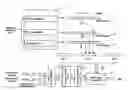
BRIEF DESCRIPTION OF THE DRAWING FIGURESFIG. 1. is adopted advice according to the simplified de-correlation method of the invention.
DETAILED DESCRIPTION OF THE INVENTIONOriginal transmitted data symbol can be expressed as
D=[ . . . d1(n−p), d2(n−p), . . . , dk(n−p), . . . , d1(n), d2(n) . . . , dk(n) . . . , d1(n+p), d2(n+p), . . . ,dk(n+p) . . . ]
Above d1(n−p), d2(n−p), . . . , dk(n−p) means (n−p)th symbol of all K users. Above d1(n), d2(n) . . . , dk(n) means nth symbol of all K users. Above d1(n+p), d2(n+p), . . . , dk(n+p) means (n+p)th symbol of all K users.
Received symbol S can be expressed as
S=[ . . . ŝ1(n−p), ŝ2(n−p), . . . , ŝkn−p), . . . , ŝ1(n), ŝ2(n) . . . , ŝk(n) . . . , ŝ1(n+p), ŝ2(n+p), . . . , ŝk(n+p) . . . ]. Above ŝ1(n−p), ŝ2(n−p), . . . , ŝk(n−p) means (n−p)th symbol of all K users. Above ŝ1(n), ŝ2(n) . . . , ŝk(n) means nth symbol of all K users. Above ŝ1(n+p), ŝ2(n+p), . . . , ŝk(n+p) means (n+P)th symbol of all K users. Let us define ŝ1(n), ŝ2(n) . . . , ŝk(n) as S(n). Since the multi-path spread in TD-SCDMA is assumed to be less than 12 chips, and the spreading factor for downlink is 16, so there are no ISI from symbols more than 2 symbols away. Also the MAI and ISI part from any particular other user symbol is always much less than desired user symbol amplitude. To recover D(n)=d1(n), d2(n) . . . , dk(n), influence from symbols in S(t) (t<n−p, or t>n+p) can be neglected. It means D(n) can be recovered from received symbols
Sp(n)=[ŝ1(n−p), ŝ2(n−p), . . . , ŝk(n−p), . . . , ŝ1(n), ŝ2(n) . . . , ŝk(n) . . . , ŝ1(n+p), ŝ2(n+p), . . . , ŝk(n+p)]. Above ŝ1(n−p), ŝ2(n−p), . . . , ŝk(n−p) means (n−p)th symbol of all K users. Above ŝ1(n), ŝ2(n) . . . , ŝk(n) means nth symbol of all K users. Above ŝ1(n+p), ŝ2(n+p), . . . , ŝk(n+p) means (n+p)th symbol of all K users. Assume P is large enough.
We here define a partial correlation matrix
Rp={ri,j}, i,j=1 . . . (2P+1)K
Here ri,j is the element of R in the ith row and jth column.
Define a new matrix V(m)={vi,j(m)}
vi,j(m)=(R−1p)i+(m−1)K,j, i=1 . . . K, j=1 . . . (2P+1)K, m=1 . . . 2P+1
Here R−1p means matrix inversion. When P+1≦n≦N−P, D(n) can be recovered as
{circumflex over (D)}(n)=V(P+1)Sp(n)
{circumflex over (D)}(n) is the estimation of transmitted symbol. When n≦P, i.e. the interference symbol before D(n) is less than P, D(n) can be recovered as
{circumflex over (D)}(n)=V(n)Sp(n).
Here Sp(n) is defined as
Sp(n)=[ŝ1(1), ŝ2(1), . . . , ŝK(1), . . . , ŝ1(n), ŝ2(n) . . . , ŝK(n) . . . , ŝ1(2P+1), ŝ2(2P+1), . . . ,ŝK(2P+1)].
Above ŝ1(1), ŝ2(1), . . . , ŝk(1) is first symbol of all K users. Above ŝ1(n), ŝ2(n) . . . , ŝk(n) is nth symbol of all K users. Above ŝ1(2P+1), ŝ2(2P+1), . . . , ŝk(2P+1) is 2P+1th symbol of all K users.
When n≧N+1−P, and the interference symbols after D(n) is less P, D(n) can be recovered as
{circumflex over (D)}(n)=V(2P+1+n−N)Sp(n).
Here Sp(n) is defined as
Sp(n)=[ŝ1(N−2P), ŝ2(N−2P), . . . ,ŝk(N−2P), . . . , ŝ1(n),ŝ2(n) . . . ,ŝk(n) . . . ,ŝ1(N),ŝ2(N), . . . ,ŝk(N)].
Above ŝ1(N−2P), ŝ2(N−2P), . . . , ŝK(N−2P) is N−2Pth symbol of all K users. Above ŝ1(n), ŝ2(n) . . . , ŝK(n) is nth symbol of all K users. Above ŝ1(N), ŝ2(N), . . . , ŝK(N)], is Nth symbol of all K users.
In addition, the simplified de-correlation method can be named as partial de-correlation whose meaning is that use de-correlation method to eliminate the influence of the symbols which are earlier or later than the current on current symbols only according to P group of symbols which are earlier or later than current symbols.
FIG. 1 is the structure sketch map of the adopted advice according to the simplified de-correlation method.
It includes K match filters 1, K buffer storage 2 which are correspondingly connected with K match filters, relative calculation device 3 to define partial correlation matrix Rp, matrix inversion device 4 and drawing out device 5 which tag after the relative calculation device to define new matrix V(m). The output of the mentioned buffer storage 2 and the output of the drawing out device 3 are connected with the input of the matrix-vector multiplication 6.
The mentioned baseband symbols of K users respectively are inputted to K match filters 1 and K buffer storage 2 to get received symbol Spn. 1 and 2 are connected with each other correspondingly The mentioned user signature sequence C(k)=(c1(k),c2(k), . . . CQ(k))T, channel impulse response H(1),H(2), . . . ,H(k), channel specific multiplication factor is respectively inputted to the relative calculation device 3 to obtain partial correlation matrix, then obtain the inverse matrix V of matrix Rp through matrix inversion device 4 and drawing out device 5, and draw out partial matrix V(m) from it. Through matrix vector multiplication 6 symbol estimation value {circumflex over (D)}(n) can be obtained from mentioned received symbol Sp(n) and V(m).
The present invention is not restricted to above advice and method, so all the technical changes known by ordinary technician of the present fields should fall into the protective scope of the present invention.
Claims
What is claimed is:1. A simplified de-correlation method in TD-SCDMA multi-user detection characterised in that is comprises:
a. Receive wireless symbols S;
b. Obtain a channel correlation matrix R, take one part from R and get a partial correlation matrix RP;
c. Do inversion operation to the partial correlation matrix RP, then obtain matrix V(m);
d. Recover original data symbols D from received symbols S by V(m) that the to location of original data symbols D corresponds to.
2. A simplified de-correlation method in TD-SCDMA multi-user detection of claim 1, characterised in that said partial correlation matrix RP={ri,j}, i,j=1 . . . (2P+1)K, said partial correlation matrix RP is submatrix of channel correlation matrix R on diagonal, said K is the user number in one time slot, wherein said P is the symbols number earlier than or latter than current symbols and have influence to current symbols.
3. A simplified de-correlation method in TD-SCDMA multi-user detection of claim 2, characterised in that said V(m)={vi,jm}, wherein
vi,j(m)=(RP−1)1+(m−1)K,j, i=1 . . . K,j=1 . . . (2P+1)K,m=1 . . . 2P+1
4. A simplified de-correlation method in TD-SCDMA multi-user detection of claim 1, characterised in that the location of original data symbols D have three situation:
1) when 1≦n≦P, V(m)=V(n), D(n) can be recovered as {circumflex over (D)}(n)=V(n)SP(n)
2) when P+1≦n≦N−P, V(m)=V(P+1), D(n) can be recovered as {circumflex over (D)}(n)=V(P+1)SP(n)
3) when N+1−P≦n≦N, V(m)=V(2P+1+n−N), D(n) can be recovered as {circumflex over (D)}(n)=V(2P+1+n−N)SP(n), said {circumflex over (D)}(n) is the estimation of original symbol, said n is location of chip.
5. A simplified de-correlation method in TD-SCDMA multi-user detection of claim 1, characterised in that:
When P+1≦n≦N−P, received wireless symbols S can be defined as
S P ( n ) = ( s ⋒ 1 ( n - P ) , s ⋒ 2 ( n - P ) , … , s ⋒ K ( n - P ) ︸ n - P th symbols of all K users , … , s ⋒ 1 ( n ) , s ⋒ 2 ( n ) , … , s ⋒ K ( n ) ︸ n th symbols of all K users , … , s ⋒ 1 ( n + P ) , s ⋒ 2 ( n + P ) , … , s ⋒ K ( n + P ) ︸ n + P th symbols of all K users ) ,
wherein, said ŝ1(n−P), ŝ2(n−P), . . . , ŝk(n−P) is (n−P)th symbols of all K users, said ŝ1(n), ŝ2(n), . . . , ŝk(n) is (n)th symbols of all K users, said ŝ1(n+p),ŝ2(n+p), . . . ,ŝk(n+p) is (n+P)th symbols of all K users;
When 1≦n≦P, received wireless symbols S can be defined as
S P ( n ) = ( s ⋒ 1 ( 1 ) , s ⋒ 2 ( 1 ) , … , s ⋒ K ( 1 ) ︸ 1 st symbols of all K users , … , s ⋒ 1 ( n ) , s ⋒ 2 ( n ) , … , s ⋒ K ( n ) ︸ n th symbols of all K users , … , s ⋒ 1 ( 2 P + 1 ) , s ⋒ 2 ( 2 P + 1 ) , … , s ⋒ K ( 2 P + 1 ) ︸ 2 P + 1 th symbols of all K users )
Here, said ŝ1(l),ŝ2(l), . . . ,ŝk(l) is 1th symbols of all K users, said ŝ1(n),ŝ2(n), . . . ,ŝk(n) is (n)th symbols of all K users, said ŝ1(2P+1),ŝ2(2P+1), . . . ,ŝk(2P+1) is 2P+1th symbols of all K users;
When N+1−P≦n≦N, received wireless symbols S can be defined as
S P ( n ) = ( s ⋒ 1 ( N - 2 P ) , s ⋒ 2 ( N - 2 P ) , … , s ⋒ K ( N - 2 P ) ︸ N - 2 P th symbols of all K users , … , s ⋒ 1 ( n ) , s ⋒ 2 ( n ) , … , s ⋒ K ( n ) ︸ n th symbols of all K users , … , s ⋒ 1 ( N ) , s ⋒ 2 ( N ) , … , s ⋒ K ( N ) ︸ N th symbols of all K users )
wherein, said ŝ1(N−2p),ŝ2(N−2p), . . . ,ŝk(N−2p), is N−2pth symbols of all K users, said ŝ1(n),ŝ2(n), . . . ,ŝk(n), is nth symbols of all K users, and said ŝ1(N),ŝ2(N), . . . ,ŝk(N),is Nth symbols of all K users.
6. A simplified de-correlation method in TD-SCDMA multi-user detection of claim 2, characterised in that said 1≦K≦16.
7. A simplified de-correlation method in TD-SCDMA multi-user detection of claim 2, characterised in that said P is integer, said N is 22.
8. A simplified de-correlation method in TD-SCDMA multi-user detection of claim 7, characterised in that said P is 2.
9. A UE system in TD-SCDMA characterised in that is comprises:
a correspond calculate equipment to define the partial correlation matrix RP;
a draw out and inversed matrix equipment to define new matrix V(m); and
a matrix-vector multiplication to multiply received wireless symbols S by said matrix V(m);
10. A UE system in TD-SCDMA of claim 9 characterised in that is also comprises K matching filters and K buffer storages which connected correspond to said matching filter one by one.
Images & Drawings included:




Sources:
- United States Patent and Trademark Office - verify current appl. status at the USPTO↗
Recent applications in this class:
- » 20130301687 2013-11-14
Symbol-level code-specific joint detection for CDMA receivers - » 20120257548 2012-10-11
ACTIVE CODE SELECTION FOR JOINT-DETECTION BASED TDSCDMA RECEIVER - » 20120163512 2012-06-28
PROCESSING NODES AND METHODS OF ESTIMATING INTERFERENCE IN A RADIO TELECOMMUNICATION NETWORK - » 20100278217 2010-11-04
Method and system for multi-user detection using two-stage processing - » 20100278035 2010-11-04
Method and system for multi-user detection using two-stage processing - » 20100254436 2010-10-07
Method and arrangement for improved G-RAKE scaling parameter estimation - » 20090268786 2009-10-29
Mobile communication system and wireless apparatus to be used for the same - » 20090225815 2009-09-10
Communication system with receivers employing generalized two-stage data estimation - » 20090129447 2009-05-21
Efficient joint detection - » 20090046692 2009-02-19
Method for receiving communication signals having differing spreading factors
Recent applications for this Assignee:
- » 20250190319 2025-06-12
METHOD AND SYSTEM TO DELAY A RESPONSE ASSOCIATED WITH A BUS TRANSACTION THAT IS TRANSMITTED TO A BUS MASTER TO PERFORM FAULT TESTING - » 20250165739 2025-05-22
RADIO FREQUENCY VOLTAGE LIMITER FOR AN RFID TRANSPONDER - » 20250119329 2025-04-10
METHOD AND DEVICE FOR DETECTING PROXIMITY OF AN EXTERNAL RF FIELD DURING ONGOING RF ACTIVITY OF THE DEVICE - » 20250119118 2025-04-10
TRANSFORMER FILTER WITH NOTCH - » 20250085344 2025-03-13
APPARATUSES AND METHODS FOR FACILIATATING A DYNAMIC CLOCK FREQUENCY FOR AT-SPEED TESTING - » 20250080342 2025-03-06
LOW-MEMORY MASKED DILITHIUM WITH ALTERNATIVE SIGNING ALGORITHM - » 20250077108 2025-03-06
Method for proving erasure of a memory - » 20250061239 2025-02-20
METHODS AND SYSTEMS FOR MULTI-MODAL SECURITY ACCESS CONTROL BASED ON DETAILS OF SECURITY CIRCUMSTANCES - » 20250023475 2025-01-16
SWITCHING REGULATOR - » 20250015814 2025-01-09
INTER-SYMBOL INTERFERENCE COMPENSATION FOR ANALOG-TO-DIGITAL CONVERTER