Stabilization of amrubicin hydrochloride
US20060247185A1
2006-11-02
11/475,882
2006-06-28
✅ Patent granted
US 8,030,283 B2
2011-10-04
-
-
Brandon Fetterolf | Shirley V Gembeh
2026-06-28
Abstract:
A stabilized amrubicin hydrochloride composition which comprises 3 to 8 wt. % water and 92 to 97 wt. % amrubicin hydrochloride; and a method of storing amrubicin hydrochloride.
Inventors:
- Kazuhiko Takahashi 1 🇯🇵 Takatsuki-shi, Japan
- Koji Fujimoto 2 🇯🇵 Kitakatsuragi-gun, Japan
- Yasuko Yamauchi 1 🇯🇵 Toyonaka-shi, Japan
- Kazuhiko Takahashi 2 🇯🇵 Takatsuki, Japan
- Yasuko Yamauchi 2 🇯🇵 Toyonaka, Japan
Assignee:
- Dainippon Sumitomo Pharma Co., Ltd. 12 🇯🇵 Osaka-Fu, Japan
Interested in similar patents?
Get notified when new applications in this technology area are published.
Classification:
C07H15/252 » CPC main
Compounds containing hydrocarbon or substituted hydrocarbon radicals directly attached to hetero atoms of saccharide radicals; Carbocyclic rings; Condensed ring systems having three or more rings Naphthacene radicals, e.g. daunomycins, adriamycins
A61P35/00 » CPC further
Antineoplastic agents
A61K31/704 IPC
Medicinal preparations containing organic active ingredients; Carbohydrates; Sugars; Derivatives thereof; Compounds having saccharide radicals attached to non-saccharide compounds by glycosidic linkages attached to a carbocyclic compound, e.g. phloridzin attached to a condensed carbocyclic ring system, e.g. sennosides, thiocolchicosides, escin, daunorubicin
C07H15/24 IPC
Compounds containing hydrocarbon or substituted hydrocarbon radicals directly attached to hetero atoms of saccharide radicals; Carbocyclic rings Condensed ring systems having three or more rings
A61K31/70 IPC
Medicinal preparations containing organic active ingredients Carbohydrates; Sugars; Derivatives thereof
Description
TECHNICAL FIELDThe present invention relates to a composition of amrubicin hydrochloride which is useful for a cancer chemotherapy agent, and its stabilization and storage methods.
BACKGROUND ART (7S,9S)-9-Acetyl-9-amino-7-[(2-deoxy-β-D-erythro-pentapyranosyl) oxy]-7,8,9,10-tetrahydro-6,11-dihydroxy-5,12-nephthacenedione hydrochloride represented by the formula (1):
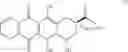
(hereinafter, referred to as amrubicin hydrochloride) has been known to be produced by, for example, the process described in JP 3-5397 B. In addition, amrubicin hydrochloride has been known to have several crystalline forms, a specific crystalline form of which is excellent in heat stability (JP 11-222497 A). However, sometimes, this compound generates as degradation by-products a desaccharification product represented by the formula (2):
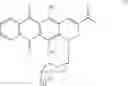
and a deamination product represented by the formula (3):
during handling thereof including drying, storage and transfer, though the amounts thereof are slight. In view of medical application, it is of very importance to further suppress the generation of these degradation by-products. In particular, since the deamination product forms insolubles during a production process of a pharmaceutical preparation, suppression of generation thereof is required more than that of the desaccharification product. In view of the above, it has been desired to further develop stabilization and storage methods.
An object of the present invention is to provide a stabilized composition of amrubicin hydrochloride, and stabilization and storage methods of amrubicin hydrochloride.
Thus, the present invention provides:
1. A stabilized amrubicin hydrochloride composition which comprises 92 to 97% by weight of amrubicin hydrochloride and 3 to 8% by weight of water;
2. A method for stabilizing amrubicin hydrochloride which comprises controlling a water content of amrubicin hydrochloride at 3 to 8% by weight; and
3. A method for storing amrubicin hydrochloride which comprises keeping amrubicin hydrochloride under an atmosphere at 5 to 90% relative humidity.
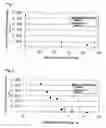
BRIEF DESCRIPTION OF DRAWINGSFIG. 1 is a graph prepared by plotting rates of by-product generation of the desaccharification product and the deamination product against relative humidity upon storage of amrubicin hydrochloride.
FIG. 2 is a graph prepared by plotting rates of by-product generation of the desaccharification product and the deamination product against water contents in compositions of amrubicin hydrochloride.
BEST MODE FOR PERFORMING THE INVENTIONAmrubicin hydrochloride can be produced, for example, by the process described in JP 3-5397 B.
The by-product generation rates of the desaccharification product and the deamination product are influenced by a water content of amrubicin hydrochloride. The by-product generation rate of the desaccharification product is increased and the by-product generation rate of the deamination product is decreased according to the decrease in a water content of amrubicin hydrochloride. On the other hand, the by-product generation rate of the deamination product is increased and the by-product generation rate of the desaccharification product is decreased according to the increase in a water content of amrubicin hydrochloride. Then, in order to reduce the by-product generation rates of both desaccharification and deamination products to further stabilize amrubicin hydrochloride, it is of importance to control a water content of amrubicin hydrochloride at 3 to 8% by weight. In particular, in view of suppression of the by-product generation of the deamination product, more preferably, a water content of a composition of amrubicin hydrochloride is controlled at 4 to 7% by weight.
The water content is calculated by the following equation:
Water content (wt. %)=(weight of water contained in amrubicin hydrochloride)/(total weight of amrubicin hydrochloride including water)×100
The stabilized amrubicin hydrochloride composition comprising 92 to 97% by weight of amrubicin hydrochloride and 3 to 8% by weight of water can be obtained, for example, by such a method that dried amrubicin hydrochloride is exposed to wetted gas such as wetted air, wetted nitrogen, etc. to add a given amount of water thereto; that amrubicin hydrochloride wetted with water is dried under ordinary or reduced pressure, or with blowing drying gas such as nitrogen gas, etc. therethrough to adjust a water content of the amrubicin hydrochloride to 3 to 8% by weight; that gas for controlling moisture such as wetted nitrogen gas etc. is blown through dried or wetted amrubicin hydrochloride to adjust a water content of the amrubicin hydrochloride to 3 to 8% by weight; or the like. Usually, a water content of amrubicin hydrochloride can be adjusted to 3 to 8% by weight by exposing it to an atmosphere at 5 to 90% relative humidity. For bringing the water content to 3% by weight or higher, more preferably, the exposure is performed by adjusting the relative humidity to 10% or higher. For bringing the water content to 4% by weight or higher, more preferably, the exposure is performed by adjusting the relative humidity to 20% or higher. Further, for bringing the water content to 7% or lower, preferably, the exposure is performed by adjusting the relative humidity to preferably 85% or lower, more preferably 80% or lower, still more preferably 70% or lower. The relatively humidity can be set within the above range according to the desired water content. Usually, the relative humidity is adjusted to 5 to 90%, preferably 10 to 80%, more preferably 20 tO 70%.
EXAMPLESThe following Example further illustrates the present invention in detail, but the present invention is not limited-to the Example.
Example 1Various compositions of amrubicin hydrochloride composed of about 91 to about 98% by weight of amrubicin hydrochloride and about 2 to about 9% by weight of water were prepared by exposing dried amrubicin hydrochloride to air whose relative humidity was adjusted (0 to 95%).
The thus-prepared amrubicin hydrochloride compositions having water contents of about 2 to about 9% by weight were stored at 30° C. and investigated rates of by-product generation of the degradation products, i.e., the desaccharification and deamination products.
The relative humidity was adjusted by reference to “Kobunshi Jikken-gaku Koza (Polymer Experiment Course) 5, Kobunshi no Bussei (Physical Properties of Polymers), 100-107 pages (Kyoritsu Shuppan Kabushiki Kaisha)”.
FIG. 1 shows a graph prepared by plotting rates of by-product generation of the desaccharification and deamination products against the relative humidity of the storage atmosphere. It can be seen from this graph that the by-product generation of both desaccharification and deamination products can be suppressed by storing amrubicin hydrochloride under an atmosphere at 5 to 90% relative humidity, thereby permitting stable storage of amrubicin hydrochloride.
FIG. 2 shows a graph prepared by plotting rates of by-product generation the desaccharification product and the deamination product against water contents in compositions of amrubicin hydrochloride. It can be seen from this graph that the by-product generation of both desaccharification and deamination products can be suppressed by controlling a water content in an amrubicin hydrochloride composition at 3 to 8% by weight, thereby permitting stable storage of amrubicin hydrochloride.
Industrial Applicability
According to the present invention, it is possible to stably store amrubicin hydrochloride by storing amrubicin hydrochloride under an atmosphere at 5 to 90% relative humidity to adjust a water content of amrubicin hydrochloride to 3 to 8% by weight, thereby suppressing the by-product generation of the desaccharification and deamination products.
Claims
1-4. (canceled)
5. A method for storing amrubicin hydrochloride which comprises keeping amrubicin hydrochloride under an atmosphere at 10 to 80% relative humidity.
6. (canceled)
7. The method according to claim 5, wherein the relative humidity is 20 to 70%.
8. The method according to claim 5, wherein the keeping of amrubicin hydrochloride is performed at atmospheric pressure.
Images & Drawings included:
Sources:
- United States Patent and Trademark Office - verify current appl. status at the USPTO↗
Similar patent applications:
- » 10489824
Stabilization of amrubicin hydrochloride
Recent applications in this class:
- » 20210002320 2021-01-07
CHEMICALLY CLEAVABLE GROUP - » 20190016747 2019-01-17
PURIFIED REBAUDIOSIDE A - » 20180230175 2018-08-16
3′-deamino-3′-(2″-pyrroline-1″-yl)-5-imino-13-deoxyanthracyclines and methods of preparation - » 20180094014 2018-04-05
Method of producing epirubicin and novel production intermediate thereof - » 20170051001 2017-02-23
Purification of epidaunorubicin - » 20160137683 2016-05-19
Method for preparing epirubicin and intermediate thereof - » 20160068558 2016-03-10
Anticancer agents of the anthracyclin family - » 20150344514 2015-12-03
Chemically cleavable group - » 20140357848 2014-12-04
Crystalline 4′-epidaunorubicin hydrochloride and use thereof - » 20140315255 2014-10-23
NOVEL ANTIBACTERIAL COMPOUNDS, METHODS OF MAKING THEM, AND USES THEREOF
Recent applications for this Assignee:
- » 20100240623 2010-09-23
8-oxoadenine derivatives acting as modulators of TLR7 - » 20070036812 2007-02-15
HLA-A24 binding cancer antigen peptide derived from livin - » 20060183730 2006-08-17
Carbapenem compounds - » 20050282905 2005-12-22
Hydroxamic acid derivative and MMP inhibitor containing the same as active ingredient - » 20050215796 2005-09-29
One-pot process for the preparation of 1,2-benzisoxazole-3-methanesulfonamide - » 20050020566 2005-01-27
Carbapenem compounds - » 10489824 2006-08-15
Stabilization of amrubicin hydrochloride - » 10474943 2007-05-22
Pyrrole derivative - » 10416334 2007-01-16
β-lactam compounds and process for producing the same - » 9743750 2009-05-19
Preparations for immunotherapy for cancer having bacterial somatic constituent as the active ingredient