Ionic liquid, method for producing same, double layer capacitor comprising same, and lithium battery
US20070099079A1
2007-05-03
10/596,831
2004-12-24
Abstract:
The present invention relates to ionic liquids comprising at least one organic ammonium ion and at least one member selected from the group consisting of anions represented by [BF3(CnF2n+1)]− wherein n represents 2, 3 or 4.
Assignee:
- NATIONAL INSTITUTE OF ADVANCED INDUSTRIAL SCIENCE AND TECHNOLOGY 115 🇯🇵 Chiyoda-ku, Tokyo, Japan
Interested in similar patents?
Get notified when new applications in this technology area are published.
Classification:
C07D295/037 » CPC main
Heterocyclic compounds containing polymethylene-imine rings with at least five ring members, 3-azabicyclo [3.2.2] nonane, piperazine, morpholine or thiomorpholine rings, having only hydrogen atoms directly attached to the ring carbon atoms containing only hydrogen and carbon atoms in addition to the ring hetero elements with quaternary ring nitrogen atoms
C07D295/088 » CPC further
Heterocyclic compounds containing polymethylene-imine rings with at least five ring members, 3-azabicyclo [3.2.2] nonane, piperazine, morpholine or thiomorpholine rings, having only hydrogen atoms directly attached to the ring carbon atoms with substituted hydrocarbon radicals attached to ring nitrogen atoms substituted by singly bound oxygen or sulfur atoms with the ring nitrogen atoms and the oxygen or sulfur atoms attached to the same carbon chain, which is not interrupted by carbocyclic rings to an acyclic saturated chain
H01M10/052 » CPC further
Secondary cells; Manufacture thereof; Accumulators with non-aqueous electrolyte Li-accumulators
H01M10/0568 » CPC further
Secondary cells; Manufacture thereof; Accumulators with non-aqueous electrolyte characterised by the materials used as electrolytes, e.g. mixed inorganic/organic electrolytes the electrolyte being constituted of organic materials only; Liquid materials characterised by the solutes
H01M6/166 » CPC further
Primary cells; Manufacture thereof; Cells with non-aqueous electrolyte with organic electrolyte characterised by the electrolyte by the solute
Y02E60/10 » CPC further
Enabling technologies; Technologies with a potential or indirect contribution to GHG emissions mitigation Energy storage using batteries
Y02E60/10 » CPC further
Enabling technologies; Technologies with a potential or indirect contribution to GHG emissions mitigation Energy storage using batteries
H01G9/035 IPC
Electrolytic capacitors, rectifiers, detectors, switching devices, light-sensitive or temperature-sensitive devices; Processes of their manufacture; Details; Electrolytes; Absorbents Liquid electrolytes, e.g. impregnating materials
C07F5/02 » CPC further
Compounds containing elements of Groups 3 or 13 of the Periodic System Boron compounds
C07C211/00 IPC
Compounds containing amino groups bound to a carbon skeleton
C07C209/00 IPC
Preparation of compounds containing amino groups bound to a carbon skeleton
Description
TECHNICAL FIELDThe present invention relates to ionic liquids, and more particularly to ionic liquids with low viscosities and melting points as well as high conductivities and electrochemical stabilities. The present invention also relates to a method of producing ionic liquids as well as lithium batteries (for example, lithium-ion batteries, lithium primary batteries and lithium secondary batteries, and particularly lithium secondary batteries) and electric double-layer capacitors comprising the ionic liquids.
PRIOR ARTIonic liquids have attracted special attention for the past several years, owing to their potential for application as the electrolytes, reaction media and catalysts for organic syntheses for a variety of electrochemical devices, such as lithium secondary batteries, solar cells, actuators, electric double-layer capacitors and the like. Compared with conventional organic liquid electrolytes, ionic liquids as such electrolytes have the main advantages of flame retardancy, non-volatility and high thermal stability. Bistrifluoromethylsulfonylimide ([(CF3SO2)2N]−) and tetrafluoroborate (BF4−) have attracted attention as anions for most of the ionic liquids so far reported, because of their high electrochemical stabilities and thermal stabilities (Patent Publications 1 and 2).
However, ionic liquids containing these anions suffer from problems such as low conductivity at low temperature, in particular.
Patent Publication 3 discloses boron compounds; however, for example, triethylmethylammonium-CF3BF3 manufactured in the Examples has a high melting point of 181° C., and therefore cannot serve as an ionic liquid.
Further, Patent Publication 4 discloses the BF3CF3 salt of 1-ethyl-3-methylimidazolium in Example 1.
[Patent Publication 1] Japanese Unexamined Patent Publication No. 2002-099001
[Patent Publication 2] Japanese Unexamined Patent Publication No. 2003-331918
[Patent Publication 3] Japanese Unexamined Patent Publication No. 2002-63934
[Patent Publication 4] Japanese Unexamined Patent Publication No. 2004-123631
DISCLOSURE OF THE INVENTIONProblems to be Solved by the Invention
An object of the present invention is to provide ionic liquids with low viscosities, low melting points and high conductivities by improving the anionic and cationic components. The present invention also relates to electric double-layer capacitors and lithium batteries comprising such ionic liquids, especially to lithium secondary batteries.
Means for Solving the Problems
In view of the aforementioned problems, the present inventors conducted extensive research, and found that an ionic liquid with a low viscosity and low melting point as well as high conductivity at low temperatures can be obtained using at least one anion represented by [BF3(CnF2n+1)]− where n represents 1, 2, 3 or 4, or using such an anion together with a salt containing a particular aliphatic or heterocyclic ammonium-based cation.
The present invention provides ionic liquids and a production method therefor as well as electric double-layer capacitors and lithium batteries using such ionic liquids, as itemized below:
1. An ionic liquid comprising:
at least one anion represented by [BF3(CnF2n+1)]− wherein n represents 1, 2, 3 or 4; and
at least one organic ammonium ion represented by general formula (I):
[NR1R2R3R4]+ (I)
wherein R1 to R4 are the same or different, each representing an alkyl, fluoroalkyl, alkoxy, polyether, or alkoxyalkyl group, or R1 and R2 taken together with the nitrogen atom may form a pyrrolidine, piperidine, or morpholine ring; provided that R1 to R4 satisfy the conditions (i) through (iii) shown below:
(i) when R1 and R2 taken together with the nitrogen atom form a pyrrolidine, piperidine, or morpholine ring, either R3 or R4 is an alkyl group with 3 or more carbon atoms or alkoxyalkyl group;
(ii) when R1 and R2 do not form a pyrrolidine, piperidine or morpholine ring, at least one of R1 to R4 is an alkoxy, polyether or alkoxyalkyl group; and
(iii) when R1 to R3 are the same or different, each being methyl or ethyl, R4 is a C3-10 linear or branched alkyl group.
2. An ionic liquid according to item 1, wherein the anion is at least one member selected from the group consisting of [BF3(CF3)]−, [BF3(C2F5)]− and [BF3(C3F7)]−.
3. An ionic liquid according to item 1, wherein R1, R2 and R3 are the same or different, each representing an alkyl group, and R4 represents an alkoxyalkyl group.
4. An ionic liquid according to item 1, wherein R1 and R2 taken together with the nitrogen atom form a pyrrolidine, piperidine or morpholine ring; R3 is methyl or ethyl; and R4 is an alkyl group with 3 or more carbon atoms or alkoxyalkyl group.
5. An ionic liquid according to item 1, wherein R1 and R2 taken together with the nitrogen atom form a pyrrolidine, piperidine or morpholine ring; R3 is methyl; and R4 is an alkyl group with 3 or more carbon atoms or alkoxyalkyl group.
6. An ionic liquid according to item 1, wherein R1 and R2 taken together with the nitrogen atom form a pyrrolidine ring; R3 is methyl; and R4 is an alkyl group with 3 or more carbon atoms or alkoxyalkyl group.
7. An electric double-layer capacitor comprising the ionic liquid according to item 1.
8. A lithium battery comprising the ionic liquid according to item 1.
9. A method of producing an ionic liquid comprising mixing a compound containing as an anionic component at least one anion represented by [BF3(CnF2n+1)]− wherein n represents 1, 2, 3 or 4 with a compound containing as a cationic component at least one organic ammonium ion represented by general formula (I):
[NR1R2R3R4]+ (I)
wherein R1 to R4 are the same or different, each representing an alkyl, fluoroalkyl, alkoxy, polyether, or alkoxyalkyl group, or R1 and R2 taken together with the nitrogen atom may form a pyrrolidine, piperidine, or morpholine ring; provided that R1 to R4 satisfy the conditions (i) through (iii) shown below:
(i) when R1 and R2 taken together with the nitrogen atom form a pyrrolidine, piperidine, or morpholine ring, either R3 or R4 is an alkyl group with 3 or more carbon atoms or alkoxyalkyl group;
(ii) when R1 and R2 do not form a pyrrolidine, piperidine or morpholine ring, at least one of R1 to R4 is an alkoxy, polyether or alkoxyalkyl group; and
(iii) when R1 to R3 are the same or different, each being methyl or ethyl, R4 is a C3-10 linear or branched alkyl group.
EFFECTS OF THE INVENTIONThe present invention provides ionic liquids with low viscosities and melting points.
Ionic liquids of the present invention are especially suitable for use in lithium batteries and electric double-layer capacitors. The ionic liquids are also useful in solar cells, electrochemical sensor devices, electrochemical (electrochromic) display devices, and the like.
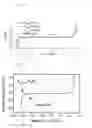
BRIEF DESCRIPTION OF THE DRAWINGSFIG. 1 is a linear sweep voltammogram of ionic liquids measured on a glassy carbon electrode (surface area: 7.85×10⁻³ cm−2 ) at the first sweep, wherein the sweep rate is 50 m Vs−1; the counter electrode is a Pt wire; the reference electrode is a platinum wire immersed in EMI-TFSI ionic liquid containing 15 mM iodine and 60 mM tetrapropylammonium iodide dissolved therein in a glass cylinder having its end capped with a glass filter; and the potential (V) for use as the potential reference is the redox potential of the ferrocene (Fc)/ferrocenium (Fc+) redox couple that can be observed when ferrocene is dissolved in each ionic liquid; and
FIG. 2 shows results of linear sweep voltammetry.
BEST MODE FOR CARRYING OUT THE INVENTIONIonic liquids for use in the present invention typically have melting points of 150° C. or less, preferably 80° C. or less, more preferably 60° C. or less, still more preferably 40° C. or less, and even more preferably 25° C. or less. For example, ionic liquids with melting points of 150° C. or less can be widely used in fuel cells. Ionic liquids for use in energy devices such as solar cells, lithium batteries, capacitors, etc., and electrochemical devices such as electrochromic devices, electrochemical sensors, etc. preferably have melting points of room temperature (25° C.) or less, and more preferably 0° C. or less.
The anionic component of the ionic liquid for use in the present invention is at least one member selected from the group consisting of BF3(CF3)−, [BF3(C2F5)]−, [BF3(C3F7)]− (i.e., [BF3(n-C3F7)]− and [BF3(i-C3F7)]−), and [BF3(C4F9)]− (i.e., [BF3(n-C4F9)]−, [BF3(i-C4F9)]−, [BF3(sec-C4F9)]−, and [BF3(tert-C4F9)]−); and preferably at least one member selected from the group consisting of [BF3(CF3)]−, [BF3(C2F5)]−, and [BF3(C3F7)]− (i.e., [BF3(n-C3F7)]− and [BF3(i-C3F7)]−); and more preferably [BF3(CF3)]− and/or [BF3(C2F5)]−. The above-mentioned anions are known compounds, and are described in, for example, G. A. Molander, B. J. Hoag, Organometallics, 22, (2003), 3313; and Zhi-Bin Zhou, Masayuki Takeda, Makoto Ue, J. Fluorine. Chem., 123 (2003) 127. The ionic liquid of the present invention may comprise a single anionic component, or two or more anionic components to further decrease the melting point.
The ionic liquid can be produced by mixing an organic ammonium compound with a salt of at least one anionic component represented by [BF3(CnF2n+1)]− wherein n represents 1, 2, 3 or 4 and a cationic component, such as an alkali metal ion (Na+, K+, Li+, Cs+, etc.), an alkaline-earth metal ion (Ca2+, Mg2+, Ba2+, etc.), or H+, Bu3Sn+, or the like; and separating an ionic liquid consisting of the organic ammonium ion and [BF3(CnF2n+)]− wherein n represents 1, 2, 3, or 4, or [BF3(CF═CF2)]−. For example, an ionic liquid consisting of [BF3(CnF2n+)]− wherein n represents 1, 2, 3, or 4 and an organic ammonium ion can be preferably obtained by mixing an (organic ammonium)+(OH)− salt with a [BF3(CnF(2n+1)]−H+salt, wherein n represents 1, 2, 3, or 4, which is prepared by passing through an ion exchange resin; and removing water. A salt exchange reaction for obtaining an ionic liquid can be carried out by solvent extraction when the desired molten salt is capable of being extracted.
Although a single organic ammonium ion may be used, a combination of two or more organic ammonium ions allows the melting point and viscosity of the ionic liquid to be further decreased.
The anion(s) of the ionic liquid used is at least one member selected from the group consisting of anions represented by [BF3(CnF2n+1)]− wherein n represents 1, 2, 3, or 4, such an anion being the primary component; however, other anions may also be added so long as the resulting salt is an ionic liquid.
Examples of organic ammonium compounds include salts of organic ammonium cations with hydroxide (OH−), halogen, nitrate, sulfate, phosphate, perchlorate, methanesulfonate, toluenesulfonate ions, and the like.
The ionic liquid may also be produced using at least one anion selected from the group represented by [BF3(CnF2n+1)]− wherein n represents 1, 2, 3 or 4 in the form of, e.g., silver, calcium, barium and/or the like salts, together with an organic ammonium ion, in the form of, e.g., a halide salt, sulfate salt or the like, to form a sparingly soluble salt, such as a silver halide, barium sulfate, calcium sulfate or the like resulting from aforementioned counterions, and removing the formed salt.
Alternatively, the ionic liquid may be prepared by mixing (organic ammonium(s) of general formula (I))+(OH)− with at least one member selected from the group consisting of anions represented by [BF3(CnF2n+1)]−H+ wherein n represents 1, 2, 3, or 4.
Examples of alkyl groups include C1-20, preferably C1-10, more preferably C1-6, and still more preferably C1-3 linear or branched alkyl groups, such as methyl, ethyl, n-propyl, isopropyl, n-butyl, sec-butyl, isobutyl, t-butyl, pentyl, hexyl, heptyl, octyl, nonyl, decyl, undecyl, dodecyl, tridecyl, tetradecyl, hexadecyl, octadecyl, eicosyl, and the like.
Examples of fluoroalkyl groups include C1-20, preferably C1-10, more preferably C1-6, and still more preferably C1-3 polyfluoroalkyl and perfluoroalkyl groups wherein at least one of the hydrogen atoms of an above-mentioned alkyl group is substituted with fluorine.
Examples of alkoxy groups include C1-20, preferably C1-10, more preferably C1-6, and still more preferably C1-3 linear or branched alkoxy groups, wherein an aforementioned alkyl group is attached to oxygen.
The alkoxy and alkyl groups of alkoxyalkyl groups are the same as mentioned above. Examples of alkoxyalkyl groups include C1-20, preferably C1-10, more preferably C1-6, and still more preferably C1-3 linear or branched alkyl groups substituted with C1-20, preferably C1-10, more preferably C1-6, and still more preferably C1-3 linear or branched alkoxy groups; such as, preferably —(C1-3 alkylene)-O—(C1-3 alkyl); and more preferably methoxymethyl (CH2OCH3), methoxyethyl (CH2CH2OCH3), ethoxymethyl (CH2OCH2CH3), ethoxyethyl (CH2CH2OCH2CH3), methoxypropyl (CH2CH2CH2OCH3), ethoxypropyl (CH2CH2CH2OCH2CH3), propoxymethyl (CH2OCH2CH2CH3), propoxyethyl (CH2CH2OCH2CH2CH3), isopropoxymethyl (CH2OCH(CH3)2), and isopropoxyethyl (CH2CH2OCH(CH3)2) groups; and most preferably methoxymethyl (CH2OCH3), methoxyethyl (CH2CH2OCH3), ethoxymethyl (CH2OCH2CH3), and ethoxyethyl (CH2CH2OCH2CH3) groups.
Examples of polyether groups include those represented by —(CH2)n1—O—(CH2CH2O)n2—(C1-4alkyl); —(CH2)n1-O—(CH2CH(CH3)O)n2—(C1-4alkyl); or —(CH2)n1—O—(CH(CH3)CH2O)n2—(C1-4 alkyl), where n1 is an integer from 1 to 4; n2 is an integer from 1 to 4; and the C1-4 alkyl is, for example, methyl, ethyl, n-propyl, isopropyl, n-butyl, isobutyl, sec-butyl, tert-butyl, or the like.
Alkenyl groups or the aforementioned alkyl groups may have one or more of —O—, —COO— and —CO— interposed between C—C single bonds at any positions to form ether, ester, or ketone structures.
Examples of alkyl groups with 3 or more carbon atoms attached to a pyrrolidine, piperidine, or morpholine ring include C3-20, preferably C3-10, and more preferably C3-7 linear or branched alkyl groups, such as n-propyl, isopropyl, n-butyl, sec-butyl, isobutyl, t-butyl, pentyl, hexyl, heptyl, octyl, nonyl, decyl, undecyl, dodecyl, tridecyl, tetradecyl, hexadecyl, octadecyl, eicosyl, and the like.
Examples of C3-10 alkyl groups represented by R4 are C3-10, preferably C4-8, and more preferably C4-6 linear or branched alkyl groups, such as n-propyl, isopropyl, n-butyl, sec-butyl, isobutyl, t-butyl, pentyl, hexyl, heptyl, octyl, nonyl, decyl, undecyl, dodecyl, tridecyl, tetradecyl, hexadecyl, octadecyl, eicosyl, and the like.
R1 and R2 taken together with the nitrogen atom to which they are attached may form pyrrolidinium, piperidinium or morpholinium.
Examples of preferable ammonium ions, wherein R1, R2 and R3 are the same or different, each being methyl or ethyl, and wherein R4 is a C3-10 linear or branched alkyl group, include methyldiethyl(n-, i-, sec-, or tert-)butylammonium (N1224), dimethylethyl(n-, i-, sec-, or tert-)butylammonium (N1124), trimethyl(n-, i-, sec-, or tert-)butylammonium (N114), triethyl(n-, i-, sec-, or tert-)butylammonium (N2224), methyldiethylhexylammonium (N1226), dimethylethylhexylammonium (N1126), trimethylhexylammonium (N1116), and triethylhexylammonium (N2226).
Examples of organic ammonium ions which can be suitably used in the present invention are illustrated below:
| TABLE 1 | |||
| R1 | R2 | R3 | R4 |
| same or different, each being methyl or ethyl | C3-10 alkyl |
| alkyl | alkyl | alkyl | alkoxyalkyl |
| alkyl | alkyl | alkyl | polyether |
| Pyrrolidine ring | alkyl | alkoxyalkyl |
| Pyrrolidine ring | alkyl | C3 or more alkyl |
| Pyrrolidine ring | alkyl | polyether |
| Pyrrolidine ring | alkyl | alkoxyalkyl |
| Pyrrolidine ring | alkyl | C3 or more alkyl |
| Pyrrolidine ring | alkyl | polyether |
| morpholine ring | alkyl | alkoxyalkyl |
| morpholine ring | alkyl | C3 or more alkyl |
| morpholine ring | alkyl | polyether |
Particularly preferable cations in the present invention which are shown by Table 1 and substituted with a lower alkyl group on the nitrogen atom are listed below:
(1) R1 to R3 are the same or different, each being methyl or ethyl, and R4 is a C3-10 alkyl;
(2) R1 to R3 are the same or different, each being a C1-4 alkyl group, and R4 is —(C1-3 alkylene)-O—(C1-3 alkyl);
(3) R1 and R2 taken together with the nitrogen atom form a pyrrolidine, piperidine, or morpholine ring; R3 is methyl or ethyl; and R4 is a C1-3 alkoxy C1-3 alkyl; and
(4) R1 and R2 taken together with the nitrogen atom form a pyrrolidine, piperidine, or morpholine ring; R3 is methyl or ethyl; and R4 is a C3-8 alkyl.
Ionic liquids of the present invention are capable of easily dissolving electrolytes such as lithium salts, and are also incombustible and have low viscosities. Therefore, the ionic liquids can be suitably used as electrolyte solvents for lithium batteries such as lithium secondary batteries, electric double-layer capacitors, solar cells, electrochemical sensor devices, electrochemical (electrochromic) display devices and the like.
EXAMPLESThe present invention is described in further detail below with reference to the Examples.
Reference Example 1 Anion SynthesisK[CF3BF3] was prepared in the manner as described in G. A. Molander, B. J. Hoag, Organometallics, 22, (2003), 3313, and then the K[CF3BF3] was subjected to a cation exchange process as described in S. Mori, K. Ida, and M. Ue, U.S. Pat. No. 4,892,944 (1990), thereby yielding aqueous Hsolv.[CF3BF3]solv.
K[C2F5BF3], K[n-C3F7BF3] and K[n-C4F9BF3] were prepared in the manner as described in Zhi-Bin Zhou, Masayuki Takeda, Makoto Ue, J. Fluorine. Chem, 123 (2003) 127, and then the K[C2F5BF3], K[n-C3F7BF3] and K[n-C4F9BF3] were each subjected to a cation exchange process as described in S. Mori, K. Ida, and M. Ue, U.S. Pat. No. 4,892,944. (1990), thereby yielding aqueous solv[n-C2F5BF3]solv, Hsolv[n-C3F7BF3]solv and Hsolv[n-C4F9BF3]solv, respectively
Reference Example 2 Cation Synthesis(1) Synthesis of diethylmethylmethoxyethylammonium chloride (C3: N102122+Cl−)
An amine (diethylmethylamine) and an equimolar amount of a halogen-substituted ether compound (methoxyethylchloride) as starting materials were mixed in acetonitrile, and then the mixture was reacted for 12 to 72 hours by heating in an autoclave under mild conditions. After the reaction, the quaternary ammonium salt product was recrystallized in an appropriate solvent, and the formation of diethylmethylmethoxyethylammonium chloride (N102122+Cl−) was confirmed by NMR.
The halide thus obtained was converted to the hydroxide (N102122+OH−) with an anion exchange resin.
(2) Synthesis of trimethylmethoxyethylammonium bromide (C1: N102111+Br−); dimethylethylmethoxyethylammonium bromide (C2: N102112+Br−); and triethylmethoxyethylammonium bromide (C4: N102222+Br−)
CH3OCH2CH2Br and an equimolar amount of an amine (one each of triethylamine, dimethylethylamine or triethylamine) as starting materials were mixed in anhydrous acetone, and then each mixture was reacted for 12 to 72 hours by heating in an autoclave under mild conditions. After the reaction, each quaternary ammonium salt product was recrystallized in acetone, and the formation of trimethylmethoxyethylammonium bromide (N10211+Br−), dimethylethylmethoxyethylammonium bromide (N102112+Br−) and triethylmethoxyethylammonium bromide (N102222+Br−) was confirmed by NMR.
The bromides thus obtained were converted to the hydroxides (N10211+OH−, N102112+OH− and N102222+OH−, respectively) with an anion exchange resin.
(3) Synthesis of methylmethoxyethylpiperidinium bromide (C5: Pi102.1+Br−); methylmethoxyethylpyrrolidinium bromide (C6: Py102.1+Br−); ethyldimethylmethoxymethylammonium bromide (C7: N102.112+Br−); butyldimethylmethylammonium bromide (C8: N1224+Br−); methylmethoxymethylpyrrolidinium bromide (C9: Py101.1+Br−); methylbutylmorpholinium bromide (C10: Mor14+Br−); and methylmethoxyethylmorpholinium bromide (C11: Mor1.102+Br−)
C5 (Pi102.1+Br−), C6 (Py102.1+Br−) and C11 (Mor1.102+Br−) were synthesized in a similar manner as in synthesis (2) above, except for using N-methylpyrrolidine, N-methylpiperidine and N-methylmorpholine instead of the amines (triethylamine, dimethylethyl amine and triethylamine).
In addition, C7 (N102.112+Br−), C8 (N1224+Br−), C9 (Py101.1+Br−) and C10 (Mor14+Br−) were synthesized in a similar manner as in synthesis (2) above, except for using dimethylethylamine, methyldiethylamine, methylpyrrolidine or N-methylmorpholine as the amine; and using CH3CH2CH2CH2Br or CH3OCH2Br as the bromide.
The bromides thus obtained were converted to the hydroxides (C5: Pi102.1+OH−; C6: Py102.1+OH−; C7: N102.112+OH−; C8: N1224+OH−; C9: Py101.1+OH−; C10: Mor14+OH−; and C11: Mor1.102+OH−, respectively) with an anion exchange resin.
The structural formulae of ammonium ions C1 through C11 are shown below:
(4) Synthesis of pyrrolidine-based quaternary ammonium salts
Cations shown below were synthesized in a similar manner as in synthesis (2), except for using N-methylpyrrolidine instead of the amines (triethylamine, dimethylethyl amine and triethylamine), and using CH3(CH2)pBr where p is an integer from 0 to 6, CH3OCH2Br, CH3OCH2CH2Br, CH3CH2OCH2CH2Br, or CH3O(CH2CH2)2OCH2CH2Br as the bromide, and the bromides obtained were then converted to the hydroxides with an anion exchange resin. The cations are shown below along with their abbreviations:
| TABLE 2 |
| R | Cation | |
| CH3 | Py11 | |
| C2H5 | Py12 | |
| n-C3H7 | Py13 | |
| n-C4H9 | Py14 | |
| n-C5H11 | Py15 | |
| n-C6H13 | Py16 | |
| n-C7H15 | Py17 | |
| C2H5O(CH2)2 | Py1.202 | |
| CH3O(OH2)O(CH2)2 | Py1.10202 | |
(5) Known ammonium compounds
In addition to the above, methyltriethylammonium hydroxide (N1222.OH−) and tetraethylammonium hydroxide (N2222.OH−) were prepared by a known process.
Example 1 Preparation of Ionic LiquidsAn aqueous solution (50 mmol) of any one of the anions (Hsolv.[CF3BF3]solv, Hsolv[n-C2F5BF3]solv, Hsolv[n-C3F7BF3]solv and Hsolv[n-C4F9BF3]solv) obtained in Reference Example 1 was filtered before use, and then the filtrate was neutralized by an equimolar amount of any one of the hydroxides of ammonium cations obtained in Reference Example 2. The ionic liquid was concentrated to about 20 ml under reduced pressure at 30 to 40° C., and then the bottom layer was separated, followed by washing with deionized water (10 ml) and toluene (20 ml×2). The resulting ionic liquid bottom layer was dried under vacuum (0.03 mmHg) at 60° C. for 12 hours, so as to yield the target ionic liquid.
Tables 3 to 5 below show the combinations of the anions and cations along with their physical values.
In addition, data such as NMR (1H, 11B and 19F), elemental analysis and the like on some of the ionic liquids obtained are presented below:
N102.122[BF4]
1H NMR (399.65 MHz/acetone-d6, δ ppm relative to internal TMS): 1.39 (t, J=7.2 Hz, NCH2CH3), 3.18 (s, NCH3), 3.38 (s, OCH3), 3.58 (q, J=7.3 Hz, NCH2CH3), 3.67 (t, J=4.8 Hz, OCH2CH2N), 3.88 (s, OCH2CH2N). Anal. Calc. for C8H20BF4NO: C, 41.2; H, 8.7; N, 6.0. Found: C, 41.3; H, 8.5; N, 5.9%.
N102.122[n-C2F5BF3]
1H NMR: (399.65 MHz/acetone-d6, δ ppm relative to internal TMS): 1.41 (t, J=7.2 Hz, NCH2CH3), 3.19 (s, NCH3), 3.39 (s, OCH3), 3.59 (q, J=7.2 Hz, NCH2CH3), 3.67 (t, J=4.8 Hz, OCH2CH2N), 3.91 (s, OCH2CH2N). 19F NMR (376.05 MHz/acetone-d6, δ ppm relative to external CCl3F): −83.0 (s, CF3), 135.8 (q, 2JBF=20.3 Hz, CF2), −152.8 (q, 1JBF=40.7 Hz, BF3). 11B NMR (128.15 MHz/acetone-d6, δ ppm relative to external BF3.Et2O): 0.149 (qt, 1JBF=40.8 Hz, 2JBF=19.1 Hz). Anal. Calc. for C10H20BF8NO: C, 36.1; H, 6.1; N, 4.2. Found: C, 36.4; H, 4.2; H, 6.0; N, 4.5%.
N102.122[n-C3F7BF3]
1H NMR (399.65 MHz/acetone-d6, δ ppm relative to internal TMS): 1.41 (t, J=7.3 Hz, NCH2CH3), 3.20 (s, NCH3), 3.38 (s, OCH3), 3.59 (q, J=7.2 Hz, NCH2CH3), 3.67 (t, J=4.8 Hz, OCH2CH2N), 3.91 (s, OCH2CH2N). 19F NMR (376.05 MHz/acetone-d6, δ ppm relative to external CCl3F): −80.3 (s, CF3), −127.5 (s, CF3CF2), 133.7 (s, CF2B), −152.3 (q, 1JBF=38.7 Hz, BF3). 11B NMR (128.15 MHz/acetone-d6, δ ppm relative to external BF3.Et2O): 0.246 (qt, 1JBF=40.6 Hz, 2JBF=19.0 Hz). Anal. Calc. for C11H20BF10NO: C, 34.5; H, 5.3; N, 3.7. Found: C, 34.7; H, 5.2; N, 3.7%.
N102.122[n-C4F9BF3]
1H NMR (399.65 MHz/acetone-d6, δ ppm relative to internal TMS): 1.41 (m, NCH2CH3), 3.21 (m, NCH3), 3.38 (m, OCH3), 3.60 (q, J=7.2 Hz, NCH2CH3), 3.67 (t, J=4.8 Hz, OCH2CH2N), 3.91 (s, OCH2CH2N). 19F NMR (376.05 MHz/acetone-d6, δ ppm relative to external CCl3F): −80.9 (s, CF3), −123.8 (s, CF3CF2), 125.8 (s, CF3CF2CF2) 133.1 (s, CF2B), −152.3 (q, 1JBF=38.7 Hz, BF3). 11B NMR (128.15 MHz/acetone-d6, δ ppm relative to external BF3.Et2O): 0.233 (qt, 1JBF=40.3 Hz, 2JBF=19.0 Hz). Anal. Calc. for C12H20BF12NO: C, 33.3; H, 4.7; N, 3.2. Found: C, 33.6; H, 4.6; N, 3.4%.
N102.111[C2F5BF3]
Elemental Analysis Calc. (Found): C, 31.5 (31.2); H, 5.3 (5.2); N, 4.6 (4.6)%. 1H NMR: 3.37 (s, 3×3H), 3.40 (s, 3H), 3.76 (s, 2H), 3.94 (s, 2H). 19F NMR: −83.0 (s, CF3), −135.8 (q, 2JBF=19.3 Hz, CF2) −153.0 (q, 1JBF=39.6 Hz, BF3). N102.112[C2F5BF3]Elemental Analysis Calc. (Found): C, 33.9 (33.7); H, 5.7 (5.6); N, 4.4 (4.3)%. 1H NMR: 1.45 (t, J=7.2 Hz, 3H), 3.28 (s, 2×3H), 3.39 (s, 3H), 3.64 (q, J=7.2 Hz, 2H), 3.71 (t, J=4.8 Hz, 2H), 3.92 (s, 2H). 19F NMR: −83.0 (s, CF3), −135.8 (q, 2JBF=19.3 Hz, CF2), −152.7 (q, 1JBF=40.7 Hz, BF3). N102.122[C2F5BF3]Elemental Analysis Calc. (Found): C, 36.1 (35.8); H, 6.1 (5.9); N, 4.2 (4.1)%. 1H NMR: 1.41 (t, J=7.2 Hz, 2×3H), 3.19 (s, 3H), 3.39 (s, 3H), 3.59 (q, J=7.2 Hz, 2×2H), 3.67 (t, J=4.8 Hz, 2H), 3.91 (s, 2H). 19F NMR: −83.0 (s, CF3), −135.8 (q, 2JBF=20.3 HZ, CF2), −152.8 (q, 1JBF=40.7 Hz, BF3). N102.222[C2F5BF3]Elemental Analysis Calc. (Found): C, 38.1 (38.1); H, 6.4 (6.4); N, 4.0 (4.0)%. 1H NMR: 1.37 (t, J=7.2 Hz, 3×3H), 3.38 (s, 3H), 3.56 (q, J=7.2 Hz, 3×2H), 3.63 (t, J=4.8 Hz, 2H), 3.87 (s, 2H). 19F NMR: −83.0 (s, CF3), −135.8 (q, 2JBF=19.4 Hz, CF2), −153.0 (q, 1JBF=39.7 Hz, BF3).
DMI[CF3BF3]
Elemental Analysis Anal. Calc. (Found): C, 30.8 (30.5); H, 3.9 (4.0); N, 12.0 (11.9)%. 1H NMR: 4.02 (s, 2×3H, NCH3), 7.66 (m, 2H, N—CH═CH—N), 8.89 (s, 1H, N—CH—N).
PMI[CF3BF3]
Elemental Analysis Calc. (Found): C, 36.7 (36.5); H, 5.0 (5.1); N, 10.7 (10.8)%. 1H NMR: 0.96 (t, J=7.2 Hz, 3H, CCH3), 1.98 (m, 2H, CH3CH2—), 4.06 (s, 3H, N—CH3), 4.32 (q, J=7.3 Hz, 2H, NCH2—), 7.71 and 7.75 (s, 2H, N—CH═CH—N), 8.99 (s, 1H, N—CH—N).
BMI[CF3BF3]
Elemental Analysis Calc. (Found): C, 39.2 (38.9); H, 5.5 (5.8); N, 10.2 (10.2)%. 1H NMR: 0.95 (t, J=7.2 Hz, 3H, CCH3), 1.40 (m, 2H, CH3CH2—), 1.93 (m, 2H, CH3CCH2—), 4.04 (s, NCH3), 4.35 (q, J=7.3 Hz, 2H, NCH2—), 7.68 and 7.74 (s, 2H, N—CH═CH—N), 8.95(s, 1H, N—CH—N).
HMI[CF3BF3]
Elemental Analysis Calc. (Found): C, 43.5 (43.2); H, 6.3 (6.0); N, 9.2 (9.3)%. 1H NMR: 0.87 (t, J=7.0 Hz, 3H, CCH3), 1.34 (m, 3×2H, CH3 (CH2)3—), 1.95 (m, 2H, NCH2CH2—), 4.04 (s, 3H, NCH3), 4.35 (t, J=7.2 Hz, 2H, NCH2—), 7.69 and 7.75 (s, 2H, N—CH═CH—N), 8.97 (s, 1H, N—CH—N).
In Tables 3 to 5, d=density at 25° C.; Tg=glass transition temperature (on heating); Tc=crystallization temperature (on heating); Tm=melting point (on heating); η=viscosity at 25° C.; K=conductivity at 25° C.; and Nd=not detected.
| TABLE 3 |
| Physicochemical Properties of Ionic |
| liquids Containing Ammonium Cations |
| η/m | κ/m | |||||
| salt | Tg/° C. | Tc/° C. | Tm/° C. | Td/° C. | Pas | Scm−1 |
| N102.222[BF4] | Nd | Nd | 56 | 372 | Solid | Solid |
| N102.122[BF4] | −95 | −51 | 8 | 372 | 426 | 1.3 |
| N102.112[BF4] | −97 | −26 | 4 | 377 | 335 | 1.7 |
| N102.111[BF4] | Nd | Nd | 54 | 376 | Solid | Solid |
| N1224[BF4] | Nd | Nd | 165 | 392 | Solid | Solid |
| N101.112[CF3BF3] | Nd | Nd | 30 | 173 | Solid | Solid |
| N102.122[CF3BF3] | Nd | Nd | −22 | 174 | 108 | 3.0 |
| N102.222[CF3BF3] | Nd | Nd | 10 | 210 | 151 | 2.0 |
| N102.112[CF3BF3] | Nd | Nd | 8 | 163 | 97 | 2.5 |
| Py102.1[CF3BF3] | Nd | Nd | −15 | 232 | 87 | 4.3 |
| Pi102.1[CF3BF3] | Nd | Nd | −16 | 234 | 203 | 1.8 |
| N1224[CF3BF3] | Nd | Nd | −3 | 212 | 210 | 2.1 |
| TABLE 4 | ||||||
| Tg/ | Tc/ | Tm/ | Td/ | η/m | κ/m | |
| salt | ° C. | ° C. | ° C. | ° C. | Pas | Scm−1 |
| N102.122[C2F5BF3] | −113 | Nd | Nd | 322 | 68 | 3.2 |
| N102.122[n-C3F7BF3] | −112 | Nd | Nd | 275 | 88 | 1.9 |
| N102.122[n-C4F9BF3] | −108 | Nd | Nd | 287 | 118 | 1.3 |
| N102.111[C2F5BF3] | Nd | Nd | 30 | 326 | Solid | Solid |
| N102.112[C2F5BF3] | −117 | −76 | −33 | 307 | 58 | 3.8 |
| N102.222[C2F5BF3] | −98 | −63 | 3 | 345 | 87 | 2.4 |
| N101.112[C2F5BF3] | Nd | Nd | 11 | 287 | 44 | 5.4 |
| Py101.1[C2F5BF3] | Nd | Nd | 26 | 299 | 37 | 6.8 |
| Py102.1[C2F5BF3] | Nd | Nd | −3 | 289 | 52 | 4.5 |
| Pi102.1[C2F5BF3] | Nd | Nd | −17 | 301 | 112 | 2.2 |
| N1224[C2F5BF3] | Nd | Nd | 15 | 320 | 104 | 2.3 |
| N102.112[n-C3F7BF3] | −113 | Nd | Nd | 291 | 70 | 2.6 |
| N102.222[n-C3F7BF3] | Nd | Nd | 6 | 351 | 91 | 1.8 |
| N102.111[n-C3F7BF3] | Nd | Nd | 23 | 284 | 76 | 2.5 |
| Py102.1[n-C3F7BF3] | Nd | Nd | 5 | 283 | 62 | 3.3 |
| Pi102.1[n-C3F7BF3] | Nd | Nd | 21 | 297 | 187 | 0.93 |
| N102.222[n-C4F9BF3] | Nd | Nd | 11 | 305 | 135 | 1.1 |
| N102.112[n-C4F9BF3] | −110 | −56 | −28 | 283 | 102 | 1.5 |
| Py102.1[n-C4F9BF3] | −100 | −63 | −13 | 284 | 84 | 2.1 |
| Pi102.1[n-C4F9BF3] | −91 | −62 | −7 | 298 | 131 | 1.5 |
| Py11[C2F5BF3] | Nd | Nd | >150 | 325 | Solid | Solid |
| Py12[C2F5BF3] | Nd | Nd | >150 | 307 | Solid | Solid |
| Py13[C2F5BF3] | Nd | Nd | 63 | 312 | Solid | Solid |
| Py14[C2F5BF3] | Nd | Nd | 22 | 311 | 71 | 3.5 |
| Py15[C2F5BF3] | Nd | Nd | 36 | 307 | Solid | Solid |
| Py16[C2F5BF3] | Nd | Nd | 58 | 307 | Solid | Solid |
| Py17[C2F5BF3] | Nd | Nd | 52 | 311 | Solid | Solid |
| Py1.101[C2F5BF3] | Nd | Nd | 26 | 299 | 37 | 6.8 |
| Py1.102[C2F5BF3] | Nd | Nd | −3 | 289 | 52 | 4.5 |
| Py1.202[C2F5BF3] | −108 | Nd | −6 | 290 | 49 | 3.7 |
| Py1.10202[C2F5BF3] | −98 | Nd | Nd | 297 | 54 | 3.0 |
| TABLE 5 |
| Ionic liquids Containing Morpholinium Cations |
| Tg/ | Tc/ | Tm/ | Td/ | η/m | κ/m | |
| salt | ° C. | ° C. | ° C. | ° C. | Pas | Scm−1 |
| Mor14[CF3BF3] | −73 | Nd | Nd | 181 | 1035 | 0.37 |
| Mor14[C2F5BF3] | −72 | Nd | Nd | 303 | 466 | 0.51 |
| Mor14[n-C3F7BF3] | Nd | Nd | 69 | 317 | Solid | Solid |
| Mor14[n-C4F9BF3] | Nd | Nd | 77 | 300 | Solid | Solid |
| Mor14[BF4] | Nd | Nd | 66 | 382 | Solid | Solid |
| Mor1.102[CF3BF3] | Nd | −42 | 0 | 232 | 471 | 0.68 |
| Mor1.102 [C2F5BF3] | −78 | Nd | Nd | 306 | 260 | 0.85 |
| Mor1.102 [n-C3F7BF3] | −75 | Nd | Nd | 302 | 377 | 0.51 |
| Mor1.102[n-C4F9BF3] | Nd | Nd | 130 | 291 | Solid | Solid |
| Mor1.102 [BF4] | −58 | 2.1 | 85 | 365 | Solid | Solid |
FIG. 1 shows a linear sweep voltammogram of the [C2F5BF3]salt.
FIG. 2 shows the results of linear sweep voltammetry performed on N102112[CF3BF3] and EMI [CF3BF3] at room temperature in a glove box (O2 and water<5 ppm) filled with argon for the evaluation of electrochemical stability (working electrode: glassy carbon; counter electrode: platinum; reference electrode: a platinum wire immersed in iodine redox-containing EMI-TFSI. Calculated using the redox potential of ferrocene in the ionic liquid as an internal standard. Measured by ALS, model 660 electrochemical analyzer).
The results of FIG. 2 show that the reduction and oxidization potentials of N102112[CF3BF3] shifted to more negative and positive potentials, respectively, than those of EMI[CF3BF3]; therefore the electrochemical stability of N102112[CF3BF3] is enhanced.
The results presented above demonstrate that the ionic liquid N102112[CF3BF3] of the present invention has a high conductivity and low melting point, hence exhibiting superior properties as a solvent for electrochemical devices and organic reactions.
Comparative Examples 1 Through 4Four compounds shown below which are disclosed in the 5 specification of Patent Publication 3 (Japanese Unexamined Patent Publication 2002-63947) and in Table 1 were synthesized, and the melting points of these compounds were measured. The results are shown below:
| TABLE 6 | |
| Salt | Melting point |
| Triethylmethylammonium (TEMA) [CF3BF3] | 181° C. |
| Tetraethylammonium [CF3BF3] | 237° C. |
| (decomposition) | |
| N,N′-dimethylpyrrolidinium [CF3BF3] | m.p.: 325° C. |
| (decomposition) | |
| N-methyl-N′-ethylpyrrolidinium [CF3BF3] | m.p.: 280° C. |
| (decomposition) | |
A comparison with the results above show that the melting points of ionic liquids greatly vary with slight differences in the structure of the ammonium cation.
Claims
1. An ionic liquid comprising:
at least one anion represented by [BF3 (CnF2n+1)]− wherein n represents 1, 2, 3 or 4; and
at least one organic ammonium ion represented by general formula (I):
[NR1R2R3R4]+ (I)
wherein R1 to R4 are the same or different, each representing an alkyl, fluoroalkyl, alkoxy, polyether, or alkoxyalkyl group, or R1 and R2 taken together with the nitrogen atom may form a pyrrolidine, piperidine, or morpholine ring; provided that R1 to R4 satisfy the conditions (i) through (iii) shown below:
(i) when R1 and R2 taken together with the nitrogen atom form a pyrrolidine, piperidine, or morpholine ring, either R3 or R4 is an alkyl group with 3 or more carbon atoms or alkoxyalkyl group;
(ii) when R1 and R2 do not form a pyrrolidine, piperidine or morpholine ring, at least one of R1 to R4 is an alkoxy, polyether or alkoxyalkyl group; and
(iii) when R1 to R3 are the same or different, each being methyl or ethyl, R4 is a C3-10 linear or branched alkyl group.
2. An ionic liquid according to claim 1, wherein the anion is at least one member selected from the group consisting of [BF3(CF3)]−, [BF3(C2F5)]− and [BF3(C3F7)]−.
3. An ionic liquid according to claim 1, wherein R1, R2 and R3 are the same or different, each representing an alkyl group, and R4 represents an alkoxyalkyl group.
4. An ionic liquid according to claim 1, wherein R1 and R2 taken together with the nitrogen atom form a pyrrolidine, piperidine or morpholine ring; R3 is methyl or ethyl; and R4 is an alkyl group with 3 or more carbon atoms or alkoxyalkyl group.
5. An ionic liquid according to claim 1, wherein R1 and R2 taken together with the nitrogen atom form a pyrrolidine, piperidine or morpholine ring; R3 is methyl; and R4 is an alkyl group with 3 or more carbon atoms or alkoxyalkyl group.
6. An ionic liquid according to claim 1, wherein R1 and R2 taken together with the nitrogen atom form a pyrrolidine ring; R3 is methyl; and R4 is an alkyl group with 3 or more carbon atoms or alkoxyalkyl group.
7. An electric double-layer capacitor comprising the ionic liquid according to claim 1.
8. A lithium battery comprising the ionic liquid according to claim 1.
9. A method of producing an ionic liquid comprising mixing a compound containing as an anionic component at least one anion represented by [BF3(CnF2n+1)]− wherein n represents 1, 2, 3 or 4 with a compound containing as a cationic component at least one organic ammonium ion represented by general formula (I):
[NR1R2R3R4]+ (I)
wherein R1 to R4 are the same or different, each representing an alkyl, fluoroalkyl, alkoxy, polyether, or alkoxyalkyl group, or R1 and R2 taken together with the nitrogen atom may form a pyrrolidine, piperidine, or morpholine ring; provided that R1 to R4 satisfy the conditions (i) through (iii) shown below:
(i) when R1 and R2 taken together with the nitrogen atom form a pyrrolidine, piperidine, or morpholine ring, either R3 or R4 is an alkyl group with 3 or more carbon atoms or alkoxyalkyl group;
(ii) when R1 and R2 do not form a pyrrolidine, piperidine or morpholine ring, at least one of R1 to R4 is an alkoxy, polyether or alkoxyalkyl group; and
(iii) when R1 to R3 are the same or different, each being methyl or ethyl, R4 is a C3-10 linear or branched alkyl group.
Images & Drawings included:





Sources:
- United States Patent and Trademark Office - verify current appl. status at the USPTO↗
Recent applications in this class:
- » 20230159478 2023-05-25
Prodrugs of 4-( (1R, 3S)-6-chloro-3-phenyl-2, 3-dihydro-1H-inden-1-yl)-1,2, 2-trimethylpiperazine and 4-( (1R, 3S)-6-chloro-3-(phenyl-D5)-2, 3-dihydro-1H-inden-1-yl)-2, 2-dimethyl-1 (methyl-D3) piperazine - » 20220033367 2022-02-03
Prodrugs of 4-((1R,3S)-6-chloro-3-phenyl-2,3-dihydro-1H-inden-1-yl)-1,2,2-trimethylpiperazine and 4-((1R,3S)-6-chloro-3-(phenyl-d)-2,3-dihydro-1H-inden-1-yl)-2,2-dimethyl-1-(methyl-d)piperazine - » 20180265486 2018-09-20
Organo-1-oxa-4-azonium cyclohexane compounds - » 20180265485 2018-09-20
Organo-1-oxa-4-azonium cyclohexane compounds - » 20180258058 2018-09-13
Organo-1-oxa-4-azonium cyclohexane compounds - » 20170044120 2017-02-16
ORGANO-1-OXA-4-AZONIUM CYCLOHEXANE COMPOUNDS - » 20160039779 2016-02-11
EMM-23 molecular sieve material, its synthesis and use - » 20150057443 2015-02-26
Cycloalkyl Amine Compounds - » 20140005384 2014-01-02
Salt forms of [R-(R*,R*)]-2-(4-fluorophenyl)-beta, delta-dihydroxy-5-(1-methylethyl)-3-phenyl-4[phenylamino) carbonyl]-1H-pyrrole-1-heptanoic acid - » 20050147982 2005-07-07
Mixtures of isobarically labeled analytes and fragments ions derived therefrom
Recent applications for this Assignee:
- » 20250171450 2025-05-29
NOVEL COELENTERAZINE DERIVATIVES - » 20250139545 2025-05-01
INFORMATION PROCESSING APPARATUS, HYDROGEN PRODUCTION SYSTEM, POWER SUPPLY SYSTEM, OPERATION PLAN CREATION METHOD, AND COMPUTER PROGRAM - » 20240376618 2024-11-14
INFORMATION PROCESSING APPARATUS, HYDROGEN PRODUCTION SYSTEM, POWER SUPPLY SYSTEM, OPERATION PLAN CREATION METHOD, AND COMPUTER PROGRAM - » 20240186037 2024-06-06
MAGNETIC MATERIAL FOR HIGH FREQUENCY USE, AND METHOD FOR PRODUCING SAME - » 20240158605 2024-05-16
ELASTOMER COMPOSITION AND METHOD OF PRODUCING SAME, CROSS-LINKED MATERIAL, AND SHAPED OBJECT - » 20240140998 2024-05-02
METHOD FOR INDUCING EMBRYOGENESIS OF SEED PLANT WITHOUT FERTILIZATION, PROTEIN USED THEREIN, NUCLEIC ACID, VECTOR, AND RECOMBINANT SEED PLANT IN WHICH EMBRYO CAN BE GENERATED WITHOUT FERTILIZATION - » 20230301850 2023-09-28
Power transmission mechanism - » 20230204600 2023-06-29
TECHNIQUE FOR CONTROLLING QUALITY OF HUMAN PLURIPOTENT STEM CELLS USING CULTURE SUPERNATANT - » 20230194977 2023-06-22
Pellicle film for photolithography, pellicle, photolithography mask, photolithography system, and method of producing pellicle film for photolithography - » 20220241308 2022-08-04
NEURONAL FUNCTION MODULATING AGENT