Method for dicing glass substrate
US20070111482A1
2007-05-17
11/473,980
2006-06-23
✅ Patent granted
US 7,393,760 B2
2008-07-01
-
-
David Nhu
2026-06-23
Abstract:
A method for dicing a sheet workpiece includes the following steps. A base (10) is provided. A water-soluble adhesive (20) is coated onto the base, and the workpiece is placed on the water-soluble adhesive. The water-soluble adhesive is hardened so as to, fix the workpiece on the base. The workpiece is diced to form cut pieces. The hardened water-soluble adhesive dissolves in water. The present method reduces the deformation of the hardened water-soluble adhesive and may thus eliminate chipping. Accordingly, the present method can contribute significantly to improving the production yield.
Assignee:
- HON HAI Precision Industry CO., LTD. 1,310 🇹🇼 Tu-Cheng City, Taiwan
- HON HAI PRECISION INDUSTRY CO., LTD. 2,357 🇹🇼 Tu-Cheng, Taipei Hsien, Taiwan
Interested in similar patents?
Get notified when new applications in this technology area are published.
Classification:
B28D5/0082 » CPC main
Fine working of gems, jewels, crystals, e.g. of semiconductor material; apparatus or devices therefor; Accessories specially adapted for use with machines for fine working of gems, jewels, crystals, e.g. of semiconductor material for supporting, holding, feeding, conveying or discharging work
B28D5/022 » CPC further
Fine working of gems, jewels, crystals, e.g. of semiconductor material; apparatus or devices therefor by rotary tools, e.g. drills by cutting with discs or wheels
H01L21/00 IPC
Processes or apparatus adapted for the manufacture or treatment of semiconductor or solid state devices or of parts thereof
H01L21/46 IPC
Processes or apparatus adapted for the manufacture or treatment of semiconductor or solid state devices or of parts thereof; Manufacture or treatment of semiconductor devices or of parts thereof the devices having at least one potential-jump barrier or surface barrier, e.g. PN junction, depletion layer or carrier concentration layer the devices having semiconductor bodies not provided for in groups, , , and with or without impurities, e.g. doping materials Treatment of semiconductor bodies using processes or apparatus not provided for in groups
H01L21/78 IPC
Processes or apparatus adapted for the manufacture or treatment of semiconductor or solid state devices or of parts thereof; Manufacture or treatment of devices consisting of a plurality of solid state components formed in or on a common substrate or of parts thereof; Manufacture of integrated circuit devices or of parts thereof; Manufacture or treatment of devices consisting of a plurality of solid state components or integrated circuits formed in, or on, a common substrate with subsequent division of the substrate into plural individual devices
Description
TECHNICAL FIELDThe present invention generally relates to methods for dicing workpieces, and, more particularly, to a method for dicing glass substrate.
BACKGROUNDCurrently, glass is in widespread use in optical products and semiconductor products, glass substrate can be diced to form small cut pieces serving as individual elements or parts.
One kind of method for dicing glass substrate includes the following steps. The glass substrate is adhered to an adhesive tape using a fixing means. In this state, the adhesive tape exhibits sufficient adhesion to the glass substrate to fix the glass substrate to the adhesive tape. The glass substrate is diced according to a predetermined plan by a dicing saw to form small cut pieces. The adhesive tape is exposed using an exposure source such as an ultraviolet lamp. In this state, the adhesion of the adhesive tape decreases, making it easy to remove the cut pieces from the adhesive tape. However, the glass substrate is very brittle and easily broken. The adhesive tape can be soft and may be significantly deformed by pressure from the dicing saw, the glass substrate cannot withstand the pressure and may become chipped.
Therefore, it is necessary to provide an improved method for dicing glass substrate.
SUMMARYIn one embodiment thereof, a method for dicing a sheet workpiece includes the following steps. A base is provided. A water-soluble adhesive is coated onto the base, and the workpiece is placed on the water-soluble adhesive. The water-soluble adhesive is hardened so as to fix the workpiece on the base. The workpiece is diced and the hardened water-soluble adhesive is dissolved in water.
Other novel features will become more apparent from the following detailed description when taken in conjunction with the accompanying drawing.
BRIEF DESCRIPTION OF THE DRAWINGMany aspects of the method for dicing glass substrate can be better understood with reference to the following drawing. The components in the drawing are not necessarily drawn to scale, the emphasis instead being placed upon clearly illustrating the principles of the present method for dicing glass substrate.
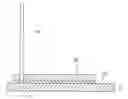
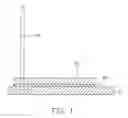
FIG. 1 is a schematic view of a dicing process in accordance with a preferred embodiment.
DETAILED DESCRIPTION OF THE EMBODIMENTSReferring to FIG. 1, a method for dicing glass substrate according to a preferred embodiment includes the following steps. A base 10 is provided. The base 10 is made of a rigid material, for example, glass. A water-soluble adhesive 20 is coated onto the base 10. In the illustrated embodiment, the water-soluble adhesive 20 is a water-soluble ultraviolet (UV) adhesive. A glass substrate 30 is placed on the water-soluble adhesive 20. In this state, the adhesion of the water-soluble adhesive 20 is weak. The water-soluble adhesive 20 can be hardened by an exposure source (not shown). In the illustrated embodiment, the exposure source can be an ultraviolet lamp. In this state, the water-soluble adhesive 20 has sufficient adhesive power to fix the glass substrate 30 to the water-soluble adhesive 20. The glass substrate 30 is diced according to a predetermined plan by a dicing saw 40 to form small cut pieces. The water-soluble adhesive 20 has sufficient adhesive power to hold the glass substrate 30 in place during dicing. Water (not shown) can be used to dissolve the hardened water-soluble adhesive 20. In this state, the adhesion of the water-soluble adhesive 20 decreases, making it easy to remove the cut pieces.
In the above-described dicing processes, the glass substrate 30 is held on the base 10 by the hardened water-soluble adhesive 20 thus preventing relative movement between the glass substrate 30 and the base 10. At the same time, both the hardened water-soluble adhesive 20 and the base 10 are relatively rigid, this reduces the deformation of the hardened water-soluble adhesive 20 by pressure from the dicing saw 40 and thus eliminates chipping. Accordingly, the present method can contribute significantly to improving the production yield.
Although a glass substrate is used in the above-described embodiment, this method of dicing glass substrate can also be applied to ceramic, quartz or rock crystal substrates.
It is believed that the present embodiments and their advantages will be understood from the foregoing description, and it will be apparent that various changes may be made thereto without departing from the spirit and scope of the invention or sacrificing all of its material advantages, the examples hereinbefore described merely being preferred or exemplary embodiments of the invention.
Claims
What is claimed is:1. A method for dicing a sheet workpiece, comprising the steps of:
providing a base;
coating a water-soluble adhesive onto the base, and placing the workpiece on the water-soluble adhesive;
hardening the water-soluble adhesive so as to fix the workpiece on the base;
dicing the workpiece; and
dissolving the hardened water-soluble adhesive.
2. The method as claimed in claim 1, wherein the base is made of glass.
3. The method as claimed in claim 1, wherein the water-soluble adhesive is a water-soluble ultraviolet adhesive.
4. The method as claimed in claim 1, wherein the water-soluble adhesive is hardened by an exposure source.
5. The method as claimed in claim 1, wherein the water-soluble adhesive is hardened by exposure to ultraviolet light.
6. The method as claimed in claim 1, wherein the workpiece is diced by a dicing saw to form cut pieces.
7. The method as claimed in claim 6, further comprising a step of removing the cut pieces from the water-soluble adhesive.
8. The method as claimed in claim 1, wherein the hardened water-soluble adhesive dissolves in water.
9. The method as claimed in claim 1, wherein the workpiece is a glass substrate.
Images & Drawings included:
Sources:
- United States Patent and Trademark Office - verify current appl. status at the USPTO↗
Similar patent applications:
Recent applications in this class:
- » 20250162200 2025-05-22
FIXING JIG AND SUBSTRATE PROCESSING APPARATUS INCLUDING THE SAME - » 20250162199 2025-05-22
FULLY-AUTOMATIC MULTI-STATION CUTTING MACHINE AND METHOD FOR CUTTING MATERIAL - » 20250073956 2025-03-06
HOLDING MECHANISM OF SLICER, CRYSTAL BAR CONVEYING STRUCTURE AND SLICER - » 20250026041 2025-01-23
LOWER JACKING MEMBER, WIRE WITHDRAWAL METHOD, AND SQUARING MACHINE - » 20240269893 2024-08-15
BRICK LOADING/UNLOADING APPARATUS AND METHOD - » 20240253271 2024-08-01
SYSTEM AND METHOD FOR SQUARING INGOT - » 20240198559 2024-06-20
METHOD FOR FIXING A MATERIAL BLOCK FOR MECHANICAL MACHINING - » 20230302683 2023-09-28
METHOD FOR CUTTING SUBSTRATE ELEMENTS - » 20230042659 2023-02-09
COMPLEX PHOTONICS CIRCUIT FABRICATION - » 20210387379 2021-12-16
AUTOMATED GEMSTONE DETACHMENT
Recent applications for this Assignee:
- » 20140363586 2014-12-11
Laser-based method for growing an array of carbon nanotubes - » 20140299819 2014-10-09
Method for making a carbon nanotube film - » 20140199855 2014-07-17
Method for making a carbon nanotube film - » 20110171419 2011-07-14
Electronic element having carbon nanotubes - » 20110110535 2011-05-12
Carbon nanotube speaker - » 20110101832 2011-05-05
SECURING MECHANISM AND ELECTRONIC DEVICE ENCLOSURE USING THE SAME - » 20110096516 2011-04-28
SUPPORTING ASSEMBLY FOR PRINTED CIRCUIT BOARD - » 20110096473 2011-04-28
Electronic device - » 20110093746 2011-04-21
System and method for determining display function of BIOS error information - » 20110073276 2011-03-31
Heat dissipation system