Biochip substrate holding method and biochip-reader
US20070122834A1
2007-05-31
11/647,138
2006-12-29
Abstract:
The present invention is characterized by the following points: In measurement of a biochip whose substrate is held on a base and samples are spotted onto the sites in an array on the substrate, a biochip substrate holding method, which does not generate deviation of site positions between the arrangement of multiple samples on the biochip and mounting of the biochip onto the biochip-reader and does not need position aligning, can be provided by holding the biochip substrate with equivalent holding mechanisms in spotting and in measurement respectively. A biochip-reader using the above mentioned method can also be provided.
Assignee:
- YOKOGAWA ELECTRIC CORPORATION 1,302 🇯🇵 Tokyo, Japan
Interested in similar patents?
Get notified when new applications in this technology area are published.
Classification:
G01N35/00029 » CPC main
Automatic analysis not limited to methods or materials provided for in any single one of groups - ; Handling materials therefor provided with flat sample substrates, e.g. slides
B01L9/52 » CPC further
Supporting devices; Holding devices Supports specially adapted for flat sample carriers, e.g. for plates, slides, chips
B01J2219/00378 » CPC further
Chemical, physical or physico-chemical processes in general; Their relevant apparatus; Sequential or parallel reactions; Apparatus and devices for combinatorial chemistry or for making arrays; Chemical library technology; Apparatus; Means for dispensing and evacuation of reagents Piezo-electric or ink jet dispensers
B01J2219/00387 » CPC further
Chemical, physical or physico-chemical processes in general; Their relevant apparatus; Sequential or parallel reactions; Apparatus and devices for combinatorial chemistry or for making arrays; Chemical library technology; Apparatus; Means for dispensing and evacuation of reagents Applications using probes
B01J2219/00527 » CPC further
Chemical, physical or physico-chemical processes in general; Their relevant apparatus; Sequential or parallel reactions; Apparatus and devices for combinatorial chemistry or for making arrays; Chemical library technology; Apparatus; Features relating to the solid phase supports Sheets
B01J2219/00585 » CPC further
Chemical, physical or physico-chemical processes in general; Their relevant apparatus; Sequential or parallel reactions; Apparatus and devices for combinatorial chemistry or for making arrays; Chemical library technology; Features relative to the processes being carried out Parallel processes
B01J2219/00596 » CPC further
Chemical, physical or physico-chemical processes in general; Their relevant apparatus; Sequential or parallel reactions; Apparatus and devices for combinatorial chemistry or for making arrays; Chemical library technology; Features relative to the processes being carried out Solid-phase processes
B01J2219/00605 » CPC further
Chemical, physical or physico-chemical processes in general; Their relevant apparatus; Sequential or parallel reactions; Apparatus and devices for combinatorial chemistry or for making arrays; Chemical library technology; Features relative to the processes being carried out; Making arrays on substantially continuous surfaces the compounds being directly bound or immobilised to solid supports
B01J2219/00612 » CPC further
Chemical, physical or physico-chemical processes in general; Their relevant apparatus; Sequential or parallel reactions; Apparatus and devices for combinatorial chemistry or for making arrays; Chemical library technology; Features relative to the processes being carried out; Making arrays on substantially continuous surfaces the compounds being directly bound or immobilised to solid supports the surface being inorganic
B01J2219/00659 » CPC further
Chemical, physical or physico-chemical processes in general; Their relevant apparatus; Sequential or parallel reactions; Apparatus and devices for combinatorial chemistry or for making arrays; Chemical library technology; Features relative to the processes being carried out; Making arrays on substantially continuous surfaces Two-dimensional arrays
B01J2219/00677 » CPC further
Chemical, physical or physico-chemical processes in general; Their relevant apparatus; Sequential or parallel reactions; Apparatus and devices for combinatorial chemistry or for making arrays; Chemical library technology; Features relative to the processes being carried out; Making arrays on substantially continuous surfaces Ex-situ synthesis followed by deposition on the substrate
B01J2219/00693 » CPC further
Chemical, physical or physico-chemical processes in general; Their relevant apparatus; Sequential or parallel reactions; Apparatus and devices for combinatorial chemistry or for making arrays; Chemical library technology; Means for controlling the apparatus of the process Means for quality control
B01J2219/00722 » CPC further
Chemical, physical or physico-chemical processes in general; Their relevant apparatus; Sequential or parallel reactions; Apparatus and devices for combinatorial chemistry or for making arrays; Chemical library technology; Type of compounds synthesised; Organic compounds Nucleotides
B01J2219/00725 » CPC further
Chemical, physical or physico-chemical processes in general; Their relevant apparatus; Sequential or parallel reactions; Apparatus and devices for combinatorial chemistry or for making arrays; Chemical library technology; Type of compounds synthesised; Organic compounds Peptides
B01L3/0244 » CPC further
Containers or dishes for laboratory use, e.g. laboratory glassware ; Droppers; Burettes; Pipettes; Drop counters; Drop formers using pins
B01L3/0268 » CPC further
Containers or dishes for laboratory use, e.g. laboratory glassware ; Droppers; Burettes; Pipettes; Drop counters; Drop formers using pulse dispensing or spraying, eg. inkjet type, piezo actuated ejection of droplets from capillaries
B01L2200/025 » CPC further
Solutions for specific problems relating to chemical or physical laboratory apparatus; Adapting objects or devices to another Align devices or objects to ensure defined positions relative to each other
B01L2300/0819 » CPC further
Additional constructional details; Geometry, shape and general structure rectangular shaped Microarrays; Biochips
G01N35/1011 » CPC further
Automatic analysis not limited to methods or materials provided for in any single one of groups - ; Handling materials therefor; Devices for transferring samples to, in, or from, the analysis apparatus, e.g. suction devices, injection devices; Characterised by arrangements for controlling the aspiration or dispense of liquids Control of the position or alignment of the transfer device
G01N2035/00158 » CPC further
Automatic analysis not limited to methods or materials provided for in any single one of groups - ; Handling materials therefor provided with flat sample substrates, e.g. slides; Characterised by type of test elements Elements containing microarrays, i.e. "biochip"
G01N2035/0491 » CPC further
Automatic analysis not limited to methods or materials provided for in any single one of groups - ; Handling materials therefor using a plurality of sample containers moved by a conveyor system past one or more treatment or analysis stations; Details of the conveyor system; Details of actuating means for conveyors or pipettes Position sensing, encoding; closed-loop control
C12Q1/68 IPC
Measuring or testing processes involving enzymes, nucleic acids or microorganisms ; Compositions therefor; Processes of preparing such compositions involving nucleic acids
C12M3/00 IPC
Tissue, human, animal or plant cell, or virus culture apparatus
G06K7/10 IPC
Methods or arrangements for sensing record carriers, e.g. for reading patterns by electromagnetic radiation, e.g. optical sensing; by corpuscular radiation
Description
This application is a divisional of application Ser. No. 10/928,184, filed Aug. 30, 2004.
BACKGROUND OF THE INVENTION1. Field of the Invention
The present invention relates to a biochip substrate holding method and a biochip-reader using the above mentioned method, and in more detail, to a holding method in which positions of biochip sites can be arranged in a good repeatability and a biochip-reader using the above mentioned method.
2. Description of the Prior Art
There are conventional biochip-readers which are configured to read fluorescence generated from a sample by irradiating exciting light such as laser light onto the sample in each biochip site (for example, refer to Patent Document 1).
These conventional biochip-readers include scanning types (scan type) that use a microlens array in which a plurality of microlenses is arranged and the irradiating beam is scanned after passing through the microlenses, or non-scanning types (scan-less type) that use no scanning, or those that do not use a microlens-array.
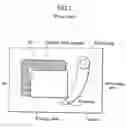
In all of these biochip-readers, a substrate used for biochips (hereinafter called the biochip substrate or simply the substrate) is normally fixed to a base using a sample holder adopted for microscopes or its equivalent. FIG. 1 shows an example of the above sample holder mechanism. The sample holder is (as shown in FIG. 1) equipped with glass slide support 2 and pivoting arm 4 which is mounted so as to enable it to pivot via coupling 3 on base 1 and is used to press end faces 5a and 5b of the two sides of rectangular glass slide (equivalent to the biochip substrate) 5, adjacent to each other, to glass slide support 2 using the action of a spiral spring (not shown in the drawing) provided in coupling 3 (for example, refer to Patent Document 2).
[Patent Document 1]
-
- Gazette for Japanese Laid-open Patent Application No. 2003-028799
[Patent Document 2]
-
- Gazette for Japanese Laid-open Patent Application No. 10-39230
However, conventional sample holders have the following disadvantages:
- (1) Because the positioning mechanism of sample holders is insufficient in biochip mounting and dismounting, positions of biochip sites deviate in directions of x, y, and/or z (the directions of x and y are those orthogonal to the optical axis and the direction of z is the direction of the optical axis itself). This necessitates position-locating after mounting.
- (2) In the case of a scan-less type, positions of microlenses deviate from positions of sites and thus position-aligning becomes necessary.
- (3) Even if the sample holder is not a scan-less type, deviation of positions must be corrected using pattern recognition or the like.
- (4) Since, for biochip substrates, accuracy in their external dimensions is not very precise that their sides are not straight and the adjacent two sides are also not perpendicular to each other, positioning using glass slide support 2 of the above mentioned sample holder and pivoting arm 4 is not exact, and its repeatability is low, introducing no exact positioning.
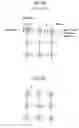
- (5) Since the biochip fixing scheme when samples are spotted to each site of a biochip is different from the biochip fixing scheme used in the sample holder, in the case of a scan-less type, deviations (in the directions of x, y, and θ) are generated between sites 6 and corresponding light beam irradiation positions 7, as shown in FIG. 2(a). In addition, θ shows the angle formed in the surface of the biochip substrate 14, which is orthogonal of the optical axis. Each site and corresponding light beam irradiation position must coincide with the other as shown in FIG. 2(b).
The objective of the present invention is to solve the above problems and so to offer a biochip substrate holding method which does not cause deviation of site positions during measurement, and thus does not require position-aligning by making holding mechanisms of biochip substrate equal both in arranging multiple samples on a biochip and in mounting a biochip to a biochip-reader, and to offer a biochip-reader using the above mentioned method.
BRIEF DESCRIPTION OF DRAWINGS[FIG. 1]
FIG. 1 is a configuration drawing indicating an example of conventional sample holders.
[FIG. 2]
FIG. 2 is a drawing showing the relationship between site positions and corresponding light beam irradiation positions on a biochip substrate.
[FIG. 3]
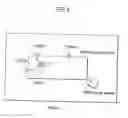
FIG. 3 is a configuration drawing indicating an embodiment of the substrate holding mechanism for achieving the biochip holding method concerning the present invention.
[FIG. 4]
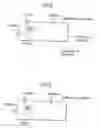
FIG. 4 gives two bird's-eye views of a biochip substrate holding mechanism of the present invention.
[FIG. 5]
FIG. 5 is a drawing indicating another embodiment of a biochip substrate holding mechanism of the present invention.
[FIG. 6]
FIG. 6 is a drawing indicating further another embodiment of a biochip substrate holding mechanism of the present invention.
DESCRIPTION OF THE PREFERRED EMBODIMENTSThe present invention will be described below in detail using drawings. FIG. 3 is a configuration drawing indicating an embodiment of the substrate holding mechanism for achieving the biochip holding method concerning the present invention.
In FIG. 3, numeral 10 denotes a base, numerals 11, 12 and 13 denote stays attached to base 10, numeral 14 a biochip substrate (hereafter simply called “substrate”) on which multiple samples are arranged in an array, numeral 15 denotes sites on substrate 14, and numeral 16 a pressing means.
Stays 11 to 13 are fixed to base 10 so that the side faces of two adjacent sides of substrate 14 mounted onto base 1 touch these stays. These stays are formed with round columns or cylinders (for example, pins) and configure point contacts with side faces of substrate 14.
Pressing means 16 applies a pressing force in an oblique direction towards the touching sides from the corner where two sides, not being the touching sides, cross each other, when substrate 14 is touched to the three stays.
In such a construction, if two adjacent sides of substrate 14 are pressed to stays 11 to 13, substrate 14 is always mounted on the predetermined position of base 10 with good repeatability, without being affected by the bend of the sides or the angle between two sides because substrate 14 contacts with these three points only.
In this case, as shown in FIG. 4, the substrate is held using essentially the same three-point contact structure either in spotting of biochip samples (FIG. 4(a)) or during measurements with the reader (FIG. 4(b)). Employing the above structure eliminates the generation of deviation in site positions when measurement is made.
Further, the present invention is not restricted to the above embodiment but may be embodied in other specific forms, changes, and versions without departing from the true spirit thereof.
For example, it is also acceptable to apply the pressing force by pressing means 16 in two directions perpendicular to each side of two sides orthogonal to each other as shown in FIG. 5, not the oblique direction as described in the above embodiment.
Further, the external shape of stays 11 to 13 is not limited to a round type but may be polygonal, for example, triangular as shown in FIG. 6. However, their edges must be touching in point contacts with the biochips.
In addition, DNA, RNA, proteins, and bio-metabolites (low-molecular materials in living bodies other than protein) and the like are used as samples.
Further, spotting of samples to the sites of a biochip can be carried out using pin, ink-jet, electrostatic adsorption and the like by holding a substrate with the substrate holding mechanism of the present invention.
Furthermore, a substrate which is the object of holding may be a glass slide or a cartridge.
As apparent from the above description, the present invention has the following effects:
- (1) Positional deviation during measurement using a reader can be minimized by making the biochip substrate holding mechanism of the reader agree with the holding mechanism when samples are spotted onto a biochip substrate.
- (2) It is not necessary to perform adjustment of site position-aligning and pattern matching based on images required in conventional readers.
- (3) Since the biochip substrate is supported at three points, good supporting reproducibility can be easily obtained without being affected by the linearity of substrate sides and orthogonality of two sides, or the like.
- (4) Glass slides or synthetic-resin or cartridges can be used as biochip substrates.
Claims
What is claimed is:1. A biochip-reader which is constructed to use a biochip, on which samples are arranged in the sites located in an array respectively, as a measuring object, to irradiate samples with a light beam, and to read reflected light from the samples;
further configured so that the positions of said sites agree with corresponding light beam irradiation positions by making a biochip substrate holding mechanism in a biochip-reader essentially agree with said biochip substrate holding mechanism in arranging multiple samples on said biochip.
2. A biochip-reader in accordance with claim 1, wherein said biochip substrate holding mechanism is a three-point holding mechanism which holds said biochip substrate by supporting said substrate in a three-point contact by touching the adjacent two sides of said biochip substrate to three stays fixed to the surface of the base and by applying a pressing force from the opposite corner where the other two sides of said biochip substrate cross each other.
3. A biochip-reader in accordance with claim 1, wherein said samples include DNA or RNA or proteins or glyco-chains or bio-metabolites.
4. A biochip-reader in accordance with claim 2, wherein said samples include DNA or RNA or proteins or glyco-chains or bio-metabolites.
5. A biochip-reader in accordance with claim 1, wherein the pressing force applied to hold said biochip substrate is an oblique one-directional pressing force from the corner where said two sides cross each other or pressing forces in two directions perpendicular to each of said two sides respectively.
6. A biochip-reader in accordance with claim 2, wherein the pressing force applied to hold said biochip substrate is an oblique one-directional pressing force from the corner where said two sides cross each other or pressing forces in two directions perpendicular to each of said two sides respectively.
7. A biochip-reader in accordance with claim 3, wherein the pressing force applied to hold said biochip substrate is an oblique one-directional pressing force from the corner where said two sides cross each other or pressing forces in two directions perpendicular to each of said two sides respectively.
8. A biochip reader in accordance with claim 4, wherein the pressing force applied to hold said biochip substrate is an oblique one-directional pressing force from the corner where said two sides cross each other or pressing forces in two directions perpendicular to each of said two sides respectively.
9. A biochip-reader in accordance with claim 1, wherein said stays have a round shape or polygonal external shape and are formed to contact with said biochip substrate in the point contact respectively.
10. A biochip-reader in accordance with claim 2, wherein said stays have a round shape or polygonal external shape and are formed to contact with said biochip substrate in the point contact respectively.
11. A biochip-reader in accordance with claim 3, wherein said stays have a round shape or polygonal external shape and are formed to contact with said biochip substrate in the point contact respectively.
12. A biochip-reader in accordance with claim 4, wherein said stays have a round shape or polygonal external shape and are formed to contact with said biochip substrate in the point contact respectively.
13. A biochip-reader in accordance with claim 5, wherein said stays have a round shape or polygonal external shape and are formed to contact with said biochip substrate in the point contact respectively.
14. A biochip-reader in accordance with claim 6, wherein said stays have a round shape or polygonal external shape and are formed to contact with said biochip substrate in the point contact respectively.
15. A biochip-reader in accordance with claim 7, wherein said stays have a round shape or polygonal external shape and are formed to contact with said biochip substrate in the point contact respectively.
16. A biochip-reader in accordance with claim 8, wherein said stays have a round shape or polygonal external shape and are formed to contact with said biochip substrate in the point contact respectively.
Images & Drawings included:

Sources:
- United States Patent and Trademark Office - verify current appl. status at the USPTO↗
Similar patent applications:
- » 20050136533
Biochip substrate holding method and biochip-reader
Recent applications in this class:
- » 20250172578 2025-05-29
AUTOMATED SPECIMEN DEPOSITION SYSTEMS AND ASSOCIATED METHODS - » 20250138034 2025-05-01
METHOD AND SYSTEM FOR AUTOMATED RETRIEVAL AND SCANNING OF GLASS SLIDES WITHIN A RESTRICTED SPATIAL ENVIRONMENT - » 20250076326 2025-03-06
MICROPLATE TRANSFER APPARATUS AND MODULARIZED LIQUID-PHASE EQUIPMENT - » 20250067760 2025-02-27
AUTOMATED SLIDE PROCESSING SYSTEMS, CONSUMABLE SLIDE PROCESSING MODULES, AND REAGENT CARTRIDGES - » 20250044309 2025-02-06
ARRANGEMENT AND METHOD FOR SEPARATING A SINGLE TEST STRIP - » 20250044308 2025-02-06
TRANSPORT ARRANGEMENT AND METHOD FOR TRANSPORTING A TEST STRIP - » 20250020677 2025-01-16
PATHOLOGY SLIDE AUTOMATION SYSTEM AND METHOD - » 20250012822 2025-01-09
HIGH THROUGHPUT SYSTEM FOR PERFOMING ASSAYS USING ELECTROCHEMILUMINESCENCE INCLUDING A CONSUMABLE SHAKING APPARATUS - » 20240402198 2024-12-05
MEDICAL TEST STRIP ANALYSIS - » 20240369584 2024-11-07
MULTI/PARALLEL SCANNER
Recent applications for this Assignee:
- » 20250172492 2025-05-29
GAS ANALYZER AND GAS ANALYSIS METHOD - » 20250155320 2025-05-15
OPTICAL TIME-DOMAIN REFLECTOMETER AND PROGRAM - » 20250144634 2025-05-08
HEAT TRANSFER DEVICE, HEATING DEVICE, AND PROCESSING DEVICE - » 20250137917 2025-05-01
SAMPLE CONTAINER HOLDING DEVICE - » 20250135461 2025-05-01
SAMPLE CONTAINER HOLDING DEVICE - » 20250111644 2025-04-03
IMAGE ANALYSIS APPARATUS, IMAGE ANALYSIS METHOD, AND COMPUTER-READABLE RECORDING MEDIUM - » 20250100419 2025-03-27
BATTERY STATE DETERMINATION METHOD AND BATTERY STATE DETERMINATION SYSTEM - » 20250079822 2025-03-06
MEASUREMENT APPARATUS, MEASUREMENT SYSTEM, AND PROGRAM - » 20250076341 2025-03-06
CURRENT MEASUREMENT APPARATUS - » 20250076113 2025-03-06
SPECTROSCOPIC ANALYSIS DEVICE AND SPECTROSCOPIC ANALYSIS METHOD