COMPOSITE DIAMOND COMPACTS
US20070130838A1
2007-06-14
11/673,632
2007-02-12
Abstract:
A composite diamond compact is provided which has a diamond compact (12) bonded to a cemented carbide substrate (10). The composite diamond compact is characterised by the second phase for the diamond compact (12) and the binder for the cemented carbide substrate (10) both being a nickel/cobalt alloy.
Interested in similar patents?
Get notified when new applications in this technology area are published.
Classification:
B24D3/06 » CPC main
Physical features of abrasive bodies, or sheets, e.g. abrasive surfaces of special nature; Abrasive bodies or sheets characterised by their constituents the constituent being used as bonding agent and being essentially inorganic metallic or mixture of metals with ceramic materials, e.g. hard metals, "cermets", cements
B22F7/008 » CPC further
Manufacture of composite layers, workpieces, or articles, comprising metallic powder, by sintering the powder, with or without compacting wherein at least one part is obtained by sintering or compression characterised by the composition
C09K3/1409 » CPC further
Materials not provided for elsewhere; Anti-slip materials; Abrasives Abrasive particles
C22C26/00 » CPC further
Alloys containing diamond or cubic or wurtzitic boron nitride, fullerenes or carbon nanotubes
B22F2005/001 » CPC further
Manufacture of workpieces or articles from metallic powder characterised by the special shape of the product Cutting tools, earth boring or grinding tool other than table ware
Y10T83/0414 » CPC further
Cutting; Processes; With preparatory or simultaneous ancillary treatment of work; By heating or cooling At localized area [e.g., line of separation]
Y10T408/81 » CPC further
Cutting by use of rotating axially moving tool Tool having crystalline cutting edge
Y10T428/30 » CPC further
Stock material or miscellaneous articles Self-sustaining carbon mass or layer with impregnant or other layer
B22F2998/00 » CPC further
Supplementary information concerning processes or compositions relating to powder metallurgy
B22F7/06 » CPC further
Manufacture of composite layers, workpieces, or articles, comprising metallic powder, by sintering the powder, with or without compacting wherein at least one part is obtained by sintering or compression of composite workpieces or articles from parts, e.g. to form tipped tools
B24D18/00 IPC
Manufacture of grinding tools or other grinding devices , e.g. wheels, not otherwise provided for
C09K3/14 IPC
Materials not provided for elsewhere Anti-slip materials; Abrasives
Description
BACKGROUND OF THE INVENTIONThis invention relates to composite diamond compacts.
Diamond compacts, also known as polycystalline diamond or PCD, are well known in the art and are used extensively in cutting, milling, drilling and other abrasive operations. Diamond compacts are polycrystalline in nature and contain a high diamond content. Diamond compacts may be produced without the use of a second or bonding phase, but generally contain such a phase. When such a phase is present, the dominant component of the phase is generally a diamond catalyst/solvent such as cobalt, nickel or iron or a combination thereof.
Diamond compacts are manufactured under elevated temperature and pressure conditions, i.e. conditions similar to those which are used for the synthesis of diamond.
Diamond compacts tend to be brittle and so in use they are usually bonded to a substrate, the substrate generally being a cemented carbide substrate. Bonding of the diamond compact to the substrate will generally take place during the manufacture of the compact itself. Diamond compacts bonded to a substrate are known as composite diamond compacts.
Composite diamond compacts are used in a variety of applications and, in particular, in drilling applications. The bonding phase for such composite diamond compacts is generally cobalt. Cobalt undergoes a phase transformation at temperatures above about 400° C. This gives rise to problems in the use of composite diamond compacts in drilling applications where temperatures of the order of 700° C. or higher are encountered at the cutting edge of such compacts. The phase transformation of the cobalt at these temperatures results in thermal fatigue craze cracking and snake skin cracking of the composite compacts during drilling applications.
SUMMARY OF THE INVENTIONAccording to the present invention, a composite diamond compact comprises a diamond compact bonded to a cemented carbide substrate, the diamond compact comprising a polycrystalline bonded mass of diamond crystals present in an amount of at least 80 percent by volume of the compact and a second phase consisting essentially of a nickel/cobalt alloys and the cemented carbide substrate comprising a mass of carbide particles bonded into a coherent form by means of a binder consisting essentially of a nickel/cobalt alloy.
Further according to the invention, there is provided the use of a composite diamond compact as described above in the abrasive applications where temperatures in excess of 500° C. are encountered at a cutting edge provided on the compact.
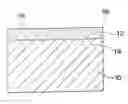
BRIEF DESCRIPTION OF THE DRAWINGThe drawing is a sectional side view of an embodiment of a composite diamond compact of the invention.
DESCRIPTION OF EMBODIMENTSThe composite diamond compact of the invention is characterised by the alloy which is present in the diamond compact and in the cemented carbide substrate. The alloy in both layers consists essentially of a nickel/cobalt alloy. This means that the components of the alloy will consist essentially of nickel and cobalt with other components being present in trace or minor amounts only. It has been found that a composite diamond compact of this nature has a significantly lower tendency to failure through delamination than prior art composite diamond compacts. Braze delamination occurs when composite abrasive compacts are brazed into drill bits. The typical braze alloys used are zinc containing alloys. Zinc corrosion attack of cobalt binder in the substrate together with residual stresses in the substrate causes delamination cracking during the bit brazing process. Further, the presence of nickel increases significantly the thermal fatigue resistance of the compact and reduces the tendency for snake skin cracking to occur during operations such as drilling where temperatures of the order of 700° C. or higher are encountered.
Thus, the invention also provides the use of a composite abrasive compact in abrasive applications where temperatures in excess of 500° C. are encountered at a cutting edge of the compact. The cutting edge will generally be provided by the peripheral edge of the diamond compact. The abrasive applications may be cutting, drilling, milling or the like.
A mass ratio of nickel to cobalt in the alloy will generally range from 75:25 to 20:80 and preferably in the range 30:70 to 45:55. A typical example of an alloy is one containing a mass ratio of nickel to cobalt of 40:60. The carbide particles of the substrate may be tungsten carbide particles, tantalum carbide particles, titanium carbide particles, molybdenum carbide particles or a mixture containing two or more of such particles.
The composite diamond compact of the invention may be made by methods known in the art. More particularly, a mass of diamond particles may be placed on a surface of a cemented carbide substrate forming an unbonded assembly which is then subjected to diamond synthesis conditions. The alloy from the substrate infiltrates the diamond mass forming a diamond compact which bonds to the substrate. In one preferred form of the invention, a recess is formed in the cemented carbide substrate and the mass of diamond particles is placed in the recess. After formation of the diamond compact, the sides of the substrate may be removed to expose the diamond compact. The diamond synthesis conditions will typically be a pressure of 40 to 70 kilobars (4 to 7 GPa) and a temperature of 1300 to 1600° C. These conditions will typically be maintained for a period of 20 to 60 minutes.
An embodiment of the invention will now be described. A cylindrical cemented carbide substrate was provided. The substrate comprised a mass of tungsten carbide particles bonded into a coherent form by means of a nickel/cobalt alloy. The mass ratio of the nickel to cobalt in the alloy was 40:60.
A recess was formed in one flat end surface of the substrate. A mass of diamond particles was placed in the recess and filled the recess. This unbonded assembly was placed in the reaction zone of a conventional high temperature/high pressure apparatus and subjected to a temperature of out 1500° C. and a pressure of about 55 kilobars (5.5 GPa). These conditions were maintained for a period sufficient to produce a diamond compact of the diamond particles. During the formation of the compact, nickel/cobalt alloy from the substrate infiltrated the diamond mass and formed a second phase for the diamond compact. The diamond compact was bonded to the cemented carbide body.
The resulting product was removed from the apparatus and the sides of the cemented carbide substrate removed. The resulting product is illustrated by the accompanying drawing and consisted of a diamond compact 12 bonded to a cemented carbide substrate 10 along interface 14. The diamond compact 12 had a second phase consisting essentially of a nickel/cobalt alloy and the cemented carbide substrate 10 had a binder consisting essentially of the same alloy. The diamond compact 12 has an upper working surface 16 and a peripheral cutting edge 18.
The composite abrasive compact illustrated by the drawing may be used as a drill insert. In use, the cutting edge 18 performs a cutting action in drilling and in hare rocks temperatures in excess of 500° C. are encountered. Due to the presence of the nickel/cobalt alloy in both the diamond compact and in the cemented carbide substrate, the thermal fatigue resistance of the composite compact is increased and there is reduction in the tendency for snake skin cracking to occur, as is a common problem with prior art composite compacts using cobalt as the binder alloy.
Claims
1. A composite diamond compact comprising
a diamond compact bonded to a cemented carbide substrate,
the diamond compact comprising
a polycrystalline bonded mass of diamond crystals present in an amount of at least 80 percent by volume of the diamond compact and
a second phase consisting essentially of a nickel/cobalt alloy,
the cemented carbide substrate comprising a mass of carbide particles bonded into a coherent form by means of a binder consisting essentially of a nickel/cobalt alloy.
2. The composite diamond compact according to claim 1, wherein the mass ratio of nickel to cobalt in both of the nickel/cobalt alloys is in the range 75:25 to 20:80.
3. The composite diamond compact according to claim 1, wherein the mass ratio of nickel to cobalt in both of the nickel/cobalt alloys is in the range 30:70 to 45:55.
4. The composite diamond compact according to claim 1, wherein the mass ratio of nickel to cobalt in both of the nickel/cobalt alloys is 40:60.
5. The composite diamond compact according to claim 1, wherein the carbide particles of the substrate are selected from tungsten carbide particles, tantalum carbide particles, titanium carbide particles, molybdenum carbide particles and a mixture containing two or more of such particles.
6-7. (canceled)
8. The composite diamond compact according to claim 2, wherein the carbide particles of the substrate are selected from tungsten carbide particles, tantalum carbide particles, titanium carbide particles, molybdenum carbide particles and a mixture containing two or more of such particles.
9. The composite diamond compact according to claim 3, wherein the carbide particles of the substrate are selected from tungsten carbide particles, tantalum carbide particles, titanium carbide particles, molybdenum carbide particles and a mixture containing two or more of such particles.
10. The composite diamond compact according to claim 4, wherein the carbide particles of the substrate are selected from tungsten carbide particles, tantalum carbide particles, titanium carbide particles, molybdenum carbide particles and a mixture containing two or more of such particles.
11. A method for cutting comprising:
cutting with a composite diamond compact,
wherein the composite diamond compact comprises
a diamond compact bonded to a cemented carbide substrate,
the diamond compact comprising
a polycrystalline bonded mass of diamond crystals present in an amount of at least 80 percent by volume of the diamond compact and
a second phase consisting essentially of a nickel/cobalt alloy,
the cemented carbide substrate comprising a mass of carbide particles bonded into a coherent form by means of a binder consisting essentially of a nickel/cobalt alloy; and
wherein said cutting is carried out at a temperature in excess of 500° C. at a cutting edge of the composite diamond compact.
12. The method according to claim 11, wherein the mass ratio of nickel to cobalt in both of the nickel/cobalt alloys is in the range 75:25 to 20:80.
13. The method according to claim 11, wherein the mass ratio of nickel to cobalt in both of the nickel/cobalt alloys is in the range 30:70 to 45:55.
14. The method according to claim 11, wherein the mass ratio of nickel to cobalt in both of the nickel/cobalt alloys is 40:60.
15. The method according to claim 11, wherein the carbide particles of the substrate are selected from tungsten carbide particles, tantalum carbide particles, titanium carbide particles, molybdenum carbide particles and a mixture containing two or more of such particles.
Images & Drawings included:
Sources:
- United States Patent and Trademark Office - verify current appl. status at the USPTO↗
Similar patent applications:
- » 20220226965
POLYCRYSTALLINE DIAMOND COMPOSITE COMPACT ELEMENT, TOOLS INCORPORATING SAME AND METHOD FOR MAKING SAME - » 20060137257
Composite diamond compacts - » 20200180033
Polycrystalline diamond composite compact elements and methods of making and using same - » 20200353591
POLYCRYSTALLINE DIAMOND COMPOSITE COMPACT ELEMENT, TOOLS INCORPORATING SAME AND METHOD FOR MAKING SAME - » 20050155295
Composite diamond compacts - » 20080314214
COMPOSITE DIAMOND COMPACTS - » 20110024201
POLYCRYSTALLINE DIAMOND COMPOSITE COMPACT ELEMENTS AND TOOLS INCORPORATING SAME - » 20110061944
POLYCRYSTALLINE DIAMOND COMPOSITE COMPACT - » 20110253459
POLYCRYSTALLINE DIAMOND COMPOSITE COMPACT ELEMENT, TOOLS INCORPORATING SAME AND METHOD FOR MAKING SAME - » 20140262533
Polycrystalline diamond composite compact
Recent applications in this class:
- » 20250041994 2025-02-06
GRINDING TOOL - » 20240383104 2024-11-21
ASSEMBLIES AND METHODS OF FORMING POLYCRYSTALLINE DIAMOND USING SUCH ASSEMBLIES - » 20240293914 2024-09-05
GRINDING MEANS AND METHOD FOR PRODUCING THE GRINDING MEANS - » 20230373064 2023-11-23
BINDER COMPOSITIONS OF TUNGSTEN TETRABORIDE AND ABRASIVE METHODS THEREOF - » 20230219194 2023-07-13
ELECTRODEPOSITION WHETSTONE AND MANUFACTURING METHOD - » 20220105604 2022-04-07
ABRASIVE ARTICLE AND METHOD FOR FORMING - » 20220023996 2022-01-27
Binder compositions of tungsten tetraboride and abrasive methods thereof - » 20210362297 2021-11-25
METHODS OF MAKING METAL BOND AND VITREOUS BOND ABRASIVE ARTICLES, AND ABRASIVE ARTICLE PRECURSORS - » 20210094149 2021-04-01
Methods of making metal bond abrasive articles and metal bond abrasive articles - » 20200023494 2020-01-23
Abrasive article and method for forming