METHOD FOR MOUNTING A REMOVABLE DECORATIVE DEVICE ON A WALL
US20070131336A1
2007-06-14
11/676,040
2007-02-16
Abstract:
A desired fabric pattern is glued to a top surface of a polymeric crease resistant backing material and a threaded outline of the pattern is stitched to the backing material. The design pattern is cut away from the backing material not covered by the threaded outline and double sided sticky tape is applied to a back surface of the backing material so that the design pattern can be removably applied to a wall surface.
Interested in similar patents?
Get notified when new applications in this technology area are published.
Classification:
B44C1/18 » CPC main
Processes, not specifically provided for elsewhere, for producing decorative surface effects Applying ornamental structures, e.g. shaped bodies consisting of plastic material
B44C5/00 » CPC further
Processes for producing special ornamental bodies
B32B3/08 » CPC further
Layered products comprising a layer with external or internal discontinuities or unevennesses, or a layer of non-planar form ; Layered products having particular features of form characterised by features of form at particular places, e.g. in edge regions characterised by added members at particular parts
B32B3/10 » CPC further
Layered products comprising a layer with external or internal discontinuities or unevennesses, or a layer of non-planar form ; Layered products having particular features of form characterised by a discontinuous layer, i.e. formed of separate pieces of material
B32B5/06 » CPC further
Layered products characterised by the non- homogeneity or physical structure, i.e. comprising a fibrous, filamentary, particulate or foam layer; Layered products characterised by having a layer differing constitutionally or physically in different parts characterised by structural features of a layer characterised by a fibrous layer to another layer, e.g. of fibres, of paper
B32B7/06 » CPC further
Layered products characterised by the relation between layers; Layered products characterised by the relative orientation of features between layers, or by the relative values of a measurable parameter between layers, i.e. products comprising layers having different physical, chemical or physicochemical properties; Layered products characterised by the interconnection of layers; Interconnection of layers permitting easy separation
B32B7/12 » CPC further
Layered products characterised by the relation between layers; Layered products characterised by the relative orientation of features between layers, or by the relative values of a measurable parameter between layers, i.e. products comprising layers having different physical, chemical or physicochemical properties; Layered products characterised by the interconnection of layers; Interconnection of layers using interposed adhesives or interposed materials with bonding properties
B32B27/12 » CPC further
Layered products comprising synthetic resin next to a fibrous or filamentary layer
B32B27/32 » CPC further
Layered products comprising synthetic resin comprising polyolefins
B32B2262/02 » CPC further
Composition or structural features of fibres which form a fibrous or filamentary layer or are present as additives Synthetic macromolecular fibres
B32B2262/062 » CPC further
Composition or structural features of fibres which form a fibrous or filamentary layer or are present as additives; Vegetal fibres Cellulose fibres, e.g. cotton
B32B2307/748 » CPC further
Properties of the layers or laminate; Other properties Releasability
B32B2405/00 » CPC further
Particular articles
B32B2405/00 » CPC further
Adhesive articles, e.g. adhesive tapes
B32B2451/00 » CPC further
Decorative or ornamental articles
B32B2607/02 » CPC further
Walls, panels Wall papers, wall coverings
B32B7/08 IPC
Layered products characterised by the relation between layers; Layered products characterised by the relative orientation of features between layers, or by the relative values of a measurable parameter between layers, i.e. products comprising layers having different physical, chemical or physicochemical properties; Layered products characterised by the interconnection of layers; Interconnection of layers by mechanical means
Description
BACKGROUND OF THE INVENTIONThis application is a continuation in part from U.S. application Ser. No. 10/813,420, filed Mar. 30, 2004.
This invention relates to decorative devices mounted on a wall. More specifically, it refers to a method for making a sewn decorative pattern and removably mounting such pattern on a wall.
Picture kits such as described in U.S. Pat. No. 3,236,368 and various display boards as shown in U.S. Pat. Nos. 3,280,972 and 3,440,750 are well known and are useful for their intended purpose. However, none of these picture kits or display boards provide for mounting a given display pattern of defined edges on a wall surface from which the display pattern can be readily removed. A way to mount decorative displays on a child's room wall that can provide for movement to different locations without adult help is needed.
SUMMARY OF THE INVENTIONThe subject invention provides a solution to the problem stated by applying a desired decorative pattern to a front surface of a polymeric crease resistant backing material and then stitching the decorative pattern to the backing material. After extraneous backing material is cut away, the decorative pattern stitched to the backing material is completed. Applying doubled sided tape to the back surface of the polymeric backing material allows a child to stick the decorative pattern to a wall surface and easily remove it for transfer to another location without any residue surface impairment or product damage.
BRIEF DESCRIPTION OF THE DRAWINGSThe invention is best understood by those having ordinary skill in the art by reference to the following detailed description when considered with the accompanying drawings in which:
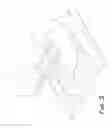
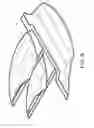
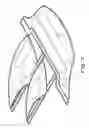
FIG. 1 is a perspective view of a polymeric backing material containing glue on a top surface.
FIG. 2 is an exploded view of a decorative design being glued to the polymeric backing material.
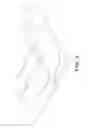
FIG. 3 is a perspective view of the decorative design glued to the polymeric backing material.
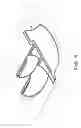
FIG. 4 is a perspective view of the decorative design stitched in place over the polymeric backing material.
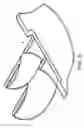
FIG. 5 is a perspective view of the decorative design including stitching cut away from extraneous portions of the polymeric backing material.
FIG. 6 is a perspective view of a back surface of the polymeric backing material containing double sided sticky tape.
FIG. 7 is a perspective view of back surface of the polymeric backing material with the double sided tape being removed for replacement.
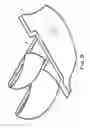
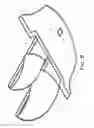
FIG. 8 is a perspective top surface view of the decorative design showing the placement of a voice or music chip.
FIG. 9 is a perspective view according to FIG. 8 with the chip sewn in place.
DETAILED DESCRIPTION OF THE BEST MODEThroughout the following detailed description, the same reference numerals refer to the same elements in all figures.
Referring to FIGS. 1-3, a decorative cloth pattern 10 is first applied with glue 12 to a top surface 14 of a crease resistant polymeric backing material 16 such as polypropylene. Various components of the decorative design pattern, as shown in FIG. 2, can be joined together on backing material 16 with glue 12. The components are one or more layers of a fabric material such as cotton or combinations of cotton fabric with polymeric fabric materials.
After the decorative pattern 10 is satisfactorily glued to backing material 16, the outline of the decorative pattern 10, as shown in FIG. 4, is stitched with thread 18. This prevents any loose ends of the fabric material from creating a frayed appearance. Carefully, the outline of the decorative pattern 10 is cut out of the polymeric backing material 16 so that extraneous backing material is discarded and only the back surface of the decorative pattern 10 contains backing material 16. The back surface 20 of the polymeric backing material 16 is shown in FIG. 6.
The stitching of the outline of the decorative pattern 10 is carried out by a stitching machine. The decorative pattern has a surface area of at least eighty square inches and in most instances has a significantly larger area so that large size designs can be prominently displayed on a vertical wall surface. It is noteworthy that the decorative pattern constitutes the entire wall mount and it is not necessary to attach the decorative pattern to additional backing materials which may contain only a portion of the decorative pattern.
Double sided tape 22 is applied at multiple locations on the bottom surface areas 20 of the backing material 16. Thereafter, the decorative pattern 10 can be applied by sticking its back surface 20 to a wall. The decorative design pattern 10 can be easily peeled from the wall by a child and applied to another wall surface. After numerous applications and removal of the decorative design pattern, the double sided tape 22 begins to lose its tackiness. As seen in FIG. 7, the double sided tape 22 is merely peeled off and replaced and the decorative pattern is again available for placement and removal from a wall surface.
Optionally, a micro chip 24 can be applied to the top surface 26 of the decorative pattern fabric 10. A piece of fabric 28 is then stitched 30 over the microchip 24. This microchip can be a source of music or voice activation for entertainment or education as desired.
Equivalent elements can be substituted for the elements described above to provide substantially the same results in substantially the same way to achieve substantially the same function.
Claims
Having disclosed the invention, what is claimed follows:1. A method for preparing a removable decorative design for mounting on a wall, the method comprising:
(a) applying glue to a top surface of a polymeric crease resistant backing material;
(b) adhering with the glue a desired fabric design pattern to the backing material top surface;
(c) stitching with thread an outline of the desired design pattern onto the backing material top surface;
(d) cutting the desired design pattern away from the backing material not covered by the threaded outline of the desired design pattern;
(e) applying double sided sticky tape to a back surface of the backing material; and
(f) directly attaching the decorative design by hand pressure to a wall surface, the decorative design adapted to be easily removed therefrom.
2. The method for preparing a removable decorative design according to claim 1 wherein the double sided sticky tape is removed and replaced after multiple uses.
3. The method for preparing a removable decorative design according to claim 1 wherein a voice or music chip is mounted on a top surface of the decorative design by stitching a fabric cover over the chip.
4. The method for preparing a removable decorative design according to claim 1 wherein the polymeric crease resistant backing material is provided as polypropylene.
5. The method for preparing a removable decorative fabric design according to claim 1 wherein the design pattern is provided as a cotton fabric.
6. The method for preparing a removable decorative design according to claim 1 wherein the design pattern is provided with a surface area of at least eighty square inches.
7. The method for preparing a removable decorative design according to Claim wherein the stitching is performed by a machine.
Images & Drawings included:


Sources:
- United States Patent and Trademark Office - verify current appl. status at the USPTO↗
Similar patent applications:
Recent applications in this class:
- » 20240383272 2024-11-21
Decorative Doorbell Cover Device - » 20240351365 2024-10-24
DIAMOND ART CANVAS - » 20210309046 2021-10-07
METHOD FOR MANUFACTURING DECORATIVE FILM FOR MOLDING, MOLDING METHOD, DECORATIVE FILM FOR MOLDING, MOLDED PRODUCT, AUTOMOBILE EXTERIOR PLATE, AND ELECTRONIC DEVICE - » 20210291582 2021-09-23
CASE FOR ELECTRONIC DEVICE, ELECTRONIC DEVICE INCLUDING SAME, AND METHOD FOR MANUFACTURING SAME - » 20200316985 2020-10-08
Gem applicator assembly - » 20190308444 2019-10-10
THREE-DIMENSIONAL APPLIQUE EFFECT - » 20180370276 2018-12-27
Decorated-part having a fine decoration using a laser processed groove - » 20180319204 2018-11-08
Decorative article featuring a microscopic periodic pattern and methods of making the same - » 20170136808 2017-05-18
Product comprising solid adhered to elastic member - » 20170120668 2017-05-04
REAR CASE FOR ELECTRONIC DEVICE