Machine For The Production Of A Finished Non-Woven
US20070212436A1
2007-09-13
10/575,299
2004-10-26
Abstract:
A machine for the production of a nonwoven, comprises a spun-bond tower and a conveyor, a consolidation device, a vacuum for expressing the moisture from the web, and an applicator for applying a product to the web downstream of the vacuum are provided.
Interested in similar patents?
Get notified when new applications in this technology area are published.
Classification:
D04H3/16 » CPC main
Non-woven fabrics formed wholly or mainly of yarns or like filamentary material of substantial length characterised by the method of strengthening or consolidating with bonds between thermoplastic filaments produced in association with filament formation, e.g. immediately following extrusion
D04H3/11 » CPC further
Non-woven fabrics formed wholly or mainly of yarns or like filamentary material of substantial length characterised by the method of strengthening or consolidating with bonds between yarns or filaments made mechanically by fluid jet
D04H18/04 » CPC further
Needling machines with water jets
D04H1/46 IPC
Non-woven fabrics formed wholly or mainly of staple fibres or like relatively short fibres from fleeces or layers composed of fibres without existing or potential cohesive properties the fleeces or layers being consolidated by mechanical means, e.g. by rolling by needling or like operations to cause entanglement of fibres
Description
The present invention relates to machines for the production of nonwovens, comprising one or more spun-bond towers and optionally one or more melt-blown heads depositing filaments and optionally fibres as a web onto a conveyor. The web thus deposited, and still fragile, is then sent to a water-jet consolidation station.
One drawback of these machines is that the web that emerges therefrom cannot be sent continuously to a product application unit.
The invention remedies this drawback.
The subject of the invention is therefore a machine for the continuous production of a nonwoven, comprising a spun-bond tower depositing filaments as a web onto a conveyor and a device for consolidating the web, characterized by a moisture-expressing means downstream, in the direction in which the web moves, of the consolidation device and by an applicator for applying a product to the web downstream of the expressing means.
According to one embodiment, the expressing means consists simply of a second conveyor over which the web passes, a vacuum device being provided between the upper and lower runs of said second conveyor, said device giving for example a vacuum of between 40 and 700 millibar and subjecting the web to a suction effect.
Thanks to this, it is now possible to make webs consisting of hydrophobic filaments, for example made of polypropylene, polyethylene or metallocene, to continuously undergo a subsequent treatment with a surfactant and/or a binder and/or a lubricant and/or a swelling agent and/or a dye, or a continuous printing operation, the expressing of the moisture being sufficient for the product applied by the applicator to be correctly applied to the web even if the latter consists of hydrophobic filaments.
The upper run of the second conveyor is given a length such that, depending on the speed with which the web passes, the moisture content of the web becomes less than 70% by weight, better still less than 50% and even better less than 20% upon exiting the second conveyor. This moisture content is in general between 10% and 70% by weight. Unlike what a drying unit would give, it is greater than 10%. In general, the residence time of the web on the second conveyor may be less than 2 seconds for a conveyor whose upper run has a length of for example 2m.
The machine may include, downstream of the product applicator, a device for drying the web, this drying device possibly being made less substantial by the fact that a good part of the moisture has already been expressed in the expressing means.
The product applicator is preferably a foam applicator or a lick-roll applicator or a spray applicator, these accommodating a residual moisture content of the web.
Preferably, for hygiene products, especially for nappies, the application takes place in longitudinal bands, thereby creating, for example, an alternation of hydrophilic and hydrophobic longitudinal regions.
In Patent Application EP-0 072 961 it is provided not to express the moisture from a nonwoven web, that is to say to expel some of the water by a mechanical means, but to dry a nonwoven web, that is to say to eliminate almost all of the water therefrom by a supply thermal energy.
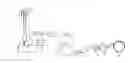
The single FIGURE of the appended drawing illustrates the invention.
The FIGURE is a schematic sectional representation of a machine according to the invention.
It comprises a spun-bond tower having an extruder for extruding an organic polymer melt that feeds a die 1 for producing a curtain of filaments F, a cooling zone 2 for solidifying the extruded filaments, at least on the surface, a suction device 3 in the form of a chamber in which the curtain of filaments is subjected to the action of high-velocity streams of air that draw the filaments, and a diffuser 4 allowing, at the exit of the suction device, the stream of air to be deflected and slowed down and the filaments F to be distributed in a random fashion as a web, which is deposited on the upper run 5 of an endless first conveyor 6. The filaments are in the form of a bundle of filaments F, lying perpendicular to the plane of the FIGURE.
Mounted above the upper run 5 is a horizontal drum 7 with an internal vacuum device shown symbolically by the letter A. The lateral surface of the drum 7 is perforated. The drum is rotated about its axis. The drum is surrounded by an apertured sleeve. Two injectors 8 project pressurized water jets onto the lateral face of the drum, it being possible for the web of filaments to pass between the drum 7 and the injectors 8 and thus to be consolidated. The jets may have a diameter of between 80 and 170 microns. The number of jets per metre may be between 1000 and 5000 and the water pressure in the injectors may be between 10 and 400 bar, while the vacuum in the drum 7 may be between minus 20 millibar and minus 200 millibar, and the drum 7 may be driven at a speed of between 1 and 400 m/min. The web then passes onto the upper run 9 of a second conveyor 10 in order to reach a second drum 11 of the same structure and same operation as the drum 7. From the drum 11, the web passes onto a drum 12 provided, like the drum 11, with injectors. The drum 12 is similar to the drum 11 in its structure and in its operation.
On leaving the drum 12, the web is sent directly to a third conveyor 15 provided with a moisture-expressing device 16, namely a box in which a 600-millibar vacuum is created, said box being interposed between the upper run and the lower run of the third conveyor 15. The upper face of the box has a slit extending transversely, facing the entire web passing over the conveyor and via which the moisture is sucked out therefrom. The upper run has a length of 3 m. The web passes along this at a speed of 200 m per minute.
Downstream of this conveyor is an applicator 17 for applying an ennobling product, which comprises an actual product application station 18, a drying station 19 and a wind-up station 20.
A ready-to-use nonwoven is thus continuously obtained.
Claims
1-5. (canceled)
6. A machine for the continuous production of a nonwoven, comprising a spun-bond tower depositing filaments as a web onto a conveyor and a device for consolidating the web, by water jets, characterized by a moisture-expressing means downstream, in the direction in which the web moves, of the consolidation device and by an applicator for applying a product to the web downstream of the expressing means.
7. A machine according to claim 6, wherein the expressing means comprises a vacuum device for subjecting the web to a suction effect.
8. A machine according to claim 7, wherein said vacuum device provides a vacuum of between about 40 millibar and about 700 millibar.
9. A machine according to claim 6, wherein the expressing means comprises a device for drying the web downstream of the product applicator.
10. A machine according to claim 6, wherein the product applicator is a foam applicator or a lick-roll applicator.
11. A machine according to claim 6, wherein the applicator is a device for applying longitudinal bands.
Images & Drawings included:

Sources:
- United States Patent and Trademark Office - verify current appl. status at the USPTO↗
Recent applications in this class:
- » 20250137179 2025-05-01
NON-WOVEN FABRIC, PRODUCTION METHOD FOR SAME, AND BUILDING MATERIAL - » 20250122656 2025-04-17
TUBE FOR MULTIROW COAXIAL MELT-BLOWN SYSTEM - » 20250066966 2025-02-27
MULTILAYER FABRIC INCLUDING A NON-WOVEN FABRIC - » 20250066965 2025-02-27
POLYESTER NONWOVEN FABRIC WITH SUPPRESSED REDUCTION IN PHYSICAL PROPERTIES BY TUFTING PROCESS, METHOD FOR MANUFACTURING SAME, AND BACKING FABRIC FOR CARPET COMPRISING SAME - » 20250059690 2025-02-20
APPARATUS AND METHOD TO PROVIDE A PATHOGENICIDAL BARRIER BETWEEN FIRST AND SECOND REGIONS - » 20250043476 2025-02-06
NONWOVEN FABRIC, SANITARY MATERIAL AND METHOD OF MANUFACTURING NONWOVEN FABRIC - » 20250003125 2025-01-02
MULTI-USE CLEANING TOWEL WITH IMPROVED QUAT EFFICACY - » 20240426035 2024-12-26
Shaped Nonwoven - » 20240417902 2024-12-19
SPUNBOND NONWOVEN FABRIC - » 20240301602 2024-09-12
ELECTRET MELT-BLOWN WEBS WITH IMPROVED FILTRATION PROPERTIES