Dental composition with improved light stability
US20080103229A1
2008-05-01
12/002,550
2007-12-18
✅ Patent granted
US 8,026,295 B2
2011-09-27
-
-
Tae H Yoon
2028-01-21
Abstract:
Dental composition having an improved light and thermal stability, including a mixture of at least a polymerizable resin, at least a polymerizable monomer, at least a polymerization initiator and/or a sensitizer and stabilizer, and at least an organic and/or inorganic filler and pigments in a content of 0 to 90 percent and at least one of the stable radicals.
Assignee:
- DENTSPLY International Inc. 209 🇺🇸 York, PA, United States
Interested in similar patents?
Get notified when new applications in this technology area are published.
Classification:
C07D211/94 » CPC further
Heterocyclic compounds containing hydrogenated pyridine rings, not condensed with other rings with a hetero atom directly attached to the ring nitrogen atom Oxygen atom, e.g. piperidine N-oxide
C08F265/04 » CPC further
Macromolecular compounds obtained by polymerising monomers on to polymers of unsaturated monocarboxylic acids or derivatives thereof as defined in group on to polymers of esters
C08F290/00 » CPC further
Macromolecular compounds obtained by polymerising monomers on to polymers modified by introduction of aliphatic unsaturated end or side groups
C08F290/06 » CPC further
Macromolecular compounds obtained by polymerising monomers on to polymers modified by introduction of aliphatic unsaturated end or side groups on to polymers modified by introduction of unsaturated end groups Polymers provided for in subclass
C08F291/00 » CPC further
Macromolecular compounds obtained by polymerising monomers on to macromolecular compounds according to more than one of the groups -
C08F293/005 » CPC further
Macromolecular compounds obtained by polymerisation on to a macromolecule having groups capable of inducing the formation of new polymer chains bound exclusively at one or both ends of the starting macromolecule using free radical "living" or "controlled" polymerisation, e.g. using a complexing agent
C08K5/3435 » CPC further
Use of organic ingredients; Nitrogen-containing compounds; Heterocyclic compounds having nitrogen in the ring having one nitrogen atom in the ring; Six-membered rings Piperidines
C08L51/003 » CPC further
Compositions of graft polymers in which the grafted component is obtained by reactions only involving carbon-to-carbon unsaturated bonds ; Compositions of derivatives of such polymers grafted on to macromolecular compounds obtained by reactions only involving unsaturated carbon-to-carbon bonds
C08L53/00 » CPC further
Compositions of block copolymers containing at least one sequence of a polymer obtained by reactions only involving carbon-to-carbon unsaturated bonds; Compositions of derivatives of such polymers
A61K6/887 » CPC main
Preparations for dentistry; Preparations for artificial teeth, for filling teeth or for capping teeth comprising natural or synthetic resins Compounds obtained by reactions only involving carbon-to-carbon unsaturated bonds
C08L25/00 » CPC further
Compositions of, homopolymers or copolymers of compounds having one or more unsaturated aliphatic radicals, each having only one carbon-to-carbon double bond, and at least one being terminated by an aromatic carbocyclic ring; Compositions of derivatives of such polymers
C08K5/34 IPC
Use of organic ingredients; Nitrogen-containing compounds Heterocyclic compounds having nitrogen in the ring
Description
RELATED APPLICATIONSThis is a continuation-in-part application of pending U.S. patent application Ser. No. 10/452,739 (Case KON-51B CON) filed on Jun. 2, 2003; which is a continuation application of U.S. patent application Ser. No. 09/754,162 (Case KON-51B) filed on Jan. 4, 2001 (abandoned); which was filed off of U.S. provisional patent application Ser. No. 60/183,269 (Case KON-51 B) filed on Feb. 17, 2000.
Claimed is a light curing dental composition with improved light sensitivity comprising prepolymers, macromonomers or polymers having at least one N-1-oxyl moiety, preferably a 4-Amino-2,2,6,6-tetramethylpiperidin-1 oxyl moiety.
TECHNICAL BACKGROUNDDental compositions comprise polymerizable acrylates and/or methacrylates that are stabilized against spontaneous polymerization by using of free-radical scavenger such as the well-known phenols 2,6-di-tert.-butyl-4-cresol (BHT), hydroquinone or hydroquinone monomethylether (HQME). On the other side they contains a photoinitiator that must be react sensible to visible or UV-light to photoinitiate the free-radical polymerization.
Light curing dental materials mostly are applied under the conditions of relatively strong operating lamps. Consequently, the international standards require that a dental composite remains stable under an illumination of 10,000 lux for 60 seconds (ISO 4049), that a dental pit and fissure sealant and a light activated water based cement remains stable under an illumination of 8,000 lux for 25 seconds (ISO 6874) and for 30 s (ISO 9917-2), respectively.
To improve light stability an optimization of the initiator/inhibitor system leads to lengthening the working times under the conditions of a dental practice. However, this optimization is limited and leads to minor reduction of light sensitivity only.
Recently, it was found, that stable organic radicals reduce the light sensitivity of a dental light-curing composite material (N. Moszner, V. Rheinberger, U.S. Pat. No. 5,847,025) when low molecular stable radicals such as 2,2-Diphenyl-1-picrylhydrazyl radicals, galvinoxyl radicals and/or triphenylmethyl radicals or 2,2,6,6-tetramethylpiperidin-1oxyl radicals are applied.
In the last decades dental composites becomes popularly as consequence of an improved dental supply. However, the application of this material class is combined with some new risks due to the release of parts of the composite, namely partly non-polymerized monomers (L. Shajii, J. P. Santerre, Biomaterials 20 (1999) 1897, W. R. Hume, T. M. Gerzia, Crit. Rev. Oral. Biol. Med. 7 (1996) 172) as well as portions of the inhibitors and/or initiator system (P. A. Liso et al., Biomaterials 18 (1997) 15). Furthermore, it is well known that free-radicals bearing some health risk (A. T. Diplock et al., Br. J. Nutr. 80 (1998), Suppl 1, 77; L. U. Thompson, Crit. Rev. Food Sci. Nutr. 34 (1994), 473).
Consequently, it seems desirable to use stable free-radicals for improved light sensitivity and to link them into the polymer system in order to avoid penetration and health risks.
The low molecular stable radicals that are suggested in U.S. Pat. No. 5,847,025 bases on piperidinium 1-oxyl radicals bearing phenol or thiophenol groups or derivatives of carboxylic or thiocarboxylic acids.
DESCRIPTION OF THE INVENTIONInvented was a dental composition having an improved light and thermal stability, comprising a mixture of
-
- (i) at least a polymerizable resin
- (ii) at least a polymerizable monomer
- (iii) at least a polymerization initiator and/or a sensitizer and stabilizer
- (iv) at least an organic and/or inorganic filler and pigments in a content of 0 to 90 percent
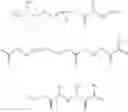
- (v) and at least one of the stable radicals of formulas 1 to 5
wherein
R0 denotes a substituted or unsubstituted C1 to C18 alkylene,
R1, R2, R3 and R4 denotes a substituted or unsubstituted C1 to C18 alkylene, preferably a methyl group
X denotes a difunctional substituted or unsubstituted C2 to C30 alkylene, C5 to C30 substituted or unsubstituted cycloalkylene, substituted or unsubstituted C5 to C30 arylene or heteroarylene, preferably the following structures
wherein R5 denotes a difunctional substituted or unsubstituted C1 to C18 alkylene, C5 to C18 substituted or unsubstituted cycloalkylene, substituted or unsubstituted C5 to C18 arylene or heteroarylene,
Y denotes H or a monofunctional substituted or unsubstituted C1 to C18 alkyl, C5 to C18 substituted or unsubstituted cycloalkyl, substituted or unsubstituted C5 to C18 aryl or heteroaryl, preferably selected from the group
wherein
R6 denotes a difunctional substituted or unsubstituted C1 to C18 alkylene, C5 to C18 substituted or unsubstituted cycloalkylene, substituted or unsubstituted C5 to C18 arylene or heteroarylene, preferably
R7 denotes difunctional substituted or unsubstituted C1 to C18 alkylene, C5 to C18 substituted or unsubstituted cycloalkylene, substituted or unsubstituted C5 to C18 arylene or heteroarylene, preferably selected from the group
R8 denotes H or a monofunctional substituted or unsubstituted C1 to C30 alkylene, C5 to C30 substituted or unsubstituted cycloalkylene, substituted or unsubstituted C5 to C30 arylene or heteroarylene
R9 denotes a monofunctional substituted or unsubstituted C1 to C30 alkylene, C5 to C30 substituted or unsubstituted cycloalkylene, substituted or unsubstituted C5 to C30 arylene or heteroarylene
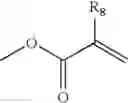
Z denotes hydrogen, or a polymerizable moiety, preferably selected from the group of
wherein
R8 denotes H or a monofunctional substituted or unsubstituted C1 to C30 alkylene, C5 to C30 substituted or unsubstituted cycloalkylene, substituted or unsubstituted C5 to C30 arylene or heteroarylene
n, m and o are integers.
Preferably the dental composition comprises at least one of the compounds 6 to 10 which having at least one piperidinium nitroxyl radical moiety
wherein
R1, R2, R3 and R4 denotes a substituted or unsubstituted C1 to C18 alkylene, preferably methyl group
X denotes a difunctional substituted or unsubstituted C2 to C30 alkylene, C5 to C30 substituted or unsubstituted cycloalkylene, substituted or unsubstituted C5 to C30 arylene or heteroarylene, preferably the following structures
wherein R5 denotes a difunctional substituted or unsubstituted C1 to C18 alkylene, C5 to C18 substituted or unsubstituted cycloalkylene, substituted or unsubstituted C5 to C18 arylene or heteroarylene,
Y denotes H or a monofunctional substituted or unsubstituted C1 to C18 alkyl, C5 to C18 substituted or unsubstituted cycloalkyl, substituted or unsubstituted C5 to C18 aryl or heteroaryl, preferably selected from the group
wherein
R6 denotes a difunctional substituted or unsubstituted C1 to C18 alkylene, C5 to C18 substituted or unsubstituted cycloalkylene, substituted or unsubstituted C5 to C18 arylene or heteroarylene, preferably
R7 denotes difunctional substituted or unsubstituted C1 to C18 alkylene, C5 to C18 substituted or unsubstituted cycloalkylene, substituted or unsubstituted C5 to C18 arylene or heteroarylene, preferably selected from the group
R8 denotes H or a monofunctional substituted or unsubstituted C1 to C30 alkylene, C5 to C30 substituted or unsubstituted cycloalkylene, substituted or unsubstituted C5 to C30 arylene or heteroarylene
R9 denotes a monofunctional substituted or unsubstituted C1 to C30 alkylene, C5 to C30 substituted or unsubstituted cycloalkylene, substituted or unsubstituted C5 to C30 arylene or heteroarylene
Z denotes hydrogen, or a polymerizable moiety, preferably selected from the group of
wherein
R8 denotes H or a monofunctional substituted or unsubstituted C1 to C30 alkylene, C5 to C30 substituted or unsubstituted cycloalkylene, substituted or unsubstituted C5 to C30 arylene or heteroarylene
n, m and o are integers.
The piperidinium nitroxyl radical moieties were obtained by two different pathways, namely by oxidation of the following compounds 11 to 15 or by incorporation of an amine comprising at least a nitroxyl radical moieties.
wherein
R1, R2, R3 and R4 denotes a substituted or unsubstituted C1 to C18 alkylene, preferably a methyl group
X denotes a difunctional substituted or unsubstituted C2 to C30 alkylene, C5 to C30 substituted or unsubstituted cycloalkylene, substituted or unsubstituted C5 to C30 arylene or heteroarylene, preferably the following structures
wherein R5 denotes a difunctional substituted or unsubstituted C1 to C18 alkylene, C5 to C18 substituted or unsubstituted cycloalkylene, substituted or unsubstituted C5 to C18 arylene or heteroarylene,
Y denotes H or a monofunctional substituted or unsubstituted C1 to C18 alkyl, C5 to C18 substituted or unsubstituted cycloalkyl, substituted or unsubstituted C5 to C18 aryl or heteroaryl, preferably selected from the group
wherein
R6 denotes a difunctional substituted or unsubstituted C1 to C18 alkylene, C5 to C18 substituted or unsubstituted cycloalkylene, substituted or unsubstituted C5 to C18 arylene or heteroarylene, preferably
R7 denotes difunctional substituted or unsubstituted C1 to C18 alkylene, C5 to C18 substituted or unsubstituted cycloalkylene, substituted or unsubstituted C5 to C18 arylene or heteroarylene, preferably selected from the group
R8 denotes H or a monofunctional substituted or unsubstituted C1 to C30 alkylene, C5 to C30 substituted or unsubstituted cycloalkylene, substituted or unsubstituted C5 to C30 arylene or heteroarylene
R9 denotes a monofunctional substituted or unsubstituted C1 to C30 alkylene, C5 to C30 substituted or unsubstituted cycloalkylene, substituted or unsubstituted C5 to C30 arylene or heteroarylene
Z denotes hydrogen, or a polymerizable moiety, preferably selected from the group of
wherein
R8 denotes H or a monofunctional substituted or unsubstituted C1 to C30 alkylene, C5 to C30 substituted or unsubstituted cycloalkylene, substituted or unsubstituted C5 to C30 arylene or heteroarylene
n, m and o are integers.
Furthermore, polymers, prepolymers or macromonomers comprising at least a nitroxyl radical moieties were synthesized by direct incorporation of amines 16 comprising at least a nitroxyl radical moieties
wherein
R0 denotes a substituted or unsubstituted C1 to C18 alkylene,
R1, R2, R3 and R4 denotes a substituted or unsubstituted C1 to C18 alkylene, preferably methyl group
with a molecule of group A, selected from the group of a diepoxide, a diisocyanate, a dicarboxylic acid or a derivative thereof, a bisacrylamide or a bisacrylate or
with a molecule of group B, selected from the group of molecules that comprise at least an epoxide and a methacrylate group, an epoxide and an isocyanate, a methacrylate and an isocyanate group, an acrylate and a methacrylate group, or with a mixture of molecules A and B.
Amines containing at least a nitroxyl radical moieties are used as comonomers for synthesis of polyamides, polyamidoamines, polyesteramines, polyureas, epoxide-amine addition polymers or prepolymers or macromonomers with the corresponding structural units mentioned above.
Preferably compounds 17 and 18 were use comprising a piperidinium nitroxyl radical moiety.
Surprisingly, the addition reaction of diepoxides and the steric hindered 4-amino-2,2,6,6-tetramethylpiperidin (ATMP) leads to linear soluble epoxide-amine addition polymers. The secondary amino groups do not react under the conditions of this polymerization. In the same manner the addition ATMP and Glycidylmethacrylat or Ethylene glycol acrylate methacrylate, respectively results in non-branched macromonomers.
Not less surprisingly it was found that the oxidation of prepolymers, macromonomers and polymers containing ATMP is possible without of a considerable degree of oxidation of hydroxylic moieties or methacrylic groups. The absorptions of hydroxylic groups at 3459/3421 cm−1 and of the double bond at 1637 cm−1 remains unchanged in the IR spectra compared to the non-oxidized molecules. Furthermore, no absorption of a keto group was observed.
The invented dental composition comprises stable radicals of formulas 1 to 5 in a content of 0.001 to 3.0% by weight, preferably in a content of 0.01 to 1.0% by weight and most preferably in a content of 0.1 to 0.5% by weight.
For example a composite containing 2,2-Bis-[p-(2-hydroxy-3-methacryloyloxypropoxy)-phenyl]-propane, Triethyleneglycol dimethacrylate, UDMA, Camphor quinone and N,N-Dimethylaminoethylbenzoic acid ethylester and a Barium-alumo-silicate glass show a light sensitivity of 25 seconds at 10,000 lux. The compressive strength is 343.9±7.3 MPa, the flexural strength (ISO 4049) is 119.2±9.3 MPa and the E-modulus is 7802±293 MPa.
A composite of the same composition that comprises additionally N,N-Bis-(2-hydroxy-3-methacryloyloxypropoxy)-4-amino-2,2,6,6-tetramethylpiperidin-1-oxyl radical of example 1 show a improved light sensitivity of 175 seconds at 10,000 lux.
EXAMPLE 1 N,N-Bis-(2-hydroxy-3-methacryloyloxypropoxy)-4-amino-2,2,6,6-tetramethylpiperidin (GMA-ATMP)4.998 g (35.17 mmol) Glycidylmethacrylat and 2.754 g (17.59 mmol) 4-amino-2,2,6,6-tetramethylpiperidin were homogeneously mixed and reacted for 48 hours at 80° C. After that time the absorption of epoxide groups at 910 cm−1 is completely missing.
Yield 7.756 g (100% of th.)
C23H40N2O6, 440.58 g/mol
IR (cm−1): 3421 (OH), 2975/2935 (CH2/CH3), 1726 (CO), 1637 (C═C)
13C NMR (ppm): 126.0 (1), 136.0 (2), 18.3 (3), 167.3 (4), 67.7/68.5 (5), 66.7/67.1 (6), 63.1 (7), 54.0/54.2 (8), 51.3/51.8 (9), 41.3 (10), 28.4/28.5 (11), 35.2 (12)
N,N-Bis-(2-hydroxy-3-methacryloyloxypropoxy)-4-amino-2,2,6,6-tetramethylpiperidin-1-oxyl radical (GMA-ATMPO)In a three-necked flask equipped with a refluxer, a gas inlet pipe and a stirrer were dissolved 7.19 g (16.32 mmol) GMA-ATMP under stirring and heating to 60° C. Then a stream of nitrogen was passed through this solution for 30 minutes.
In 250 ml Erlenmeyer flask were dissolved under stirring 8.06 g (24.48 mmol) K3Fe(CN)6 and 4.95 g (123.65 mmol) NaOH in 180 ml water.
Thereafter the aqueous solution was added to the three-necked flask and stirred intensively for 4 hours at 23° C. The organic phase was separated and washed three times with 80 ml of deionized water and dried over Na2SO4. After removing the solvent at 50° C. and an end pressure of 3 mbar the products remains.
In the ESR spectrum a strong signal of nitroxyl radicals was found.
Yield 3.95 g (53.3% of th.)
IR (Sub.) cm−1: v(O—H) 3411; vas(CH3,CH2) 2960, 2929; vs(CH3,CH2) 2850;
-
- v(C═O) 1716; v(C═C) 1637; v(C—O) 1173
1.6600 g (11.68 mmol) Glycidylmethacrylat and 1.0000 g (5.84 mmol) 4-amino-2,2,6,6-tetramethylpiperidin-1oxyl radical were homogeneously mixed and reacted 24 hours at 60° C. and 40 hours at 80° C. After that time the absorption of epoxide groups at 910 cm−1 is completely missing.
In the ESR spectrum a strong signal of nitroxyl radicals was found.
Yield 2.660 g (100% of th.)
C23H39N2O7, 455.57 g/mol
IR (cm−1): 3452 (OH), 2975/2935 (CH2/CH3), 1728 (CO), 1637 (C═C)
EXAMPLE 3 Poly-[3,7-dihydroxy-1,9-dioxa-5-aza-(2,2,6,6-tetramethylpiperidine) nonamethylene-1,4-phenylene isopropylidene-1,4-phenylene] (AP-ATMP)5.0000 g (14.69 mmol) Bis-2,2-[4-(2,3-epoxypropoxy)-phenyl]-propane (DGEBA) and 2.2953 g (14.69 mmol) 4-amino-2,2,6,6-tetramethylpiperidin were slightly heated to 60° C. and mixed homogeneously. Then the mixture was reacted at 60° C. for 24 hours. After that time the absorption of epoxide groups at 915 cm−1 is completely missing.
Yield 7.295 g (100% of th.)
(C31H46N2O4)n, (510.71)n g/mol
13C NMR (ppm): 31.0 (1), 41.7 (2), 143.5 (3), 127.7 (4), 113.9 (5), 156.4 (6), 69.9 (7), 68.3/68.7 (8), 54.2/54.4 (9), 50.2 (10), 46.8 (11), 51.0/51.2 (12), 35.1/35.2 (13), 28.4/28.7 (14)
EXAMPLE 4In a 250 ml three-necked flask equipped with a refluxer, a gas inlet pipe and a stirrer were dissolved 5.00 g (2.50 mmol) of the steric hindered amine Chimasorb 944 FD (CIBA-Geigy, CAS-Nr. 71878-19-8) in 200 ml Toluene under stirring and heating to 60° C. Then a stream of nitrogen was passed through this solution for 30 minutes.
In 250 ml Erlenmeyer flask were dissolved under stirring 10.70 g (32.50 mmol) K3Fe(CN)6 and 6.57 g (164.16 mmol) NaOH in 80 ml water.
Thereafter the aqueous solution was added to the three-necked flask and stirred intensively for 4 hours at 23° C. The organic phase was separated and washed three times with 80 ml of deionized water and dried over Na2SO4. After removing the solvent at 50° C. and an end pressure of 3 mbar the products remains.
Yield 4.33 g (86.60% of th.)
In the ESR spectrum a strong signal of nitroxyl radicals was found.
EXAMPLE 5 N,N-Bis-(3-oxa-4-oxo-6-methacryloyloxyhexyl)-4-amino-2,2,6,6-tetramethylpiperidin (AMA-ATMP)10.000 g (63.99 mmol) 4-Amino-2,2,6,6-tetramethylpiperidin and 23.57 g (127.98 mmol) Ethylenglycol acrylatmethacrylat were homogeneously mixed and reacted at 23° C. for 14 days. After that time the absorption of acrylate double bond at 1620 cm−1 is completely missing.
Yield 33.57 g (100% of th.)
C23H40N2O6, 440.58 g/mol
N,N-Bis-(3-oxa-4-oxo-6-methacryloyloxyhexyl)-4-amino-2,2,6,6-tetramethylpiperidin-1-oxyl radical (AMA-ATM PO)N,N-Bis-(3-oxa-4-oxo-6-methacryloyloxyhexyl)-4-amino-2,2,6,6-tetramethylpiperidin was oxi-dized according the same procedure as described in example 1.
Yield 5.27 g (97.8% of th.)
In the ESR spectrum a strong signal of nitroxyl radicals was found.
EXAMPLE 6 N,N-Bis-(3-oxa-4-oxo-6-methacryloyloxyhexyl)-4-amino-2,2,6,6-tetramethylpiperidin-1-oxyl radical (AMA-ATMPO)1.075 g (5.84 mmol) Ethylenglycol acrylatmethacrylat and 1.0000 g (5.84 mmol) 4-Amino-2,2,6,6-tetramethylpiperidin-1 oxyl radical were homogeneously mixed and reacted 24 hours at 60° C. and 40 hours at 80° C. After that time the absorption of acrylate double bond at 1620 cm−1 is completely missing.
In the ESR spectrum a strong signal of nitroxyl radicals was found.
Yield 2.075 g (100% of th.)
C27H43N2O9, 539.65 g/mol
IR (cm−1): 2960/2845 (CH2/CH3), 1720 (CO), 1637 (C═C)
COMPARATIVE EXAMPLE 139.742 g 2,2-Bis-[p-(2-hydroxy-3-methacryloyloxypropoxy)-phenyl]-propane, 24.839 g Triethyleneglycol dimethacrylate, 34.774 g Urethane dimethacrylate, 0.298 g chamfer quinone and 0.348 g Dimethylaminoethyl benzoic acid ethylester were mixed homogeneously. To this resin mixture were added 270.370 g of a barium alumo-silicate glass and mixed homogeneously.
The properties are summarized in Table 1.
APPLICATION EXAMPLE 139.742 g 2,2-Bis-[p-(2-hydroxy-3-methacryloyloxypropoxy)-phenyl]-propane, 24.839 g Triethyleneglycol dimethacrylate, 34.774 g Urethane dimethacrylate, 0.298 g chamfer quinone, 0.348 g Dimethylaminoethyl benzoic acid ethylester and 0.034 g 4-Amino-2,2,6,6-tetramethyl-piperidin-1-oxyl radical (Fluka) were mixed homogeneously. To this resin mixture were added 270.370 g of a barium alumo-silicate glass and mixed homogeneously.
The properties are summarized in Table 1.
APPLICATION EXAMPLE 239.742 g 2,2-Bis-[p-(2-hydroxy-3-methacryloyloxypropoxy)-phenyl]-propane, 24.839 g Triethyleneglycol dimethacrylate, 34.774 g Urethane dimethacrylate, 0.298 g chamfer quinone, 0.348 g Dimethylaminoethyl benzoic acid ethylester and 0.091 g GMA-ATMPO of example 2 were mixed homogeneously. To this resin mixture were added 270.370 g of a barium alumo-silicate glass and mixed homogeneously.
The properties are summarized in Table 1.
APPLICATION EXAMPLE 339.742 g 2,2-Bis-[p-(2-hydroxy-3-methacryloyloxypropoxy)-phenyl]-propane, 24.839 g Triethyleneglycol dimethacrylate, 34.774 g Urethane dimethacrylate, 0.298 g chamfer quinone, 0.348 g Dimethylaminoethyl benzoic acid ethylester and 0.100 g AMA-ATMPO of example 5 were mixed homogeneously. To this resin mixture were added 270.370 g of a barium alumo-silicate glass and mixed homogeneously.
The properties are summarized in Table 1.
APPLICATION EXAMPLE 439.742 g 2,2-Bis-[p-(2-hydroxy-3-methacryloyloxypropoxy)-phenyl]-propane, 24.839 g Triethyleneglycol dimethacrylate, 34.774 g Urethane dimethacrylate, 0.298 g chamfer quinone, 0.348 g Dimethylaminoethyl benzoic acid ethylester and 0.100 g of oxidized amine of example 4 were mixed homogeneously. To this resin mixture were added 270.370 g of a barium alumo-silicate glass and mixed homogeneously.
The properties are summarized in Table 1.
| TABLE 1 |
| Properties of dental composites of application examples 1 to 3 and of comparative example 1 |
| Example | Comp. 1 | Appl. 1 | Appl. 2 | Appl. 3 |
| Sensitivity to ambient light, ISO 4049 | sec | 25 | 185 | 180 | 180 |
| (10000 lux) | |||||
| Compressive strength | MPa | 343.9 ± 7.3 | 318.6 ± 17.8 | 316.3 ± 11.1 | 338.5 ± 6.6 |
| Flexural strength, ISO 4049 | MPa | 119.2 ± 9.3 | 107.7 ± 10.7 | 108.3 ± 5.0 | 117.9 ± 5.6 |
| E-modulus | MPa | 7802 ± 293 | 7691 ± 343 | 7324 ± 442 | 7698 ± 212 |
Claims
We claim:1. Dental composition having an improved light and thermal stability, comprising a mixture of
(i) at least one polymerizable resin
(ii) at least one polymerizable monomer
(iii) at least one polymerization initiator and/or a sensitizer and stabilizer
(iv) at least one organic or inorganic filler and pigments in a content of 0 to 90 percent
(v) and at least one of the stable radicals of formulas 1 to 5
wherein
R0 denotes a C1 to C18 alkylene,
R1, R2, R3 and R4 denotes a C1 to C18 alkylene,
X denotes a difunctional C2 to C30 alkylene, C5 to C30 cycloalkylene, C5 to C30 arylene or heteroarylene, selected from the group consisting of
wherein R5 denotes a difunctional C1 to C18 alkylene, C5 to C18 cycloalkylene, C5 to C18 arylene or heteroarylene,
Y denotes H or a monofunctional C1 to C18 alkyl, C5 to C18 cycloalkyl, C5 to C18 aryl or heteroaryl, selected from the group consisting of
wherein
R6 denotes a difunctional C1 to C18 alkylene, C5 to C18 cycloalkylene, C5 to C18 arylene or heteroarylene, selected from the group consisting of
R7 denotes difunctional C1 to C18 alkylene, C5 to C18 cycloalkylene, C5 to C18 arylene or heteroarylene, selected from the group
R8 denotes H or a monofunctional C1 to C30 alkylene, C5 to C30 cycloalkylene, C5 to C30 arylene or heteroarylene
R9 denotes a monofunctional C1 to C30 alkylene, C5 to C30 cycloalkylene, C5 to C30 arylene or heteroarylene
Z denotes hydrogen, or a polymerizable moiety, preferably selected from the group of
wherein
n, m and o are integers.
2. Dental composition of claim 1, comprising at least one of the compounds 6 to 10 having at least one piperidinium nitroxyl radical moiety
wherein
R1, R2, R3 and R4 denotes a C1 to C18 alkylene,
X denotes a difunctional C2 to C30 alkylene, C5 to C30 cycloalkylene, C5 to C30 arylene or heteroarylene, selected from the group consisting of
wherein R5 denotes a difunctional C1 to C18 alkylene, C5 to C18 cycloalkylene, C5 to C18 arylene or heteroarylene,
Y denotes H or a monofunctional C1 to C18 alkyl, C5 to C18 cycloalkyl, C5 to C18 aryl or heteroaryl, selected from the group consisting of
wherein
R6 denotes a difunctional C1 to C18 alkylene, C5 to C18 cycloalkylene, C5 to C18 arylene or heteroarylene, selected from the group consisting of
R7 denotes difunctional C1 to C18 alkylene, C5 to C18 cycloalkylene, C5 to C18 arylene or heteroarylene,
R8 denotes H or a monofunctional C1 to C30 alkylene, C5 to C30 cycloalkylene, C5 to C30 arylene or heteroarylene
R9 denotes a monofunctional C1 to C30 alkylene, C5 to C30 cycloalkylene, C5 to C30 arylene or heteroarylene
Z denotes hydrogen, or a polymerizable moiety, preferably selected from the group of
wherein
n, m and o are integers.
3. Dental composition of claim 1, wherein molecules containing piperidinium nitroxyl radical moieties are obtained by oxidation of one of the compounds 11 to 15
wherein
R1, R2, R3 and R4 denotes a C1 to C18 alkylene,
X denotes a difunctional C2 to C30 alkylene, C5 to C30 cycloalkylene, C5 to C30 arylene or heteroarylene, selected from the group consisting of
wherein R5 denotes a difunctional C1 to C18 alkylene, C5 to C18 cycloalkylene, C5 to C18 arylene or heteroarylene,
Y denotes H or a monofunctional C1 to C18 alkyl, C5 to C18 cycloalkyl, C5 to C18 aryl or heteroaryl, preferably selected from the group consisting of
wherein
R6 denotes a difunctional C1 to C18 alkylene, C5 to C18 cycloalkylene, C5 to C18 arylene or heteroarylene, selected from the group consisting of
R7 denotes difunctional C1 to C18 alkylene, C5 to C18 cycloalkylene, C5 to C18 arylene or heteroarylene,
R8 denotes H or a monofunctional C1 to C30 alkylene, C5 to C30 cycloalkylene, C5 to C30 arylene or heteroarylene
R9 denotes a monofunctional C1 to C30 alkylene, C5 to C30 cycloalkylene, C5 to C30 arylene or heteroarylene
Z denotes hydrogen, or a polymerizable moiety, preferably selected from the group of
wherein
n, m and o are integers.
4. Dental composition of claim 1, wherein polymers, prepolymers or macromonomers containing nitroxyl radical moieties were obtained by reaction of compound 16
wherein
R0 denotes a C1 to C18 alkylene,
R1, R2, R3 and R4 denotes a C1 to C18 alkylene,
with a molecule of group A, selected from the group consisting of a diepoxide, a diisocyanate, a dicarboxylic acid and a derivative thereof, a bisacrylamide, a bisacrylate and
with a molecule of group B, selected from the group consisting of molecules that comprise at least an epoxide and a methacrylate group, an epoxide and an isocyanate, a methacrylate and an isocyanate group, an acrylate and a methacrylate group, or
with a mixture of molecules A and B.
5. Dental composition of claim 4, wherein amines containing nitroxyl radical moieties are contained as comonomers in polyamides, polyamidoamines, polyesteramines, polyureas, epoxide-amine addition polymers.
6. Dental composition of claim 4, wherein amines containing nitroxyl radical moieties are contained as comonomers in macromonomers or prepolymers having polyamide, polyamidoamine, polyesteramine, polyurea or epoxide-amine addition polymer structural units.
7. Dental composition of claim 1, wherein molecules containing piperidinium nitroxyl radical of compounds 17 or 18.
8. Dental composition of claim 1, wherein the dental composition comprises stable radicals of formulas 1 to 5 in a content of 0.001 to 3.0% by weight.
9. Dental composition of claim 1, wherein the dental composition preferably comprises stable radicals of formulas 1 to 5 in a content of 0.01 to 1.0% by weight.
10. Dental composition of claim 1, wherein the dental composition most preferably comprises stable radicals of formulas 1 to 5 in a content of 0.01 to 0.2% by weight.
Images & Drawings included:









Sources:
- United States Patent and Trademark Office - verify current appl. status at the USPTO↗
Recent applications in this class:
- » 20250255785 2025-08-14
Dental Product with Reduced Extrusion Forces - » 20250248902 2025-08-07
Curable Composition for Dental Purposes - » 20250241831 2025-07-31
DENTAL COMPOSITION - » 20250127689 2025-04-24
METHOD OF STIMULATING DENTIN FORMATION WITH HYDROXY-SUBSTITUTED AZOBENZENE MATERIALS - » 20250057732 2025-02-20
DENTAL CURABLE COMPOSITION - » 20250049644 2025-02-13
Dental Compositions - » 20250000749 2025-01-02
DENTAL CURABLE COMPOSITION - » 20240423878 2024-12-26
SELF-ADHESIVE FISSURE SEALANT - » 20240366479 2024-11-07
METHOD OF PRODUCING DENTAL COMPOSITION AND DENTAL COMPOSITION - » 20240325256 2024-10-03
PHOTOPOLYMERIZABLE COMPOSITION FOR 3D PRINTER CONTAINING POLYMERIZABLE MONOMER HAVING ALLOPHANATE BOND
Recent applications for this Assignee:
- » 20180142377 2018-05-24
Medical Instrument Made of Monocrystalline Shape Memory Alloys and Manufacturing Methods - » 20180071175 2018-03-15
Dental cement composition - » 20170231720 2017-08-17
PLED DENTAL MATRIX SYSTEM - » 20160367793 2016-12-22
Catheter coupling arrangement - » 20160307016 2016-10-20
Method for reading a two-dimensional code by means of a camera used for three-dimensional optical measurement of objects - » 20160296304 2016-10-13
Optical measuring system and method for optically measuring an object in a three-dimensional manner - » 20160175467 2016-06-23
HEATING APPARATUS WITH A DISINFECTION DEVICE - » 20160143706 2016-05-26
Cervical matrix - » 20160114148 2016-04-28
Apparatus including a conduit clamping device - » 20160113845 2016-04-28
Process for producing a blank, and a blank