Procedure for deep rolling crankshafts
US20080196465A1
2008-08-21
11/886,683
2006-02-01
✅ Patent granted
US 7,779,660 B2
2010-08-24
WO; PCT/EP2006/050598; 20060201
WO; WO2006/100149; 20060928
Edward Tolan
2026-12-16
Abstract:
The invention relates to a method for deep rolling the passes or radii on the transitions between journal and cheeks or flanges of crankshafts by means of a deep rolling device (1) of a deep rolling machine, said deep rolling device having a lazy tongs-type design. The deep rolling device (1) has two tongs arms (2, 3) that are articulated to each other via a pivot joint (24). The corresponding outer ends (4, 5, 9, 10) of the tongs arms (2, 3) are provided with a deep rolling tool (6) or a force generator (11) for generating the deep rolling force. A measuring tape (18) and a sensor (19) which are provided on the pivot joint (24) are used to measure the impression depth of the deep rolling rollers (12) under the effect of the deep rolling force. A measuring device (22) mounted on the exterior (21) of a tongs arm (2) is used to measure the degree by which the tongs arm (2) bends under the effect of the deep rolling force.
Inventors:
- Alfred Heimann 15 🇩🇪 Aachen, Germany
- Roland Heffe 5 🇩🇪 Korschenbroich, Germany
- Theo Nijssen 4 🇳🇱 Beesel, Netherlands
- Frank Risters 4 🇩🇪 Erkelenz, Germany
- Ralf Freitag 1 🇩🇪 Grevenbroich, Germany
- Juergen Winnertz 1 🇩🇪 Erkelenz, Germany
Assignee:
- Hegenscheidt-MFD GmbH Co. KG 1 🇩🇪 Erkenlenz, Germany
- Hegenscheidt-MFD GmbH & Co. KG 2 🇩🇪 , Germany
Interested in similar patents?
Get notified when new applications in this technology area are published.
Classification:
B21H7/185 » CPC main
Making articles not provided for in the preceding groups, e.g. agricultural tools, dinner forks, knives, spoons grooved pins; Rolling grooves, e.g. oil grooves, in articles; Rolling annular grooves Filet rolling, e.g. of crankshafts
B23P9/02 » CPC further
Treating or finishing surfaces mechanically, with or without calibrating, primarily to resist wear or impact, e.g. smoothing or roughening turbine blades or bearings ; Features of such surfaces not otherwise provided for, their treatment being unspecified Treating or finishing by applying pressure, e.g. knurling
B24B5/42 » CPC further
Machines or devices designed for grinding surfaces of revolution on work, including those which also grind adjacent plane surfaces; Accessories therefor; Single-purpose machines or devices for grinding crankshafts or crankpins
B24B39/045 » CPC further
Burnishing machines or devices, i.e. requiring pressure members for compacting the surface zone ; Accessories therefor designed for working external surfaces of revolution the working tool being composed of a plurality of working rolls or balls
B24B49/00 » CPC further
Measuring; Indicating; Controlling
B24B49/00 » CPC further
Measuring or gauging equipment for controlling the feed movement of the grinding tool or work; Arrangements of indicating or measuring equipment, e.g. for indicating the start of the grinding operation
C21D7/08 » CPC further
Modifying the physical properties of iron or steel by deformation by cold working of the surface by burnishing or the like
B21K1/08 IPC
Making machine elements axles or shafts crankshafts
B21B37/18 IPC
Control devices or methods specially adapted for metal-rolling mills or the work produced thereby; Control of thickness, width, diameter or other transverse dimensions Automatic gauge control
B21B37/58 IPC
Control devices or methods specially adapted for metal-rolling mills or the work produced thereby Roll-force control; Roll-gap control
Description
The invention concerns a procedure for deep rolling the recesses or radii on the transitions between bearing trunnions and webs or flanges of crankshafts using a shear-type construction deep rolling unit of a deep rolling machine with two shearing arms which are connected with articulation to one another by a rotating joint. A deep rolling head and a support roller head are arranged on the respective reciprocal outer ends of the shearing arms as parts of a deep rolling tool or a power unit to generate the deep rolling force.
A comparable procedure for hardening workpiece surfaces is known, for example, from DE 195 11 882 B4. According to this, a procedure for hardening workpiece surfaces by generating internal pressure stress using deforming tools and measuring the workpiece surface is known, whereby the workpiece surface is measured during the hardening process and controlled variables for setting/altering workpiece parameters are derived from the measurement results. At the same time, a device on a deep rolling unit whereby a pneumatic sensing head is spring-stored in the deep rolling tool, which is arranged diametrally opposite the deep roller is known.
The disadvantage of the known procedure and the device designed for it is that the surface contour is measured at a point on the workpiece, here the crankshaft, in the immediate vicinity of which the parts of the deep rolling tool are operative. It is difficult to attach an additional measuring device within the narrow dimensions of a deep rolling tool. A tool located there is particularly subject to the risk of contamination. Finally, it is much more accurate and direct to determine the effect of the deep rolling tool directly on the workpiece and not the long way round using pneumatic media.
As a result, it is the task of the present invention to propose a procedure and a device for measuring both the engaging depth of the deep rollers in the recesses or radii of the crankshaft to be deep rolled and also the deep rolling force which is necessary for the penetration of the deep rollers in the radii or recesses.
In accordance with the invention, this problem is solved by measuring the engaging depth of the deep rollers in the recesses or radii subject to the deep rolling force by measuring the reciprocal position which the two shearing arms momentarily occupy at the rotating joint. Thus, the point at which the engaging depth is measured is sufficiently far away from the place where the penetration takes place to prevent contamination, without affecting the deep rolling unit's available space.
In contrast, the deep rolling force is measured by measuring the deflection of one of the two shearing arms subjected to the deep rolling force between the outer end which the power unit is attached to and the rotating joint. With this arrangement, the space available for the deep rolling unit in the deep rolling machine is optimally used and at the same time, easy accessibility to the measuring location is maintained. Thanks to the high resolution of modern measuring devices, the measured values obtained are very precise and free from any other influences from the machine.
The measured values of the engaging depth and the deep rolling force are fed to a common evaluation station and converted into controlled variables, either for the engaging depth or for the deep rolling force, by means of which the entire deep rolling process can be controlled very accurately.
A device for measuring the engaging depth includes, on the rotating joint, a measuring tape belonging to one of the two shearing arms and a sensor belonging to the other shearing arm which measures the respective position of the measuring tape.
To measure the deep rolling force, a wire strain gauge is attached to one of the two long sides of a shearing arm, which measures the deflection of the shearing arm when subjected to the deep rolling force.
The following section describes the invention with a design example.
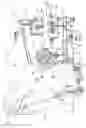
The FIGURE shows a side view of the basic parts of a deep rolling device, on a reduced scale.
The deep rolling unit (1) is designed in shear-type construction. It consists of the two shearing arms (2 and 3), which are connected to one other with articulation via a rotating joint (24). The deep rolling tool (6) and its parts, the deep rolling head (7) and support roller head (8), are arranged between the first two related outer ends (4 and 5) of the shearing arms (2 and 3).
The power unit (11) for generating the deep rolling force between the deep rolling head (7) and the support roller head (8) is located between the second outer ends (9 and 10) of the two shearing arms (2 and 3). Subject to the force of the power unit (11), deep rollers (12) penetrate the recesses or radii on the bearing trunnions of crankshafts (not shown), which are supported opposite the deep rollers (12) by the two support rollers (13 and 14). The relevant expert will be sufficiently aware of this procedure, rendering a more detailed description unnecessary.
The rotating joint (24) is formed by a bolt (15), which is surrounded by the eyes (16 and 17) of one of the two shearing arms (2 and 3). A measuring tape (18) is arranged on the outer circumference of the eye (17), which includes a large section of the outer circumference of the eye (17). A sensor (19) which determines the respective position of the measuring tape (18) and thus the position of the two shearing arms (2 and 3) to one another and transfers an evaluation unit via connections (20) (not shown) is on the shearing arm (2). The measuring resolution of this arrangement is sufficiently high so as to very accurately determine the engaging depth of the deep rollers, which lies in the region between 0.1 and 0.01 mm.
A further measuring device (22) is on the exterior side (21) of the second outer end (9) of the shearing arm (2). Wire strain gauges are arranged in the interior of the measuring device (22) (not shown), which are attached to the surface of the exterior side (21). The second outer end of the shearing arm (2) is deflected when subjected to the deep rolling force of the power unit (11). This deflection is proportional to the level of the deep rolling force. By measuring the deflection with the measuring device (22), a measuring value is obtained which corresponds to the level of the deep rolling force. The measuring device (22) is also connected to the above-mentioned evaluation and control station via connections (23).
REFERENCE DRAWING LIST
- 1 Deep rolling unit
- 2 Shearing arm
- 3 Shearing arm
- 4 First outer end
- 5 First outer end
- 6 Deep rolling tool
- 7 Deep rolling head
- 8 Support roller head
- 9 Second outer end
- 10 Second outer end
- 11 Power unit
- 12 Work roller
- 13 Support roller
- 14 Support roller
- 15 Pin
- 16 Eye
- 17 Eye
- 18 Measuring tape
- 19 Sensor
- 20 Connection
- 21 Exterior side
- 22 Measuring device
- 23 Connection
- 24 Articulated joint
Claims
1-8. (canceled)
9. A method for deep rolling the recesses or radii on the transitions between bearing trunnions and webs or flanges of crankshafts using a shear-type construction deep rolling unit of a deep rolling machine with two shearing arms which are connected at a rotating joint with articulation to one another comprising:
arranging a deep rolling head and a support roller head as parts of a deep rolling tool and a power unit;
generating the deep rolling force, via said power unit, on the respective reciprocal outer ends of the shearing arms; and
measuring the engaging depth of the deep rollers in the recesses or radii subject to the deep rolling force by measuring the reciprocal position which the two shearing arms momentarily occupy at the rotating joint.
10. A method for deep rolling the recesses or radii on the transitions between bearing trunnions and webs or flanges of crankshafts using a shear-type construction deep rolling unit of a deep rolling machine with two shearing arms which are connected at a rotating joint with articulation to one another comprising:
arranging a deep rolling head and a support roller head as parts of a deep rolling tool and a power unit;
generating the deep rolling force, via said power unit, on the respective reciprocal outer ends of the shearing arms; and
measuring the deflection of one of the two shearing arms subject to the deep rolling force between its outer end, which is attached to the power unit, and the rotating joint.
11. The method according to claim 9, further comprising simultaneously measuring the engaging depth and the deep rolling force.
12. The method according to claim 9, further comprising regulating the deep rolling force using the measured engaging depth.
13. The method according to claim 10, further comprising regulating the engaging depth using the measured deep rolling force.
14. The device for implementing the procedure according to claim 9, wherein a measuring tape, belonging to one of the two shearing arms, and a sensor, belonging to the other shearing arm, which measures the respective position of the measuring tape, are on the rotating joint.
15. The device according to claim 10 comprising a wire strain gauge on one of the two long sides of a shearing arm for measuring the deflection.
16. The device according to claim 14, wherein the measured values of the engaging depth and the deep rolling force are fed to a common evaluation station which monitors and controls the deep rolling process.
17. The device according to claim 15, wherein the measured values of the engaging depth and the deep rolling force are fed to a common evaluation station which monitors and controls the deep rolling process.
18. The method according to claim 10, further comprising simultaneously measuring the engaging depth and the deep rolling force.
Images & Drawings included:

Sources:
- United States Patent and Trademark Office - verify current appl. status at the USPTO↗
Recent applications in this class:
- » 20190143398 2019-05-16
LASER-HARDENED FILLET-ROLLED CRANKSHAFT - » 20170252796 2017-09-07
Hard-rolling roller head for the deep rolling of the crankpins of a split-pin crankshaft - » 20160167107 2016-06-16
Rolling tool - » 20140109364 2014-04-24
Method and production line for machining a crankshaft - » 20080184756 2008-08-07
Deep rolling roller head for split-pin crankshafts - » 20060162410 2006-07-27
Composite fabrication facility of steel tube and fabrication method of steel tube - » 20060150700 2006-07-13
Deep rolling roller head of a deep rolling tool - » 20060150405 2006-07-13
Process for finish-machining crank shafts for motor car engines - » 20060000254 2006-01-05
Apparatus and method of rolling split pin crankshafts - » 20050223769 2005-10-13
Plug-in lower tool
Recent applications for this Assignee:
- » 20080173055 2008-07-24
Deep rolling head of a deep rolling tool for the deep rolling of crankshafts