Keypad assembly
US20080223702A1
2008-09-18
11/741,901
2007-04-30
✅ Patent granted
US 7,834,285 B2
2010-11-16
-
-
Renee S Luebke | Lheiren Mae A Caroc
2029-02-17
Abstract:
A compact keypad structure includes keypad panel with smooth face, matted face or patterned layer. The keypad structure includes a flexible printed circuit board, an illumination layer, a resilient layer and a keypad layer in bottom-up order. The illumination layer includes an illumination plate to illuminate the bottom of the resilient body when the keypad is operated. Therefore, the surface of the keypad has transparent effect for display. The first carrier and the second carrier of the keypad layer, and the resilient body of the resilient layer are deformed when external force is applied to the surface of the keypad. A protrusion is pressed against the surface of the illumination plate and a metal dome on another face of the illumination plate is deformed and pressed against the flexible printed circuit board. The metal dome is in contact with contact of the flexible printed circuit board to output an operation signal.
Assignee:
- ICHIA TECHNOLOGIES, INC. 32 🇹🇼 Taoyuan, Taiwan
Interested in similar patents?
Get notified when new applications in this technology area are published.
Classification:
H01H13/705 » CPC main
Switches having rectilinearly-movable operating part or parts adapted for pushing or pulling in one direction only, e.g. push-button switch having a plurality of operating members associated with different sets of contacts, e.g. keyboard with contacts carried by or formed from layers in a multilayer structure, e.g. membrane switches characterised by construction, mounting or arrangement of operating parts, e.g. push-buttons or keys
H01H13/83 » CPC further
Switches having rectilinearly-movable operating part or parts adapted for pushing or pulling in one direction only, e.g. push-button switch having a plurality of operating members associated with different sets of contacts, e.g. keyboard characterised by legends, e.g. Braille, liquid crystal displays, light emitting or optical elements
H01H2219/018 » CPC further
Legends replaceable; adaptable Electroluminescent panel
H01H2219/036 » CPC further
Legends Light emitting elements
Y10T29/49105 » CPC further
Metal working; Method of mechanical manufacture; Electrical device making Switch making
Y10T29/49117 » CPC further
Metal working; Method of mechanical manufacture; Electrical device making Conductor or circuit manufacturing
Y10T29/49135 » CPC further
Metal working; Method of mechanical manufacture; Electrical device making; Conductor or circuit manufacturing; On flat or curved insulated base, e.g., printed circuit, etc.; Assembling to base an electrical component, e.g., capacitor, etc. with component orienting and shaping, e.g., cutting or bending, etc.
Y10T29/49155 » CPC further
Metal working; Method of mechanical manufacture; Electrical device making; Conductor or circuit manufacturing; On flat or curved insulated base, e.g., printed circuit, etc. Manufacturing circuit on or in base
Y10T29/49156 » CPC further
Metal working; Method of mechanical manufacture; Electrical device making; Conductor or circuit manufacturing; On flat or curved insulated base, e.g., printed circuit, etc.; Manufacturing circuit on or in base with selective destruction of conductive paths
Y10T29/4998 » CPC further
Metal working; Method of mechanical manufacture Combined manufacture including applying or shaping of fluent material
H01H13/04 IPC
Switches having rectilinearly-movable operating part or parts adapted for pushing or pulling in one direction only, e.g. push-button switch; Details Cases; Covers
H01H19/04 IPC
Switches operated by an operating part which is rotatable about a longitudinal axis thereof and which is acted upon directly by a solid body external to the switch, e.g. by a hand; Details Cases; Covers
Description
1. FIELD OF THE INVENTION
The present invention relates to a keypad structure, especially to a compact keypad structure.
2. DESCRIPTION OF PRIOR ART
The users of mobile phones generally consider the appearance and compact size of the mobile phones besides the functions of the mobile phones. Therefore, certain mobile phones are printed with colorful pattern on the casing and keypad thereof to enhance added-on value and purchase desire. Moreover, to this end, three-dimension pattern can be formed on the casing.
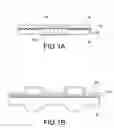
Taiwan patent gazette No. M304441 discloses a prior three-dimension pattern. With reference to FIG. 1A, this prior art comprises a base 1a, a first transparent layer 2a on the base 1a, a first color layer 3a and color opening area 31a on the first transparent layer 2a. A second transparent layer 4a is on the first color layer 3a and a second color layer 5a is attached to the second transparent layer 4a. By this structure, the keypad product has colorful and textual appearance with different depth of fields, thus rendering various visual effects to the keypad. However, the method for manufacturing the prior art three-dimension pattern is time and labor consuming and cost is increased.
Taiwan patent gazette No. M301397 discloses another prior pattern formed in keypad structure. With reference to FIG. 1B, a pattern layer 1b is sandwiched between a membrane layer 2b and a resilient layer 3b to provide light-glaring effect. However, because the pattern layer 1b is sandwiched between the membrane layer 2b and the resilient layer 3b, the manufacture is complicated and time consuming. The thickness of keypad is increased and it is undesirable for compact keypad.
SUMMARY OF THE INVENTION
It is an object of the present invention to provide a compact keypad, wherein smooth face, matted face or patterned layer is directly formed on the surface of keypad panel and keycap surface. Therefore, the thickness of the keypad is not increased; the manufacturing procedures and time are also saved.
Accordingly, the present invention provides a compact keypad structure comprising:
a flexible printed circuit board being a thin-film printed circuit board formed with circuit traces and contacts;
an illumination layer comprising illumination plate on the flexible printed circuit board, where the illumination plate can be an electroluminescent panel and comprises a plurality of metal domes on another face thereof, the metal domes are corresponding to the contacts of the flexible printed circuit board;
a resilient layer arranged on the illumination layer and comprising a second carrier and a resilient body arranged on one face of the second carrier, a reflection layer arranged on the second carrier, the resilient body comprising a plurality of supporters and a protrusion between two supporters, wherein the protrusion is corresponding to the metal dome;
a keypad layer comprising a first carrier attached to the second carrier, the first carrier comprising a keypad set with a plurality of keycaps, wherein a keycap surface has a smooth face and a supporting surface connecting the keycaps has a matted face because the keypad is manufactured with a first molding cavity with rugged bottom face and a second molding cavity with rugged bottom face.
BRIEF DESCRIPTION OF DRAWING
The features of the invention believed to be novel are set forth with particularity in the appended claims. The invention itself however may be best understood by reference to the following detailed description of the invention, which describes certain exemplary embodiments of the invention, taken in conjunction with the accompanying drawings in which:
FIG. 1A shows a sectional view of a prior art patterned layer in keypad structure.
FIG. 1B shows a sectional view of another prior art patterned layer in keypad structure.
FIG. 2A shows the flowchart for manufacturing the compact keypad according to the first preferable embodiment of the present invention.
FIG. 2B shows the flowchart for manufacturing the compact keypad according to the second preferable embodiment of the present invention.
FIG. 3 shows the perspective view of the first carrier according to the present invention.
FIG. 4 shows the sectional view of a first molding die according to the first design of the present invention.
FIG. 5 shows the pressing operation by the first molding die shown in FIG. 4.
FIG. 6 shows the printing on backside of the keypad panel according to the present invention.
FIG. 7 is a sectional view for the keypad panel in FIG. 6.
FIG. 8 shows the sectional view of the second carrier according to the present invention.
FIG. 9 shows the perspective view of the second carrier according to the present invention.
FIG. 10 shows that the keypad panel and the silicon rubber are placed into the second molding die.
FIG. 11 is a sectional view showing the keypad panel assembled with the resilient layer.
FIG. 12 is a sectional view showing the keypad panel assembled with the keypad layer
FIG. 13 shows the exploded view of the compact keypad structure of the present invention, where a flexible printed circuit board, an illumination layer, a resilient layer and a keypad panel are shown.
FIG. 14 shows a section view for the keypad shown in FIG. 13.
FIG. 15 shows a key-pressing operation for the keypad shown in FIG. 14.
FIG. 16 shows the sectional view demonstrating the pattern of the keypad panel of the present invention.
FIG. 17 shows the top view demonstrating the pattern of the keypad panel of the present invention.
FIG. 18 shows a partially-enlarged view of the first molding cavity according to the second design of the present invention.
FIG. 19 shows a partially enlarged view of the first molding cavity according to the third design of the present invention.
FIG. 20 shows the sectional view of the finished keypad panel made with the first molding cavity shown in FIG. 19.
FIG. 21 shows a partially enlarged view of the first molding cavity according to the fourth design of the present invention.
FIG. 22 shows the sectional view of the finished keypad panel made with the first molding cavity shown in FIG. 21.
FIG. 23 shows a partially enlarged view of the first molding cavity according to the fifth design of the present invention.
FIG. 24 shows the sectional view of the finished keypad panel made with the first molding cavity shown in FIG. 23.
FIG. 25 is a schematic drawing showing the keypad panel of the present invention in use for a mobile phone.
FIG. 26 is a schematic drawing showing the keypad structure of the present invention in use for a panel of audio equipment of a vehicle.
DETAILED DESCRIPTION OF THE INVENTION
FIG. 2A shows the flowchart for manufacturing the compact keypad according to the first preferable embodiment of the present invention. The present invention provides a method for manufacturing a keypad with patterned layer. At step 100, a first carrier 2 made of transparent Polycarbonate film is prepared.
At step 102, with also reference to FIG. 3, locating hole 21 is pressed on the surface of the first carrier 2 and the locating hole 21 is used to clamp the carrier 2 to the guiding post 13 of the first molding die 1.
At step 104, with also reference to FIG. 4, a first molding die 1 is prepared with a first molding cavity 11 defined in the first molding die 1. The first molding cavity 11 further comprises a plurality of second molding cavities 12 with shapes corresponding to keycaps. The bottom face 111 of the first molding cavity 11 is a rugged face, and the bottom face 121 of the second molding cavity 12 is a smooth face.
At step 106, with also reference to FIG. 4, colloid 3′ is applied to the first molding cavity 11 of the first molding die 1, where the colloid 3′ is, for example, an ultraviolet curable resin.
At step 108, with also reference to FIG. 4, the first carrier 2 is placed to cover the colloid 3′.
At step 110, with also reference to FIG. 5, a rolling wheel 4 is used to roll on the surface of the first carrier 2 such that the colloid 3′ is filled into the first molding cavity 11 and the second molding cavity 12. Air among the colloid 3′ and the first carrier 2, the first molding cavity 11 and the second molding cavity 12 is expelled outside to prevent air from remaining in the colloid 3′. Therefore, air bubble is not present in the colloid 3′.
At step 112, the rolled first molding cavity 11 is exposed to ultraviolet light to cure the colloid 3′ made of ultraviolet curable resin and the colloid 3′ is formed into a keypad layer 3.
At step 114, the first carrier 2 and the keypad layer 3 are removed from the first molding die 1 and then subjected to trimming and printed with locating hole.
At step 116, with also reference to FIG. 6, black ink is printed on another face of the first carrier 2 to form a background color layer 5. Patterns 51 with the shapes of hollow letter, number or symbol are formed on the background color layer 5 and corresponding to the keycaps of the colloid 3′.
At step 118, with also reference to FIG. 6, a red ink is printed on the surface of the hollow End pattern 511 of background color layer 5 to form a functional color layer 511′.
At step 120, with also reference to FIG. 6, a green ink is printed on the surface of the hollow Dial pattern 512 of background color layer 5 to form another functional color layer 512′
At step 122, with also reference to FIG. 6, a white ink is printed on surface of the hollow text/number keys 513 of background color layer 5 to form a text color layer 513′, where the hollow text/number keys 513 manifest white color.
At step 124, with also reference to FIGS. 6 and 7, a twin adhesive 52 is pasted to surfaces of the background color layer 5, the functional color layers 511′ and 512′, and the textual color layer 513′, thus finishing the manufacture of keypad layer.
At step 126, with also reference to FIG. 8, a second carrier 2′ is prepared, where the second carrier 2′ is made of transparent Polyethylene Terephthalate Film material.
At step 128, with also reference to FIG. 8, the surface of the second carrier 2′ is subjected to a corona treatment, which is an electrical-shock treatment to enhance adhesion property on surface of the second carrier 2′.
At step 130, with also reference to FIG. 8, locating hole 21′ is pressed on the second carrier 2′ to facilitate the clamping of the second carrier 2′ on a printing machine.
At step 132, with also reference to FIG. 8, a reflection layer 22′ with a white ink is printed to the surface of the second carrier 2′.
At step 134, with also reference to FIG. 9, a bonding glue 23′ is printed on the surface of the reflection layer 22′.
At step 136, locating hole 24′ is pressed on the second carrier 2′ to facilitate the second carrier 2′ to clamp to the second molding die 1′.
At step 138, the second carrier 2′ is cut into shape corresponding to keypad panel.
At step 140, with also reference to FIGS. 10 and 11, the second carrier 2′ and the silicon rubber 6′ are placed into the second molding die 1′; and the second carrier 2′ and silicon rubber 6′ are combined by thermally pressing to form a resilient layer 6. A resilient body 61 is formed atop the resilient layer 6. Supporter 62 and protrusion 63 corresponding to a keycap are formed on the resilient body 61.
At step 142, with also reference to FIG. 12, the second carrier 2′ on the resilient layer 6 is attached to the first carrier 1 on the keypad layer 3.
At step 144, the resulting structure is cut into shape of keypad panel.
With reference to FIG. 2B, the process for the compact keypad according to the second preferred embodiment of the present invention is demonstrated. The steps shown in FIG. 2B are similar to those shown in FIG. 2A except that a step 115 is added between steps 114 and 116. At step 115, an aluminum layer with 40% light transmission ratio is sputtered on the back side of the first carrier 2 before printing the background color layer 5. Therefore, a metal-like effect is present on the resulting keypad panel.
FIG. 13 shows the exploded view of the compact keypad of the present invention, where a flexible printed circuit board 7, an illumination layer 8, a resilient layer 6 and a keypad panel 3 are shown.
The flexible printed circuit board 7 is a thin-film printed circuit board formed with circuit traces 71 and contacts 72.
The illumination layer 8 is an illumination plate 81 on the flexible printed circuit board 7. The illumination plate 81 is, for example, an electroluminescent panel according to the preferred embodiment of the present invention. A plurality of metal domes 82 is provided on another face of the illumination plate 81, where the metal domes 82 are corresponding to the contacts 72 of the flexible printed circuit board 7.
With reference to FIG. 14, the resilient layer 6 is placed on the illumination layer 8 and comprises a second carrier 2′ and a resilient body 61 on the second carrier 2′. The second carrier 2′ comprises a reflection layer 22′ and the resilient body 61 comprises a plurality of supporters 62. A protrusion 63 is formed between the supporters 62 and corresponding to the metal dome 82.
The keypad layer 3 comprises a first carrier 2 attached with the second carrier 2′. The first carrier 2 comprises a keypad set 31, where the keypad set 31 comprises a plurality of keycaps 311. The bottom face 111 of the first molding cavity 11 is a rugged face and the bottom face 121 of the second molding cavity 12 is a smooth face. Therefore, the face of the finished keycap 311 is smooth face, while the supporting face 312 between the keycaps 311 is a matted face.
FIG. 14 shows a section view for the keypad shown in FIG. 13. FIG. 15 shows a key-pressing operation for the keypad shown in FIG. 14. The surface light generated by the illumination plate 81 of the illumination layer 8 is directly impinged on the bottom of the resilient body 61. The light then passes the resilient body 61, the second carrier 2′ and the first carrier 2 such that the keycap 311 on the keypad panel 3 has light transparent effect.
When user exerts force on the keycap 311, the resilient body 61, the second carrier 2′ and the first carrier 2 are deformed and the protrusion 63 presses against the surface of the light illumination plate 81 to generate an operation signal.
FIG. 16 shows the sectional view demonstrating the pattern of the keypad of the present invention. FIG. 17 shows the top view demonstrating the pattern of the keypad of the present invention. FIG. 18 shows a partially-enlarged view of the first molding cavity according to the second design of the present invention. When the bottom face 111 of the first molding cavity 11 and the bottom face 121 of the second molding cavity 12 are provided with patterns 112 and 122, respectively, the keycap 311 and the supporting face 312 of the finished keypad panel 3 also have pattern layer 3″. In the shown figure, the pattern layer 3″ is one of spinning pattern, strip pattern and Archimedean screw pattern.
FIG. 19 shows a partially enlarged view of the first molding cavity according to the third design of the present invention. FIG. 20 shows the sectional view of the finished keypad made with the first molding cavity shown in FIG. 19. As shown in this figure, when the second molding cavity 12 is absent from the first molding cavity 11, the keycap 311 does not project from the surface of the keypad panel 3 after the keypad panel 3 is finished. Therefore, the keypad panel 3 has a flat surface.
FIG. 21 shows a partially enlarged view of the first molding cavity according to the fourth design of the present invention. FIG. 22 shows the sectional view of the finished keypad made with the first molding cavity shown in FIG. 21. When pattern 112 is formed on the bottom face 111 of the first molding cavity 11, a pattern layer 3″ is also formed on the whole surface of the keypad panel 3 after the keypad panel 3 is finished. In the shown figure, the pattern layer 3″ can be one of spinning pattern, strip pattern and Archimedean screw pattern.
FIG. 23 shows a partially enlarged view of the first molding cavity according to the fifth design of the present invention. FIG. 24 shows the sectional view of the finished keypad made with the first molding cavity shown in FIG. 23. When pattern 112 is formed on the bottom face 111 of the first molding cavity 11 and corresponding to the position of keycap 311, a pattern layer 3″ is also formed on the surface of the planar keycap 311 of the keypad panel 3 after the keypad panel 3 is finished. In the shown figure, the pattern layer 3″ can be one of spinning pattern, strip pattern and Archimedean screw pattern.
FIG. 25 is a schematic drawing showing the keypad of the present invention in use for a mobile phone. When the keypad of the present invention is used for a mobile phone 9, the surface light source in the keypad directly illuminates the keypad panel 3, whereby the keycap 311 of the keypad panel 3 has transparent effect.
FIG. 26 is a schematic drawing showing the keypad of the present invention in use for a panel of audio equipment of a vehicle. The keypad of the present invention can be used for panel 10 of audio equipment of a vehicle to control the air condition, the audio-video system and satellite navigation for the vehicle beside the application for mobile phone.
Although the present invention has been described with reference to the preferred embodiment thereof, it will be understood that the invention is not limited to the details thereof. Various substitutions and modifications have suggested in the foregoing description, and other will occur to those of ordinary skill in the art. Therefore, all such substitutions and modifications are intended to be embraced within the scope of the invention as defined in the appended claims.
Claims
What is claimed is:1. A compact keypad structure comprising:
a resilient body comprising a plurality of supporters and a protrusion between two supporters;
a second carrier arranged on the resilient body and comprising a reflection layer on the face attaching to the resilient body;
a first carrier arranged on the second carrier and comprising a background color layer on another face of the first carrier, a functional color layer arranged on the background color layer, a textual color layer arranged on the background color layer and the functional color layer; and
a keypad layer comprising a matted supporting face on the surface of the first carrier and a plurality of protruding keycaps on the surface of the matted supporting face, the keypad being corresponding to the protrusion and comprising a smooth face on the surface thereof.
2. The compact keypad structure as in claim 1, wherein the resilient body is a silicon rubber.
3. The compact keypad structure as in claim 1, wherein the first carrier is made of transparent Polycarbonate film and the second carrier is made of transparent Polyethylene Terephthalate film.
4. The compact keypad structure as in claim 1, wherein the background color layer is made of black ink and comprises pattern of hollow text, number or symbol.
5. The compact keypad structure as in claim 1, wherein the functional color layer is provided on the pattern of Dial key.
6. The compact keypad structure as in claim 1, wherein the functional color layer is provided on the pattern of End key.
7. The compact keypad structure as in claim 1, wherein the textual color layer is arranged on the pattern of hollow text, number or symbol.
8. The compact keypad structure as in claim 1, wherein an illumination layer is provided below the resilient body and comprises an illumination plate, a plurality of metal domes is provided on another face of the illumination plate and corresponding to the protrusions.
9. The compact keypad structure as in claim 8, wherein the illumination plate is an electroluminescent panel.
10. The compact keypad structure as in claim 8, wherein a flexible printed circuit board is arranged below the illumination layer.
11. A compact keypad structure comprising:
a resilient body comprising a plurality of supporters and a protrusion between two supporters;
a second carrier arranged on the resilient body and comprising a reflection layer on the face attaching to the resilient body;
a first carrier arranged on the second carrier and comprising a metal layer between the first carrier and the second carrier, a background color layer formed on the metal layer, a functional color layer arranged on the background color layer, a textual color layer arranged on the background color layer and the functional color layer; and
a keypad layer arranged on the surface of the first carrier and comprising a patterned layer.
12. The compact keypad structure as in claim 11, wherein the resilient body is a silicon rubber.
13. The compact keypad structure as in claim 11, wherein the first carrier is made of transparent Polycarbonate film and the second carrier is made of transparent Polyethylene Terephthalate film.
14. The compact keypad structure as in claim 11, wherein the background color layer is made of black ink and comprises pattern of hollow text, number or symbol.
15. The compact keypad structure as in claim 11, wherein the functional color layer is provided on the pattern of Dial key.
16. The compact keypad structure as in claim 11, wherein the functional color layer is provided on the pattern of End key.
17. The compact keypad structure as in claim 11, wherein the textual color layer is arranged on the pattern of hollow text, number or symbol.
18. The compact keypad structure as in claim 11, wherein the patterned layer is one of spinning pattern, strip pattern and Archimedean screw pattern.
19. The compact keypad structure as in claim 11, wherein the keypad layer comprises a supporting face on the first carrier and a plurality of keycaps projective on the supporting face, wherein the supporting face and the keycaps comprise patterned layer.
20. The compact keypad structure as in claim 19, wherein the patterned layer is one of spinning pattern, strip pattern and Archimedean screw pattern.
21. The compact keypad structure as in claim 11, wherein the keypad layer comprises a patterned layer corresponding to the position of keypad.
22. The compact keypad structure as in claim 21, wherein the patterned layer is one of spinning pattern, strip pattern and Archimedean screw pattern.
23. The compact keypad structure as in claim 11, wherein an illumination layer is provided below the resilient body and comprises an illumination plate, a plurality of metal domes is provided on another face of the illumination plate and corresponding to the protrusions.
24. The compact keypad structure as in claim 23, wherein the illumination plate is an electroluminescent panel.
25. The compact keypad structure as in claim 23, wherein a flexible printed circuit board is arranged below the illumination layer.
Images & Drawings included:



Sources:
- United States Patent and Trademark Office - verify current appl. status at the USPTO↗
Similar patent applications:
- » 20190138202
Heatable vehicle keypad assembly and keypad heating method - » 20120200994
Keypad assembly with a contoured keypad facade for a mobile computing device - » 20070205986
Metal Keypad Assembly for Mobile Phone and Manufacturing Method of Keypad - » 20090095613
Key button, key assembly using the key button and portable electronic device using the keypad assembly - » 20100025212
Key button and key assembly using the key button and portable electronic device using the keypad assembly - » 10126220
Keypad assembly with supplementary buttons and method for operating the same - » 10675635
Keypad assembly for portable radiotelephone and method of controlling the same - » 20050070324
Mobile communication device having rotating keypad assembly - » 20050068201
Method and system for assembling keypad - » 11114643
Light emitting keypad assembly
Recent applications in this class:
- » 20250104940 2025-03-27
KEY INPUT DEVICE - » 20240339273 2024-10-10
KEYBOARD AND ELECTRONIC DEVICE - » 20240120162 2024-04-11
KEY STRUCTURE - » 20230245843 2023-08-03
Keyswitch structure and keyboard therewith - » 20230245842 2023-08-03
Audio keyboard button with varying output - » 20230223215 2023-07-13
Keyboard device - » 20230223214 2023-07-13
Control device - » 20230223213 2023-07-13
Control device - » 20230207235 2023-06-29
KEYBOARD ASSEMBLY, DEVICE FRAMEWORK, AND ELECTRONIC DEVICE - » 20230207234 2023-06-29
Shaft and keyboard
Recent applications for this Assignee:
- » 20170297386 2017-10-19
Tire pressure monitoring device and carrier module thereof - » 20140286825 2014-09-25
TEST STRIP FOR MEASURING BIOLOGICAL FLUID - » 20140284304 2014-09-25
METHOD OF FABRICATING TEST STRIP OF BIOLOGICAL FLUID - » 20140224527 2014-08-14
Flexible circuit board and process for producing the same - » 20140103008 2014-04-17
METHOD OF FABRICATING TEST STRIP FOR MEASURING BIOLOGICAL FLUID - » 20120154180 2012-06-21
Light guide structure, keypad structure including the same, and method of fabricating the same - » 20120029127 2012-02-02
COATING STRUCTURE, CHEMICAL COMPOSITION FOR FORMING THE SAME, AND METHOD OF FORMING THE SAME - » 20100013776 2010-01-21
Thin keypad assembly - » 20090242368 2009-10-01
Non-backlighted illuminating keypad - » 20090241338 2009-10-01
Method of manufacturing non-backlighted illuminating keypad