Pyrotechnic agent
US20090133787A1
2009-05-28
11/916,346
2006-06-02
✅ Patent granted
US 10,968,147 B2
2021-04-06
WO; PCT/EP2006/062862; 20060602
WO; WO2006/128910; 20061207
Aileen B Felton
Fitch, Even, Tabin & Flannery, LLP
2031-09-24
Abstract:
The invention relates to a pyrotechnic agent containing at least one azotetrazolate as a component thereof.
Inventors:
- Ulrich BLEY 15 🇩🇪 Fürth, Germany
- Aleksej HOSCHENKO 9 🇩🇪 Fürth, Germany
- Peter Simon LECHNER 11 🇩🇪 Oberasbach, Germany
- Rainer Hagel 14 🇩🇪 Erlangen, Germany
- Julia Havlik 1 🇩🇪 Furth, Germany
Assignee:
- RUAG AMMOTEC GmbH 30 🇩🇪 Fürth, Germany
- RUAG AMMOTEC GMBH 13 🇩🇪 Fuerth, Germany
Applicant:
Interested in similar patents?
Get notified when new applications in this technology area are published.
Classification:
C06B29/22 IPC
Compositions containing an inorganic oxygen-halogen salt, e.g. chlorate, perchlorate the salt being ammonium perchlorate
C09B29/00 IPC
Monoazo dyes prepared by diazotising and coupling
C06B47/08 IPC
Compositions in which the components are separately stored until the moment of burning or explosion, e.g. "Sprengel"-type explosives; Suspensions of solid component in a normally non-explosive liquid phase, including a thickened aqueous phase the components comprising a binary propellant a component containing hydrazine or a hydrazine derivative
C06B25/34 IPC
Compositions containing a nitrated organic compound the compound being a nitrated acyclic, alicyclic or heterocyclic amine
C06B31/02 IPC
Compositions containing an inorganic nitrogen-oxygen salt the salt being an alkali metal or an alkaline earth metal nitrate
C06B29/02 IPC
Compositions containing an inorganic oxygen-halogen salt, e.g. chlorate, perchlorate of an alkali metal
C06B47/10 IPC
Compositions in which the components are separately stored until the moment of burning or explosion, e.g. "Sprengel"-type explosives; Suspensions of solid component in a normally non-explosive liquid phase, including a thickened aqueous phase the components comprising a binary propellant a component containing free boron, an organic borane or a binary compound of boron, except with oxygen
C06B27/00 IPC
Compositions containing a metal, boron, silicon, selenium or tellurium or mixtures, intercompounds or hydrides thereof, and hydrocarbons or halogenated hydrocarbons
C06B31/28 IPC
Compositions containing an inorganic nitrogen-oxygen salt the salt being ammonium nitrate
C06D5/06 » CPC further
Generation of pressure gas, e.g. for blasting cartridges, starting cartridges, rockets by reaction of two or more solids
C06C9/00 » CPC main
Chemical contact igniters; Chemical lighters
Description
Pyrotechnic agents within the meaning of the invention are substances or mixtures of substances that can produce a pyrotechnic effect.
In particular the present invention provides a pyrotechnic agent that can be used as a thermal early-ignition agent.
Areas of application of such thermal early-ignition agents are for example safety systems, preferably thermal safety fuses in gas generators or separators for batteries. Such safety systems are in turn preferably used in vehicles.
Thermal early-ignition agents are pyrotechnic substances or mixtures that inter alia have the task of igniting in a controlled manner the mixtures of the gas generator, which as a rule produce thermally very stable gas, in the event of a vehicle fire.
Another example of application of thermal early-ignition agents is their use as a pyrotechnic charge in separators, preferably for battery terminals. These separators are designed to interrupt the power supply in the event of a fire, in particular a vehicle fire, or in the event of a vehicle accident, in which the gas generator is triggered.
As thermal early-ignition agents there are used for example nitrocellulose, propellant charge powders derived therefrom, or the mixtures based on nitrotriazolone and guanidine nitrate, described in patent application DE 197 30 873 Al. These mixtures have ignition temperatures of ca. 160° C., and in the case of nitrocellulose have inadequate long-term storage stability.
The object of the present invention was to provide a pyrotechnic agent with an ignition temperature of around 180° C. and with satisfactory long-term storage stability. A further object of the present invention was to provide a pyrotechnic agent that can be used as a thermal early-ignition agent for gas generators in vehicle safety systems. Yet a further object of the present invention was to provide a pyrotechnic agent that can be used in separators for battery terminals.
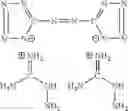
According to the invention this object is surprisingly achieved by the features of the main claim. Preferred embodiments are disclosed in the sub-claims. In this connection, according to the invention azotetrazolates are used as components. In particular aminoguanidine-5,5′-azotetrazolate (C4H14N18), abbreviated to AGATZ, and guanidine-5,5′-azotetrazolate (C4H12N16), abbreviated to GATZ, are used as azotetrazolate component.
The azotetrazolate component can be used either alone or in mixtures with one another and/or with further components. The structural formulae of AGATZ and GATZ are as follows:
Aminoguanidine-5,5′-azotetrazolate (C4H14N18, AGATZ)
Guanidine-5,5′-azotetrazolate (C4H12N16, GATZ)
The deflagration temperature of pure AGATZ is 209° C., and of GATZ is 240° C.
It was surprisingly found that with mixtures of AGATZ and/or GATZ and/or selected components, the deflagration temperatures can be controlled in the range from 165° C. to 195° C. and the deflagration temperatures of the mixture may be lower than those of the individual components.
For early-ignition agents deflagration temperatures below 200° C. are particularly useful. The pyrotechnic agents according to the invention meet this requirement, and have excellent long-term storage stability.
The following can be used as additives:
1. Oxidising Agents (Individually or in Mixtures)
-
- Nitrates of the alkali or alkaline-earth metals or of ammonium, such as sodium, potassium or ammonium nitrate, perchlorates of the alkali or alkaline-earth metals or of ammonium, peroxides of the alkali or alkaline-earth metals or of zinc.
2. Nitrogen-Containing Compounds (Individually or in Mixtures)
-
- Ammonium picrate, aminoguanidinium picrate, guanidinium picrate, aminoguanidinium styphnate, guanidinium styphnate, nitroguanidine, nitroaminoguanidine, nitrotriazolone, derivatives of tetrazole such as 5-aminotetrazole, ditetrazolylamine, ditetrazole and its salts, nitraminotetrazole and its salts such as ammonium nitraminotetrazolate and aminoguanidinium nitraminotetrazolate, aminoguanidine nitrate, diaminoguanidine nitrate, triaminoguanidine nitrate, guanidine nitrate, dicyandiamidine nitrate, diaminoguanidine azotetrazolate, triaminoguanidine azotetrazolate or ammonium azotetrazolate.
3. Energy-Rich Additives (Individually or in Mixtures)
-
- Hexogen, octogen, nitrocellulose.
4. Reducing Agents (Individually or in Mixtures)
-
- Aluminium, titanium, titanium hydride, boron, boron hydride, zirconium, zirconium hydride, silicon, graphite, activated charcoal, carbon black.
5. Binders (Individually or in Mixtures)
-
- Cellulose as well as its derivatives, polyvinyl-butyrals, polynitropolyphenylene, polynitrophenyl ether, plexigum, polyvinyl acetate, copolymers.
6. Combustion Moderators, Stabilisers and Processing Aids (Individually or in Mixtures)
-
- Ferrocene and derivatives, acetonylacetates, salicylates, barium carbonate, strontium carbonate, magnesium carbonate, melamine, zinc oxide, zinc carbonate, silicates, silica gels, silicic acids, for example Aerosil (Degussa Company), boron nitride.
The production and processing is carried out according to conventional processes known per se. These include for example kneading, extrusion, extrusion moulding, tabletting or granulation.
The present invention provides in particular:
-
- a pyrotechnic agent, which contains as component one or more azotetrazolates;
- a pyrotechnic agent, wherein the azotetrazolate component is selected from aminoguanidine-5,5′-azotetrazolate (AGATZ) and guanidine-5,5′-azotetrazolate (GATZ) or mixtures of the two;
- a pyrotechnic agent, wherein the amount of the azotetrazolate component is 100 wt. %;
- a pyrotechnic agent, wherein the amount of the azotetrazolate component is 10 to 99 wt. %, preferably 15 to 60 wt. %, particularly preferably 20 to 50 wt. %;
- a pyrotechnic agent that contains 1 to 90 wt. %, preferably 40 to 85 wt. %, particularly preferably 50 to 80 wt. %, of an additive or mixtures of several additives;
- a pyrotechnic agent, wherein the additives are selected from: ammonium picrate, aminoguanidinium picrate, guanidinium picrate, aminoguanidinium styphnate, guanidinium styphnate, nitroguanidine, nitroamino-guanidine, nitrotriazolone, derivatives of tetrazole and/or its salts, nitraminotetrazole and/or its salts, aminoguanidine nitrate, diaminoguanidine nitrate, triaminoguanidine nitrate, guanidine nitrate, dicyandiamidine nitrate, diaminoguanidine azotetrazolate, triaminoguanidine azotetrazolate, ammonium azotetrazolate; nitrates of alkali and/or alkaline-earth metals and/or of ammonium, perchlorates of alkali and/or alkaline-earth metals and/or of ammonium, peroxides of alkali and/or alkaline-earth metals and/or of zinc; aluminium, titanium, titanium hydride, boron, boron hydride, zirconium, zirconium hydride, silicon, graphite, activated charcoal, carbon black; cellulose and/or its derivatives, polyvinylbutyrals, polynitropolyphenylene, polynitrophenyl ether, plexigum, polyvinyl acetate and copolymers; hexogen, octogen; ferrocene and/or its derivatives, acetonylacetates, salicylates, barium carbonate, strontium carbonate, magnesium carbonate, melamine, zinc oxide, zinc carbonate, silicates, silica gels, silicic acids, for example Aerosil (Degussa Company), boron nitride;
- a pyrotechnic agent that contains 10 to 90 wt. %, preferably 20 to 70 wt. %, particularly preferably 30 to 60 wt. % of an oxidising agent;
- a pyrotechnic agent, wherein the oxidising agent is selected from one or more nitrates of alkali and/or alkaline-earth metals and/or of ammonium, perchlorates of alkali and/or alkaline-earth metals and/or of ammonium, peroxides of alkali and/or alkaline-earth metals and/or of zinc;
- a pyrotechnic agent that contains 10 to 90 wt. %, preferably 10 to 60 wt. %, particularly preferably 15 to 40 wt. % of a nitrogen-containing compound;
- a pyrotechnic agent, wherein the nitrogen-containing compound is selected from one or more of ammonium picrate, aminoguanidinium picrate, guanidinium picrate, aminoguanidinium styphnate, guanidinium styphnate, nitroguanidine, nitroaminoguanidine, nitrotriazolone, derivatives of tetrazole and/or its salts, nitraminotetrazole and/or its salts, aminoguanidine nitrate, diaminoguanidine nitrate, triaminoguanidine nitrate, guanidine nitrate, dicyandiamidine nitrate, diaminoguanidine azotetrazolate, triaminoguanidine azotetrazolate, ammonium azotetrazolate;
- a pyrotechnic agent that contains 1 to 90 wt. %, preferably 1 to 60 wt. %, particularly preferably 1 to 40 wt. % of high-energy additives;
- a pyrotechnic agent, wherein the high-energy additives are selected from one or more of hexogen, octogen and/or nitrocellulose;
- a pyrotechnic agent that contains 1 to 80 wt. %, preferably 1 to 40 wt. %, particularly preferably 1 to 15 wt. % of a reducing agent;
- a pyrotechnic agent, wherein the reducing agent is selected from one or more of aluminium, titanium, titanium hydride, boron, boron hydride, zirconium, zirconium hydride, silicon, graphite, activated charcoal, carbon black;
- a pyrotechnic agent that contains 1 to 80 wt. %, preferably 1 to 40 wt. %, particularly preferably 1 to 20 wt. % of a binder;
- a pyrotechnic agent, wherein the binder is selected from one or more of cellulose and its derivatives, polyvinylbutyrals, polynitropolyphenylene, polynitrophenyl ether, plexigum, polyvinyl acetate and copolymers;
- a pyrotechnic agent that contains 0.1 to 20 wt. %, preferably 0.1 to 15 wt. %, particularly preferably 1 to 10 wt. % of combustion moderators, stabilisers and processing aids;
- a pyrotechnic agent, wherein the combustion moderators and processing aids are selected from one or more of ferrocene and its derivatives, acetonylacetatess, salicylates, barium carbonate, strontium carbonate, magnesium carbonate, melamine, zinc oxide, zinc carbonate, silicates, silica gels, silicic acids, for example Aerosil (Degussa Company), and/or boron nitride;
- use of the pyrotechnic agent according to the invention as a thermal early-ignition agent;
- use of the pyrotechnic agent according to the invention as a thermal safety fuse;
- use of the pyrotechnic agent according to the invention in vehicle safety systems;
- use of the pyrotechnic agent according to the invention in gas generators;
- use of the pyrotechnic agent according to the invention in separators, preferably for battery terminals.
The invention is described in more detail by means of the following examples, without however being restricted thereto:
The compositions of 27 different mixtures of the pyrotechnic agent are listed in Table 1. The components were weighed out in the specified amounts (amounts refer to weight percent) into plastics containers and homogenised for 30 minutes in a tumble mixer.
| TABLE 1 |
| Mixtures |
| Amino- | |||||||
| AGATZ | guanidinium | Sodium | Potassium | ||||
| Mixture | (GATZ) | Hexogen | Octogen | picrate | Others | nitrate | nitrate |
| 1 | 30 | 20 | 50 | ||||
| 2 | 30 | 20 | 50 | ||||
| 3 | 30 | 30 | 40 | ||||
| 4 | 30 | 10 | 20 | 40 | |||
| 5 | 30 | 10 | 20 | 40 | |||
| 6 | 30 | 10 | AGSt: 20 | 40 | |||
| 7 | 30 | 10 | 20 | 40 | |||
| 8 | 30 | 10 | AGSt: 20 | 40 | |||
| 9 | 30 | GPik: 10 | 40 | ||||
| AGSt: 20 | |||||||
| 10 | 30 | GPik: 30 | 40 | ||||
| 11 | 30 | 20 | AGSt: 10 | 40 | |||
| 12 | 30 | 30 | 40 | ||||
| 13 | 30 | 30 | 40 | ||||
| 14 | 30 | 30 | 40 | ||||
| 15 | 30 | AGSt: 30 | 40 | ||||
| 16 | 30 | 10 | GPik: 20 | 40 | |||
| 17 | 30 | 10 | Nigu: 20 | 40 | |||
| 18 | 30 | AGSt: 30 | 40 | ||||
| 19 | 30 | 10 | GSt: 20 | 40 | |||
| 20 | GATZ: 30 | AGSt: 30 | 40 | ||||
| 21 | GATZ: 30 | 30 | 40 | ||||
| 22 | GATZ: 30 | 10 | AGSt: 20 | 40 | |||
| 23 | 30 | AGSt: 10 | 40 | ||||
| APik: 20 | |||||||
| 24 | 30 | 20 | APik: 10 | 40 | |||
| 25 | 30 | APik: 30 | 40 | ||||
| 26 | 30 | 10 | GPik: 20 | 40 | |||
| 27 | 30 | 10 | GPik: 20 | 40 | |||
| AGSt: Aminoguanidinium styphnate | |||||||
| GPik: Guanidinium picrate | |||||||
| Nigu: Nitroguanidine | |||||||
| APik: Ammonium picrate |
The deflagration temperatures and friction and impact sensitivities of the mixtures are given in Table 2. The friction and impact sensitivities were measured according to the methods of the Bundesanstalt für Materialforschung (BAM) (Federal Institute for Materials Testing), while the deflagration temperatures were measured by thermo-gravimetric analysis (Mettler Company) at a heating rate of 10° C. per minute.
| TABLE 2 |
| Summary of the deflagration temperatures |
| and friction and impact sensitivities |
| Deflagration | Friction | Impact | ||
| temperature | sensitivity | sensitivity | ||
| Mixture | [° C.] | [N] | [J] | |
| 1 | 180 | 240 | 3 | |
| 2 | 190 | 240 | 3 | |
| 3 | 182 | >360 | 4 | |
| 4 | 165 | 240 | 3 | |
| 5 | 172 | 360 | 2 | |
| 6 | 190 | >360 | 2 | |
| 7 | 172 | >360 | 2 | |
| 8 | 172 | >360 | 4 | |
| 9 | 181 | >360 | 5 | |
| 10 | 192 | >360 | 8 | |
| 11 | 178 | >360 | 6 | |
| 12 | 182 | >360 | 4 | |
| 13 | 221 | 360 | 2 | |
| 14 | 217 | 240 | 3 | |
| 15 | 172 | >360 | 6 | |
| 16 | 192 | >360 | 5 | |
| 17 | 191 | >360 | 6 | |
| 18 | 174 | >360 | 6 | |
| 19 | 182 | >360 | 10 | |
| 20 | 181 | >360 | 8 | |
| 21 | 195 | >360 | 10 | |
| 22 | 180 | >360 | 4 | |
| 23 | 180 | >360 | 5 | |
| 24 | 180 | >360 | 4 | |
| 25 | 175 | >360 | 3 | |
| 26 | 175 | >360 | 2 | |
| 27 | 180 | >360 | 3 | |
The weight losses and deflagration temperatures after thermal loading (24 hours, 125° C. and 400 hours, 110° C.) of some of the mixtures chosen from the examples are summarised in Table 3. The measurement of the weight loss was carried out in a similar way to the Holland Test. The deflagration temperatures were measured by thermo-gravimetric analysis (Mettler Company) at a heating rate of 10° C. per minute.
After 400 hours only slight weight losses of 0.1 to 0.7 wt. % are detected, and there are no significant changes in the deflagration temperature after thermal loading.
| TABLE 3 |
| Summary of the weight losses and deflagration temperatures |
| Deflagration | Deflagration | |||
| Weight loss | Weight loss | temp, after | temp, after | |
| Mix- | 24 h, 125° C. | 400 h, 110° C. | 24 h, 125° C. | 400 h, 110° C. |
| ture | [wt. %] | [wt. %] | [° C.] | [° C.] |
| 5 | 0.34 | 0.7 | 172 | 178 |
| 12 | 0.03 | 0.1 | 182 | 191 |
| 26 | 2.11 | 0.7 | 175 | 175 |
| 27 | 0.36 | 0.2 | 180 | 186 |
These results show that the specific pyrotechnic agents according to the invention have deflagration temperatures in the range from 172° to 191° C. and should be regarded as stable according to the requirements of the automobile industry.
In addition the following mixtures have proved to be particularly advantageous, in particular also for use in separators for battery terminals:
-
- 30 wt. % aminoguanidine-5,5′-azotetrazolate, 27.5 wt. % guanidinium picrate, 40 wt. % sodium nitrate, 2 wt. % titanium and 0.5 wt. % graphite;
- 29 wt. % aminoguanidine-5,5′-azotetrazolate, 29 wt. % guanidinium picrate, 40 wt. % sodium nitrate, 1.5 wt. % barium carbonate and 0.5 wt. % Aerosil; 24 wt. % aminoguanidine-5,5′-azotetrazolate, 24 wt. % guanidinium picrate, 50 wt. % sodium nitrate, 1.5 wt. % barium carbonate and 0.5 wt. % Aerosil;
29 wt. % aminoguanidine-5,5′-azotetrazolate, 29 wt. % guanidinium picrate, 40 wt. % sodium nitrate, 1.5 wt. % strontium carbonate and 0.5 wt. % Aerosil.
Claims
1. A pyrotechnic agent, which contains as component one or more azotetrazolates.
2. A pyrotechnic agent according to claim 1, characterised in that the azotetrazolate component is selected from aminoguanidine-5,5′-azotetrazolate (AGATZ) and guanidine-5,5′-azotetrazolate (GATZ) or mixtures of the two.
3. A pyrotechnic agent according to claim 1, characterised in that the amount of the azotetrazolate component is 10 to 99 wt. %, preferably 15 to 60 wt. %, particularly preferably 20 to 50 wt. %.
4. A pyrotechnic agent according to claim 1, characterised in that it contains 1 to 90 wt. %, preferably 40 to 85 wt. %, particularly preferably 50 to 80 wt. % of an additive or mixtures of several additives.
5. A pyrotechnic agent according to claim 1, characterised in that the additives are selected from: ammonium picrate, aminoguanidinium picrate, guanidinium picrate, aminoguanidinium styphnate, guanidinium styphnate, nitroguanidine, nitroaminoguanidine, nitrotriazolone, derivatives of tetrazole and/or its salts, nitraminotetrazole and/or its salts, aminoguanidine nitrate, diaminoguanidine nitrate, triaminoguanidine nitrate, guanidine nitrate, dicyandiamidine nitrate, diaminoguanidine azotetrazolate; nitrates of alkali and/or alkaline-earth metals and/or of ammonium, perchlorates of alkali and/or alkaline-earth metals and/or of ammonium, peroxides of alkali and/or alkaline-earth metals and/or of zinc; aluminium, titanium, titanium hydride, boron, boron hydride, zirconium, zirconium hydride, silicon, graphite, activated charcoal, carbon black; cellulose and/or its derivatives, polyvinylbutyrals, polynitropolyphenylene, polynitrophenyl ether, plexigum, polyvinyl acetate and copolymers; hexogen, octogen; ferrocene and/or its derivatives, acetonylacetates, salicylates, silicates, silica gels, boron nitride.
6. A pyrotechnic agent according to claim 1, characterised in that it contains 10 to 90 wt. %, preferably 20 to 70 wt. %, particularly preferably 30 to 60 wt. % of an oxidising agent.
7. A pyrotechnic agent according to claim 1, characterised in that the oxidising agent is selected from one or more of the nitrates of the alkali and/or alkaline-earth metals and/or of ammonium, the perchlorates of the alkali and/or alkaline-earth metals and/or of ammonium, the peroxides of the alkali and/or alkaline-earth metals and/or of zinc.
8. A pyrotechnic agent according to claim 1, characterised in that it contains 10 to 90 wt. %, preferably 10 to 60 wt. %, particularly preferably 15 to 40 wt. % of a nitrogen-containing compound.
9. A pyrotechnic agent according to claim 1, characterised in that the nitrogen-containing compound is selected from one or more of ammonium picrate, aminoguanidinium picrate, guanidinium picrate, aminoguanidinium styphnate, guanidinium styphnate, nitroguanidine, nitroaminoguanidine, nitrotriazolone, derivatives of tetrazole and/or its salts, nitraminotetrazole and/or its salts, aminoguanidine nitrate, diaminoguanidine nitrate, triaminoguanidine nitrate, guanidine nitrate, dicyandiamidine nitrate, diaminoguanidine azotetrazolate.
10. A pyrotechnic agent according to claim 1, characterised in that it contains 1 to 90 wt. %, preferably 1 to 60 wt. %, particularly preferably 1 to 40 wt. % of high-energy additives.
11. A pyrotechnic agent according to claim 1, characterised in that the high-energy additives are selected from one or more of hexogen, octogen and/or nitrocellulose.
12. A pyrotechnic agent according to claim 1, characterised in that it contains 1 to 80 wt. %, preferably 1 to 40 wt. %, particularly preferably 1 to 15 wt. % of a reducing agent.
13. A pyrotechnic agent according to claim 1, characterised in that the reducing agent is selected from one or more of aluminium, titanium, titanium hydride, boron, boron hydride, zirconium, zirconium hydride, silicon, graphite, activated charcoal, carbon black.
14. A pyrotechnic agent according to claim 1, characterised in that it contains 1 to 80 wt. %, preferably 1 to 40 wt. %, particularly preferably 1 to 20 wt. % of a binder.
15. A pyrotechnic agent according to 4, characterised in that the binder is selected from one or more of cellulose and its derivatives, polyvinylbutyrals, polynitropolyphenylene, polynitrophenyl ether, plexigum, polyvinyl acetate and copolymers.
16. A pyrotechnic agent according to claim 1, characterised in that it contains 0.1 to 20 wt. %, preferably 0.1 to 15 wt. %, particularly preferably 1 to 10 wt. % of combustion moderators and processing aids.
17. A pyrotechnic agent according to claim 1, characterised in that the combustion moderators and processing aids are selected from one or more of ferrocene and its derivatives, acetonylacetates, salicylates, silicates, silica gels and/or boron nitride.
18. A pyrotechnic agent according to claim 1, characterised in that it contains 30 wt. % of aminoguanidine-5,5′-azotetrazolate, 27.5 wt. % of guanidinium picrate, 40 wt. % of sodium nitrate, 2 wt. % of titanium and 0.5 wt. % of graphite.
19. A pyrotechnic agent according to claim 1, characterised in that it contains 29 wt. % of aminoguanidine-5,5′-azotetrazolate, 29 wt. % of guanidinium picrate, 40 wt. % of sodium nitrate, 1.5 wt. % of barium carbonate and 0.5 wt. % of Aerosil.
20. A pyrotechnic agent according to claim 1, characterised in that it contains 24 wt. % of aminoguanidine-5,5′-azotetrazolate, 24 wt. % of guanidinium picrate, 50 wt. % of sodium nitrate, 1.5 wt. % of barium carbonate and 0.5 wt. % of Aerosil.
21. A pyrotechnic agent according to claim 1, characterised in that it contains 29 wt. % of aminoguanidine-5,5′-azotetrazolate, 29 wt. % of guanidinium picrate, 40 wt. % of sodium nitrate, 1.5 wt. % of strontium carbonate and 0.5 wt. % of Aerosil.
22. A pyrotechnic agent according to claim 1, characterised in that the amount of the azotetrazolate component is 100wt. %.
23. Use of a pyrotechnic agent according to claim 1 as thermal early-ignition agent.
24. Use of a pyrotechnic agent according to claim 1 as thermal safety fuse.
25. Use of a pyrotechnic agent according to claim 1 in vehicle safety systems.
26. Use of a pyrotechnic agent according to claim 1 in gas generators.
27. Use of a pyrotechnic agent according to claim 1 in separators, preferably for battery terminals.
Images & Drawings included:

Sources:
- United States Patent and Trademark Office - verify current appl. status at the USPTO↗
Similar patent applications:
- » 20170137339
Pyrotechnic Igniting Agent - » 20200331822
USE OF A TETRAPHENYLPHOSPHONIUM HALOGENATED SALT AS SMOKE-PRODUCING AGENT AND SMOKE-PRODUCING PYROTECHNIC COMPOSITION INCORPORATING SUCH A MATERIAL - » 20060065337
Pyrotechnic actuator equipped with a charge comprising an oxidant and a reducing agent which are separate
Recent applications in this class:
- » 20180215679 2018-08-02
IGNITION FORMULATION AND COMBUSTIBLE COMPOSITION - » 20140113239 2014-04-24
Self-lighting device for a cigarette - » 20140087315 2014-03-27
Fire Igniter - » 20130205751 2013-08-15
Fast ignition and sustained combustion of ionic liquids - » 20130157203 2013-06-20
GAS FIRED CATALYTIC HEATER - » 20110203714 2011-08-25
Nano-laminate-based ignitors - » 20110123940 2011-05-26
Gas fired catalytic heater - » 20100036086 2010-02-11
Energy-producing material - » 20090159163 2009-06-25
Explosive Composition and Explosive Composition Shaped Body as Well as Method for Producing the Same - » 20080110365 2008-05-15
Axially compact mechanical igniter for thermal batteries and the like
Recent applications for this Assignee:
- » 20240302145 2024-09-12
Projectile, in particular deformation and/or partial fragmentation projectile, and method for producing a projectile - » 20230117939 2023-04-20
Expanding bullet - » 20230117770 2023-04-20
Intermediate for manufacturing projectiles of a deformable bullet, projectile, deformed projectile, tool for manufacturing the intermediate and method for manufacturing the intermediate - » 20220357139 2022-11-10
Metallic solid projectile, tool arrangement and method for producing metallic solid projectiles - » 20220357138 2022-11-10
EXPANDING BULLET - » 20210396504 2021-12-23
Projectile having a caliber of less than 13 mm and a system for tracking a projectile - » 20210278181 2021-09-09
Expanding bullet - » 20200393224 2020-12-17
Projectile, method of manufacturing a projectile and ammunition - » 20200370872 2020-11-26
Intermediate for manufacturing projectiles of a deformable bullet, projectile, deformed projectile, tool for manufacturing the intermediate and method for manufacturing the intermediate - » 20200243290 2020-07-30
Pyrotechnical disconnection unit, system for electrically charging an electric energy cell, mobile device and charging device