Fluid transfer multi-layer tube based on a polyamide and an ethyl vinyl alcohol or polyvinyl alcohol
US20100062201A1
2010-03-11
12/513,257
2007-10-24
✅ Patent granted
US 8,309,193 B2
2012-11-13
WO; PCT/US2007/082332; 20071024
WO; WO2008/057763; 20080515
Rena Dye | Yan Lan
2028-05-04
Abstract:
The present invention relates to a symmetrical multi-layer tube based on polyamide and ethyl vinyl alcohol (EVOH) or polyvinyl alcohol (PVOH) for transferring fluids. As examples of tubes for transferring fluids, mention may be made of fuel (gasoline, diesel fuel) pipes, in particular for carrying fuel from the tank to the engine of motor vehicles. Other examples of fluid transfer include, but are not limited to, the fluids used in fuel cells, CO2 systems for cooling, hydraulic systems, cooling circuits and air-conditioning circuits, and medium-pressure power transfer.
Inventors:
- Mehdi M. Emad 4 🇺🇸 Collegeville, PA, United States
- Gregory S. O'Brien 32 🇺🇸 Downingtown, PA, United States
- Franck Bertoux 2 🇨🇦 Montreal, Canada
- Franck Bertoux 1 🇺🇸 Montreal, CA, United States
Assignee:
- Arkema Inc. 363 🇺🇸 King of Prussia, PA, United States
Interested in similar patents?
Get notified when new applications in this technology area are published.
Classification:
B32B27/08 » CPC main
Layered products comprising synthetic resin as the main or only constituent of a layer, next to another layer of a of synthetic resin
B32B27/30 » CPC further
Layered products comprising synthetic resin comprising vinyl (co)polymers; comprising acrylic (co)polymers
B32B27/34 » CPC further
Layered products comprising synthetic resin comprising polyamides
F16L2011/047 » CPC further
Hoses, i.e. flexible pipes made of rubber or flexible plastics with a diffusion barrier layer
Y10T428/1393 » CPC further
Stock material or miscellaneous articles; Hollow or container type article [e.g., tube, vase, etc.]; Polymer or resin containing [i.e., natural or synthetic]; Open-ended, self-supporting conduit, cylinder, or tube-type article Multilayer [continuous layer]
B32B7/02 IPC
Layered products characterised by the relation between layers; Layered products characterised by the relative orientation of features between layers, or by the relative values of a measurable parameter between layers, i.e. products comprising layers having different physical, chemical or physicochemical properties; Layered products characterised by the interconnection of layers Physical, chemical or physicochemical properties
F16L11/04 IPC
Hoses, i.e. flexible pipes made of rubber or flexible plastics
B32B1/08 » CPC further
Layered products having a general shape other than plane Tubular products
Description
FIELD OF THE INVENTION
The present invention relates to a symmetrical multi-layer tube based on polyamide and ethyl vinyl alcohol (EVOH) or polyvinyl alcohol (PVOH) for transferring fluids.
As examples of tubes for transferring fluids, mention may be made of fuel (gasoline, diesel fuel) pipes, in particular for carrying fuel from the tank to the engine of motor vehicles. Other examples of fluid transfer include, but are not limited to, the fluids used in fuel cells, CO2 systems for cooling, hydraulic systems, cooling circuits and air-conditioning circuits, and medium-pressure power transfer.
BACKGROUND OF THE INVENTION
For safety and environmental protection reasons, motor-vehicle manufacturers require fuel tubes to have good mechanical properties, such as burst strength and flexibility, good cold (−40° C.) impact strength and high-temperature strength, a very low permeability to hydrocarbons and to their additives, particularly alcohols such as methanol and ethanol. These tubes must also have good resistance to the fuels and lubrication oils for engines. These tubes are manufactured by co-extruding the various layers using standard techniques for thermoplastics.
One type of tube used in these applications is based on a polyamide/fluoropolymer structure, such as in European patent number EP 558 373. The petrol permeability is excellent but the shock resistance is insufficient.
Multi-layer tubes, such as described in EP 696 301, EP 740 754 and EP 726 926 disclose tubes for transporting fuel, which comprise respectively a polyamide outer layer, a tie layer, a PVDF (polyvinylidene fluoride) layer, a tie layer and a polyamide inner layer in contact with the petrol. Adhesion between PVDF and polyamides is difficult due to the inertness of the PVDF.
Ethyl vinyl alcohol (EVOH) and polyvinyl alcohol (PVOH) can be used as a less expensive barrier layer. It also has a density differential advantage, and can provide a better permeation barrier for many hydrocarbon components.
One difficulty with multi-layer tubing is that the thickness of the layers and the unsymmetrical design can produce undesired stress during manufacture and use. These stresses can lead to splitting, resulting in serious safety concerns for low permeable multi-layer fuel tubing.
Surprisingly, it has now been found that by combining more flexible polyamide inner and outer layers with an EVOH or PVOH layer, with a symmetrical design, the safety issues caused by splitting of a multi-layer tubing can be resolved.
SUMMARY OF THE INVENTION
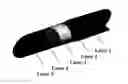
The invention relates to a symmetrical multi-layer tube comprising, in its radial direction from the outside inwards:
a) a polyamide outer layer (1);
b) an adhesive layer (2);
c) an ethyl vinyl alcohol and/or polyvinyl alcohol layer (3);
d) an adhesive layer (4); and
e) a polyamide inner layer (5),
wherein said inner and outer polyamide layers have essentially the same thickness and essentially the same composition; wherein said adhesive layers (2) and (4) have essentially the same thickness and essentially the same composition, and wherein the layers being successive and adhering to one another in their respective contact region.
According to one advantageous embodiment, the polyamide of the outer layer (1) is a polyamide having amine terminal groups or comprising more amine terminal groups than acid terminal groups.
According to one advantageous embodiment, a layer of a polyamide having amine terminal groups or one comprising more amine terminal groups than acid terminal groups is placed between the outer layer (1) and the layer (2).
These tubes may have an outside diameter of 6 to 110 mm and a thickness of around 0.5 to 5 mm.
Advantageously, the thickness of the inner and outer layer (1 and 5) represents between 70 and 90% of the thickness of the tube.
The tube of the present invention has a very low permeability to fuel, especially to hydrocarbons and to their additives, in particular alcohols like methanol and ethanol, or even ethers such as MTBE or ETBE. These tubes also have good resistance to fuels and to lubricating oils for engines.
This tube exhibits very good mechanical properties at low temperature and at high temperature.
The invention also relates to the use of these tubes for transporting fuel.
BRIEF DESCRIPTION OF THE DRAWINGS
FIG. 1: Shows a cut-away drawing of the fuel line structure of the invention having a five-layer structure.
DETAILED DESCRIPTION OF THE INVENTION
By “symmetrical” as used herein to describe the structure of the multi-layer tube is meant that the inner and outer layers are the same polyamide and have essentially the same thickness—though the inner layer may can contain an electrical conducting material. The two adhesive layers will also have essentially the same thickness, and the same composition The middle layer is a ethyl vinyl alcohol (EVOH) and/or polyvinyl alcohol (PVOH) layer having a thickness of between 0.09 inches and 0.11 inches.
The multi-layer tube of the invention has at least five layers, but could also have 7 or 9 layers—symmetrical around the EVOH or PVOH center layer. A five layer structure will be described in detail, though one can use the same concept with an EVOH or PVZOH core, adhesive layer(s) and polyamide inner and outer layers, in structures having 2 or 4 additional layers.
With regard to the polyamide layers (1 and 5), the polyamide layers that form the inner and outer layers of the fuel line have the same thickness. Preferably, the compositions of these inner and outer polyamide layers are the same, with the exception that the inner layer preferably contains additional electrical conductive material. The inner layer may contain an electrical conductive material, such as, but not limited to carbon black, and carbon nanotubes. The polyamide can be, but is not limited to PA-11 and PA-12, which are a preferred embodiment. Mention may also be made of those of formula X, Y/Z or 6, Y2/Z in which: X denotes the residues of an aliphatic diamine having from 6 to 10 carbon atoms; Y denotes the residues of an aliphatic dicarboxylic acid having from 10 to 14 carbon atoms; Y2 denotes the residues of an aliphatic dicarboxylic acid having from 15 to 20 carbon atoms; and Z denotes at least one unit chosen from the residues of a lactam, the residues of an alpha, omega-aminocarboxylic acid, the unit X1, Y1 in which X1 denotes the residues of an aliphatic diamine and Y1 denotes the residues of an aliphatic dicarboxylic acid, where the weight ratios Z/(X+Y+Z) and Z/(6+Y2+Z) being between 0 and 15%.
Mention may be made by way of example of PA-6, 10 (hexamethylenediamine and sebacic acid units), PA-6, 12 (hexamethylenediamine and dodecanedioic acid units) and PA-10, 10 (1,10-decane diamine and sebacic acid units). The polyamide of the inner layer (3) may be chosen from the polyamides mentioned in the case of the outer layer, PA-6 and PA-6/polyolefin blends having a PA-6 matrix and a polyolefin dispersed phase.
The inherent viscosity of the polyamide of the inner and outer layers (1, 5) may be between 1 and 2 and advantageously between 1.2 and 1.8. The inherent viscosity is measured at 20° C. for a 0.5% concentration in metacresol. The polyamide may contain from 0 to 30% by weight of at least one product chosen from plasticizers and impact modifiers per 100 to 70% of polyamide respectively. This polyamide may contain the usual additives, such as UV stabilizers, thermal stabilizers, antioxidants, fire retardants, etc. The inner layer may contain an electrical conductive material, such as, but not limited to carbon black, and carbon nanotubes,
Advantageously, the impact modifier is chosen from elastomers and very low-density polyethylenes.
With regard to the adhesive layers (2 and 4): the adhesive layer is chosen to have an affinity for both the polyamide layers and for the EVOH or PVOH barrier layer. The choice of an effective adhesive depends on the polyamide used. In one embodiment, a blend of polyamide 6/12 and polyamide 12/6 is employed as the adhesive layer. Polyamide 6 adheres well to EVOH/PVOH, while polyamide 12 adheres well to the preferred PA 11 or PA 12. Additionally, this mixture can disrupt the crystallinity which can be a benefit for mechanical properties of the fuel tube.
Other useful adhesive layer compositions include LOTADER polymers (Arkema Inc.) and other adhesive or tie layers known for affinity to both polyamide and EVOH/PVOH.
In one embodiment, the adhesive layer contains impact modifier. To maintain symmetry of the hose construction, the adhesive layers (2 and 4) preferably are of the same composition. Using the same composition reduces stress within the structure, as well as providing manufacturing efficiencies.
With regard to the EVOH and/or PVOH: The middle layer (barrier layer) of the composition is EVOH and or PVOH having a thickness of from 0.080 inches to 0.110 inches.
It is known that the thickness of the barrier layer has an adverse effect on the mechanical properties of the tubing. A thickness of 130 micron (0.13 mm) and above can cause premature tubing failure (splitting). In order to reduce splitting at higher barrier layers special (costly) processing equipment is needed. This could be in the form of modification to the existing equipment (130 degrees F. bath and/or flaming) to cut the tubing on line and or specific cooling sequence. However, tubing of the invention requires no changes to the standard manufacturing equipment nor any specific procedure needed to avoid tube splitting during cutting and/or following the fitting assembly step. The thickness of the barrier layer is preferably about 0.110 mm +/−0.010 (range of 0.100-0.120 mm). This barrier layer thickness provides good permeation characteristics, as specified in SAE J2260 version 2005 for this type of multi-layer tubing construction.
One or more of the layers may also contain typical additives, including, but not limited to: pigments; antioxidants; fire retardants; UV stabilizers; nano-fillers; nucleating agents.
EXAMPLES
A tube was formed by coextruding the layers listed in Table 1. As can be seen, the tube is symmetrical in terms of thickness and composition, within strict tolerances. Note that the inner and outer polyamide layers are slightly different in composition.
| TABLE 1 | |||
| Target | Temperatures (° C.) |
| thickness | Tolerance | Zone | Zone | Zone | Zone | ||||
| Material | (mm) | (mm) | Bush | 1 | 2 | 3 | 4 | connector | Head |
| RILSAN | 0.4 | 0.36-0.44 | 20 | 180 | 200 | 220 | 230 | 235 | 230-250 |
| AESN Black | |||||||||
| P210 TL | |||||||||
| (outside | |||||||||
| layer) | |||||||||
| ORGALLOY | 0.05 | 0.045-0.055 | 20 | 180 | 190 | 210 | 220 | 230 | 230-250 |
| HX256OT | |||||||||
| EVOH | 0.1 | 0.09-0.11 | 20 | 190 | 210 | 220 | 230 | 235 | 230-250 |
| ORGALLOY | 0.05 | 0.045-0.055 | 20 | 180 | 190 | 210 | 220 | 230 | 230-250 |
| HX256OT | |||||||||
| RILSAN | 0.4 | 0.36-0.44 | 20 | 190 | 220 | 240 | 250 | 250 | 230-250 |
| AESN Black | |||||||||
| P410 TL | |||||||||
| (outside | |||||||||
| layer) | |||||||||
| RILSAN AESN Black P210 TL and RILSAN AESN Black P410 are impact-modified | |||||||||
| nylon-12 from Arkema Inc. | |||||||||
| ORGALLOY HX256OT is a polyamide alloy from Arkem, Inc. |
Claims
1. A symmetrical multi-layer tube comprising, in its radial direction from the outside inwards:
a) a polyamide outer layer (1);
b) an adhesive layer (2);
c) an ethyl vinyl alcohol and/or polyvinyl alcohol layer (3);
d) an adhesive layer (4); and
e) a polyamide inner layer (5),
wherein said inner and outer polyamide layers have essentially the same thickness and essentially the same composition; wherein said adhesive layers (2) and (4) have essentially the same thickness and essentially the same composition, and wherein the layers being successive and adhering to one another in their respective contact region.
2. The tube according to claim 1, in which the polyamide of the outer layer (1) is a polyamide having amine terminal groups or comprising more amine terminal groups than acid terminal groups.
3. The tube according to claim 1 in which a layer of a polyamide having amine terminal groups or one comprising more amine terminal groups than acid terminal groups is placed between the outer layer (1) and the layer (2).
4. The tube according to claim 1 wherein said inner layer polyamide comprises an impact modifier.
5. The tube according to claim 1 wherein said polyamide comprises polyamide 11 or polyamide 12.
6. The tube of claim 1 comprising a tube for transporting hydrocarbon fuel.
Images & Drawings included:

Sources:
- United States Patent and Trademark Office - verify current appl. status at the USPTO↗
Recent applications in this class:
- » 20250289209 2025-09-18
GAS BARRIER FILM - » 20250282126 2025-09-11
MULTILAYER PACKAGING FILM AND PROCESS - » 20250282125 2025-09-11
DECORATIVE SHEET AND DECORATIVE MATERIAL - » 20250282124 2025-09-11
TEMPERED GLASS FOR PREVENTING GENERATION OF RAINBOW PATTERN AND MANUFACTURING METHOD THEREOF - » 20250276507 2025-09-04
RETORTABLE PACKAGING FILM - » 20250269633 2025-08-28
ENGINEERED PLANK AND ITS MANUFACTURING METHOD - » 20250269632 2025-08-28
LOW STATIC DISCHARGE NON-BLOCKING MULTILAYER BARRIER FILM - » 20250269631 2025-08-28
RECYCLABLE PACKAGE WITH FITMENT - » 20250262848 2025-08-21
MULTI-MATERIAL SHEATHING SYSTEM - » 20250262847 2025-08-21
STRUCTURE AND METHOD FOR ENVIRONMENTALLY FRIENDLY BLISTER PACKAGING
Recent applications for this Assignee:
- » 20250162885 2025-05-22
METHOD FOR SURFACE MODIFICATION AND DENSIFICATION OF LOW BULK DENSITY MATERIALS - » 20250064694 2025-02-27
METHODS OF FORMING DRY-TO-THE-TOUCH PEROXIDE COMPOSITIONS - » 20240262031 2024-08-08
MATERIAL EXTRUSION 3-D PRINTING ON COMPATIBLE THERMOPLASTIC FILM - » 20240190067 2024-06-13
MATTING AGENT RESIN FOR 3D PRINTING - » 20240159482 2024-05-16
METHOD FOR MONITORING A TUBE SHEET OF A HEAT EXCHANGER - » 20230126554 2023-04-27
Polyol pre-mixes having improved shelf life - » 20220403155 2022-12-22
FUNCTIONALIZED PROCESS AID BLENDS FOR CELLULAR PVC - » 20220402215 2022-12-22
ACRYLIC SUPPORT STRUCTURE FOR 3D PRINTED FLUOROPOLYMER ARTICLE - » 20220379568 2022-12-01
Weldable thermoplastic composite composites - » 20220348754 2022-11-03
COMPOSITE FUNCTIONALIZED ACRYLIC PROCESS AIDS FOR GLOSS AND SURFACE MODIFICATION