Method of increasing storage capacity of natural gas storage caverns
US20100189508A1
2010-07-29
12/303,712
2007-06-06
✅ Patent granted
US 8,128,317 B2
2012-03-06
WO; PCT/CA2007/000947; 20070606
WO; WO2007/140581; 20071213
Tara Mayo-Pinnock
2028-04-01
Abstract:
A method of increasing the storage capacity of a natural gas storage cavern, involves the step of adding liquefied natural gas to gaseous natural gas in the natural gas storage caverns. The addition of liquefied natural gas serves to reduce the temperature and associated pressure of gaseous natural gas in the natural gas storage cavern, thereby increasing the capacity of the natural gas storage cavern.
Interested in similar patents?
Get notified when new applications in this technology area are published.
Classification:
F17C5/02 » CPC main
Methods or apparatus for filling containers with liquefied, solidified, or compressed gases under pressures for filling with liquefied gases
F17C2221/033 » CPC further
Handled fluid, in particular type of fluid; Mixtures; Hydrocarbons Methane, e.g. natural gas, CNG, LNG, GNL, GNC, PLNG
F17C2223/0161 » CPC further
Handled fluid before transfer, i.e. state of fluid when stored in the vessel or before transfer from the vessel characterised by the phase; Two-phase; Liquefied gas, e.g. LPG, GPL cryogenic, e.g. LNG, GNL, PLNG
F17C2223/033 » CPC further
Handled fluid before transfer, i.e. state of fluid when stored in the vessel or before transfer from the vessel characterised by the pressure level Small pressure, e.g. for liquefied gas
F17C2225/0161 » CPC further
Handled fluid after transfer, i.e. state of fluid after transfer from the vessel characterised by the phase; Two-phase; Liquefied gas, e.g. LPG, GPL cryogenic, e.g. LNG, GNL, PLNG
F17C2225/035 » CPC further
Handled fluid after transfer, i.e. state of fluid after transfer from the vessel characterised by the pressure level High pressure, i.e. between 10 and 80 bars
F17C2227/0142 » CPC further
Transfer of fluids, i.e. method or means for transferring the fluid; Heat exchange with the fluid; Propulsion of the fluid with pumps or compressors; Pumps with specified pump type, e.g. piston or impulsive type
F17C2250/043 » CPC further
Accessories; Control means; Indicating, measuring or monitoring of parameters; Indicating or measuring of parameters as input values; Parameters indicated or measured Pressure
F17C2250/0439 » CPC further
Accessories; Control means; Indicating, measuring or monitoring of parameters; Indicating or measuring of parameters as input values; Parameters indicated or measured Temperature
F17C2265/022 » CPC further
Effects achieved by gas storage or gas handling; Mixing fluids identical fluid
F17C2270/0152 » CPC further
Applications for fluid transport or storage placed underground; Type of cavity by digging cavities Salt caverns
B65G5/00 IPC
Storing fluids in natural or artificial cavities or chambers in the earth
F25J1/00 IPC
Processes or apparatus for liquefying or solidifying gases or gaseous mixtures
Description
FIELD OF THE INVENTION
The present invention relates to a method of increasing the storage capacity of natural gas storage caverns.
BACKGROUND OF THE INVENTION
Natural gas is traditionally stored in a gaseous form in large volume salt caverns and aquifiers to meet peak demand and ensure a secure supply. The gas is added by compression, resulting in an increment in cavern temperature and an associated increment in cavern pressure. These increments in pressure and temperature increase compression costs and reduce cavern capacity. The typical operating conditions at these caverns are at pressures greater than 2000 psig and temperatures of ˜100 C. The actual pressure and temperature is dependent on its mode of operation.
SUMMARY OF THE INVENTION
A method of increasing the storage capacity of a natural gas storage cavern, involves the step of adding liquefied natural gas to gaseous natural gas in the natural gas storage caverns. The addition of liquefied natural gas serves to reduce the temperature and associated pressure of gaseous natural gas in the natural gas storage cavern, thereby increasing the capacity of the natural gas storage cavern.
BRIEF DESCRIPTION OF THE DRAWINGS
These and other features of the invention will become more apparent from the following description in which reference is made to the appended drawings, the drawings are for the purpose of illustration only and are not intended to in any way limit the scope of the invention to the particular embodiment or embodiments shown, wherein:
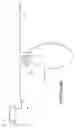
THE FIGURE is a schematic diagram of a natural gas storage cavern illustrating the method of increasing the storage capacity of natural gas storage caverns.
DETAILED DESCRIPTION OF THE PREFERRED EMBODIMENT
The method will now be described with reference to THE FIGURE.
Liquefied Natural Gas (LNG) is stored at −160 C at atmospheric pressure in insulated cryogenic tanks 12. Gaseous natural gas is stored in cavern 14 at operating conditions are typically about 2000 psig and 100 C. The basic process involves adding liquefied natural gas from cryogenic tank 12 to gaseous natural gas in cavern 14. For this purpose a pump 16 is used that is a cryogenic high pressure reciprocating pump. LNG is preferably added by pump 16 at a controlled flow rate to achieve a desired reduction in cavern temperature to increase cavern capacity. The mixing of the colder LNG at the point of discharge with the stored warmer gas will preferentially be at the center of the cavern for better distribution and heat transfer. Cavern pressure and temperature sensors, generally identified by reference numeral 18, monitor the result of the flow LNG into cavern 14. The operation of pump 16 is controlled based upon monitored feedback from sensors 18. The LNG gives up its cold to the natural gas within cavern 14. The lowering of the temperature of the natural gas increases the gas storage capacity of cavern 14.
Heat from the ground surrounding cavern 14 will allow the gas to expand with time, thus resulting in an incremental increase in pressure within cavern 14 over time. This is because pressure increases proportionally to temperature, moreover the volume changes 600 fold from the original pumped liquid phase to its present gaseous phase. This facilitates self pressurization within cavern 14 when it is desired to extract gas from cavern 14 and send it to natural gas distribution, generally indicated by reference numeral 20.
A further benefit is obtained through a reduction in compression costs. It is less costly to input LNG by means of a pump than it is to insert more gaseous form natural gas into cavern 14 that is already at 2000 psig using a compressor. In addition, the lowering of temperature and pressure with LNG also results in a reduction in compression costs when more gaseous form natural gas is being inserted into cavern 14 which is now at a lower temperature and a lower pressure.
In this patent document, the word “comprising” is used in its non-limiting sense to mean that items following the word are included, but items not specifically mentioned are not excluded. A reference to an element by the indefinite article “a” does not exclude the possibility that more than one of the element is present, unless the context clearly requires that there be one and only one of the elements.
It will be apparent to one skilled in the art that modifications may be made to the illustrated embodiment without departing from the spirit and scope of the invention as hereinafter defined in the Claims.
Claims
1. A method of increasing the storage capacity of a natural gas storage cavern, comprising the step of:
using sensors (18) to monitor at least one of pressure or temperature in a natural gas storage cavern;
adding selected quantities of liquefied natural gas to gaseous natural gas in the natural gas storage cavern (14) to maintain at least one of the pressure or the temperature of the natural gas storage cavern (14) at a pre-selected level pursuant to a control strategy in which a reduction of the temperature and associated pressure of gaseous natural gas in the natural gas storage cavern (14) is effected for the express purpose of increasing the storage capacity of the natural gas storage cavern (14), while maintaining the temperature within the thermo-elastic limits of the natural gas storage cavern (14).
Images & Drawings included:
Sources:
- United States Patent and Trademark Office - verify current appl. status at the USPTO↗
Similar patent applications:
Recent applications in this class:
- » 20250257847 2025-08-14
SYSTEMS FOR REFUELING LIQUEFIED PETROLEUM (LP) GAS TANKS - » 20250230900 2025-07-17
CONTROL SYSTEM AND METHOD FOR PREVENTING HYDROGEN BOIL-OFF LOSSES - » 20250155084 2025-05-15
SYSTEMS AND METHODS FOR REFUELING LIQUEFIED PETROLEUM (LP) GAS TANKS - » 20250137591 2025-05-01
BUNKERING VESSEL - » 20250035263 2025-01-30
MOBILE CO2 FILLING SYSTEM FOR FILLING ONSITE CO2 STORAGE AND DISPENSING SYSTEMS WITH CO2 - » 20250003554 2025-01-02
METHOD FOR DELIVERY OF LIQUID CRYOGEN - » 20240418323 2024-12-19
BUNKERING VESSEL - » 20240410526 2024-12-12
CARBON DIOXIDE OCEAN LIQUID BALLOON STORAGE METHOD - » 20240392923 2024-11-28
DEVICE AND METHOD FOR FILLING A PRESSURIZED-GAS TANK - » 20240369188 2024-11-07
BUNKERING VESSEL