Celery variety stix (PYC 6651)
US20100235953A1
2010-09-16
12/403,310
2009-03-12
✅ Patent granted
US 8,093,471 B2
2012-01-10
-
-
Cathy Kingdon Worley
2030-05-29
Abstract:
A new variety of celery designated as STIX (PYC 6651) and whose seed has an ATCC accession number PTA-9654 is presented. STIX has long petioles that make it well suited for making celery sticks.
Assignee:
- SYNGENTA PARTICIPATIONS AG 1,925 🇨🇭 Basel, Switzerland
Interested in similar patents?
Get notified when new applications in this technology area are published.
Classification:
A01H6/064 » CPC main
Angiosperms, i.e. flowering plants, characterised by their botanic taxonomy; Apiaceae, e.g. celery or carrot Apium graveolens [celery]
A01H5/04 » CPC further
Angiosperms, i.e. flowering plants, characterised by their plant parts; Angiosperms characterised otherwise than by their botanic taxonomy Stems
A01H5/00 IPC
Products
A01H5/00 IPC
Angiosperms, i.e. flowering plants, characterised by their plant parts; Angiosperms characterised otherwise than by their botanic taxonomy
C12N5/04 IPC
Undifferentiated human, animal or plant cells, e.g. cell lines; Tissues; Cultivation or maintenance thereof; Culture media therefor Plant cells or tissues
Description
FIELD OF INVENTION
The present invention refers generally to the field of plant breeding and in particular to a new variety of celery.
BACKGROUND
The commercial vegetable crop known as celery is widely used in cooking a variety of dishes and is frequently eaten without cooking, for example as a light snack. There are a number of varieties of celery crops. Although these crops of the celery family generally share a similar look and flavor, they differ in specific traits such as petiole size, shape, and number, succulence, ribbiness, disease resistance, shelf life, and bolting pattern, among others.
These specific traits make a celery variety more or less appealing from a commercial standpoint. For example, a variety that is disease resistant and has a longer shelf life is likely to be more commercially valuable than a variety that is susceptible to diseases or has a short shelf life. Also, since the parts of a celery plant that are most commonly consumed are the petioles (or the “stalks”), a variety that produces more or longer petioles is likely to be more desirable than a variety that produces fewer or shorter petioles.
While the pursuit to produce a celery variety that is more appealing for farmers and stores is on-going, it is important that the new varieties retain the flavor, texture, and nutritional properties of the parent plant that is desired by consumers. Thus, search continues for a celery variety that is appealing for consumption while presenting economic advantages to farmers and stores.
SUMMARY
The invention is a variety of celery whose seed has an ATCC number PTA-9654.
DETAILED DESCRIPTION
The crop of the invention is a member of Apium graveolens L. of the family Umbelliferae.
Characteristics
PYC 6651 is an exceptionally tall dark green celery with long, medium-smooth, slender petioles. Celeries are often consumed as celery sticks that are approximately four-inches long. PYC 6651 is especially suited for being prepared into approximately-four-inch sticks to be packaged for lunches and snacks. A single petiole of PYC 6651 may give as many as 4 or 5 four-inch cuts, which is significantly more than the 2 or 3 four-inch cuts obtained from a petiole of the shorter, conventional celery varieties. PYC 6651 also carriers a very high level of resistance to the disease Fusarium oxysporum.
Stix shows good genetic uniformity, is genetically stable and has remained so for two subsequent generations of seed production.
Some comparison data between PYC 6651 and other varieties are presented in the tables below.
| TABLE 1A |
| LSD Pair-wise Comparison of Seed Stalk Length (Run 1) |
| Name of Variety | Mean Seed Stalk Length (cm) | Homogeneous Groups |
| PYC 6651 | 15.438 | A |
| Green Bay | 9.012 | B |
| Challenger | 6.962 | C |
| Mission | 6.013 | C |
| Alpha = 0.05 | ||
| Standard Error for Comparison = 0.5627 | ||
| Critical T value = 1.976 | ||
| Critical Value for Comparison 1.1116 | ||
| Error term used: Error, 153 DF |
| TABLE 1B |
| LSD Pair-wise Comparison of Seed Stalk (Run 2) |
| Name of Variety | Mean | Homogeneous Groups | |
| PYC 6651 | 12.025 | A | |
| Green Bay | 9.312 | B | |
| Challenger | 8.700 | B | |
| Mission | 7.250 | C | |
| Alpha = 0.05 | |||
| Standard Error for Comparison = 0.4358 | |||
| Critical T Value = 1.976 | |||
| Critical Value for Comparison = 0.8609 | |||
| Error terms used: Error, 115 DF |
| TABLE 2A |
| LSD Pair-wise Comparison of |
| Number of Stalks that are >40 cm (Run 1) |
| Name of Variety | Mean | Homogeneous Groups | |
| PYC 6651 | 11.917 | A | |
| Challenger | 10.300 | B | |
| Alpha = 0.05 | |||
| Standard Error for Comparison = 0.2419 | |||
| Critical T Value = 1.981 | |||
| Critical Value for Comparison = 0.4793 | |||
| Error term used: Error, 115 DF |
| TABLE 2B |
| LSD Pair-wise Comparison of |
| Number of Stalks that are >40 cm (Run 2) |
| Name of Variety | Mean | Homogeneous Groups | |
| PYC 6651 | 11.250 | A | |
| Challenger | 9.975 | B | |
| Alpha = 0.05 | |||
| Standard Error for Comparison = 0.3148 | |||
| Critical T Value = 1.992 | |||
| Critical Value for Comparison = 0.6271 | |||
| Error term used: Error, 75 DF |
| TABLE 3A |
| LSD Pair-wise Comparison of |
| Number of Stalks that are <40 cm (Run 1) |
| Name of Variety | Mean | Homogeneous Groups | |
| PYC 6651 | 3.7667 | A | |
| Challenger | 3.8667 | A | |
| Alpha = 0.05 | |||
| Standard Error for Comparison = 0.1721 | |||
| Critical T Value = 1.981 | |||
| Critical Value for Comparison = 0.3409 | |||
| Error terms used: Error, 115 DF |
| TABLE 3B |
| LSD Pair-wise Comparison of |
| Number of Stalks that are <40 cm (Run 2) |
| Name of Variety | Mean | Homogeneous Groups | |
| PYC 6651 | 4.0750 | A | |
| Challenger | 4.0250 | A | |
| Alpha = 0.05 | |||
| Standard Error for Comparison = 0.1991 | |||
| Critical T Value = 1.992 | |||
| Critical Value for Comparison = 0.3966 | |||
| Error terms used: Error, 75 DF |
| TABLE 4A |
| LSD Pair-wise Comparison of Length (Run 1) |
| Name of Variety | Mean | Homogeneous Groups | |
| PYC 6651 | 46.100 | A | |
| Challenger | 33.200 | B | |
| Alpha = 0.05 | |||
| Standard Error for Comparison = 0.6212 | |||
| Critical T Value = 1.981 | |||
| Critical Value for Comparison = 1.2306 | |||
| Error terms used: Error, 115 DF |
| TABLE 4B |
| LSD Pair-wise Comparison of Length (Run 2) |
| Name of Variety | Mean | Homogeneous Groups | |
| PYC 6651 | 46.275 | A | |
| Challenger | 33.275 | B | |
| Alpha = 0.05 | |||
| Standard Error for Comparison = 0.7411 | |||
| Critical T Value = 1.992 | |||
| Critical Value for Comparison = 1.4763 | |||
| Error terms used: Error, 75 DF |
| TABLE 5A |
| LSD Pair-wise Comparison of Thickness (Run 1) |
| Name of Variety | Mean | Homogeneous Groups | |
| PYC 6651 | 9.0333 | B | |
| Challenger | 9.6833 | A | |
| Alpha = 0.05 | |||
| Standard Error for Comparison = 0.2777 | |||
| Critical T Value = 1.981 | |||
| Critical Value for Comparison = 0.5501 | |||
| Error terms used: Error, 115 DF |
| TABLE 5B |
| LSD Pair-wise Comparison of Thickness (Run 2) |
| Name of Variety | Mean | Homogeneous Groups | |
| PYC 6651 | 8.8500 | B | |
| Challenger | 9.98250 | A | |
| Alpha = 0.05 | |||
| Standard Error for Comparison = 0.3783 | |||
| Critical T Value = 1.992 | |||
| Critical Value for Comparison = 0.7536 | |||
| Error terms used: Error, 75 DF |
| TABLE 6A |
| LSD Pair-wise Comparison of Width (Run 1) |
| Name of Variety | Mean | Homogeneous Groups | |
| PYC 6651 | 18.233 | B | |
| Challenger | 22.900 | A | |
| Alpha = 0.05 | |||
| Standard Error for Comparison = 0.3966 | |||
| Critical T Value = 1.981 | |||
| Critical Value for Comparison = 0.7856 | |||
| Error terms used: Error, 115 DF |
| TABLE 6B |
| LSD Pair-wise Comparison of Width (Run 2) |
| Name of Variety | Mean | Homogeneous Groups | |
| PYC 6651 | 18.100 | B | |
| Challenger | 22.450 | A | |
| Alpha = 0.05 | |||
| Standard Error for Comparison = 0.5142 | |||
| Critical T Value = 1.992 | |||
| Critical Value for Comparison = 1.0243 | |||
| Error terms used: Error, 75 DF |
| TABLE 7A |
| LSD Pair-wise Comparison of Height (Run 1) |
| Name of Variety | Mean | Homogeneous Groups | |
| PYC 6651 | 102.07 | A | |
| Challenger | 81.40 | B | |
| Alpha = 0.05 | |||
| Standard Error for Comparison = 0.7246 | |||
| Critical T Value = 1.981 | |||
| Critical Value for Comparison = 1.4352 | |||
| Error terms used: Error, 115 DF |
| TABLE 7B |
| LSD Pair-wise Comparison of Height (Run 2) |
| Name of Variety | Mean | Homogeneous Groups | |
| PYC 6651 | 102.83 | A | |
| Challenger | 81.67 | B | |
| Alpha = 0.05 | |||
| Standard Error for Comparison = 0.8274 | |||
| Critical T Value = 1.992 | |||
| Critical Value for Comparison = 1.6482 | |||
| Error terms used: Error, 75 D |
| TABLE 8 |
| LSD Pair-wise Comparison of Fusarium Resistance |
| (on a scale of 1 to 5, 5 being most resistant) |
| Name of Variety | Mean | Homogeneous Groups | |
| Napoleon | 4.6667 | A | |
| Challenger | 1.3333 | B | |
| PYC 6651 | 1.0167 | C | |
| Alpha = 0.05 | |||
| Standard Error for Comparison = 0.0842 | |||
| Critical T Value = 1.973 | |||
| Critical Value for Comparison = 0.1662 |
Stix is similar to the celery cultivar “Challenger.” However, Stix is significantly taller (102.5 cm vs. 46.2 cm), has more stalks longer than 40 cm (11.6 vs. 10.1), has longer petioles to the first joint (46.2 cm vs. 33.3 cm), and is more resistant to Fusarium oxysporum f. sp. apii, Race 2 (1.1 vs. 1.5 on a 1-5 scale, with 1 being highly resistant) as compared to Challenger.
Horticultural trait data was collected in 2007 and 2008. The first trial was planted on Feb. 14, 2007, and transplanted to a field belonging to Betteravia Farms in Santa maria, Calif. on Apr. 19, 2007. Data was collected on Jul. 9, 2007. The second trial was planted on Feb. 22, 2008, and transplanted to a field belonging to Betteravia Farms in Santa Maria, Calif. on May 13, 2008. Data was collected on Jul. 24, 2008.
The experimental design for both trials was a Randomized Complete Block. The trial in 2007 utilized four replications with 15 plants per replication. The trial in 2008 utilized four replications with 10 plants per replication. An Analysis of Variance (ANOVA) for a Randomized Complete Block (RCBD) design was performed on data from each of the trials. All pair-wise comparisons were performed to evaluate the Least Significant Differences (LSD) with an Alpha value of 0.05 (see Tables above). The commercially available software program Statistix 9 was used for the analyses.
Fusarium resistance was collected in 2007 and 2008. In addition to Stix and Challenger, the cultivar “Napoleon” was included as a susceptible control. Both trials were planted in a field known to have high levels of Fusarium oxysporum f. sp. apii, Race 2. The first trial was planted on Apr. 10, 2007 and transplanted on Jun. 15, 2007. Data was collected on Sep. 17, 2007. The second trial was planted on Apr. 8, 2008 and transplanted on Jun. 18, 2008. Data was collected on Sep. 24, 2008. Resistance was evaluated using the following method of scoring:
-
- 1=Plant appears healthy and shows no evidence of Fusarium in crown
- 2=plant appears healthy, but shows slight traces of discoloration in vascular tissue of crown due to Fusarium
- 3=plant appears healthy, but shows obvious discoloration in crown due to Fusarium
- 4=plant shows moderate stunting and yellowing and pronounced discoloration in crown
- 5=plant is severely stunted and yellowed with pronounced discoloration in crown along with secondary decay
The experimental design for both Fusarium trials was a Randomized Complete Block. The trial in 2007 utilized four replications with 15 plants per replication. The trial in 2008 utilized three replications with 10 plants per replication. A One-Way Analysis of Variance was performed on data from each of the trials. All Pair-wise comparisons were performed to evaluate the Least Significant Differences (LSD) with an Alpha value of 0.05 (see Tables above). The software program Statistix 9 was used for the analyses.
Population Selection
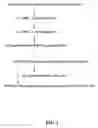
Stix (PYC 6651) celery was developed via the Pedigree Breeding Method utilizing Single Plant Selections followed by Mass Selection procedures. FIG. 1 shows a flowchart depicting the breeding history of Stix.
In the summer of 1996, a single extra-tall off-type plant (generation S0) was selected from a field of the celery variety “Picador” grown at Leach Farms in Berlin, Wis. This plant was identified as 96A002-1. Its petioles and roots were trimmed and it was taken to California where it was transplanted into a pot and grown over winter outdoors to induce bolting.
In February of 1997, the extra-tall S0 Picador was transplanted again from the pot into a celery nursery. It bolted that spring and was caged singly before flowering in a 3′×3′×6′ 20-mesh insect proof cage to assure self pollination.
The (S1) seed from this cage was harvested and cleaned in the fall of 1997, and the S1 seed was planted into a trial in Berlin, Wis. in the spring of 1998. The S1 plot was quite variable in height and plants tended to produce a large number of suckers at the base. Two plants that appeared to be cleaner around their bases and had good height were selected at maturity in August of 1998.
The two selected plants were each singly caged in a 3′×3′×6′ 20-mesh insect proof cage and flowered in the spring of 1999. S2 seed was harvested from them in the fall of 1999.
One of the two S2 seed lots was planted into a trial in Decatur, Mich. in the spring of 2000. It was fairly uniform with most plants having very long, slender petioles. Most of the plants again tended to produce sucker growth around the base. Two plants were selected on the basis of height and presence of fewer suckers. These plants were again each singly caged in a 3′×3′×6′ 20-mesh insect proof cage, and S3 seeds were harvested from them in the fall of 2001.
After two generations (S1 and S2) of selection for horticulturally acceptable traits (i.e., selection against suckering and for tall petioles), two lines of S3 generation seed were planted to a Fusarium trial for screening in Santa Maria, Calif. in June 2002. The S3 seeds were planted in a field with fusarium presence to test for fusarium resistance.
One of these S3 plots demonstrated excellent field resistance to Fusarium oxysporum f. sp. apii in the trial. The plot was somewhat variable for petiole length and still showed sucker growth at the base. From this plot two plants were selected in September, again primarily for petiole length and presence of fewer suckers. The two plants were overwintered outdoor in pots, individually caged in 2003, and produced S4 seeds. The S4 seeds were harvested in October of 2003.
These S4 lots were planted again in the fusarium field in Santa Maria in 2004. There was good uniformity within and between the two lots. Both lots demonstrated excellent fusarium resistance and were unusually tall with long slender petioles. There was a noticeably reduced tendency for sucker growth. One of the lines was given the experimental designation PYC 6651. Six plants were selected from it and caged in mass in a large pollination cage in 2004. F5 seeds were harvested from that cage in the fall of 2005 (celery is a biennial plant).
The F5 lot has served as the source for trialing in 2006 and 2007 and as stock seed for a commercial size increase in 2007.
Criteria for selection during the development of Stix (PYC 6651) included 1) an exceptionally tall dark green celery with long, medium-smooth, slender petioles, and 2) a very high level of resistance to the Fusarium disease of celery.
Although the foregoing invention has been described in some detail by way of illustration and examples for purposes of clarity and understanding, it will be apparent that modifications and alternative embodiments of the invention are contemplated which do not depart from the spirit and scope of the invention as defined by the foregoing teachings and appended claims.
Claims
What is claimed is:1. A seed of celery cultivar “STIX (PYC 6651),” wherein a representative sample of seed has been deposited under ATCC accession number PTA-9654.
2. A celery plant produced by growing the seed of claim 1.
3. A plant part from the plant of claim 2.
4. A celery plant having all of physiological and morphological characteristics of the celery plant of claim 2.
5. A plant part from the plant of claim 4.
6. Pollen of the plant of claim 2.
7. An ovule of the plant of claim 2.
8. A tissue culture of regenerable cells of the plant of claim 2.
Images & Drawings included:
Sources:
- United States Patent and Trademark Office - verify current appl. status at the USPTO↗
Recent applications in this class:
- » 20250287892 2025-09-18
CELERY CULTIVAR TBG 48 - » 20250228175 2025-07-17
CELERY CULTIVAR TBG 47 - » 20250072346 2025-03-06
CELERY CULTIVAR TBG 52 - » 20240306573 2024-09-19
CELERY CULTIVAR TBG 54 - » 20240268292 2024-08-15
CELERY CULTIVAR TBG 44 - » 20240224911 2024-07-11
Fusarium Resistance in Celery - » 20230380362 2023-11-30
Celery cultivar TBG 35 - » 20230337613 2023-10-26
Celery cultivar TBG 37 - » 20230337612 2023-10-26
Celery cultivar TBG 28 - » 20230320299 2023-10-12
Celery cultivar TBG 45
Recent applications for this Assignee:
- » 20250122524 2025-04-17
ENGINEERED PESTICIDAL PROTEINS AND METHODS OF CONTROLLING PLANT PESTS - » 20250024804 2025-01-23
DOWNY MILDEW RESISTANT IMPATIENS - » 20240423154 2024-12-26
TOMATO PLANT PRODUCING FRUITS WITH MODIFIED SUGAR CONTENT - » 20240360462 2024-10-31
CONTROL OF COLEOPTERAN PESTS USING RNA MOLECULES - » 20240292845 2024-09-05
CONTROL OF PLANT PESTS USING RNA MOLECULES - » 20240284911 2024-08-29
METHOD OF CONTROLLING WEEDS IN WARM SEASON TURFGRASS - » 20240276939 2024-08-22
VARIETY CORN LINES - » 20240172751 2024-05-30
METHODS OF PEST CONTROL IN SOYBEAN - » 20240099305 2024-03-28
PESTICIDAL COMPOSITION - » 20240099213 2024-03-28
HAPLOID INDUCTION COMPOSITIONS AND METHODS FOR USE THEREFOR