SUPRAMOLECULAR BLOCK COPOLYMER COMPOSITIONS FOR SUB-MICRON LITHOGRAPHY
US20110097559A1
2011-04-28
12/990,941
2009-05-07
Abstract:
A polymeric composition and method of preparation for application in sub-micron lithography, comprising a blend of A-B and B′-C block, random, branched, or graft copolymers, where: (i) the B and B′ blocks or grafts have attractive supramolecular interactions characterized by a negative Flory-Huggins parameter; (ii) the composition exhibits a microphase-separated, three-domain morphology with A, C, and B/B′ domains comprised largely of A blocks or grafts, C blocks or grafts, and a mixture of B and B′ blocks or grafts, respectively. Long-range ordering of nanometer-scale domain features has been achieved in thin films of such supramolecular polymer blends, while avoiding macrophase separation. The strategy offers a diversity of morphologies for sub-micron lithographic applications in tandem with ease of chemical synthesis.
Inventors:
- Craig J. Hawker 56 🇺🇸 Santa Barbara, CA, United States
- Edward J. Kramer 13 🇺🇸 Santa Barbara, CA, United States
- Chuanbing Tang 1 🇺🇸 Santa Barbara, CA, United States
- Glenn Fredrickson 1 🇺🇸 Santa barbara, CA, United States
Interested in similar patents?
Get notified when new applications in this technology area are published.
Classification:
H01L21/0337 » CPC main
Processes or apparatus adapted for the manufacture or treatment of semiconductor or solid state devices or of parts thereof; Manufacture or treatment of semiconductor devices or of parts thereof; Making masks on semiconductor bodies for further photolithographic processing not provided for in group or comprising inorganic layers characterised by their size, orientation, disposition, behaviour, shape, in horizontal or vertical plane characterised by the process involved to create the mask, e.g. lift-off masks, sidewalls, or to modify the mask, e.g. pre-treatment, post-treatment
B81C1/00031 » CPC further
Manufacture or treatment of devices or systems in or on a substrate for manufacturing microsystems without movable or flexible elements Regular or irregular arrays of nanoscale structures, e.g. etch mask layer
B82Y30/00 » CPC further
Nanotechnology for materials or surface science, e.g. nanocomposites
C08F293/005 » CPC further
Macromolecular compounds obtained by polymerisation on to a macromolecule having groups capable of inducing the formation of new polymer chains bound exclusively at one or both ends of the starting macromolecule using free radical "living" or "controlled" polymerisation, e.g. using a complexing agent
C08G83/008 » CPC further
Macromolecular compounds not provided for in groups - Supramolecular polymers
B81B2203/0361 » CPC further
Basic microelectromechanical structures; Static structures Tips, pillars
B81C2201/0149 » CPC further
Manufacture or treatment of microstructural devices or systems in or on a substrate; Shaping material; Structuring the bulk substrate or layers on the substrate; Film patterning; Film patterning Forming nanoscale microstructures using auto-arranging or self-assembling material
C08L2205/02 » CPC further
Polymer mixtures characterised by other features containing two or more polymers of the same -group
Y10T428/24802 » CPC further
Stock material or miscellaneous articles; Structurally defined web or sheet [e.g., overall dimension, etc.] Discontinuous or differential coating, impregnation or bond [e.g., artwork, printing, retouched photograph, etc.]
C08L2666/24 » CPC further
Composition of polymers characterized by a further compound in the blend, being organic macromolecular compounds, natural resins, waxes or and bituminous materials, non-macromolecular organic substances, inorganic substances or characterized by their function in the composition; Organic macromolecular compounds, natural resins, waxes or and bituminous materials Graft or block copolymers according to groups , or ; Derivatives thereof
B32B3/30 IPC
Layered products comprising a layer with external or internal discontinuities or unevennesses, or a layer of non-planar form ; Layered products having particular features of form characterised by a particular shape of the outline of the cross-section of a continuous layer; characterised by a layer with cavities or internal voids ; characterised by an apertured layer characterised by a layer formed with recesses or projections, e.g. hollows, grooves, protuberances, ribs
C08L53/00 » CPC further
Compositions of block copolymers containing at least one sequence of a polymer obtained by reactions only involving carbon-to-carbon unsaturated bonds; Compositions of derivatives of such polymers
B29C41/12 IPC
Shaping by coating a mould, core or other substrate, i.e. by depositing material and stripping-off the shaped article; Apparatus therefor for making articles of definite length, i.e. discrete articles Spreading-out the material on a substrate, e.g. on the surface of a liquid
G03G13/14 IPC
Electrographic processes using a charge pattern Transferring a pattern to a second base
Description
CROSS-REFERENCE TO RELATED APPLICATIONS
This application claims the benefit of Provisional Patent Application No. 61/126,959 filed on May 8, 2008, which is incorporated by reference herein.
STATEMENT REGARDING FEDERALLY SPONSORED RESEARCH OR DEVELOPMENT
This invention was made with support of Nanoelectronics Research Initiative (NRI), a company consortium established by Semiconductor Research Corporation (SRC), under Grant RID#1549 (SRC/NRI). The SRC has certain rights in this invention.
FIELD OF THE INVENTION
The invention relates to polymeric compositions for sub-micron lithography.
BACKGROUND OF THE INVENTION
The manufacture and miniaturization of integrated circuit components has made possible the operation of microprocessors at gigahertz frequencies as well as achieving gigabit capacities in dynamic random access memory (DRAM)1. However, one of the main future limitations for this technology is the inability to continue scaling to smaller dimensions the photolithographic techniques currently employed in complimentary metal oxide semiconductor (CMOS) transistors2. One promising technique to achieve this desired device miniaturization is Block Copolymer (BCP) lithography3,4. BCP lithography involves a self-assembly process that affords well-ordered patterns with domain sizes and periods ranging from 5 to 100 nm over large areas with relative ease and speed. It has been previously used to fabricate ordered arrays of cobalt, silicon and silicon oxide5,6. However to replace photolithography with BCP lithography, two major challenges are the achievement of long-range ordering from self-assembly of the BCP coupled with the elucidation of strategies for producing a wide range of symmetrical and non-symmetrical nanopatterns. Long-range ordering in thin films has been achieved with A-B, A-B-A or A-B-C block copolymers, and in specially designed mixtures of A-B block copolymers and C homopolymers7-9. However, no long-range ordering has been achieved in thin film mixtures of two chemically dissimilar block copolymers, because such mixtures tend to exhibit macrophase separation.
BRIEF SUMMARY OF THE INVENTION
The present invention overcomes the foregoing drawbacks by providing a broad strategy that allows for the development of polymeric compositions for sub-micron lithography comprising a mixture of an A-B block or graft copolymer and a B′-C block or graft copolymer with a controlled microphase separated, three-domain structure. Through attractive supramolecular interactions between B and B′ blocks or grafts, this blended system exhibits microphases similar to ABC triblock copolymers, thus having advantages of diverse morphology, but avoids the rigorous synthesis of ABC triblock copolymers, just requiring synthesis of simpler binary A-B and B′-C copolymers. The attractive interactions between B and B′ segments, described by a negative Flory interaction parameter, can be achieved by a variety of supramolecular interactions such as hydrogen bonding (e.g. complexation between poly(4-vinylpyridine) and poly(4-hydroxystyrene)), π-πstacking (e.g. backbone stacking of polyphenylenevinylene, or poly(3-hexylthiophene)), metal coordination (e.g. terpyridine-metal ion bridging different polymer blocks), etc.
The present invention provides an entirely new approach to develop self-assembled nanoscale patterns for use in sub-micron lithography. The invention provides access to the diverse morphologies that ABC triblock copolymers offer, but only requires the synthesis of binary A-B and B′-C block or graft copolymers. Successful implementation of such sub-micron lithographic techniques could enable the fabrication of >1010 devices on a chip in a low-cost and multifunctional manner.
More particularly, a method is provided for preparing a polymeric composition, comprising a supramolecularly interacting blend of A-B and B′-C block or graft copolymers, wherein:
(i) said A-B block or graft copolymer is itself a mixture of one or more A-B block or graft copolymers, each with at least one polymerized block or graft of polymer A and at least one polymerized block or graft of polymer B;
(ii) said B′-C block or graft copolymer is itself a mixture of one or more B′-C block or graft copolymers, each with at least one polymerized block or graft of polymer B′ and at least one polymerized block or graft of polymer C;
(iii) the B blocks or grafts of the A-B component have attractive interactions with the B′ blocks or grafts of the B′-C component, such interactions being described by a negative Flory-Huggins parameter χBB′; and
(iv) the composition exhibits a microphase-separated, three-domain morphology with distinct A, C, and B/B′ domains comprised largely of A polymer segments, C polymer segments, and a mixture of B and B′ polymer segments, respectively.
In another embodiment, the A-B block or graft copolymer can be an A-B diblock copolymer and the B′-C block or graft copolymer can be a B′-C diblock copolymer.
In specific embodiments, the blocks or grafts A, B, B′, and C can each bear a group selected from olefins, conjugated dienes, methacrylates, styrenes, acrylates, acrylamides, and acrylonitriles, esters, ethers, urethanes, ureas, amides, and statistical copolymers thereof. In another embodiment, the B and B′ blocks or grafts are themselves random or statistical copolymers of a common monomer, along with comonomers that bear the functional groups responsible for the attractive supramolecular interaction.
Thin films of these blended block copolymer systems can be treated so as to achieve long-range orientational and positional ordering of microdomains at a macroscopic scale. Given the simplicity of binary A-B and B′-C copolymer synthesis and the diverse set of morphologies that can be achieved by blending such materials, this method significantly broadens the scope of block copolymer lithography.
BRIEF DESCRIPTION OF THE DRAWINGS
For a more complete understanding of the present invention, reference is now made to the following descriptions taken in conjunction with the accompanying drawing, in which:
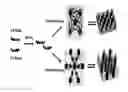
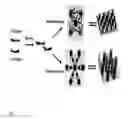
FIG. 1 illustrates a scheme for microphase separation of A-B and B′-C diblock copolymer blends through supramolecular interaction of B and B′ segments with a negative Flory-Huggins parameter;
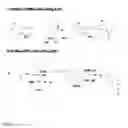
FIG. 2 depicts one example of synthesis of A-B and B′-C diblock copolymers;
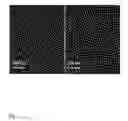
FIG. 3 shows AFM images of hexagonal (left) and square (right) packing of microdomain features in thin films of an A-B and B′-C blended system; and
FIG. 4 shows SEM images of hexagonal (left) and square (right) packing of microdomain features in thin films of an A-B and B′-C blended system.
DETAILED DESCRIPTION OF THE INVENTION
We have demonstrated a novel route that allows blends of two block copolymers to avoid macrophase separation and achieve long-range ordering in thin films. Self-assembly of this system leads to a rich array of highly ordered and geometrically diverse microphase separated structures, such as microdomain arrays with hexagonal packing, square packing, or a mixture of both. This system can be used as a lithographic mask to achieve ordered nanopillars or nanopores with preservation of its precursor structures. The size of the ordered features is primarily in the range of 5-20 nm but can be larger or smaller. The novel method involves a polymeric composition comprising a mixture of an A-B block or graft copolymer and a B′-C block or graft copolymer with a microphase-separated, three-domain structure in which the B and B′ segments are bound together into a mixed B/B′ domain through attractive supramolecular interactions characterized by a negative Flory-Huggins parameter. FIG. 1 illustrates a scheme for one particular embodiment—the case of an A-B and B′-C diblock copolymer blend with attractive supramolecular interactions among the B and B′ segments. This blended system provides access to the microphase structures of ABC triblock copolymers, thus having the advantage of diverse morphology (highly desirable in the microelectronics area and not achievable with simple AB block copolymers), but avoids the rigorous synthesis of ABC triblock copolymers. Only binary A-B and B′-C copolymers need to be synthesized. Negative Flory-Huggins interaction parameters can be achieved by many types of supramolecular interactions such as hydrogen bonding, π-π stacking, metal coordination, etc. The method presented in this invention offers the following key features:
-
- 1. The interactions between segments of the B and B′ blocks or grafts are attractive, which can be described by a negative Flory-Huggins interaction parameter χBB′.
- 2. The composition microphase separates to produce a three-domain structure with
- a. A domains comprised largely of A block or graft segments;
- b. C domains comprised largely of C block or graft segments; and
- c. B/B′ domains comprised largely of a mixture of B and B′ block or graft segments.
- 3. The A, B/B′, and C domains can be either discrete or continuous.
- 4. The A, B/B′, and/or C domains can be removed from the composition by a suitable chemical and/or physical treatment.
- 5. Macrophase separation of the A-B and B′-C block or graft copolymers is avoided due to the supramolecular attraction between the B and B′ blocks or grafts.
The Flory-Huggins parameter χBB′ is a parameter known in the polymer science literature that describes the tendency for polymer segments of types B and B′ to mix. Generally, the lower the value of χBB′, the better the miscibility of B and B′ polymer segments. A negative value of χBB′ is known to promote strong mixing of B and B′ block segments.
An example of such a system is described below.
Example 1
We prepared and blended the two diblock copolymers poly(methyl methacrylate)-b-poly(styrene-r-4-vinylpyridine) (PMMA-b-P(S-r-4VP)) and poly(ethylene oxide)-b-poly(styrene-r-4-hydroxystyene) (PEO-b-P(S-r-HS)) in order to illustrate the invention. This blended system combines the readily-achievable long-range order offered by PEO segments in PEO-PS diblock copolymers and the photodegradability of PMMA segments in PMMA-PS diblock copolymers. 4-vinylpyridine has an attractive supramolecular interaction with 4-hydroxystyrene through hydrogen bonding, which drives the P(S-r-4VP) and P(S-r-HS) blocks to mix into a common B/B′ domain, avoiding macrophase separation. The synthesis of PMMA-b-P(S-r-4 VP) as the A-B diblock copolymer and PEO-b-P(S-r-HS) as the C-B′ diblock copolymer was accomplished as shown in FIG. 2 by reversible addition-fragmentation chain transfer (RAFT) polymerization and atom transfer radical polymerization (ATRP) respectively. Addition of styrene and 4-vinylpyridine to macroinitiator PMMA yielded the desired PMMA-b-P(S-r-4VP), the desired A-B diblock copolymer. PEO ATRP initiators were chain extended with a mixture of styrene and acetoxystyrene (AS), resulting in a PEO-b-P(S-r-HS) diblock copolymer. Subsequent hydrolysis of acetoxystyrene under hydrazine solution converted polyacetoxystyrene into polyhydroxystyrene, yielding PEO-b-P(S-r-HS) as the desired C-B′ diblock copolymer.
Example 2
A method to achieve long-range ordering for the above specific system is to utilize solvent-annealing under controlled humidity conditions. The processing is very simple and fast and does not require expensive instrumentation. The above A-B and B′-C diblock copolymers were blended, dissolved in benzene and then spin-coated onto substrates such as silicon wafers followed by solvent annealing under controlled humidity. No macrophase separation was observed. FIG. 3 shows the formation of microphases consisting of hexagonal and square arrays of cylindrical domains. The cylinders align perpendicular to the substrate and the film surface and span the whole wafer. This procedure allows for the creation of hexagonal or square arrays of cylindrical domains with low concentrations of defects over large areas. Solvent annealing with these blended polymers produced a mixed poly(styrene-r-4-vinylpyridine) and poly(styrene-r-4-hydroxystyene) (B/B′) matrix with separated A and C cylinders comprised of PMMA blocks and PEO blocks, respectively. By controlling the molecular weight of each block, the size of the ordered domains can be tuned within to be between 1 and 50 nm, preferably 5-20 nm.
Nanoporous films can be obtained by removing the PMMA domains under UV light irradiation and simultaneously cross-linking the PS matrix. FIG. 4 shows scanning electron microscope (SEM) images of the resulting nanoporous thin films. Clearly, the hexagonal and square ordering was preserved. The darker regions correspond to the pores, which originate from the degraded PMMA domains.
This work shows the potential for many other block copolymer systems to be applied in a similar fashion to obtain ordered films. Among many possible functional groups, polymers bearing the following groups are particularly attractive: olefins, conjugated dienes, methacrylates, styrenes, acrylates, acrylamides, and acrylonitriles. In these systems, macrophase separation can be suppressed as long as the B and B′ segments have a negative Flory-Huggins interaction parameter. Additional processing techniques, such as thermal annealing, neutral surfaces, chemical modified substrates, and graphoepitaxy, can be applied to improve the quality of the lateral in-plane order of the microdomains, the details of which depend on the type of polymers chosen. The use of an ultra-thin (1-10 nm) crosslinked neutralization layer and low molecular weight materials (e.g. in the range of 1,000 to 50,000 g/mol) may also lead to the fabrication of feature sizes in the 1-50 nm and preferably 5-20 nm range over a variety of homogeneous and heterogeneous surfaces10.
The strategy described here not only offers the diversity of morphologies seen in ABC triblock copolymers, but also requires only the synthesis of diblock copolymers. We envision that the successful implementation of such sub-micron lithographic techniques could enable the fabrication of >1010 devices on a chip in a low-cost and multifunctional manner.
Although the present invention has been described in connection with the preferred embodiments, it is to be understood that modifications and variations may be utilized without departing from the principles and scope of the invention, as those skilled in the art will readily understand. Accordingly, such modifications may be practiced within the scope of the following claims.
REFERENCES
- 1. Black, C. T., Guarini, K. W., Milkove, K. R., Baker, S. M., Russell, T. P., Tuominen, M. T., “Integration of Self-Assembled Diblock Copolymers for Semiconductor Capacitor Fabrication”, App. Phys. Letts., 2001, 79, 409-411.
- 2. Skolnicki, T.; Hutchby, J A, King, T J.; Wong, H. S. P., Beouff, F., “The Road to the End of CMOS Scaling,” IEEE Circuits and Devices Magazine, 2005, 16-26.
- 3. Harrison, C.; Park, M.; Register, R.; Adamson, D.; Mansky, P.; Chaikin, P. “Method of Nanoscale Patterning and Products Made Thereby”, U.S. (1999), 5 pp. U.S. Pat. No. 5,948,470.
- 4. Nealey, P. F.; De Pablo, J. J.; Cerrina, F.; Solak, H. H.; Yang, X.; Peters, R. D.; Wang, Q. “Guided Self-assembly of Block Copolymer Films on Interferometrically Nanopatterned Substrates”, U.S. Pat. Appl. Publ. (2003), 18 pp. US 2003091752.
- 5. Cheng, J. Y.; Ross, C. A.; Chan, V. Z.-H.; Thomas, E. L.; Lammertink, R. G. H.; Vancso, G. I. “Formation of a Cobalt Magnetic Dot Array via Block Copolymer Lithography”, Adv. Mater., 2001, 13, 1174-1178.
- 6. Zschech, D.; Kim, D. H.; Milenin, A. P.; Scholz, R.; Hillebrand, R.; Hawker, C. I.; Russell, T. P.; Steinhart, M.; Gosele, U. “Ordered Arrays of <100>-Oriented Silicon Nanorods by CMOS-Compatible Block Copolymer Lithography”, Nano Leu.; 2007; 7; 1516-1520.
- 7. Park, M.; Harrison, C.; Chaikin, P. M.; Register, R. A.; Adamson, D. H. “Block Copolymer Lithography: Periodic Arrays of ˜1011 Holes in I Square centimeter”, Science, 1997, 276, 1401-1404.
- 8. Bang, J.; Kim, S. H.; Drockenmuller, E.; Misner, M. I.; Russell, T. P.; Hawker, C. J., “Defect-Free Nanoporous Thin Films from ABC Triblock Copolymers”, J. Am. Chem. Soc. 2006, 128, 7622-7629.
- 9. Kim, S. H.; Misner, M. J.; Russell, T. P., “Solvent Induced Ordering in Thin Film Diblock Copolymer/Homopolymer Mixtures”, Adv. Mater. 2004, 16, 2119-2123.
- 10. Ryu, D. Y., Shin, K., Drockenmuller, E., Hawker, C. J., Russell, T. P., “A Generalized Approach to the Modification of Solid Surfaces”, Science, 2005, 308, 236-239.
Claims
1. A polymeric composition comprising a blend of A-B and B′-C block, random, branched or graft copolymers, wherein:
(i) said A-B block or graft copolymer is itself a mixture of one or more A-B block, random, branched or graft copolymers, each with at least one polymerized block or graft of polymer A and at least one polymerized block or graft of polymer B;
(ii) said B′-C block, random, branched or graft copolymer is itself a mixture of one or more B′-C block or graft copolymers, each with at least one polymerized block or graft of polymer B′ and at least one polymerized block or graft of polymer C;
(iii) the B blocks or grafts of the A-B component have attractive interactions with the B′ blocks or grafts of the B′-C component, such interactions being described by a negative Flory-Huggins parameter χBB′; and
(iv) the composition exhibits a microphase-separated, three-domain morphology with distinct A, C, and B/B′ domains comprised largely of A polymer segments, C polymer segments, and a mixture of B and B′ polymer segments, respectively.
2. The composition of claim 1 in which said A-B block, random, branched or graft copolymer is an A-B diblock copolymer and said B′-C block or graft copolymer is a B′-C diblock copolymer.
3. The composition of claim 2 in which one or both of the B and B′ blocks are themselves random or statistical copolymers comprised of two or more monomers.
4. The composition of claim 1 in which the blocks or grafts of A, B, B′, and/or C bear a group selected from olefins, conjugated dienes, methacrylates, styrenics, acrylates, acrylamides, acrylonitriles, esters, ethers, urethanes, ureas, amides, and statistical copolymers thereof.
5. The composition of claim 3 in which the A-B block or graft copolymer, as an example, is the diblock copolymer poly(methyl methacrylate)-b-poly(styrene-r-4-vinylpyridine).
6. The composition of claim 3 in which the B′-C block or graft copolymer, as an example, is the diblock copolymer poly(styrene-r-4-hydroxystyene)-b-poly(ethylene oxide).
7. A method for preparing a polymeric composition, comprising a supramolecularly interacting blend of A-B and B′-C block, random, branched or graft copolymers, wherein:
(i) said A-B block, random, branched or graft copolymer is itself a mixture of one or more A-B block or graft copolymers, each with at least one polymerized block or graft of polymer A and at least one polymerized block or graft of polymer B;
(ii) said B′-C block, random, branched or graft copolymer is itself a mixture of one or more B′-C block or graft copolymers, each with at least one polymerized block or graft of polymer B′ and at least one polymerized block or graft of polymer C;
(iii) the B blocks, random, branched or grafts of the A-B component have attractive interactions with the B′ blocks or grafts of the B′-C component, such interactions being described by a negative Flory-Huggins parameter χBB′; and
(iv) the composition exhibits a microphase-separated, three-domain morphology with distinct A, C, and B/B′ domains comprised largely of A polymer segments, C polymer segments, and a mixture of B and B′ polymer segments, respectively.
8. The method of claim 7 in which said A-B block, random, branched or graft copolymer is an A-B diblock copolymer and said B′-C block or graft copolymer is a B′-C diblock copolymer.
9. The method of claim 8 in which one or both of the B and B′ blocks are themselves random or statistical copolymers comprised of two or more monomers.
10. The method of claim 7 in which the blocks or grafts of A, B, B′, and/or C bear a group selected from olefins, conjugated dienes, methacrylates, styrenics, acrylates, acrylamides, acrylonitriles, esters, ethers, urethanes, ureas, amides, and statistical copolymers thereof.
11. The method of claim 9 in which the A-B block or graft copolymer is the diblock copolymer poly(methyl methacrylate)-b-poly(styrene-r-4-vinylpyridine).
12. The method of claim 9 in which the B′-C block or graft copolymer is the diblock copolymer poly(styrene-r-4-hydroxystyene)-b-poly(ethylene oxide).
13. The method of claim 7 wherein the A-B and B′-C block or graft copolymers are dissolved in a common solvent or solvent mixture, the solution spin-cast onto a substrate and subsequently subjected to solvent annealing with or without humidity control to develop and improve the long-range order of the microphase-separated three-domain morphology.
14. The method of claim 7 wherein the A-B and B′-C block or graft copolymers are dissolved in a common solvent or solvent mixture, the solution spin-cast onto a substrate and subsequently subjected to thermal annealing with or without humidity control to develop and improve the long-range order of the microphase-separated three-domain morphology.
15. The method of claim 13 or 14, further comprising the use of graphoepitaxial techniques to improve the in-plane order of the microphase-separated three-domain morphology and/or to align the morphology relative to the substrate.
16. The method of claim 13 or 14, further comprising removing the A, C, and/or B/B′ domains by a suitable chemical and/or physical treatment.
17. The method of claim 13 or 14, further comprising performing lithographic techniques such as etching, pattern transfer, or templating as are conventionally carried out with traditional photoresists to create a pattern on an underlying substrate.
18. An article produced by the method of claim 13 or 14.
19. An article produced by the method of claim 15 or 16.
20. An article produced by the method of claim 17.
Images & Drawings included:
Sources:
- United States Patent and Trademark Office - verify current appl. status at the USPTO↗
Recent applications in this class:
- » 20250174459 2025-05-29
ASSEMBLY STRUCTURE INCLUDING A PLURALITY OF SPACERS AND METHOD OF MANUFACTURING THE SAME - » 20250166994 2025-05-22
DEPOSITION PROCESS FOR PATTERNING EDGE PLACEMENT ERROR IMPROVEMENT - » 20250157820 2025-05-15
METHODS FOR FORMING VERTICALLY LAYERED IONIC LIQUID CRYSTAL (ILC) STRUCTURES ON A SEMICONDUCTOR SUBSTRATE - » 20250149337 2025-05-08
HIGH SELECTIVITY CRYOGENIC TUNGSTEN-BORON-CARBIDE ETCH - » 20250140558 2025-05-01
METHOD OF FORMING PATTERNS, SEMICONDUCTOR MEMORY DEVICE, AND METHOD OF MANUFACTURING SEMICONDUCTOR MEMORY DEVICE - » 20250140557 2025-05-01
METHOD FOR FORMING A REDUCED SIZE FEATURE - » 20250132159 2025-04-24
HARDMASK INTEGRATION FOR HIGH ASPECT RATIO APPLICATIONS - » 20250125148 2025-04-17
METHOD FOR TWO-DIMENSIONAL MENTAL LINE PATTERNING - » 20250118559 2025-04-10
MANDREL STRUCTURES AND METHODS OF FABRICATING THE SAME IN SEMICONDUCTOR DEVICES - » 20250118558 2025-04-10
MASK PATTERN AND METHOD OF FORMING A FINE PATTERN OF A SEMICONDUCTOR DEVICE USING THE SAME