Document scanner
US20120044547A1
2012-02-23
12/858,488
2010-08-18
✅ Patent granted
US 8,456,718 B2
2013-06-04
-
-
Houshang Safaipour
Nelson Adrian Blish
2031-08-10
Abstract:
A document scanner (10) includes an input tray (30) for holding documents (20) prior to imaging; an output tray (150) for holding documents after the documents exit the scanner; an output image capture device (140) for capturing images of the output tray; an image processor for determining characteristics of the output tray or characteristic of the documents after the documents exit the scanner; and scanner functions are modified based on the output tray characteristics or the document characteristics.
Inventors:
- David M. Schaertel 14 🇺🇸 Webster, NY, United States
- Daniel P. Phinney 20 🇺🇸 Rochester, NY, United States
- Bruce A. Link 27 🇺🇸 Rochester, NY, United States
- Bruce A. Holroyd 4 🇺🇸 Rochester, NY, United States
- Marybeth Schmidt 4 🇺🇸 Rush, NY, United States
Assignee:
- Eastman Kodak Company 4,928 🇺🇸 Rochester, NY, United States
Applicant:
Interested in similar patents?
Get notified when new applications in this technology area are published.
Classification:
H04N1/04 IPC
Scanning, transmission or reproduction of documents or the like, e.g. facsimile transmission; Details thereof Scanning arrangements, i.e. arrangements for the displacement of active reading or reproducing elements relative to the original or reproducing medium, or
H04N1/0057 » CPC main
Scanning, transmission or reproduction of documents or the like, e.g. facsimile transmission; Details thereof; Handling of original or reproduction media, e.g. cutting, separating, stacking Conveying sheets before or after scanning
H04N1/00591 » CPC further
Scanning, transmission or reproduction of documents or the like, e.g. facsimile transmission; Details thereof; Handling of original or reproduction media, e.g. cutting, separating, stacking; Conveying sheets before or after scanning from the scanning position
H04N1/0062 » CPC further
Scanning, transmission or reproduction of documents or the like, e.g. facsimile transmission; Details thereof; Handling of original or reproduction media, e.g. cutting, separating, stacking Removing sheets from a stack or inputting media
H04N1/00631 » CPC further
Scanning, transmission or reproduction of documents or the like, e.g. facsimile transmission; Details thereof; Handling of original or reproduction media, e.g. cutting, separating, stacking Ejecting or stacking
H04N1/00687 » CPC further
Scanning, transmission or reproduction of documents or the like, e.g. facsimile transmission; Details thereof; Detecting the presence, position or size of a sheet or correcting its position before scanning; Object of the detection Presence or absence
H04N1/00697 » CPC further
Scanning, transmission or reproduction of documents or the like, e.g. facsimile transmission; Details thereof; Detecting the presence, position or size of a sheet or correcting its position before scanning; Object of the detection; Presence or absence in an output tray
H04N1/00734 » CPC further
Scanning, transmission or reproduction of documents or the like, e.g. facsimile transmission; Details thereof; Detecting the presence, position or size of a sheet or correcting its position before scanning; Detection means Optical detectors
H04N1/00742 » CPC further
Scanning, transmission or reproduction of documents or the like, e.g. facsimile transmission; Details thereof; Detecting the presence, position or size of a sheet or correcting its position before scanning Detection methods
H04N1/12 » CPC further
Scanning, transmission or reproduction of documents or the like, e.g. facsimile transmission; Details thereof; Scanning arrangements, i.e. arrangements for the displacement of active reading or reproducing elements relative to the original or reproducing medium, or using the sheet-feed movement as the slow scanning component,
H04N2201/0081 » CPC further
Indexing scheme relating to scanning, transmission or reproduction of documents or the like, and to details thereof; Types of the still picture apparatus Image reader
Description
CROSS REFERENCE TO RELATED APPLICATIONS
Reference is made to commonly-assigned copending U.S. patent application Ser. No. _______ (Attorney Docket No. 96504/NAB), filed herewith, entitled A METHOD OF SCANNING DOCUMENTS, by Schaertel et al.; U.S. patent application Ser. No. 12/839,476, filed Jul. 20, 2010, entitled METHOD FOR DOCUMENT SCANNING, by Schaertel et al.; U.S. patent application Ser. No. 12/839,471, filed Jul. 20, 2010, entitled A DOCUMENT SCANNER, by Schaertel et al.; and U.S. patent application Ser. No. 12/276,641 (now U.S. Publication No. 2010/0127447), filed Nov. 24, 2008, entitled DOCUMENT TRANSPORT APPARTUS, by Hammen; the disclosures of which are incorporated herein.
FIELD OF THE INVENTION
This invention relates to extracting properties of a document and the exit area characteristics as the document exits the scanner. This information is used to enable, disable, or improve features or functions of the scanner.
BACKGROUND OF THE INVENTION
A document scanner moves a document through a transport path and creates an image of the document as it moves. The processor for the document scanner has preset document characteristics and the operator must select functions and features to accommodate the specific requirements for a particular type of document. Alternately, the scanner may default to less efficient settings that will process all documents since scanners are not typically programmed with specific requirements on a document-by-document basis.
The preset characteristics include document characteristics such as size, weight, texture; and specific application requirements such as resolution and imaging mode, color, simplex, or duplex. In a document scanner, the documents to be scanned may vary by size, weight, color content, physical condition, or other characteristics, which may require different scanner features to be enabled or operator actions to be employed, for the most optimal and efficient mode of operation. Prior knowledge of these many different document attributes can enable the proper selection of scanner features to improve the efficiency of the scanning process or enable other features which may provide specific applications required by a particular type, style, or size of document. Prior knowledge of the documents physical condition can also prompt immediate action from the operator to protect the document or scanner or allow other features within the scanner to perform more reliably.
The exit area of the scanner is used for collecting the scanned documents as they exit the transport. A document must also exit the scanner, once it has been imaged, in an orderly fashion. By discerning document characteristics in the exit area as well as the exit area characteristics such as number of documents, the exit area features which control stacking and tracking can be managed.
There is a need, therefore, for detection of document characteristics after the document exits the transport path.
SUMMARY OF THE INVENTION
Briefly, according to one aspect of the present invention a document scanner includes an input tray for holding documents prior to imaging; an output tray for holding documents after the documents exit the scanner; an output image capture device for capturing images of the output tray; an image processor for determining characteristics of the output tray or characteristic of the documents after the documents exit the scanner; and scanner functions are modified based on the output tray characteristics or the document characteristics.
The invention and its objects and advantages will become more apparent in the detailed description of the preferred embodiment presented below.
BRIEF DESCRIPTION OF THE DRAWINGS
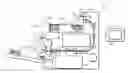
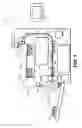
FIG. 1 is a cross-section view from the side of a document scanner according to the present invention.
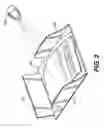
FIG. 2 is a perspective view of a scanner output tray.
DETAILED DESCRIPTION OF THE INVENTION
The present invention will be directed in particular to elements forming part of, or in cooperation more directly with the apparatus in accordance with the present invention. It is to be understood that elements not specifically shown or described may take various forms well known to those skilled in the art.
FIG. 1 is a side cross-sectional view of a document scanner 10. As shown in FIG. 1, documents 20 are first placed in the input tray 30 of the scanner. The document is moved forward into the scanner by the feed roller 50 and separation roller 60. The document continues through the document transport 70, is imaged by the front and rear cameras 80 and 90 respectively, and then moves out of the transport exit 130 into the output tray 150.
As the document 20 exits the transport 70 at the transport exit 130, the document and the output tray 150 are imaged by the output imaging device 140. The images are sent to the image processor 100 to discern document 20 and output tray 150 characteristics.
One output tray characteristic is whether or not there are documents 20 present in the output tray 150. If the output tray 150 is determined to be empty the processor 110 will determine how many documents 20 can be scanned before the output tray 150 becomes full. Also determining the output tray 150 level of documents 152 will be used by the processor 110 to stop scanning if the output tray becomes full. This may happen if the operator continues to place documents in the input tray 30 while scanning without removing documents from the output tray 150.
Another important characteristic is the stacking of the documents 20 in the output tray 150. If the documents 20 are not laying flat, one on top of another, the processor 110 will stop the scanning process and prevent additional documents from stacking improperly. Improper stacking may be an indication of the controlled output stacking 120 feature not be operating properly or being inadvertently turned off. Based on the output tray 150 characteristics, proper adjustment of the output tray side guides 160 or end stop 170 will be determined. The scanning may be stopped for the operator to adjust the side guides or end stop, or an auto adjust feature can be employed to make the correction while scanning is continued.
Based on document information from an input imaging device 40 the number of documents entering the scanner is be compared to the number of documents exiting the scanner. The document condition exiting the scanner will also be compared to condition of documents entering the scanner to determine if damage to the document, such as bent or torn corners 154, is occurring within the document transport 70, as is shown in FIG. 2. The processor will then stop the scanning process and alert the operator.
Using the information from the input imaging device 40 the number of documents 20 entering the document scanner 10 can be compared to the number of documents 20 exiting the scanner. If the number of documents 20 exiting the document scanner 10 does not match the number of documents 20 entering the document scanner 10 the operator will be alerted to the lost document.
In a C-shape document transport the document order can be tracked using document content captured by the output imaging device 140 in conjunction with the rear camera 90. In a straight through document transport, the document order can be tracked using the document content captured by the output imaging device in conjunction with the front camera 80.
The invention has been described in detail with particular reference to certain preferred embodiments thereof, but it will be understood that variations and modifications can be effected within the scope of the invention.
PARTS LIST
- 10 document scanner
- 20 documents
- 30 input tray
- 40 input imaging device
- 50 feed roller
- 60 separation roller
- 70 document transport
- 80 front camera
- 90 rear camera
- 100 image processor
- 110 processor
- 120 controlled output stacking
- 130 transport exit
- 140 output imaging device
- 150 output tray
- 152 level of documents in the output tray
- 154 document with a torn corner
- 160 output tray side guides
- 170 end stop
Claims
1. A document scanner comprising:
an input tray for holding documents prior to imaging;
an output tray for holding documents after the documents exit the scanner;
an output image capture device for capturing images of the output tray;
an image processor for determining characteristics of the output tray or characteristic of the documents after the documents exit the scanner; and
wherein scanner functions are modified based on said output tray characteristics or said document characteristics.
2. A document scanner as in claim 1 comprising an input image capture device for capturing images of documents in the input tray.
3. A document scanner as in claim 1 wherein images of documents are captured as they exit the scanner.
4. A document scanner as in claim 1 wherein images of the documents are captured after they exit the scanner.
5. A document scanner as in claim 1 wherein one characteristic is whether or the output tray is empty.
6. A document scanner as in claim 1 wherein one characteristic is a level of documents in the output tray.
7. A document scanner as in claim 1 wherein one characteristic is whether the documents are improperly stacked.
8. A document scanner as in claim 7 wherein an operator is alerted if the documents are improperly stacked.
9. A document scanner as in claim 7 wherein the processor determines if the documents are improperly stacked due to output tray side guides or end stop.
10. A document scanner as in claim 1 wherein the processor compares the input condition of the document to the output condition of the document.
Images & Drawings included:
Sources:
- United States Patent and Trademark Office - verify current appl. status at the USPTO↗
Similar patent applications:
- » 20120250108
Document scanner, an associated method of operating a document scanner, and an associated program storage device - » 20180257887
Document scanner with automated document alignment system - » 20070102872
Automatic document scanner with upright visible document images - » 10353508
Document scanning method and document scanner - » 10136502
Retractable lamp for an improved document scanner paper path - » 10227849
Document scanner with light focusing device - » 20050105119
Easy scan kiosk for low volume document scanner - » 10348586
Electronic device display and document scanner - » 10303263
Method and apparatus for detection of multiple documents in a document scanner using multiple ultrasonic sensors - » 10237957
Method of optimal focusing for document scanner
Recent applications in this class:
- » 20250203024 2025-06-19
IMAGE READING DEVICE AND IMAGE FORMING SYSTEM - » 20240364823 2024-10-31
MEDIA CONVEYING APPARATUS, IMAGE PROCESSING SYSTEM, AND MEDIA CONVEYING METHOD - » 20240267471 2024-08-08
INFORMATION PROCESSING APPARATUS AND NON-TRANSITORY COMPUTER READABLE MEDIUM - » 20240236249 2024-07-11
Sheet feeding apparatus, image reading apparatus, and image forming apparatus - » 20240223710 2024-07-04
Image reading apparatus and image forming system - » 20240098196 2024-03-21
Image reading apparatus and image forming apparatus - » 20230164277 2023-05-25
Image reading apparatus and image forming system to drive backing rollers relative to outlet conveyance rollers - » 20230030207 2023-02-02
Reading device and image forming apparatus - » 20230007129 2023-01-05
Image reading apparatus and image forming apparatus - » 20220303403 2022-09-22
Image reading apparatus, image processing method
Recent applications for this Assignee:
- » 20250083435 2025-03-13
Inking system with plurality of fountain roller elements - » 20250083434 2025-03-13
INK TRAY INSERT - » 20240140743 2024-05-02
PRINTING PLATE PICKING SYSTEM AND PROCESS - » 20240118227 2024-04-11
MEDIA CONDUCTIVITY MEASUREMENT SYSTEM - » 20240053697 2024-02-15
Printer providing in-track error correction incorporating anti-aliasing at cross-track positions - » 20230314935 2023-10-05
Lithographic printing plate precursor and method of use - » 20230138562 2023-05-04
Electrophotographic printing system including lateral translations to reduce burn-in artifacts - » 20230137371 2023-05-04
Reproducing out-of-gamut spot colors on a color printer - » 20230133375 2023-05-04
User-preferred reproduction of out-of-gamut spot colors - » 20230130313 2023-04-27
Reducing artifacts using alternating light source power levels