Azalea plant named 'MNIHAR017'
US20120054934P1
2012-03-01
12/807,057
2010-08-25
Abstract:
A new and distinct variety of Azalea plant with spring and fall blooming, attractive, showy, single dark-red flowers, easily propagated by semi-hardwood cuttings in late spring through summer, moderate growth rate under normal fertilization and moisture conditions; broadly-rounded and freely-branching in habit, grows well in containers, thrives in shade or sun and is hardy in Zone 7, is disclosed.
Inventors:
- James O. Harris 21 🇺🇸 Lawrenceville, GA, United States
- Ella Ruth Harris 8 🇺🇸 Lawrenceville, GA, United States
Assignee:
- McCorkle Nurseries, Inc. 9 🇺🇸 Dearing, GA, United States
Interested in similar patents?
Get notified when new applications in this technology area are published.
Classification:
A01H5/00 IPC
Products
A01H5/00 IPC
Angiosperms, i.e. flowering plants, characterised by their plant parts; Angiosperms characterised otherwise than by their botanic taxonomy
Description
GENUS AND SPECIES
Rhododendron sp.
VARIETY DENOMINATION
‘MNIHAR017’
BACKGROUND OF THE NEW PLANT
The present invention is a new and distinct variety of evergreen Azalea of the genus Rhododendron. This new Azalea, hereinafter referred to as ‘MNIHAR017’, was discovered in 2003 in Lawrenceville, Ga. ‘MNIHAR017’ originated from a planned cross hybridization in 1999 between the female azalea plant ‘Conleb’ (U.S. Plant Pat. No. 10,581) and the male azalea plant ‘Jay Valentine’ (unpatented) in a controlled environment in Lawrenceville, Ga. The present invention has a unique combination of blooming period, growth habit, and cold hardiness.
The new plant was first propagated via semi-hardwood cuttings in 2003 in Dearing, Ga. and has been asexually reproduced repeatedly by semi-hardwood cuttings in Dearing, Ga. for over seven years. The new plant retains its distinctive characteristics and reproduces true to type in successive asexual propagations by semi-hardwood cuttings.
Plant Breeder's Rights for the instant plant have not been applied for ‘MNIHAR017’ has not been made publicly available or sold more than one year prior to the filing date of this application.
SUMMARY OF THE INVENTION
The following are the most outstanding and distinguishing characteristics of this new plant when grown under normal horticultural practices in Dearing, Ga.
1. Spring and fall blooming;
2. Attractive, showy, dark-red flowers;
3. Numerous single flowers;
4. Easily propagated by semi-hardwood cuttings in late spring through summer;
5. Moderate growth rate under normal fertilization and moisture conditions;
6. Upright, globose, dense and compact in nature;
7. Grows well in containers;
8. Thrives in shade or sun; and
9. Hardy in Zone 7.
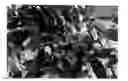
DESCRIPTION OF THE PHOTOGRAPHS
This new Azalea plant is illustrated by the accompanying photographs which show buds, flowers, immature foliage and mature foliage. The colors shown are as true as can be reasonably obtained by conventional photographic means. The photographs are of 4-years-old plants grown in filtered shade in September in 2009 in Dearing, Ga.
FIG. 1 is a close-up showing the stems and mature foliage.
FIG. 2 shows the mature foliage and growth habit of a five-year-old plant.
FIG. 3 is a close-up showing flower buds and immature foliage.
FIG. 4 is a close-up showing flower size, form, and color.
DETAILED BOTANICAL DESCRIPTION OF THE NEW PLANT
The following is a detailed description of the new variety of Azalea based on observations made of 4-year-old plants grown in 3-gallon containers according to wholesale commercial production conditions under full-sun and in an evaluation bed under semi-shade conditions in Dearing, Ga. in spring, summer, and fall in 2009. The colors of the various plant parts are detailed with reference to The Royal Horticultural Society Colour Chart (2001).
- Classification:
-
- Family.—Ericaceae.
- Species.—Rhododendron sp.
- Common name.—Azalea.
- Commercial name.—‘MNIHAR017’.
-
- Parentage:
-
- Female parent.—The azalea plant ‘Conleb’ (U.S. Plant Pat. No. 10,581).
- Male parent.—The azalea plant ‘Jay Valentine’ (unpatented).
-
- Growth:
-
- Form.—Upright, globose.
- Texture.—Medium.
- Height.—91.44 cm to 121.92 cm.
- Width.—137.16 cm to 167.64 cm.
- Growth habit.—Freely-branching; dense and compact in nature.
- Growth rate.—Moderate to rapid growth rate under normal fertilization and moisture conditions. In a period of five years from a rooted cutting the plant reaches a height of 60.96 cm and a spread of 83.82 cm. The growth rate is normally averages about 11.1 cm per year; the plant reaches a height of 91.44 cm to 121.92 cm at maturity while maintaining a dense habit due to the abundant branch development.
- Spring growth.—The date of initial spring growth is April 5, followed by continuous growth through fall.
- Life cycle.—Perennial and evergreen.
-
- Leaves:
-
- Arrangement.—Alternate, simple, and evergreen.
- Shape.—Elliptic to obovate.
- Apex.—Acute.
- Base.—Acute.
- Margin.—Entire.
- Length.—3.5 cm.
- Width.—1.3 cm.
- Venation pattern.—Pinnate; the mid-veins and laterals are impressed on the upper surface and the prominent on the lower surface.
- Immature leaf.—Upper surface: Color: Matte, RHS 144A (yellow-green) Pubescence: Scabrous with some strigose along midrib and margin; color is RHS N155A (white) Lower surface: Color: Matte, RHS 146C (yellow-green) Pubescence: Strigose and scabrous along midrib and margin; color is RHS N155A (white).
- Mature leaf.—Upper surface: Color: Semi-glossy, RHS 147A (yellow-green) Pubescence: Scabrous, color is RHS 166D (greyed-orange) Lower surface: Color: Matte, RHS 146B (yellow-green) Pubescence: Scabrous, strigose along midrib; color is RHS 164A (greyed-orange).
- Petiole.—Length: 0.6 cm Diameter: 0.15 cm by 0.1 cm Pubescence: Strigose with some pilose, length is 0.1 cm to 0.3 cm; color is RHS 165C (greyed-orange) and RHS N155A (white) maturing to RHS 155C (white) Color: Begins as RHS 145A (yellow-green) and matures to RHS 146C (yellow-green).
-
- Stems:
-
- Form.—Densely branched at buds.
- Young stems (1-year old and younger).—Color: RHS 46A (red) maturing to RHS 144A (yellow-green) Pubescence: Strigose RHS 155C (white) to RHS N167B (greyed-orange).
- Second-year stems.—Stem and pubescence color: RHS 199B (greyed-brown) with a low amount of strigose pubescence present, RHS 199B (greyed-brown) in color Length: 7 cm on average Diameter: 0.15 cm Pith: Solid and uniform Internode length: Average 0.9 cm.
-
- Flower buds:
-
- Arrangement and form.—Tight; borne in groups of two or three, sheathed by a pair of modified leaf bracts which are 1.5 cm in length, 0.8 cm in width, persistent and RHS 147A (yellow-green) in color.
- Shape.—Ovate.
- Apex.—Acute.
- Base.—Rounded.
- Length (at tight bud).—1.3 cm.
- Diameter (at tight bud).—0.6 cm.
- Color (of scales).—Immature scales are RHS 145D (yellow-green) and mature to RHS 146B (yellow-green) with areas of RHS 178C (greyed-red).
- Texture.—Pubescent; strigose pubescence RHS 165B (greyed-orange) in color.
- Pedicel.—Length: 0.6 cm Diameter: 0.2 cm Texture: Pubescent, strigose pubescence that is RHS N155C (white) Color: RHS 46A (red).
- Calyx.—Form and arrangement: Composed of 5 sepals in a cup-shape Length: 0.9 cm Width: 0.9 cm Color: RHS 144A (yellow-green) with some RHS 46A (red) at base Pubescence: Strigose and strigillose; RHS N155C (white) in color Sepals: Shape: Lanceolate and broadly elliptical Apex: Cuspidate to Obtuse Base: Fused; joined at base to form a cup Margin: Entire with some lobulate Color: Upper RHS 144A (yellow-green) with some RHS46A (red) at base, Lower RHS 144A (yellow-green) with areas of RHS 145B (yellow-green) Length: 1.1 cm Width: 0.45 cm.
-
- Flowers:
-
- Type.—Perfect, Single flowers.
- Shape.—Open funnel-shaped.
- Flowering habit and period.—Borne on the current season's growth; two and a half weeks beginning in early April in Dearing, Ga.; flowering resumes in late August and continues until frost which can be as late as November or December.
- Lastingness of flowers on the plant.—4 to 6 days in the sun; 4 to 7 days in the shade.
- Fragrance.—Absent.
- Diameter.—5.0 cm.
- Depth.—3.8 cm.
- Petals.—Quantity per flower and arrangement: 5 imbricate petals that are fused at the base and remain fused tip to 1.5 cm Shape: Obovate Apex: Rounded Base: Fused Margin: Entire to undulate Texture (both upper and lower surfaces): Glabrous Length (of petals without spots): 3.5 cm Width (of petals without spots): 2.2 cm Color: upper surfaces are RHS 46A (red) with areas of RHS N34A (orange-red); lower surfaces are RHS 46B (red) with areas of RHS N34A (orange-red) near the apex; the upper surface of the spots are RHS 187B (greyed-purple) and lower surface of spots are not visible.
-
- Reproductive parts:
-
- Pistil.—Quantity and form: Single, non-petaloid Length: 3.2 cm Diameter: 0.05 cm Stigma: Color: RHS 46A (red) Diameter: 0.15 cm Style color: RHS 47B (red) Ovary: Pubescent, Pilose RHS N155A (white), with 5 locules.
- Stamens.—Number: 5 to 6 per flower; non-petaloid with some slightly petaloid Length: 2.5 cm Color: RHS 47B (red) Anther: RHS 187A (greyed-purple); 0.25 cm in length by 0.1 cm in width Pollen: Abundant; RHS 155D (white).
-
- Fruit:
-
- Maturity.—The capsule matures in about 6 months in Dearing, Ga. and the fruit set is low and contains about 100-300 non-winged seeds.
- Length.—0.6 cm.
- Width.—0.5 cm.
- Color.—RHS 146B (yellow-green).
-
CULTURE
‘MNIHAR017’ grows well in a wide range of conditions and tolerates sun to shade. ‘MNIHAR017’ prefers moist, well-drained soil that is rich in organic matter and responds well to mulching and medium applications of fertilizer. ‘MNIHAR017’ does best in soil with a pH of 5.0 to 5.5 and is propagated with semi-hardwood cuttings in late spring through the summer. Azaleas root in five to six weeks with high 80% plus percentage of rooting, tissue culture is also an effective means of propagation for azaleas.
DISEASES AND INSECTS
Lace bugs, root weevils, and spider mites can be a problem. Fungal and bacterial pathogens have not been observed, but no resistance testing has been performed and no claim to abnormal resistance to pathogens can be made.
COMPARISON WITH PARENTAL AND COMMERCIAL VARIETIES
In Table 1, the ‘MNIHAR017’ is compared to parental varieties ‘Conleb’ (U.S. Plant Pat. No. 10,581) and ‘Jay Valentine’ (unpatented) and lists the differences between the varieties.
| TABLE 1 | |||
| Characteristic | ‘MNIHAR017’ | ‘Conleb’ | ‘Jay Valentine’ |
| Plant Height | 91.44 cm to | 121.92 cm to | 121.92 cm |
| (Mature) | 121.92 cm | 152.4 cm | |
| Flower Diameter | 5 cm | 6.5 cm | 6.25 cm to |
| 7.62 cm | |||
| Flower Form | Single | Single to semi- | Single |
| double | |||
| Flower Color | Dark Red | Red | Deep Red |
| Bloom Period | April and late | April and late | April |
| August until frost | July until frost | ||
| Hardy Zone | 7 | 7 | 7 |
| Stamen Number | 5 to 6 | 0 to 9 | 5 |
| Stamen Type | Petaloid | Petaloid and | Petaloid |
| Non-petaloid | |||
When ‘MNIHAR017’ is compared to the commercial variety ‘Roblen’ (U.S. Plant Pat. No. 16,248), ‘MNIHAR017’ has a broader growth habit (60.96 cm and a spread of 83.82 cm in five years) than ‘Roblen’ which has a height of 91.44 cm and a spread of 60.96 cm in six years. Additionally, ‘MNIHAR017’ produces dark-red flowers, while ‘Roblen’ has bright red flowers.
Claims
I claim:1. A new variety of Azalea plant named ‘MNIHAR017’ as herein shown and described.
Images & Drawings included:


Sources:
- United States Patent and Trademark Office - verify current appl. status at the USPTO↗
Recent applications in this class:
- » 20240292771 2024-08-29
Campanula plant named 'Twilight' - » 20240251691 2024-07-25
HYDRANGEA PLANT NAMED 'HYLV17520' - » 20240251690 2024-07-25
Vaccinium Plant Named 'BWPBLUE02' - » 20240251689 2024-07-25
BLUEBERRY PLANT NAMED 'FC13-113' - » 20240251688 2024-07-25
BLUEBERRY PLANT NAMED 'FCM14-057' - » 20240237567 2024-07-11
PONGAMIA VARIETIES - » 20240224827 2024-07-04
PELARGONIUM PLANT NAMED 'PEQZ0103' - » 20240215470 2024-06-27
Agapanthus plant named 'Monsapho' - » 20240215469 2024-06-27
plant named ‘LOCORA3519’ - » 20240206359 2024-06-20
CORYLUS PLANT NAMED 'BWM01'
Recent applications for this Assignee:
- » 20120054933 2012-03-01
Azalea plant named 'MNIHAR011' - » 20120054932 2012-03-01
Azealea plant named 'MNIHAR018' - » 20120054931 2012-03-01
Azalea plant named 'MNIHAR015' - » 20120054930 2012-03-01
Azalea plant named 'MNIHAR016' - » 20120054929 2012-03-01
Azalea plant named 'MNIHAR014' - » 20120054928 2012-03-01
Azalea plant named 'MNIHAR012' - » 20120054927 2012-03-01
Azalea plant named 'MNIHAR013' - » 20110203022 2011-08-18
Azalea Plant Named 'MNIHAR010'