Hand sanitizer
US20120121461A1
2012-05-17
13/321,403
2010-03-29
✅ Patent granted
US 9,072,800 B2
2015-07-07
WO; PCT/GB2010/050525; 20100329
WO; WO2010/133855; 20101125
Monzer R Chorbaji
Merchant & Gould P.C.
2030-03-29
Abstract:
A hand sanitizer (2) comprises: (a) a first part comprising a chlorite in an alcoholic medium having a first foam promoter dissolved therein and contained in a first foam dispenser (4) whereby it is dispensed as a first foam; and (b) a second part which comprises an acid in an alcoholic medium which has a second foam promoter dissolved therein and which is contained in a second foam dispenser (6) whereby it is dispensed as a second foam; wherein the chlorite and the acid will react to provide chlorine dioxide when the first foam is mixed with the second foam; and wherein a mixture (18) of equal quantities of the first part and the second part contains at least 50% alcohol by weight.
Inventors:
- Bruce Philip Green 6 🇬🇧 Northampton, United Kingdom
- Bruce Philip Green 1 🇬🇧 Northamptonshire, United Kingdom
Assignee:
- TRISTEL PLC 5 🇬🇧 Snailwell, United Kingdom
- Tristel PLC 3 🇬🇧 Snailwell, Newmarket, United Kingdom
Applicant:
Interested in similar patents?
Get notified when new applications in this technology area are published.
Classification:
A61L2/0082 » CPC main
Methods or apparatus for disinfecting or sterilising materials or objects other than foodstuffs or contact lenses; Accessories therefor for pharmaceuticals, biologicals or living parts using chemical substances
A01N31/02 » CPC further
Biocides, pest repellants or attractants, or plant growth regulators containing organic oxygen or sulfur compounds Acyclic compounds
A01N2300/00 » CPC further
Combinations or mixtures of active ingredients covered by classes - with other active or formulation relevant ingredients, e.g. specific carrier materials or surfactants, covered by classes -
A61P31/04 » CPC further
Antiinfectives, i.e. antibiotics, antiseptics, chemotherapeutics Antibacterial agents
A61K33/00 IPC
Medicinal preparations containing inorganic active ingredients
B67D7/70 IPC
Apparatus or devices for transferring liquids from bulk storage containers or reservoirs into vehicles or into portable containers, e.g. for retail sale purposes; Details or accessories; Arrangements of pumps of two or more pumps in series or parallel
A61L9/00 IPC
Disinfection, sterilisation or deodorisation of air
A01N59/00 » CPC further
Biocides, pest repellants or attractants, or plant growth regulators containing elements or inorganic compounds
C01B11/024 » CPC further
Oxides or oxyacids of halogens; Salts thereof; Oxides of chlorine; Chlorine dioxide (ClO); Preparation from chlorites or chlorates from chlorites
A61K51/00 IPC
Preparations containing radioactive substances for use in therapy or testing
B08B7/00 IPC
Cleaning by methods not provided for in a single other subclass or a single group in this subclass
B08B9/00 IPC
Cleaning hollow articles by methods or apparatus specially adapted thereto
B08B3/00 IPC
Cleaning by methods involving the use or presence of liquid or steam
A61L2/00 IPC
Methods or apparatus for disinfecting or sterilising materials or objects other than foodstuffs or contact lenses; Accessories therefor
A61L2/00 IPC
Disinfection or sterilising
A01N25/16 » CPC further
Biocides, pest repellants or attractants, or plant growth regulators, characterised by their forms, or by their non-active ingredients or by their methods of application, e.g. seed treatment or sequential application ; Substances for reducing the noxious effect of the active ingredients to organisms other than pests Foams
A61L2/22 » CPC further
Methods or apparatus for disinfecting or sterilising materials or objects other than foodstuffs or contact lenses; Accessories therefor using chemical substances Phase substances, e.g. smokes, aerosols or sprayed or atomised substances
C01B11/02 IPC
Oxides or oxyacids of halogens; Salts thereof Oxides of chlorine
Description
BACKGROUND
The present invention relates to a hand sanitizer.
The rise of hospital-acquired infections such as MRSA and Clostridium difficile has emphasized the need for cleanliness. In particular, effective hand sanitizing is needed for people working in a clinical environment.
SUMMARY OF THE INVENTION
Aspects of the invention are specified in the independent claims. Preferred features are specified in the dependent claims.
The invention provides the benefits of an antibacterial alcohol hand wash and sanitizer with the sporicidal properties of chlorine dioxide (ClO2).
The term “alcoholic medium” is used herein to refer to a fluid containing alcohol, typically an aqueous solution of an alcohol. The alcohol may be ethanol, isopropanol, n-propanol or a mixture of these. In one embodiment the alcohol is or contains 3-methoxy-3-methylbutan-1-ol (MMB) which we have found to provide fast drying times and improved skin feel compared to ethanol.
We have surprisingly found that producing ClO2 in an the presence of a substantial quantity of an alcohol does not noticeably result in disagreeable oxidized products of the alcohol, such as acetaldehyde or acetic acid from ethanol. Without wishing to be bound by theory, we believe that the short time during which the ClO2 is in contact with the alcohol when the foams are mixed does not allow oxidation of the alcohol to a level where the smell of oxidized product is noticeable. Moreover, we have surprisingly found that sodium chlorite is stable in an alcoholic medium for extended periods, despite its being an oxidizing agent.
The foam dispensers may be provided in a common housing and dispensed using a common actuator, for example as described in WO 2006/079822, the contents of which are hereby incorporated by reference in their entirety.
BRIEF DESCRIPTION OF THE DRAWINGS
The invention will now be further described, by way of example only, with reference to the following drawings in which:
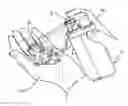
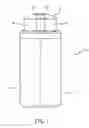
FIG. 1 shows a hand sanitizer in accordance with an embodiment of the invention; and
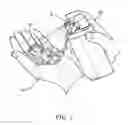
FIG. 2 shows the hand sanitizer of FIG. 1 in use.
DETAILED DESCRIPTION
In this specification, all parts are by weight unless otherwise indicated.
The hand sanitizer 2 in this example uses a Dual Foamer foam dispenser from Airspray
International BV. The hand sanitizer 2 has a first dispenser chamber 4 clipped to a second dispenser chamber 6. The chambers 4, 6 are part of two small foam pump systems which dispense their contents as foams when respective piston members 14, 16 are depressed. Operation of a single actuator 8 depresses both piston members 14, 16, causing a volume of liquid (in this example, 0.8 ml) to be pumped from each chamber 4, 6 simultaneously and combined with air to form a foam. The liquid from chamber 4 is turned into a first foam and the liquid from chamber 6 is turned into a second foam. The first and second foams are dispensed via respective separate nozzle orifices 10, 12 in the actuator 8.
The first dispenser chamber 4 contains a first part comprising a chlorite in an aqueous medium having a first foam promoter dissolved therein and contained in a first foam dispenser whereby it is dispensed as a first foam. Exemplary formulations of the first part are set out in Table 1A and Table 2A.
The second dispenser chamber 6 contains a second part comprising an acid in an alcoholic medium which has a second foam promoter dissolved therein and which is contained in a second foam dispenser whereby it is dispensed as a second foam. Exemplary formulations of the second part are set out in Table 1B and Table 2B.
| TABLE 1A | ||
| First Part | % | |
| 1 | Demineralized water | Balance |
| 2 | Sodium chlorite solution | 0.5 |
| 3 | Surfactant (dimethicone Copolyol) | 0.5 |
| 4 | Ethanol-B | 80 |
| 5 | Hydroxyethylcellulose | 0.25 |
| TABLE 1B | ||
| Second Part | % | |
| 1 | Demineralized water | Balance |
| 2 | Ethanol-B | 80 |
| 3 | Citric acid (ANH) | 1 |
| 4 | Sorbic acid | 0.01 |
| 5 | Boric acid | 0.01 |
| 6 | Glycerine (veg) | 0.5 |
| 7 | Sodium benzoate | 0.2 |
| 8 | Surfactant (dimethicone copolyol) | 0.5 |
| 9 | Hydroxyethylcellulose | 0.25 |
| 10 | Sodium acetate | 0.2 |
In both the first part and the second part, dimethicone copolyol surfactant is used as a foam promoter. In other embodiments, we have found that a surfactant comprising a mixture of equal parts of dimethicone copolyol, polydimethylsiloxane diquat, alkylamino carboxylate and alkylbetaine, gives good foam stability with both aqueous and alcoholic media.
| TABLE 2A | ||
| First Part | % | |
| 1 | Demineralized water | Balance |
| 2 | Sodium chlorite solution | 0.5 |
| 3 | Surfactant (dimethicone Copolyol) | 0.5 |
| 4 | Ethanol-B | 30 |
| 5 | Hydroxyethylcellulose | 0.25 |
| TABLE 2B | ||
| Second Part | % | |
| 1 | Demineralized water | Balance |
| 2 | Ethanol-B | 70 |
| 3 | Citric acid (ANH) | 1 |
| 4 | Sorbic acid | 0.01 |
| 5 | Boric acid | 0.01 |
| 6 | Glycerine (veg) | 0.5 |
| 7 | Sodium benzoate | 0.2 |
| 8 | Surfactant (dimethicone copolyol) | 0.5 |
| 9 | Hydroxyethylcellulose | 0.25 |
| 10 | Sodium acetate | 0.2 |
Referring now to FIG. 2, the foam from each nozzle is sprayed onto a user's hand 20 by the action of a user's finger 22 on the actuator 8. The foams mix to provide a sterilizing foam composition 18 containing ethanol and ClO2. The user rubs both hands together to mix the foams thoroughly and cover his hands with the sterilizing foam composition 18.
Antibiotics, antivirals, or other antimicrobial agents may optionally be incorporated in either or both of the first part and the second part. Suitable agents will be well known to those of ordinary skill in the art. Examples include cationics, amphoterics and phenolics.
After the user's hands have been thoroughly sanitized by covering and rubbing with the foam mixture 18, the user may rinse off the mixture 18. However, the alcohol content makes the foam mixture quite volatile and the user may choose simply to allow his hands to dry by evaporation.
The embodiment of Table 1 provides foams which, contain 80% alcohol and, when combined, chlorine dioxide, which we have found provides excellent sterilizing properties when used as a hand sanitizer, being more effective than conventional alcohol hand sanitizers or chlorine dioxide hand sanitizers alone.
The embodiment of Tables 2A and 2B has 30% alcohol in the First Part, and 70% alcohol in the second part. When dispensed as foams and mixed, in equal parts, the combined foam has 50% alcohol, and also provides effective hand sterilization.
Humectants, moisturizers and fragrances may optionally be included in the first part or (preferably) the second part, as is well known in the art per se.
Corrosion inhibitors may be included in the first part and/or the second part, for improved packaging and protection of the dispenser.
We have found that in order to achieve an alcoholic foam with suitable stability and ‘quick-break’ properties, incorporation of a thickener or film former (hydroxyethylcellulose in the examples of Tables 1 and 2) is desirable. The optimum range for the film former is 0.01-1%, preferably 0.1-0.25% . Limiting the concentration of film former to about 0.25% helps to reduce unwanted residue when the hand sanitizer is used without rinsing.
| TABLE 3A |
| First Part |
| Material | % | |
| Demineralized Water | Balance | |
| Sodium chlorite | 0.50 | |
| * | Surfactant | 0.50 |
| *** | Alcohol | 80.00 |
| ** | Film formers | 0.25 |
| TABLE 3B |
| Second Part |
| Material | % | |
| Demineralized Water | Balance | |
| Sodium chlorite | 0.50 | |
| * | Surfactant | 0.50 |
| *** | Alcohol | 30.00 |
| ** | Film formers | 0.25 |
| TABLE 4A |
| First Part |
| * | Surfactant combination of: |
| Dimethicone Copolyol | |
| Polydimethylsiloxane Diquat | |
| Alkylamino Carboxylate + Alkylbetaine | |
| ** | Film formers - see list below |
| *** | Ethanol, isopropanol, n-propanol |
| Component | % | |
| Demineralized Water | Balance | |
| *** | Alcohol | 80.00 |
| Citric Acid | 1.00 | |
| Sorbic Acid | 0.01 | |
| Boric Acid | 0.01 | |
| Glycerine | 0.50 | |
| Sodium Benzoate | 0.20 | |
| * | Surfactant | 0.50 |
| ** | Film formers | 0.25 |
| Sodium Acetate | 0.20 | |
| TABLE 4B |
| Second Part |
| Material | % | |
| Demineralized Water | Balance | |
| *** | Alcohol | 70.00 |
| Citric Acid | 1.00 | |
| Sorbic Acid | 0.01 | |
| Boric Acid | 0.01 | |
| Glycerine | 0.50 | |
| Sodium Benzoate | 0.20 | |
| * | Surfactant | 0.50 |
| ** | Film formers | 0.25 |
| Sodium Acetate | 0.20 | |
Suitable film formers include: alginates, alkyl and hydroxyalkylcellulose, carboxymethylcellulose, carrageenan, guar gum, gum agar, gum Arabic, gum ghatti, gum karaya, gum tragacanth, hydroxyethylcellulose, hydroxypropylcellulose, locust bean gum, pectins, polyacrylamide, poly(acrylic acid) and its homologs, poly(ethylene glycol), poly(ethylene oxide), poly(vinyl alcohol), poly(vinyl pyrrolidone) starch and its modifications, tamarind gum, xanthan gum.
It will be appreciated that alternative film formers well known per se to those skilled in the art may be used provided that they are soluble in the alcoholic medium. Moreover, alternative surfactants may be used, notably surfactants which aid in foam stabilization. Non-limiting examples include: carboxylic acid salts, sulphonic acid salts (for example linear or non-linear alkyl benezesulphonates, methyl ester-α-sulphonates, α-olefin sulphonates), sulphuric acid ester salts, alkyl sulphates, alkyl ethoxylate sulphates, alkyl sulphate triethanolamines, diethanolamide, alkyl ethoxylates,alkyl phenyl ethoxylates,alkyl trimethylammonium salts, dialkyl dimethylammonium chlorides, alkyl pyridinium chlorides, alkyl carboxybetaines, phosphoric and polyphosphoric acid esters, fluorinated anionics, long chain amines and their salts, acylated diamines and polymines and their salts, quaternary ammonium salts, polyoxyethylenated (POE) long-chain amines, amine oxides, POE alklyphenols, alkylphenol “ethoxylates”, POE straight-chain alcohols, alcohol “ethoxylates”, POE polyoxypropylene glycols, POE mercaptans, long-chain carboxylic acid esters, alkanolamine “condensates”, alkanolamides, tertiary acetylenic glycols and their “ethoxylates” POE silicones, N-alkylpyrrolidones, alkylpolyglycosides, pH-sensitive zwitterionics, pH-insensitive zwitterionics, α-sulphofatty acid methyl esters (SME), acylated aminoacids, N-acyl L-glutamates, N-acyl glycinates, N-acyl DL-alananinates, other acylated aminoacids, Nopol alkoxylates.
In another embodiment, we have found that use of MMB as some or all of the alcohol component can provide the benefits of fast drying and greatly improved skin feel compared to ethanol. MMB also has the benefit over ethanol that it is substantially non-flammable. Pure MMB has a flash point of 68° C. measured by Tag Closed Cup, while a mixture of MMB and 10% or more water has no flash point. MMB is considered to be extremely safe, having no R and S phrases and Occupational Exposure Limit.
Table 5 summarises comparative drying speeds of mixtures of MMB and water, and mixtures of ethanol and water. In each case, a 0.1 ml sample was visually assessed for speed of drying. Rates of evaporation were determined by placing a sample onto a standard filter paper and measuring the time for complete evaporation. The time for diethyl ether evaporation is taken as unity, and the quoted numbers for each sample are expressed relative to diethyl ether.
| TABLE 5 | ||||
| Demin. Water | 10% Ethanol | 50% Ethanol | 10% MMB | 50% MMB |
| (D) | in D. | in D. | in D. | in D. |
| 77 | 21 | 12 | 24 | 14 |
The above demonstrates a similar evaporation rate for comparable solutions of ethanol in water and MMB in water. Qualitative testing demonstrated a greatly improved skin feel of MMB over ethanol.
Claims
1-9. (canceled)
10. A hand sanitizer comprising:
(a) a first part comprising a chlorite in an alcoholic medium having a first foam promoter dissolved therein and contained in a first foam dispenser whereby it is dispensed as a first foam; and
(b) a second part which comprises an acid in an alcoholic medium which has a second foam promoter dissolved therein and which is contained in a second foam dispenser whereby it is dispensed as a second foam;
wherein the chlorite and the acid will react to provide chlorine dioxide when the first foam is mixed with the second foam; and wherein a mixture of equal quantities of the first part and the second part contains at least 50% alcohol by weight.
11. A hand sanitizer according to claim 10, wherein the alcohol is present in a concentration of from 50-80% by weight when equal quantities of the first part and the second part are mixed.
12. A hand sanitizer according to claim 10, wherein the first part and the second part each further comprises from 0.01 to 1% by weight of a thickener or film former.
13. A hand sanitizer according to claim 12, wherein the thickener or film former is present in a concentration of from 0.1 to 0.25% by weight.
14. A hand sanitizer according to claim 10, wherein the alcohol comprises ethanol, isopropanol, n-propanol or a mixture thereof.
15. A hand sanitizer according to claim 10, wherein at least a part of the alcohol comprises 3-methoxy-3-methylbutan-1-ol (MMB).
16. A hand sanitizer according to claim 15, wherein substantially all of the alcohol is MMB.
17. A hand sanitizer according to claim 10, wherein the foam promoter is dimethicone copolyol, polydimethylsiloxane diquat, alkylamino carboxylate and alkylbetaine or a mixture of any or all of the aforementioned components.
18. A method of sanitizing hands, comprising taking a hand sanitizer according to claim 10, dispensing first and second foams onto a user's hand, and rubbing the user's hands together so as to mix the foams and cover the user's hands with the mixed foam.
Images & Drawings included:
Sources:
- United States Patent and Trademark Office - verify current appl. status at the USPTO↗
Similar patent applications:
- » 20220273835
QUICK HAND SANITIZING METHOD AND QUICK HAND SANITIZING DEVICE - » 20080084315
Composition for sanitizing hands and a method for verifying and monitoring hand washing and sanitizing practices - » 20170254111
Apparatus for dispensing sanitizer fluid and recording data pertaining to hand sanitization - » 20170318964
Method and apparatus for dispensing sanitizer fluid, opening doors, and recording data pertaining to hand sanitization - » 20200069058
Method and apparatus for dispensing sanitizer fluid, opening doors, and recording data pertaining to hand sanitization - » 20150308149
Method and apparatus for dispensing sanitizer fluid via door handles, and recording data pertaining to hand sanitization - » 20210393993
Hand sanitizers with improved aesthetics and skin-conditioning to encourage compliance with hand hygiene guidelines - » 20150258003
Hand sanitizers with improved aesthetics and skin-conditioning to encourage compliance with hand hygiene guidelines - » 15421772
Hypochlorous acid-based hand sanitizer - » 14215741
Hand sanitizer monitor
Recent applications in this class:
- » 20240335575 2024-10-10
METHOD AND APPARATUS FOR INACTIVATING PATHOGENS IN UNITS OF WHOLE BLOOD USING SUPERPARAMAGNETIC NANOPARTICLES COATED WITH CHEMILUMINESCENCE REAGENTS AND BROAD-SPECTRUM ANTI-VIRAL THERAPEUTICS - » 20240139356 2024-05-02
Disinfecting Cap for Male and Female Connectors - » 20240139355 2024-05-02
Universal Disinfecting Cap for Different Types of Female Connectors - » 20230355816 2023-11-09
Sanitiser - » 20220080061 2022-03-17
SANITISER - » 20210379216 2021-12-09
APPARATUS AND METHODS FOR INFECTIOUS VIRUS MITIGATION - » 20200215211 2020-07-09
Apparatus and methods for maintaining sterility of a specimen container - » 20180207300 2018-07-26
Apparatus and methods for maintaining sterility of a specimen container - » 20180028699 2018-02-01
Substitute Packaging to a Prep Pad in a Form of an Encapsulated Pellet in Such a Way That the Use of it Will Result in a Fast, Compact, Convenient and Efficient Alternate to the Use of a Prep Pad - » 20180028698 2018-02-01
Alternate Fast, Convenient and Efficient Device to Replace the Use of Prep Pad Soaked With a Variety of Solutions
Recent applications for this Assignee:
- » 20140142489 2014-05-22
STERILANT SYSTEM - » 20130202484 2013-08-08
Hand sanitizer - » 20100314267 2010-12-16
Decontamination system - » 20100189598 2010-07-29
Sterilisation apparatus - » 20100036305 2010-02-11
Sterilant system - » 15765872 2019-10-22
Dispensing capsule