High numerical aperture light scattering instrument for detecting particles in fluid
US20120140221A1
2012-06-07
11/995,671
2006-07-12
✅ Patent granted
US 8,947,661 B2
2015-02-03
WO; PCT/US2006/027174; 20060712
WO; WO2007/009029; 20070118
Tri T Ton
Michael L. Greenberg, Esq. | Greenberg & Lieberman, LLC
2031-11-09
Abstract:
A device (FIG. 2) that uses light to detect particles in fluid is disclosed. The device incorporates a lens and reflector on a flow cell to increase the numerical aperture of a subsequent light collection system without any increase in spherical aberration.
Assignee:
- Lighthouse Worldwide Solutions, Inc 7 🇺🇸 Fremont, CA, United States
Applicant:
Interested in similar patents?
Get notified when new applications in this technology area are published.
Classification:
G02B17/08 IPC
Systems with reflecting surfaces, with or without refracting elements Catadioptric systems
G01N21/53 » CPC main
Investigating or analysing materials by the use of optical means, i.e. using sub-millimetre waves, infrared, visible or ultraviolet light; Systems in which incident light is modified in accordance with the properties of the material investigated; Scattering, i.e. diffuse reflection within a body or fluid within a flowing fluid, e.g. smoke
G01N15/0205 » CPC further
Investigating characteristics of particles; Investigating permeability, pore-volume, or surface-area of porous materials; Investigating particle size or size distribution by optical means, e.g. by light scattering, diffraction, holography or imaging
G01N15/1456 » CPC further
Investigating characteristics of particles; Investigating permeability, pore-volume, or surface-area of porous materials; Investigating individual particles; Electro-optical investigation, e.g. flow cytometers without spatial resolution of the texture or inner structure of the particle, e.g. processing of pulse signals
G02B19/0014 » CPC further
Condensers, e.g. light collectors or similar non-imaging optics characterised by the optical means employed having refractive surfaces only at least one surface having optical power
G02B19/0076 » CPC further
Condensers, e.g. light collectors or similar non-imaging optics characterised by the use for use with a detector
G01N21/00 IPC
Investigating or analysing materials by the use of optical means, i.e. using sub-millimetre waves, infrared, visible or ultraviolet light
G01N15/02 IPC
Investigating characteristics of particles; Investigating permeability, pore-volume, or surface-area of porous materials Investigating particle size or size distribution
G01N15/14 IPC
Investigating characteristics of particles; Investigating permeability, pore-volume, or surface-area of porous materials; Investigating individual particles Electro-optical investigation, e.g. flow cytometers
G02B19/00 IPC
Condensers, e.g. light collectors or similar non-imaging optics
Description
FIELD OF THE INVENTION
The present invention relates to particle sensors, and more particularly, to a particle sensor for fluid.
BACKGROUND OF THE INVENTION
A general understanding of the principles of the context of the present invention can be found in “Theoretical analysis of numerical aperture increasing lens microscope”, S. B. Ippolito, B. B. Goldger, and M. S. Unlu, Journal of Applied Physics 97, 053105 (2005).
Conventional right angle (90 degree scatter) particle counters employ a planar flow cell and separate collection optics system to detect particles in fluid. The planar flow cell is required so that the surfaces can be highly polished and AR coated to minimize stray light and improve sensitivity. However, this optical configuration results in a limited numerical aperture that can lead to a classical reversal in the response curve as the amount of light actually decreases as particle sizes increase in the Mie regime making the device of little use in this regime. There is a need for an invention that effectively eliminates this problem.
In addition, there is a need for an invention that permits the numerical aperture of the collection system to be increased without introducing spherical aberration thereby allowing the device to detect smaller particles.
U.S. Pat. No. 4,728,190 refers to the use of lens in contact with a capillary or flow cell. However, these elements are part of a near forward geometry light scattering instrument (scattered light and light source centered on the same axis). Unlike the present invention, U.S. Pat. No. 4,728,190 applies to a right angle geometry light scattering instrument (scattered light and light source orthogonal to each other).
In addition, unlike the present invention, the primary purpose of the lens/capillary combination in U.S. Pat. No. 4,728,190 is to reduce stray light at the air/glass interface of the face of the capillary or flow cell in the path of the light source. This is not a benefit of the lens/reflector/flow cell combination in the present invention.
SUMMARY
The present invention provides an improved method for detecting particles in fluid. The present invention results in a single collection optic system with a high numerical aperture that provides improved response linearity through the Rayleigh and Mie Scatter size regimes and increased particle sensitivity over conventional instruments.
BRIEF DESCRIPTION OF THE DRAWINGS
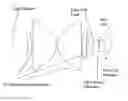
FIG. 1 shows an example of relevant art to the present invention.
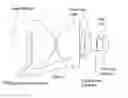
FIG. 2 shows the present invention.
DETAILED DESCRIPTION
A classical 90 degree light scatter collection optics system is shown in FIG. 1. It is comprised of a planar flow cell and a series of lenses for collecting scattered light. The direction of the particle flow, light source and collection optics are all orthogonal and 90 degrees from one another.
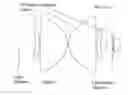
In FIG. 2, an optional lens and reflector on the flow cell improve the light collection capabilities of the instrument as described previously. Again, the direction of the particle flow, light source and collection optics are all orthogonal and 90 degrees from one another.
The Flow Cell Reflector serves to reflect the light scattered in its direction within the glass medium back to the center of the flow cell making the light available for the collection system. By keeping this light collection path entirely in the glass medium the numerical aperture is increased for the reflector. The Flow Cell Lens serves to increase the light gathering capability of the 90 Degree Collection Optics without aberration.
The present invention is designed to function as follows. First, the light source will illuminate the fluid as it travels through the flow cell. Such illumination will scatter off of any particles contained in the fluid. The flow cell lenses (when in use), will focus this light into the center of the flow cell. From the flow cell lenses, the scattered light will be emitted into a series of 90 degree collection optics. When flow cell lenses are not employed, the light will be naturally scattered into the 90 degree collection optics. Light that is emitted into the 90 degree collection optics from the flow cell lenses will be more intense then light that is simply captured by the 90 degree collection optics without the benefit of the flow cell lenses. Finally, after passing through the 90 degree collection optics, the light will be focused by the 90 degree collection optics upon the light detection sensor. When the sensor detects light, the system will conclude that there is a particle present in the flow cell. The resulting light intensity received by the light detector will be proportional to the particle size.
Claims
I claim:1. A device for optically detecting particles in fluid comprising:
a light collection system which maximizes the light intensity output scattered from a particle in fluid passing through it.
2. The device of claim 1, where light collection system means a flow cell, or a lens and optional reflector in optical contact with one another.
3. A device for optically detecting particles in fluid comprising:
a light collection system which maximizes the light intensity output scattered from a particle in fluid resulting in a monotonic relationship between scattered light intensity and particle size for spherical polystyrene particles with light sources having wavelengths in the range of 430 nm to 1500 nm suspended in fluids with optical indexes ranging between 1.3 and 1.5.
4. The device of claim 3, where light collection system means a flow cell, lens and optional reflector in optical contact with one another.
5. A device for optically detecting particles in fluid comprising:
a flow cell lens; and
reflectors in optical contact with said flow cell lens.
6. The device of claim 5, wherein said reflectors and said flow cell lens direct light into fluid in said flow cell.
7. The device of claim 6, wherein said reflectors direct light in an orientation that is perpendicular to the direction of said lens and a light detection system.
Images & Drawings included:
Sources:
- United States Patent and Trademark Office - verify current appl. status at the USPTO↗
Recent applications in this class:
- » 20250290852 2025-09-18
SURFACE SCATTER TURBIDIMETER AND TURBIDITY MEASUREMENT METHOD - » 20250180477 2025-06-05
METHOD AND DEVICE FOR INVERTING OCEAN-ATMOSPHERE OPTICAL PARAMETERS AND STORAGE MEDIUM - » 20250164393 2025-05-22
OPTICAL EXTINCTION ANALYZER WITH CONTINUOUS AIRFLOW SAMPLING - » 20250123204 2025-04-17
OPTICAL CHAMBER BASE WITH INTEGRATED REFLECTIVE SURFACES FOR PARTICLE DETECTION - » 20250044225 2025-02-06
Systems And Methods For Off-Axis Bubble Detection - » 20240418646 2024-12-19
Systems and methods for differentiating bubble points from dew points - » 20240402083 2024-12-05
METHODS AND APPARATUSES FOR MEASURING FLUID COMPOSITION AND TURBIDITY - » 20240361238 2024-10-31
LIGHT SCATTERING MEASUREMENT BASED ON SKIP LIGHT PULSES - » 20240230531 2024-07-11
ACCURATE TURBIDITY MEASUREMENT SYSTEM AND METHOD, USING SPECKLE PATTERN - » 20240133808 2024-04-25
ACCURATE TURBIDITY MEASUREMENT SYSTEM AND METHOD, USING SPECKLE PATTERN
Recent applications for this Assignee:
- » 20190213849 2019-07-11
Illuminated handle for portable instruments - » 20180293850 2018-10-11
Illuminated handle for portable instruments - » 20180275021 2018-09-27
Self-aligning, magnetically retained air sampler assembly component - » 20090243807 2009-10-01
RFID system for identifying location of sensors/indicators - » 20090051908 2009-02-26
Surface particle counter - » 20070285661 2007-12-13
Design for particle sensor system