Drywall finisher's precision cutout template
US20120186094A1
2012-07-26
12/930,961
2011-01-21
Abstract:
Interchangeable template set for precisely and quickly cutting openings in gypsum, tile, wood paneling or other wall covering material. Floating design and wide variety of available templates (electrical outlets, round water pipe pass-throughs, HVAC duct openings, etc., allows the desired opening to be clearly and quickly marked and the hole cut with very close tolerances to minimize waste material and reduce heating/cooling loss, increasing energy efficiency.
Interested in similar patents?
Get notified when new applications in this technology area are published.
Classification:
G01B3/08 » CPC main
Instruments as specified in the subgroups and characterised by the use of mechanical measuring means; Rulers with scales or marks for direct reading rigid extensible
B43L13/201 » CPC further
Drawing instruments, or writing or drawing appliances or accessories not otherwise provided for; Curve rulers or templets Stencils for drawing figures, objects
E04F21/0076 » CPC further
Implements for finishing work on buildings for marking and cutting tiles
G01B3/14 » CPC further
Instruments as specified in the subgroups and characterised by the use of mechanical measuring means Templates for checking contours
H02G1/00 » CPC further
Methods or apparatus specially adapted for installing, maintaining, repairing or dismantling electric cables or lines
Y02B10/30 » CPC further
Integration of renewable energy sources in buildings Wind power
Y02B10/30 » CPC further
Integration of renewable energy sources in buildings Wind power
G01B1/00 IPC
Measuring instruments characterised by the selection of material therefor
Description
CROSS REFERENCE TO RELATED APPLICATION
NONE
STATEMENT REGARDING FEDERALLY SPONSORED RESEARCH OR DEVELOPMENT
No Federal research or development funds were used in the development of this concept/product.
THE NAMES OF THE PARTIES TO A JOINT RESEARCH AGREEMENT
N/A
INCORPORATION-BY-REFERENCE OF MATERIAL SUBMITTED ON A COMPACT DISC
N/A
BACKGROUND OF THE INVENTION
The current tools available for commercial and residential finishing of interior wall surfacing material, e.g., drywall, wood paneling, tile, etc. are the same ones that have been used in general carpentry (measuring tape, utility knife, router, tracing pencil, etc.) for decades. Using these general tools to make precision cuts when installing (hanging) wall material, especially to accommodate known shapes and dimensions such as electrical outlet boxes and plumbing or utility pass-through ports or “runs” through interior walls to finish the interior of a house is very time intensive and the cuts are anything but uniform and precise.
One proposed solution is to use a standard sized electrical wall outlet box constructed of plastic or aluminum box as the cutout template, hereafter known as the “template or template box.” The template box would be threaded to accept telescoping rods with friction locks attached to each of the four sides of the box. Each extension rod would be at least eight feet long and as much as ten feet long and capable of spanning a standard sheet of interior gypsum surfacing material (a standard “drywall” sheet is 4 feet×8 feet in size, but can also be obtained in 4 feet×12 feet lengths). Using the telescoping extension rods to position the electrical box, the template would thus be capable of “floating” to any position on the wall where the 4×8 foot sheet of drywall could be hung. In this way, the exact position of the cutout for an electrical box or other opening could be determined, marked and cut on a blank sheet of drywall or other interior surfacing/finishing material (plywood, gypsum, tile, etc.).
Once the location of the electrical box, other desired fixture or pass-through port has been determined, the Precision Cutout Template is placed where the cutout is desired on the wall and the rods extended to where the edges of a standard sheet of drywall would end and the friction locked used to lock the cutout location into place. The Template is then placed onto the drywall or other surface material, the desired opening marked and the cut made. Time to complete this entire process is less than one minute—even less as the wallboard installer gains experience with the tool. Currently, to measure, transfer measurements, mark and cut an opening takes about five minutes. Using the Precision Cutout template reduces time to measure and cut each outlet hole in a sheet of drywall significantly. Also, the template permits extremely close tolerances between the electrical box or other opening pass-through and the access hole made in the surface material (as little as ⅛th inch). This will greatly reduce finishing time and also prove more energy efficient (less cold air infiltration) and reduce opportunities for insects and other unwanted guests to enter the inside of the dwelling.
This patent submission represents a proposed solution to an on-going construction need.
FIELD OF THE INVENTION
Tool—For class 072
A tangible instrumentality having a surface portion which is designed and intended to engage or react against work with sufficient force to effect an operation of the class type. Note. A core, mandrel, anvil, or the like, which may be “passive” in the sense of supplying only reaction force is included in this definition. The tool may be either transitory or enduring; it may be destroyed in a single use.
(1) DESCRIPTION OF THE RELATED ART INCLUDING INFORMATION DISCLOSED UNDER 37 CFR 1.97 AND CFR1.98
ART UNIT: 2834
BRIEF SUMMARY OF INVENTION
Modify a standard sized electrical wall outlet box constructed of plastic or aluminum box to act as the cutout template, hereafter known as the “template or template box.” The template box would be threaded to accept telescoping rods with friction locks attached to each of the four sides of the box. Each extension rod would be at least eight feet long and as much as ten feet long and capable of spanning a standard sheet of interior gypsum surfacing material (a standard “drywall” sheet is 4 feet×8 feet in size, but can also be obtained in 4 feet×12 feet lengths). Using the telescoping extension rods to position the electrical box, the template would thus be capable of “floating” to any position on the wall where the 4×8 foot sheet of drywall could be hung. In this way, the exact position of the cutout for an electrical box or other opening could be determined, marked and cut on a blank sheet of drywall or other interior surfacing/finishing material (plywood, gypsum, tile, etc.).
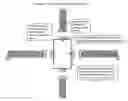
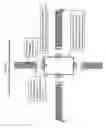
The telescoping extension rod (FIG. 1, items 1a-d, page 17) can be extended as necessary to span several different sizes of drywall sheets. FIG. 1, items 2a-d depict the female threaded receptacles that connect the telescoping positioning rods to the template box. FIG. 1, items 3a-d depict the positioning hooks/tabs which hook over the edge of the sheet of material to be cut, holding the template device firmly in place so that a precise opening in the material may be cut.
BRIEF DESCRIPTION OF THE SEVERAL VIEWS OF THE DRAWING
FIGS. 1, 1a-d (page 17) depicts a cross section of the entire device, showing the propeller on the front of the wind turbine and the aux engine mounted on the rear of the unit.
1a—extendable positioning rod—maximum length, ten feet
1b—extendable positioning rod—maximum length, ten feet
1c—extendable positioning rod—maximum length, six feet
1d—extendable positioning rod—maximum length, six feet
FIGS. 1, 2a-d (page 17)
2a—threaded female receptacle for extendable positioning rod
2b—threaded female receptacle for extendable positioning rod
2c—threaded female receptacle for extendable positioning rod
2d—threaded female receptacle for extendable positioning rod
FIGS. 1, 3a-d (page 17)
3a—metal hook/clip used to secure extendable positioning rod to the edge of the sheet of drywall or other material to be cut
3b—metal hook/clip used to secure extendable positioning rod to the edge of the sheet of drywall or other material to be cut
3c—metal hook/clip used to secure extendable positioning rod to the edge of the sheet of drywall or other material to be cut
3d—metal hook/clip used to secure extendable positioning rod to the edge of the sheet of drywall or other material to be cut
(I) DETAILED DESCRIPTION OF THE INVENTION
This is a craftsman's template set designed to precisely and quickly guide a worker as he marks openings in wall covering/finishing material during building construction or renovation. The template set consists of a high-impact plastic and cast aluminum assembly, with four extensible aluminum rods, each fitted with a friction lock and metal clips/hook to maintain position on surface edges (see FIG. 1, items 1-4, a through d, page 17).
Templates will consist of a wide variety of “industry standard” sized electrical and plumbing fixtures. For example, single, double, and triple electrical wall outlet boxes, constructed of plastic or aluminum box may be used as the cutout template, hereafter known as the “template or template box.” The template box would be threaded to accept telescoping rods with friction locks attached to each of the four sides of the box. Each extension rod would be at least eight feet long and as much as ten feet long and capable of spanning a standard sheet of interior gypsum surfacing material (a standard “drywall” sheet is 4 feet×8 feet in size, but can also be obtained in 4 feet×12 feet lengths). Using the telescoping extension rods to position the electrical box, the template would thus be capable of “floating” to any position on the wall where the 4×8 foot sheet of drywall could be hung. In this way, the exact position of the cutout for an electrical box, plumbing, HVAC or other opening could be determined, marked and cut on a blank sheet of drywall or other interior surfacing/finishing material (plywood, gypsum, tile, etc.).
Once the location of the electrical box, other desired fixture or pass-through port has been determined, the Precision Cutout Template is placed where the cutout is desired on the wall and the rods extended to where the edges of a standard sheet of drywall would end and the friction locked used to lock the cutout location into place. The Template is then placed onto the drywall or other surface material, the desired opening marked and the cut made.
(I) SEQUENCE LISTING
Reference to Sequence Listing, a Table or a Computer Program Listing Compact Disc Appendix
N/A
Claims
1. Using this device will save time and enable more precise cuts in sheeting material to be made. Using the telescoping extension rods to position the electrical box, the template would “float” to any position on the wall where the 4×8 or 4×12 foot sheet of drywall could be hung. In this way, the exact position of the cutout for an electrical box or other opening could be determined, marked and cut on a blank sheet of drywall or other interior surfacing/finishing material (plywood, gypsum, tile, etc.).
Time to complete this entire process is less than one minute—even less as the wallboard installer gains experience with the tool. Currently, to measure, transfer measurements, mark and cut an opening in gypsum wallboard takes about five minutes. Using the Precision Cutout template reduces time to measure and cut each outlet hole in a sheet of drywall significantly—as much as 80% (typically, less than one minute). Also, the template permits extremely close tolerances between the electrical box or other opening pass-through and the access hole made in the surface material (as little as ⅛th inch). This will greatly reduce finishing time and also prove more energy efficient (less cold air infiltration) and reduce opportunities for insects and other unwanted guests to enter the inside of the dwelling.
Images & Drawings included:


Sources:
- United States Patent and Trademark Office - verify current appl. status at the USPTO↗
Recent applications in this class:
- » 20220082366 2022-03-17
Tournament fishing measurement system device and method - » 20210404786 2021-12-30
MEASURING TOOL - » 20180023934 2018-01-25
Tool for measuring angles and length in structures and frames - » 20170167841 2017-06-15
Adjustable square ruler - » 20170097219 2017-04-06
Adjustable ruler and measuring device - » 20170089681 2017-03-30
Linear displacement measuring apparatus - » 20170074631 2017-03-16
Device for inspecting and measuring sewer/utility structures - » 20150354933 2015-12-10
CONSTRUCTION BOARD INSTALLATION - » 20140230259 2014-08-21
DISTANCE MEASURING APPARATUS - » 20140068954 2014-03-13
Cylindrical ruler