Fuselage segment, and method for the production of a fuselage segment
US20120187245A1
2012-07-26
13/262,246
2010-03-30
✅ Patent granted
US 8,844,870 B2
2014-09-30
WO; PCT/EP2010/054247; 20100330
WO; WO2010/112527; 20101007
Tien Dinh | Steven Hawk
Carter, DeLuca, Farrell & Schmidt, LLP
2030-07-07
Abstract:
A fuselage segment of an aircraft fuselage is provided with an outer skin and an inner skin that are spaced apart from one another by a core, wherein conduits for system installations are integrated into the core, as well as a method for manufacturing such a fuselage segment.
Assignee:
- AIRBUS OPERATIONS GMBH 2,524 🇩🇪 Hamburg, Germany
Applicant:
Interested in similar patents?
Get notified when new applications in this technology area are published.
Classification:
B64C1/12 » CPC main
Fuselages; Constructional features common to fuselages, wings, stabilising surfaces and the like; Frames; Stringers; Longerons ; Fuselage sections Construction or attachment of skin panels
B32B1/00 » CPC further
Layered products having a general shape other than plane
B32B3/12 » CPC further
Layered products comprising a layer with external or internal discontinuities or unevennesses, or a layer of non-planar form ; Layered products having particular features of form characterised by a discontinuous layer, i.e. formed of separate pieces of material characterised by a layer of regularly- arranged cells, e.g. a honeycomb structure
B32B3/266 » CPC further
Layered products comprising a layer with external or internal discontinuities or unevennesses, or a layer of non-planar form ; Layered products having particular features of form characterised by a particular shape of the outline of the cross-section of a continuous layer; characterised by a layer with cavities or internal voids ; characterised by an apertured layer characterised by an apertured layer, the apertures going through the whole thickness of the layer, e.g. expanded metal, perforated layer, slit layer regular cells
B32B5/02 » CPC further
Layered products characterised by the non- homogeneity or physical structure, i.e. comprising a fibrous, filamentary, particulate or foam layer; Layered products characterised by having a layer differing constitutionally or physically in different parts characterised by structural features of a layer
B32B5/18 » CPC further
Layered products characterised by the non- homogeneity or physical structure, i.e. comprising a fibrous, filamentary, particulate or foam layer; Layered products characterised by having a layer differing constitutionally or physically in different parts characterised by features of a layer of foamed material
B32B5/22 » CPC further
Layered products characterised by the non- homogeneity or physical structure, i.e. comprising a fibrous, filamentary, particulate or foam layer; Layered products characterised by having a layer differing constitutionally or physically in different parts characterised by the presence of two or more layers which are next to each other and are fibrous, filamentary, formed of particles or foamed
B32B5/245 » CPC further
Layered products characterised by the non- homogeneity or physical structure, i.e. comprising a fibrous, filamentary, particulate or foam layer; Layered products characterised by having a layer differing constitutionally or physically in different parts characterised by the presence of two or more layers which are next to each other and are fibrous, filamentary, formed of particles or foamed one layer being a fibrous or filamentary layer another layer next to it being a foam layer
B32B7/02 » CPC further
Layered products characterised by the relation between layers; Layered products characterised by the relative orientation of features between layers, or by the relative values of a measurable parameter between layers, i.e. products comprising layers having different physical, chemical or physicochemical properties; Layered products characterised by the interconnection of layers Physical, chemical or physicochemical properties
B32B15/046 » CPC further
Layered products comprising a layer of metal comprising metal as the main or only constituent of a layer, next to another layer of a of foam
B32B2260/021 » CPC further
Layered product comprising an impregnated, embedded, or bonded layer wherein the layer comprises an impregnation, embedding, or binder material; Composition of the impregnated, bonded or embedded layer Fibrous or filamentary layer
B32B2260/046 » CPC further
Layered product comprising an impregnated, embedded, or bonded layer wherein the layer comprises an impregnation, embedding, or binder material; Impregnation, embedding, or binder material Synthetic resin
B32B2262/101 » CPC further
Composition or structural features of fibres which form a fibrous or filamentary layer or are present as additives; Inorganic fibres Glass fibres
B32B2262/106 » CPC further
Composition or structural features of fibres which form a fibrous or filamentary layer or are present as additives; Inorganic fibres Carbon fibres, e.g. graphite fibres
B32B2266/02 » CPC further
Composition of foam Organic
B32B2266/0214 » CPC further
Composition of foam; Organic Materials belonging to
B32B2266/045 » CPC further
Composition of foam; Inorganic Metal
B32B2307/536 » CPC further
Properties of the layers or laminate having particular mechanical properties Hardness
B32B2307/718 » CPC further
Properties of the layers or laminate; Other properties Weight, e.g. weight per square meter
B32B2605/18 » CPC further
Vehicles Aircraft
B64C2211/00 » CPC further
Modular constructions of airplanes or helicopters
Y02T50/40 » CPC further
Aeronautics or air transport Weight reduction
Y02T50/40 » CPC further
Aeronautics or air transport Weight reduction
Y10T29/49 » CPC further
Metal working Method of mechanical manufacture
B23P17/04 IPC
Metal-working operations, not covered by a single other subclass or another group in this subclass characterised by the nature of the material involved or the kind of product independently of its shape
B64D11/00 » CPC further
Passenger or crew accommodation; Flight-deck installations not otherwise provided for
B64C2001/0072 » CPC further
Fuselages; Constructional features common to fuselages, wings, stabilising surfaces and the like; Fuselage structures substantially made from particular materials from composite materials
B32B27/04 » CPC further
Layered products comprising synthetic resin as impregnant, bonding, or embedding substance
B64C1/40 » CPC further
Fuselages; Constructional features common to fuselages, wings, stabilising surfaces and the like Sound or heat insulation, e.g. using insulation blankets
B64C1/00 IPC
Fuselages; Constructional features common to fuselages, wings, stabilising surfaces and the like
B64C1/00 IPC
Aircraft structures or fairings
B32B5/32 » CPC further
Layered products characterised by the non- homogeneity or physical structure, i.e. comprising a fibrous, filamentary, particulate or foam layer; Layered products characterised by having a layer differing constitutionally or physically in different parts characterised by the presence of two or more layers which are next to each other and are fibrous, filamentary, formed of particles or foamed layers being foamed
B32B27/02 » CPC further
Layered products comprising synthetic resin in the form of fibres or filaments
B64D13/00 » CPC further
Arrangements or adaptations of air-treatment apparatus for aircraft crew or passengers, or freight space, or structural parts of the aircraft
Description
The invention pertains to a fuselage segment of an aircraft fuselage according to the preamble of claim 1 and to a method for manufacturing such a fuselage segment.
A known fuselage segment is disclosed in DE 10 2007 003 275 A1 of the applicant. This fuselage segment is realized in the form of a shell element with two CFRP-skins, between which a core with a honeycomb structure or a foam structure is arranged. The shell element forms an aircraft fuselage together with a plurality of similar shell elements, wherein this aircraft fuselage is reinforced with a plurality of stringers and frames for stabilization purposes. All conduits for system installations such as, for example, electrical cables and air-conditioning ducts are respectively mounted on corresponding brackets of the stringers and frames.
In this solution, it is disadvantageous that equipment systems and cabin elements are installed separately in the primary structure. The mounting of the conduits requires numerous brackets that increase the cost of the fuselage assembly. Furthermore, the brackets disadvantageously affect the weight of the aircraft.
It is the objective of the present invention to develop a fuselage segment of an aircraft fuselage that eliminates the aforementioned disadvantages and allows a simplified assembly, as well as a method for manufacturing such a fuselage segment.
This objective is attained with a fuselage segment with the characteristics of claim 1 and a method according to claim 10.
An inventive fuselage segment features a core that is covered by an inner skin on the cabin side and an outer skin. According to the invention, ducts for system installations are integrated into the core.
The inventive solution provides the advantage that brackets are no longer required for mounting conduits such as, e.g., air-conditioning ducts. The assembly of the aircraft fuselage therefore becomes less complex. In addition, the elimination of the brackets lowers the weight of the aircraft in comparison with known aircraft with bracket solutions. For example, electromagnetic interactions between current-carrying cables can be prevented by accordingly positioning the conduits relative to one another. The elimination of the brackets also makes it possible to lower the assembly and manufacturing costs. The inventive fuselage segment may furthermore be realized in such a way that stringers and frames or other longitudinal and circumferential reinforcements of the aircraft fuselage can be eliminated, wherein this also positively affects the assembly and the weight of the aircraft. With respect to its structure, the fuselage segment can be optimized in accordance with the occurring loads.
In one exemplary embodiment, the fuselage segment is composed of several parts. In this case, the core is manufactured separately of the outer skin and the inner skin. The core has, for example, a honeycomb structure.
In another exemplary embodiment, the fuselage segment does not have a sandwich structure, but rather a one-piece foam structure, in which the inner skin, the outer skin and the core are realized in one piece. This means that the inner skin and the outer skin are not bonded to the core or otherwise connected to the core, but created during a manufacturing step of the core. In other words, the inner skin and the outer skin consist of the same foam material that is sectionally subjected to a different type of treatment. In this exemplary embodiment, it is advantageous to reinforce the foam material with carbon fibers such that the carbon fiber reinforcement effectively extends through the core from the outer skin to the inner skin.
The material of the core and the material of the outer skin and the inner skin may have a different hardness. It is particularly advantageous if the hardness of the core'material increases from a region on the cabin side in the direction of the outer skin. In this way, the stability of the fuselage segment can be increased and the insulation can be improved due to the reduced hardness of the material in the region on the cabin side.
The core may consist of a multilayer foam material such that a purposeful insulation can be achieved. Condensation within the fuselage segment can be significantly reduced with a sensible configuration of the foam material because erratic temperature gradients hardly occur.
In one variation, the conduits consist of tubular elements.
In order to additionally lower the weight of the aircraft, the conduits are in another variation integrated into the core in such a way that their wall is formed by the core material.
The inner skin may form a side wall of the cabin. The realization of the side wall in the form of a component of the primary structure reduces the number of cabin components such that the assembly becomes even less complex.
According to an exemplary embodiment of the inventive method, the conduits are produced in the core during the manufacture thereof.
According to another exemplary embodiment, the conduits are produced in the core after the manufacture thereof. In this case, the conduits are respectively substituted or replaced with suitable filler materials during the manufacture of the core. The filler materials are removed from the core after the manufacture thereof such that the core material itself forms the walls of the conduits. The fillers may consist, for example, of wax-based tubular bodies that liquefy and flow out of the core during a corresponding treatment after the manufacture thereof such that a conduit in the form of a correspondingly shaped hollow space is created in the core.
According to another inventive method, the inner skin, the outer skin and the core already have their final structure with the required material properties and material structures after the removal of the fuselage segment from the moulding tool.
However, it is also possible to provide the foam material and, in particular, the inner skin and the outer skin with the required material properties such as, for example, the corresponding degree of hardness in a step that is carried out after the removal of the fuselage segment from the moulding tool. It would be conceivable, for example, to carry out a treatment under UV-light.
A plastic-based material, as well as a metal-based material, may be considered as suitable foam material. Likewise, the materials of the inner skin and the outer skin are not limited to CFRP-materials, but may also consist of other fiber-reinforced composite materials such as glass fiber-reinforced materials (GFR-materials), plastic-metal alloys or pure metal alloys. It would furthermore be conceivable that the inner skin and the outer skin consist of different materials.
The conduits are not limited to the aforementioned examples only, but rather may also be used for all systems to be installed in an aircraft. Other examples are electrical cables for the power supply of the airborne supply system, signal lines for the flight control and water conduits.
Openings for windows and doors are either created during the manufacture of the fuselage cell or subsequently produced in the fuselage cell.
The axial length of the fuselage segment and its circumference may vary. It would be conceivable to realize the fuselage segment in the form of a shell element that, in principle, extends over the entire length of the aircraft. It would likewise be conceivable to realize the fuselage segment in the form of a barrel element that can be joined into an aircraft fuselage by means of transverse butt joints (cross butt joints).
Other advantages exemplary embodiments of the invention form the objects of the dependent claims.
Preferred exemplary embodiments of the invention are described in greater detail below with reference to a schematic drawing.
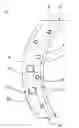
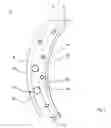
The only FIG. 1 shows a cross section through an inventive fuselage segment 2 of an aircraft fuselage. The fuselage segment 2 is realized in the form of a curved shell element of sandwich construction with an inner skin 4 and an outer skin 6, between which a core 8 is arranged. In the region of its narrow sides 10, 12, the fuselage segment 2 and other not-shown inventive fuselage segments are assembled into a barrel-shaped fuselage.
The inner skin 4 forms a sidewall of an aircraft cabin. The outer skin 6 serves as the common outer surface of an aircraft fuselage and protects the core 8 from environmental influences. The inner skin 4 and the outer skin 6 consist of a carbon fiber-reinforced material (CFR-material) and are connected to the core 8. The material of the inner skin 4 and the outer skin has a higher hardness than that of the core 8.
The core 8 consists of a foam material and features a radially inner layer 14 and a radially outer layer 16. The hardness of the radially inner layer 14 is lower than that of the radially outer layer 16 in order to improve the insulation.
Conduits 20, 22 for system installations such as, for example, current-carrying cable harnesses, cable harnesses that carry data signals or air-conditioning ducts are integrated into the core 8. Only two conduits 20, 22 are identified by reference symbols in FIG. 1 and representative for all other conduits. The conduits 20, 22 are realized in the form of tubular elements 24, 26 produced in the core 8. With respect to their position in the core 8 and their inside diameter, they correspond to their respective function. Conduits 20 for accommodating cable harnesses that carry data signals generally have a smaller inside diameter than conduits 22 that form air-conditioning ducts.
The degrees of hardness of the inner skin 4, the outer skin 6 and the core 8 are chosen such that no stringers and frames or other types of longitudinal and circumferential reinforcements are required for creating the aircraft fuselage.
In an inventive method, the tubular elements 24, 26 for the conduits 20, 22 are positioned in a moulding tool for moulding the core 8. Subsequently, the mould is filled with a suitable plastic-based raw material in order to create the core 8. The moulding tool is then activated in such a way that the foam-like core 8 is formed. The inner skin 4 and the outer skin 6 are manufactured in conventional fashion. After the manufacture of the core 8, the inner skin 4 and the outer skin 6, they are correspondingly connected to one another.
The invention discloses a fuselage segment 2 of an aircraft fuselage with an outer skin 6 and an inner skin 4 that are spaced apart from one another by a core 8, wherein conduits 20, 22 for system installations are integrated into the core 8, as well as a method for manufacturing such a fuselage segment 2.
LIST OF REFERENCE SYMBOLS
- 2 Fuselage segment
- 4 Inner skin
- 6 Outer skin
- 8 Core
- 10 Narrow side
- 12 Narrow side
- 14 Radially inner layer
- 16 Radially outer layer
- 20 Conduit
- 22 Conduit
- 24 Tubular element
- 26 Tubular element
Claims
What is claimed is:1. A fuselage segment of an aircraft fuselage, comprising:
an inner skin on a cabin side; and
an outer skin that cover a core, wherein conduits for system installations are integrated into the core.
2. The fuselage segment according to claim 1, wherein the inner skin and the outer skin are realized separately of the core.
3. The fuselage segment according to claim 1, wherein the fuselage segment is realized in one piece.
4. The fuselage segment according to claim 3, wherein a hardness of the material of the core increases from a region on a side of the inner skin in a direction of the outer skin.
5. The fuselage segment according to claim 1, wherein the core consists of a multilayer foam material.
6. The fuselage segment according to claim 1, wherein the conduits consist of tubular elements.
7. The fuselage segment according to claim 1, wherein the conduits are integrated into the core in such a way that their wall is formed by the core material.
8. The fuselage segment according to claim 1, wherein the inner skin forms a sidewall of a cabin.
9. A method for manufacturing a fuselage segment according to claim 1, wherein the conduits are produced in the core during the manufacture of the core or after the manufacture of the core.
Images & Drawings included:
Sources:
- United States Patent and Trademark Office - verify current appl. status at the USPTO↗
Recent applications in this class:
- » 20250236383 2025-07-24
CENTERBODY PRESSURE VESSEL WITH AN ARCHED COMPRESSION SURFACE - » 20250229889 2025-07-17
ASSEMBLY FOR REINFORCING THE FUSELAGE OF AN AIRCRAFT WHEN REMOVING A REMOVABLE PANEL - » 20250171131 2025-05-29
ANTI-CRIPPLING ELEMENT STIFFENER AND ASSOCIATED METHODS - » 20240294244 2024-09-05
AIRCRAFT WITH CARBON FIBER MATERIAL AND A METHOD OF MANUFACTURE - » 20230406476 2023-12-21
Aircraft including a fuselage and a panel removably fixed to the fuselage with the aid of fixing means - » 20230382511 2023-11-30
STIFFENER INTEGRATION IN AN ISOGRID STRUCTURE - » 20230242235 2023-08-03
PANEL SYSTEMS AND METHODS FOR HELICOPTERS - » 20230159151 2023-05-25
AEROSPACE COMPONENT JOINTS FOR AIRCRAFT AND RELATED METHODS - » 20230128247 2023-04-27
Resistive Skin Element for an Acoustic Panel Intended for an Aircraft - » 20230026741 2023-01-26
METHOD FOR MANUFACTURING A STRUCTURAL ELEMENT FOR A FUSELAGE OF AN AIRCRAFT
Recent applications for this Assignee:
- » 20250269975 2025-08-28
FUSELAGE FOR AN AIRCRAFT OR SPACECRAFT, AND AIRCRAFT OR SPACECRAFT - » 20250256829 2025-08-14
AIRCRAFT STRUCTURE PART AND METHOD FOR PROVIDING AN AIRCRAFT STRUCTURE PART - » 20250201879 2025-06-19
Soft-Start Strategy Of A Fuel Cell - » 20250198329 2025-06-19
ENGINE PROTECTION COVER DEVICE FOR AIRTIGHT SEALING AN ENGINE OF AN AIRCRAFT OR SPACECRAFT - » 20250173475 2025-05-29
SIMULATION METHOD, ASSEMBLY METHOD, ASSEMBLY PROGRAM, COMPUTER-READABLE DATA CARRIER, COMPUTING DEVICE AND ASSEMBLY ARRANGEMENT FOR ASSEMBLING AN APPARATUS - » 20250136267 2025-05-01
HATCH LOCKING DEVICE, AIRCRAFT OR SPACECRAFT HATCH AND AIRCRAFT OR SPACECRAFT - » 20250136265 2025-05-01
AIRCRAFT CARGO DOOR ACTUATION SYSTEM - » 20250136264 2025-05-01
AIRCRAFT CARGO DOOR ACTUATION SYSTEM - » 20250128817 2025-04-24
METHOD AND SYSTEM FOR OPERATING A PUMP AND VALVE IN A WATER SUPPLY SYSTEM OF AN AIRCRAFT - » 20250108908 2025-04-03
AIRCRAFT TANK DEVICE FOR INCREASING A FLIGHT RANGE AND A WING AREA OF AN AIRCRAFT AS WELL AS AIRCRAFT