Cherry tree named 'SWEET SARETTA'
US20140033377P1
2014-01-30
13/986,686
2013-05-24
Abstract:
PA1UNIBO ‘Sweet Saretta’ is a novel cherry tree derived from a seedling of unknown cross which was planted at Vignola, Modena Province, Italy. The genus and species (cultivar) of PA5UNIBO is Prunus avium. It was initially propagated by grafting to root stocks of varying vigor and, after testing in districts and plantings of differing types, proved to have the qualities proper to a promising new cultivar for the market.
Inventors:
- Stefano LUGLI 5 🇮🇹 Modena, Italy
- Riccardo CORREALE 6 🇮🇹 Bologna, Italy
- Michelangelo GRANDI 5 🇮🇹 Castenaso (BO), Italy
Interested in similar patents?
Get notified when new applications in this technology area are published.
Classification:
A01H5/00 IPC
Products
A01H5/00 IPC
Angiosperms, i.e. flowering plants, characterised by their plant parts; Angiosperms characterised otherwise than by their botanic taxonomy
Description
CROSS-REFERENCE TO RELATED APPLICATIONS
Priority is claimed of the pending EU Plant Patent for ‘Sweet Saretta’, which was filed on 25 May 2012 as Application No. 2012/1161 in the name of Applicant (holder) Alma Mater Studiorum—University of Bologna, the entire contents of which is expressly incorporated herein by reference. EU Trademark for ‘Sweet Saretta’ was released on 2 Jan. 2013 as Registration No. 011058691 of Applicant (holder) Alma Mater Studiorum—University of Bologna.
LATIN NAME OF THE GENUS/SPECIES OF THE PLANT CLAIMED (CULTIVAR)
Prunus avium.
VARIETY DENOMINATION
PA5UNIBO
BACKGROUND OF THE INVENTION
PA5UNIBO, named ‘Sweet Saretta’, derived from seedling of unknown cross and originally called Selection DCA BO B5A87, was planted at Vignola, Modena Province, Italy, in February 2002 and first cropped in 2004. It was initially propagated by grafting to root stocks of varying vigor and, after testing in districts and plantings of differing types, proved to have the properties proper to a promising new cultivar for the market. It picks 22-24 days after ‘Burlat’ (6 days after ‘Bing’) as ‘Sylvia’ and just before ‘Lapins’.
BRIEF SUMMARY OF THE INVENTION
The parentage of the variety is unknown. The name of a comparison variety is ‘Sylvia’. Compared to ‘Sylvia’, Prunus avium PA5UNIBO ‘Sweet Saretta’ has larger fruit of firmer flesh, more uniform ripening and higher sugar content. PA5UNIBO was selected for its high qualities, including tree growth and yield performance, and fruit appearance and excellent taste-flavor properties. The distinctive traits of PA5UNIBO also include mid-to-late picking date, uniform ripening, and high field performance. The date of discovery/cross was in the year 2000. The location of the discovery was Vignola, Modena Province, Italy. The date of the first asexual propagation was in 2008 in Vignola, Modena Province, Italy. PA5UNIBO was initially propagated on ‘Gisela 6’ in the trial fields of Bologna University to test field and cropping performance in a medium-to-high density planting.
BRIEF DESCRIPTION OF THE DRAWINGS
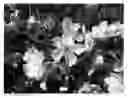
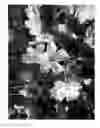
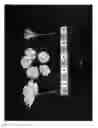
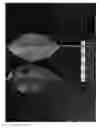
The accompanying photographs show typical specimens of the new variety as depicted in color as nearly true as is reasonably possible in color illustrations of this character.
FIG. 1 illustrates the detail of fully-open blossoms of PA5UNIBO.
FIG. 2 is the flower, full front, in profile and with separated petals, of PA5UNIBO.
FIG. 3 shows the leaf profile of PA5UNIBO. Two leaves have been detached and one has been placed upper leaf surface side down to show the lower leaf surface details.
FIG. 4 illustrates the details of a fruit cropping, including an example measurement, of PA5UNIBO.
FIG. 5 shows the tree architecture of PA5UNIBO with width-spread and height.
DETAILED BOTANICAL DESCRIPTION OF THE VARIETY
- General:
-
- Age of described tree(s).—5 years, slender spindle training system.
- Location of described trees(s).—Vignola, Modena Province, Italy.
- Name of color chart used.—The Royal Horticultural Society Colour Chart.
- Name of root stock.—‘Gisela 6’.
-
- Tree:
-
- Vigor.—High.
- Height.—3.5-4 meters.
- Spread.—3 meters.
- Growth habit.—Open canopy.
- Canopy density.—Medium.
- Trunk diameter at specified height.—16-17 cm, as measured at about 5 cm above graft joint.
- Trunk color.—Dark reddish-brown (200A).
- Bark texture.—Of average roughness.
- Tendency toward alternate bearing.—No.
- Winter hardiness.—Unknown, no winter cold damage found in this Po Valley district.
- Chilling requirement.—Unknown.
-
- Branch:
-
- Length.—160-220 cm of main branches.
- Diameter.—5-8 cm.
- Crotch angle.—45-60° depending on training system.
- Bark color.—Dark reddish-brown (200A).
- Bark texture.—Of verge roughness.
-
- Current year shoot:
-
- Length.—40-60 cm.
- Color.—Dark reddish-brown (200C/200D) with fairly diffuse gray overtone (201A).
-
- Winter hardiness:
-
- USDA Hardiness Zone.—Unknown.
- Chilling requirement.—Unknown.
-
- Flower buds:
-
- Number per spur.—4-6, mostly 5.
- Shape.—Ovoid.
- Length.—About 1 cm.
- Diameter.—Under 1 cm.
- Color.—Reddish perules (187C).
-
- Flowers:
-
- Number per cluster.—Minimum 7-maximum 11 per spur, 2-3 per bud. Abundant bloom.
- Relative position of petals.—Slightly overlapping petals.
- Diameter.—38-40 mm.
- Depth.—16-18 mm, as measured from receptacle to maximum petal aperture.
- Is pollen produced?.—Yes.
- Coloration of pollen.—Yellow (13A).
-
- Sepal:
-
- Length.—6-7 mm.
- Shape.—Conical.
- Width.—About 5 mm.
- Apex.—Pointed.
- Base.—Pointed.
- Margin descriptors.—Regular margin.
- Color — upper surface.—Green (139C).
- Color — lower surface.—Pale green (138C).
-
- Petals:
-
- Number per flower.—5.
- Shape.—Circular.
- Length.—16-19 mm.
- Width.—16-17 mm.
- Apex.—Slightly sunken.
- Base.—Slightly pointed.
- Margin.—Slightly undulated.
- Color — upper surface.—White (155B).
- Color — lower surface.—White (155B).
-
- Bloom:
-
- Date of bud burst.—7-8 Apr. 2013.
- Date of first bloom.—13 Apr. 2013.
- Date of full bloom.—16 Apr. 2013.
-
- Pedicel:
-
- Length.—26-34 mm.
- Diameter.—1.2-1.4 mm.
- Color.—Green (143B).
-
- Pistil:
-
- Quantity.—1.
- Size: 15-19 mm.
- Color.—Green (143C).
-
- Anthers:
-
- Quantity.—26-30 of 5-15 mm length; many anthers in each flower are at the same height as the stigma and some exceed it. White filament (155D).
- Size.—Under 1 mm diameter.
- Color.—Yellow (15C).
-
- Stigma:
-
- Quantity.—1.
- Size.—About 1 mm.
- Color.—Green (142A).
-
- Styles:
-
- Quantity.—1.
- Size.—12-14 mm length.
- Color.—Pale-white-green (142C) tending toward rosé (36C) at end of bloom.
-
- Ovary/ies:
-
- Quantity.—1.
- Size.—3-5 mm.
- Color.—Green (143C).
-
- Leaves:
-
- Length.—13.7-15.8 cm.
- Width.—6.7-9.1 cm.
- Shape.—Elliptical.
- Apex shape.—Pointed.
- Base shape.—Pointed.
- Margin.—Fine-toothed.
- Color — upper surface.—Dark green (137A/137B).
- Color — lower surface.—Pale green (138B) with green-yellow central vein (152A/152B).
-
- Petiole:
-
- Length.—3.4-4.6 cm.
- Diameter.—About 2 mm.
- Color.—Green-yellow (152A/152B) under and reddish upper (183A).
-
- Fruit:
-
- Shape.—Heart-shaped.
- Diameter.—Mostly 30-32 mm.
- Height.—26-28 mm.
- Weight.—11-12 grams, average weight.
- Number per cluster.—6-9 per spur.
- Skin color (include ground color and over color).—Bright red (N186C) tending toward bright vermilion red (N186B) at advanced maturity.
- Lenticels present? Density?.—Yes, medium.
- Skin thickness.—Medium-thin.
- Skin texture.—Medium.
- Anthocyanin coloration present near skin?.—No.
- Tenacity of flesh to stone.—Low.
- Flesh color.—Red (53A).
- Flesh texture.—Fine.
- Juiciness.—High.
- Juice analysis (brix, acidity, tss, etc.).—18.5° Brix and 7.8 g/l malic acid (2012 data).
- Stone size.—Medium.
- Stone shape.—Elliptical.
- Stone color.—Pale brown (165D).
-
- Fruit stem:
-
- Length.—36-39 mm.
- Diameter.—Just over 1 mm.
- Color.—Green (143B).
-
- Harvest:
-
- Maturity date range.—22-24 days after ‘Burlat’ (4-6 after ‘Bing’).
- Harvest date range (if different).—Same as above.
-
Because of the outstanding and unique horticultural characters of the claimed plant, especially its long harvest period and large size, this cherry can be planted to extend the cultivar's season. Although this new variety of cherry possesses the above-described characteristics, it is to be understood that variations and fluctuations may occur in the magnitude and qualities due to changes in growing and climate conditions, irrigation, fertilization, pruning and pest control.
Claims
What is claimed is:1. A new and distinct cherry tree as herein described and illustrated.
Images & Drawings included:

Sources:
- United States Patent and Trademark Office - verify current appl. status at the USPTO↗
Recent applications in this class:
- » 20240292771 2024-08-29
Campanula plant named 'Twilight' - » 20240251691 2024-07-25
HYDRANGEA PLANT NAMED 'HYLV17520' - » 20240251690 2024-07-25
Vaccinium Plant Named 'BWPBLUE02' - » 20240251689 2024-07-25
BLUEBERRY PLANT NAMED 'FC13-113' - » 20240251688 2024-07-25
BLUEBERRY PLANT NAMED 'FCM14-057' - » 20240237567 2024-07-11
PONGAMIA VARIETIES - » 20240224827 2024-07-04
PELARGONIUM PLANT NAMED 'PEQZ0103' - » 20240215470 2024-06-27
Agapanthus plant named 'Monsapho' - » 20240215469 2024-06-27
plant named ‘LOCORA3519’ - » 20240206359 2024-06-20
CORYLUS PLANT NAMED 'BWM01'