Remote controlled rescue vehicle
US20140054915A1
2014-02-27
13/573,144
2012-08-24
✅ Patent granted
US 8,807,619 B2
2014-08-19
-
-
Lori Lyjak
2032-08-24
Abstract:
The Remote Control Rescue Vehicle is driven by remote control into enemy territory to rescue an injured soldier during battle or in extreme conditions. It can maneuver through very rough terrain and retrieve the soldier with a ramp lowered into position and a conveyer moving backwards through the forward motion of the vehicle will pull the soldier into the vehicle protected by a solid steel armor to be returned safely for triage or surgery.
Assignee:
- Michael Ray Miller 1 🇺🇸 Apache Junction, AZ, United States
Applicant:
Interested in similar patents?
Get notified when new applications in this technology area are published.
Classification:
A61G3/061 » CPC main
Ambulance aspects of vehicles; Vehicles with special provisions for transporting patients or disabled persons, or their personal conveyances, e.g. for facilitating access of, or for loading, wheelchairs; Loading or unloading personal conveyances; Facilitating access of patients or disabled persons to, or exit from, vehicles; Transfer using ramps, lifts or the like using ramps
B62D39/00 » CPC further
Vehicle bodies not otherwise provided for, e.g. safety vehicles
A61G3/00 IPC
Ambulance aspects of vehicles; Vehicles with special provisions for transporting patients or disabled persons, or their personal conveyances, e.g. for facilitating access of, or for loading, wheelchairs
Description
New Utility Non-Provisional Application from provisional application No. 61/575,786 file date: Aug. 29, 2011.
There is no federally sponsored or research or development associated with this application. There is no joint research agreement associated with this application.
BACKGROUND OF THE INVENTION
(1) Field of the Invention
The “Remote Control Rescue Vehicle” is a new vehicle that has the ability to rescue a soldier after being injured in battle. There is no other vehicle that functions the way this invention does.
(2) Description of the Art Including Information Disclosed Under 37 CFR 1.97 & 1.98
The art described in the drawings of the utility function illustrate the unique ability of the invention to rescue an injured soldier during battle and bring them safely back for triage and surgery.
BRIEF SUMMARY OF THE INVENTION
The “Remote Control Rescue Vehicle” is able to move into enemy territory by remote control and can retrieve a soldier that has been injured by a moving ramp with conveyer belt that operates backwards through the forward motion of the vehicle therefore pulling the body onto the ramp and into the vehicle body that is protected by a solid steel enclosure ensuring the safe return of the injured soldier.
BRIEF DESCRIPTION OF THE SEVERAL VIEWS OF THE DRAWINGS
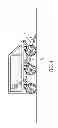
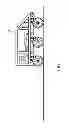
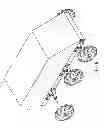
There are 6 drawings in total that describe and illustrate the design and function of the “Remote Control Rescue Vehicle”.
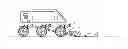
FIG. 1: is the entire vehicle as shown.
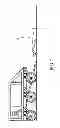
FIG. 2: is the vehicle and soldier down with the ramp in position.
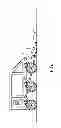
FIG. 3: is the vehicle with the ramp in second position pulling the body onto the ramp.
FIG. 4: is the vehicle with the ramp in third position pulling the body into the vehicle.
FIG. 5: is the vehicle with the ramp and body fully inside and protected.
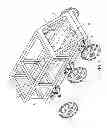
FIG. 6: is the solid steel protective armor protecting the body.
DETAILED DESCRIPTION OF THE PREFERRED EMBODIMENT
FIG. 1: In illustration #1 shows the tubular vehicle frame with the #2 pneumatic tire with #3 the vehicle engine located in the rear of the vehicle with #4 the ramp with the conveyer belt surface with #5 the linear actuator that raises and lowers the ramp with #6 the independent coil over shock with #7 the Remote Control receiver unit with #8 the suspension single action swing arm with #9 the soldiers body inside the vehicle framework lying upon the ramp.
FIG. 2: In this illustration it shows the side view of the vehicle with #4 the conveyer belt ramp in first position to #9 the injured soldier.
FIG. 3: In this illustration it shows the side view of the vehicle #4 the conveyer belt ramp pulling the #9 injured soldier onto the ramp.
FIG. 4: In this illustration it shows the side view of the vehicle with #4 the conveyer belt ramp pulling the injured soldier into the vehicle.
FIG. 5: In this illustration it shows the side view of the vehicle with #9 the injured soldier inside the vehicle and now protected to be moved to a safe place.
FIG. 6: In this illustration it shows the side angled view of #10 the solid steel protective armor to protect the injured soldier for a safe return.
DETAILED DESCRIPTION OF THE INVENTION
The “Remote Control Rescue Vehicle” is a new and unique design of rescue vehicle for military and commercial uses. It is an all-terrain vehicle to be used in hostile environments and in battle to be used by remote control to enter hostile territory and find an injured soldier or person in a hostile situation. The vehicle is comprised of a light and strong tubular UGV 100 chassis and frame with rectangular tubing suspension swing arms with independent coil over shocks and pneumatic tires to survive the terrain with 30″ of suspension travel distance from the ground and to survive possible enemy fire through the rescue process. The engine is a combustion engine with regular gas or diesel and the vehicle uses a dry braking system. The speed of the vehicle can reach 85 MPH. The vehicle contains an adjustable ramp which is lowered or raised inside the vehicle and is comprised of a conveyer belt with rubber padding to remain flexible. The ramp is lowered into position when an injured person or soldier is found and the ramp is moved under the head of the person with the conveyer belt moving backwards while the ramp or vehicle is moving forward to gently pull the person or soldier onto the ramp and pulled inside the vehicle for protection. With the solid steel protective armor surrounding the entire vehicle the person or soldier is totally protected while being moved to a safe place for medical attention. The vehicle can be custom fitted for mine sweeping and many other applications. It is a uniquely designed vehicle that is versatile in its number of uses and is one of the most diverse vehicles of this type for commercial or military use.
Claims
I claim:1. The remote control rescue vehicle is made of a light weight tubular frame and chassis with a ground clearance of at least 30″.
2. The vehicle is comprised of a single control arm coil over shock suspension system with pneumatic tires, a dry disk brake system, a combustion engine, remote control receiver unit, conveyer belt ramp with linear actuator that moves backwards at the same speed as the forward motion of the vehicle.
3. The vehicle has a solid steel protective armor covering surrounding the tubular frame for protection of the person being rescued.
4. A mansaver vehicle that is made of a light weight tubular frame and chassis with a ground clearance of at least 30″.
5. A vehicle is comprised of a single control arm coil over shock suspension system with pneumatic tires, a dry disk brake system, a combustion engine, remote control receiver unit, conveyer belt ramp with linear actuator that moves backward as the vehicle moves forward.
6. A vehicle having an elongated frame that allows a human body to lay stretched being protected by a bullet proof outer shell.
Images & Drawings included:
Sources:
- United States Patent and Trademark Office - verify current appl. status at the USPTO↗
Recent applications in this class:
- » 20250281339 2025-09-11
WHEELCHAIR TRANSPORT CARRIER - » 20250241806 2025-07-31
ACCESS SYSTEM FOR A TRANSPORT VEHICLE - » 20250127667 2025-04-24
APPARATUS AND METHODS FOR MODIFYING A BATTERY ELECTRIC VEHICLE FOR WHEELCHAIR ACCESS - » 20250114256 2025-04-10
ACCESS SYSTEM WITH OVERRUN PROTECTION - » 20250057706 2025-02-20
MODULAR RAMP WITH COLLAPSIBLE SIDE RAIL AND LIGHTING - » 20250032330 2025-01-30
BOARDING SYSTEM FOR A VEHICLE WITH A MULTI-PART BOARDING RAMP - » 20250017791 2025-01-16
DOOR RAMP STRUCTURE FOR VEHICLE - » 20240366442 2024-11-07
PERCEPTION-BASED CONTROLLER FOR INGRESS, EGRESS, AND SECUREMENT OF A WHEELCHAIR IN A WHEELCHAIR ACCESSIBLE VEHICLE - » 20240269018 2024-08-15
PERCEPTION-BASED OBSTRUCTION DETECTION SYSTEM FOR A RAMP IN A WHEELCHAIR ACCESSIBLE VEHICLE - » 20240197549 2024-06-20
ACCESS PLATFORM