Halogen-free resin composition and method for preparation of copper clad laminate with same
US20140150963A1
2014-06-05
14/239,045
2011-09-02
✅ Patent granted
US 9,139,750 B2
2015-09-22
WO; PCT/CN2011/079273; 20110902
WO; WO2013/029271; 20130307
Robert Jones, Jr.
Workman Nydegger
2031-09-02
Abstract:
A halogen-free resin composition and a method for preparation of copper clad laminate with the same, wherein based on total parts by weight of solid components, the halogen-free resin composition comprises a reactive allyl phenoxy cyclotriphosphazene or vinyl phenoxy cyclotriphosphazene of 5-50 parts, a thermosetting resin of 15-85 parts, a crosslinking curing agent of 1-35 parts, a crosslinking curing accelerant of 0-5 parts and a filler of 0-100 parts. In the present invention, the reactive allyl phenoxy cyclotriphosphazene or vinyl phenoxy cyclotriphosphazene having very low water absorption is introduced into the thermosetting resin, satisfying both the halogen-free and antiflaming requirements and improving the electrical properties of the system, and making it possible to prepare the halogen-free high-frequency high-speed substrate material. The resulted copper clad laminate satisfies the halogen-free requirement, and has advantages such as excellent resistance to heat and moisture, and low dielectric loss.
Assignee:
- Shengyi Technology Co., Ltd. 37 🇨🇳 Guangdong, China
Applicant:
Interested in similar patents?
Get notified when new applications in this technology area are published.
Classification:
C09D163/10 » CPC main
Coating compositions based on epoxy resins; Coating compositions based on derivatives of epoxy resins Epoxy resins modified by unsaturated compounds
B32B15/08 » CPC further
Layered products comprising a layer of metal comprising metal as the main or only constituent of a layer, next to another layer of a of synthetic resin
B32B15/14 » CPC further
Layered products comprising a layer of metal next to a fibrous or filamentary layer
B32B15/20 » CPC further
Layered products comprising a layer of metal comprising aluminium or copper
B32B37/10 » CPC further
Methods or apparatus for laminating, e.g. by curing or by ultrasonic bonding characterised by the pressing technique, e.g. using action of vacuum or fluid pressure
B32B38/08 » CPC further
Ancillary operations in connection with laminating processes Impregnating
C08K5/0025 » CPC further
Use of organic ingredients; Organic ingredients according to more than one of the "one dot" groups of - Crosslinking or vulcanising agents; including accelerators
C08K5/5399 » CPC further
Use of organic ingredients; Phosphorus-containing compounds Phosphorus bound to nitrogen
C09D143/02 » CPC further
Coating compositions based on homopolymers or copolymers of compounds having one or more unsaturated aliphatic radicals, each having only one carbon-to-carbon double bond, and containing boron, silicon, phosphorus, selenium, tellurium, or a metal; Coating compositions based on derivatives of such polymers Homopolymers or copolymers of monomers containing phosphorus
C09D145/00 » CPC further
Coating compositions based on homopolymers or copolymers of compounds having no unsaturated aliphatic radicals in a side chain, and having one or more carbon-to-carbon double bonds in a carbocyclic or in a heterocyclic system; Coating compositions based on derivatives of such polymers
C09D171/12 » CPC main
Coating compositions based on polyethers obtained by reactions forming an ether link in the main chain ; Coating compositions based on derivatives of such polymers; Polyethers derived from hydroxy compounds or from their metallic derivatives from phenols Polyphenylene oxides
H05K1/0346 » CPC further
Printed circuits; Details; Use of materials for the substrate; Organic insulating material consisting of one material containing N
H05K1/0346 » CPC further
Printed circuits; Details; Use of materials for the substrate; Organic insulating material consisting of one material containing N
B32B2260/023 » CPC further
Layered product comprising an impregnated, embedded, or bonded layer wherein the layer comprises an impregnation, embedding, or binder material; Composition of the impregnated, bonded or embedded layer; Fibrous or filamentary layer Two or more layers
B32B2260/046 » CPC further
Layered product comprising an impregnated, embedded, or bonded layer wherein the layer comprises an impregnation, embedding, or binder material; Impregnation, embedding, or binder material Synthetic resin
B32B2262/101 » CPC further
Composition or structural features of fibres which form a fibrous or filamentary layer or are present as additives; Inorganic fibres Glass fibres
B32B2305/076 » CPC further
Condition, form or state of the layers or laminate; Parts immersed or impregnated in a matrix Prepregs
H05K1/0373 » CPC further
Printed circuits; Details; Use of materials for the substrate; Organic insulating material consisting of two or more materials, e.g. two or more polymers, polymer + filler, + reinforcement containing additives, e.g. fillers
H05K1/0373 » CPC further
Printed circuits; Details; Use of materials for the substrate; Organic insulating material consisting of two or more materials, e.g. two or more polymers, polymer + filler, + reinforcement containing additives, e.g. fillers
H05K3/022 » CPC further
Apparatus or processes for manufacturing printed circuits in which the conductive material is applied to the surface of the insulating support and is thereafter removed from such areas of the surface which are not intended for current conducting or shielding Processes for manufacturing precursors of printed circuits, i.e. copper-clad substrates
H05K3/022 » CPC further
Apparatus or processes for manufacturing printed circuits in which the conductive material is applied to the surface of the insulating support and is thereafter removed from such areas of the surface which are not intended for current conducting or shielding Processes for manufacturing precursors of printed circuits, i.e. copper-clad substrates
H05K2201/012 » CPC further
Indexing scheme relating to printed circuits covered by; Dielectrics; Properties and characteristics in general Flame-retardant; Preventing of inflammation
H05K2201/012 » CPC further
Indexing scheme relating to printed circuits covered by; Dielectrics; Properties and characteristics in general Flame-retardant; Preventing of inflammation
H05K2201/0209 » CPC further
Indexing scheme relating to printed circuits covered by; Fillers; Particles; Fibers; Reinforcement materials; Fillers and particles; Materials Inorganic, non-metallic particles
H05K2201/0209 » CPC further
Indexing scheme relating to printed circuits covered by; Fillers; Particles; Fibers; Reinforcement materials; Fillers and particles; Materials Inorganic, non-metallic particles
Y10T156/1075 » CPC further
Adhesive bonding and miscellaneous chemical manufacture; Methods of surface bonding and/or assembly therefor with cutting, punching, tearing or severing; Prior to assembly of plural laminae from single stock and assembling to each other or to additional lamina
C08K5/00 IPC
Use of organic ingredients
H05K1/03 IPC
Printed circuits; Details Use of materials for the substrate
H05K1/03 IPC
Printed circuits; Details Use of materials for the substrate
C08K3/00 IPC
Use of inorganic substances as compounding ingredients
H05K3/02 IPC
Apparatus or processes for manufacturing printed circuits in which the conductive material is applied to the surface of the insulating support and is thereafter removed from such areas of the surface which are not intended for current conducting or shielding
H05K3/02 IPC
Apparatus or processes for manufacturing printed circuits in which the conductive material is applied to the surface of the insulating support and is thereafter removed from such areas of the surface which are not intended for current conducting or shielding
Description
TECHNICAL FIELD
The present invention relates to a resin composition, especially a halogen-free resin composition and method for preparation of copper clad laminate with same.
BACKGROUND ART
Recently, electronic devices are continuously developed with the development of integrated technology, bonding technology and mounting technology of semiconductor devices used in wiring of electronic devices, high-density electronic packages and high-density printed circuit board. Especially, a rapid development thereof occurs in electronic devices using broadband, e.g. mobile communication devices.
As a component of such electronic devices, printed circuit board develops in a direction of a higher degree of multilayer printed circuit boards and more precise wiring. In order to increase the signal transmission speed to a level desired for speeding up the information processing, an effective way is to reduce the dielectric constant of the used materials. In order to reduce the transmission loss, an effective way is to use the materials having a lower dielectric loss tangent (dielectric loss).
While the electronic technology rapidly develops, people are pursuing environmental protection. However, the conventional high-frequency high speed materials basically use halides, antimonides and the like to achieve the object of flame retardance. When the halide-containing copper foil laminate is on fire and combusts, it will emit a great amount of smoke and an undesirable odor, as well hydrogen halide gas having a great toxicity and a strong causticity, which not only pollute the environment, but also endanger human health. Currently, the epoxy resins corresponding to the phosphorous-containing phenanthrene type compound DOPO or ODOPB are generally and industrially used to achieve the common FR-4 and the flame retardance. The phosphorous-containing phenanthrene type compound DOPO or ODOPB, however, still has a greater water absorption and a great effect on the dielectric constant and dielectric loss tangent.
CONTENTS OF THE INVENTION
The object of the present invention lies in providing a halogen-free resin composition,
Another object of the present invention lies in providing a method for preparing copper clad laminate by using the halogen-free resin composition, said method being simple, wherein the produced copper clad laminate has the advantages of halogen-free, excellent heat resistance and moisture resistance and low dielectric loss.
In order to achieve said objects, the present invention provides a halogen-free resin composition, based on the total weight parts of the solid components, comprising
-
- from 5 to 50 parts by weight of reactive allylphenoxyl-cyclotriphosphazene or vinylcyclotriphosphazene;
- from 15 to 85 parts by weight of a thermosetting resin;
- from 1 to 35 parts by weight of a crosslinking curing agent;
- from 0 to 5 parts by weight of a crosslinking curing accelerator; and
- from 0 to 100 parts by weight of a packing.
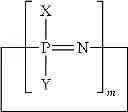
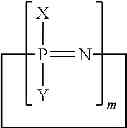
Said reactive allylphenoxylcyclotriphosphazene or vinylcyclo-triphosphazene has the following structural formula (I)
wherein m represents an integer of 3-25; X is phenoxyl
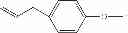
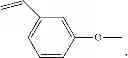
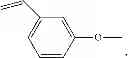
in an amount of 0-2m-1: Y is selected from the group consisting of p-allylphenoxyl
m-allylpheno
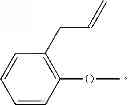
o-allyl-phenoxyl
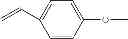
p-vinylphenoxyl
and m-vinylphenoxyl
in an amount of 1-2m; X+Y=2m.
Said thermosetting resin comprises one or more of the following resins
-
- epoxy resins, including bisphenol A epoxy resin, bisphenol F epoxy resin, dicyclopentadiene epoxy resin, triphenolic epoxy resin, biphenyl-type epoxy resin, naphthol epoxy resin, and phosphorous-containing epoxy resin;
- benzoxazine resin, including bisphenol A-type benzoxazine resin, bisphenol F-type benzoxazine resin, dicyclopentadiene-type benzoxazine resin and phenolphthalein-type benzoxazine resin;
- cyanate resin, including bisphenol A-type cyanate resin, dicyclopentadiene-type cyanate resin and phenolic aldehyde-type cyanate resin;
- bismaleimide resin, including 4,4′-diphenylmothane bismaleimide resin, allyl-modified diphenylmothane bismaleimide resin;
- reactive polyphenylene oxide resin, having a number average molecular weight of 1000-7000, wherein the reactive groups is hydroxyl or double bond; and
- C5 hydrocarbon resin consisting of vinylbutylbenzene resin having a molecular weight of 11000, vinylpolybutadiene resin with polar groups and a copolymer in which butadiene is grafted to styrene with maleic anhydride.
Said crosslinking curing agent is selected from the group consisting of dicyandiamide, aromatic amine, anhydride, phenols, fulminuric triene ester and phosphorous-containing phenolic aldehyde, or combinations thereof.
Said crosslinking curing accelerator is selected from the group consisting of 2-methylimidazole, 2-ethyl-4-methylimidazole, 2-phenylimidazole, tri-(dimethylaminomethyl), hexamethylene tetramine, dicumyl peroxide, tert-butyl peroxybenzoate, 2,5-di(2-ethylcaproyl peroxy)-2,5-dimethylhexane, acetopyruvic salts, and caprilate, or combinations thereof.
Said packing is one or more selected from the group consisting of aluminium hydroxide, magnesium hydroxide, zeolite, wollastonite, silicon dioxide, magnesia, calcium silicate, calcium carbonate, clay, talc and mica. Further, the present invention provides a method for preparing a copper clad laminate with he halogen-free resin composition above, comprising
-
- Step 1: dissolving from 5 to 50 parts by weight of reactive allylphenoxycyclotriphosphazene or vinylphenoxycyclotriphosphazene in a solvent until complete dissolution at room temperature or moderate temperature;
- Step 2: adding from 15 to 85 parts by weight of the corresponding thermosetting resin, form 1 to 35 parts by weight of a crosslinking curing agent, from 0 to 5 parts by weight of a crosslinking curing accelerator and from 0 to 100 parts by weight of a packing into said solution, homogeneously stirring to obtain a liquid cement;
- Step 3: homogeneously coating with said liquid cement E-glass cloth having a flattening surface, and then baking to a B-stage prepreg;
- Step 4: cutting the B-stage prepreg to a suitable size according to the press size, stacking several prepregs regularly, a copper foil being placed over and under the prepregs, pressing in a vacuum hot press to obtain a copper clad laminate.
She solvent is one or more selected from benzene and ketone solvents; said moderate temperature is ≦80° C.
During the step 3 of baking the B-stage prepreg, the temperature is set up according to the boiling point of the solvent used therein, and ranges from 85 to 175° C., and the baking lasts 5-20 min.
In step 4, the pressing process is carried out by the bench pressing method, comprising the specific steps of increasing from room temperature to 150° C. within 15 min and remaining for 30 min, then increasing to 180° C. within 5 min and remaining for 2 h, finally decreasing to room temperature within 30 min; increasing the pressure from 0 to 0.6 Mpa within 1 min and remaining for 20 min, then increasing the pressure 1.0 Mpa within 1 min and remaining for 2.5 h and post-processing at 200-245° C. and remaining for 1-5 h.
The prevent invention has the following beneficial effects. The reactive allyl phenoxy cyclotriphosphazene or vinyl phenoxy cyclotriphosphazene having very low water absorption is introduced into the thermosetting resin, satisfying both the halogen-free and antiflaming requirements and improving the electrical properties of the system (decreasing and stabilizing Dk (dielectric constant) and Df (dielectric loss factor)), and making it possible to prepare the halogen-free high-frequency high-speed substrate material. The resulted copper clad laminate satisfies the halogen-free requirement, and has advantages such as excellent resistance to heat and moisture, and low dielectric loss.
Embodiments
The halogen-free resin composition of the present invention comprises, based on the total weight parts of the solid components, comprising
-
- from 5 to 50 parts by weight of reactive allylphenoxyl-cyclotriphosphazene or vinylcyclotriphosphazene;
- from 15 to 85 parts by weight of a thermosetting resin;
- from 1 to 35 parts by weight of a crosslinking curing agent;
- from 0 to 5 parts by weight of a crosslinking curing accelerator; and
- from 0 to 100 parts by weight of a packing.
Said reactive allylphenoxylcyclotriphosphazene or vinylcyclo-triphosphazene has the following structural formula (I)
wherein m represents an integer of 3-25; X is phenoxyl in an amount of 0-2m-1: Y is selected from the group
ing of p-allylphenoxyl
m-allylpheno
o-allyl-phenoxyl
p-vinylphenoxyl
and m-vinylphenoxyl
in an amount of 1-2m; X+Y=2m.
Said reactive allylphenoxylcyclotriphosphazene or vinylcyclo-triphoshazene is a phosphazene compound having very low water absorption. By reacting the reactive groups therein with the specific thermosetting resin, the present invention may satisfy the halogen-free and antiflaming requirements of the high-frequency high-speed material, without any effect on the excellent dielectric constant and dielectric loss tangent performance.
Said thermosetting resin comprises one or more of the following resins
-
- epoxy resins, including bisphenol A epoxy resin, bisphenol F epoxy resin, dicyclopentadiene (DCPD)epoxy resin, triphenolic epoxy resin, biphenyl-type epoxy resin, naphthol epoxy resin, and phosphorous-containing epoxy resin; benzoxazine resin, including bisphenol A-type benzoxazine resin, bisphenol F-type benzoxazine resin, dicyclopentadiene-type benzoxazine resin and phenolphthalein-type benzoxazine resin; cyanate resin, including bisphenol A-type cyanate resin, dicyclopentadiene-type cyanate resin and phenolic aldehyde-type cyanate resin; bismaleimide resin, including 4,4′-diphenylmothane bismaleimide resin, allyl-modified diphenylmothane bismaleimide resin; reactive polyphenylene oxide resin, having a number average molecular weight of 1000-7000, wherein the reactive groups is hydroxyl or double bond; and C5 hydrocarbon resin consisting of vinylbutylbenzene resin having a molecular weight of 11000, vinylpolybutadiene resin with polar groups and a copolymer in which butadiene is grafted to styrene with maleic anhydride.
Said crosslinking curing agent is selected from the group consisting of dicyandiamide, aromatic amine, anhydride, phenols, fulminuric triene ester and phosphorous-containing phenolic aldehyde, or combinations thereof.
Said crosslinking curing accelerator is selected from the group consisting of 2-methylimidazole, 2-ethyl-4-methylimidazole, 2-phenylimidazole, DMP-30 (tri-(dimethylaminomethyl)), hexamethylene tetramine, dicumyl peroxide, tert-butyl peroxybenzoate, 2,5-di(2-ethylcaproyl peroxy)-2,5-dimethylhexane, acetopyruvic salts, and caprilate, or combinations thereof.
Said packing is one or more selected from the group consisting of aluminium hydroxide, magnesium hydroxide, zeolite, wollastonite, silicon dioxide, magnesia, calcium silicate, calcium carbonate, clay, talc and mica. The amount of said inorganic packing may be adjusted according to the use purpose, and may be better from 0 to 100 parts by weight, most preferably from 25 to 100 parts by weight, based on the total amount of 100 parts by weight of the organic solids of the components in said halogen-free resin composition.
The aforesaid halogen-free resin composition is used to prepare prepregs, copper clad laminates and the like, wherein the fabricated prepregs include the substrate material and the halogen-free resin composition coated thereon; the substrate material is glass cloth, preferably E-glass cloth; the fabricated copper clad laminates include several stacked prepregs, and copper foils on one or both sides of the stacked prepregs. The resulted copper clad laminate satisfies the halogen-free requirement, and has advantages such as excellent resistance to heat and moisture, and low dielectric loss.
The method for preparing a copper clad laminate with he halogen-free resin composition above comprises the following steps:
-
- Step 1: dissolving from 5 to 50 parts by weight of reactive allylphenoxycyclotriphosphazene or vinylphenoxycyclotriphosphazene in a phenol or ketone solvent until complete dissolution at normal temperature or moderate temperature, wherein the solvent may be one or more phenol or ketone solvents; said normal temperature is the normal temperature in the prior art; the moderate temperature represents the temperature range of ≦80° C.;
- Step 2: adding from 15 to 85 parts by weight of the corresponding thermosetting resin, form 1 to 35 parts by weight of a crosslinking curing agent, from 0 to 5 parts by weight of a crosslinking curing accelerator and from 0 to 100 parts by weight of a packing into said solution, homogeneously stirring to obtain a liquid cement;
- Step 3: homogeneously coating with said liquid cement E-glass cloth having a flattening surface, and then baking to a B-stage prepreg, wherein during the process of baking the B-stage prepreg, the temperature is set up according to the boiling point of the solvent used therein, and ranges from 85 to 175° C., and the baking lasts 5-20 min;
- Step 4: cutting the B-stage prepreg to a suitable size according to the press size, stacking several prepregs regularly, a copper foil being placed over and under the prepregs, pressing in a vacuum hot press to obtain a copper clad laminate. In such step, the pressing process is carried out by the bench pressing method (step-by-step temperature-increasing and pressure-increasing), comprising the specific steps of increasing from room temperature to 150° C. within 15 min and remaining for 30 min, then increasing to 180° C. within 5 min and remaining for 2 h, finally decreasing to room temperature within 30 min; increasing the pressure from 0 to 0.6 Mpa within 1 min and remaining for 20 min, then increasing the pressure 1.0 Mpa within 1 min and remaining for 2.5 h and post-processing at 200-245° C. and remaining for 1-5 h.
As for the fabricated copper clad laminate above, the dielectric constant, glass transition temperature, peeling strength, combustibility resistance, hygroscopicity and punching property thereof are measured, and further detailedly explained and described by the following examples.
The present invention is detailedly explained with the examples as follows, but not limited within the scope of the examples.
EXAMPLE 1
A solvent, hexachlorocyclotriphosphazene, allylphenol (containing o-allylphenol as the primary ingredient), and an acid-binding agent were added to a reaction device, stirred, protected by feeding nitrogen gas, and heated to 50-120° C. A catalyst was added to the reaction device to react for 5-16 h, then cool to room temperature and leach. The filtrate was distilled under pressure to evaporate the solvent to obtain a brown powder or viscous product. After 30 g of said product was dissolved in an organic solvent, 50 g of DCPD epoxy resin (which was HP-7200H (DIC), and had an equivalent of 275-280), 20 g of DCPD phenolic resin (which was Nihon Petro-chemical DPP-600 M), a suitable amount of imidazole and 2,5-(di(2-ethylcaproyl peroxy)) were added, homogeneously stirred to obtain a liquid cement. A flattening E-glass cloth having an area of 300×300 cm and a smooth surface was coated with said liquid cement, baked in an oven at 155° C. for 7 min to obtain a prepreg. 5 prepregs the rough edges of which were cut off were stacked, and copper foils having a thickness of 35 μm were attached on and under the prepregs and pressed in a vacuum hot press to obtain a copper clad laminate. The pressing process is carried out by the bench pressing method (step-by-step temperature-increasing and pressure-increasing), comprising increasing from room temperature to 150° C. within 15 min and remaining for 30 min, then increasing to 180° C. within 5 min and remaining for 2 h, finally decreasing to room temperature within 30 min; increasing the pressure from 0 to 0.6 Mpa within 1 min and remaining for 20 min, then increasing the pressure 1.0 Mpa within 1 min and remaining for 2.5 h. The basic performances of the produced copper clad laminate are stated in Table 1 blow.
EXAMPLE 2
A solvent, hexachlorocyclotriphosphazene, allylphenol (containing o-allylphenol as the primary ingredient), and an acid-binding agent were added to a reaction device, stirred, protected by feeding nitrogen gas, and heated to 50-120° C. A catalyst was added to the reaction device to react for 5-16 h, then cool to room temperature and leach. The filtrate was distilled under pressure to evaporate the solvent to obtain a brown powder or viscous product. After 30 g of said product was dissolved in an organic solvent, 40 g of DCPD benzoxazine (which was MT36000 (Huntsman)), 20 g of DCPD epoxy resin (which was HP-7200H (DIC) and had an equivalent of 275-280), 10 g of styrene/maleic anhydride (said anhydride being EP-30, Sartomer), a suitable amount of imidazole and 2,5-(di(2-ethylcaproyl peroxy)) were added, homogeneously stirred to obtain a liquid cement. A flattening E-glass cloth having an area of 300×300 cm and a smooth surface was coated with said liquid cement, baked in an oven at 155° C. for 7 min to obtain a prepreg. 5 prepregs the rough edges of which were cut off were stacked, and copper foils having a thickness of 35 μm were attached on and under the prepregs and pressed in a vacuum hot press to obtain a copper clad laminate. The pressing process is carried out by the bench pressing method (step-by-step temperature-increasing and pressure-increasing), comprising increasing from room temperature to 150° C. within 15 min and remaining for 30 min, then increasing to 190° C. within 5 min and remaining for 2 h, finally decreasing to room temperature within 30 min; increasing the pressure from 0 to 0.6 Mpa within 1 min and remaining for 20 min, then increasing the pressure 1.0 Mpa within 1 min and remaining for 2.5 h. The basic performances of the produced copper clad laminate are stated in Table 1 blow.
EXAMPLE 3
A solvent, hexachlorocyclotriphosphazene, allylphenol (containing o-allylphenol as the primary ingredient), and an acid-binding agent were added to a reaction device, stirred, protected by feeding nitrogen gas, and heated to 50-120° C. A catalyst was added to the reaction device to react for 5-16 h, then cool to room temperature and leach. The filtrate was distilled under pressure to evaporate the solvent to obtain a brown powder or viscous product. After 30 g of said product was dissolved in an organic solvent, 30 g of DPCP cyanate (which was LONZA-Primaset BADCy), 20 g of 4,4′-diphenylmothane bismaleimide resin, 20 g of DCPD epoxy resin (which was HP-7200H (DIC) and had an equivalent of 275-280), and a suitable amount of aluminum acetopyruvate were added, homogeneously stirred to obtain a liquid cement. A flattening E-glass cloth having an area of 300×300 cm and a smooth surface was coated with said liquid cement, baked in an oven at 155° C. for 7 min to obtain a prepreg. 5 prepregs the rough edges of which were cut off were stacked, and copper foils having a thickness of 35 μm were attached on and under the prepregs and pressed in a vacuum hot press to obtain a copper clad laminate. The pressing process is carried out by the bench pressing method (step-by-step temperature-increasing and pressure-increasing), comprising increasing from room temperature to 150° C. within 15 min and remaining for 30 min, then increasing to 210° C. within 5 min and remaining for 2 h, finally decreasing to room temperature within 30 min; increasing the pressure from 0 to 0.6 Mpa within 1 min and remaining for 20 min, then increasing the pressure 1.0 Mpa within 1 min and remaining for 2.5 h. The basic performances of the produced copper clad laminate are stated in Table 1 blow.
EXAMPLE 4
A solvent, hexachlorocyclotriphosphazene, allylphenol (containing o-allylphenol as the primary ingredient), and an acid-binding agent were added to a reaction device, stirred, protected by feeding nitrogen gas, and heated to 50-120° C. A catalyst was added to the reaction device to react for 5-16 h, then cool to room temperature and leach. The filtrate was distilled under pressure to evaporate the solvent to obtain a brown powder or viscous product. After 30 g of said product was dissolved in an organic solvent, 50 g of reactive polyphenylene oxide resin (which was MX9000, SABIC), 20 g of DCPD epoxy resin (which was HP-7200H (DIC) and had an equivalent of 275-280), a suitable amount of imidazole and 2,5-(di(2-ethylcaproyl peroxy)) were added, homogeneously stirred to obtain a liquid cement. A flattening E-glass cloth having an area of 300×300 cm and a smooth surface was coated with said liquid cement, baked in an oven at 155° C. for 7 min to obtain a prepreg. 5 prepregs the rough edges of which were cut off were stacked, and copper foils having a thickness of 35 μm were attached on and under the prepregs and pressed in a vacuum hot press to obtain a copper clad laminate. The pressing process is carried out by the bench pressing method (step-by-step temperature-increasing and pressure-increasing), comprising increasing from room temperature to 150° C. within 15 min and remaining for 30 min, then increasing to 190° C. within 5 min and remaining for 2 h, finally decreasing to room temperature within 30 min; increasing the pressure from 0 to 0.6 Mpa within 1 min and remaining for 20 min, then increasing the pressure 1.0 Mpa within 1 min and remaining for 2.5 h. The basic performances of the produced copper clad laminate are stated in Table 1 blow.
Comparison Example 1
A solvent, hexachlorocyclotriphosphazene, vinylphenol (a 50/50 mixture of p-vinylphenol and m-vinylphenol) and an acid-binding agent were added to a reaction device, stirred, protected by feeding nitrogen gas, and heated to 50-120° C. A catalyst was added to the reaction device to react for 5-16 h, then cool to room temperature and leach. The filtrate was distilled under pressure to evaporate the solvent to obtain a brown powder or viscous product. After 30 g of said product was dissolved in an organic solvent, 30 g of DPCP cyanate (which was LONZA-Primaset BADCy), 20 g of 4,4′-diphenylmothane bismaleimide resin, 20 g of DCPD epoxy resin (which was HP-7200H (DIC)) were added. The prepregs the rough edges of which were cut off were stacked, and copper foils having a thickness of 35 μm were attached on and under the prepregs and pressed in a vacuum hot press to obtain a copper clad laminate. The pressing process is carried out by the bench pressing method (step-by-step temperature-increasing and pressure-increasing), comprising increasing from room temperature to 150° C. within 15 min and remaining for 30 min, then increasing to 190° C. within 5 min and remaining for 2 h, finally decreasing to room temperature within 30 min; increasing the pressure from 0 to 0.6 Mpa within 1 min and remaining for 20 min, then increasing the pressure 1.0 Mpa within 1 min and remaining for 2.5 h. The basic performances of the produced copper clad laminate are stated in Table 1 blow.
Comparison Example 2
A solvent, hexachlorocyclotriphosphazene, vinylphenol (a 50/50 mixture of p-vinylphenol and m-vinylphenol) and an acid-binding agent were added to a reaction device, stirred, protected by feeding nitrogen gas, and heated to 50-120° C. A catalyst was added to the reaction device to react for 5-16 h, then cool to room temperature and leach. The filtrate was distilled under pressure to evaporate the solvent to obtain a brown powder or viscous product. After 30 g of said product was dissolved in an organic solvent, 50 g of reactive polyphenylene oxide resin (which was MX9000, SABIC), 20 g of DCPD epoxy resin (which was HP-7200H (DIC) and had an equivalent of 275-280), a suitable amount of imidazole and 2,5-(di(2-ethylcaproyl peroxy)) were added, homogeneously stirred to obtain a liquid cement. A flattening E-glass cloth having an area of 300×300 cm and a smooth surface was coated with said liquid cement, baked in an oven at 155° C. for 7 min to obtain a prepreg. 5 prepregs the rough edges of which were cut off were stacked, and copper foils having a thickness of 35 μm were attached on and under the prepregs and pressed in a vacuum hot press to obtain a copper clad laminate. The pressing process is carried out by the bench pressing method (step-by-step temperature-increasing and pressure-increasing), comprising increasing from room temperature to 150° C. within 15 min and remaining for 30 min, then increasing to 190° C. within 5 min and remaining for 2 h, finally decreasing to room temperature within 30 min; increasing the pressure from 0 to 0.6 Mpa within 1 min and remaining for 20 min, then increasing the pressure 1.0 Mpa within 1 min and remaining for 2.5 h. The basic performances of the produced copper clad laminate are stated in Table 1 blow.
| TABLE 1 |
| Property Evaluation |
| Exam- | Exam- | Exam- | Exam- | Com. | Com. | |
| ple | ple | ple | ple | Exp. | Exp. | |
| 1 | 2 | 3 | 4 | 1 | 2 | |
| Glass transition | 160-170 | 170-185 | 195-225 | 195-215 | 200-230 | 190-220 |
| temperature Tg | ||||||
| ° C., DMA) | ||||||
| Peeling | >1.4 | >1.4 | >1.0 | >1.0 | >1.0 | >1.0 |
| strength | ||||||
| (½ OZ, N/mm) | ||||||
| Combustibility | V-1 | V-0 | V-0 | V-0 | V-0 | V-0 |
| (1.60 mm) | ||||||
| Dip-soldering | ◯ | A | ◯ | ◯ | ◯ | ◯ |
| resistance | ||||||
| (stratification) | ||||||
| Hygroscopicity | 0.11 | 0.10 | 0.13 | 0.11 | 0.12 | 0.10 |
| Dielectric | 4.0 | 4.2 | 3.8 | 3.6 | 3.7 | 3.5 |
| constant | ||||||
| (RC50, 1 GHz) | ||||||
| Dielectric loss | 0.010 | 0.009 | 0.005 | 0.003 | 0.005 | 0.003 |
| (RC50, 1 GHz) | ||||||
| T-300/min | >60 | >60 | >120 | >120 | >120 | >120 |
| Punching | ◯ | Δ | ◯ | ◯ | Δ | ◯ |
| property | ||||||
The aforesaid properties are measured by the following methods.
(1) Glass transition temperature (Tg): measured according to the differential scanning calorimetry (DSC) as stipulated under IPC-TM-650 2.4.25.
(2) Combustibility resistance: measured according to UL 94 vertical firing method.
(3) Dip-soldering resistance: the sample (the substrate material of 100×100 mm) which remains in pressure processing device at 121° C. and 105 Kpa for 2 hours is impregnated in a solder bath heated to 260° C. for 20 seconds to visually observe (h1) whether there is stratification; (h2) whether there is white plague or wrinkling, wherein the symbol ◯ in the table represents unchanged; the symbol Δ represents white plague; the symbol x represents stratification.
(4) Hygroscopicity: measured according to the method of IPC-TM-650 2.6.2.1.
(5) Dielectric Loss Factor: measured according to the resonance method using strip lines and IPC-TM-650 2.6.2.1.
(6) Punching property: the basis material having a thickness of 1.60 mm is placed on a punch die having a certain figure for punching to visually observe (h1) no bright border at the hole edge; (h2) bright border at the hole edge; (h3) cleavage of the hole edge, which are respectively represented with ◯, Δ and x.
According to the results above, it can be seen that the present invention can satisfy both the halogen-free and antiflaming requirements (halogen content falling within the scope required by the JPCA halogen-free requirements) without not reducing the dielectric performance, excellent resistance to heat, and better processability.
The aforesaid examples are not used to limit the content of the composition of the present invention. Any tiny amendment, equivalent change or modification to the aforesaid examples according to the technical essence of the present invention and the weight part or content of the composition still falls within the scope of the technical solution of the present invention.
Claims
1. A halogen-free resin composition, comprising, based on the total weight parts of the solid components,
from 5 to 50 parts by weight of reactive allylphenoxylcyclo-triphosphazene or vinylcyclotriphosphazene;
from 15 to 85 parts by weight of a thermosetting resin;
from 1 to 35 parts by weight of a crosslinking curing agent;
from 0 to 5 parts by weight of a crosslinking curing accelerator; and
from 0 to 100 parts by weight of a packing.
2. The halogen-free resin composition according to claim 1, wherein said reactive allylphenoxylcyclotriphosphazene or vinylcyclotriphosphazene has the following structural formula (I)
wherein m represents an integer of 3-25; X is phenoxyl
in an amount of 0-2m-1: Y is selected from the group consisting of p-allylphenoxyl
m-allylpheno
o-allyl-phenoxyl
p-vinylphenoxyl
and m-vinylphenoxyl
in an amount of 1-2m; X+Y=2m.
3. The halogen-free resin composition according to claim 1, wherein said thermosetting resin comprises one or more of the following resins
epoxy resins, including bisphenol A epoxy resin, bisphenol F epoxy resin, dicyclopentadiene epoxy resin, triphenolic epoxy resin, biphenyl-type epoxy resin, naphthol epoxy resin, and phosphorous-containing epoxy resin;
benzoxazine resin, including bisphenol A-type benzoxazine resin, bisphenol F-type benzoxazine resin, dicyclopentadiene-type benzoxazine resin and phenolphthalein-type benzoxazine resin;
cyanate resin, including bisphenol A-type cyanate resin, dicyclopentadiene-type cyanate resin and phenolic aldehyde-type cyanate resin;
bismaleimide resin, including 4,4′-diphenylmothane bismaleimide resin, allyl-modified diphenylmothane bismaleimide resin;
reactive polyphenylene oxide resin, having a number average molecular weight of 1000-7000, wherein the reactive groups is hydroxyl or double bond; and
C5 hydrocarbon resin consisting of vinylbutylbenzene resin having a m molecular weight of 11000, vinylpolybutadiene resin with polar groups and a copolymer in which butadiene is grafted to styrene with maleic anhydride.
4. The halogen-free resin composition according to claim 1, wherein said crosslinking curing agent is selected from the group consisting of dicyandiamide, aromatic amine, anhydride, phenols, fulminuric triene ester and phosphorous-containing phenolic aldehyde, or combinations thereof.
5. The halogen-free resin composition according to claim 1, wherein said crosslinking curing accelerator is selected from the group consisting of 2-methylimidazole, 2-ethyl-4-methylimidazole, 2-phenylimidazole, tri-(dimethylaminomethyl), hexamethylene tetramine, dicumyl peroxide, tert-butyl peroxybenzoate, 2,5-di(2-ethylcaproyl peroxy)-2,5-dimethylhexane, acetopyruvic salts, and caprilate, or combinations thereof.
6. The halogen-free resin composition according to claim 1, wherein said packing is one or more selected from the group consisting of aluminium hydroxide, magnesium hydroxide, zeolite, wollastonite, silicon dioxide, magnesia, calcium silicate, calcium carbonate, clay, talc and mica.
7. A method for preparing a copper clad laminate with he halogen-free resin composition according to claim 1, comprising
Step 1: dissolving from 5 to 50 parts by weight of reactive allylphenoxycyclotriphosphazene or vinylphenoxycyclotriphosphazene in a solvent until complete dissolution at room temperature or moderate temperature;
Step 2: adding from 15 to 85 parts by weight of the corresponding thermosetting resin, form 1 to 35 parts by weight of a crosslinking curing agent, from 0 to 5 parts by weight of a crosslinking curing accelerator and from 0 to 100 parts by weight of a packing into said solution, homogeneously stirring to obtain a liquid cement;
Step 3: homogeneously coating with said liquid cement E-glass cloth having a flattening surface, and then baking to a B-stage prepreg;
Step 4: cutting the B-stage prepreg to a suitable size according to the press size, stacking several prepregs regularly, a copper foil being placed over and under the prepregs, pressing in a vacuum hot press to obtain a copper clad laminate.
8. The method for preparing a copper clad laminate according to claim 7, wherein the solvent is one or more selected from benzene and ketone solvents; said moderate temperature is ≦80° C.
9. The method for preparing a copper clad laminate according to claim 7, wherein, during the step 3 of baking the B-stage prepreg, the temperature is set up according to the boiling point of the solvent used therein, and ranges from 85 to 175° C., and the baking lasts 5-20 min.
10. The method for preparing a copper clad laminate according to claim 7, wherein, in step 4, the pressing process is carried out by the bench pressing method, comprising the specific steps of increasing from room temperature to 150° C. within 15 min and remaining for 30 min, then increasing to 180° C. within 5 min and remaining for 2 h, finally decreasing to room temperature within 30 min; increasing the pressure from 0 to 0.6 Mpa within 1 min and remaining for 20 min, then increasing the pressure 1.0 Mpa within 1 min and remaining for 2.5 h and post-processing at 200-245° C. and remaining for 1-5 h.
Images & Drawings included:




Sources:
- United States Patent and Trademark Office - verify current appl. status at the USPTO↗
Recent applications in this class:
- » 20230104830 2023-04-06
COATING AGENT - » 20230011370 2023-01-12
COMPONENT MADE OF THERMOPLASTIC COMPOSITE MATERIAL COMPRISING AT LEAST ONE TIE LAYER BASED ON AT LEAST ONE AMORPHOUS THERMOPLASTIC RESIN - » 20210179885 2021-06-17
Composite laminate and method for producing same, and metal resin bonded product and method for producing same - » 20210009846 2021-01-14
INSULATED WIRE, COIL, AND ELECTRICAL OR ELECTRONIC EQUIPMENT - » 20200224053 2020-07-16
COATING COMPOSITIONS INCLUDING A RESOLE PHENOLIC RESIN, ARTICLES, AND METHODS OF COATING - » 20200131398 2020-04-30
Coating agent, process of forming coating films, primer treatment process, process of repairing concretes, and process of constructing roads - » 20190031908 2019-01-31
Polyarylether ketone compositions and method of coating a metal surface - » 20170306175 2017-10-26
Poly(arylene ether) resin composition and cable coated with the same - » 20170247566 2017-08-31
Particulate poly(phenylene ether)-containing varnish composition, composite and laminate prepared therefrom, and method of forming composite - » 20160340546 2016-11-24
Process for preparing polyphenylene ether microspore dispersion
Recent applications for this Assignee:
- » 20220227942 2022-07-21
Resin composition, prepreg, laminate, metal foil-clad laminate, and printed circuit board - » 20220056225 2022-02-24
Thermosetting resin composition, prepreg containing same, metal foil-clad laminate and printed circuit board - » 20210403659 2021-12-30
Resin composition, prepreg for printed circuit and metal-coated laminate - » 20210307164 2021-09-30
Circuit material and circuit board containing the same - » 20210221743 2021-07-22
Boron nitride agglomerate, thermosetting resin composition containing same, and use thereof - » 20200332109 2020-10-22
Resin composition for a metal substrate, and resin varnish and metal base copper-clad laminate comprising the same - » 20200247970 2020-08-06
Thermosetting resin composition, prepreg, laminate, and printed circuit board - » 20200247947 2020-08-06
Vinyl thermosetting resin composition, prepreg, laminate, and printed circuit board - » 20200207976 2020-07-02
EPOXY RESIN COMPOSITION AND PREPREG, LAMINATED BOARD AND PRINTED-CIRCUIT BOARD COMPRISING SAME - » 20200207899 2020-07-02
Thermosetting resin composition, prepreg made therefrom, laminate clad with metal foil, and high-frequency circuit board